Monday, 5 October 2015

Comments on Wittgenstein's Beetle-in-a-Box Argument


Mental events and states were traditionally deemed to be private. Public language, on the other hand, is intersubjective. Yet we use a public language to communicate purportedly private mental events, items or states. If mental events, items or states were genuinely private, then how would we know that other people were referring to the same things we refer to? To us (if not them), other people’s private mental items, states and events would be like possible “beetles in a box”. That's partly why Ludwig Wittgenstein concluded that our language for sensations isn't only public: it must also refer to public items. (This is all part of Wittgenstein's Private Language argument.)

For example, when someone says, “I'm in pain”, he's not describing a private pain-state. The utterance is (as it were) the pain state. Our behaviour (including linguistic behaviour) is literally everything. If someone were to refer to something only they had seen, then we wouldn’t get the whole import of their reference. Thus when we use a language for pain, we must be referring to essentially public items. We can't therefore believe that pain-words refer to private pain-things. This is the case with other names or words too. They refer to entities which are essentially publicly accessible.

Pain-words must refer to things which are publicly accessible: not private. Thus pain can't be a beetle in a permanently-closed box. If pain is in any kind of box, then it's in an open and publicly-accessible one. The named object, if private, must “drop out of consideration as irrelevant”. Other people can't and don't see private mental states or events. Public items are needed for a public language. Language is a shared phenomenon primarily because there are shared words and the shared objects of these words. Without the shared objects of our names and words, there'd be no shared language. The shared objects largely determine the shared language.

If a language isn't public (or shared), then it's not, in fact, a language. If we were just communicating with ourselves, then perhaps we wouldn’t need a descriptive language at all. We would simply know that we are in pain and, therefore, pain-descriptions wouldn't be necessary.

It follows that if there are private mental states, events or items in S's mind, and S were to name these items, then he'd have to introduce his own names or words rather than use names or words he'd acquired from other people. After all, how could public names refer to truly private items? There couldn’t be a public (or intersubjective) ostensive definition of S’s private mental items, states or events. Indeed it was Wittgenstein’s argument that there couldn’t even be a private ostensive definition of one’s own private mental items, states or events. How would S know that he was describing (or defining) a mental item, state or event correctly or incorrectly? The correctness or otherwise of an ostensibly private ostensive definition would depend on a third party determining whether or not such an attribution is correct or incorrect. As Wittgenstein put it (to paraphrase):

If S doesn’t know if he’s going right, then how would he know that he’s going wrong (in his self-attributions)?

Yes, but what about pain itself?”

Despite all the above, there must still be a sense that certain mental items, states or events are indeed private - such as pain. This seems to be self-evident.

For example, if I don't communicate my pain with either linguistic or physical behaviour, then no one else would know that I'm in pain. But I am in pain. Only I know that I'm in pain. Therefore my pain is private.

It's true that if I were to express my pain (either in a language or even by physical behaviour), then, yes, I would be using a public language. And even if I use such words to talk to myself about my own pain, then I'd still be using public words and public expressions. Thus we could say that the epistemic status of the belief (how it's known or the way it's known) depends on the external world and public language.

However, there's more to a pain than our knowledge of it. It has both an ontological and an experiential status. We can also accept the fact that any ontological and experiential status the pain does have will itself be coloured by public language. (For one, those parts of public language which have given us the tools and concepts to think about a pain’s ontological and experiential status!) Though, yet again, there's still something about pain that's above and beyond its epistemic position and its ontological and experiential status. There's a state - a pain - that's the subject of all these public expressions. These public expressions are about something other than themselves. They're about pain.

Even though the very concept PAIN is a public concept, what the concept itself is about is more than a concept: it's about something which falls under the concept PAIN (or under the word “pain”). Thus even if it's the case that everything we say (or even think) about a pain is somehow polluted by public language, there'd still be something about the pain that has nothing to do with public discourse. More to the point, there's something about a pain that's indeed private.

The problem is that (as Wittgenstein himself argued) as soon as we say anything about this private something, it becomes (for other persons and even for oneself) a public something. What's said about this something (its experiential nature, etc.) is public. Though what all this public talk is about is something private. We can’t, however, get to this private something without polluting it with public language. And even when we get to it ourselves, it's still thus polluted. The private pain, then, is like a Kantian “thing-in-itself”. Its true reality or status can never be known if such a status is deemed to be how the pain is regardless of public language.

Of course many philosophers will deem the very idea of a pain-in-itself suspect. Does that idea even make sense? Does it serve any purpose?

Reference

Wittgenstein, Ludwig. (1945 to 1949) Philosophical Investigations.


Thursday, 1 October 2015

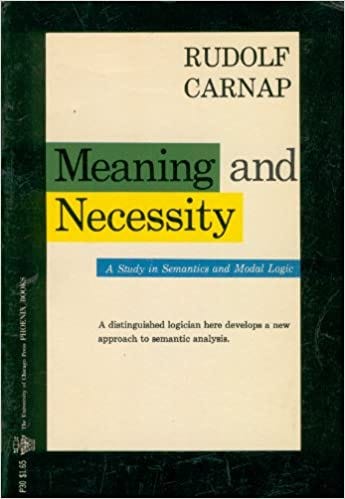
Rudolf Carnap's Modal Semantics


First things first. The technical terms used in this short and simplified piece will be somewhat controversial. The main reason for this is that many philosophers tend to invent their own terms or use old terms in new ways. In addition, even a neologism can still be very closely related to previous words or concepts. Thus we have “sense”, “intension”, “reference”, “denotation”, etc. used in different ways by different philosophers. So it’s often merely — or at least partly — a case of (to use Derrida’s term) “sign-substitutions” in which the new “signs” hardly differ from the substituted ones — at least not in important ways. And then there’s always the (fairly) new kids on the block — such as David Chalmers’ “primary intension” and “secondary intension” (in his two-dimensional semantics).

That said, all these different terms do refer to different concepts or functions and there’s no claim in the following that they’re all (really) identical.

Intensions and Extensions

The German philosopher Rudolf Carnap (1891–1970) believed that an expression means what it means because it possesses both an extension and an intension (alternatively, a reference to a class and a sense). He believed that this approach would effectively bring the meanings of expressions down to earth and away from abstracta and/or “private” mental entities. Extensions are, after all, collections of concrete objects and intensions are the means to get at those extensions (or at the objects within those extensions). That means that concrete objects (or collections of such objects) are important when it comes to extracting the meanings from expressions.

In much of the traditional picture, it was either abstract objects or private mental entities which fundamentally determined the meanings of expressions. Of course Carnap still allowed for the existence and use of abstract intensions (that’s if if they are in fact abstract).

Expressions (or statements) have references for the parts and then for the whole; and also an intension for the parts and then for the whole. (In this manner, Carnap in many ways simply updated Gottlob Frege with new jargon or with his own sign-substitutions.)

So did Carnap see intensions as concepts, predicates or properties?

Carnap on Necessity

Carnap saw modality in terms of semantics. That effectively means that modal properties don’t belong to objects qua objects: they belong to statements qua statements. That is, statements have modal properties, not objects.

Take this statement:

“A is necessarily B."

Basically, traditionalists believed that this statement is about things; not about sentences or words. Thus Carnap — to paraphrase — offered this alternative:

“The expression ‘A is [necessarily] B’ states a semantic necessity.”

What’s necessary in the above isn’t the properties of things: it’s a property of the sentence itself (e.g., as is the case with analytic statements).

Thus the expression “A is B” implicitly (or elliptically) refers to prior expression which generate this further necessary statement. That means that necessity is either stipulated and/or conventional. In other words, it’s a property of the sentences and concepts we use (i.e., it is de dicto necessity): not the things we refer to with those sentences (i.e., de re necessity).

Thus, according to Carnap, modal logic is actually a branch of semantics. This means that necessity is generated by the meanings or concepts which are themselves properties of the sentences which are taken to assert certain necessities about things. So if necessity were really a property of things and their properties, then it would be ontology (rather than semantics) which deals with such properties.

Carnap on Analyticity

Carnap accepted analyticity. He saw analyticity primarily in terms of what he called “individual concepts”.

Thus Carnap explained necessity by way of analyticity. That is, in

a = b

both a and b are “concepts of the same individual”; not variables which stand in for concrete objects. So perhaps we should write the above in this way instead:

[Ca] = [Cb]

Thus if a and b are concepts (C) of — or for - the same individual, then we can create an analytic statement.

For example, in the often-used example

All bachelors are unmarried men.”

the words “bachelors” and “unmarried men” both refer to (or denote) different concepts of the same set of individuals (i.e., they have the same extension). Thus, according to Carnap, modal contexts were really “disguised quotational contexts”. In other words, the sentence

i) “Bachelors are unmarried men.”

is transformed into:

ii) “The sentence ‘Bachelors are unmarried men’ is analytic.”

Thus i) above is an example of de re necessity: it’s a statement about concrete objects: bachelors and unmarried men.) And ii) above is an example of de dicto necessity: it’s a statement about the words “bachelor” and “unmarried”.

In terms of necessity, it’s not necessary that the concrete objects unmarried men are bachelors. Yet in terms of stipulational/conventional necessity (which may sound like an oxymoron), it is necessary that the word “unmarried man” can be substituted (to use a term Quine used) salve veritate with the word “bachelor”.

Alternatively, we can used a conditional to get this point across:

(Uc Bc)

However, that conditional above (in which ‘c’ means concept) doesn’t (really) capture the modal property necessity. Thus we can have a biconditional instead:

(Uc ≡ Bc)


Reference

Carnap, Rudolph. (1947) Meaning and Necessity


[I can be found on Twitter here.]

Tuesday, 29 September 2015

Comments on Frege's Modes of Presentation


J.S. Mill believed that the meanings of singular terms were their denotations. Denotations are usually seen as objects of some description. Therefore any proposition which had a term whose meaning was its denotation would literally(?) have an object within it.

Thus Gottlob Frege argued that meanings can't be denotations. Instead of objects being in propositions, Frege suggested that “different ways of thinking” of an object are contained within propositions. Thus if a belief (or desire) can't literally contain the object of that belief (or desire), then it must contain “specific ways of thinking” of that object. That is, we shouldn’t mix up the ontology of objects with propositional structure and meaning. They belong to different ontological worlds.

Similarly, ways of thinking can't literally contain objects within them and neither do minds generally. It followed, for Frege, that what he called “sense” had to be distinguished from what many call “reference” or “denotation”. (Fregean) senses therefore determine references. They determine the ways in which the referents are thought about. Thus senses are “modes of presentation” of objects; not the objects themselves. Indeed we have no access to an object other than via a mode of presentation or a sense.

Think about what the contrary would entail.

It would mean that the object itself would be in the proposition or in its linguistic expression. That can't possibly be the case. Propositions are abstract entities (according to Frege); whereas objects are mainly concrete. An abstraction can't contain something in concreto.

The Individuation of Objects


In terms of the modes of presentation of an object, it can also be said that a criterion of identity must come along with a “principle of unity”. In addition, an object must have some kind of temporal longevity if it's to be deemed an object in the first place.

How can an object have temporal longevity?

It does so because it has a principle of unity. That principle tells us that certain facts about that object unify it and they do so because they tell us what things about that object must remain in order for the object to remain as that very object. The unity of the object is what makes it the thing it is over time.

Why should an object have a single criterion of identity? Why not many criteria?

It's traditionally thought that an object’s “essence” will determine what we take to be a criterion of identity for an object. However, just as we had choices as to what could be criteria of identity, so we may choices as to what constitutes the essence of a single object.

This is where we depart from Frege and from many other philosophers.

One set of essential properties may work for one group of individuals (or one set of situations) and another set may work for another group of individuals (or set of situations). Why assume that there's one real essence (which may contain a set of properties) of an object and no more?

Perhaps it all depends on the modes of presentation of that object.

Each different mode of presentation may determine its own essence. For example, under a mode of presentation that's supplied by physics, an object may have an essence specified in terms of its molecular or atomic structure. This would be a constitutional or inherent essence. However, under the mode of presentation of people who relate to - or use - the object under scrutiny, the essence may be specified in terms of that object’s role or its relation to the scrutiniser.

Many people will have different ways of individuating the very same object. It will depend on how that object is seen - both literally and metaphorically. It will depend on our particular relation to that object. It will also depend on the cognitive baggage which we bring to the object under scrutiny.

People with different beliefs - or different agglomerations of knowledge - will individuate the very same object in different ways. We could of course have a God’s eye view of an object. Wouldn’t that view involve an infinite conjunction of properties and relations which belong to the scrutinised object? Alternatively, perhaps a God’s eye view of an object would entail an infinite disjunction of properties instead. That is, an infinite set of possible characterisations or individuations of the object. Mortal individuaters can't of course use infinite conjunctions or infinite disjunctions. Mere mortals can't even comprehend them. Thus a God’s eye view of the object at hand would only be of use to the person with God’s eye – viz., God himself.

Reference

Frege, Gottlob. (1892) Über Sinn und Bedeutung ('On Sense and Reference').


Monday, 28 September 2015

Embodied Cognition & Anti-Realism


It can be said (just to get it out of the way) that there's no direct denial of the world (or of an “independent reality”) by any/most theorists of embodied cognition. Neither is there a stress on subjectivity. What theorists of embodied cognition do claim is that the way the world is perceived (as well as how it's conceptualised and categorised) is determined by how each animal (including human beings) is embodied within the world.

It can also be said that metaphysical realists have always known about the “limitations” of our senses and minds when it comes to correctly understanding the world. They believed that those limitations, however, must be transcended in order to represent the world in the most accurate (or truthful) way possible. Of course many would argue that human beings can't transcend their embodiment in that they can't escape from their physiological and anatomical nature (which, in turn, determines our sensorimotor experiences). Yet reason and cognition itself (even if embodied) can surely transcend some of these limitations.

In a certain sense (weak or strong) it can be said that some of those engaged in embodied cognition are anti-realists or even idealists (of some other appropriate metaphysical ist). Indeed many uphold the self-description "constructivists".

In terms of anti-realism, it's the case that theorists of embodiment don't uphold the cognitivist/classicist (or, for that matter, realist) position that the world is determinate and “cut at the joints” into kinds/universals, facts or whatever. Or, rather, they happily admit that this may well be so. Nonetheless, such a world isn't passively mirrored or even represented by our cognitive system/s. Instead, because human beings are built in very particular ways (as well as being essentially “goal-directed”), this largely accounts for how the world is represented or even given to us. Thus even if the world is determinate and neatly cut at the joints, that wouldn't matter because our sensorimotor systems aren't built to perfectly replicate that cut-up world.

Whether cognitivists/classicists are realists in the traditional metaphysical sense is hard to say. They're certainly seen (by workers in embodied cognition) as viewing human beings (as well as other organisms) as passive re-presenters of a determinate and circumscribed world. Or, in Richard Rorty's phrase, (at least some) cognitivists see human minds as “mirrors of nature”.

I've just compared embodied cognitivists to anti-realists; though pragmatists is also a good description of them – at least in a limited sense.

Many evolutionary theorists and pragmatists have often said (in the last 100 years or so) that, from an evolutionary point of view, there's often little point in mirroring or even (precisely) representing nature. (That's if it's metaphysically possible in the first place.) Like the theorists of embodiment, they've argued that the precise mirroring of nature can often be counter-productive from an evolutionary (or goal-directed) point of view. More precisely, accurate representations (or even truthful ones) may end up being time-consuming or irrelevant. What matters is getting a job done. And that job is (usually) survival.

Other questions to ask may be about how we human beings are embodied (along with our sensorimotor machinery) and how that will determine how we represent the world. Indeed how we represent/view the world is also determined by how we deal with the world. In the words of the theorists of embodiment, we human beings “construct” the world (or construct “our worlds”).

Concepts and Categories

Are the theorists of embodiment taking a line similar to that which the British Empiricists took when they argue that the formation of mental concepts and categories is determined – or made possible – by the specific sensorimotor experiences (as well as their limitations) animals have?

This is empiricist in that our senses (or our sensorimotor experiences) are seen to be the basis of later concepts and categories. That parallels (at least to some extent) the British empiricist theory that “sense impressions” are the basis of later “ideas”. Indeed John Locke famously said that there's “nothing in the mind that wasn't first in the senses” [1690]. Cognitivists of embodiment, however, add the important detail that humans - as well as other animals - are limited to which concepts and categories they can form by the nature of their sensorimotor experiences and therefore by their physiological and anatomical nature.

So what about Kant?

Kant argued that the our a priori and transcendental “categories” and “concepts” determine (therefore also limit or constrain) all experiences [1787]. In the case of embodied cognition, however, it's not that

    i) mental categories and concepts determine experience. 
it's that

ii) experiences determine our categories and concepts.

What is transcendental (if in a weak or metaphorical sense) is the psychological and anatomical embodiment of the animal concerned. It's that embodiment which will determine the types of sensorimotor experiences animals have. Thus those embodied experiences also determine the nature of the resultant concepts and categories formed by human beings and perhaps also by other species of animal.

The Construction of the Physical/Social World

Instead of emphasising how "conceptual schemes", languages, "language games", "paradigms", epistemes, etc. somehow “construct” the world (as relativists, anti-realists, etc. have done), theorists of embodiment emphasise how bodies, sensorimotor experience, engagement and the environment play parts in constructing the world.

In the case of relativists, anti-realists and older types of constructivist, the arrow pointed from mind to world. However, in the case of embodied cognition, the arrow seems to point from world to mind. Thus:

world → mind (metaphysical realists, etc.)

world ← mind (anti-realists, relativists, idealists, etc.)

world → mind/body (theorists of embodiment)

On close inspection, however, it may be better to say that for the theorists of embodiment the arrow points in both directions: from world to mind/body and from mind/body to world. That's partly because the world hasn't completely dropped out of the picture. The environment (along with the goal-directed behaviours and actions aimed at that environment) clearly has a causal impact on minds and bodies. However, the sensory and embodied nature of human beings helps us “construct” (to some extent) that world at the very same time. Thus:

world ↔ mind/body (theorists of embodiment)

Nonetheless, some philosophers have moved beyond the simple physiological and embodied construction of the physical world into areas which are a little bit more controversial.

George Lakoff and Mark Johnson [2003], for example, argue that such embodied constructions involve the projection of “schemas” which help us to understand the world. The important point here is that this understanding is deemed (by Lakoff and Johnson) to be “metaphorical” in nature.

Constructivist positions can also take on an explicitly political hue. In constructivist epistemology, for example, construction is seen (at least by people like Ernst von Glaserfeld [1989]) as being a “radical, creative, revisionist process”; not one of mirroring nature or even one of representing (as such) the world. In this process, human beings (or persons) construct a tailor-made “knowledge system” that represents not nature and society; but a subject's experiences of nature and society. Not only that: the knowledge-system is intended to (politically) rectify the existing representations/constructions of the world which the subject is unhappy with.

References

Kant, Immanuel. (1787) Critique of Pure Reason.
Lakoff George, Johnson, Mark. (2003) Metaphors We Live By.
Locke, John. (1690) An Essay Concerning Human Understanding.


Saturday, 26 September 2015

Ladyman & Ross's Philosophy of Physics: Ontology (5)


These pieces are primarily commentaries on the 'Ontic Structural Realism and the Philosophy of Physics' chapter of James Ladyman and Don Ross's book Every Thing Must Go. There are also a handful of references to – and quotes from – other parts of that book.

                                *****************************************************
  
Ladyman and Ross (L & R) offer a list of four statements which they believe summarise the position of “standard metaphysics”.

Take (i).

    (i) “There are individuals in spacetime whose existence is independent of each other. Facts about the identity and diversity of these individuals are determined independently of their relations to each other.”

The problem is how to take the word “independent” in the above. One can accept individuals and also believe they that they aren't independent of other individuals. That is, the existence of individuated objects and their lack of independence aren't mutually exclusive. What's more, one can accept the “identity and diversity of these individuals” and also deny that such “individuals are determined independently of their relations to each other”. In other words, I don't see why a commitment to individuals necessarily means that one also accepts their complete independence from all other individuals (or from events, processes, conditions, states, etc.).

In addition, it's simply false that metaphysicians have accepted all that's claimed in (i). Randomly, take the various monists in history and philosophers like Bradley and A.N. Whitehead. They certainly didn't believe that individuals are “independent of each other”.

What about L & R's second statement? They say that “standard metaphysicians assume” the following:

    (ii) “Each has some properties that are intrinsic to it.”

Here again what was said about claim (i) partly goes for claim (ii) as well. Throughout the history of Western metaphysics there have been metaphysicians who would now be classed as anti-essentialists. Indeed we could go back to Heraclitus to find anti-essentialists (or at least to find proto anti-essentialists).In addition, we had the medieval nominalists. Come the 20th century, there have been many anti-essentialist metaphysicians and philosophers.

What do essentialists believe? That an individual “has some properties that are intrinsic to it”. In addition, some of the ontologists who've (broadly speaking) accepted the bundle theory of individuals could also be classed as anti-essentialists. (In that they would have denied the statement that each individual must have at least some intrinsic properties.)

Discernibility and Individuality

One method for distinguishing two objects is basically Quine's reworking of Leibniz. Quine called it “absolute discernibility”. L & R express his position this way:

Quine called two objects... absolutely discernible if there exists a formula in one variable which is true of one object and not the other.”

This is a reworking of Leibniz (with the addition of references to “formulas”) thus:

(x) (y) (F) (x = y ⊃. F (x) ≡ F (y).)

One way a and b can be deemed to be “absolutely discernible” is if they “occupy different positions in space and time”.

Now for “relatively discernible”.

According to L & R,

[m]oments in time are relatively discernible since any two always satisfy the ‘earlier than’ relation in one order only”.

This clearly makes a moment in time relational in nature. Or at least its relatively discernible nature is accounted for by its relational nature (i.e., ‘earlier than’, 'later than', etc.).

What's just been said about time is similar to what's also said about space (as well as the “mathematical objects” which measure it). L & R write:

An example of mathematical objects which are not absolutely discernible but are relatively discernible include the points of a one-dimensional space with an ordering relation...”

More precisely,

... for any such pair of points x and y, if they are not the same point then either x > y or x < y but not both.”

Here there's a fusion of points in space with moments in time. Thus x and y are absolutely discernible because x is before (or “earlier than”) y or x is after (or “later than”) than y. In other words, x can't be both earlier than and later than y (as well as vice versa) at one and the same time.

Now let's take L & R's definitions of discernibility and individuality. They write:

The former epistemic notion concerns what enables us to tell that one thing is different from another. The latter metaphysical notion concerns whatever it is in virtue of that two things are different from one another, adding the restriction that one thing is identical with itself and not with anything else.”

At first glance these definitions come across as two different ways of saying the same thing. Clearly the second definition (“whatever it is in virtue of that two things are different from one another”) is ontological in character and the former (“what enables us to tell that one thing is different from another”) is, as L & R say, epistemic. However, don't the two definitions fuse? That is, in order to know “whatever it is in virtue of that two things are different from one another” (an ontological fact) one would need to employ the epistemic tools which “enable us to tell that one thing is different from another”. Thus the ontological question merges with the epistemological question (or vice versa).

Black's Spheres, Substantivalism & Relationalism

We can say that because of the spatial differences between Max Black's two spheres (in his well-known thought experiment), sphere a and sphere b would only be classed as “weakly discernible” on L & R's picture.

L & R make Max Black's example more concrete (as well as scientific) by talking about fermions instead of spheres (which are a mile apart). According to L & R:

Clearly, fermions in entangled states like the singlet state violate both absolute and relative discernibility...”

Fermions “in entangled states like the singlet state” aren't absolutely discernible because there are neither spatial nor temporal means to disentangle each fermion from other fermions. (Hence the technical term “entanglement”.) However, Max Black's two spheres are also spatially indiscernible in that they're in constant movement around a figure of eight. Thus sphere a would be continuously occupying a spacial point which had only just been occupied by sphere b – as well as vice versa. (The only way out of this would be to either literally or imaginatively freeze the movements of both spheres – though surely that's unacceptable.)

One problem which can be raised about objects (as well as about L & R's position on objects) can be expressed by stating two positions:

i) Objects have their intrinsic natures independently of the rest of the world.

ii) Objects can exist independently of the rest of the world.

This problem specifically arises in the context of “points of spacetime” rather than objects. (Although it may be said that they amount to the same thing.) In this case, L & R use the word “exist” (as in ii) above). This is also a product of two different positions: substantivalism and relationalism. Thus:

i) According to substantivalism the “points of the spacetime manifold exist independently of the material contents of the universe”.

    ii) According to relationalism “spatio-temporal facts are about the relations between various elements of the material contents of spacetime”.

The idea that “points of the spacetime manifold exist independently of the material contents of the universe” sounds a little like David Lewis's take (1982) on intrinsic properties. Lewis wrote:

A thing has its intrinsic properties in virtue of the way that thing itself, and nothing else, is.”

Lewis's position (if not the substantivalist position) can be taken to its most extreme in the following statement:

Object a would still have intrinsic property P if, after the world around it disappeared, a would still have P.

In L & R's rendition of substantivalism, it's said that an object or point in spacetime could “exist” regardless of everything else. Could there ever be “the way that a thing itself is” regardless of everything else? That is, can object a be the way that it is regardless of its relations to other properties/objects/events, its place in time and space and so on?

References

Ladyman, James, Ross, Don. (2007) Every Thing Must Go: Metaphysics Naturalised.
Lewis, David. (1982) 'Extrinsic Properties'.
Quine, W. V. O. (1976) 'Grades of Discriminability'.