Sunday, 10 October 2021

When Alan Turing and Ludwig Wittgenstein Discussed the Liar Paradox


Alan Turing attended Ludwig Wittgenstein’s ‘Lectures on the Foundations of Mathematics’ in Cambridge in 1939. The following is one account of those lectures:

“For several terms at Cambridge in 1939, Ludwig Wittgenstein lectured on the philosophical foundations of mathematics. A lecture class taught by Wittgenstein, however, hardly resembled a lecture. He sat on a chair in the middle of the room, with some of the class sitting in chairs, some on the floor. He never used notes. He paused frequently, sometimes for several minutes, while he puzzled out a problem. He often asked his listeners questions and reacted to their replies. Many meetings were largely conversation.”

In relevance to this essay, Alan Turing (1912–1954) strongly disagreed with Ludwig Wittgenstein’s argument that mathematicians and philosophers should happily allow contradictions to exist within mathematical systems.

In basic terms, Wittgenstein stressed two things:

1) The strong distinction which must be made between accepting contradictions within mathematics and accepting contradictions outside mathematics.
2) The supposed applications and consequences of these mathematical contradictions and paradoxes outside mathematics.

As for 1) above, Wittgenstein said (as quoted by Andrew Hodges):

“Why are people afraid of contradictions? It is easy to understand why they should be afraid of contradictions in orders, descriptions, etc. outside mathematics. The question is: Why should they be afraid of contradictions inside mathematics?”

Wittgenstein can be read as not actually questioning the logical validity or status of these paradoxes and metatheorems. He was making a purely philosophical point about their supposed — and numerous — applications and consequences outside of mathematics. (These consequences — if not always applications — usually include stuff about consciousness, God, human intuition, the universe, human uniqueness, religion, arguments against artificial intelligence, meaning, purpose, etc.)

Thus Wittgenstein’s position on mathematical contradictions and paradoxes was largely down to his (as it has often been called) mathematical anthropocentrism. That is, to his belief that mathematics is a human invention. More concretely, in his “middle period” Wittgenstein stated that “[w]e make mathematics”; and some time later he said that we “invent” mathematics.

It can be seen, then, that Wittgenstein was clearly an anti-Platonist. Thus it’s not a surprise that he also said that

“the mathematician is not a discoverer: he is an inventor”.

Indeed the later Wittgenstein even went so far as to say that

[i]t helps if one says: the proof of the Fermat proposition is not to be discovered, but to be invented”.

One other very concrete way in which Wittgenstein expressed his anti-Platonism was when he made the point that it’s wrong to assume that because

“a straight line can be drawn between any two points [that] the line already exists even if no one has drawn it”.

Wittgenstein consequently made the ironic comparison (which many may find ridiculous) that “chess only had to be discovered, it was always there!”.

In terms of contradictions and paradoxes again.

All the above means that if mathematics is a human invention, then any contradictions and paradoxes there are (within mathematics) must be down to… us. And if they’re down to us, then they aren’t telling us anything about the physical world (which includes Turing’s bridge — see later) or even about a platonic world of numbers — because such as thing doesn’t even exist.

Yet many of Wittgenstein’s remarks on paradoxes, Gödel's theorems, mathematical contradictions, etc. have been seen — by various commentators — as being almost (to use my own word) philistine in nature. (Much has been written on Wittgenstein’s remarks on Gödel's theorems — see here.)

The Liar Language Game

Wittgenstein tackled the most famous of all paradoxes — the Liar Paradox. In a discussion with Turing, he said:

“Think of the case of the Liar: It is very queer in a way that this should have puzzled anyone — much more extraordinary than you might think… Because the thing works like this: if a man says ‘I am lying’ we say that it follows that he is not lying, from which it follows that he is lying and so on. Well, so what? You can go on like that until you are black in the face. Why not? It doesn’t matter. …it is just a useless language-game, and why should anyone be excited?”

At first glance it seems that Wittgenstein was perfectly correct to use the philosophical term (his own) “language-game” to refer to the Liar Paradox — as well as to many of the other paradoxes thrown up in what’s often called the foundations of mathematics. (More correctly, these paradoxes were seen to arise within various language games.) After all, the Liar paradox is internal to a language (game) which allows such a kind of self-reference. Indeed in which other language (game) would you ever find the statement, “This sentence is false”? (Even it’s supposed everyday translation - “I am a liar” — seems somewhat contrived.) These sentences simply don’t belong to everyday languages at all. Thus they must belong to a specific technical language game. (As do, for example, Gödel sentences.)

(Of course everyday language does allow other kinds of self-reference which don’t generate — obvious? — contradictions or paradoxes; such as merely referring to oneself when one says “I am happy”.)

So Wittgenstein’s position can be summed up by saying that the Liar language game doesn’t so much as display (or spot) a contradiction or paradox — it creates one.

Wittgenstein was basically stressing the artificiality of the Liar paradox. Now that artificiality doesn’t automatically mean that it has nothing to offer us. In that case, then, the word “artificiality” needn’t be negative in tone. It may simply a reference to something which is… artificial. As it is, though, Wittgenstein did mean it in an entirely negative way. After all, he said that the Liar paradox “is just a useless language-game”.

Alan Turing, on the other hand, seemed to be interested in the Liar paradox for purely intellectual reasons. (Although he will later refer to the construction of bridges.) He replied:

“What puzzles one is that one usually uses a contradiction as a criterion for having done something wrong. But in this case one cannot find anything done wrong.”

In basic terms, Turing was arguing that, unlike many other cases of contradiction, the Lair paradox doesn’t simply uncover a contradiction: it makes it the case that both x and not-x must be accepted. That is, when a (Cretan) liar utters “I am lying”, and it leads to it being interpreted as making the speaker both a liar and not a liar (i.e., at one and the same time), then “in this case one cannot find anything done wrong”.

One can almost guess Wittgenstein’s reply to this. He said:

“Yes — and more: nothing has been done wrong [].”

Wittgenstein’s argument (at least as it can be seen) was that the Liar paradox does indeed lead to this bizarre conclusion because — in a strong sense - it was designed to do so. That is, it is part of a language-game which was specifically created to bring about a paradox. And because it’s a self-enclosed and artificial language-game, then Wittgenstein also asked “where will the harm come” from allowing such a contradiction or paradox?

Alan Turing’s Bridge

It was said a moment ago that Alan Turing appeared to be interested in the Lair paradox for purely formal reasons. However, he did then state the following:

“The real harm will not come in unless there is an application, in which a bridge may fall down or something of that sort [] You cannot be confident about applying your calculus until you know that there are no hidden contradictions in it.”

On the surface at least, it does seem somewhat bizarre that Turing should have even suspected that the Liar paradox could lead to a bridge falling down. That is, Turing believed — if somewhat tangentially — that a bridge may fall down if some of the mathematics used in its design somehow instantiated a paradox (or a contradiction) of the kind exemplified by the Liar paradox.

Yet it’s hard to imagine the precise route from the Lair paradox to practical (or concrete) applications of mathematics of any kind — let alone to the building of a bridge and then that bridge falling down.

Indeed many (pure) mathematicians have often noted the complete irrelevance of much of this paradoxical and foundational stuff to what they do. Thus if it’s irrelevant to many mathematicians, then surely it would be even more irrelevant to the designers who use mathematics in the design of their bridges.

This metamathematics/the applications of mathematics opposition is summed up by the mathematician and physicist Alan Sokal in two parts. Firstly, Sokal stresses the difference between “metatheorems” and “conventional mathematical theorems” in the following way:

[] Metatheorems in mathematical logic, such as Gödel's theorem or independence theorems in set theory, have a logical status that is slightly different from that of conventional mathematical theorems.”

And it’s precisely because of this substantive difference that Sokal continues in this way:

“It should, however be emphasized that these rarefied branches of mathematics have very little impact on the bulk of mathematical research and almost no impact on the natural sciences.”

So if such metatheorems have (to be rhetorical for a moment) almost zero “impact on the natural sciences”, then surely they have less than zero impact on the design of bridges.

Again, it’s hard to see how there could be any (as it were) concrete manifestation of the Liar paradox. That said, perhaps Turing’s argument is that there couldn’t be such a concrete manifestation. And that’s precisely because if there were such a manifestation — then some bridges would fall down!

So what about Wittgenstein's response to this line of reasoning?

Wittgenstein responded to Turing by saying that “[b]ut nothing has ever gone wrong that way yet”. That is, no bridge has ever fallen down due to a paradox or contradiction in mathematics.

The Principle of Explosion

As already hinted at, all the above can be boiled down to Alan Turing predicting (or simply conceiving of) concrete and design-related manifestations of what is called (by logicians) the principle of explosion.

Yet it was Wittgenstein who noted what Turing was actually getting at. He said:

“Suppose I convince [someone] of the paradox of the Liar, and he says, ‘I lie, therefore I do not lie, therefore I lie and I do not lie, therefore we have a contradiction, therefore 2x2 = 369.’…”

In other words, “from a contradiction, anything follows”. Or to put that as Wittgenstein himself put it:

If we allow the sentence

“I lie, therefore I do not lie, therefore I lie and I do not lie…”

then we must also allow this equation:

2 x 2 = 369

But in the case of 2 x 2 = 369, Wittgenstein argued thatwe should not call this ‘multiplication’ at all”. And surely he was right. Yet this conclusion is seen to be a logical consequence of accepting the legitimacy of the Liar paradox.

Finally, it can also be added, in a Wittgensteinian manner, that we are free to invent a language (game) in which 2 x 2 (or, perhaps more accurately, “2 x 2”) does indeed equal 369 (or “369”)!

[I can be found on Twitter here.]

Friday, 8 October 2021

Daniel Dennett on the Difference Between Imagining & Conceiving a Zombie


i) Introduction
ii) Descartes on Imagining and Conceiving
iii) Conceiving and Intuition
iv) What is it to Conceive of a Philosophical Zombie?
v) Philip Goff on Anil Seth Confusing Imagining and Conceiving

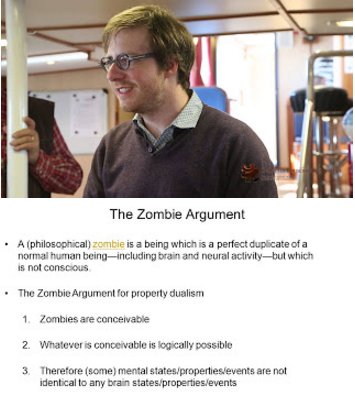
The philosophical notion of conceivability is at the very heart of the work of philosophers like David Chalmers and Philip Goff. Without it, their arguments against physicalism — and in support of the possibility of philosophical zombies - wouldn’t even get off the ground in the first place. In fact these philosophers wouldn’t even be widely known today if it weren’t for the importance they’ve placed on (philosophical) conceivability.

For example, in David Chalmers’ brilliant book, The Consciousness Mind (1996), there are comments and arguments about logical possibility and conceivability on almost every page. And this was the book which jumpstarted Chalmers’ career.

I even suspect that Chalmers and Goff would agree with this account of the importance they place on conceivability. That said, they probably wouldn’t word it in precisely the same in which way I have.

So it’s ironic that despite this importance given to distinguishing imagining any given x from conceiving of that same x, the philosopher Daniel Dennett (1942-) still asks the following question:

“Can you conceive of one? Can you imagine one? What is the difference?”

I doubt that Dennett is arguing that there’s no difference at all between imagining and conceiving any given x. Perhaps he’s simply claiming that it’s a difference that doesn’t really make (much of) a difference (i.e., to these specific issues).

I would also add that — in these cases at least — it’s not just that there’s no difference between conceiving and imagining any given x (or that the difference isn’t important), it’s that nothing may be conceived of in the first place — at least in the case of philosophical zombies! (See my Can You Conceive of a Philosophical Zombie… or a Million-Sided Object? | by Paul Austin Murphy | Curious | Medium.)

In addition and to use Dennett’s words, “we are entitled to ask them how they would know” that they’ve conceived of any given x.

Dennett’s question above is about those people who “say they can conceive of (philosophical) zombies”. So we can ask how they know that they’re conceiving a zombie rather than (merely) imagining one. That is, “[w]hat is the difference” between conceiving of a philosophical zombie and imagining a philosophical zombie?

It may be worse than that: perhaps neither conceiving nor imagining will help us distinguish a human being who actually instantiates experience (or consciousness) from a philosophical zombie. So whichever option we choose, there may still be a more particular problem when it comes to philosophical zombies.

(Note: If it’s accepted that imagining and conceiving are so different, then surely we have no right to say that the very same x has been both conceived of and imagined. In other words, what does the conceiving of any given x and the imagining of that same x share?)

Nearly all of this dates back to Descartes.

Descartes on Imagining and Conceiving

The 17th-century French philosopher Descartes (1596–1640) emphasised — in strong terms — this distinction between imagining and conceiving. The following is Daniel Dennett putting Descartes’ position:

“Just imagining something is not enough — and, in fact, Descartes tells us, it is not conceiving at all. According to Descartes, imagining uses your (ultimately mechanistic) body, with all its limitations (nearsightedness, limited resolution, angle, and depth); conceiving uses just your mind, which is a much more powerful organ of discernment, unfettered by the requirements of mechanism.”

So here we have a concern with distinguishing our imagining any given x and our conceiving of that same x. Just as relevantly, that distinction is tied very strongly to a dualist (or, more widely, a non-physicalist) explanation of why the two are so dissimilar. And it just so happens that the contemporary philosophers David Chalmers (1966-) and Philip Goff also incorporate dualism (or at least anti-physicalism) into their overall philosophies (more of which later).

In the case of Descartes, it’s the non-physical mind (which is a “much more powerful organ of discernment”) that allows us to conceive of x; whereas the “ultimately mechanistic body” (“with all its limitations”) allows us only to imagine that same x.

Thus the non-physical mind is necessary — at least according to Descartes — for conceiving of anything. In parallel, if we focus on (mere) imagination, then we’re only focussing on the body. And the body (with all its limitations) is not enough for the conceivings which Descartes had in mind.

So what did Descartes have in mind?

In this instance at least, Dennett tells us that Descartes

“offers a compelling example of the difference: the chiliagon, a regular thousand-sided polygon”.

And guess what — Philip Goff also focussed on polygons when he discussed conceivability. Except, in his own case, he ups the ante and cites — as a relevant example — the case of a million-sided polygon: a megagon! (See later section.)

Dennett goes into more detail about Descartes’ position on conceiving. He writes:

“Descartes doesn’t tell you to perform such constructions; to him conception, like imagination, is a kind of direct and episodic mental act, glomming without bothering to picture, or something like that.”

Basically, the best (if somewhat oxymoronic) way of putting Descartes’ position is to say that the conceiving (or “conception”) of any given x is an act of imagination which doesn’t actually use (or include) any mental images!

This raises the question:

Once we take away all the (mental) images, then what do we have left?

Conceiving and Intuition

Dennett’s description of Descartes’ position makes it seem that the conceiving any given x is very similar to the philosophical notion of intuiting (or having “direct insight” into) such an x. This is especially the case when Dennett says that these kinds of conceiving are examples of “glomming without bothering to picture”.

Thus when Descartes conceived of a chiliagon it might have been like a (as it were) Gödelian mathematician intuiting the truth of an unprovable statement (see here). And consider too a mathematician like Roger Penrose (1932-) who plays down “picturing” and even “words” when it comes to gaining access to mathematical truths in the platonic realm. (Penrose also plays down words and pictures when he does mathematics generally.) For example, Penrose also seems to go beyond purely mathematical Platonism when he stated the following:

[I] find words almost useless for mathematical thinking. Other kinds of thinking, perhaps such as philosophizing, seem to be much better suited to verbal expression. Perhaps this is why so many philosophers seem to be of the opinion that language is essential for intelligent or conscious thought!”

Alternatively, Descartes’ conceivings might have been like the philosopher Laurence BonJour’s own direct insights into metaphysical necessities — those necessities which are true of the physical world itself.

Basically, then, Dennett’s account of Cartesian conceiving (i.e., as a “kind of direct and episodic mental act”) seems like a perfect description of an act of intuition or direct insight.

That said, Dennett’s final words are perhaps the most important (or relevant) to this discussion. (After all, much has already been written on Gödelian and other kinds of intuition.) Dennett concludes:

“You somehow just grasp (mentally) the relevant concepts (SIDE, THOUSAND, REGULAR, POLYGON), and shazam! You’ve got it. I have always been suspicious of this Cartesian basic act of conceiving.”

Now what exactly is it to “grasp (mentally)” the concepts SIDE, THOUSAND, REGULAR and POLYGON? In addition, don’t these concepts need to be (as it were) fused together in order to grasp a chiliagon? After all, whatever conceiving of the concept SIDE, THOUSAND, REGULAR or POLYGON separately consists in, these concepts still need to be stuck together in order to grasp the broader concept — CHILIAGON.

What is it to Conceive of a Philosophical Zombie?

Perhaps Descartes was on much stronger ground when he discussed the conceiving of a chiliagon than David Chalmers and Philip Goff are when they discuss the conceiving of a philosophical zombie. Or the very least that can be said is that a chiliagon is in a different logical space to a philosophical zombie.

But, again, what is it to conceive of a philosophical zombie? What is the mental or abstract content of such an act of conceiving?

Dennett picks up on this in the following way:

“When people say they can conceive of (philosophical) zombies, we are entitled to ask them how they know. Conceiving is not easy!”

More particularly, how does, for example, a dualist, anti-physicalist or anyone else know that he’s conceived of a philosophical zombie? How do we know that he has conceived of a philosophical zombie? In addition, how does he (to use Michael Dummett’s term) “manifest” his act of conceiving of a zombie to others? What if it’s a thoroughly private act? And, if it is private, then what status could it possibly have when it comes to establishing a metaphysical position or thesis?

We can get even more fundamental here: What is it to conceive of… anything? This isn’t to argue that we don’t conceive of things. It’s just a demand for some kind of account.

In any case, Dennett give some examples of things which he believes are difficult to conceive. He writes:

“Can you conceive of more than three dimensions? The curvature of space? Quantum entanglement?”

The least that can be said is that Dennett’s examples are all very different.

So perhaps we can’t imagine more than three dimensions, the curvature of space and quantum entanglement; though we can conceive of them.

Dennett continues (as already quoted):

“Just imagining something is not enough — and, in fact, Descartes tells us, it is not conceiving at all.”

The thing is that the existence of more than three dimensions, the curvature of space and quantum entanglement must have been conceived of — many times — because they’re accepted notions in physics. Indeed they’re even accepted aspects of the physical world (or at least two of them are)! That is, no one has ever seen or observed these things. And, depending on definitions, not one has ever imagined these things either. So all we have left is to conceive of more than three dimensions, the curvature of space and quantum entanglement.

Thus Descartes, Goff and Chalmers may be onto something here!

Yet even here conceiving of these things may be in a different logical space to conceiving of a philosophical zombie. After all, there are a lot of equations, natural laws, theories, indirect/direct observations, experiments, etc. to account for extra dimensions, the curvature of space and quantum entanglement. Are there a lot of equations, natural laws, theories, experiments, indirect/direct observations, experiments, etc. to account for philosophical zombies?

Of course not.

And that’s primarily because Goff and Chalmers themselves accept that philosophical zombies are only a logical possibility. Thus there are no equations, direct/indirect observations, natural laws, experiments or physical theories which account for the existence of philosophical zombies.

Philip Goff on Anil Seth’s Confusing Imagining and Conceiving

Anil Seth

As stated, both David Chalmers and Philip Goff make much of the distinction that we must make between (merely) imagining x and conceiving of that same x. To them, this difference is extremely important.

For example, the following is Philip Goff writing about those academics who confuse (or conflate) the two:

“The zombie argument is generally known in the academic philosophical literature as the ‘conceivability argument.’ I think this is something of a misnomer, as it suggests that the argument has something to do with what can be imagined.”

So not only does Goff believe that the word “imagine” is misleading: he also believes the same about the word “conceive. Of course that’s primarily because Goff believes that people conflate (or confuse) imaginability with conceivability.

Philip Goff

As it is, Goff doesn’t care that much about merely imagining any given x: his position is about the conceiving of that x.

(Again: if it’s accepted that imagining and conceiving are so different, then surely we have no right to say that the very same x has been both conceived of and imagined. In other words, what does the conceiving of any given x and the imagining of that same x share?)

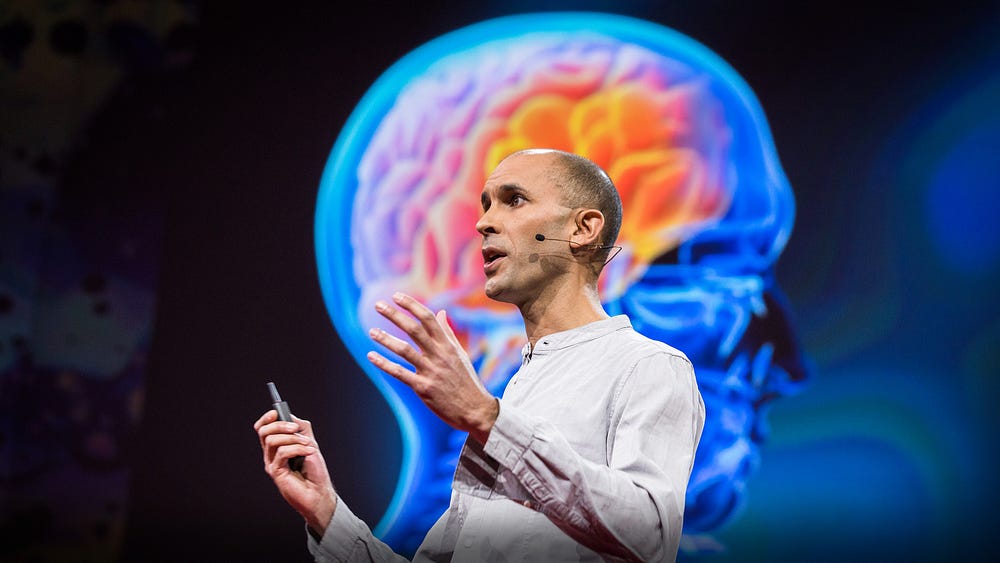
So Goff spots such a confusion (or conflation) in the arguments of the cognitive neuroscientist Anil Seth (1972-).

Goff firstly quotes Anil Seth’s own words in the following way:

“‘Conceivability arguments are generally weak since they often rest on failures of imagination or knowledge, rather than on insights into necessity. For example: the more I know about aerodynamics, the less I can imagine a 787 Dreamliner flying backwards. It cannot be done and such a thing is only ‘conceivable’ through ignorance about how wings work.’”

And the following is Goff’s response to that passage:

“The zombies argument is concerned with logical possibility, whereas Seth’s example deals with natural possibility. It is inconsistent with the laws of nature for a 787 Dreamliner to fly backward, and one appreciates this as one learns about the relevant laws of nature. But it is certainly not contradictory for a 787 Dreamliner to fly backward; if the laws of nature had been very different, such a thing might have been possible. In other words, a 787 Dreamliner flying backward is not naturally possible but it is logically possible.”

Goff derives what he calls a “logical possibility” (see here) from what he has conceived. And, in this case at least, what he conceived didn’t abide by “natural possibility”. In other words, Goff’s conceivable x outruns the natural. Indeed his conceivable x even outruns the actual (or the real).

Conclusion

Let’s forget about what is logically possible for the moment because — to Goff — it’s a product of what is conceivable. This means that the first port of call is the act of conceiving of any given x.

Yet the case against being able to conceive of a philosophical zombie has little (though not nothing) to do with with a belief that mental images (or imagery of whatever kinds) are required.

Take the case of a megagon again.

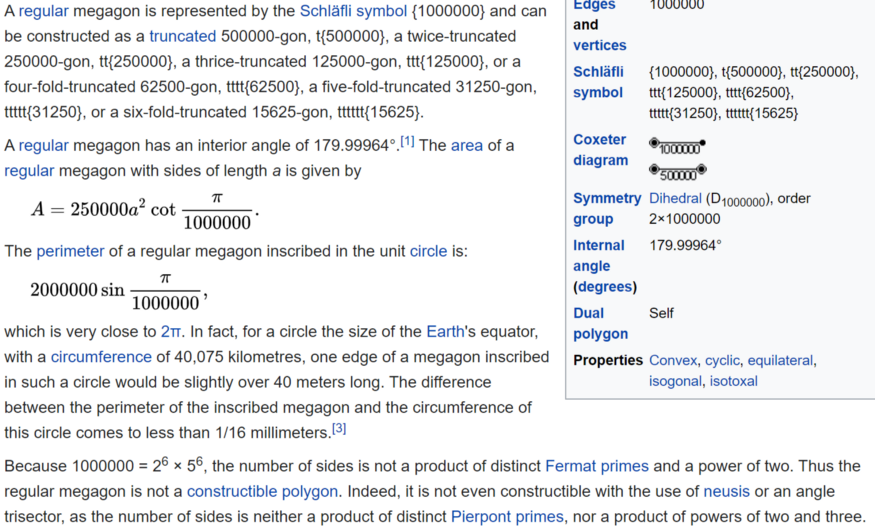
No one can imagine what a megagon looks like because it looks like a circle. The lack of conceivability in this case is down to not knowing all the mathematics. (Thus non-mathematicians must rely on the testimony of mathematicians when it comes to the — abstract — existence of a megagon; and the same goes for Daniel Dennett’s earlier examples of curved space and entanglement.)

This situation may well be passed on — at least to some extent — to the case of a philosophical zombie.

Simply writing the words “A zombie is exactly like a human being in every respect — except it has not consciousness”, and then thinking about those words and noting that they don’t contain a contradiction, is not to actually conceive of a philosophical zombie at all.

Philip Goff particularly makes the philosophical notion of conceivability seem purely logical in nature. That’s why he often mentions “contradictions”. Yet it can’t all be purely logical. Using words like “zombie”, “human being”, “experience”, “metaphysics”, “behaviour”, etc. means that Goff has automatically gone way beyond (pure) logic. In other words, Goff is using terms which are extremely loaded — from a philosophical point of view. And it can therefore be argued that a purely (as it were) logical conceiving (or reading) of a philosophical zombie no longer does the trick.

Yet Goff is still attempting to make it seem that what he’s arguing is purely logical. If it were purely logical (say, only a matter of Ps, Qs and logical operations), then a pure conceiving of a (logical) x would be fine. But we’re supposed to be conceiving of philosophical zombies!

So has Philip Goff actually conceived of a philosophical zombie (or a megagon) in the first place?

*) See my Can You Conceive of a Philosophical Zombie… or a Million-Sided Object? | by Paul Austin Murphy | Curious | Medium

[I can be found on Twitter here.]

Saturday, 2 October 2021

Jacques Derrida: Every Concept Deconstructs Itself


i) Introduction
ii) Deconstruction and Self-Reference
iii) The Concepts Used to Fight Injustice
iv) Conceit and Deconstructive Play
v) Christina Howells vs. “Analytic” Accounts of Derrida’s Work

A few words of warning to begin with.

One problem with this essay is that it’s an account of Jacques Derrida from a person who’s mainly influenced by analytic philosophy. What’s more, the main quotes used in this piece are taken from an analytic philosopher. That said, I have read (some of) Derrida’s papers/books and I’ve even written essays on them. The problem remains, however, is that I never felt that I understood what was being said. Perhaps that’s because — at least in some cases — nothing was being said.

(See the final section of this essay for more on my philosophical bias regarding Derrida.)

Deconstruction and Self-Reference

[In the following, I shall use the word “concept” in its everyday non-philosophical sense. In technical philosophy, a concept is seen to be the “semantic content” of a natural-language word, an abstract object, something in the brain, something in the mind, etc.]

When characterising Jacques Derrida (1930–2004), the philosopher Howard Dainton (paraphrasing Gary Gutting, who was sympathetic to Derrida) states one of Derrida’s (“under erasure”) p̶o̶s̶i̶t̶i̶o̶n̶s̶ in this way:

[E]very concept deconstructs itself.”

The self-referential problems here seem almost too obvious to point out.

Does the concept/idea [every concept deconstructs itself] also deconstruct itself? Or, more accurately, do the concepts used to advance the position that every concept deconstructs itself also deconstruct themselves?

If they don’t, then why don’t they do so?

And if they do, then where do we go from there?

Similarly, does the position (using the words of Howard Dainton again) that

“contradictions can never be avoided”

also involve contradictions which can never be avoided?

If it doesn’t, then why doesn’t it do so?

And if it does, then where do we go from there?

But let’s be more specific and concrete about these often poetic and oracular phrases from Derrida.

Of course Derrida probably never said that “every concept deconstructs itself” in such a simplistic — or clear! — manner. That said, if you Google the words “every concept deconstructs itself” and “contradictions which can never be avoided” you will find dozens or even hundreds of quotes from both Derrida himself and references to those who have (positively) interpreted him as holding precisely these positions. (See here and here.)

Despite stating all that, this may simply be an analytic philosopher’s misreading of deconstruction. Ironically enough, Derrida himself claimed that “all readings are misreadings” (see here). Yet, at the very same time, many devotees of Derrida feel very strongly about certain (mainly political) misreadings (see here) — as did Derrida himself! In any case, misreadings of Derrida may be of the kind that Professor Christina Howells warns her fellow academic experts against (see final section).

So if these ways of putting Derrida’s position are too simplistic (or simply too clear), then are there better ways of putting them?

Of course if Derrida did believe that every concept deconstructs itself (even if he never actually used the words “every concept deconstructs itself”), then you can bet that any (as it were) more faithful way expressing his position (say, as expressed by a follower of Derrida) will be difficult to understand. That is unless one is an academic devotee of Derrida. And even if one is a devotee of Derrida, then there’ll still be no guarantee that any two such people will agree on their readings of Derrida. In fact, they often don’t!

What’s more, if every concept deconstructs itself, then perhaps agreement — or even mutual understanding — is impossible.

The Concepts Used To Fight Injustice

When deconstruction was fully played out (or taken to its various philosophical conclusions), Derrida often didn’t like the resultant readings of his work. More broadly, Derrida had problems — in his later years especially — with the philosophical freedom deconstruction was supposed to allow. (Or was it? Or wasn’t it? Or both? Or neither? Or…?) Basically, Derrida clearly believed that at least some concepts did not deconstruct themselves.

This is where politics inevitably enters the equation.

For example, do the concepts used to fight racism, sexism, fascism, capitalism and injustice deconstruct themselves?

These political isms have been mentioned because they’re precisely the political isms most poststructuralists, etc. fought against using Derrida’s deconstructive weapons.

Surely if every concept deconstruct itself, then these concepts must do so too.

These political underpinnings of deconstruction are mentioned to highlight a problem. And that problem was graphically pointed out by Thomas A. McCarthy. This is how he put it:

“Deconstruction can hardly give voice to the excluded other. The wholesale character of its critique of logocentrism deprives it of any language in which to do so.”

And that’s the primary reason why Derrida didn’t — and perhaps couldn’t — even hint at anything directly (rather than tangentially) political — at least not until his (explicit) “political turn” in the 1990s. Hence the prior obscure, ineffable and (it can be easily argued) pretentious prose.

This is McCarthy again:

“It is [] merely by accident that his writings contain little analysis of political institutions and arrangements, historical circumstances and tendencies, or social groups and social movements, and no constructions of right and good, justice and fairness, legitimacy and legality?”

McCarthy believes that Deconstruction and/or post-structuralism attempted to “liberate the Other”. The problem is that there’s an indefinite number of Others. And many Others are also at mutual odds with each other. Yet surely only a shared language — the language that deconstruction rejected or deconstructed — can help liberate any given Other.

More particularly, isn’t it the case that the words ‘legality’, ‘legitimacy’, ‘fairness’, ‘justice’ are very good examples of transcendental signifieds— at least according to Derrida’s own book (or “text”)? Thus Derrida’s only interest in philosophical words or concepts (until the 1990s) was to violently deconstruct them. If he hadn’t done that, then his whole enterprise would have self-destructed (if not deconstructed) itself.

In the end, however, Derrida’s politics did trump his philosophy when he more or less (re?)embraced Marxism and made some very logocentric statements about, for example, (platonic!) Justice (see here). And he did so largely in response to what he took to be various (political) misreadings(!) of his own work.

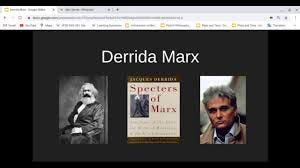
More specifically, Derrida only started to wax lyrically — and explicitly — about Karl Marx, Justice, etc. late in his life. For example, when he wrote his Specters of Marx in 1993 — some 40 or more years after he first started writing philosophy.

This was Derrida’s “political turn”.

(Many of Derrida’s followers and admirers have stated that politics or “Ethics” imbued all his work from the very beginning.)

Now take the words of Professor Simon Critchley when he tackled Derrida’s (supposed?) relativism. He said:

[]Derrida, who is always perceived as a relativist. []In Derrida’s later work, we see him moving more and more explicitly towards a defence of a normative universalism, and a belief in the undeconstructability of justice, as he puts it, which is an overarching value that cannot be relativised.”

Is the above a misreading? Indeed, what would make it either a True Reading or a misreading?

But what of Derrida himself?

In Specters of Marx, Derrida gave a very-positive appraisal of both Karl Marx and Marxism. For example, Derrida wrote:

“The name of New International is given here to what calls to the friendship of an alliance without institution among those who … continue to be inspired by at least one of the spirits of Marx or of Marxism. It is a call for them to ally themselves, in a new, concrete and real way… in the critique of the state of international law, the concepts of State and nation, and so forth: in order to renew this critique, and especially to radicalise it.”

So did misreadings of Derrida also include the concept that every concept deconstructs itself? Of course if every concept deconstructs itself, then Derrida (as already stated) could never have stated that “every concept deconstructs itself” simply or clearly. Instead Derrida “played with the sign”. That is, he played philosophical games… Until, that is, he realised the negative political effects of deconstruction’s free-for-all play. (This is something that Marxists and others on the Left were keen to point out about Derrida’s work; as well as about the work of various postmodernists.)

(Derrida one wrote this: “To risk meaning nothing is to start to play.”)

So, again, where does that leave the concepts used to fight racism, fascism, capitalism, sexism and injustice generally?

More specifically, does the concept [deconstruction] deconstruct itself?

If it doesn’t, then why doesn’t it do so?

And if it does, then where to we go from there?

Derrida might well have “argued” that the concept [deconstruction] does indeed deconstruct itself — in order to prove his point. On the other hand, he did (more or less) argue that the concept [deconstruction] isn’t a concept at all! That, to many, was simply Derrida playing another one of his philosophical games again.

Again, do the concepts used to fight racism, fascism, sexism, capitalism and injustice also deconstruct themselves? More specifically, would Derrida have ever “interrogated” those political activists who freely used many (logocentric) concepts (i.e., from Western philosophy) to further leftwing political goals and causes? Or did Derrida only interrogate those selected bad concepts used by the philosophers, politicians and laypeople he had political problems with? (Derrida and his followers often used the word “interrogate” — see here.)

As a politically committed individual, it would have been very difficult philosophically, and very problematic politically, for Derrida to ever have argued that the concepts used against racism, fascism, capitalism, sexism and injustice deconstructed themselves because that would have rendered these concepts — as well as the activists who used them — politically impotent had they acted on his words. Yet, of course, Derrida never did argue that. Instead, Derrida only had other concepts in mind — (politically) bad concepts.

(Bad concepts such as [truth], [logic], [objectivity], [logos] [God], [nationalism], [race], [universality], [reason], [profit], etc.)

Conceit and Deconstructive Play

Why would a philosopher or anyone else (to quote Howard Dainton again)

“play with the conceits that lie in the interstices of concepts”

in the first place?

Moreover, perhaps deconstructive gameplaying makes

“straightforward rational discourse impossible [because] one can only play with the conceits that lie in the interstices of concepts”.

Would someone’s reasons for indulging in deconstructive play themselves involve self-deconstructing concepts and contain essential contradictions? Thus how could such a philosopher have any moral, political and/or philosophical reasons (or motivations) to do anything at all if every concept deconstructs itself? Again, would that include concepts used against racism, fascism, capitalism, sexism, injustice and also used to defend deconstruction itself?

So what is all this deconstructive play really about?

What is its goal?

Many would argue that it’s primary goal is (or was) political.

Yet that partly backfired — at least on my own reading of Derrida’s strongly negative reactions to some (political) misreadings of his own work.

To repeat: how could deconstruction have had any goals at all if every concept deconstructs itself? So perhaps Derrida and his followers believed that some concepts don’t actually deconstruct themselves. Only politically bad concepts do.

Christina Howells vs. “Analytic” Accounts of Derrida’s Work

As stated in the introduction, the problem here is that this is an account of Jacques Derrida using quotes from from an (English) analytic philosopher.

But is that really a problem?

According Professor Christina Howells (of the University of Oxford) it certainly is. For example, she says that

“there is a risk of [analytic philosophers] transforming [continental] philosophers into something they’re not, and making them say something they weren’t saying”.

Why is that? Howells says it’s because

“we’d loose much of the specificity that way, and you could we be left with banality”.

Howells then goes on to say that

“when you extract from a long elaborated discussion a kernel which is then acceptable to analytic philosophy, whether it is about being with others, or about what Derrida might mean by différance, if he were prepared to express it quite differently, you’ve lost too much”.

So what happened to The Death of the Author? And what about Jacques Derrida’s “interpretative play” and there being “no outside-text” (il n’y a pas de hors-texte)?

In any case, I had no choice but to rely on writers like Dainton because I simply don’t understand much deconstructive and/or poststructuralist prose — at least as it is advanced from the inside.

Let me repeat that:

I don’t understand most of what is said by these academics and philosophers.

And that’s the case even after attempting to do so for a long time. Now that may simply be because I’m plain thick. Either that or I haven’t embedded myself deeply enough, and for long enough, in this academic milieu. That said, my current cognitive situation (along with many other educated people as regards Derrida) is what it is.

So where do we go from here?

Is there a midway position between the critical positions adopted by some analytic philosophers and Derrida’s own tribal academic devotees?

[I can be found on Twitter here.]