Monday, 25 October 2021

Derrida & Others on What Deconstruction Isn’t (or W̶h̶a̶t̶ D̶e̶c̶o̶n̶s̶t̶r̶u̶c̶t̶i̶o̶n̶ I̶s̶n̶’t̶)


“A world of signs without fault, without truth…” — Derrida

(i) Jacques Derrida on What Deconstruction Isn’t 
(ii) Gayatri Spivak & Christopher Norris on What Deconstruction Isn’t 
(iii) Simon Critchley & Others on What Deconstruction Is

It must immediately be said that the problem with writing a negatively critical essay on Jacques Derrida is that the French philosopher didn’t really give (or allow) his readers any means to challenge his ideas or words. And by the words “negatively critical” I mean anything written by someone — or by anyone — on the outside of Derrida’s academic or intellectual milieu of admirers and followers.

That small amount said, more on this issue will be found in my forthcoming essay, ‘Jacques Derrida the Philosophical Joker’.

Jacques Derrida on What Deconstruction Isn’t
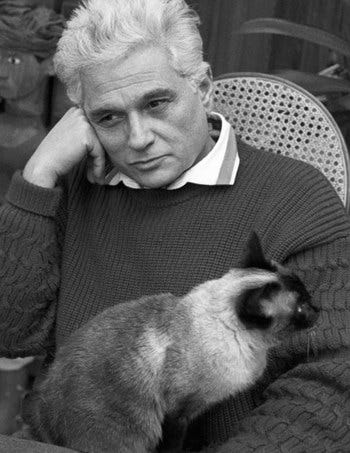
The French philosopher Jacques Derrida (1930–2004) himself summed up the central theme of this essay. He did so in his ‘Letter to a Japanese Friend’ (1983); in which he wrote the following words:

“All sentences of the type ‘deconstruction is X’ or ‘deconstruction is not Xa priori miss the point, which is to say that they are at least false. As you know, one of the principal things at stake in what is called in my texts ‘deconstruction’ is precisely the delimiting of ontology and above all of the third person present indicative: S is P.”

It can be seen that Derrida simply and directly contradicted himself in the passage above — which he might very well have allowed himself to do!

He told us that deconstruction isn’t X, it isn’t not-X, and that it isn’t Y. And then he even warned us against stating what deconstruction is. Yet he then went straight ahead and told us… what deconstruction is!

So what did Derrida believe that deconstruction is — at least in this instance? This (to requote):

[D]econstruction is precisely the delimiting of ontology and above all the third person present indicative: S is P.”

Now if that isn’t telling us what deconstruction is, then I don’t know what is. Of course, deconstruction may not only be “the delimiting of ontology”; but surely that delimiting is at least a part of what deconstruction is.

In any case, this passage from Derrida fails in almost every other respect too. Yet it will of course be argued by deconstructors and other fans of Derrida — either directly or in arcane prose— that it only fails from a logocentric perspective! So, as stated briefly in the introduction, as someone firmly on the Outside of the academic and intellectual milieu which surrounds Derrida and his work, it is (as it were) a priori guaranteed that I won’t — and can’t — understand the term logocentrism. In fact a potential reader would need to make a leap of faith into Derrida in order to discover the ̶t̶r̶u̶t̶h̶ about logocentrism — and indeed the ̶t̶r̶u̶t̶h̶ about deconstruction generally.

Derrida might also even have said (if in a roundabout way) that his words above were expressed (or even designed) to fail in every respect… or not to fail in every respect… or to do both… or to do all three… or to read intertexts on a transcendental infinite of quantum Otherness.

So where to begin?

What about truth?

Derrida — in the passage above — was also saying (outrightly!) that something is “false”. (Derrida used the words “they are at least false”.) So surely Derrida must have believed in truth in order to say that something is false.

So we can also ask if it true that the the third person present indicative is S is P? Yet Derrida would never have plainly and clearly said, “I believe in truth” or even anything like that.

It can also be asked exactly why it is that “All sentences of the type ‘Deconstruction is X’” manage to “miss the point”? Is it because they’re false? Is it because there is, in actual fact, something true — or even semantically determinate — about what deconstruction is? Or was Derrida just using words in any way he wished (i.e., playing with the sign or signifier) — perhaps for political, career, literary and/or emotional reasons?

Yet Derrida himself did believe in truth! And he — if only rarely — said so.

Take the following passage (in response to John Searle) from Limited Inc (1988) in which Derrida was explicit as could be:

[H]ow can he discuss, and discuss the reading of what he writes? The answer is simple, this definition of the deconstructionist is false (that’s right: false, not true) and feeble: it supposes a bad (that’s right: bad, not good) and feeble reading of numerous texts, first of all mind, which therefore must be read or re-read.”

The thing here is that it took the American philosopher John Searle’s criticisms to drag a commitment to truth out of Derrida. And by selectively endorsing the notion of truth in this particular instance, this too can be seen as typical Derridean gameplaying and/or one-upmanship. And that’s because in large amounts of Derrida’s other work he explicitly carried out the deconstruction of the concept [truth] — and, indeed, of all other logocentric concepts.

The thing is, then, that Derrida did and he didn’t believe in truth.

He believed in truth in order to win one philosophical game and rejected it in order to win another.

The other way of putting this is that Derrida did believe in truth when it came to defending very particular political and philosophical causes and ideas. However, he didn’t believe in truth when he was attacking other very particular political and philosophical causes and ideas.

So what about Derrida with his other face on?

In the following Derrida speaks of his embrace “of the play of the world” in which we have

“a world of signs without fault, without truth, and without origin which is offered to an active interpretation”.

This is much more literary and flamboyant that his clear and sarcastic riposte to John Searle above. And that was often the case with Derrida. Specifically, when explicitly accepting truth (or Justice), he was (fairly) clear and explicit. However, when rejecting truth, he was usually obscure, pretentious and/or implicit.

And, of course, it was the case that Derrida also shoehorned in his own technical terms (or neologisms) into these debates. And that enabled him to slither around a little. That is, he might have argued that the word “truth” — as used by himself — was put “under eraser” (sous rature) … Except that the word “truth” wasn’t put under eraser in the passage (against Searle) above.

At least Derrida didn’t refrain from using the logocentric word “false”. Of course Derrida would have had an easy reason for this in that he often admitted that he — and others — couldn’t escape from “Western metaphysics”. For example, in his ‘Structure, sign and play in the discourse of the human sciences’ (1966/1970), he wrote the following words:

“There is no sense in doing without the concepts of metaphysics in order to shake metaphysics. We have no language — no syntax and no lexicon — which is foreign to this history; we can pronounce not a single destructive proposition which has not [been contaminated]…”

So Derrida stated what the third person indicative is and therefore made an explicit commitment to at least some level of semantic — and even ontological — determinacy. And all this within his broader deconstructive context of a stance against ontological rigidity and semantic determinacy.

Now what about these words from the opening passage?-

“One of the principle things in deconstruction is the delimiting of ontology [].”

What reasons did Derrida — or anyone else — have for wanting to “delimit[] ontology”? Were they moral reasons? Political reasons? Reasons of Derrida’s highly-successful career and/or of his strong commitment to philosophical one-upmanship? Would any of his reasons for delimiting ontology have been based on ontological positions, values or beliefs which were themselves unlimited or undeconstructible? (In Derrida’s own case, consider his stance on platonic Justice. See ‘Derrida on Justice: The à-venir and the Undeconstructible’.)

Elsewhere and in response to a question from Toshihiko Izutsu about the meaning (or definition) of “deconstruction”, Derrida said that the question “What is deconstruction?” is problematic because it should be a question of “what deconstruction is not, or rather ought not to be”. Derrida also stated that “[d]econstruction is not a method, and cannot be transformed into one”. Furthermore, Derrida also told his readers that deconstruction isn’t a kind of analysis or a critique (see here).

Of course because Derrida and his followers attempted to have their cakes and eat them too, they wouldn’t have ever argued that there is literally no method, analysis or critique, etc. in deconstruction. So it can be argued that they simply didn’t like the terms “method”, “analysis” or “critique” because those words would have tied them too closely to the Platonic/Western Tradition. That said, it’s no surprise that Derrida also stated that there was “the necessity of returning to them, at least under erasure”. Yet the logic of these denials and negations hardly makes sense. It simply doesn’t follow that when there’s a definition of deconstruction, then that definition would be an attempt to make the concept [deconstruction] immune to deconstruction — or even immune to plain criticism/analysis.

Gayatri Spivak and Christopher Norris on What Deconstruction Isn’t
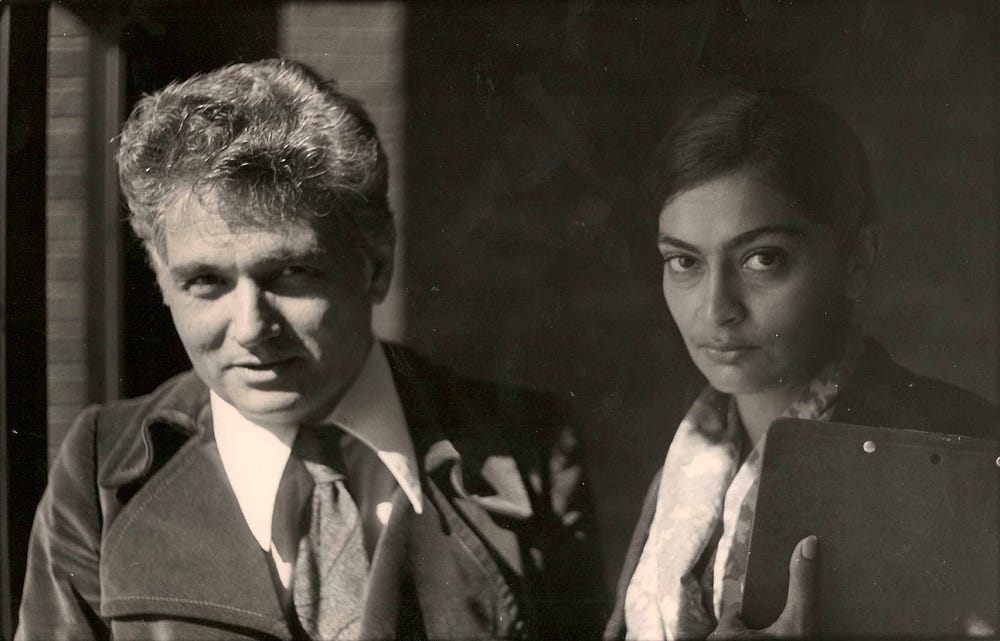
Jacques Derrida and Gayatri Chakravorty Spivak

Even philosophers and theorists who were sympathetic to Derrida have been keen to know what deconstruction is - despite all the claims that it isn’t… anything. (Or that it is and it isn’t something… or neither… or… or…)

Take the case of the Indian literary theorist and feminist critic Gayatri Chakravorty Spivak (1942-).

At one point Spivak wanted (or desired) deconstruction to be something. Thus she wrote the following words:

“For a time I felt ferociously angry with deconstruction because Derrida seemed not to be enough of a Marxist. He also seemed to be a sexist. But that’s because I was wanting deconstruction to be what it isn’t. I’ve realized its limits — by not asking it to do everything for me… I have little patience with people who are so deeply into deconstruction that they have nothing else substantive to think about.”

In order to have believed that Derrida wasn’t “enough of a Marxist”, then that must have meant that Spivak also believed that Derrida was — at least to some extent — a Marxist. (How did she quantify this?)

In addition, in order for Spivak to have said that she “want[ed] deconstruction to be what it isn’t”, then surely she must have come to know (or at least believed she came to know) what deconstruction is. That is, if Spivak didn’t know what deconstruction is (at least in some sense), then how did Spivak come to know that it wasn’t Marxist enough for her? What exactly made deconstruction not Marxist enough for Spivak? It must have been something about what deconstruction is.

Similarly, Spivak must have known what deconstruction is in order to have “realized its limits”. In other words, any given x (which has “limits”) must also have boundaries of some kind. And in order to recognise the boundaries of that x, one must also know — at least to some extent — what that x is. Thus, in Spivak’s case, she must have known (or simply believed she knew) what deconstruction is.

Now let’s take a look at Christopher Norris.
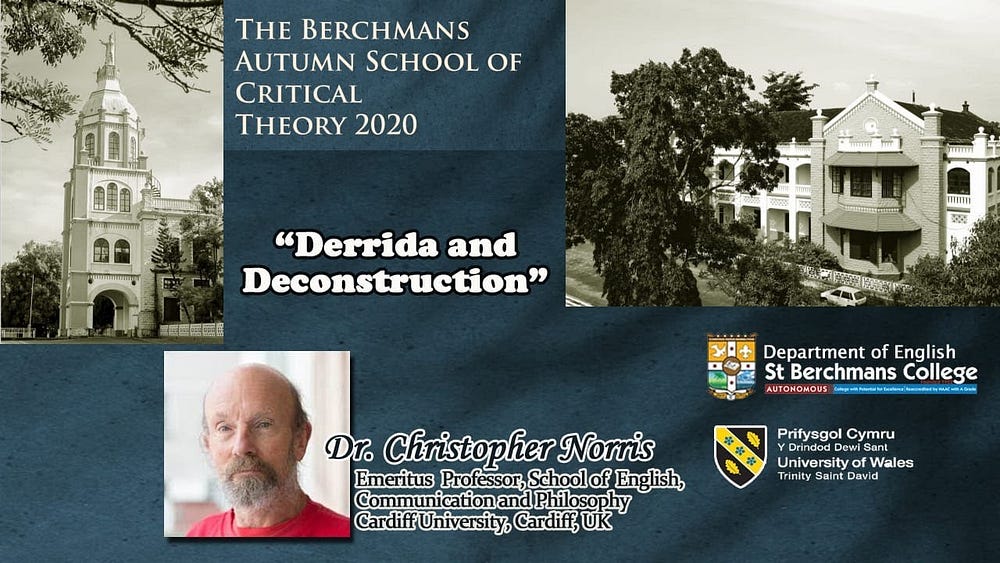
The following passage is philosopher and literary critic Christopher Norris (1947-) telling us what deconstruction isn’t:

“The point will bear repeating: deconstruction is not simply a strategic reversal of categories which otherwise remain distinct and unaffected. It seeks to undo both a given order of priorities and the very system of conceptual opposition that makes that order possible.”

As in the case of Gayatri Spivak, in order for Norris to have told us what deconstruction isn’t, he must have known what deconstruction is — at least to some extent. More concretely, if deconstruction

“is not simply a strategic reversal of categories which otherwise remain distinct and unaffected”

then that must be because deconstruction is something other than that reversal of categories.

Norris continued:

“Thus Derrida is emphatically not trying to prove that ‘writing’ in its normal, restricted sense is somehow more basic than speech. On the contrary, he agrees with Saussure that linguistics had better not yield uncritically to the ‘prestige’ that written texts have traditionally enjoyed in Western culture.”

So, in this instance at least, Norris rejected what’s often called the “binary opposition” of writing/speech (see Derrida’s arche-writing). And that must surely mean the following:

Deconstruction is the rejection of binary oppositions.

Isn’t that what Norris is explicitly saying?

So deconstruction is… something?

Of course there are many other examples of Derrida and other deconstructors telling us what deconstruction isn’t.

For example, it’s said that deconstruction isn’t a “project” either. Yet if deconstruction had no project at all, then why would Derrida — or any other deconstructor — have ever written a single syllable? Indeed it can also be added here that the position of having no project is still a project — i.e., the project of not having a project.

Simon Critchley & Others on What Deconstruction Is

Professor Simon Critchley

There are many negative definitions (or accounts) of what deconstruction is. Take these examples:

“the latest fashion in literary theory”, “an ancient error of scepticism and irrationalism”, “a repetition of dead-end themes in German idealism”, “a dangerous neo-Heideggerianism”, “a needless and frivolous hermeticism”, etc.

But let’s concentrate here on some positive accounts (or definitions) of what deconstruction is.

Take the following words from Professor Simon Critchley (1960-). (These words aren’t actually expressed as a definition.) Critchley writes:

[T]his relation to tradition [as displayed by continental philosophy] is not some conservative acquiescence in the face of the past, but rather takes the form of a critical confrontation with the history of philosophy, what Heidegger calls Destruktion or Abbau, words that Derrida renders into French as déconstruction. It is a question here of a critical dismantling of the tradition in terms of what has been unthought within it and what remains to be thought.”

(This mention of “the past” by Critchley is a reference to most — or even all — analytic philosophers ignoring the history of philosophy.)

This is one definition of what deconstruction is that’s surely essential (in a non-ontological sense, of course) and wide-ranging. It’s also very helpful in that it tells us how the word “deconstruction” was born.

So to express Critchley’s words as a example of Derrida’s S is P. We have this:

Deconstruction is a critical confrontation with the history of philosophy.

Of course no one would argue that deconstruction could be entirely summed up by the single sentence, “Deconstruction is a critical confrontation with the history of philosophy.” (Or, for that matter, with this sentence: “Deconstruction opposes all binary oppositions.”) Yet we can still say, “Deconstruction is X” … or Y, or Z, etc. Thus not being able to sum deconstruction up in a single S is P puts it in exactly the same position as every other philosophical ism!

So why did Derrida and other deconstructors have such a big problem with statements like “Deconstruction is…”?

Yet some deconstructors (i.e., other than the ones mentioned in this essay) have also told us exactly what deconstruction is.

For example, the following are some (seemingly) positive definitions of what deconstruction is: “an ethical response to complacency”, “literature’s revenge on philosophy”, “not what you think”, “a positive device for making trouble”, “a way of reading theoretical texts”, “a way of doing philosophy”; and, more relevantly to this essay, “resistance to questions which begin ‘What is…?’”.

Of course Derrida himself would no doubt have rejected all those positive accounts of deconstruction… as he also rejected all the negative ones too.

Yet would those rejections be any different from, say, Ludwig Wittgenstein rejecting most — or even all — of the interpretations of his work (as he almost did)? Or any different from scholars (or experts) getting hot under the collar when their favourite philosophers (or theorists) are encroached upon by someone seemingly less expert (or in the know) than they believe they are?

Thus Derrida has simply suffered — when it comes to the supposed “misreadings” of what deconstruction is — the same fate as all other philosophers. (Derrida once said: “All our readings are misreadings.”) But, because of Derrida’s bizarre prose style and his relentless game-playing, the situation has often been far worse than most of the other cases which can be cited.

[I can be found on Twitter here.]

Monday, 18 October 2021

Albert Einstein’s Own Words on His General Theory of Relativity: A Philosophical Commentary


This essay will raise largely philosophical issues concerning Albert Einstein’s general theory of relativity. Such issues will be prompted by Einstein’s own words on this matter. The essay will also include those intuitive questions which laypersons may ask about Einstein’s theory. I’ll also assume that at least a certain degree of ignorance (or naivety) — on my own part — will be displayed about the detailed physics of general relativity.

These philosophical questions and issues should be taken within the context of there being a large amount of mathematics and (as it were) pure physics in Einstein’s Relativity: The Special and the General Theory— far more than you’d see in most (or even all ) contemporary “popular science” books. Indeed there are equations and mathematical symbols on virtually every page. And all that despite the fact that Einstein aimed his book at those “who are not conversant with the mathematical apparatus of theoretical physics”.

Relativity: The Special and the General Theory began life as a short paper and it was first published in 1916. (My own English edition dates from 1920; which is the same edition displayed in the image above.)

To quote Einstein’s own preface (part of which has just been quoted), this book’s aim is to give

“an exact insight into the theory of relativity to those readers who, from a general scientific and philosophical point of view, are interested in the theory, but who are not conversant with the mathematical apparatus of theoretical physics”.

The Special Theory of Relativity

Since this essay in on the general theory of relativity and I’ll be using Einstein’s own words as a springboard, then it’s wise to begin by quoting Einstein himself distinguishing his general theory of relativity (1915) from his special theory of relativity (1905).

Einstein makes an important distinction in the following:

[A]ccording to the general theory of relativity, the law of the constancy of the velocity of light in vacuo, which constitutes one of the two fundamental assumptions in the special theory of relativity [] cannot claim any unlimited validity. A curvature of rays of light can only take place when the velocity of propagation of light varies with position.”

Then Einstein makes it clear that his own (prior) special theory of relativity is not thereby dead or irrelevant. Thus:

"Now we might think that as a consequence of this, the special theory of relativity would be laid in the dust. But in reality this is not the case. We can only conclude that the special theory of relativity cannot claim an unlimited domain of validity; its results hold only so long as we are able to disregard the influences of gravitational fields on the phenomena (e.g. of light.)”

This means that it is gravity that’s the vital addition to Relativity when it comes to the general theory. And when gravity and its effects were introduced, then a lot more of physics and cosmology needed to be modified — or even drastically changed — too.

The General Theory of Relativity

Matter and Space

It’s now well known that Albert Einstein argued that space and time are intimately connected — hence the introduction of the notion spacetime. However, he argued that space and matter are intimately connected too. Of course these two separate unifications (i.e., space and time & matter and space) are themselves placed in a larger unification in Einstein’s overall scheme.

Einstein believed that space is “determined by matter”. More technically, he believed that it’s the “geometrical properties of space” which are determined by matter. Thus when matter determines (this word is, so far, vague) a given area of space, then that space’s geometrical properties change.

Einstein concluded with the following words:

“Thus we can draw conclusions about the geometrical structure of the universe only if we base our considerations on the state of the matter as being something that is known.”

This is basically to say that in order to know about the geometrical structure of a given area of space (or indeed the universe as a whole), then we also need to know about “the state of the matter” in that given area of space. Thus if we know about that matter, then we also (or can also) know about that spatial area’s geometrical properties.

So does that also work the other way around?

That is, in order to know about a given piece of matter, do we also need to know about the geometrical structure of the area of space in which that piece of matter is (as it were) imbedded?

All the above raises a question similar to the one asked about the precise relation between mind and matter/the brain (i.e., if we accept some form of dualism). Basically, if the brain and mind are completely different (to use a philosophical term) substances, then how do they interact at all? Similarly, if space and matter are completely different substances(?), then how do they interact at all?

Again, Einstein told us that “the geometrical properties of space are not independent”: they are “determined by matter”. Does that mean that — as with the physicalist notion of mind — space is a kind of matter? Perhaps the least we can say is that space is not nothing. That is, we don’t need to say that space is matter — simply that it is in some way… physical. Indeed if space isn’t in some way physical, then how could it be determined by matter?

So how, exactly, does matter “determine” space’s geometrical properties?

Not only that: we still don’t really know what space and matter are. Perhaps if we can know what they are, then we’d also come to know how matter determines the geometrical properties of space.

Gravitational Fields and Distributions of Matter

Einstein gave us a concrete example of the reciprocal relation between gravitational fields and matter. He wrote:

“We already know from our previous discussion that the behaviour of measuring-rods and clocks is influenced by gravitational fields, i.e. by the distribution of matter.”

Firstly, it must be said that Einstein seemed to be setting up an identity relation here. Thus:

gravitational fields = the distribution of matter

So is it that gravitational fields are an effect of distributions of matter or that they actually are distributions of matter? In any case, the least we can say (at this juncture) is that there’s an intimate relation between gravitational fields and distributions of matter.

This raises the following question: What is a gravitational field?

In any case, even if gravitational fields couldn’t exist without distributions of matter, that doesn’t also mean that they are one and the same thing. In addition, it may still be the case that both gravitational fields and distributions of matter are physical; though not physical in precisely the same way.

Indeed if we accept Einstein’s general theory of relativity, then there’s a way of looking at these issues in which there’s no gravitational force at all. More technically, gravitational fields simply “represent” the curvature of spacetime. This means that gravity is a “fictitious force”. Thus we don’t really need to ask the question, “What is gravity?” And that’s because gravity doesn’t actually exist. (These “interpretations” may not matter to many physicists in that they don’t alter the data.)

We’re still left with this question: “What is spacetime?”

Rigid Bodies?

Einstein often referred to “rigid bodies” in his Relativity: The Special and the General Theory.

Rigid bodies can be characterised negatively in this way:

Rigid bodies are bodies which are not influenced by gravitational fields.

Basically, a rigid body is a body that retains all its geometrical over time.

Yet since gravitational fields exist, then there are no such things as rigid bodies. A non-rigid (Einsteinian) body, on the other hand, is constantly influenced by gravitational fields. And that’s because such fields never (as it were) go away.

More concretely, Einstein told us that a “rigid rod” is not actually rigid at all. He wrote:

“This proves that the propositions of Euclidean geometry cannot hold exactly on the rotating disc, nor in general in a gravitational field, at least if we attribute the length I to the rod in all positions and in every orientation.”

So if a rod is length I at one place and at one time, then it won’t still be length I at another place and at another time. (It must be borne in mind that the differences here are fantastically small!) Yet at that other place and other time it’s still exactly the same rod! To repeat: every change of position and every change of orientation of this rod (which was initially designated as having length I) will change its geometry (or, more simply, its size).

(Philosophers have had fun with the “standard rods”, etc. which are used for measurement — see ‘Kripke, Duchamp & the Standard Metre’.)

Clocks

Einstein then stated that gravitational fields (or various distributions of matter) “influence [] the behaviour of measuring-rods and clocks”. So here again we can ask if it’s the case that physical things (i.e., gravitational fields) are influencing other physical things (i.e., measuring-rods and clocks).

Einstein supplies detail about gravitational effects on clocks. (In this case, it’s in relation to a rotating circular disk on which two clocks are placed.) He wrote:

“Thus on our circular [rotating] disc, to make the case more general, in every gravitational field, a clock will go more quickly or less quickly, according to the position in which the clock is situated (at rest).”

In other words, a clock will either go “more quickly or less quickly” depending on its precise physical and spatial relation to the gravitational field. This means that there is no absolute time which can be supplied by the clock: the time it gives is dependent on its relation to (or place within) a gravitational field. As Einstein put it:

“For this reason it is not possible to obtain a reasonable definition of time with the aid of clocks which are arranged at rest with respect to the body of reference.”

So even if these two clocks were set at the same time and given the same time, then, after those settings, differences will occur which have nothing to do with the clocks’ respective mechanisms and everything to do with their relative positions in the gravitational field. That also means that there’s no absolute way of choosing which of the two clocks (in two different places) is giving the right time. They both are. And that’s the case even though they give — very slightly — different times.

It’s not only the relative positions of the clocks which determines their different times: it’s also a question of their velocities. Einstein wrote:

“As judged from this body, the clock at the centre of the disc has no velocity, whereas the clock at the edge of the disc is in motion relative to K in consequence of the rotation [].”

Thus one clock has no velocity (relative to K) and the other clock is in motion (relative to K). What follows from that? According to Einstein,

“it follows that the latter clock goes at a rate permanently slower than that of the clock at the centre of the circular disc, i.e. as observed from K.

The clock in motion, then, is slower precisely because it’s in motion. Similarly, the clock at the centre of the disk (which has no velocity) is running more quickly. In other words, velocity (roughly, speed with direction) slows time down. Or, at least at this juncture, velocity slows clock time down.

So, in the case of the two clocks in Einstein’s thought experiment, we can ask this question:

Is it that gravitational fields makes one clock run slower or is it that time itself — for that clock — runs slower?

In other words, is there a difference between clock time and time itself?

The problem here is that if we have no other way of measuring time (or knowing about time) other than via clocks or other (moving) “bodies”, then surely that which measures time and time itself are intimately connected — at least in Einstein’s picture.

In Einstein’s own words, “a physical definition of time” depends on both gravitational fields and how those fields influence clocks. Indeed this fact, as Einstein concedes, wasn’t factored into his special theory of relativity. In other words, time-telling (though not time itself) is relative in the general theory of relativity; whereas in the special theory of relativity it isn’t. That is, although the relativity of time was obviously recognised in the special theory of relativity, the (as it were) relativity of clocks (or other time-telling bodies) wasn’t.

We now also need to ask how, exactly, gravitational fields (to use Einstein’s vague non-technical word) “influence” rigid bodies such as clocks and measuring-rods.

Just a final note on Einstein’s focus on clocks, measuring-rods and rigid bodies (as also featured in the next section).

At this stage of his career, Einstein didn’t attempt to tell his readers what space and time actually are — despite my own questions so far. Instead he took an operationalist (though that term came later) position on these matters. Indeed none other than Alan Turing (1912–1954) picked up on this after reading Einstein. He expressed Einstein’s (1916) position (as quoted by Andrew Hodges) in the following passage:

“It is meaningless to ask whether the two p[oin]ts are always the same distance apart, as you stipulate that the distance is your unit and your ideas have to go by that definition… These ways of measuring are really conventions. You modify your laws to suit your method of measurement.”

Of course Turing himself applied this line of reasoning to this question: “Can a machine think?” In other words, he answered that question operationally in terms of what can be shown to be an example of thinking under controlled circumstances.

Let’s now move on to physical space.

Physical Space

The (as it were) physicality of space has been directly known since Faraday and Maxwell and — in a sense — indirectly known since Newton. The following is how Einstein put it:

“The success of the Faraday-Maxwell interpretation of electromagnetic action at a distance resulted in physicists becoming convinced that there are no such things as instantaneous actions at a distance (not involving an intermediary medium) of the type of Newton’s law of gravitation.”

More particularly, the physicality of space was highlighted when Einstein asked us to “imagine a spherical space”.

Was this a case of Einstein asking us to imagine (a) space without something in it? Or to put that another way: Was Einstein asking us to imagine space itself being spherical?

These questions are asked because in order to imagine a spherical space, Einstein actually imported rigid bodies — again!— into his act of imagination. To use Einstein’s own words:

“To imagine a space means nothing else that that we imagine an epitome of our ‘space’ experience, i.e. of experience that we can have in the movement of ‘rigid’ bodies. In this sense we can imagine a spherical space.”

This basically means that we actually imagine “the movement of rigid bodies” within a given space. And from that “experience” we can conceive (rather than imagine) of space itself being spherical. That is, a clue to the sphericity of space is provided by the movement (or trajectories) of rigid bodies. That means that the imagination — or even observation — of space alone can’t tell us that space is spherical. Instead, it’s the movement of bodies within space which must show us that this is so.

Again: Einstein wasn’t asking us to imagine space with nothing in it. (Perhaps that would be an impossible act of imagination.) Instead we must imagine moving bodies within space and from that act of imagination deduce (or “conceive” — a word which Einstein used later) that space is indeed spherical.

Thus it’s only in (to use Einstein’s own words) “this sense” that we can imagine a spherical space.

In addition, we can only make sense of space when we — in some cases at least — bring in “motion relative to a practically rigid body of reference”. Thus space still exists; though we can only make sense of it when we include a dynamics which is itself a product of introducing rigid bodies and frames of reference.

Another demonstration of the physicality and shape of space is offered by Einstein in his following words:

“At first, the straight lines which radiate from the starting point diverge farther and farther from one another, but later they approach each other, and finally they run together again at a ‘counter-point’ to the starting point. Under such conditions they have traversed the whole spherical space.”

In Euclidean (flat) space, these straight lines would keep on diverging farther and farther from each other. Indeed there would be nothing to stop this from happening. But because (Einstein’s) space is spherical (or curved), then at some point the two lines must eventually “approach each other, and finally [] run together [] at a ‘counter-point’ to the starting point”. In other words, the two lines have journeyed around a spherical space. So this is roughly equivalent to two lines being drawn from a given point on the surface of (say) a football, the two lines then going in different (or opposite) directions, and then the lines finding their way back to a “counter-point to the starting point”.

Yet perhaps the best known of Einstein’s examples of the physicality of space was actually cosmological in extent. This is Einstein’s theory of the bending of light. Einstein himself wrote:

“If the displacement of spectral lines toward the red by the gravitational potential does not exist, then the general theory of relativity will be untenable.”

To state the obvious: if space weren’t physical, then these spectral lines wouldn’t become bent or displaced. Thus the space through which these spectral lines traverse has a geometry which determines their movement. And that movement is not in a straight line.

Finally, Einstein offered us a broad conclusion to all his technical detail on the physical nature of space. He wrote:

“In the first place we entirely shun the vague word ‘space,’ of which, we must honestly acknowledge, we cannot form the slightest conception, and we replace it by ‘motion relative to a practically rigid body of reference.’”

In other words, space as an abstraction — or as an absolute — must be “entirely shun[ed]”.

[I can be found on Twitter here.]

Sunday, 10 October 2021

When Alan Turing and Ludwig Wittgenstein Discussed the Liar Paradox


Alan Turing attended Ludwig Wittgenstein’s ‘Lectures on the Foundations of Mathematics’ in Cambridge in 1939. The following is one account of those lectures:

“For several terms at Cambridge in 1939, Ludwig Wittgenstein lectured on the philosophical foundations of mathematics. A lecture class taught by Wittgenstein, however, hardly resembled a lecture. He sat on a chair in the middle of the room, with some of the class sitting in chairs, some on the floor. He never used notes. He paused frequently, sometimes for several minutes, while he puzzled out a problem. He often asked his listeners questions and reacted to their replies. Many meetings were largely conversation.”

In relevance to this essay, Alan Turing (1912–1954) strongly disagreed with Ludwig Wittgenstein’s argument that mathematicians and philosophers should happily allow contradictions to exist within mathematical systems.

In basic terms, Wittgenstein stressed two things:

1) The strong distinction which must be made between accepting contradictions within mathematics and accepting contradictions outside mathematics.
2) The supposed applications and consequences of these mathematical contradictions and paradoxes outside mathematics.

As for 1) above, Wittgenstein said (as quoted by Andrew Hodges):

“Why are people afraid of contradictions? It is easy to understand why they should be afraid of contradictions in orders, descriptions, etc. outside mathematics. The question is: Why should they be afraid of contradictions inside mathematics?”

Wittgenstein can be read as not actually questioning the logical validity or status of these paradoxes and metatheorems. He was making a purely philosophical point about their supposed — and numerous — applications and consequences outside of mathematics. (These consequences — if not always applications — usually include stuff about consciousness, God, human intuition, the universe, human uniqueness, religion, arguments against artificial intelligence, meaning, purpose, etc.)

Thus Wittgenstein’s position on mathematical contradictions and paradoxes was largely down to his (as it has often been called) mathematical anthropocentrism. That is, to his belief that mathematics is a human invention. More concretely, in his “middle period” Wittgenstein stated that “[w]e make mathematics”; and some time later he said that we “invent” mathematics.

It can be seen, then, that Wittgenstein was clearly an anti-Platonist. Thus it’s not a surprise that he also said that

“the mathematician is not a discoverer: he is an inventor”.

Indeed the later Wittgenstein even went so far as to say that

[i]t helps if one says: the proof of the Fermat proposition is not to be discovered, but to be invented”.

One other very concrete way in which Wittgenstein expressed his anti-Platonism was when he made the point that it’s wrong to assume that because

“a straight line can be drawn between any two points [that] the line already exists even if no one has drawn it”.

Wittgenstein consequently made the ironic comparison (which many may find ridiculous) that “chess only had to be discovered, it was always there!”.

In terms of contradictions and paradoxes again.

All the above means that if mathematics is a human invention, then any contradictions and paradoxes there are (within mathematics) must be down to… us. And if they’re down to us, then they aren’t telling us anything about the physical world (which includes Turing’s bridge — see later) or even about a platonic world of numbers — because such as thing doesn’t even exist.

Yet many of Wittgenstein’s remarks on paradoxes, Gödel's theorems, mathematical contradictions, etc. have been seen — by various commentators — as being almost (to use my own word) philistine in nature. (Much has been written on Wittgenstein’s remarks on Gödel's theorems — see here.)

The Liar Language Game

Wittgenstein tackled the most famous of all paradoxes — the Liar Paradox. In a discussion with Turing, he said:

“Think of the case of the Liar: It is very queer in a way that this should have puzzled anyone — much more extraordinary than you might think… Because the thing works like this: if a man says ‘I am lying’ we say that it follows that he is not lying, from which it follows that he is lying and so on. Well, so what? You can go on like that until you are black in the face. Why not? It doesn’t matter. …it is just a useless language-game, and why should anyone be excited?”

At first glance it seems that Wittgenstein was perfectly correct to use the philosophical term (his own) “language-game” to refer to the Liar Paradox — as well as to many of the other paradoxes thrown up in what’s often called the foundations of mathematics. (More correctly, these paradoxes were seen to arise within various language games.) After all, the Liar paradox is internal to a language (game) which allows such a kind of self-reference. Indeed in which other language (game) would you ever find the statement, “This sentence is false”? (Even it’s supposed everyday translation - “I am a liar” — seems somewhat contrived.) These sentences simply don’t belong to everyday languages at all. Thus they must belong to a specific technical language game. (As do, for example, Gödel sentences.)

(Of course everyday language does allow other kinds of self-reference which don’t generate — obvious? — contradictions or paradoxes; such as merely referring to oneself when one says “I am happy”.)

So Wittgenstein’s position can be summed up by saying that the Liar language game doesn’t so much as display (or spot) a contradiction or paradox — it creates one.

Wittgenstein was basically stressing the artificiality of the Liar paradox. Now that artificiality doesn’t automatically mean that it has nothing to offer us. In that case, then, the word “artificiality” needn’t be negative in tone. It may simply a reference to something which is… artificial. As it is, though, Wittgenstein did mean it in an entirely negative way. After all, he said that the Liar paradox “is just a useless language-game”.

Alan Turing, on the other hand, seemed to be interested in the Liar paradox for purely intellectual reasons. (Although he will later refer to the construction of bridges.) He replied:

“What puzzles one is that one usually uses a contradiction as a criterion for having done something wrong. But in this case one cannot find anything done wrong.”

In basic terms, Turing was arguing that, unlike many other cases of contradiction, the Lair paradox doesn’t simply uncover a contradiction: it makes it the case that both x and not-x must be accepted. That is, when a (Cretan) liar utters “I am lying”, and it leads to it being interpreted as making the speaker both a liar and not a liar (i.e., at one and the same time), then “in this case one cannot find anything done wrong”.

One can almost guess Wittgenstein’s reply to this. He said:

“Yes — and more: nothing has been done wrong [].”

Wittgenstein’s argument (at least as it can be seen) was that the Liar paradox does indeed lead to this bizarre conclusion because — in a strong sense - it was designed to do so. That is, it is part of a language-game which was specifically created to bring about a paradox. And because it’s a self-enclosed and artificial language-game, then Wittgenstein also asked “where will the harm come” from allowing such a contradiction or paradox?

Alan Turing’s Bridge

It was said a moment ago that Alan Turing appeared to be interested in the Lair paradox for purely formal reasons. However, he did then state the following:

“The real harm will not come in unless there is an application, in which a bridge may fall down or something of that sort [] You cannot be confident about applying your calculus until you know that there are no hidden contradictions in it.”

On the surface at least, it does seem somewhat bizarre that Turing should have even suspected that the Liar paradox could lead to a bridge falling down. That is, Turing believed — if somewhat tangentially — that a bridge may fall down if some of the mathematics used in its design somehow instantiated a paradox (or a contradiction) of the kind exemplified by the Liar paradox.

Yet it’s hard to imagine the precise route from the Lair paradox to practical (or concrete) applications of mathematics of any kind — let alone to the building of a bridge and then that bridge falling down.

Indeed many (pure) mathematicians have often noted the complete irrelevance of much of this paradoxical and foundational stuff to what they do. Thus if it’s irrelevant to many mathematicians, then surely it would be even more irrelevant to the designers who use mathematics in the design of their bridges.

This metamathematics/the applications of mathematics opposition is summed up by the mathematician and physicist Alan Sokal in two parts. Firstly, Sokal stresses the difference between “metatheorems” and “conventional mathematical theorems” in the following way:

[] Metatheorems in mathematical logic, such as Gödel's theorem or independence theorems in set theory, have a logical status that is slightly different from that of conventional mathematical theorems.”

And it’s precisely because of this substantive difference that Sokal continues in this way:

“It should, however be emphasized that these rarefied branches of mathematics have very little impact on the bulk of mathematical research and almost no impact on the natural sciences.”

So if such metatheorems have (to be rhetorical for a moment) almost zero “impact on the natural sciences”, then surely they have less than zero impact on the design of bridges.

Again, it’s hard to see how there could be any (as it were) concrete manifestation of the Liar paradox. That said, perhaps Turing’s argument is that there couldn’t be such a concrete manifestation. And that’s precisely because if there were such a manifestation — then some bridges would fall down!

So what about Wittgenstein's response to this line of reasoning?

Wittgenstein responded to Turing by saying that “[b]ut nothing has ever gone wrong that way yet”. That is, no bridge has ever fallen down due to a paradox or contradiction in mathematics.

The Principle of Explosion

As already hinted at, all the above can be boiled down to Alan Turing predicting (or simply conceiving of) concrete and design-related manifestations of what is called (by logicians) the principle of explosion.

Yet it was Wittgenstein who noted what Turing was actually getting at. He said:

“Suppose I convince [someone] of the paradox of the Liar, and he says, ‘I lie, therefore I do not lie, therefore I lie and I do not lie, therefore we have a contradiction, therefore 2x2 = 369.’…”

In other words, “from a contradiction, anything follows”. Or to put that as Wittgenstein himself put it:

If we allow the sentence

“I lie, therefore I do not lie, therefore I lie and I do not lie…”

then we must also allow this equation:

2 x 2 = 369

But in the case of 2 x 2 = 369, Wittgenstein argued thatwe should not call this ‘multiplication’ at all”. And surely he was right. Yet this conclusion is seen to be a logical consequence of accepting the legitimacy of the Liar paradox.

Finally, it can also be added, in a Wittgensteinian manner, that we are free to invent a language (game) in which 2 x 2 (or, perhaps more accurately, “2 x 2”) does indeed equal 369 (or “369”)!

[I can be found on Twitter here.]