Tuesday, 21 December 2021

Philip Goff’s Panpsychism vs. Sam Coleman’s Russellian Monism?


(i) Introduction 
(ii) Panpsychist Russellian Monism vs. Panprotopsychist Russellian Monism 
(iii) Experiences Without an Experiencer? 
(iv) Sam Coleman’s Neutral Ultimates

Just a quick note on the title.

As ever with the shifting minutia of the technical terms used in (analytic) philosophy, things are complicated by the fact that Philip Goff’s position can also be deemed to be a kind of Russellian monism and Sam Coleman’s position can be deemed to be a kind of panpsychism. (Indeed Coleman states that his position “needn’t constitute a wholesale abandonment of panpsychism”.)

That said, what will be seem as important and fundamental distinctions from the inside of this philosophical (or academic) debate may not seem that way when looked at from the outside in. So, as a consequence of this (as well as to simplify things), it’s probably best to see Goff as being a (as it were) basic panpsychist and Coleman as being a Russellian monist — and that’s despite the many crossovers and grey areas between their two positions. Indeed Goff is best seen as a panpsychist for the simple reason that his position squares with most accepted conceptions — if there even are such things! — of panpsychism. And not to forget that Goff classes himself as a panpsychist.

So let’s go into more detail about the technical distinctions just hinted at.

Panpsychist Russellian Monism vs. Panprotopsychist Russellian Monism

The situation is complicated because Sam Coleman and Philip Goff believe that this debate isn’t simply a case of the following:

Russellian (neutral) monism vs. panpsychism

It’s actually a case of this:

panprotopsychist Russellian monism vs. panpsychist Russellian monism.

The following passage is how both Coleman and Goff explain the difference:

“Panpsychist Russellian monists hold that the categorical properties of basic physical entities are experiential properties.”

Panprotopsychist Russellian monists, on the other hand,

“hold that the categorical properties of basic physical entities are proto-experiential”.

So what are “proto-experiential” properties?

According to Coleman and Goff again:

“They are not themselves experiential properties but are crucial ingredients in facts that explain the production of consciousness.”

Thus Sam Coleman’s solution to the problems he spots in Philip Goff’s panpsychism is itself a variation on Bertrand Russell’s neutral monism (see here). Yet, as hinted at in the introduction, Goff too is strongly influenced by neutral monism. (Both Coleman and Goff use the term “Russellian monism”.)

Coleman’s position is a potential solution because in his own philosophical theory (as he puts it):

[P]henomenal qualities are irreducible but subjects are reducible.”

This means that phenomenal qualities are fundamental and therefore irreducible; whereas subjects are reducible because (presumably) they’re complex (i.e., made up of many different parts and “qualities”).

Coleman distances himself further from panpsychism (or at least from Philip Goff’s panpsychism) when he says that

“the neutral monist constructs the universe from neither-mental-nor-physical qualities, of which colours might be said to provide the exemplar”.

Goff (rather than Coleman) now gives an (as it were) concrete example of these distinctions when he discusses mass and other “categorical properties of basic physical entities”. He writes:

“Physics characterises mass in terms of a certain disposition (to resist acceleration and to attract other massive things)… If the categorical properties of basic physical entities are taken to be phenomenal properties , the resulting view is form of panpsychism. If the categorical properties of basic physical entities are taken to be protophenomenal properties, the resulting view is a form of panprotopsychism.”

So how much sense does it make to talk about experiences, phenomenal properties or even protophenomenal properties being instantiated without a mind, subject or being that (as it were) owns or has them?

Experiences Without an Experiencer?

Philip Goff raises this point in the following passage:

“You can’t have a feeling just floating around without a conscious mind to experience it, just as you can’t have a shape floating around without an object whose shape it is. The existence of an experience trivially entails the existence of an experiencer (just as the existence of a shape trivially entails the existence of a shaped object).”

Admittedly, there’s a difference here in that Goff firstly talks about “a feeling”, not experiences or phenomenal properties in the (as it were) abstract. So it does seem that a feeling must “belong to”… something. Indeed Goff himself states that a feeling must belong to “a conscious mind” which can “experience it”.

Yet Goff moves on from talking about a feeling to talking about “an experience”. He then states that “[t]he existence of an experience trivially entails the existence of an experiencer”. This appears to go against Goff’s own panpsychism in that he also believes that, for example, particles and even spacetime itself instantiate — or literally are — phenomenal properties or experience. (In his Galileo’s Error, Goff writes: “Spacetime on its own is a simple and ubiquitous experience [].”) In these cases, then, Goff clearly does not believe that particles and spacetime require “an experiencer”. In other words, when it comes to particles, spacetime, etc., experiences (or phenomenal properties) are simply instantiated — full stop. Thus there’s no requirement for an experiencer.

[If we agree with Goff and believe that spacetime enters the panpsychist equation, then which parts of spacetime have “simple and ubiquitous experience[s]”? All of spacetime? A arbitrary bit of it? A Planck-length section of it?]

Yet if we can have an experience without an experiencer, then why can’t we also have a feeling without a feeler?

If Goff is, on the one hand, demanding that experiences belong to the “minds” (or subjects) which have those very same experiences, then that will explain his criticisms of Coleman’s position.

More specifically, Goff states that Coleman has “argued that we cannot make coherent sense of minds combining”. And the following passage is Coleman putting his own position (as found in his paper ‘The Real Combination Problem’):

“The dilemma is as follows: Panpsychists take the micro-material realm to feature phenomenal properties, plus micro-subjects to whom these properties belong. However, it is impossible to explain the generation of a macro-subject (like one of us) in terms of the assembly of micro-subjects, for, as I show, subjects cannot combine. Therefore the panpsychist explanatory project is derailed by the insistence that the world’s ultimate material constituents are subjects of experience.”

It can be presumed here that we “cannot make coherent sense of minds combining” because such minds would be (as it were) in competition with each other. Alternatively, surely they’d (again metaphorically) cancel each other out. Indeed Coleman puts the extreme(?) panpsychist position when he states that “the panpsychist fills quarks and electrons with conscious minds”. Thus, when it comes to a macromind (or macrosubject), surely all these quark-minds, electron-minds and many other microminds would be in competition with each other or cancel each other out.

(Despite the previous paragraph, microminds competing with each other or cancelling each other out doesn’t — in and of itself — rule out the possibility of combination or summing.)

So Coleman’s solution to this problem would seem to be that we can (or must) posit rudimentary things which instantiate experiences (or “phenomenal qualities”) without such things also having (or being) minds (or subjects) of some kind. And Coleman himself offers this alternative when he states that the

“the panpsychist faces a choice of giving up her explanatory ambitions, or of giving up the claim that the ultimates are subjects”.

In other words, such experiences (or, in Coleman’s terminology, “proto-experiential qualities”) must literally run free of minds (or subjects). Thus these experiences exist (as it were) in and of themselves. And, if that’s the case, then we won’t have the problem of a multitude of “minds combining” to form a macromind. Instead, we’d simply have the experiences of a multitude of different rudimentary objects (i.e., ones which aren’t also subjects or minds) combining to create a macromind.

[Sam Coleman’s idea that colour may be such a neutral quality seems obviously false and scientifically naive. But that can’t be discussed in this essay . See Coleman’s position on the metaphysical nature of colour here.]

So what about Goff’s position?

At least as stated in the upcoming passage, Goff’s position doesn’t necessarily contradict Coleman’s. And that’s primarily because Goff doesn’t mention either minds or subjects. That is, Goff concludes with the following words:

“So if we can account for the presence of complex, macro-level forms of consciousness (in terms of facts about micro-level consciousness), we have thereby accounted for the presence of complex, macro-level conscious minds (in terms of facts about micro-level consciousness).”

Note again the lack of the word “mind” or “subject” in the passage above. So here at least Goff’s argument seems to be that in order to “account for the presence of complex, macro-level forms of consciousness”, we need not — or even must not — also posit rudimentary (or micro-level) minds or subjects. Moreover, is Goff’s argument that we must only posit rudimentary (or micro-level) experiences which run free of minds (or subjects)? Yet, despite the passage above, Coleman’s idea of a chaos (or flux) of a multitude of microminds (or microsubjects) competing with one another would indeed work against Goff’s own take on panpsychism. That is, in Goff’s brand of panpsychism, a multitude of microminds (or microsubjects) are indeed incorporated into the metaphysical picture.

Again, there seems to be a contradiction here.

On the one hand, Goff states that we can make sense of “complex, macro-level forms of consciousness” in terms of “facts about micro-level consciousness”. (Importantly, these facts at the microlevel — at least according to Coleman — must run free of minds or subjects ; lest we have a chaos of rival microminds which supposedly make up a macromind.) Yet earlier on Goff has also said that “[t]he existence of an experience trivially entails the existence of an experiencer”. That means that Goff is also arguing that these micro-level examples of consciousness must also instantiate (or be) minds — i.e., they must all belong to “an experiencer”.

Unless, of course, when Goff wrote “[t]he existence of an experience trivially entails the existence of an experiencer” he was putting someone else’s position.

In any case, Coleman then explicitly comments on this subject/phenomenal qualities (to use his own word) “dilemma”.

Sam Coleman’s Neutral Ultimates

Sam Coleman states the following:

“This needn’t constitute a wholesale abandonment of panpsychism, however, since panpsychists can maintain that the ultimates possess phenomenal qualities, despite not being subjects of those qualities. This proposal requires us to make sense of phenomenal qualities existing independently of experiencing subjects, a challenge I tackle in the penultimate section.”

At first this may not seem to be too problematic because all sorts of objects (or things) have properties without also being subjects or minds. So a rose, for example, can have the property being red without also being a subject or a mind. Yet, of course, in this case the situation is very different because Coleman is talking about phenomenal qualities. But can any object x have phenomenal qualities without also being a subject or a mind?

[One can add to Coleman’s argument by saying that if particles or other rudimentary objects are deemed to have — or are — minds or subjects, then why can’t we also say that they’re selves or persons too? Indeed I suspect that some panpsychists have already gone in this direction.]

Well, perhaps the big difference is that Coleman is actually talking about what he calls “proto-experiential qualities” — despite the fact that he actually uses the words “phenomenal qualities” in the passage above. So experiential (or phenomenal) qualities may well require minds or subjects. However, proto-experiential qualities do not require minds or subjects!

In addition, one obvious point to make about the passage above is that Coleman uses the word “possess”. That is, what he calls “ultimates” do indeed possess “phenomenal qualities” — yet they aren’t also “subjects”. This means that ultimates aren’t the “subjects of those qualities”.

But what does that mean? Does it mean the following?-

ultimates (literally) = phenomenal qualities

Alternatively:

an ultimate = a phenomenal quality

Moreover, is Coleman’s position that his ultimates instantiate (or even have) phenomenal qualities without also thereby being subjects or minds? Again, what is it, exactly, that instantiates — or has — phenomenal qualities? Is it that no thing at all instantiates (or has) phenomenal qualities when it comes to ultimates? That is, is it that ultimates exist and simply are proto-experiential (or proto-phenomenal) qualities?

[I can be found on Twitter here.]

Wednesday, 15 December 2021

Why Most Postmodernist, Poststructuralist, Etc. Texts are Obscure and Pretentious

See the video in which Jaques ‘Jaques’ Liverot speaks about politics - here.


[] A certain sort of analytic philosopher who dismisses as meaningless what does not instantly make sense to his shallow pate…. I coined a name for people like him: ‘philosophistine.’ A philistine out of his depth among real philosophers.”

Bill Vallicella [Vallicella “taught philosophy at various universities in the USA and abroad”. See source of quote here.]


Firstly, when other critics have said similar things to that which will be said in the following essay they’ve often been deemed to be intellectually philistine (or worse!) by post-structuralists, postmodernists, “theorists”, sympathetic academics, etc.

Basically, critics of such prose are seen not to have the intellect and/or imagination to discover the deep and profound ideas hidden so deeply within these texts. This is a kind of catch 22. That is, in order to understand such clever, deep and profound texts, one needs to have a clever, deep and profound mind. So if one doesn’t have a clever, deep and profound mind, then you — by definition — won’t understand these texts.

So criticisms of such texts must be down to the readers not having minds that are clever, deep and profound enough to understand them. The upshot here is that the vast majority of readers (including highly-educated and philosophically-literate readers) are shut out of what can only be called academic tribes.

These kind of statements about philistinism — and sometimes much worse abuse — were also aimed at Alan Sokal after the Sokal Affair.

For example, take Jacques Derrida’s responses to Sokal (which seem pathetic, trivial and dishonest).

Derrida stated that what Sokal did was “sad” and an “act of intellectual bad faith” because it “ruin[ed] the chance to carefully examine controversies” about the nature of science. Derrida even had the audacity to claim that Sokal wasn’t “serious” because he’s used a “quick practical joke” to basically score a cheap point. Yet this is from a philosopher who — at the time — had been repeatedly compared to a “joker”, “clown” and “charlatan” for at least three decades. (See Derrida’s article on Sokal in Le Monde here.)

More relevantly than all that, the academic Gabriel Stolzenberg once argued that Sokal hadn’t understood the clever, deep and profound philosophies he was criticising. And this meant, to him, that Sokal’s criticisms were simply “meaningless”. (Yes, it really must have been that simple to him.) And then, of course, Stolzenberg used the academic cliché that Sokal’s criticisms were a result of “misreadings”! (As per usual: “misreading” = negative reading.)

In addition to the above, the New York Times suggested (see here) that most — or even all — of those who took Sokal’s side were “conservatives”. Others said that Sokal’s book was an attack on “multiculturalism”. And, at least according to Sokal himself, the authors were compared to “schoolteachers giving poor grades” to various postmodernists, theorists, etc. To top that, one journalist even wanted to find out about Sokal’s sex life to see if that explained his (reactionary?) criticisms and positions on this issue.

They Don’t Understand Their Own Texts

“Though, of necessity, some of the arguments I shall give are not altogether simple, I have tried to make my case as clearly as I can, using only elementary notions where possible.”

Roger Penrose [Penrose is a mathematician, mathematical physicist and Nobel Laureate in Physics . See source of quote here.]


Perhaps the primary reason why most readers (even educated and philosophically-literate ones) don’t understand most post-modernist, post-structuralist, theorist, etc. texts is that the writers of those texts don’t understand them themselves. In other words, perhaps there isn’t much to understand in the first place. Alternatively, if there is something to understand, then it’s often very simple and even banal — hence the tortuous prose which is used to hide these facts.

So how do such writers, theorists and academics get away with all this?

Katha Pollitt (as quoted by Alan Sokal) cites a very convincing reason. She says that they

“make their way through the text by moving from one familiar name or notion to the next like a frog jumping across a murky pond by way of lily pads”.

So perhaps it’s not the ideas and theories which are being understood by the fans of these theorists, academics and philosophers… let alone the arguments. (Some — even many — poststructuralists, postmodernists, “theorists”, etc. have explicitly — either indirectly or directly — spoken against argumentation, reason, science, etc.) Instead, it’s the case that the sympathetic reader simply recognises “familiar name[s]” and familiar “notion[s]” and thus feels (as it were) at home in the text — and that’s basically it. In other words, when glancing through a text, the sympathetic (or non-critical) reader will see many technical terms and names he recognises — and that will be (almost?) enough for him. So no matter how those terms and names are juxtaposed in the text, the names and notions will still be recognised by such a reader. This would even be the case if the words were a literal cut-up text because the names and notions would still be there for the sympathetic (or non-critical) reader to recognise. (The cut-up technique is — or was — a process in which old texts are cut up and rearranged to create new texts.)

Indeed all the above is largely why it was so easy for Alan Sokal, James A. Lindsay, Peter Boghossian and Helen Pluckrose to pull off their stunts. (The later three writers — up until 2019 — had four parodies published in journals and three had been accepted; though some were rejected.) That is, primarily because

“the comedy of the Sokal incident is that it suggests that even the postmodernists don’t really understand one another’s writing”.

Of course if these authors don’t actually understand their own work, then that seems to imply that there’s at least something there to understand. Yet who else could understand these texts if the authors themselves don’t understand them?

The only answer to that is that there’s usually nothing (much) to understand in the first place.

After all, if academic/theorist X doesn’t understand his/her own text, then that must mean that there’s nothing (much) to understand. And if there’s nothing (much) to understand (as well as the academic/theorist knowing that), then which options does he or she have left? The obvious one is to make it seem as if there is something deep and profound to understand. And the best way of doing that is to write the text in an obscure and pretentious way. And that obscurity and pretence will be but a means to hide the fact that there isn’t much to understand in the first place.

So if sympathetic academics and students don’t understand the texts of their favourite philosophical Big Names, then no wonder they were hoodwinked by Sokal and Co. All that mattered was that these parodists used many academically-fashionable proper names, many academically-fashionable terms and referred to many academically-fashionable notions — virtually in any order whatsoever.

And, of course, students pick up on this.

Many students realise that in order to advance their studies, future (bourgeois) careers and general financial security, then they must “learn to repeat and to embellish discourses that they only barely understand”. And, if students do this well, then

[t]hey can, if they are lucky, make an academic career out of it by becoming expert in the manipulation of an erudite jargon”.

[I personally had first-hand experience of this as a mature student when I quickly noted that many (or at least some) dumb or lazy students had learned how to replicate the ideas — and even the prose styles — of their postmodernist teachers. In this particular case, my fellow students were basically force-fed highly-politicised theories (along with a politicised semiotics), which of course many students “embraced”…lest they fail the course.]

Does all the above seem a little over the top?

Well think of what Sokal says about what actually occurred in his own case. He wrote:

“After all, one of us managed, after only three months of study, to master the postmodern lingo well enough to publish an article in a prestigious journal.”

And, as already stated, other critics (or parodists) have done exactly the same thing as Sokal and had the same results. (For example, see ‘The Conceptual Penis’ by Peter Boghossian and James Lyndsey, which was published by Cogent Social Sciences. See the publication’s retraction here.)

In Defence of Pretentiousness

Professor Brian Massumi
[]Deleuze’s writing achieves a kind of learned lucidity that can only be described as a Dionysian sobriety, a lunacy of intensified clarity.”

Brian Massumi [Massumi is a social theorist. See source of quote here.]


Of course some fans of these postmodernist, poststructuralist, etc. texts have offered reasons as to why hardly anyone (outside various tight academic tribes) understands most of their texts.

Professor Simon Critchley

Take Professor Simon Critchley on Derrida’s prose. He wrote:

“I think it is rather his use of language, because he wants to use language to make it say things that it hasn’t previously said.”

Critchley elaborates on his theme:

“And he has got different devices for doing this. I remember an argument he had with Habermas about whether or not he conflates philosophy and literature, and he denies that he does. But that doesn’t mean that some of the features of a literary style don’t appear in his work.”

And then we have some relevant details which at least partly explain Derrida’s obscure writing style. Critchley goes on to say that Derrida used

“intertextual references that aren’t explicit; allusions that aren’t explicit; neologisms; and what he calls paleonomy, where he takes an old word, and puts a new concept in it”.
Professor Christina Howells

Or take Professor Christina Howells (at Oxford University) stress on the importance of “technical language” (as it were) in itself being relevant when she says that Derrida claimed that he had created

“a specific type of philosophy, and it was technical, and there was no reason why anyone reading it should immediately understand it, anymore than they would any other specialised, technical language”.

Howells then concludes by saying that

“there is a risk of transforming the philosophers into something they’re not, and making them say something they weren’t saying”.

Professor Christina Howells also uses the word “banality” about some of the translations (by analytic philosophers and others) of the supposedly deep and profound prose she so admires.

It may well be case that when these texts are simplified (or rendered understandable — if that’s even possible in all cases), then they do indeed become banal. Yet that’s because they were banal in the first place and not because the deepness and profundity has been squeezed out of them by philistine translators. Similarly, what if these writers make their prose obscure precisely because they know that the philosophy, ideas or theories “underneath” is largely banal!

So is it that the obscurities hide their banalities?

And is that part of the reason why Howells seems to (for want of a better word) fear any simple — or even any — translations of such prose? That is, does she fear that such translations would display at least some of the banalities underneath the arcane prose?

******************************

Four examples:

“The move from a structuralist account in which capital is understood to structure social relations in relatively homologous ways to a view of hegemony in which power relations are subject to repetition, convergence, and rearticulation brought the question of temporality into the thinking of structure, and marked a shift from a form of Althusserian theory that takes structural totalities as theoretical objects to one in which the insights into the contingent possibility of structure inaugurate a renewed conception of hegemony as bound up with the contingent sites and strategies of the rearticulation of power.”— Judith Butler

This passage won a prize for “bad writing” and has often been quoted… and why not?

“Law is the universalization of the preference hierarchy of the Other, the instantiation of repressed desire. If this be so, then we can coax the legal syllogism from the couch. This familiar defamiliarization of the conventional Ordinary problematizes much of the turn to the ornate Interpretive. In this sense, the enactment comes, if at all, with foudroyant force, an irresistible tsunami of hypercathexis toward concretized Law.”— Jethro K. Lieberman

I believe that this is a parody because of the title of the essay/paper this passage belongs to… but I wasn’t sure. And that’s the point! (See source here.)

“The erectile organ can be equated with the √-1, the symbol of the signification produced above, of the jouissance [ecstasy] it restores — by the coefficient of its statement — to the function of a missing signifier: (-1).”— Jacques Lacan

Even some fans of Lacan have called his prose style “obscure” and “wilfully difficult”.

“If such a sublime cyborg would insinuate the future as post-Fordist subject, his palpably masochistic locations as ecstatic agent of the sublime super-state need to be decoded as the `now-all-but-unreadable DNA’ of a fast de-industrialising Detroit, just as his Robocop-like strategy of carceral negotiation and street control remains the tirelessly American one of inflicting regeneration through violence upon the racially hetero-glossic wilds and others of the inner city”— Prof Rob Wilson of the University of California, Santa Cruz.

[I can be found on Twitter here.]

Monday, 6 December 2021

Wolfgang Pauli’s *Philosophical* Position on Quantum Mechanics and Angels


The Swiss-American theoretical physicist Wolfgang Pauli (1900–1958) once stated (in a 1954 letter to Max Born) the following often-quoted words:

[O]ne should no more rack one’s brain about the problem of whether something one cannot know anything about exists all the same, than about the ancient question of how many angels are able to sit on the point of a needle. But it seems to me that Einstein’s questions are ultimately always of this kind.”

Despite the bluntness and irony of that passage, it can still be argued that Pauli had a philosophical position on the reality that some scientists, philosophers and laypeople believe (as it were) hides behind our observations, experiments, tests, etc. So Pauli’s position can itself be interpreted as a philosophical position. In other words, Pauli wasn’t just offering a philistine scream of “shut up and calculate!”. (This is somewhat parallel to, for example, eliminative materialists and ontic structural realists whom are often deemed to offer “anti-philosophical” and “scientistic” positions while at the very same time being philosophers themselves.)

More specifically, Pauli rejected the opposition between reality itself (or “ultimate reality”) and what we can can know about reality (as did Niels Bohr). In other words, knowing “how Nature is” amounts to no more than a metaphysician’s dream. All we actually have is “what we can say about Nature”. And, at the quantum-mechanical level, what we can say is what we can say with the mathematics — in conjunction with experiments, tests, predictions, observations, etc. Consequently, just about everything else is analogical and/or imagistic in nature. Indeed the analogical/imagistic stuff can — and often does — mislead us.

Of course it can be asked whether or not Pauli was really talking about something that “one cannot know anything about” — or just being very impatient. (It must be noted that Pauli wrote these words in 1954 — long after the “quantum revolution” of the 1920s and 1930s.) Similarly, how did Pauli himself know that we could never know these things? After all, this is very unlike some of the perennially unsolvable problems in metaphysics. Here, instead, Pauli was discussing the very real (or concrete) experiments, data and observations which physicists (as it were) held in their hands and not the things which hide (as it were) underneath. And that distinction doesn’t even arise when it comes to most purely metaphysical disputes. This means that Pauli wasn’t turning his nose up at ancient philosophical problems as, say, Martin Heidegger and Ludwig Wittgenstein did. No, Pauli had a problem with something that was very new (i.e., well before the opening quote) — the interpretations of quantum mechanics. (The theoretical physicist Paul Dirac took a similar — though less sarcastic — stance on this when he stated the following: “The interpretation of quantum mechanics has been dealt with by many authors, and I do not want to discuss it here. I want to deal with more fundamental things.”)

So why was Wolfgang Pauli so quick off the mark with his remarks?

That said, perhaps Pauli wasn’t so quick off the mark at all.

Perhaps Pauli realised that the quantum-mechanical equivalents of angels sitting on the point of a needle would be forever beyond the grasp of physicists — by definition! After all, such arguments exist even when it comes to the macro (or “classical”) world. So they’re even more likely to be on the right track when it comes to quantum-mechanical phenomena.

So Pauli might have had incredible foresight on these matters.

Take the physicist David Finkelstein’s words on the problems with the many different interpretations of quantum mechanics.

He firstly tells us that “[q]uantum theory was split up into dialects” and that this was the case because “[d]ifferent people describe the same experiences in remarkably different languages”. Consequently, that widespread pluralism may seem fine and healthy … except for the fact that all “[t]his is confusing even to physicists”.

It was said earlier that Wolfgang Pauli’s position is philosophical precisely because if some x (or the supposed “reality”) is by definition always closed off to us (as well as the fact that we can never measure x or measurements always “disturb” x), then to question both the acceptance and importance of this hidden reality is a philosophical position. Sure, it can also be seen as a pragmatic position. Yet that too is still a philosophical position.

It’s of course the case that Pauli himself might well have believed that his position wasn’t at all philosophical. Or, at the least, he probably didn’t believe that it was a philosophical position which he could back up with lots of — philosophical! — arguments, conceptual analyses, etc.

But that doesn’t matter.

Other people can and did fill in the philosophical details which Pauli himself — qua physicist, not philosopher! — never got around to filling in.

So now take the words of physicist N. David Mermin (1935-) on this subject.

He tells us that quantum theory

“is so beautiful and so powerful that it can, in itself, acquire the persuasive character of a complete explanation”.

Is that a philosophical position? Well, both yes and no. Perhaps it doesn’t even matter what the answer to that question is — especially if we buy into the “shut up and calculate” mantra in the first place!

In any case, an anti-philosopher (or someone against the interpretation of QM) could argue that we have no need, right or philosophical justification to interpret the mathematical formalism/s, observations, data, experimental results, tests, etc. Of course it can be asked if it’s ever possible — even in principle — to completely bypass all interpretation in quantum mechanics. Probably not. So, in that case, we’d need to be specific as to what the interpretation is and what precisely it is that’s being interpreted. Indeed can we even say what it is (beyond the mathematics, etc.) without relying on at least a degree of interpretation?

Conclusion

All the above means that one can take a positive and pragmatic (or instrumentalist) position on all the many and various interpretations of quantum mechanics. Alternatively, one can take a pessimistic position on them.

The theoretical physicist Steven Weinberg (1933–1921) took the latter option. He wrote:

“My own conclusion is that today there is no interpretation of quantum mechanics that does not have serious flaws. This view is not universally shared. Indeed, many physicists are satisfied with their own interpretation of quantum mechanics. But different physicists are satisfied with different interpretations. In my view, we ought to take seriously the possibility of finding some more satisfactory other theory, to which quantum mechanics is only a good approximation.”

Now is Weinberg’s position philosophical in nature (just as with Wolfgang Pauli earlier)? Is Weinberg saying that it’s not all about observations, predictions, experiments, tests, etc. — it’s also about (Einstein’s) what is? In other words, is it a realist position on the interpretation of quantum mechanics?

Finally, one can even take a philosophical position against all interpretations of quantum mechanics. And, of course, all the interpretations of quantum mechanics are at least partly — often mainly — philosophical in nature. That’s right — even an outright rejection of all the interpretations of quantum mechanics will (or may ) still be a philosophical position. That’s especially the case if the person rejecting the interpretations of quantum mechanics believes that there’s something fundamentally suspect about the very idea of interpretation in the first place— at least as it’s usually found in quantum mechanics.

[I can be found on Twitter here.]

Sunday, 5 December 2021

Einstein’s Special Relativity is “Relativist” — Just Not Morally, Politically or Philosophically So


(i) Introduction
(ii) Against Relativism
(iii) Operationalism
(iv) Is Special Relativity at Least Partly Relativist?

To begin with, it can easily be doubted that any flesh-and-blood relativist has ever actually claimed that Albert Einstein’s Special Relativity (SR) is itself an example of philosophical, moral or political relativism. Instead, the best that’s been argued is that some of the positions advanced in that theory (if amended somewhat) are applicable across the board.

Moreover, the word “relativity” is more likely to be used than “relativism” (or “relativist”) by postmodernists, post-structuralists, constructionists, etc. For example, the works of Jean Baudrillard and his commentators are liberally peppered with the word “relativity” (see here.)

Added to that is the fact that hardly any theorist, philosopher or political activist has ever classed himself as a “relativist”. (Perhaps, in these contexts at least, self-descriptions don’t really matter that much.)

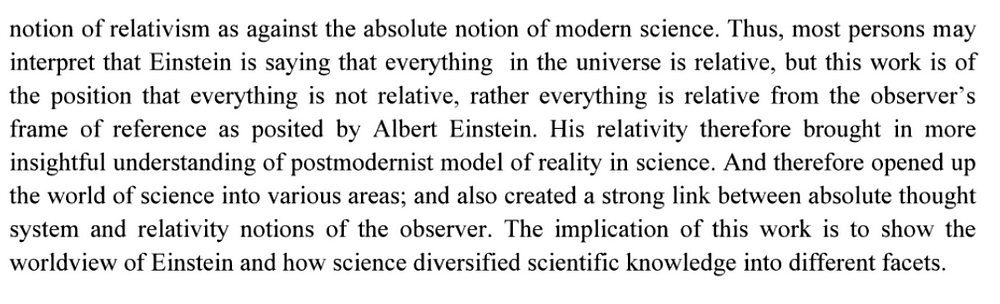
In any case, the following passage displays some of the problems which will be tackled in this essay:

Firstly, in the passage above there’s an explicit rejection of the “relativist” interpretation of Einsteinian Relativity when the author says that

“most persons may interpret that Einstein is saying that everything in the universe is relative, but his work is of the position that everything is not relative, rather everything is relative from the observer’s frames of reference”.

Yet isn’t that precisely what the relativist argues — that “everything is relative from” the subject’s point of view? In other words, does using the words “observer’s frame of reference” (rather than “subject’s point of view”) really make that much of a difference — at least outside the precise context of Einstein’s own physics?

The writer then goes on to conclude:

[T]herefore [Einsteinian Relativity] brought in more insightful understanding of postmodernist model of reality in science.”

Of course it’s true that there’s no explicit mention of moral or political relativism here — but he does tie Einsteinian Relativity to postmodernism. And the fact remains that no postmodernist philosopher (or theorist) I know has been at all concerned with “frames of reference” as exclusively found in physics. In other words, it’s clear here that such postmodernists, etc. were hoping to apply Einstein's findings to domains far outside physics. (Jean Baudrillard — as mentioned in parenthesis earlier - is a good example of this.)

Against Relativism

The American journalist and author Walter Isaacson (1952-) sums up the (as it were) non-relativist reality of Einstein’s Relativity in the following words:

“In both his science and his moral philosophy, Einstein was driven by a quest for certainty and deterministic laws. If his theory of relativity produced ripples that unsettled the realms of morality and culture, this was not caused by what Einstein believed but by how he was popularly interpreted.”

In addition to the above, the British historian Paul Johnson (1928-) made similar points in the following passage:

“At the beginning of the 1920s the belief began to circulate, for the first time at a popular level, that there were no longer any absolutes: of time and space, of good and evil, of knowledge, above all of value. Mistakenly but perhaps inevitably, relativity became confused with relativism.”

Indeed, Einstein’s best-known quote - “God does not play dice” — is hardly a claim of any kind of political, moral or philosophical relativist. Moreover, Einstein was a vocal and long-standing scientific realist. (Special Relativity, of course, predates the “quantum revolution” of the 1920s and wasn’t usually directly tied in with it — at least not in the early days.)

Yet Einstein-the-realist can still easily be squared with Special Relativity.

So it’s hugely ironic that poststructuralists, postmodernists, constructionists, etc. have used Albert Einstein’s Special Relativity as a means to bolster their own philosophical, epistemic or political theories of relativism. (That’s even though they’ve rarely used the actual word “relativism” about their own positions.) Indeed, using (or misusing) SR for relativism began well before any post-1960s postmodernists, etc. got hold of it. Einstein himself, for example, was disturbed by the fact that his SR was said to gave rise to some kinds of modern art and to moral relativism (see here). In this case, however, unlike postmodernists, etc. using SR for relativism, Einstein’s SR was thought to have actually given rise to various culturally, politically and philosophically relativist positions. That is, it was Einstein’s SR itself that was blamed (or sometimes praised) for such things.

Indeed, there was even more grist to the relativists’ mill when Einstein took a stand on absolutes. Einstein did so in the following passage:

“The ‘Principle of Relativity’ in its widest sense is contained in the statement: The totality of physical phenomena is of such a character that it gives no basis for the introduction of the concept of ‘absolute motion’; or, shorter but less precise: There is no ‘absolute motion.’ [].”

… Well, as you can see, Einstein didn’t actually take a position on absolutes (as an abstraction) at all . He took a position on “absolute motion”… absolute time, absolute space, etc — as indeed did Gottfried Leibniz (1646–1716) long before him (see here).

Yet, despite all that, one main point of the Special Relativity was to demonstrate that

“the laws of physics work the same for everyone, regardless of how they’re moving through space”.

So Einstein did indeed stress various and many relativities (the precise kinds will be discussed in a moment) in order to demonstrate universality and constancy. This means that what was deemed to be relative by Einstein was mainly a means to that end.

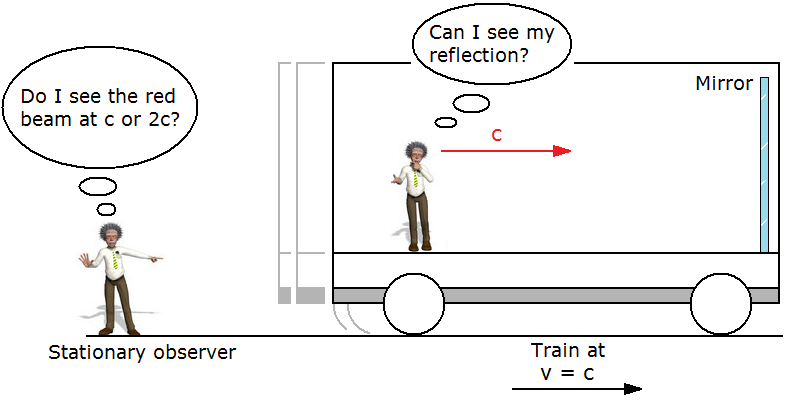
More specifically, with SR we have various relativities alongside the universal constant that is the speed of light (c). In other words, the speed of light doesn’t change relative to the motion of the object which is emitting the light (or light itself) or the person who’s observing that light. So c is constant even though everything else can and does change.

So even though time, position and motion are relative , the laws of physics are the same in all cases. And, as we’ve just seen, so is the speed of light. Another ways of putting this is to say that even though there are many genuine relativities (as well as constant change), none of these things change the universal and constant nature of the laws of physics themselves — at least not in Einstein’s view.

That said, and taking on board all the above, the closest one could come to justifying any connection between Einstein and relativism was his brief embrace of what was once called operationalism.

Operationalism

The odd thing about Einstein’s (early) operationalism is that in many ways Einstein has always been seen as the supreme example of a theoretical physicist and exponent of many thoughts experiments. (See Einstein’s thought experiments here.) So perhaps this reference to operationalism is all down to two different stages in Einstein’s career. Alternatively, perhaps it’s simply about different ways of tackling the same problems in physics — at any stage in anyone’s career.

Primarily, then, an “operationalist” stance on physics stresses the role of the subject (or observer) and his/her “operations” (e.g., experiments, tests, observations, etc.). And, indeed, operationalism could be seen in the Copenhagenist stress on experiments, predictions and observations in the 1920s and 1930s — i.e., rather than on “reality” (or “metaphysical reality”). This stress on experience can be traced back to the empiricists of the 18th century — if not well before that.

Yet many commentators have also stressed Einstein’s own problems with operationalism. Indeed, the main early exponent of operationalism, Percy Williams Bridgman (1882–1961), once stated the following words:

“Einstein did not carry over into his general relativity theory the lessons and insights he himself has taught us in his special theory.”

In addition to that, other commentators have said that Einstein’s “operationalist remarks” weren’t an attempt to advance a specific philosophical position on physics. And, as already hinted at, Einstein did indeed move away from operationalism after his General Relativity of 1915.

So Bridgman (primarily in his book The Logic of Modern Physics of 1927) was retrospectively providing a detailed philosophical account of all those mentions of “clocks”, “measuring rods”, “rigid bodies” and frames of reference in Einstein’s published words — see here. (Note that Bridgman’s book was written some 12 years after Einstein’s General Relativity and some 23 years after Special Relativity.)

Despite that and according to Bridgman, Einstein’s (early) work did nonetheless stress the need to link all scientific concepts to experimental procedures. (This was certainly something the Copenhagenists also stressed in the 1920s and 1930s.)

In more philosophical and fundamental terms, operationalism — just like the Copenhagen interpretation of quantum mechanics — had nothing to say about “objectivity” or the “objective world”. Indeed, this operationalist position can be directly tied to Einstein’s SR in that, say, length and mass weren’t seen as being absolute properties. Specifically, in Einstein’s SR, length is entirely dependent on the ruler used to measure an object, specific reference frames and what number is then given to that measurement. Mass too was — and still is — deemed relative to velocity, etc.

What’s more, an operationalist stance — despite Bridgman’s earlier words — can also be detected in Einstein’s General Relativity. (Perhaps it would be more accurate to say that an operationalist interpretation of General Relativity can be given.) After all, Einstein’s well-known distinction between inertial mass and (universal) gravitational mass is made in terms of “operational definitions”. (Einstein himself never used these two words.) That is, inertial mass is first noted when an operation is carried out. And that operation is the application of a force to a given mass (or object) and then observing its acceleration. (All this is in accord with Newton’s Second Law of Motion.) Similarly, gravitational mass is first noted when an operation is carried out. Yet this time the operation is putting the same object (or perhaps a different one) on a scale to insure a balance which disregards force and acceleration.

So here we have two different operations on a given mass (or given object) which produced the same result. And thus we had Einstein’s Principle of Equivalence.

Having stated all the above, this essay will now advance the position that the denial of literally any connection whatsoever between Special Relativity and (moral, philosophical or political) relativism is far too strong a stance to take.

Is Special Relativity at Least Partly Relativist?

According to Alan Sokal and Jean Bricmont, one person who was at least formerly seen (by some commentators) as a postmodernist or poststructuralist, Bruno Latour (1947-), did make a correct distinction between Einsteinian Relativity and relativism. Thus:

[] Latour draws an eminently sensible distinction between ‘relativism’ and ‘relativity’: in the former, points of view are subjective and irreconcilable; in the latter, space-time coordinates can be transformed unambiguously between reference frames.”

Yet there most certainly is an element of the “subjective” (or a stress on experience) in Special Relativity — but simply (as already stated) as a means to an end.

Philosophically, it can be argued that even if — or even though — “points of view are subjective”, then that doesn’t also mean that they’re (always) “irreconcilable”. Indeed, from that very subjectivity (or at least from the recognition of that subjectivity) one can work towards intersubjectivity. (This squares with Einstein’s own position in his SR.) To use Sokal and Bricmont’s own words, that intrinsic and given subjectivity can itself “be transformed unambiguously between reference frames”. Moreover, even the reference frames of physics are chosen from a subjective standpoint. That is, intersubjective reference frames firstly arise from the many previous subject-based choices of reference frames.

More fundamentally and as many philosophers — of many different persuasions (e.g., from empiricists to idealists) — have argued, the first port of call is always one’s own consciousness or experience. Thus, it’s where laypersons, theorists or scientists go from their subjectivity (or personal experiences) that matters — as Einstein himself (kinda) indirectly argued in his Special Relativity. In other words, Einstein explained how to unite different subjectivities (or experiences) together in order to advance various projects and theories within physics… not within morality, politics or philosophy.

[I can be found on Twitter here.]