Saturday, 8 January 2022

Graham Priest’s Radical Dialetheic Logic and Reality

 Are there “true contradictions” in the world?

The word dialetheism comes from the Greek δι (di- ‘twice’) and ἀλήθεια (alḗtheia ‘truth’). It’s the view that there are some statements which are both true and false. In other words, it’s the view that there can be a true statement whose negation is also true. In the literature, these statements are called “true contradictions” or (to use Graham Priest’s neologism) dialetheia.

The philosopher and logician Graham Priest (1948-) is the main proponent of dialetheism.

Priest is an Australian who now lives in New York. He’s written many books and had numerous articles published in journals of philosophy and logic. Priest is also the Distinguished Professor of Philosophy at the CUNY Graduate Center and an “honorary” professor at the University of Melbourne. He was educated at the University of Cambridge and at the London School of Economics.

Priest also practices karate and tai chi. His interest in Eastern philosophy — particularly Buddhist logic and philosophy (see here) — has strongly influenced his dialetheism.

Dialetheism
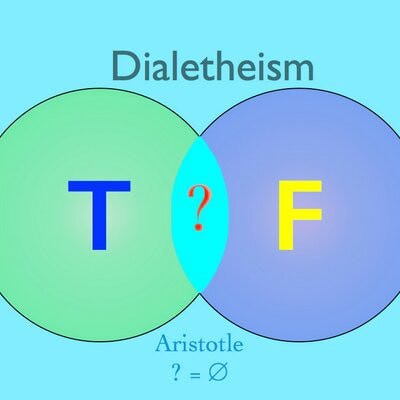
Dialetheism isn’t a formal logic. It’s (as Graham Priest himself puts it) “a theory of truth”. And this emphasis leads dialetheists to construct a logic which deals with truth. Or, at the least, with truth as it’s thrown up primarily by various paradoxes in set theory and elsewhere. Indeed Graham Priest himself states that

“the whole point of the dialetheic solution to the semantic paradoxes is to get rid of the distinction between object language and meta-language”.

(Clearly, this is a Tarski-influenced focus on the nature of truth.)

In what follows I question the truth-for-dialetheism issue by asking questions about dialetheism’s relation to (to use Priest’s word) “reality”.

¬Boolean Negation
Firstly, Graham Priest makes the claim that

[e]ven dialetheists, after all, need to show that they don’t accept 1 = 0”.

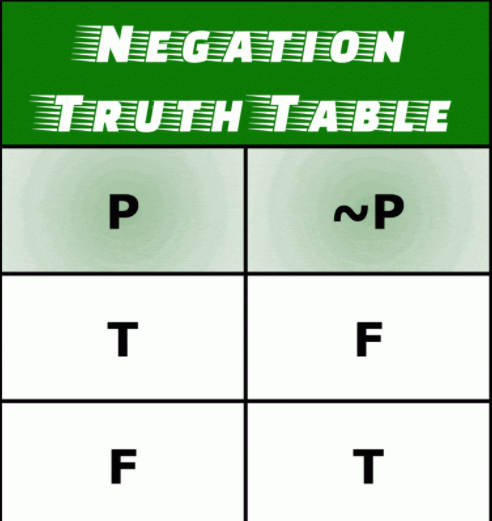
On the surface it would seem that if dialetheists don’t — or won’t — accept 1 = 0, then neither must they accept ¬A A. And this isn’t simply the case because one proposition involves numbers and the equality sign, and the other doesn’t.

Priest clarifies this 1 ≠ 0/¬A A dichotomy when he tackles Boolean negation.

According to Priest:

[I]F not-A is compatible with A, then asserting not-A cannot constitute a denial.”

A classical logician may be dumbfounded by the claim that “¬A is compatible with A”. However, that’s because dialetheists have their own take on the issue of negation and denial. Priest explains matters and what he says, at least at first sight, seems to make sense. That is, if we “deny A one must assert something which is incompatible with it”. True. So this must mean that on Priest’s view it’s the case that ¬A isn’t incompatible with A: it must be… compatible with it.

Thus, to Priest, the ¬A in A ¬A isn’t an example of Boolean negation.

So is it an example of any kind of negation?

It’s hard to say. In any case, the dialetheic ¬A, according to Priest, “cannot constitute a denial”.

Priest repeats his position by saying that “[t]o deny A is simply to assert its negation”. Thus a dialetheic ¬A isn’t the same as a Boolean ¬A.

So what does Priest mean by “compatible” (or “incompatible”)?

Negation and Dialetheic Consistency
Priest explains his position in this way:

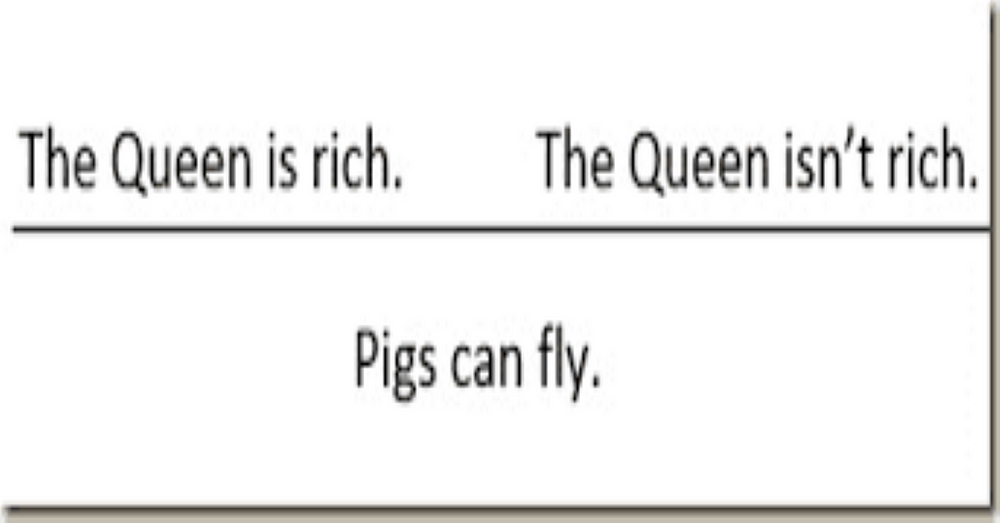
[W]e all, from time to time, discover that our views are, unwittingly, inconsistent. A series of questions prompts us to assert both A and ¬A for some A.”

Prima facie, this seems to be the case. That is, perhaps it’s wise to “assert” both A and ¬A if both appear to be true. Alternatively, we may assert A and ¬A if both have equal evidential, logical or philosophical weight. Nonetheless, at the end of the day most people will hope that either A or ¬A will be shown to be true (or perhaps simply to be more acceptable). Thus our initial acceptance of both A and ¬A certainly isn’t also a commitment to any (as Priest puts it) “inconsistency of the world”. In other words, our acceptance of both A and ¬A tells us more about us than it tells us about reality or the world.

For example, there may be equal evidence (if there could ever be an absolute equality of evidence) for these two statements:

(1) “Jones was murdered”
(2) “Jones killed himself.”

Of course it couldn’t have been the case that Jones was both murdered and he killed himself.

So let Priest continue.

He asks us this question: “Is the second assertion [i.e., ¬A] a denial of A?” Yes, it certainly seems to be. Yet Priest disagrees. Indeed Priest finishes off by saying that ¬A

“is conveying the information that one accepts ¬A, not that one does not accept A”.

In terms only of classical logic, what Priest states seems to be false. However, if we return to the two statements mentioned earlier — then, yes, my acceptance of the statement “Jones was murdered” may not also mean that I must also deny the statement “Jones killed himself”. In tandem with my remarks about equal evidential or logical/philosophical weight, my provisional acceptance of the statement “Jones was murdered” doesn’t mean that I will — or that I must — also outrightly deny (or reject) the statement that “Jones killed himself”.

I’ve cheated a little here in order to make things simpler.

For a start, statements (or propositions) aren’t usually symbolised with the capital letters (or symbols) A and B. My two statements (or propositions), in the tradition, are usually symbolised by the letters p and q. Thus A and its negation aren’t statements (or propositions): they are states of affair. (A state of affairs need not “obtain” or be actual.) In this case, we have the (past) state of affairs Jones being murdered and the state of affairs Jones killing himself — one of which must have obtained. (It can still be argued that these two states of affairs must still expressed by statements; and, indeed, by natural-language sentences.)

What’s more, the statement “Jones killed himself” isn’t even a strict and clear-cut negation of “Jones was murdered” (i.e., it’s not a Boolean negation). A strict and clear-cut negation of “Jones was murdered” should be “It is not the case that Jones was murdered”, not “Jones killed himself”. Of course the statement “Jones killed himself” can be seen as some sort of denial — or rejection — of the statement “Jones was murdered”; though it’s not a strict (Boolean) negation.

So perhaps all this partly explains Priest’s position of rejecting Boolean negation as well as accepting a dialetheic… what?

In other words, if the symbolismA ¬A” is seen as including only the autonym “A” (i.e., a self-referential symbol without content), then clearly it can’t be accepted. Only they aren’t autonyms in Priest’s book — they have content. That is, the symbolism (i.e., mention, not use) “A ¬A” expresses the dialetheic acceptance of “contradictories” in reality (or in the world).

Consistency and the World
The American philosopher and logician Bryson Brown (in his paper ‘On Paraconsistency’) also states the importance of consistency (actually, inconsistency) for dialetheism. (Informatively, he also tells us that dialetheists are “radical paraconsistentists”.) He writes:

[Dialetheists] hold that the world is inconsistent, and aim at a general logic that goes beyond all the consistency constraints of classical logic.”

Deriving the notion of an inconsistent world from our psychologistic and/or epistemological limitations (as well as from accepted notions in the philosophy of science) is problematic. (See psychologism.) In other words, the epistemological conclusion of an inconsistent world can’t also be applied to the world itself. This statement, however, may well be deemed to be a crude and naive metaphysically-realist position. That said, if one self-consciously “goes beyond all [ ] consistency”, then that surely implies that, in their heart of hearts, dialetheists know that the world is still either consistent or neither consistent nor inconsistent. (See the later words on Spinoza.)

Another way to put all this is in terms of some of the paradoxes of set theory. Bryson Brown says that

“the dialetheists take paradoxes such as the liar and the paradoxes of naïve set theory at face value”.

So it may be the case that dialetheists choose — for logical and/or epistemological reasons — to accept paradoxes even though they also believe that, ultimately, they aren’t true of the world. Then again, Brown continues by saying that dialetheists “view these paradoxes as proofs that certain inconsistencies are true”…

But true of what?

True only of the logical and linguistic expressions of the paradoxes or true of the world itself?

Again, this stress on the world (or reality) may betray a naïve, crude and, perhaps, an old-fashioned view of logic. Nonetheless, Priest himself does mention “reality” when he talks of consistency and inconsistency.

For example, when discussing the virtue of simplicity, Priest asks the following question:

“If there is some reason for supposing that reality is, quite generally, very consistent — say some sort of transcendental argument — then inconsistency is clearly a negative criterion. If not, then perhaps not.”

As it is, how can the world be either inconsistent or consistent? Indeed a position can be taken on this which is similar — or parallel — to Baruch Spinoza’s philosophical point that the world can only… well, be. The following is how Spinoza himself put it:

“I would warn you that I do not attribute to nature either beauty or deformity, order or confusion. Only in relation to our imagination can things be called beautiful or ugly, well-ordered or confused.”

Here, yet again, this may be betraying an implicit (naïve) realism. Yet it must still be stated that what we say about the world (whether via science, philosophy, mathematics or logic) may well be consistent or inconsistent. (We may also say, with Spinoza, that the world is “beautiful” or “ugly”.) However, the world itself can be neither consistent nor inconsistent. Thus, it seems to follow, that inconsistency is neither a “negative criterion” nor a positive criterion. The only way out of this, as far as can be seen, is if Priest squares his dialetheic logic with findings and/or positions in metaphysics and in science; which indeed he does from time to time. (For example, take Priest’s references to quantum mechanics and to Buddhist philosophy/logic.)

Science was mentioned a moment ago and perhaps science (or at least physics) is coming to Priest’s rescue here.

There’s a lot of talk of simplicity and consistency (along with the other positive criteria which play a part in theory choice) when it comes to scientific theories. Priest too, without actually mentioning science, also says that “simplicity and consistency may well pull in opposite directions”. More specifically, “a high degree of simplicity may outweigh a low degree of inconsistency”. Thus, if this is applied to scientific theories (or, more simply, to theories generally), then it must also apply to the logic/s which account for (or make sense of) such theories. Priest must therefore believe that dialetheic logic does a good job of capturing these movements in “opposite directions”. Nonetheless, stressing simplicity (at the expense of consistency), or consistency (at the expense of simplicity), doesn’t seem to entail — or even imply — an inconsistent reality or even any specifically dialetheic position. Alternatively, there’s nothing hidden in these positions which hints at the fact that it may be “rational to accept a contradiction”. That said, Priest does go on to say that

“there is nothing to stop the person accepting both their original view and the objection put to it, which is inconsistent with it”.

As pointed out earlier, talk of acceptance or non-acceptance is psychologistic and/or epistemological in nature, not logical or ontological. In other words, the predicaments of our epistemological and psychological positions shouldn’t be read into the world.

Finally, Priest’s point about a “transcendental argument” (see transcendental arguments) is apt because it can be said that in order for the world to be fully understood (in, say, a Kantian manner) it would also need to be consistent. However, Priest could either say that reality isn’t fully understood or that such a transcendental argument isn’t needed in the first place. That may be the case because we can happily accept that the world is inconsistent without engendering too many problems. And the way we could bypass any (serious) problem is by utilising dialetheic logic!

The Dialetheic Use of Possible Worlds

It’s difficult to tell how much Graham Priest depends on the notion — or existence! — of possible worlds to justify his dialetheism.

Take this example of Priest’s possible-worlds talk:

“It might be thought that the fact that ¬(A ¬A) holds at a world entails that one or other of A and ¬A fails; but this does not necessarily follow.”

Is Priest saying that ¬(A¬A) holds at the actual world (i.e., our world); though not “necessarily” at all possible worlds? Indeed considering the aforementioned views on negation and inconsistency, it may hold at any — or every — possible world too! At other possible worlds, Priest believes that A¬A can hold because of his views on both negation and consistency. This means that the dialetheic A¬A is not necessarily false.

Priest offers us the following symbolisation of his position:

¬A is true at w iff is A false at w.
¬A is false at w iff A is true at w.

So what about Priest’s prior A¬A?

According to Priest, “it is possible for A to be both true and false at a world”. That, of course, is the dialetheic position. Does it require possible worlds when Priest, elsewhere, has already said that it’s also applicable at our world — the actual world?

Not surprisingly, Priest concedes that “it is natural to ask whether there really are possible worlds at which something may be both true and false”. Priest thinks that this is a “fair question”. Nonetheless, he also thinks that “the best reasons for thinking this to be possible are also reasons for thinking it to be actual”. That seems to follow from his possible-worlds logic. That is, since possible worlds are infinite in number, we can argue the following:

i) If it’s possible for A ∧ ¬A to be true at least one possible world,
then, with an infinite amount of worlds,
ii) it’s also possible that A ∧ ¬A is true at our actual world.

If we move away from from scientific and set-theoretical reasons for embracing dialetheism, the acceptance of ¬A A can also be justified by the claim — which some (or all) dialetheists have made — that logic can’t prove anything outside itself (as it were). That’s because anything is possible at a possible world. (Yes; though what about the actual world?) In terms of the epistemology of dialetheism (which was mentioned earlier), dialetheists also subscribe to the traditional (Cartesian) view that nothing is certain except our own experiences and mental states.

*****************************

Notes

(1) Graham Priest does make an (or even the) important distinction between paraconsistent logic and dialetheic logic. In terms of paraconsistent logic, Priest states that contradictories

“may [be] set [ ] together in possible worlds, to provide paraconsistent logics, logics which allow for the sensible handling of inconsistent information and theories”.

In terms of dialetheism, on the other hand, logics

“may set contradictories together in the actual world, to allow for things such as a simple and natural theory of truth”.

(2) Bryson Brown puts the position of dialetheism in terms of the Liar Paradox. This paradox can be formulated in this manner:

L: This sentence is false.

Through a convoluted logical procedure (which is convincing if we take L as it stands), Bryson comes to the conclusion that “L is true if and only if L is false”. From there he also concludes that “it follows that L must be both” true and false. Of course accepting the nature of the Lair Paradox (in any of its forms) isn’t the same as accepting the dialetheic position. But let’s leave that there.

My own problem with with L itself is that it has no (semantic) content. And if it has no content, then that may be partly — or even wholly — responsible for the paradox itself.

In any case, it can happily be admitted that most logicians and philosophers disagree with any fixation on L’s semantic content; though some do agree with it. The other thing is that other formulations of the Liar Paradox — such as “Everything the Liar says is false” and “Everything I say is false” — seem less problematic from the point of view of semantic content.

[I can be found on Twitter here.]

Sunday, 2 January 2022

Ludwig Wittgenstein on Mathematical Truth


“A mathematician is bound to be horrified by my mathematical comments. [] He has learned to regard them as something contemptible []."

Wittgenstein (in his Philosophical Grammar, 1932)

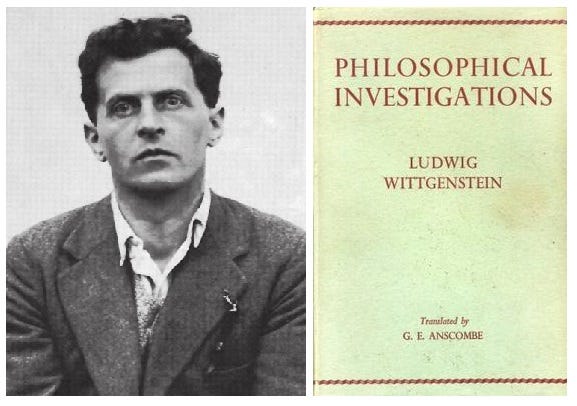
Much of what Ludwig Wittgenstein (1889–1951) wrote is hard to decipher. And that’s the primary reason why there’s what can (sarcastically) be called a Wittgenstein Interpretation Industry. This also explains why many loyal Wittgensteinians get so hot under the collar when other commentators “get Wittgenstein wrong!”. Indeed, unlike many other philosophers, much of the debate around Wittgenstein’s work isn’t about whether or not what he wrote is true or false, well argued or badly argued, worthwhile or worthless, etc. — but about what he actually meant.

Lee Braver (in his Groundless Grounds: A Study of Wittgenstein and Heidegger) puts all this better when he wrote the following words:

[Wittgenstein’s] writing style is perhaps the most obscure of all the great analytic figures, leading to an unusual state of affairs: ‘one of the most striking characteristics of the secondary literature on Wittgenstein is the overwhelming lack of agreement about what he believed and why.’ Already in 1961, the literature on the Tractatus was compared to literary scholarship in dissension and sheer mass. His opaque prose and sparse argumentation have given rise to a cottage industry of exegetical work and scholarly contention [].”

Thus all that is but a preamble to the essay which follows. It can also be said that I’m getting my excuses out of the way before I begin.

Mathematical Truth and Mathematical Correctness

“The terms ‘sense’ and ‘nonsense’, rather than the terms ‘true’ and ‘false’, bring out the relation of mathematical to nonmathematical propositions.”

Wittgenstein (Lectures, Cambridge 1932–35)

The “late Wittgenstein” argued (at least to paraphrase or even to interpret) that if the operations on numbers result in truths, then shouldn’t it also be the case that the numbers themselves (in whichever order) have truth-conditions or references? (Perhaps the term reference is better suited here.) In basic terms, shouldn’t each number correspond or refer to something? But if the numbers themselves have no truth-conditions or references, then how can the concept of truth be carried over to the operations on numbers? Surely you can’t have one without the other.

And all that is largely why Wittgenstein emphasised what he called “correctness” (as well as mathematical “grammar”) rather than truth.

The operations on numbers also fall under Wittgenstein’s meaning is use theory.

So does the correct use of numbers also imply truth?

There may be a correct and incorrect way to operate on numbers; though is there a true way to operate on numbers? The words “truth” and “correctness” aren’t, after all, synonyms.

Wittgenstein believed that correctness is determined by rules; which are themselves a product of persons, conventions and and/or language games. Truth, on the other hand, has been deemed by many philosophers, mathematicians and laypeople to be separable from minds, conventions, etc. (i.e., as in the various philosophical realisms).

Wittgenstein himself wrote the following on rules and their role in mathematics:

“Because they all agree in what they do, we lay it down as a rule, and put it in the archives. Not until we do that have we got to mathematics. One of the main reasons for adopting this as a standard, is that it’s the natural way to do it, the natural way to go — for all these people.”

Thus, according to Wittgenstein, we can count in a correct way; though not in a true way. Truth could only enter the equation if numbers themselves were true of something else or if they referred to something else. In other words, the inscriptions or symbols must have entities to which they can correspond or refer. Only then, on a Platonist picture at least, could we talk of truth in mathematics.

Of course many people intuitively feel that there must be more to mathematics than mere inscriptions/symbols on the page and the correct rules (or correct mathematical “grammar”) for using those inscriptions/symbols. (This position is usually called formalism; though Wittgenstein went way beyond, say, David Hilbert’s formalism.) But do we think in the same way when we play a game of chess? Do we expect the pieces and the moves to somehow correspond or refer to things (whether people or events) external to the actual game of chess? It can be granted that if someone takes chess literally, then he may well think in terms of the pieces and moves corresponding — or referring - to real historical battles, political situations and well-known historical persons. (This may well be the case for certain individuals.) However, such correspondence-relations aren’t in fact needed when one plays chess. Indeed chess can be seen in purely abstract terms despite the fact that we play the game with castles, pawns, bishops, etc. More abstract forms (which have no correspondents or referents in — or to — the external world) could easily become the substitutes of castles, pawns, etc. And such substitutions would have no important impact on the nature of the game itself.

Thus — on this Wittgensteinian reading — there are correct moves in chess; though there are no such things as true moves… Of course that’s unless we’re using the word “correct” as a literal synonym for the word “true”!

[Note: Although no one expects the individual words in a natural-language statement to have their own truth conditions — the names within such statements do have their own references and other words may have their extension. Few people have demanded that connectives, prepositions, etc. have any of these things.]

Mathematical Grammar

“Consider Professor Hardy’s article (‘Mathematical Proof’) and his remark that ‘to mathematical propositions there corresponds — in some sense, however sophisticated — a reality.’ [] We think of ‘reality’ as something we can point to. It is this, that. Professor Hardy is comparing mathematical propositions to the propositions of physics. This comparison is extremely misleading.”

Wittgenstein (Lectures on the Foundations of Mathematics)

Wittgenstein believed that mathematical statements are grammatical in nature. Thus if the grammar is in order, then the mathematics is correct. So he elaborated on the quote above with the following few words about Blaise Pascal:

“The mathematician Pascal admires the beauty of a theorem in number theory; it’s as though he were admiring a beautiful natural phenomenon. Its marvellous, he says, what wonderful properties numbers have. It’s as though he were admiring the regularities in a kind of crystal.”

So what about the following statement? -

Mathematical statements are correct because such statements are true.

That’s a possible riposte.

Wittgenstein might have simply turned that statement on its head and claimed the following:

Mathematical statements are true precisely because they’re grammatically correct.

That could be to concede that mathematical grammar is parasitical on mathematical truth. Alternatively, it might be to concede that mathematical truth is parasitical on mathematical grammar. In addition, if Wittgenstein dispensed with mathematical truth, then perhaps we can also dispense with mathematical grammar… Or at least it can be said that you can’t have one without the other.

Wittgenstein might also have accepted mathematical truth; though only when it isn’t conceived as some kind of correspondence with (or reference/relation to) abstract entities in a Platonic world.

So is it possible to make sense of mathematical truth when it’s is cashed out exclusively in terms of abiding by grammatical rules?

For a long time truth itself (regardless of mathematics) has been cashed out in many ways other than in terms of correspondence (i.e., as in the correspondence theory of truth). Thus why should mathematical truth be any different?

The question therefore is this:

Can mathematical truth be cashed out solely in terms of following grammatical rules?

What is it, then, to follow a rule?

Is it to conform to a norm and/or to a practice?

Use and Mention: “2 + 2 = 4” 2 + 2 = 4

In what follows the philosophical and/or semantic distinction between use and mention needs to be highlighted. In this case, the distinction is between the linguistic expression “2 + 2 = 4” and 2 + 2 = 4. Admittedly, sometimes it’s hard to distinguish the two (I had problems in the last section) — at least in the following context and if one takes a broadly Wittgensteinian position.

In very simple terms, the distinction can be shown when it comes to the word “cat”:

Use: “This cat is very aloof.”
Mention: “The word ‘cat’ is derived from...”

The first sentence refers to the animal called a “cat”: it uses the word “cat” to refer to that animal. The second statement is about the word “cat”.

More relevantly:

Mention: “2 = 2 = 4” — a linguistic expression
Use: 2 + 2 = 4 — an (abstract) equation

(Note that the mention example above uses numbers within a linguistic expression. To be careful, some philosophers would advise using numerals or number-words like “two” and “four” instead of the symbols “2” and “4”.)

So now take this statement (a mention):

“The statement ‘2 + 2 equals 4’ is true.”

Isn’t there a rule which tells us that if we add 2 and 2, then the result will be the number 4? That said, there could be a rule which tells us this:

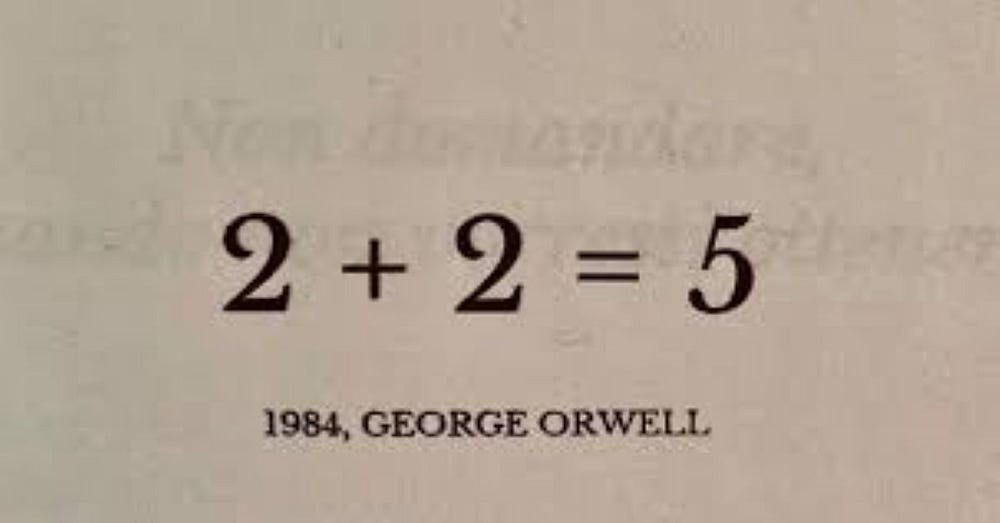
“The statement ‘2 + 2 equals 5’ is true and is perfectly in order.”

That is, when 2 is doubled, an additional number must be added. However, this new rule would simply be parasitical on the rule that 2 + 2 must equal 4 because it does, after all, talk of the addition of a number to the result of doubling the number 2. The rule doesn’t, on the other hand, state “2 + 2” does equal 5: it says that a number needs to be added to the sum of 4 and 4.

So let’s try a purer formulation.

Take the statement (or even rule) that “2 + 2 equals 5” without mentioning any addition of an extra number…

A Dialogue Between a Wittgensteinian and an Opponent

A Wittgensteinian:

“Why can’t 2 plus 2 equal 5? Or, at the least, why can’t I express ‘2 plus 2 equals 5’ as a rule? Indeed you’re simply assuming that the numbers I’m using have the same properties as the numbers that you’re using. Clearly, if I use my numbers in the way that you use your numbers, then evidently my statement ‘2 + 2 = 5’ will be incorrect. However, my numbers aren’t the same as your numbers. Thus in my language game (or system) 2 + 2 does indeed equal 5.”

An anti-Wittgensteinian:

“Then you’re misusing the arithmetical concepts [addition] and [equality].”

A Wittgensteinian:

“Yes, if I use the concepts [equality] and [addition] in the same way in which you use them, then evidently my statement ‘2 + 2 = 5’ will be incorrect. But my concepts [addition] and [equality] aren’t equal to yours. In my language game (or system), they work differently.”

An anti-Wittgensteinian:

“But you’ve just contradicted yourself. You said that your concepts [addition] and [equality] aren’t ‘equal’ to my concepts [addition] and [equality]. But you’ve just used the concept [equality] in the way I use it. You’ve just said that your ‘concepts aren’t equal to’ mine. And with that I agree. Therefore it would follow that the concept [equality] you use in your mathematical system isn’t equal to your use of the concept [equality] when you use it to talk about your own mathematical ‘language game’.”

A Wittgensteinian:

“Yes, you’re right. According to one language game (i.e., mathematics) I use the concept [equality] in one way. And according to another language game (talking about mathematics or metamathematics), I use the concept — or at least the word — in another way.”

An anti-Wittgensteinian:

“If that’s the case, then how the hell can we have a proper conversation if we’re using the same concepts (actually, words) in different ways? If you can arbitrarily stipulate a meaning of a concept in any way you like, then perhaps we’re not having a genuine conversation at all. We’ll simply be talking at cross-purposes.”

A Wittgensteinian:

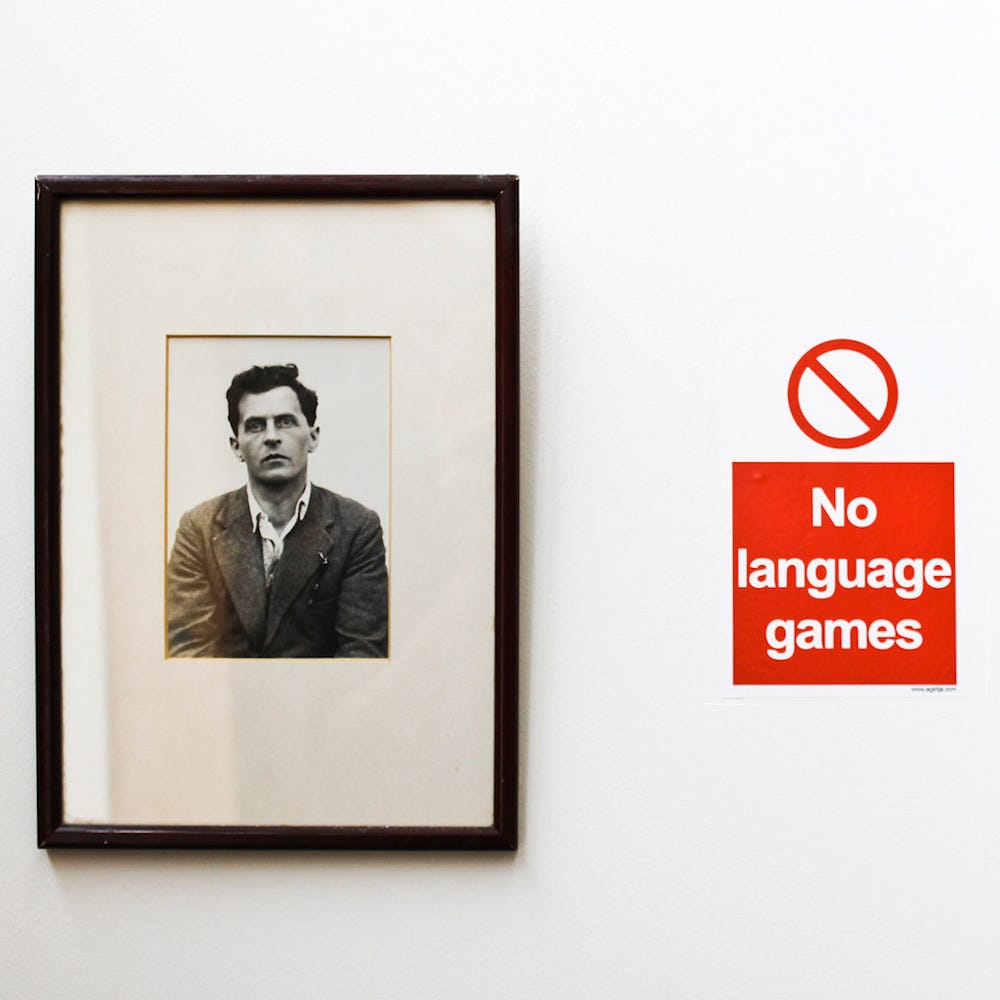
“No, because I know that the concept [equality] is always relative to a language game. Therefore if I know what language game the concept belongs to, then I also understand the concept. I understand your use of the word ‘equality’ because I know which language games it belongs to. Therefore I can understand you and we aren’t talking at cross-purposes. All I need to determine is the language game to which the concept or word belongs. And even in my own case, I need to be aware of how I’m using a particular concept or word. I need to know which language game I’m using when conversing with other people. And you too need to be aware of which language game the people you talk to are playing — otherwise you’ll be talking at cross purposes. You may of course believe that you don’t belong to any language game or even that your position is beyond language games. However, such a position would be a meta-language game; which would simply be another language game with highfalutin ambitions.”

(*) See my ‘When Alan Turing and Ludwig Wittgenstein Discussed the Liar Paradox’.

[I can be found on Twitter here.]

Wednesday, 29 December 2021

Is Physicist Roger Penrose a (Tacit) Panpsychist?


“But there is one thing that I do believe in relation to this problem [of consciousness], and that is that it is a scientific question that eventually should become answerable, no matter how far from being about to answer it we may be at present.” — Roger Penrose

(i) Introduction
(ii) Is Roger Penrose a Panpsychist?
(iii) What About Organisation and Complexity?
(iv) Physics and Biology
(v) Are Ants Conscious?
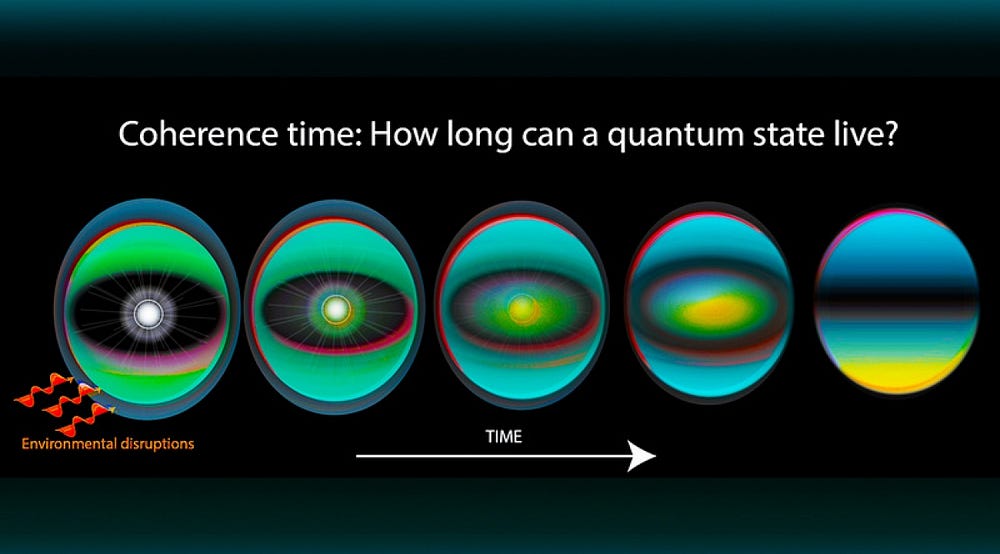
(vi) Quantum Stuff (e.g., Coherence)
(vii) Conclusion

The title above asks if the British mathematical physicist and philosopher of science Roger Penrose (1931-) is a (tacit) panpsychist. Well, he’s certainly not an open panpsychist. Added to that is the fact that he’s rarely — if ever — used the word “panpsychism”. And he certainly hasn’t used that word to describe any of his own theories.

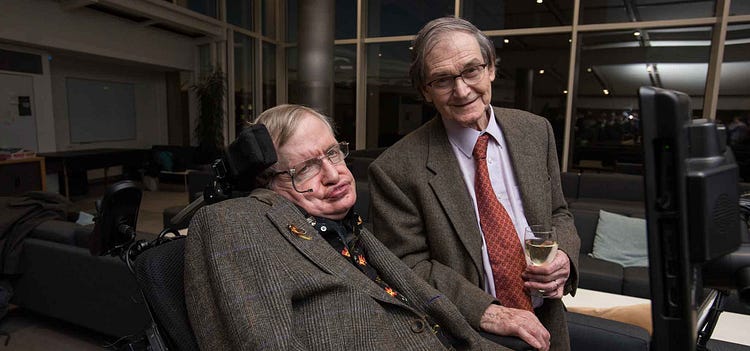
Stephen Hawking and Roger Penrose

Just to give a quick hint of the main reason why Penrose can’t really be an out-and-out panpsychist.

It’s basically down to his exclusive focus on biological entities. That is, although Penrose offers us the possibility than a single neuron, liver cell or even a paramecium may instantiate some basic form (or level) of consciousness, he never stretches that possibility beyond the biological realm. Indeed his strong scientific, mathematical and philosophical position against the possibility of artificial intelligence makes that crystal clear.

So this essay will conclude that it’s perhaps a little too strong to claim that Penrose’s theories are panpsychist in nature. That said, this issue is complicated; as will be shown later.

In any case, NBC News did once state the following:

“Three decades ago [this was written in 2017], Penrose introduced a key element of panpsychism with his theory that consciousness is rooted in the statistical rules of quantum physics as they apply in the microscopic spaces between neurons in the brain.”

Yet this particular journalist continued by saying that Penrose “does not overtly identify himself as a panpsychist”.

And just as Penrose doesn’t use the word “panpsychism”, so he’s never used (as far as I know) the word “cosmopsychism”. Yet here again is Space.com tying Penrose to this philosophical position:

“Importantly, however, ‘Orch OR suggests there is a connection between the brain’s biomolecular processes and the basic structure of the universe’, according to a statement published in the March 2014 paper ‘Consciousness In The Universe: A Review of the Orch OR Theory’, written by Penrose and Hameroff in the journal Physics of Life Reviews.”

So whatever the case is, Penrose is certainly doing panpsychists at least some favours when he shows them (even if that’s not his aim) that panpsychism can be grounded in at least some kind of science (see opening quote). And that’s even though Penrose’s own science of consciousness is hugely controversial!

Is Roger Penrose a Panpsychist?

Roger Penrose most explicit raising of the possibility of panpsychism (though, again, he never actually uses the word “panpsychism”) can be found in the following passage:

“The question is significantly raised, of course, as to whether a paramecium — or, indeed, an individual human liver cell — might actually possess some rudimentary form of consciousness [].”

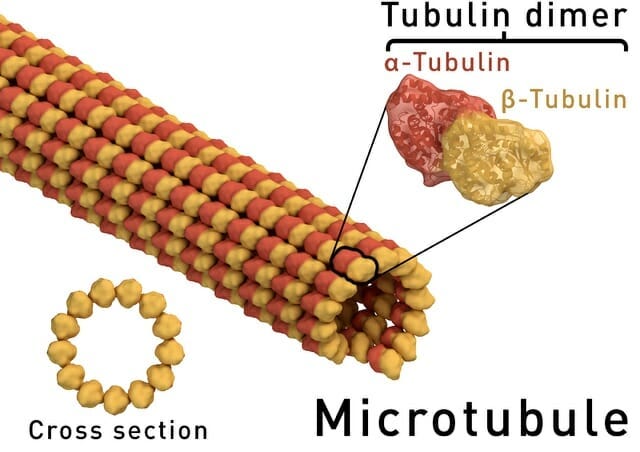
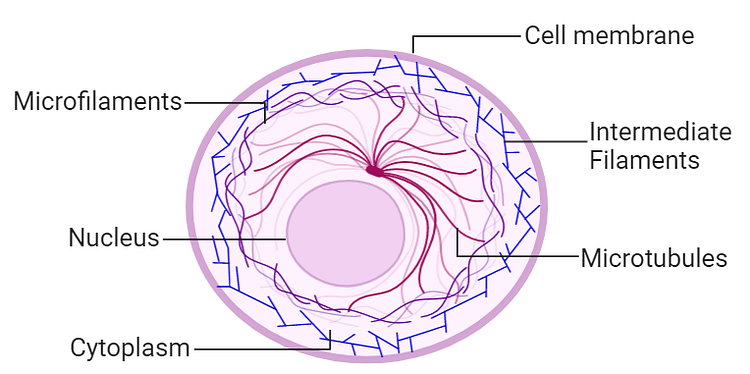
This question is significantly raised because it’s the logical result of Penrose’s own position on consciousness. This position, in basic terms, has it that cytoskeletons and their microtubules are vital when it comes to the “bringing about” (or instantiation) of consciousness. And a paramecium and a human liver cell contain both of these things! In Penrose’s own words:

“I have been making the case that it is to the microtubules in the cytoskeleton, rather than to neurons, that we must look for the place where collective (coherent) quantum effects are most likely to be found.”

And yet

“cytoskeletons are ubiquitous amongst eukaryiotic cells — the kind of cells that constitutes plants and animals”.

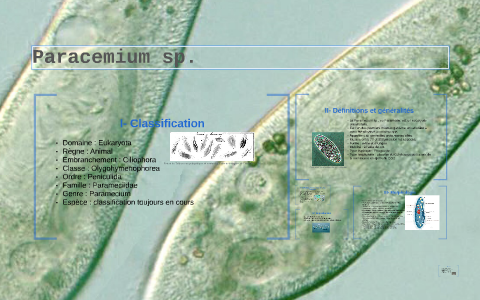
Penrose specifically waxes lyrically about the single-celled paramecium when he writes:

“If we are to believe that neurons are the only things that control the sophisticated actions of animals, then the humble paramecium presents us with a profound problem.”

So what is the nature of that problem? Penrose continues:

“For she [a paramecium] swims about her pod with her numerous tiny hairlike legs — the cilia — darting in the direction of bacterial food which she senses using a variety of mechanisms, or retreating at the prospect of danger, ready to swim off in another direction. She can also negotiate obstructions by swimming around them. Moreover, she can apparently even learn from her past experiences [].”

Finally:

“How is all this achieved by an animal without a single neuron or synapse? Indeed, being but a single cell, and not being a neuron herself, she has no place to accommodate such accessories.”

But forget these other creatures! What about the neurons in human brains?

Penrose writes:

“It is the cytoskeleton's role as the cell’s ‘nervous system’ that will have the main importance for us here. For our own neurons are themselves single cells, and each neuron has its own cytoskeleton!”

More relevantly:

“Does this mean that there is a sense in which each individual neuron might itself have something akin to is own ‘personal nervous system’?”

What About Organisation and Complexity?

It may — at least at first — seem like a bizarre possibility that a paramecium, liver cell or individual neuron may instantiate a “rudimentary form of consciousness”. However, Penrose does go on to qualify his position when he states the following:

[I]t must also be the case that the detailed neural organization of the brain is fundamentally involved in governing what form that consciousness must take. Moreover, if that organization were not important, then our livers would evoke as much consciousness as do our brains.”

So Penrose’s basic (if implicit) point is that we should firstly establish what “form” (or level) of consciousness any given entity has (i.e., whether that’s a paramecium, a human liver cell, a single neuron, or an entire human brain). And clearly Penrose is raising the possibility of an extremely basic form of consciousness for a paramecium, liver cell and an individual neuron. Indeed one can even use the technical terms of philosophers here and say that a paramecium, liver cell and an individual neuron may instantiate “proto-experience”,protophenomenal properties” or “panprotophenomenal properties”.

Yet even though Penrose makes it clear that he’s only talking about extremely basic levels of consciousness here — and even then he’s only raising the possibility of such things— he still concludes with the following words:

“Nevertheless [] what the preceding arguments strongly suggest is that it is not just the neuronal organization of our brains that is important. The cytoskeletal underpinnings of those neurons seem to be essential for consciousness to be present.”

The obvious point to make here is that even if (or even though) the “cytoskeletal underpinnings of those neurons seem to be essential for consciousness to be present”, these underpinnings alone may not bring about consciousness.

So, in basic terms, the following is a simplification of Penrose’s position:

the cytoskeletal underpinnings of neurons + neuronal organisation = consciousness

Indeed we can invert Penrose’s earlier words

“it is not just the neuronal organization of our brains that is important”

with the following statement:

It is not just the cytoskeletal underpinnings of neurons that are important when it comes to consciousness.

Physics and Biology

It will be seen that all Penrose’s examples of the possibility of consciousness (i.e., other than human beings and higher animals) are biological in nature. So that, in itself, won’t be of much help to those panpsychists who believe that consciousness exists all the way down the line from human beings to apes to mice to ants to rocks to particles… and even to spacetime itself. That said and despite the tenor of this essay, Penrose doesn’t see any “essential” reason why non-biological entities can’t be conscious too— at least in principle. Indeed he even argues that

“such (putative) non-computational processes [i.e., in the brain and which Penrose believes are vital for both consciousness and what he calls 'understanding'] would also have to be inherent in the action of inanimate matter, since living human brains are ultimately composed of the same material, satisfying the same physical laws, as are the inanimate objects of the universe”.

Penrose also tells us that he doesn’t perceive any necessity that such a device [one that instantiates or merely simulates consciousness] be biological in nature”. He goes on:

“I perceive no essential dividing line between biology and physics (or between biology, chemistry, and physics).”

Yet it doesn’t follow that because Penrose doesn’t perceive an “essential” distinction, difference or “dividing line” between biology and physics that he that doesn’t perceive any dividing line at all. And that’s precisely why Penrose immediately carries on with the following words:

“Biological systems indeed tend to have a subtlety of organization that far outstrips even the most sophisticated of our (often very sophisticated) physical creations.”

It must now be stated that Penrose stated all the above in reference to his earlier discussions of artificial intelligence. Yet his words equally apply to the issue of panpsychism too.

Now strictly in terms of AI.

Are Ants Conscious?

Roger Penrose believes that ants are one step ahead of all AI entities. And here again his stress on biology inevitably enters the picture. Penrose claims that the

“actual capabilities of an ant seem to outstrip by far, anything that has been achieved by the standard procedures of AI”.

It’s not clear if Penrose was being careful or if I’m being pedantic here. That is, when Penrose stated the above did he ignore (or dismiss) the ability of AI entities (or even basic computers) to do advanced mathematical calculations, win people at chess, read fingerprints, etc? As far as I know, there aren’t many ants that are good at chess, mathematical calculations, etc. It can be supposed, then, that this may boil down to what Penrose means firstly by the the words “actual capabilities” (i.e., of an ant) and by the the words “standard procedures” (i.e., of AI).

In any case, many AI theorists and champions of AI have pointed out that most of the critics of AI tend to artfully select those things which humans and other animals can do and which AI entities or computers can’t do. Yet of course this approach can be turned on its head by stressing the things that AI entities can do but which humans and other animals can’t do. So, in both these cases, this approach may not be very helpful and may simply amount to mindless point-scoring.

But let’s move on.

Penrose also implicitly ties his ants-vs-AI argument to panpsychism — at least via the issue (again) of microtubules. Penrose continues:

“One might well wonder how much an ant gains from its enormous array of nano-level ‘microtubular information processors’, as opposed to what it could do if it had only ‘neuron-type switches’. As for a paramecium, there is no case to answer.”

So, on a (partly) sarcastic note, this question can now be asked:

How much microtubular quantum stuff must an ant — or anything else — have (or instantiate) in order to actually be conscious?

Now it can be wondered if the supposed “measure” of consciousness (i.e., phi or Φ) in integrated information theory (IIT) may be of help here. Indeed, as Penrose himself hints, even a humble single-celled paramecium may have enough microtubular quantum stuff to bring about — or instantiate — its own consciousness.

Having said all that, Penrose then deflates his tacit panpsychism when he says that he has “always had difficulties in believing that insects have much or any of this quality [of consciousness]”.

To complicate matters even more, Penrose goes straight ahead and qualifies these “difficulties” by tying ants yet closer to a possible panpsychist position — at least at it must be tied to microtubules, etc. Penrose writes:

“Nevertheless [] the behaviour pattern of an ant is enormously complex and subtle. Need we believe that their wonderfully effective control systems are unaided by whatever principle it is that give us our own qualities of understanding?”

Quantum Stuff (e.g., Coherence)

Penrose expresses his prime motivation for stressing the importance of cytoskeletons and microtubules when he states that

“without such quantum coherence we shall not find a sufficient role for the new OR [Orchestrated objective reduction] physics that must provide the noncomputational prerequisite for the encompassing of the phenomenon of consciousness within scientific terms”.

Penrose then cites the biological and technical reasons why he takes this position. He continues:

“Their controlling neuronal cells have their own cytoskeletons, and if these cytoskeletons contain microtubules that are capable of sustaining the quantum-coherent states that I am suggesting are, at root, necessary for our own awareness, then might they not also be beneficiaries of this elusive quality?”

Moreover:

“If the microtubules in our brains do posses the enormous sophistication needed for the maintaining of collective quantum-coherent activity, then it is difficult to see how natural selection could have evolved this facility just for us and (some of) our multicellular cousins.”

Then, almost like a good panpsychist, Penrose goes all the way down the line by finishing off with the claim that these

“quantum-coherent states must also have been valuable structures to the early eukaryotic one-celled animals, although it is quite possible that the value to them may have been very different from what it is to us”.

Conclusion

The new interest in panpsychism as produced a lot of cheap and easy “New Age” crap.

In the end, then, it may be unclear if Penrose is a panpsychist — even a tacit panpsychist. His stress on biology certainly puts him at odds with most — or even all — panpsychists. Indeed one can argue that the whole point of panpsychism is that it downplays biology; and, in the process, seemingly gets rid of such problems as strong emergence.

The other thing is that Penrose only discusses the possibility of consciousness in these rudimentary biological entities. This isn’t odd because, as a theoretical physicist, he’s always discussing all sorts of other possibilities too. (Usually possibilities which are worlds away from the issue of panpsychism.) In fact he’s doing what all good philosophers should do — give (most/some of!) these possibilities the benefit of the doubt… at least at first.

On the other hand, it seems that most panpsychists have somewhat smoothly and easily moved from the possibility of consciousness in rudimentary entities to their actually being conscious. (There are various philosophers — such as David Lewis, David Chalmers, Philip Goff, etc. — whose entire philosophies seem to be based on the reality of possibilities.) And most panpsychists have found it easy to move from possibility to actuality because they’ve almost completely divorced their panpsychism from science. (Scientific terms and issues are — of course — brought up by panpsychists; though often in a very superficial way and usually to give panpsychism a little scientific kudos.) Thus the move from the possibility to the actual truth of panpsychism has been easy for such panpsychists.

All this (as it were) turning-the-(merely)possible-concrete is something Penrose himself would have a serious problem with.

And that’s why I believe he probably isn’t a panpsychist.

[I can be found on Twitter here.]