The following essay isn’t going to tackle Bertrand Russell’s famous (or infamous) paradox (i.e., Russell’s Paradox). Instead, it’s going to deal with some of the set-theoretical and philosophical details which led up to the paradox. Primarily, it asks various questions about the philosophical (i.e., ontological) nature of sets. Specifically, questions about the Universal Set — or the Set of Everything.
******************************
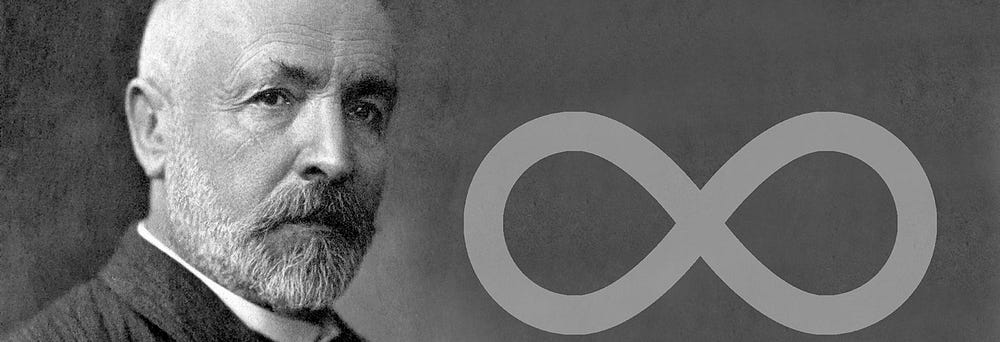
Georg Cantor
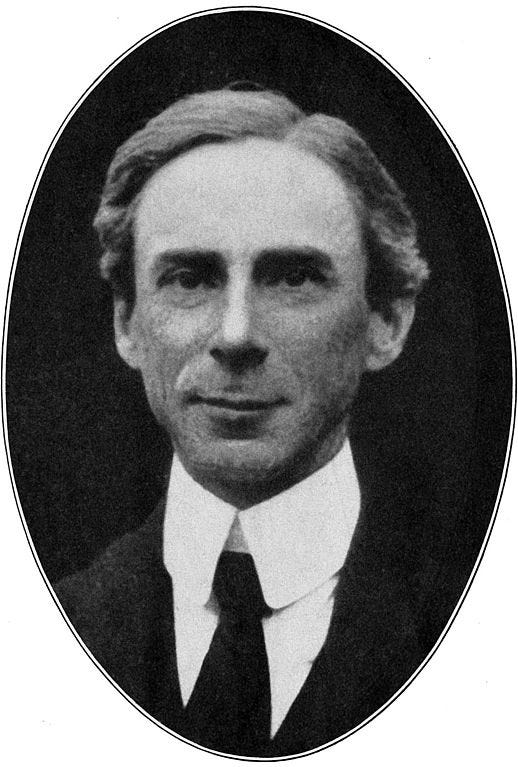
Rather bizarrely, the English philosopher Bertrand Russell (1872–1970) once set out to calculate how many things there are in the universe. And after Russell had done that, he was led to conclude that there must (or simply could) be a set which includes literally everything (or every… thing).
(Of course the practical problems with such an act of “counting” are irrelevant because this was a purely mathematical or set-theoretical enterprise.)
Russell claimed that if he could (as it were) discover a set which included literally every… thing, and that the nature of sets determines the nature of numbers (or that sets literally are numbers), then that set would be the largest number.
In short and on the resultant paradox.
In the 1890s Georg Cantor himself had already come to realise that his positions on sets would lead to a contradiction. Indeed he communicated this finding to David Hilbert (1862- 1943) and Richard Dedekind (1831–1916). That said, Cantor didn’t technically formulate the paradox: Ernst Zermelo (1871–1953) did. Moreover, in 1903 Hilbert (again) wrote a letter to Gottlob Frege (1848–1925) about Russell’s paradox in which he wrote the following words: “I believe Dr. Zermelo discovered it three or four years ago.”However, Zermelo (like Cantor before him) never published his finding.
Sets and Numbers
Clearly with Russell’s (early) position we have the notion that the members of a set determine that set. And, if that’s the case, then there must be a largest number — at least if we follow Russell’s reasoning at that point in his career. (In set theory, the actual nature of numbers and sets is much disputed — see later.)
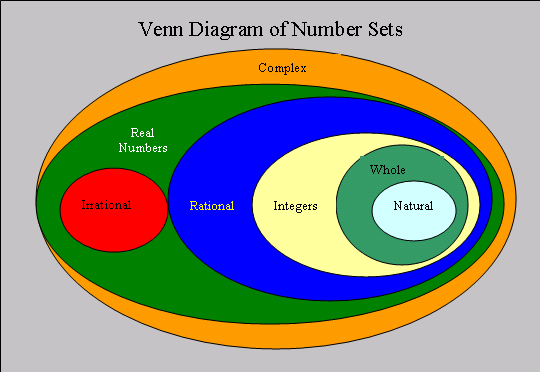
According to Russell and Frege before him, numbers are sets. Therefore what makes up a set determines or (as it were) constitutes a number. So if literally everything (or every thing) is included in a set, and that set is finite, then it also determines the finitely largest number.
But what did Russell mean by the word “everything”? Did he meanonly every concrete or empirical thing? What aboutminds? Indeed what aboutabstract entities such as universals, properties, possible worlds… and numbers? Yet if Russell had included abstract objects (or entities) in his (to use German/Platonic capitals) Set of Everything, then surely it couldn’t have included everything because numbers, for one, are infinite…
Of course that statement raises two issues:
(1) If sets determine (or constitute) numbers, then numbers clearly can’t be the members of sets.
(2) Is there an assumption (from the outset) here that there are (or are not) actual infinities?
As just hinted at, one can’t call in numbers here because it’s the nature of sets (at least in this theory) which determines the nature — and even existence — of numbers.
More simply, that Set of Everything can’t have numbers as members because sets themselvesare deemed to be numbers.
But are Numbers Really Sets?
The problematic nature of (in the singular) set theory is displayed by statements such as the following:
“Many set theories do not allow for the existence of a universal set.”
Yet some set theories do allow for the existence of a universal set.
This multiplicity of set theories hints at either the complexity of the issue or that there’ll never be a definitive (or conclusive) position on the nature (rather than the mathematical everyday use) of sets and numbers. And perhaps the main reason for this is one of the following: 1) Sets are abstract. 2) Sets (at least if seen as Platonic entities) don’t exist at all.
So are these essentially philosophical — even stipulative — interpretations of sets and numbers simply vying for intellectual dominance?
In any case, if numbers are sets, then sets are numbers. Thus:
If sets = (i.e., are numerically identical to) numbers, then numbers = sets
Yet the often-seen phrase “sets of a number” (or “sets of numbers”) implies, by its very grammar, that sets can’t be (or equal) numbers. Specifically, the two words “sets of” implies that there are sets and there are numbers. (Alternatively, there is a set and there are that set’s members.) The same kind of reasoning also applies to phrases such as “numbers are represented — or modelled - by sets” and “the natural numbers can be constructed using sets”.
So some theorists argue that there are sets and there are the sets’ members. The two are very different. Analogically, there is a collection of sweets and the bag that the sweets come in. Clearly the bag and the sweets aren’t identical. Thus saying “There is no bag of sweets” (i.e., there is no set) and saying “The bag of sweets is empty” (i.e., the set is empty) are two very different statements.
Yet because we’re talking about abstracta here (i.e., sets and numbers, not bags and sweets), then that analogy may well break down.
In any case, any given x can’t also be y. Of course that’s only if the symbols x and y symbolise (or refer to) physical or abstract objects, not intensionalterms, the content of psychological states… or, for that matter, sets. (Intensions basically “belong” to words/terms or psychological states, not to things. However, that’s the case even though such words or psychological states can actually be “about” things.)
As for sets. Jimmy the cat (x) belongs to the set of mammals (y). Yet if we’re talking about individual objects and not sets, Jimmy the cat can’t actually also be Johnny the dog — which is also a mammal (x ≠ y).
On the other hand, many (or even all) the arguments which state that numbers aren’t sets rely on the (Platonic) position that numbers are (eternal)abstract objects. That said, sets too are usually seen to be abstract in nature. That said, Bertrand Russell (again) once believed that all a set’s members (when taken together) literally constitute — or are — the said set. Yet it’s unclear if Russell’s view — even if true or correct — automatically stops sets from being abstract.
There’s also problems with the empty set (symbolised: {}) and sets which only have one member. (A set with one member is called a singleton or unit set -sometimes symbolised: { s }.) In the case of the empty set, there’s literally nothing (or no thing) to determine the nature of that set. And in the case of sets with only one member (whose one member can even be {null}), then such sets and “their” single members (or elements) must be one and the same thing.
So why the need to postulate such sets in the first place?
Conclusion
Finally, it can be said (if only in very broad terms) that mathematics works fine as it is: it’s only the philosophical nature of numbers and sets that’s problematic. Indeed this parallels — at least to some extent - the clear opposition between the mathematical formalism/s of quantum mechanics and the many and various interpretationsof that theory.
To repeat: mathematics is a domain of much consensus. Yet the domain of the philosophy of sets and numbers isn’t. Indeed there are (to be melodramatic for a moment) an infinite amount of actual and possible positions to take on the ontological nature of sets and numbers.
It’s strange that in a philosophical world (circa the 1920s to the late 1940s) in which metalinguistic statements, metalanguages and other higher-order techniques were so popular that the Verificationist Principle (as well as Karl Popper’s falsificationism) came in for so much criticism. And from then on, of course, the Verification Principle’s ostensible self-refuting nature is usually the first thing that many people say about it. (Many people say it about logical positivism itself.)
*******************************
The English Philosopher A.J. Ayer (1910–1989) was just one philosopher who himself offered more than one version of the Verification Principle (see here). (This raises the question as to the use of the singular word “Principle”.)
There are many and various versions of Verification Principle, each of lesser or greater degrees of detail. That said, I’ll cite the following simple expression of it. Thus:
“Every statement must be either verifiable or tautological in order to be meaningful.”
Of course we can now ask:
What about that very statement? Is is either verifiable or tautological?
Isn’t it (almost) obvious that the verificationist statement is aimed at statements which(to put it broadly) refer to the world? If that wasn’t the case, then why did verificationists talk about such things as “evidence”, “testability” and “verification” in the first place? Yet if the Verification Principe is a statement about other statements (i.e., not a statement about the world), then is it at all apt to ask for a verification of the Principle itself?
It now needs to be said that the word “world” is being used very broadly here. It’s simply meant in the sense of statements that are about — or refer to — phenomena which aren’t themselves other statements. And that includes statements about physical reality, metaphysical reality, “abstract reality” or whatever.
To repeat: clearly the sentence
“Every statement must be either verifiable or tautological in order to be meaningful.”
is not itself a statement about the world. Of course the linguistic expression above can be said to be in the world. (Where else could it be?) Yet it’s not about the world — it’s about other statements which are about (or refer to) the world. Again, linguistically- or vocally-expressed statements about the world are in the world too… That’s unless one is referring to the abstract propositions which are believed — by some philosophers — to be their “content”. In that case, then, the linguistic expression of the Verification Principle itself may have the status of expressing an abstract entity that isn’t in the world — i.e., it is abstract. In that case, it’s an abstract entity (that’s also expressed linguistically in space and time) about other statements which refer to — or are about — the world.
Clearly, then, the Verificationist Statement is not verifiable in the way in which statements about the world are verifiable. It’s of an entirely different logical order.
[It must be said here that if that much is granted, then perhaps many more statements can be given such a — as it were — special status.]
“A hypothesis is testable if there is a possibility of deciding whether it is true or false based on experimentation by anyone.”
Now the above is strictly a scientific doctrine. Thus it’s not really meant to be applicable across the board; or applicable to, more relevantly, philosophical statements (as, arguably, the Verification Principle is). Nonetheless, let’s express it as a general principle:
Every statement about the world must be either testable or tautological if it is to be deemed meaningful.
On first glance, the statement directly above must refer to itself — primarily because of the quantifier “every” at the beginning. That is, it states that every statement must be either testable or tautological. Therefore it too must be either testable or tautological. However, the statement (or principle) can be taken normatively. In that case, it may not be correct to call it a “statement” at all. And that’s because it’s not evaluable in terms of truth or falsity in the first place (see later).
Take the formulation again:
Every statement about the world must be either testable or tautological if it is to be deemed meaningful.
Now the above can be taken to be a linguistic expression of an abstract content or proposition (i.e., that’s not strictly speaking in the world or about the world). It’s not, therefore, a reference to things/events/conditions/etc. which are in the world. Thus the testability statement doesn’t refer to the world; though the statements it refers to do refer to the world.
So here’s another formulation:
The testability statement expresses an abstract entity (i.e., it can be taken propositionally) which is about statements which refer to the world.
It follows that the testability statement (at least on the reading so far given) needn’t necessarily be either testable or tautological. We could see it, instead, in various other ways. It could be a normative, stipulative, prescriptive, foundational, axiomatic or simply a higher-order statement. Of course whether any of these possibilities are workable or acceptable is another matter. Nevertheless, the testability statement is certainly of a different logical order than statements which refer to the world.
The Normative and Modal ‘Must’
The Verification and Testability Principles state that meaningful statements must either be testable/verifiable or tautological in nature.
Now the word “must” can be taken normatively or modally (see here).
If the word “must” is taken normatively, then it can also be replaced by the word “should”. (This would make its normative character clearer.) If the word “must” is taken logically, on the other hand, then the testability/verificationist metastatement is claiming that all statements about the world are (or should be) either testable/verifiable or tautological otherwise they’re meaningless. It can also be a modal claim about world-directed statements.
In a sense, then, the modal and/or normative character of the Testability and Verifiability Statements can’t be clearly disentangled. That is, if it’s the case that all meaningful statements which refer to the world are either testable or verifiable, then the verificationist can (or should) also say that they should be either testable or verifiable (i.e., in order to be genuine statements about the world). The normative “must” (or “should”) is therefore born of the modal “must”. Or, more clearly, the normative “must” (or “should”) is born of the modal property must necessarily be the case.
Of course what’s necessarily the case doesn’t depend on what should necessarily be the case (or even on what simply should be the case). However, we’re talking about both a normative statement and a statement which also includes a modal claim about world-directed statements in all possible cases or situations.
Finally, even if the Verification and Testability Principles aren’t actually (as it’s often put) “self-referentially self-refuting”, then that doesn’t automatically mean that there aren’t other things wrong with them.
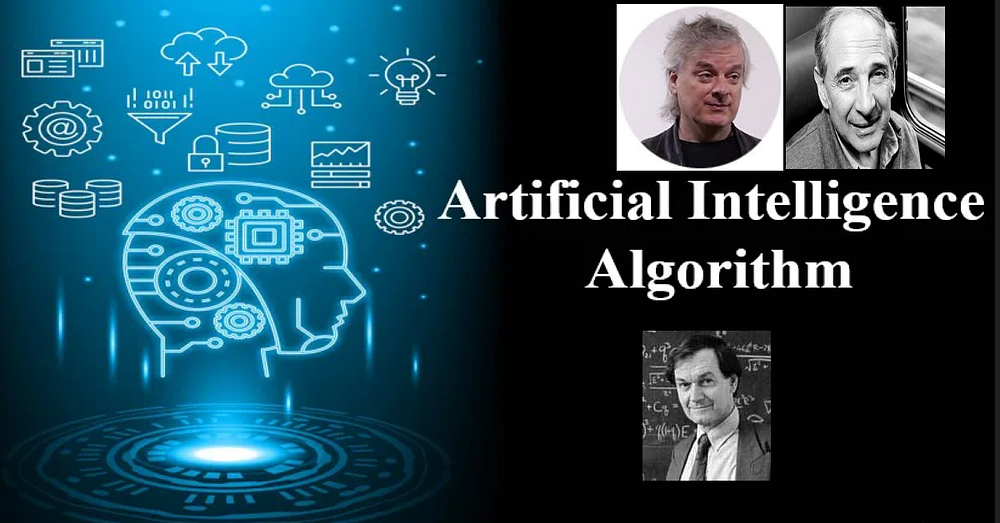
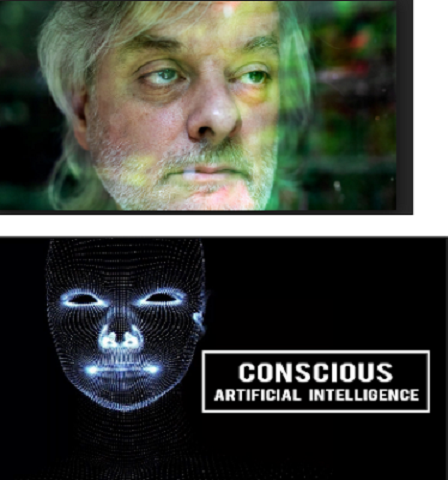
Top: David Chalmers and John Searle. Bottom: Roger Penrose
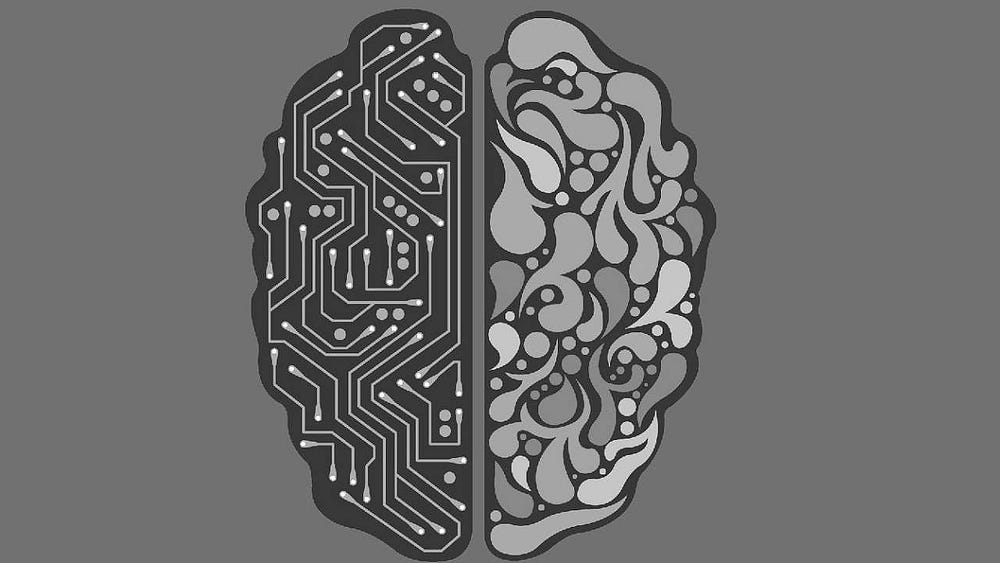
In many discussions of artificial intelligence (AI) it’s almost as if many — or even all — AI theorists and workers in the field believe that disembodied algorithms and computations alone can in and of themselves bring about mind, consciousness and understanding. (The same can be said, though less strongly, about the functions of thefunctionalists.) This (implicit) position — as the philosopher John Searle once argued (more of which later) - is a kind of contemporary dualism in which abstract objects (i.e., computations and algorithms) bring about mind, consciousness and understanding on their own. Abstract algorithms, then, may well have become the contemporary version of Descartes’ mind-as-a-non-physical-substance — at least according to Searle.
It’s hard to even comprehend how anyone could believe that an algorithm or computation alone could be a candidate for possession of (or capable of bringing about) a (to use Roger Penrose’s example) conscious state or consciousness itself. (Perhaps no one does believe that.) In fact it’s hard to comprehend what that could even mean. Yet when you read (some/much) AI literature, that appears to be exactly what various theorists and workers in the field believe.
Of course no AI theorist would ever claim that his (as it were)Marvellous Algorithms don’t actually need to be implemented. Yet if the material (or nature) of the implementation is irrelevant, then isn’t implementationin toto irrelevant too?
So if we do have the situation of AI theorists emphasising algorithms or computations at the expense of literally everything else, then this ends up being, as Roger Penrose will argue later, a kind of Platonism (or abstractionism) in which implementation is either, at best, secondary; or, at worst, completely irrelevant.
Another angle on this issue is to argue that it’s wrong to accept this algorithm-implementation“binary opposition” in the first place. This means that it isn’t at all wrong to concentrate on algorithms. It’s just wrong to completely ignore the “physical implementation” side of things. Or, as the philosopher Patricia Churchland once stated, it’s wrong to completely “ignore neuroscience” (i.e., brains and biology) and focus entirely on algorithms, functions, computations, etc.
So, at best, surely we need the (correct) material implementation of such abstract objects.
AI’s Platonic Algorithms?
Let me quote a passage in which the mathematical physicist and mathematician Roger Penrose (1931-) raises the possibility that strongartificial intelligence theorists are implicitly committed to at least some kind of Platonism.
Firstly, Penrose raises the issue of the physical “enaction” and implementation of a relevant algorithm:
“The issue of what physical actions should count as actually enacting an algorithm is profoundly unclear.”
Then this problem is seen to lead — logically — to a kind of Platonism. Penrose continues:
“Perhaps such actions are not necessary at all, and to be in accordance with view point A, the mere Platonic mathematical existence of the algorithm would be sufficient for its ‘awareness’ to be present.”
Of course no AI theorist would ever claim that even a Marvellous Algorithm doesn’t need to be implemented and enacted at the end of the day. In addition, he’d probably scoff at Penrose’s idea that the “the mere Platonic mathematical existence of the algorithm would be sufficient for its ‘awareness’ to be present”.
Yet surely Penrose has a point.
If it’s literally all about algorithms (which can be — to borrow a term from the philosophy of mind - multiply realised), then why can’t the relevant algorithms do the required job entirely on their own? That is, why don’t these abstract algorithms automatically instantiate consciousness (to be metaphorical for a moment) while floating around in their abstract spaces?
In any case, Penrose’s position can be expressed in very simple terms.
If the strong AI position is all about algorithms, then literally any implementation of a Marvellous Algorithm (or Set of Magic Algorithms) would bring about consciousness and understanding.
More specifically, Penrose focuses on a single qualium. (The issue of the status, existence and reality of qualia will be ignored this piece.) He writes:
“Such an implementation would, according to the proponents of such a suggestion, have to evoke theactual experience of the intended qualium.”
If the precise hardware doesn’t at all matter, then only the Marvellous Algorithm matters. Of course the Marvellous Algorithm would need to be implemented… in something. Yet this may not be the case if we follow the strong AI position to its logical conclusion. At least this conclusion can be drawn out of Penrose’s own words.
So now let’s tackle the actual implementation of Marvellous Algorithms.
“[s]uch an implementation [of a “clear-cut and reasonably simple algorithmic suggestion”]would, according to the proponents of such a suggestion, have to evoke the actual experience of the intended qualium”.
It’s hard to tell what that ostensible AI position could even mean. Of course that’s only if Penrose is being fair to AI theorists in his account. In other words, surely it can’t possibly be the case that an implementation (or “enaction”) of any algorithm (even if complex rather than “simple”) could in and of itself “evoke” an actual experience or evoke anything at all — a qualium or otherwise. Again, it’s hard to understand what all that could mean.
Of course if we accept that the human brain does implement algorithms and computations, then our fleshy “hardware” (or wetware) already does evoke consciousness.
So are we talking about a single algorithm here? Perhaps. However, even if multiple algorithms (which are embedded — or part of — a larger algorithm) are being discussed, implementation — or at least implementation alone — still can’t be the whole story. The whole story must surely depend on the nature of the hardware (whether non-biological, biological or otherwise), how the algorithms are actually implemented and on many other (non-abstract) factors.
There’s another problem with what Penrose says (which may just be one of his wording) when he writes the following:
“It would be hard [] to accept seriously that such a computation [] could actually experience mentality to any significant degree.”
Surely AI theorists don’t argue that a relevant algorithm (or set of algorithms) “could actually experience mentality”: they argue that such an algorithm brings about, causes or whatever “mentality”. How on earth, in other words, could an abstract entity — an algorithm — actually experience mentality? If anything, this is a category mistake on Penrose’s part.
Of course Penrose might have simply meant this:
algorithm + implementation = the experience of mentality
Yet even here there there are philosophical problems.
Firstly, what would it be that (to use Penrose’s words again) “experiencesmentality”? The algorithm itself or the algorithm-implementation fusion? Could that fusion actually be an experience? Or would somethingelse — such as a person or any physical entity — be needed to actually “have” (or instantiate) that experience?
As stated in the introduction, Roger Penrose and John Searle have accused (if that’s the right word) AI theorists of dualism and Platonism; and AI theorists have returned the favour by accusing Penrose and Searle of exactly the same isms.
So who exactly are the Platonists and dualists… and who are the physicalists?
Is AI Physicalist?
It’s ironic that Penrose should state (or perhaps simply hint) that his own position on consciousness is better described as “physicalist” (see physicalism) than the position of strong AI theorists. He puts this in the following passage:
“According to A, the material construction construction of a thinking device is regarded as irrelevant. It is simply the computation that it performs that determines all its mental attributes.”
Then comes another accusation of Platonism and indeed of dualism:
“Computations themselves are pieces of abstract mathematics, divorced from any association with particular material bodies. Thus, according to A, mental attributes are themselves things with no particular association with physical objects [].”
Thus Penrose seems to correctly conclude (though that’s only if we accept his take on what what AI theorists are implicitly committed to) by saying “so the term ‘physicalist’ might seem a little inappropriate” for this AI position. Penrose’s own position, on the other hand,
“demand[s]that the actual physical constitution of an object must indeed be playing a vital role in determining whether or not there is genuine mentality present in association with it”.
Of course all this (at least in regards both Penrose’s position and that of strong AI) seems like a reversal of terminology. Penrose himself recognises this and says that “such terminology would be at variance with some common usage” — certainly the common usage of many analytic philosophers.
In any case, the biologist and neuroscientist Gerald Edelman (1929–2014) takes a similar position to Penrose — at least when it comes to his emphasis on biology and the brain.
For example, Edelman once said that mind and consciousness
“can only be understood from a biological standpoint, not through physics or computer science or other approaches that ignore the structure of the brain”.
And then there’s the philosopher John Searle’s position.
Searle himself doesn’t spot an implicit Platonism in AI theory (as does Penrose): he spots an implicit dualism. Of course this is ironic because many AI theorists, philosophers and functionalists have accused Searle of being a “dualist” (see here).
Searle’s basic position is that if AI theorists, computationalists or functionalists dispute — or simply ignore — the physical and causal biology of brains and exclusively focus on syntax, computations/algorithms and functions, then that will surely lead to at least some kind of dualism. In other words, Searle argues that AI theorists and functionalists set up a radicaldisjunction between the actual physical (therefore causal) reality of the brain when they explain — or account for — intentionality, mind, consciousness and understanding.
So Searle’s basic position on all this is stated in the following:
i) If Strong AI proponents ignore (or play down) the physical biology of brains; and, instead, focus exclusively on syntax, computations/algorithms or functions,
ii) then that will surely lead to some kind of dualism in which non-physical (i.e., abstract)objectsplay the role of Descartes’ non-physical (i.e., “non-extended”) mind.
Again: Searle is noting the radical disjunction which is set up between the actual physical reality of biological brains and how these philosophers, scientists and theorists actually explain — and account for — mind, consciousness and understanding.
We also have John Searle’s position as it’s expressed in the following:
“If mental operations consist of computational operations on formal symbols, it follows that they have no interesting connection with the brain, and the only connection would be that the brain just happens to be one of the indefinitely many types of machines capable of instantiating the program.”
Now for the dualism:
“This form of dualism is not the traditional Cartesian variety that claims that there are two sorts of substances, but it is Cartesian in the sense that it insists that what is specifically mental about the brain has no intrinsic connection with the actual properties of the brain. This underlying dualism is masked from us by the fact that AI literature contains frequent fulminations against ‘dualism’.”
Despite all the words above, Searle doesn’t believe that only biological brains can give rise to understanding and consciousness. Searle’s position is that — empirically speaking — only brains do give rise to understanding and consciousness. So he’s emphasising what he takes to be an empirical fact. That is, Searle isn’t denying the logical — and even metaphysical — possibility that other entitiescan bring forth minds, consciousness and understanding.
Roger Penrose on Abstract-Concrete Isomorphisms
Is there some kind of isomorphicrelation between the (as it were) shape of the abstract algorithm and the shape of its concrete implementation? Penrose himself asks this question a little less metaphorically. He writes:
“Does ‘enaction’ mean that bits of physical material must be moved around in accordance with the successive operations of the algorithm?”
Yet surely this does happen in countless cases when it comes to computers. (In this case, electricity is being “moved around”, transistors are opened and shut, etc.) Or as David Chalmers puts it in the specific case of simulating (or even mimicking) the human brain:
“[I]n an ordinary computer that implements a neuron-by-neuron simulation of my brain, there will be real causation going on between voltages in various circuits, precisely mirroring patterns of causation between the neurons.”
So Penrose isn’t questioning these successful implantations and enactions in computers (how could he be?) but simply saying that material must matter. Alternatively, does Penrose believe that implementations and enactions don’t makes sense only when it comes to the singular case of consciousness?
The Australian philosopher David Chalmers (1966-) offers some help here.
David Chalmers on Causal Structure
Take a recipe for a meal.
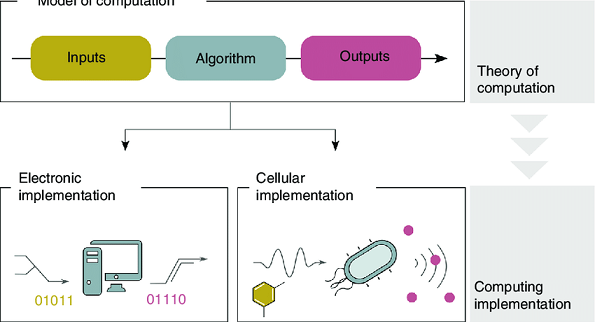
To David Chalmers, the recipe is a “syntactic object”. However, the meal itself (as well as the cooking process) is an “implementation” which occurs in what he calls the “real world”.
Chalmers also talks about “causal structure” in relation to programmes and their physical implementation. Thus:
“Implementations of programs, on the other hand, are concrete systems with causal dynamics, and are not purely syntactic. An implementation has causal heft in the real world, and it is in virtue of this causal heft that consciousness and intentionality arise.”
“It is the program that is syntactic, it is the implementation that has semantic content.”
More clearly, a physical machine is deemed to belong to the semantic domain and a syntactic programme is deemed to be abstract. Thus a physical machine is said to provide a “semantic interpretation” of the abstract syntax.
Yet how can the semantic automatically arise from an implementation of that which is purely abstract and syntactic?
Well… that depends.
Firstly, it may not automatically arise. And, secondly, it may depend on the nature of the implementation as well as physical material used for the implementation.
To go back to Roger Penrose’s earlier words on “enaction”. He asked this question:
“Does ‘enaction’ mean that bits of physical material must be moved around in accordance with the successive operations of the algorithm?”
And it’s here that — in Chalmers’ case at least — we arrive at the importance and relevance of “causal structure”.
So it’s not only about implementation: it’s also about the fact that any given implementation will have a certain causal structure. And, according to Chalmers, only certain (physical) causal structures will (or could) bring forth consciousness, mind and understanding.
Does the physical implementation need to be (to use a word that Chalmers himself uses) an “isomorphic” kind of mirroring (or a precise “mapping”) of the abstract? And if it does, then how does that (in itself) bring about the semantics?
One can see how vitally important causation is to Chalmers when he says that “both computation and content should be dependent on the common notion of causation”. In other words, an algorithm or computation and a given implementation will share a causal structure. Indeed Chalmers cites the example of a Turing machine when he says that “we need only ensure that this formal structure is reflected in the causal structure of the implementation”.
“Certainly, when computer designers ensure that their machines implement the programs that they are supposed to, they do this by ensuring that the mechanisms have the right causal organization.”
In addition, Chalmers tells us what a physical implementation is in the simplest possible terms. And, in his definition, he again refers to “causal structure”:
“A physical system implements a given computation when the causal structure of the physical system mirrors the formal structure of the computation.”
“A physical system implements a given computation when there exists a grouping of physical states of the system into state-types and a one-to-one mapping from formal states of the computation to physical state-types, such that formal states related by an abstract state-transition relation are mapped onto physical state-types related by a corresponding causal state-transition relation.”
Chalmers also stresses the notion of (correct) “mapping”. And what’s relevant about mappingis that the “causal relations between physical state-types will precisely mirror the abstract relations between formal states”. Moreover:
“What is important is the overall form of the definition: in particular, the way it ensures that the formal state-transitional structure of the computation mirrors the causal state-transitional structure of the physical system.”
“While it may be plausible that static sets of abstract symbols do not have intrinsic semantic properties, it is much less clear that formally specified causal processes cannot support a mind.”
In Chalmers’ account, then, the (causal) concrete does appear to be vital in that the “computational descriptions are applied to physical systems [because] they effectively provide a formal description of the systems’ causal organisation”.
So what is it, exactly, that’s being described?
According to Chalmers, the physical (or concrete) “causal organisation” is being described. And when described, it becomes an “abstract causal organisation”. (Is the word “causal” at all apt when used in conjunction with what is abstract?) However, the causal organisation is abstract in the sense that all peripheral non-causal and non-functional aspects of the physical system are simply factored out. Thus all we have left is an abstract remainder. Nonetheless, it’s still a physical (or concrete) system that provides the (as it were) input and an abstract causal organisation (captured computationally) that effectively becomes the output.
“It is easy to think of a computer as simply an input-output device, with nothing in between except for some formal mathematical manipulations.”
However:
“This was of looking at things[]leaves out the key fact that there are rich causal dynamics inside a computer, just as there are in the brain.”
Chalmers has just mentioned the human brain. Indeed he discusses the “mirroring” of the brain in non-biological physical systems. Yet many have argued that the mere mirroring of the human brain defeats the object of AI. However, since this raises its own issues and is more particular than the prior discussion about the relation between abstract algorithms and their concrete implementations, nothing more will be said about the brain here.
Conclusion
As stated in the introduction, it’s of course the case that most — or perhaps all — adherents of Strong AI would never deny that their abstract objects (i.e., algorithms and computations) need to be implemented in the (to use Chalmers’ words) “physical world”. That said, the manner of that implementation (as well as the nature of the physical material which does that job) seems to be seen as almost — or even literally — irrelevant to them. It’s certainly the case that brains and biology are often played down. (There are AI exceptions to this.)
Yet it must be said that not a single example of AI success has been achieved without implementation. Indeed that seems like a statement of the blindingly obvious! However, Roger Penrose, John Searle and David Chalmers are focussing on mind, consciousness and understanding and tying such things to biology and brains. So even though innumerable algorithms have been successfully implemented in innumerable physical/concrete ways (ways which we experience many times in our everyday lives — from our laptops to scanning devices), when it comes to mind, consciousness and understanding (or “genuine intelligence” in Penrose’s case), things may be very different. In other words, there may be fundamental reasons as to why taking a Platonic position (as, arguably, most AI theorists and workers do) on algorithms and computations will come up short when it comes to consciousness, mind and understanding.
Penrose particularly stresses the biology of consciousness in that he notes the importance of such things as microtubulesand (biologically-based) quantum coherence. Chalmers stresses causal structure. (He doesn’t tie causal structure exclusively to human brains; though he does believe — like Patricia Churchland — that many AI theorists ignore it.) And Searle most certainly does stress brains, biology and causation.
And now it must be stated that Chalmers, Penrose and Searle don’t actually deny the possibility that understanding and consciousness may be successfully instantiated by artificial entities in the future. What they do is offer their words of warning to AI theorists and workers in the field.
So, to finish off, let me quote a passage from Penrose in which he provides some hope for AI theorists — though only if they take on board the various fundamental facts (as he sees them) about animal brains. Penrose writes:
“[I]t should be clear[] that I am by no means arguing that it would be necessarily impossible to build a genuinely intelligent device[].”
But then comes large but (or qualification):
“[S]o long as such a device were not a ‘machine, in the specific sense of being computationally controlled. Instead it would have to incorporate the same kind of physical action that is responsible for evoking our own awareness. Since we do not yet have any physical theory of that action, it is certainly premature to speculate on when or whether such a putative device might be constructed.”
As can quickly be seen, Penrose’s hope-for-AI may not in fact amount to much — at least not if one accepts Penrose’s own arguments and positions.
So whatever the case is, Penrose, Chalmers and Searle argue — in their own individual ways — that biology, brains and causation are indeed important when it comes to strong (i.e., not weak) artificial intelligence.