Sunday, 20 February 2022

Thomas Nagel on Wittgenstein and Other “Deflationary” Philosophers (Part Four)

Thomas Nagel’s Platonic attack on Ludwig Wittgenstein and other “shallow” (i.e., non-transcendent) philosophers.

Left: Thomas Nagel. Right: Ludwig Wittgenstein

Skip the following square-bracketed introduction if you’ve already read my ‘Thomas Nagel as Philosopher-Priest and New Mysterian (Part One)’, ‘Thomas Nagel on Darwinian Imperialism, Naturalism and Mind (Part Two)’ and ‘Thomas Nagel on Good and Bad Philosophy (Part Three)’.

[This essay was written quite some time ago. The style is somewhat rhetorical, literary and (as it were) psychologistic. That said, I still agree with much of its philosophical content. Indeed many analytic philosophers would probably regard this essay as one long ad hominem against the American philosopher Thomas Nagel (1937-). Sure; there is an element of the ad hominem in the following. Yet hopefully it will be shown that there’s more to the essay than that. In fact I chose to write in a rhetorical style partly in response to the clear and prevalent rhetoric and “psychologising” I found in Thomas Nagel’s own book, The Last Word.]

**********************************

Thomas Nagel on the Late Wittgenstein


It is the “spiritually degenerate” position of (as it’s often put) the late Wittgenstein which particularly irks the American philosopher Thomas Nagel (1937-).

But firstly, let’s take Nagel’s more general position on philosophy.

Nagel believes that what he calls “deflationary philosophers” are (or were) going “against the philosophical impulse itself”. So just as Noam Chomsky argued that there is a “language faculty” (or “module”) in the brain, so Nagel argues that there’s a (of course he doesn’t put it this way) philosophy faculty there too. More than that: a faculty (a philosophy machine in the mind) with a fixed stock of ahistorical and acultural questions, issues and concepts which make up the a priori of all philosophical thought from the Philosophy Department of New York University to the council estates of Bradford. According to Nagel, such philosophical givens are what “spring eternal from the human heart”.

Nagel also makes it clear he sees these deflationary philosophers (the one who don’t share his Platonic vision) as being spiritually degenerate. What’s more, they are (or were) making philosophy what he calls “shallow”. Basically, it’s the old not-really-philosophy accusation again (traditionally aimed at many philosophers from Descartes to Derrida). Indeed Nagel stated that Wittgenstein, Rorty, Sellars, Putnam, et al were all “sick of the subject and glad to be rid of its problems”. There is, of course, an element of truth in Nagel’s statement — at least when it comes to Wittgenstein and Rorty. And it’s also ironic that one of his targets, Hilary Putnam (1926–2016), also expressed his own problem with what he too called “deflationary” philosophers. (He mainly had Richard Rorty in mind.) In Putnam’s own words:

“There is an excitement in the air. And if I react to Professor Rorty’s book (1979) with a certain sharpness, it is because one more ‘deflationary’ book, one more book telling is that the deep questions aren’t deep and the whole enterprise was a mistake, is just what we don’t need right now.”

So we have Nagel accusing Putnam of being a “deflationary” philosopher and Putnam himself accusing other philosophers of exactly the same philosophical sin.

If we return to Wittgenstein.

Nagel puts forward what he sees as the main late-Wittgensteinian claim here:

[I]t makes sense to say that someone is or is not using a concept correctly only against the background of the possibility of agreement and identifiable disagreement in judgments employing the concept [].”

So what’s wrong with that?

In other words, in which other way would the correctness of concept use be judged? By an individual philosopher himself and that philosopher alone? Would such a philosopher thereby be creating some kind of philosophical (as it were) private language?

So, on this Nagelian view, our contingent concepts need to match up with Platonic Forms or with Fregean (or Nagelian) concepts. And, if they mirror such Forms, then our concepts are the correct ones. And they must now be used correctly because they match up.

Clearly these Nagelian concepts share a lot with the ostensible abstract propositions which are then clothed with natural-language sentences. However, so the argument goes, no (abstract) proposition gains its identity from its natural-language expressions. Instead, we simply express the pre-existing proposition. Only in that sense can we (as it were) tell the truth about such a proposition.

It’s also worth noting that Nagel believes that it’s the late Wittgenstein (rather than, say, Nagel’s — to use his own words — “usual suspects” such as Jacques Derrida or Michel Foucault) who (to use his own word again) “endangers” philosophy. This makes a lot of sense when bearing in mind that many analytic philosophers have claimed Wittgenstein as one of them. Therefore Wittgenstein is more directly responsible for the fact that the cancer of what Nagel calls “linguistic idealism” has spread to the Analytic Philosophy Department than any other philosopher.

Thus it’s philosophical transcendence that’s at threat because (according to Nagel) Wittgenstein’s position

“depends on a position so radical that it [] undermines the weaker transcendent pretensions of even the least philosophical of thoughts” .

Incidentally, the English philosopher Michael Dummett (1925 -2011) similarly stressed meaning and the invariants of language (see here) . And perhaps that was why Dummett also believed that if we fully took on board the positions advanced in Wittgenstein’s Philosophical Investigations (1953)then we’d be denied a systematic theory of meaning. (See Dummett’s ‘Wittgenstein’s Philosophy of Mathematics.)

Now a few more words on Nagel’s broader vision.

Bad Language


Nagel believes that there’s no question that what he calls the “obsession” with language has “contributed to the devaluation of reason”.

Nagel doesn’t mince his words here. He also states that this emphasis on language has resulted in “decadence”.

All this clearly shows that Nagel believes that language shouldn’t be boss. Perhaps more than that (in the style of Plato ): Nagel believes that language is a hindrance to pure thought. (See Part Five where I analyse this claim.)

Nagel wants to see the world with what he calls an “unclouded eye”. He also wants concepts and even reasonings to be utterly free — per impossible — from language. In other words, philosophers would be giving up what he calls “the ambition of transcendence” if they weren’t sceptical — just like him — about language. Thus, to ignore Nagel’s own last words on philosophy would be to be held in the chains of something as contingent as language.

As hinted at, Nagel’s distaste for language has parallels with Plato’s distaste for the senses. Thus Plato escaped from the senses and ascended into the world of abstract and eternal Forms. Nagel, on the other hand, would like to get free from language in order to inhabit the (or his) View from Nowhere.

Who knows, perhaps Thomas Nagel already lives in Nowhere.

[I can be found on Twitter here.]


Thursday, 17 February 2022

Does Intelligence Always Come Along with Consciousness, Experience and/or Mind?

 Is there intelligence without consciousness and consciousness without intelligence?

Not all the critics of Strong Artificial Intelligence need to take an absolute position against it. Some critics may simply have problem with the particular arguments of a particular philosopher or AI theorist. In other words, such people can even (at least in theory) accept Strong AI and simply reject someone else’s arguments for it.

(Bear in mind that the term “Strong AI” is interpreted in at least four very different ways — see here.)

Thus not all critics of Strong AI need believe that non-biological systems “will never be genuinely intelligent” or even that they’ll never have consciousness or minds.

So someone can still adopt a critical position on Strong AI which has nothing strongly to do with any biological-artificial dichotomy.

Let’s put it this way. There are many natural/biological entities which don’t display intelligence (though this will almost entirely depend on definitions) and which don’t have (or display) any form of consciousness. On the other hand, there are many non-biological (or artificial) things which do display (or instantiate) intelligence. This means that there’s no necessary (or absolute) link between the natural/biological and intelligence or between the artificial and a lack of intelligence

And the same may even be true of mind, consciousness and/or experience.

All the above means that one needn’t adopt a “biocentric” position. That is, one needn’t have a problem with intelligent non-biological systems at all. That said, it must now be pointed out there’s often an unwarranted leap that’s made from artificial intelligence to artificial minds and certainly to artificial consciousness. Yet the questioning of these leaps needn’t be directly connected to any bias toward “carbon-based” or biological systems.

In addition, if a system displays intelligence or “acts intelligently”, then one can also argue — and many have done so — that, by definition, it must also actually be intelligent.

And all that brings us to intelligence itself — as dealt with in a more abstract manner.

Intelligence

Many people conflate intelligence with consciousness, mind and/or experience. This means (again) that one can be critical of some claims of Strong AI and not have any problem at all with admitting that computers, robots, etc. are intelligent. The problem is when consciousness, mind and experience are added into the pot. Alternatively, the problem may be when theorists (such as Roger Penrose) deem intelligence to actually require consciousness, mind and/or experience.

So it can be easily and strongly argued that computers (or non-biological complex systems) are already intelligent.

Yet when it comes to intelligence (unlike experience, understanding, consciousness, etc.), perhaps there can be no appearance-reality distinction. That is, if a complex system displays intelligence (or acts intelligently), then it must be intelligent. However, the same may not also be true of consciousness, experience, understanding and even the mind itself. (Bear in mind here that the word “mind” has as many definitions as the word “consciousness” — yet that point is usually only made about the latter, not the former.)

For example, a complex system (such as a computer or zombie) may act as if it is conscious; though it may not actually be conscious. Indeed the Australian philosopher David Chalmers has spent his entire career making this point. (See Chalmers on zombies here.)

So, as it is, one doesn’t need to be that sceptical about the intelligence of complex non-biological systems. That said, one can (still) be sceptical about computer minds and computer consciousness.

Let’s move back to intelligence.

If a computer wins human beings at chess, then it is intelligent. Full stop… Surely that’s the case? And that means that someone can adopt a behaviourist position on intelligence; though perhaps not also on mind or consciousness.

Of course I would need to defend the position that there is, in fact, an intelligence-consciousness dichotomy. And this position is also complicated by the simple fact that many people define these words in very different ways.

Programming

Some people also argue that because a (as it’s often put) “computer is simply programmed to be intelligent”, then it can’t be “genuinely intelligent” at all. Yet that doesn’t follow. Or, more correctly, it doesn’t automatically follow.

Human beings (especially very young children) are also programmed! That is, human beings — not only young children — are fed a language, information, facts, etc; and they then use all these things in various and many different ways. Sure, human persons also show a certain degree of flexibility — even at a very young age. That said, so too do some — even many — computers.

Of course many philosophers and scientists also question agency (or “free will”) when it comes to human beings too! That is, they doubt that human beings are genuinely autonomous or free from “determining causes”.

In any case, there are computers which can correct themselves. There are also computers which can go in directions which go beyond the programmes which run them or which they “follow”.

In terms of winning games of chess against human persons or solving mathematical problems which people haven’t solved: isn’t this an example of going beyond the programming? That is, even such achievements are “a result of the programming”, aren’t they still examples of going beyond the programming? As stated, when human beings go beyond the “programming” (however loosely this word is defined or whether I need to use scare quotes), isn’t that going beyond also a result of the previous programming?

Embodied and Embedded Computers

Experience and consciousness have been mentioned.

All this isn’t only a question of computers having (or not having) consciousness or experience. It’s also about the importance of experience when it comes to intelligence. More accurately, it’s about how experience may be necessary in order to have (what Roger Penrose calls) “genuine intelligence”; rather than the possibility that intelligence must always come along with experience or consciousness.

This is something which people involved in AI (including Marvin Minsky) have noted since the 1960s.

One important problem was mainly down to computers not being embodied or embedded within environments. However, computers can be both embodied within robots and then embedded within physical environments. Indeed some computer-robots also have “artificial organs” which function as “sensory receptors”. (Do I need to use scare quotes here?)

People may now ask if they are real sensory receptors. That is, isn’t it the case that in order for sensory receptors to be sensory receptors that they would also need to be linked to real experiences or to consciousness itself? Not really. Many scientists cite much data which shows that even single-celled organisms have sensory receptors. That said, they don’t also believe that such organisms instantiate consciousness or have (humanlike?) experiences.

[I can be found on Twitter here.]

Wednesday, 16 February 2022

An Account of Inductive Logic and Deductive Logic in the Late 19th Century

The 19th Century (ostensible) split between inductive logic and deductive logic.

In the second half of the 19th century many philosophers and (less so) logicians studied the kind of reasoning that’s employed in the experimental sciences. That basically meant that logic wasn’t really seen — by them — as being an autonomous discipline. In other words, they believed that logic was something developed by studying actual examples of reasoning.

There was a reaction against this historical and philosophical trend — if not always a conscious one. That reaction gave rise to mathematical logic and the new —and more rigorous — kinds of deductive logic of the early 20th century. That said, symbolic logic — from the mid-19th century onward — also existed alongside these other trends. In addition, mathematical logic can be dated back to George Boole’s works; some of which were written before the second half of the 19th century.

Inductive Inference and Soundness

What was the classic take on inductive inference?

It was that firstly people observe a finite amount of a given phenomenon. And then they generalise about such a phenomenon. The actual inference itself, therefore, is to as-yet-unobserved phenomena which will — or are hoped to — display the generalised features made about the observed phenomenon or phenomena.

For example, people infer (or did infer) that the next swan they’ll see will be white because they’ve seen many (or only) white swans.

Now there’s an important difference between inductive inference and deductive inference. Inductive inferences aren’t sound; though (correct) deductive inferences are sound.

So what does the word soundness mean?

Firstly, soundness refers to a property of mathematical and logical systems; whereas an individual inference, statement or conclusion is said to be sound.

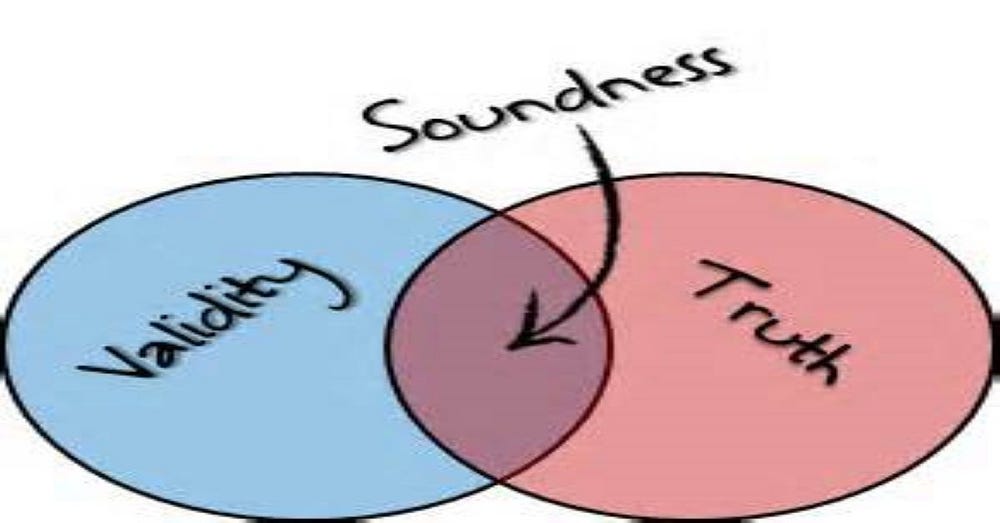
A sound inference or conclusion is an inference or conclusion which can’t be false given true premises. This means that a purely deductive inference must be sound. However, inductive inferences aren’t sound. Instead, inductive inferences are probable rather than sound. (It can’t be said that inductive logic is entirely about probabilities. See inductive probability.) So, in a strong sense, with inductive inferences we never have enough knowledge to fully warrant our conclusions. And that’s because no amount of knowledge would render the conclusions sound. Or, as the Dutch computer scientist and Professor of Artificial Intelligence Peter A. Flach puts it (in his ‘Modern Logic and its Role in the Study of Logic’), in inductive reasonings there will always be “missing knowledge”. Thus we must — instead — make “educated guesses” as to the nature of that missing knowledge.

Yet that lack of soundness wasn’t seen as being a big problem by many late-19th century philosophers; especially since soundness isn’t available — even in principle — when it comes to inductive logic. In fact, non-sound logic was still seen as being very useful. And, conversely, sound (deductive) logic was seen as being… well, pretty useless — at least at specific times or in particular situations.

There is a drawback.

That drawback is is that unsound conclusions may turn out to be (outright) false. Yet even this possibility isn’t so bad when seen in the light of, say, C.S. Peirce’s position of fallibilism. In other words, when we adopt this position we accept our own fallibility at the same time as being aware that we’re still making scientific, logical and philosophical progress.

Inductive Logic as the Logic of Truth

Many late-19th-century logicians and philosophers asked themselves the following question:

What truly distinguishes inductive logic from deductive logic?

The answer usually was that inductive logic is a “logic of truth”. Deductive logic, on the other hand, primarily deals with consistency, validity, consequence, soundness, etc. — all of which can exist in perfect isolation from truth. For example, a madman may be a fine deductive logician with a perfectly consistent and coherent world-view. Yet his world-view may well be based on things which are, nonetheless, entirely… false.

More technically, deductive logic can begin with premises which are simply false — and even known to be false! Yet that which is derived from such false premises may still be (internally) valid and consistent.

So why can’t we also say that whereas the premises are false, the deductions or inferences themselves are still true because they’re correctly derived from the premises?

Truth and Correctness in Logic

If the metaphysical notion of truth is so problematic and disparate, then why shouldn’t we call statements that belong to a valid and consistent system true? (Mathematicians do.) Yet all this will entirely depend on what, precisely, we take truth to be.

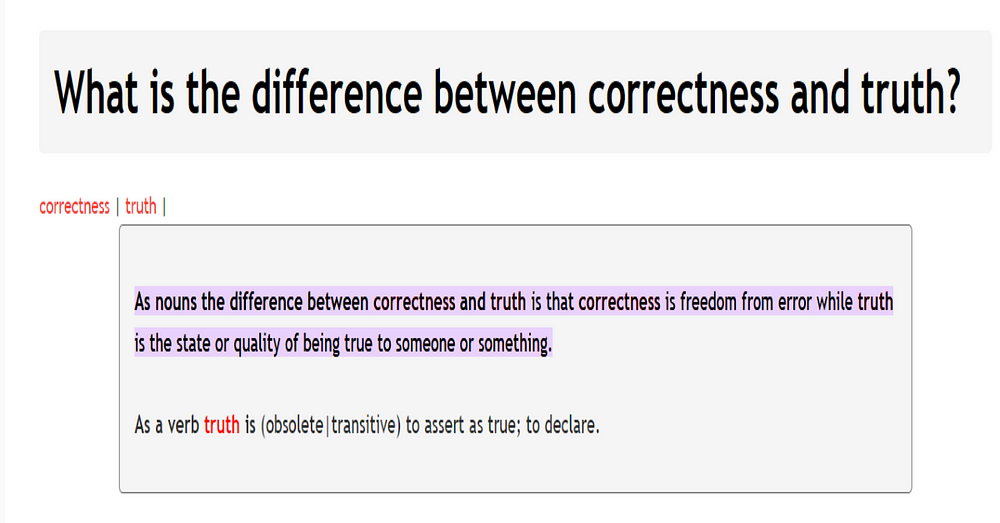
So the distinction between the words “correct” and “true” may be helpful here.

For example, we can say that a correct statement is a particular type of true statement. Alternatively, we can say that a true statement is a particular kind of correct statement. (These may be differences which don’t really make a difference.) In any case, some truths are determined by empirical realities. Whereas other truths are determined by the fact that they’re correctly derived (or deduced) from given premises, statements or axioms.

Much the same was the case with Ludwig Wittgenstein’s distinctions between statements which are true and statements which are (merely?) correct (see here). More specifically, Wittgenstein believed that certain things are deemed true simply because they conform to conventions, rules and/or norms. (He even applied this position to the “truths” of mathematics.) On the other hand, many people deem other things to be true in spite of what the community thinks or regardless of conventions, norms or rules.

So why not simply invert these terms in that “truth” becomes “correctness” and “correctness” become “truth”? The point here is that although these distinctions are effective in distinguishing certain types of statements from one another, they’re rarely distinguished from the perspective of metaphysically analysing the nature of truth itself.

So are these distinctions just ones of use and convenience? In other words, do they have any metaphysical or even semantic weight?

Deductive and Mathematical Logic

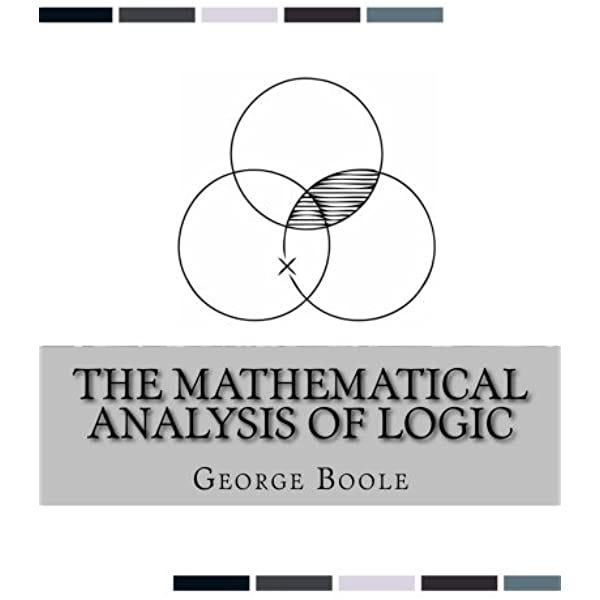
Perhaps mathematical logic all began with George Boole (1815–1864). The book above was published in 1847.

Much of early-20th-century logic developed in isolation from science and everyday reasoning. (Of course it was still believed that such a logic’s findings could — or would — be applicable outside the logic itself.) In simple and broad terms, it can be argued that logic also became less relevant to other areas of discourse in the early 20th century. More specifically, it became less relevant to philosophy and to the experimental sciences.

The simple reason why deductive logic impressed 20th century mathematical logicians and philosophers (see mathematical logic) is that in any deductive system one “moves from truths to further truths”. In inductive logic, on the other hand, one moves from probabilities to further probabilities. Thus inductive logic isn’t airtight in the manner in which deductive logic is. In the latter case, one essentially accumulates more truth (if “truth” is the correct word here) from a given set of truths (e.g., from premises, axioms, etc.).

Why, exactly, were non-deductive forms of reasoning largely ignored in the Fregean (see here) and post-Fregean age of mathematical logic? The answer is that they could provide no help to what’s often been called “foundational research” in mathematics. (See the foundations of mathematics.) And, of course, mathematical systems are often (or always) deductive systems. (Even “mathematical induction” is deemed to be deductive!)

Indeed all this was part and parcel of the rejection of any form of (what was called) psychologism in logic, mathematics and philosophy.

“Pure logic” (to use Edmund Husserl’s term) doesn’t deal with thought processes at all. It is (or was) believed — by many — to deal with timeless logical laws, truths and principles which — arguably — would exist even if no one had thought about (or expressed) them. Inductive reasoning, on the other hand, fundamentally relies on observations. Thus the notion of observation is clearly a psychological one. And the same goes for (to cite a more specific example) C.S. Peirce’s theory of abduction. (Here the abductive act is a psychological phenomenon - even a creative one.)

As hinted at earlier, people don’t really rely that much on deductive logic in their everyday lives. More clearly, both mathematical logic and deductive logic don’t seem to be closely connected to how people actually reason. Now that may be simply be because most people don’t reason correctly. (Consequently, perhaps they should mimic the inferences of deductive logic and mathematical logic.) On the hand, inductive logic is primarily concerned with observations and inferences from those observations.

Consequently, all the words above may make it seem strange that mathematical logic was so important to so many (analytic) philosophers of the first half of the 20th century.

******************************

Note: A Short Digression on C.S. Peirce’s Theory of Abduction

C.S. Peirce’s notion of abduction may seem, at least prima facie, to be indistinguishable from induction.

An abduction somehow explains certain observations. In other words, it’s a hypothesis. Or, the other way around, from such an abductive hypothesis we can know what kind of observations to expect given pre-existing data. However, unlike induction, an abductive argument will begin with some kind of generalisation. Thus:

i) All the beans from this bag are white.
ii) These beans are white.
iii) Therefore, these beans are from this bag.

The second premise moves to the particular. The conclusion, in this case, in a sense fuses the first and second premises. That is, because all the beans in the bag are white, then it’s probable that these particular white beans may be from that bag. In the above example, it’s not yet known where the white beans have come from. The conclusion, given in the first premise, hypothesises the probability that given all the beans in the bag are white, then these particular white beans may be — or are — also be from the bag.

Indeed the first premise (“All the beans from this bag are white”) can itself be seen as the conclusion of a previous inductive argument. That is, from the observations of many particular white beans, it might have been concluded that all the beans in the bag must be white. Or, to use Peter Flach’s terms again, the first premise of the abductive argument gives us the inductive “general rule”. The abductive part of the argument will be the inference that the particular white beans in front of the observer are probably from the bag of white beans. In this instance, abduction takes over where induction left off.

[I can be found on Twitter here.]

Wednesday, 9 February 2022

Douglas Hofstadter’s Gödel Sentence (G) is Both a Theorem and Not a Theorem

Douglas Hofstadter’s simple reworking of Kurt Gödel's First Incompleteness Theorem.

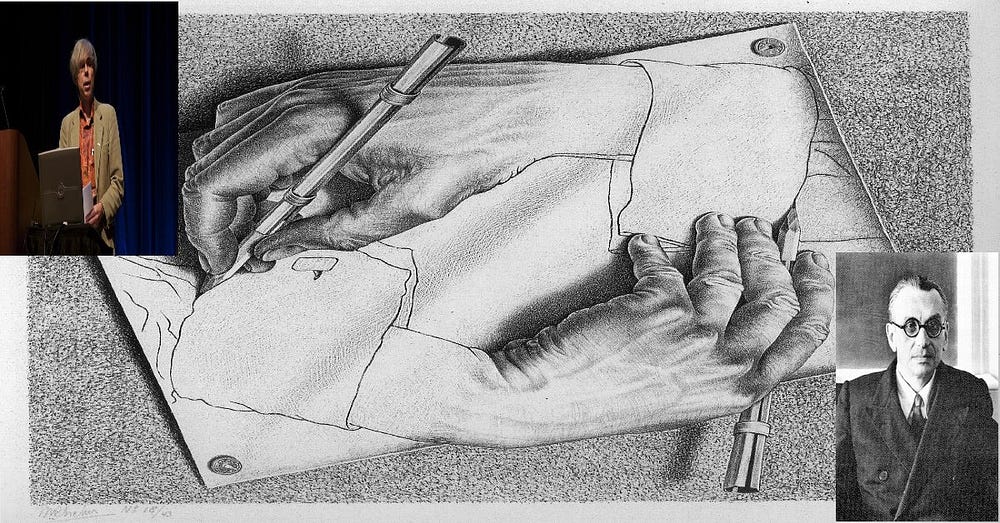
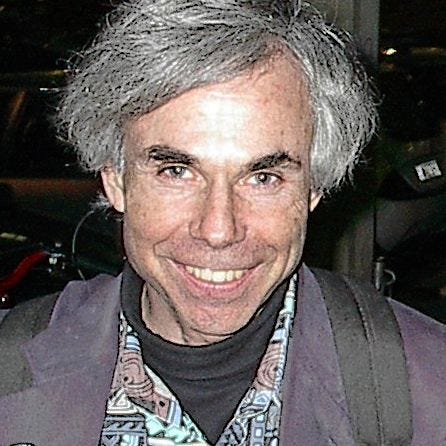
Left: Douglas Hofstadter. Right: Kurt Gödel. The drawing is by M.C. Escher (1898–1972).

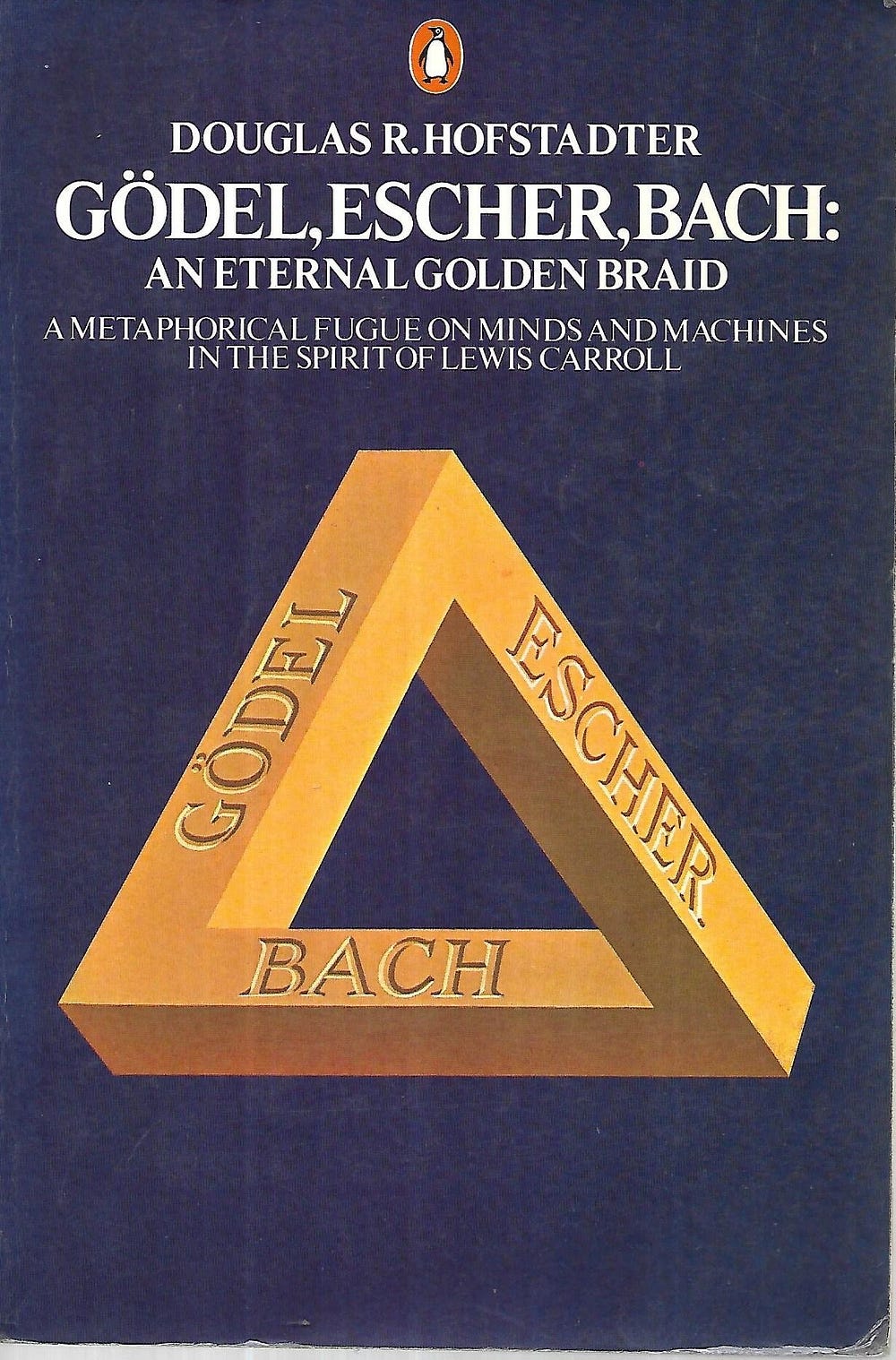
Douglas Hofstadter (who was born in 1945) is an American mathematician, cognitive scientist and physicist who has written on artificial intelligence (AI) and consciousness. He’s primarily known for his book Gödel, Escher, Bach: An Eternal Golden Braid. This book won the Pulitzer Prize and a National Book Award for Science. It’s also the primary source of this essay.

Self-Reference is Everywhere

Douglas Hofstadter’s Gödel sentence G is almost entirely based on Kurt Gödel's very own G — as it’s displayed in the latter’s first incompleteness theorem. (Of course Gödel himself never used the symbol G or the words “Gödel sentence”.)

Hofstadter also picked up on the importance of self-reference when it comes to Gödel's G, mathematical systems and indeed metamathematics as a whole.

It can now be said that the entire enterprise of metamathematics can be seen to be self-referential. Indeed, according to Hofstadter himself, Gödel's main idea was

“to use mathematical reasoning in exploring mathematical reasoning itself”.

Hofstadter concluded by saying that

“perhaps its richest implication was the one Gödel found: Gödel's Incompleteness Theorem”.

In more particular terms and with more direct relevance to this essay, Hofstadter also told us that

“it is in the nature of any formalization of number theory that its metalanguage is embedded with it”.

In broad terms, then, Gödelian metamathematics was a kinda incestuous or nepotistic enterprise. (Analogically, it was a little like getting the police to investigate the police.) Yet this was seen to be a good thing by Gödel and by many others. That’s primarily because what better means of investigation (or analysis) can there be than using mathematics? So, if that’s the case, then why not use mathematics to analyse (or investigate) mathematics itself?

In addition and on a simpler scale: if numbers can code individual symbols and whole statements, then all sorts of juxtapositions (or even games) will be made possible. After all, numbers are the domain of the infinite. And this may also mean that Gödelian number coding will also be the domain of the infinite.

In any case, from maths being applied to maths, we had the consequence of Gödel's First Incompleteness Theorem — which itself introduced statements (or mere “strings”) which referred to themselves. More precisely, we then had self-referential symbols which were actually embedded within the statements they were about. And, in turn, such symbols and statements were assigned a number.

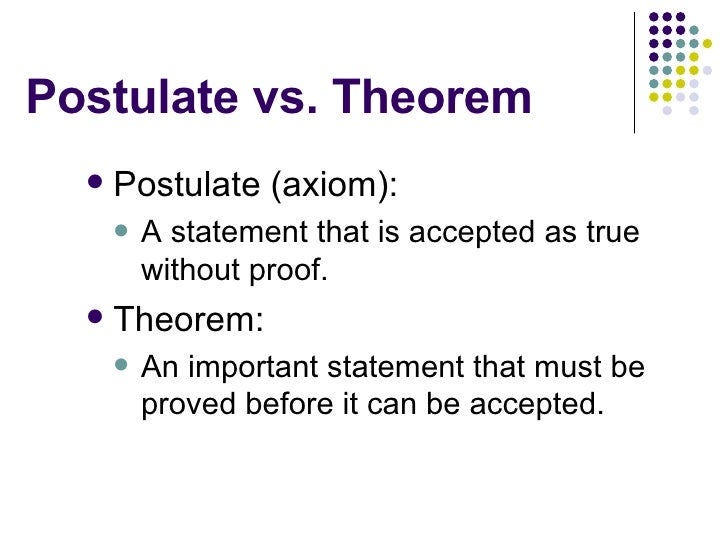
What is a Theorem?

Since the term “theorem” is central to this essay, let Douglas Hofstadter himself tell us what it is. Thus:

“Such strings, producible by the rules [within mathematical systems], are called theorems.”

Hofstadter then made a distinction between two types of theorem.

Firstly, he explained the first (“common”) type of theorem:

“The term ‘theorem’ has, of course, a common usage in mathematics which is quite different from this one. It means some statement in ordinary language which has been proven to be true by a rigorous argument, such as Zeno’s Theorem about the ‘unexistence’ of motion, or Euclid’s Theorem about the infinitude of primes.”

Then, more relevantly to this essay, Hofstadter defines the second type:

“But in formal systems, theorems need not be thought of as statements — they are merely strings of symbols. And instead of being proven, theorems are merely produced, as if by machine, according to certain typographical rules.”

The words “merely strings of symbols” strongly and perfectly explain much about self-referential paradoxes and indeed Hofstadter’s own G. That is, such theorems aren’t “thought of as statements” primarily because they contain no semantic content. (Arguably, the very fact that “empty” symbols and strings can be used and manipulated in specific and prescribed ways means that they must indeed have a semantics!) And, because of that, these theorems (such as G itself) “instead of being proven”, are “merely produced” (i.e., “as if by machine, according to typographical rules”).

Thus if these theorems are merely(?) strings of symbols, then no wonder we can play logical games with them. Like an actual material string, we can tie the theorems and symbols in a multitude of different “knots”. However, if symbols or logical strings were actually meant to mean something, or refer to something outside themselves, then perhaps such logical games wouldn’t be possible.

Douglas Hofstadter’s Sentence G

Douglas Hofstadter cites a (or even the) problem with self-reference — at least when it comes to self-referential sentences or what he calls “strings”. (It’s not clear — at least to me — if Hofstadter himself sees it as a problem.)

Hofstadter cites sentence G, which is a theorem of his own Typographical Number Theory (TNT).

So what is theorem G? This:

G is not a theorem.

Firstly: note that Hofstadter used both the words “if G were a theorem” and “[G] being a theorem”. This must mean that G both is and is not a theorem in Hofstadter’s Typographical Number Theory.

Hofstadter also stated that

“if G were a theorem[of Typographical Number Theory] , it would express a truth”.

G would state a truth because, according to Hofstadter, “TNT never has falsities for theorems”.

So the sentence (or what Hofstadter calls a “string”)

G is not a theorem.

must be “a truth”.

G says of itself that it’s not a theorem and that statement is also (taken to be) true.

Yet G is also a theorem (as in Hofstadter’s “[G] being a theorem”) of TNT!

For comparison: in one formal expression of the Liar Paradox, the statement “(A) Statement A is false” turns out to be both false and true. In Hofstadter’s case, on the other hand, G turns out to be both a theorem and not a theorem. And, of course, Hofstadter’s own G also involves the notion (or property) of truth.

Hofstadter put all the above in another way by stating the following:

“By being a theorem, G would have to be a falsity.”

Why is that? Because (again) G says of itself:

G is not a theorem.

And if G is not a theorem, then what status does it have? Hofstadter has already told us that all theorems of TNT must be true. So G is true because it’s a theorem of TNT. Yet it’s also a theorem which states — of itself — that it isn’t a theorem. Basically, then, G must be true in a way that that’s at odds with what Hofstadter calls “common” theorems. And G is so in the sense that it’s true at the same time as saying it isn’t a theorem. Moreover, G’s truth cannot (therefore) be proven within TNT.

So does that also mean that G (as it were) becomes a theorem of TNT by virtue of it saying (of itself) that it “is not a theorem”? That is, by denying its own theoremhood, does G becomes a theorem? Thus “G is not a theorem” must also be true in order for it to be a theorem. Yet, because G says (of itself) that it “is not a theorem”, then that must mean that it is (or at least can be) a theorem of TNT. Thus G’s saying of itself that it isn’t a theorem is also a statement of its (or a) truth. And, by denying its own status as a theorem, G actually becomes a theorem.

Now let’s spend a little time on Gödel's own G.

Kurt Gödel’s Own G

On Gödel's first incompleteness theorem.

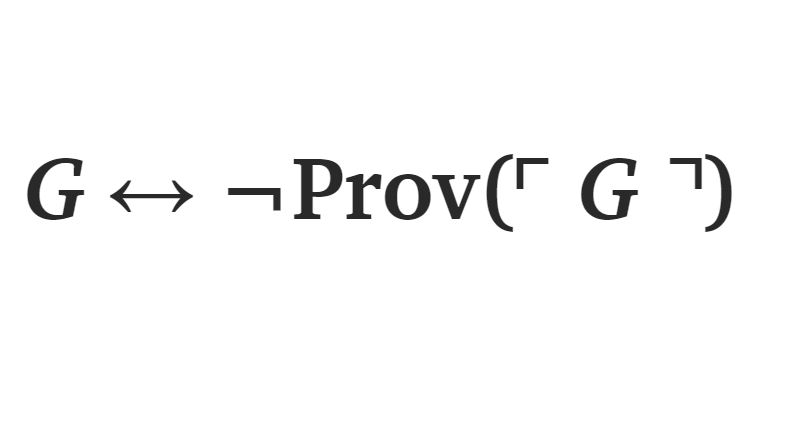
Take the following symbolic representation of Gödel's own sentence G from the logician and philosopher Professor Alasdair Urquhart (as found in his paper ‘Metatheory’):

G ↔ ¬Prov(G⌝)

The above means:

The sentence G is true if and only if it is not provable in system T.

Some readers may wondering about the second use of the symbol G and its surrounding superscripted square brackets.

This is a code number or a Gödel number.

A code number or Gödel number is a number which is used to identify something which is not a number. This means that the symbol ⌜ G⌝ is the code number of the Gödel sentence G (i.e., the symbol G without brackets). Furthermore, a Gödel number is a specific kind of code number. In mathematical logic, Gödel numbers are natural numbers which are assigned to statements (as well as to the individual symbols within those statements ) within a given system or formal language.

Now let’s get back to Hofstadter.

Hofstadter’s G Again

Hofstadter himself concluded by saying that

“knowing that G is not a theorem, we’d have to concede that G expresses a truth”.

So G isn’t — and also is — a theorem of TNT.

All this parallels (as already hinted at) the true but unproven statements in Gödelian systems. In actual fact, this is a simple rewording (or reworking) of Gödel's very own G.

To repeat.

If Hofstadter’s G were a theorem, then it couldn’t be true because it says of itself that it “is not a theorem” (of TNT). So G can only be taken as a truth if it’s also taken not to be a theorem. This, of course, exactly parallels Gödel's own G which is true in a Gödelian system — yet still unproven in that very same system.

Then Hofstadter made the (almost) obvious Gödelian conclusion when he wrote these final words:

“Here is a situation in which TNT doesn’t live up to our expectations — we have found a string which expresses a true statement, yet the string is not a theorem.”

************************************

See my related publications in Cantor’s Paradise:

(1) ‘Why Empty Logic Leads to the Liar Paradox’. (2) ‘(A) The sentence A is not true’. (3) ‘Gödel’s First Incompleteness Theorem in Simple Symbols and Simple Terms’.

[I can be found on Twitter here.]