On the American and British pragmatists’ reaction against formal and mathematical logic in the late 19th and early 20th centuries.
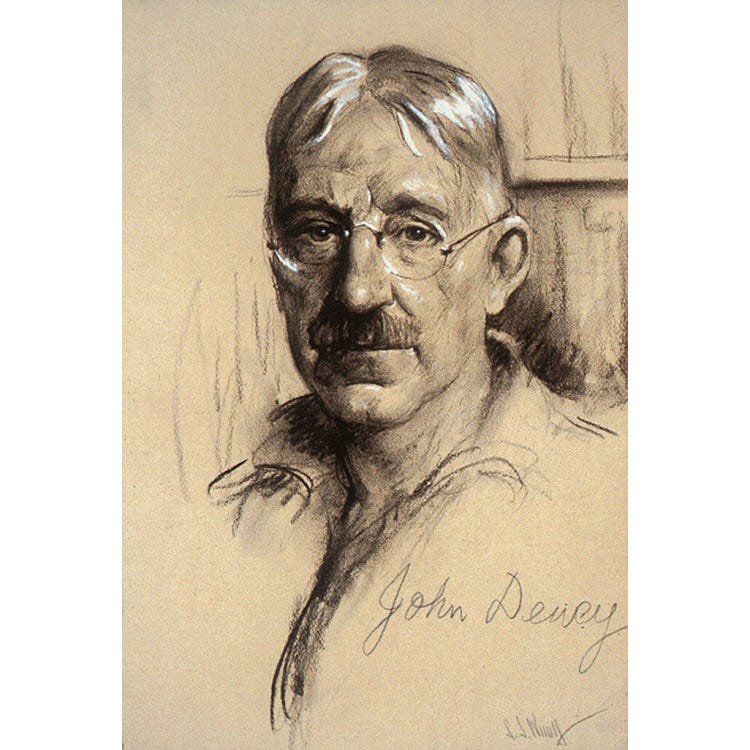
Left: John Dewey. Right: F.C.S. Schiller
The German-British philosopherF.C.S. Schiller (1864–1937) argued that logic is — or at least should be — a “theory of inquiry”. (This position is captured in Schiller’s book, Logic for Use.) In America and, to a lesser degree, in the United Kingdom, such a view was in the air from roughly the 1870s to the 1920s… and onward (see here). Indeed the American philosopher and pragmatist John Dewey (there’s more on Dewey in the final section) wrote a book called Logic — The Theory of Inquiry. (Dewey was influenced by Schiller; just as Schiller was, in turn, influenced by C.S. Peirce.)
So if logic is a theory of inquiry, then that means that it will be — primarily — an inquiry into human thought processes rather than into the formal relations which exist between logical symbols and statements. In addition, one prime pursuit of this kind of logic was to understand how people actually “fall into error”. Its concern, therefore, wasn’t such things as system-based validity,entailment, consistency, etc. And that was because— so these pragmatists believed — these things don’t depend on (as it were) empirical or observational truth — even if they do depend on soundness.
Schiller also argued that science simply isn’t as logical as many people assume. (Ironically, there was much that went under the description the logic of science written after Schiller died.) Moreover, logical techniques and logical methodologies, in Schiller’s eyes, aren’t fool-proof. Schiller also argued (perhaps obviously) that logic alone can’t solve all the problems that bedevil scientific experiment and research.
More specifically, Schiller argued that scientists simply can’t know (as the phrase has it) a priori about all the possible (what Schiller called) “unforeseen objections” (i.e., to their theories or experiments) which may appear on the scene in the future. In other words, there’s simply no way that these future possibilities can be known (orpreempted) beforehand. And it’s not only these possible objections which are unforeseen; but also new physical conditions or experimental findings.
So scientists can’t logically (or fully) predict any future changes to science.
Now consider, for example, the impossibility of scientists predicting quantum phenomena in, say, the 18th century. And think also of all the other “revolutions” in 20th century science which could never have been predicted or preempted.
In terms of logic itself.
Consider the rise of many-valued logic. Consider the attacks — or at least questionings or revisions — of the Law of ExcludedMiddle. (The American philosopher W.V.O. Quine became a pragmatist about the Law of Excluded Middle — or at least its applicability - in response to the findings of quantum mechanics and the results of various scientific experiments — see here.)
Hardly any of these radical scientific and logical changes could have been prophesised in the (as mentioned) 18th century or even in the first half of the 19th century.
A traditional empiricistmight also have argued that many of these scientific (if not logical) revolutions couldn’t have been predicted if such predictions, by their very nature, were simply — or at least partly — dependent on past and present experiences or observations. And because such things weren’t observed in the 18th century, then it follows that they couldn’t have been predicted either. This means that no matter how strong or speculative the prediction actually is, it should — or would — still at least partly depend on empirical data or observations. And if such things weren’t available to point in the direction of, say, quantum phenomena again, then such phenomena couldn’t even have been speculated about.
Of course it might have been the case that certain speculators’ predicted such scientific revolutions by (as it were) accident. Indeed in the philosophy of science much is made of scientists, philosophers and evenlunaticsgetting things right — yet for the wrong reasons. So, in broad terms, some people have made wild leaps in the dark and still got things right. However, even if such speculators got things right, then few — if any — scientists (of their day) would have taken much — or any — notice of them. That primarily because such speculative theories (or ideas) would have been completely divested of any observational or experimental foundation or content.
Of course even the scientists who were strict sceptics would never have demanded complete and unequivocal justifications of the speculators’ predictions or hypotheses. Indeed scientists have always realised that speculations are vital in science. That said, such scientists would at least have expected the aforementioned speculations (or theories) to have had at least (as it were) one foot on the ground. In other words, such speculations should never entirely belong to another world.
A Little More on John Dewey
In John Dewey’s eyes, logic should be largely derived from the methods and practices which are used in science and by everyday people — even those people who aren’t experts. And because science is always on the move, then Dewey also believed (as expressed in his Essays on Experimental Logic) that logicians shouldn’t see logical principles as
“eternal truths which have been laid down once and for all as supplying a pattern of reasoning to which all inquiry must conform”.
More generally, Dewey expressed his naturalist position on logic (or at least on “thinking”) in this way:
“[T]hinking, or knowledge-getting, is far from being the armchair thing it is often supposed to be. The reason it is not an armchair thing is that it is not an event going on exclusively within the cortex or the cortex and vocal organs. It involves the explorations by which relevant data are procured and the physical analyses by which they are refined and made precise.”
So Dewey believed (like C.S. Peirce before him) that logic should be fallibilist in nature — just like science. Indeed his fellow American philosopher W.V.O. Quine (as already mentioned) was even a fallibilist when it came to both mathematics and logic.
Dewey also (if indirectly) argued that the arrow should point from the world to logic; as well asfrom science to logic. In that sense, then, logic seemed to take a back seat when it came to science.
Moreover, because science’s relation to the world is both more (as it were) direct than logic’s and philosophy’s, then the latter two (to use Quine’s words) “should deferto science”. Alternatively and to use a term used in the 20th century, logic and philosophy should be naturalisedso that they don’t systematically conflict with science and its findings.
So Dewey clearly took a pragmatist line on logic.
Dewey noted the many successes (however defined) of science and everyday life. He therefore believed that whichever logical rules or principles scientists and everyday people use when they scored their particular successes, that logicians should also adopt them. In any case, scientists themselves have always taken on board new logical methods in their pursuits. And Dewey believed that logicians should do so too.
Philosopher Philip Goff tells us that “science is supposed to offer explanations [of the] subjective inner world of feeling and experience”. Does it?
The English philosopher and panpsychist Philip Goff offers us a broad dismissal of what he calls the “brute identity theory”. In Goff’s own words:
“The brute identity theory is very unsatisfying. Science is supposed to offer explanations I want to know how processes in the brain result in a subjective inner world of feeling and experience.”
It must be said here that Philip Goff is almost entirely beholden to the prior arguments and positions of the philosophersSaul Kripke (1940 — ) and David Chalmers (1966 — ). These two philosophers attacked identity theorists with the argument that they can’t — or couldn’t — identify (to use Goff’s own examples) feelings, experiences and pains with brain states (or, indeed, with anything physical). And that’s because human subjects are (as it’s often put) “directly aware” of the “qualitative” nature of their feelings, experiences and pains. That is, all these things have qualitative features (or properties) which no brain state ever has.
Explanations?
Firstly, science (if we can speak of science in the singular) does “offer explanations” of the “subjective inner world of feeling and experience”. It’s just that none of its explanations satisfy Philip Goff.
More relevantly, explanations as to how “processes in the brain result in a subjective inner world of feeling and experience” were even provided by the old-schoolidentity theorists of the 1950s and 1960s. (Why is Goff going back so far? See the history here.) And neuroscientists and others today also provide explanations on this subject. It’s just — again — that Goff doesn’t like any of their explanations. That’s because Goff believes that all such explanations lack something — they lack a certain je ne sais quoi. And Goff’s je ne sais quoi is particularly philosophical.
What’s more, the (as it were) how-explanation which Goff demands may never be forthcoming. (David Chalmers asks “why”, not “how” — see here.) That may well be because it’s a demand which can never be met — not even in principle. (Remember Goff’s words “[s]cience is supposed to offer explanations” here.)
Think about this.
Would — or could — any physical how-explanation of what Goff calls the “subjective inner world” ever satisfy him? That is, would — or could — any move from the brain to the inner world of “feeling and experience” ever satisfy Goff? After all, if Goff believes — from the very start! — that feelings and experiences are both definitionally and metaphysically different to anything at the level of the brain, then literally all the how-explanations which lead from the brain to feelings and experiences will always be automatically ruled out. In other words, Goff demands an “explanation” which can never be given — at least not if given on his own impossible terms… And I use the word “impossible” because even a (careful) physicalist like the Korean-American philosopher Jaegwon Kim (1934–2019) had this to say on a closely- related matter:
“[I]f we think of certain properties as having their own intrinsic characterizations that are entirely independent of anther set of properties, there is no hope of reducing the former to the latter.”
In any case, Goff (at least partly) came to the conclusions stated above by analysing the claims and positions of theidentity theorists of the 1950s and 1960s. (Goff doesn’t mention this historical detail.)
“If we have sufficient empirical evidence that pain is identical with brain state X, which brute identity theorists claim we would have if pain were found to be systematically correlated with brain state X, then we can simply assert the identity and the case is closed. It is a philosophical confusion, according to the brute identity theory, to suppose that anything more is required.”
And, elsewhere, Goff puts the words “[f]eelings are no more real than the Loch Ness Monster” into the mouth of a Dr. Ivor Cutler; who’s a fictional neuroscientist — and presumably an Identity Theorist — at the factual California Institute of Technology.
Firstly, according to Goff’s take on identity theorists, there’s a too-smooth move from the fact that
pain Y is “systematically correlated with brain state X”
to the conclusion that
“we can [therefore] simply assert the identity and the case is closed”.
Yet it’s not that brain state X and pain state Y are systematically correlated which automatically leads to an identity. It’s that thissystematic correlation gives the identity theorist a very strong reason to believe that there is — in fact — an identity. (The difference between type and token identity will be ignored here; as well as the fact that even if the identity theory were correct, a particular pain may still not — or even will not — be identical to a particular place in the brain.)
The following is how the American experimental psychologist Edwin Boring (as quoted by U.T. Place) put it in the 1930s:
“To the author a perfect correlation is identity. Two events that always occur together at the same time in the same place, without any temporal or spatial differentiation at all, are not two events but the same event. The mind-body correlations as formulated at present, do not admit of spatial correlation, so they reduce to matters of simple correlation in time. The need for identification is no less urgent in this case.”
“[I]f you find structural isomorphisms between our perceptions and twitches in the brain, then that is taken to be a good reason to think that the mind is nothing more than activity in the brain. (What other sort of evidence could you use?)”
Of course it’s the case that not all correlations entail — or even imply — identities. It’s just that in some cases they do.
So, clearly, smoking lots of cigarettes came to be strongly correlated with lung cancer. However, smoking lots of cigarettes is still not (to state the obvious) identical to lung cancer.
As already stated, Philip Goff essentially tackles the positions of the identity theorists of the 1950s and 1960s. Yet I doubt that any identity theorist — even at this stage in philosophical history — ever denied that there’s a first-person (or “inner”) angle to the physical-mental identities they posited.
The View From the Inside
Perhaps the seemingly(?) non-physical nature of Goff’s “feeling and experience” is largely — or even entirely — down to people’s subjective (or first-person) take on them. That is, to the (as it were) “owners” of feelings and experiences, such things do indeed seem to be non-physical. Yet do feelings and experiences seeming-to-be-non-physical mean that they are non-physical? Perhaps there’s a fundamental reason (purely phenomenological in nature) as to why the owner (or haver) of experience or feeling C takes it to be non-physical.
All this all ties in with broader takes on the privacy of feelings and experiences.
So why is fundamental privacy given so much credence in this philosophical debate?
Firstly, how do we move from that stress on the view-from-the-inside (in this particular case, the non-physical nature of feelings and experiences) to anything outside that inner domain? How do we move to anything specifically scientific — and indeed anything philosophical — from that which is deemed to be intrinsically private? In other words, what work is this innerness doing? Is it just a brute or fundamental fact — full stop?
The following argument ishow the British-American philosopher Peter Carruthers (1952- ) expresses the relevance of privacy to this debate. He writes:
(1) Conscious states are private to the person who has them.
(2) Brain-states are not private: like any other physical state, they form part of the public realm.
(Conclusion) So (by Leibniz’s Law) conscious states are not in fact identical with brain-states.”
Not many people would doubt premise (1) above. What’s more, a behaviourist or eliminativist position isn’t being advanced here either. However, this question remains:
What can we conclude given that feelings and experiences are inner or private?
More clearly:
Is the claim that feelings and experiences are are non-physical itself largely (or even entirely) down to their being (as it were) viewed from the inside?
This means that it follows that because “[c]onscious states are private to the person who has them”, then the notion of the non-physicality of those states will be private to the person who has them too. Yet how can we draw out the actual non-physicality of (in Goff’s case) feelings and experiences from such personal “reports” on them?
Again, from a private (or phenomenological) viewpoint, feelings and experiences do seem to be non-physical. Yet that private seeming doesn’t mean that feelings and experiences are non-physical. Perhaps that seeming-to-be-non-physical is largely a product of personal psychology, learning, culture, history and sociology.
To repeat.
When a subject hasafeeling or experience, it seems (to that subject)to benon-physical. Yet why should we accept that feeling or experience C is non-physical simply because its owner takes it to be that way? What relevance does that personal (or private) account of a feeling or experience have on its actual metaphysical status?
To take an extreme analogy.
To subject S, the cricket bat in the water seems to be bent. Yet that doesn’t mean that the cricket bat in the water is bent — it’s refracted. Similarly, subject S hallucinating a red goblin is “private to the person” who has that hallucination. Yet we wouldn’t conclude that the red goblin exists.
Now take another loosely analogical argument.
The reader’s experience (or observation) of a specific concrete building isn’t identical to that concrete building itself. And my own experience (or observation) of that concrete building isn’t identical tothe reader’sexperience(or observation)of that very same concrete building. In these simple cases, then, few people would claim an absolute identity between an experience (or observation) of a concrete building (or an experience/observation of anything else) and the building itself. That is, the experiences (or observations) of that building are never confused (or conflated) with the building itself (unless, that is, one is an out-and-out idealist).
Yet aren’t many people doing something similar to that when it comes to their own feelings and experiences?
Again, feelings and experiences seem to be non-physical. Therefore many people believe that feelings and experiences are non-physical. Yet that would be like seeing the concrete building as actually being black and white when wearing sunglasses (or even if one is suffering from a retinal problem of vision). Sure, the cases aren’t identical because feelings and experiences are private or inner; whereas the concrete building is far from being private. Yet that doesn’t mean that we can’t make mistakes about private conscious (or mental) states. Indeed there’s a large literature on this very subject which tells us that we often do (see here).
So perhaps we can conclude that the seemingly non-physical nature of feelings and experiences is purely a product of private states or describing things from the inside. As Carruthers (again) puts it:
“Even if descriptions of consciousness experiences are logically independent of all descriptions of physical states (as the cartesian conception implies) it may in fact be the case that those descriptions are descriptions of the very same things. This is just what the thesis of mind/brain identity affirms.”
Thus we shouldn’t also conclude that such feelings and experiences actually are non-physical from our descriptions.
In addition, does this mean that such people are taking their own positions — or descriptions — on the (metaphysical) nature of their own feelings and experiences to be gospel?
That last claim doesn’t mean that people make mistakes about the very (as it were) having of a feeling or experience or even about its phenomenology. The mistakes come only when people describe — or theorise about — their feelings and experiences. Mistakes also come about because of people’s assumptions about their own feelings and experiences. (The non-physical nature of feelings and experiences isn’t the only example of this.) Thus such descriptions, theories and assumptions may be highly mistaken or confused.
All that said, there’s no eliminativist or behaviourist denial of feelings and experiences here. What is being questioned is what people say or believe about their own feelings and experiences. And, in this case at least, many people believe (if only when pressed by philosophers and given a philosophical vocabulary) that all their feelings and experiences are non-physical.
Yet despite all the above, mental privacy can be — or at least it can become — scientifically kosher.
Paul Churchland on the Introspection of Neural States
So let’s finally consider the Canadian philosopher Paul Churchland (1942 — ) position on the introspection of mental states.
Despite what some (or even many) philosophers and laypeople believe, Churchland doesn’t deny that there’s such a thing as introspection. (For that matter, Churchland doesn’t deny that people have thoughts, pains or mental states generally.) That said, his position on introspection — and on much else — is truly radical.
For example, take Churchland’s detail as to why even introspection deals with scientifically-acceptable phenomena.
“For if mental states are indeed brain states, then it is really brain states we have been introspecting all along, though without fully appreciating what they are.”
So when we introspect we “may discriminate efficiently between a great variety of neural states”. However, we may not “being able to reveal on its own the detailed nature of the states being discriminated”.
The conclusion here is that although Churchland wants to eliminate propositional attitudes(see here) such as beliefs, desires, etc. (as basically seen as being “sentences in the brain”), he doesn’t actually want to eliminate mental states such as feelings and experiences (see here) in toto. Quite simply, that’s because this would be virtually impossible today or even in the future. Instead Churchland wants to re-envision what mental states are and how we should theorise (or philosophise) about them.
Conclusion
The last two sections directly above were partly counterpoised against Thomas Nagel’s very-well-known and much-discussed paper ‘What is it like to be a bat?’ (1974). Arguably, it can be said that the very essence of this paper isn’t the non-physicality or irreducibility of “qualia” or the impossibility of “knowing what it’s like to be a bat”: it is the prime importance of human subjectivity or the human first-person perspective. (Of course all these issues are strongly related to each other.)
“[E]very subjective phenomenon is essentially connected with a single point of view, and it seems inevitable that an objective, physical theory will abandon that point of view.”
Nagel also says that “one must take up the bat’s point of view” and that
“[i]t is difficult to understand what could be meant by the objective character of an experience, apart from the particular point of view from which its subject apprehends it”.
Yet in the above a position was advanced which was roughly similar to John Heil’s in that there was no denial of the inner there. In Heil’s own words:
“Attempts to accommodate subjectivity to the ‘third-person perspective’ are bound to fail. We must recognise ‘subjectivity as a rock-bottom element’ of reality and find a way of reconciling subjectivity with the ‘third-person perspective’ in a way that leaves subjectivity intact.’”
Finally: the (to quote Nagel again) “single point of view” isn’t denied: it’s what we make of it that matters.