Friday, 23 December 2022

Did Mathematics “Know” the Universe is Expanding, When Einstein Didn’t?

A New Scientist writer asks her readers two questions: (1) “How did Einstein’s equations ‘know’ that the universe was expanding, when he did not?” (2) “How is it possible that mathematics ‘knows’ about Higgs particles?”… What do these questions mean? Are they anthropomorphic in nature?
(i) Introduction: Mathematics Knows Things
(ii) Einstein Rejects the Universe’s Expansion
(iii) Input and Output
(iv) Pure Maths and Describing the World
(v) Eugene Wigner
(vi) Max Tegmark
(vii) Lee Smolin

Introduction: Mathematics Knows Things

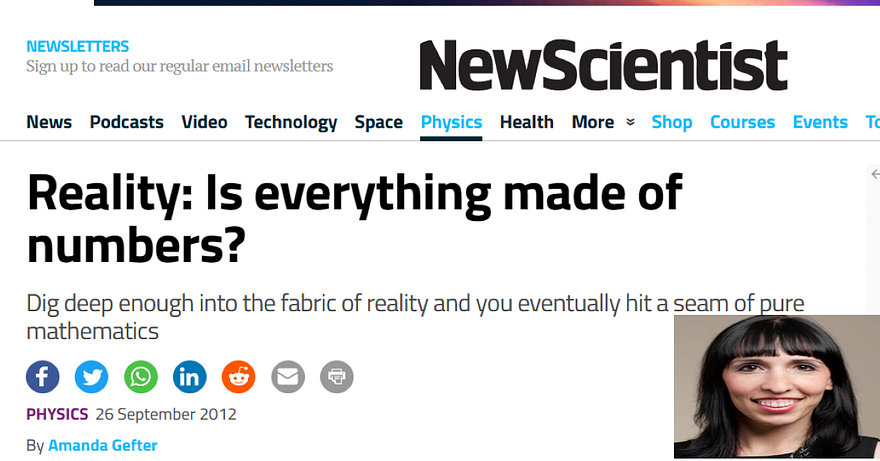
In an article called ‘Reality: Is everything made of numbers?’, the New Scientist’s Amanda Gefter sets the scene in the following way:

“When Albert Einstein finally completed his general theory of relativity in 1916, he looked down at the equations and discovered an unexpected message: the universe is expanding.”

However:

“Einstein didn’t believe the physical universe could shrink or grow, so he ignored what the equations were telling him.”

What is directly relevant to this essay is Gefter’s following question:

How did Einstein’s equations ‘know’ that the universe was expanding, when he did not?”

Interestingly, Amanda Gefter then applies the very same reasoning to Higgs particles. Indeed, she even uses the word “knows” again. (Which is also put in scare quotes.) She writes:

“How is it possible that mathematics ‘knows’ about Higgs particles or any other feature of physical reality?”

These questions have an anthropomorphic ring to them. Indeed, they’re more anthropomorphic (see here too) than some comments about ants or dolphins

So is Amanda Gefter excused from accusations of anthropomorphism simply because she puts the word “know” in scare quotes?

The problem here is that if her words aren’t taken literally, then it’s hard to think of an alternative way of taking them.

So it all depends.

Perhaps Gefter’s use of the word “know” is, at least partly, explained in the following passage from her article:

“‘Maybe it’s because math is reality,’ says physicist Brian Greene of Columbia University, New York. Perhaps if we dig deep enough, we would find that physical objects like tables and chairs are ultimately not made of particles or strings, but of numbers.”

This maths-is-reality stance will be tackled later.

So now let’s return to Gefter’s comments on Einstein ruling out an expanding universe.

Einstein Rejects the Universe’s Expansion

Much has been written about the scientific, philosophical and even religious reasons why Einstein might have (initially) ruled out the expansion of the universe. So these reasons may explain why he also rejected (to use a phrase used by many writers about many physicists) “what the mathematics was telling him” or what the maths knew.

However, the maths might not have been (as it were) running off in its own direction at all. Instead, Einstein might have simply rejected his own equations for all the reasons just mentioned. [See Einstein’s ‘Physical cosmology’.]

So it was still (perhaps paradoxically) Einstein’s own maths (or equations) which supposedly knew stuff which he didn’t know. That is, it wasn’t someone else’s maths. And it wasn’t (as it were) math’s very own maths either.

This means that maths itself (or maths alone) didn’t know that the universe is expanding.

That’s mainly because maths — i.e., on its own — doesn’t include the notions of the universe, expansion, gravity, space, matter, mass, etc. These are terms from physics and cosmology, not (pure) mathematics.

Thus, the equations which Einstein both created and used led to (physical) consequences which Einstein rejected. However, that didn’t mean that there was any genuine independence of the equations from Einstein himself. (This isn’t a reference to maths — as it were — in the abstract, but to the equations which Einstein himself created.) After all, if Einstein hadn’t recognised his famous cosmological “blunder”, then the maths still couldn’t have known anything he didn’t know. And, again, Einstein arguably rejected his own equations for reasons that had nothing to do with maths. Yet it was still his own equations which he rejected. That is, the equations which Einstein rejected didn’t create themselves, let alone show that they has applications to the notions in physics which were around in the early 20th century.

Input and Output

The New Scientist’s Amanda Gefter continues with this basic input-output scenario:

“If mathematics is nothing more than a language we use to describe the world, an invention of the human brain, how can it churn out anything beyond what we put in?”

We humans “put in” all sorts of stuff into all sorts of things. These things “churn out” all sorts of other stuff which is different to what we put in.

For example, we put coal into a stove and it churns out heat and smoke. We put data into a computer and it churns out all sorts of information which we didn’t put in.

There are literally innumerable examples of this.

So what we put in is transformed into something else. That something else is still a byproduct of what we put in. Thus heat and smoke are byproducts of putting coal in a stove. And, as many people who’re critical of the claims of artificial intelligence are keen to tell us, computers wouldn’t churn out anything if we hadn’t firstly put in the data (as well as if we hadn’t built the computer in the first place).

So perhaps this New Scientist writer has something distinct in mind when it comes to mathematics.

Well, mathematics is definitely distinct from a stove and what we we put into it. Similarly, its not like a computer or the data we put into it (though mathematical data can be fed into a computer).

But so what?

A stove isn’t a computer either. And an apple isn’t an orange.

Amanda Gefter also says that some (or many) scientists believe that maths is “nothing more than a language we use to describe the world”.

Pure Maths and Describing the World

Very few mathematicians and physicists have ever claimed that mathematics “is nothing more than a language we use to describe the world”. There is, after all, such a thing as pure mathematics (see also ‘Applied Mathematics’). That is, there is much maths which doesn’t — and perhaps even couldn’t — have any use in terms of “describing the world”.

This may be debatable, however.

Even some arcane mathematics in history came to have a use in physics. However, such maths obviously had a previous independence from physics for the simple fact that it existed for years — even hundreds of years — before physicists found a use for it.

Similarly, even those people who claim that maths is (to use Gefter’s words again) “an invention of the human brain” don’t see it simply in terms of its use in describing the world. So maths can be such an “invention”, and yet still have no use in physics — or anywhere else.

Predictably, Amanda Gefter then mentions and quotes the theoretical physicist Eugene Wigner (1902–1995).

Eugene Wigner
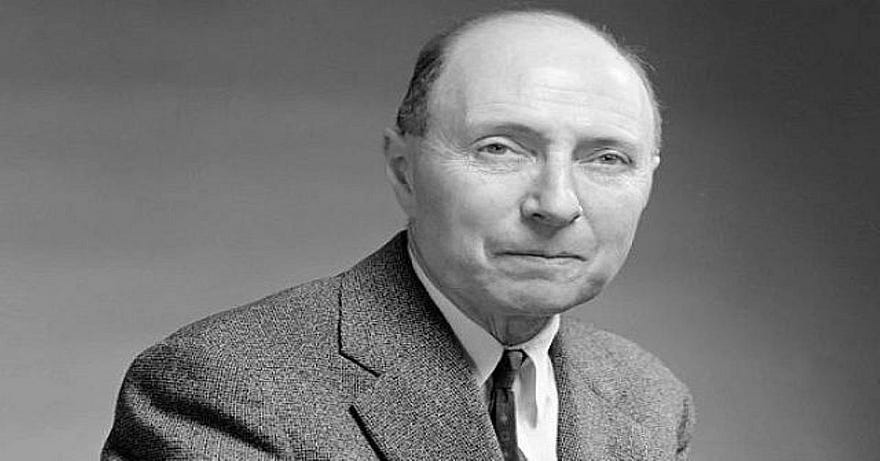
Gefter writes:

“‘It is difficult to avoid the impression that a miracle confronts us here,’ wrote physicist Eugene Wigner in his classic 1960 paper ‘The unreasonable effectiveness of mathematics in the natural sciences’ (Communications on Pure and Applied Mathematics, vol 13, p 1).”

Wigner himself also wrote:

“The miracle of the appropriateness of the language of mathematics for the formulation of the laws of physics is a wonderful gift which we neither understand nor deserve.”

So, relevantly, now let’s requote Gefter quoting Brian Greene:

“‘Maybe it’s because math is reality,’ says physicist Brian Greene of Columbia University, New York. Perhaps if we dig deep enough, we would find that physical objects like tables and chairs are ultimately not made of particles or strings, but of numbers.”

Isn’t it best to state that reality is maths (or, less strongly, reality is mathematical), rather than Brian Greene’s “math is reality”? At least that’s how Pythagoreans and many physicists have put it over the years. That said, if you reverse a mathematical identity, then nothing is really changed. Thus if we have 2 + 2 = 4, and then reverse it to 4 = 2 + 2, then we get the same result. So perhaps stating that maths is reality is the same as stating that reality is maths.

In any case, why does it automatically follow that maths knows things simply because maths is reality?

That is, even if maths is reality, it would still require physicists to know that. Physicists also need to realise that maths and reality are one and the same thing. That is, if maths is reality (or if reality is maths), then physicists would still need to construct the equations and theories which help show us that that this is the case.

Indeed, if there is a necessary — and indeed blindingly obvious — contribution from physicists to this (as it were) maths = reality equation, then that equation may not hold at all. After all, physicists often get the maths-of-reality wrong. They also offer us contradictory maths-of-reality.

The physicist and cosmologist Max Tegmark also mentions Eugene Wigner a couple of times (i.e., in his book Our Mathematical Universe). Tegmark is clearly inspired by Wigner’s well-known questions and points.

Max Tegmark
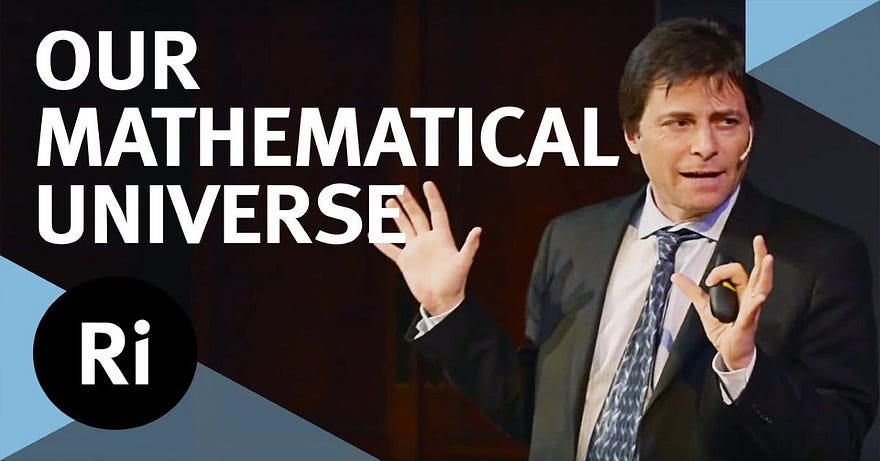
So we have the following passage from Wigner, which Tegmark quotes:

“The enormous usefulness of mathematics in the natural sciences is something bordering on the mysterious and there is no rational explanation for it.”

Albert Einstein also asked the same question in the following:

“How can it be that mathematics, being after all a product of human thought which is independent of experience, is so admirably appropriate to the objects of reality?”

… But hang on a minute!

Einstein’s following oft-quoted conclusion (as found in his ‘Geometry and Experience’) appears to be radically at odds with both Wigner’s and Tegmark’s positions:

[] In my opinion the answer to this question is, briefly, this: As far as the laws of mathematics refer to reality, they are not certain; and as far as they are certain, they do not refer to reality.”

So does the “unreasonable effectiveness” of electricity or roads also “demand an explanation”? That ironic question is asked because there are indeed explanations of maths effectiveness. However, I feel that they won’t satisfy mathematical mysterians like Max Tegmark.

The theoretical physicist Lee Smolin (1955-) also refers to “the obvious effectiveness of mathematics in physics”.

Lee Smolin
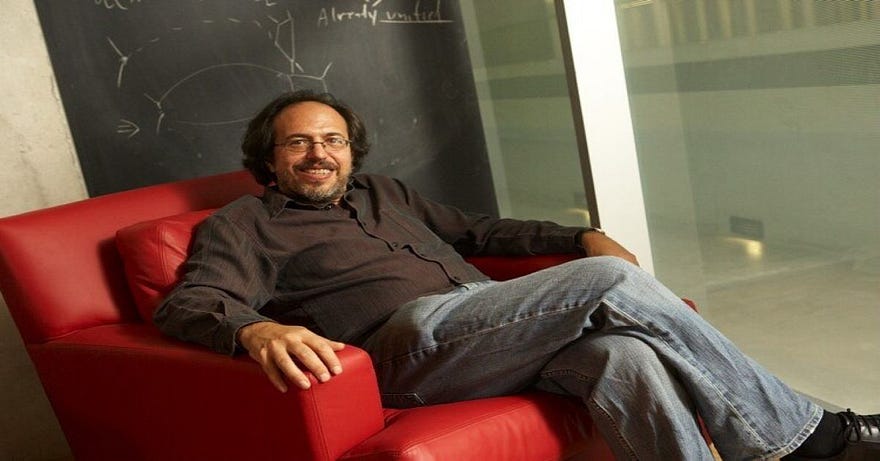
Smolin initially refers to the purely pragmatic utility of mathematics when it comes to physics.

Thus, we can all happily accept the unreasonable effectiveness of mathematics in physics.

But where do we go from there?

Smolin himself goes on to state that he has

“never heard a good a priori argument that the world must be organised according to mathematical principles”.

Again: mathematics is useful — extremely useful — in physics. So much so that there wouldn’t be any modern physics without maths. That said, it still can’t be concluded from this effectiveness that (to use Smolin’s words again) “the world must be organised according to mathematical principles”.

In other words, the unreasonable effectiveness of mathematics doesn’t mean — or have the consequence — that the world itself is (or must be) organised according to mathematical principles. Of course, it gives physicists reasons — even very good reasons — to believe that. However, the effectiveness of mathematics in physics — alone — doesn’t have the (logical) consequence that the world itself must be organised according to mathematical principles.

And it certainly doesn’t mean that (as Brian Greene put it) “math is reality” (or that reality is maths).

More specifically, when Smolin uses the words “a good a priori argument” (or simply when he uses the epistemological term a priori), he seems to be saying that many physicists simply assume that “the world” (or Nature) is mathematical precisely because of the unreasonable effectiveness of mathematics in physics

All this is very close to being a circular position. Thus:

(i) Mathematics is unreasonably effective in physics because the world itself is mathematical. 
(ii) Because the world itself is mathematical, it logically follows that the mathematics in physics will be
unreasonably effective.

However, isn’t the above like making the following (admittedly much weaker or less sexy) claim? —

(i) Cement is unreasonably effective when it comes to building houses. 
(ii) Therefore houses must be built on cement-based principles.

Later on in the same chapter, Smolin goes on to be even more explicit about these assumptions when he writes the following words:

[W]hat is both wonderful and terrifying is that is absolutely no reason that nature at its deepest level must have anything to do with mathematics.”

At first sight, this seems like an incredible claim.

Or at least one would presume that many— or even most — physicists would have (deep?) problems with Smolin’s statement.

However, that shock may simply be down — again — to the false inference (which many physicists make) from the the unreasonable effectiveness of mathematics to the conclusion that nature itself (“at its deepest level”) must be mathematical.

To repeat: we have the following line of reasoning from some (or even many) mathematical and theoretical physicists:

(i) Mathematics is unreasonably effective in physics. 
(ii) Therefore the world
itself must be organised according to mathematical principles.

Now it must be borne in mind that not all (or even most) physicists actually express (or even think — in great detail — about) these almost purely philosophical issues.

My flickr account and Twitter account.

Sunday, 18 December 2022

Are the questions “Why is water wet?” and “Why does the physical give rise to experience?” bogus?

The philosopher Valerie Hardcastle tackles the mysterian’s questions, “Why is water H₂O?”, “Why is water wet?” and “Why couldn’t water be XYZ?”. Gordon Park Baker once stated that “the unexamined question is not worth answering” and that “questions, just as much as assertions, carry presuppositions”. So can we apply Baker’s words to this mysterian’s questions?

(1) Introduction
(2) Valerie Hardcastle’s Chat With a Water-Mysterian
(3) Bogus Questions?
(4) Is This Water-Mysterian Really a Materialist?
(5) Water = H₂O
(6) Modal Imagination

This essay is primarily about Valerie Gray Hardcastle’s analysis of what she calls a “water-mysterian” and the latter’s philosophical position on water’s constitution and wetness. (This analysis is found in Hardcastle’s paper ‘The Why of Consciousness: A Non-Issue for Materialists’, which was published in the Journal of Consciousness Studies.)

The American philosopher Valerie Gray Hardcastle discusses the views of a water-mysterian because such a person is meant to be equivalent to a (well) consciousness-mysterian (see ‘New Mysterianism’). That is, mysterianism about water is supposed to be analogous (or simply comparable) to mysterianism about consciousness. Hardcastle’s example of water is, therefore, simply used to get the point across.

To show that all this is really about consciousness, on a page after all the quotes used from Hardcastle in this piece, she explicitly tells us that we have

“a good reason to think that the mind is nothing more than activity in the brain”.

More relevantly, Hardcastle tackles the water-mysterian’s questions, “Why is water H₂O?” and “Why is water wet?”.

Thus we can now rewrite Hardcastle’s words directly above:

We have a good reason to think that water’s wetness is nothing more than H₂O or the activity of H₂O molecules.

Hardcastle does indeed raise some interesting points. However, she may not be entirely fair to her opponents or correct on everything she says. What’s more, Hardcastle mightn’t have been fair to this fictional water-mysterian (or mysterians generally). Indeed, the term “water-mysterian” may itself be deemed to be a (as “postmodern” academics put it) rhetorical trope.

Valerie Hardcastle’s Chat With a Water-Mysterian

Valerie Hardcastle sets up a fictional discussion with the water-mysterian with these words:

“Let us return to the example of water being wet. Consider the following exchange. A water-mysterian wonders why water has this peculiar property. She inquires and you give an explanation of the molecular compositions of water and a brief story about the connection between micro-chemical properties and macro-phenomena.”

This water-mysterian even fully accepts the science (or chemistry) of water. Or at least Hardcastle has her state the following:

“Ah, she say, I am a materialist, so I am convinced that you have properly correlated water with its underlying molecular composition. I also have no reason to doubt that your story about the macro-effects of chemical properties to be wrong. But I still am not satisfied, for you have left off in your explanations what I find most puzzling. Why is water H₂O?”

The water-mysterian then indulges in some modal philosophy, which is strongly in hock to the (vast) philosophical literature on this subject. She finishes off with this passage:

“Why couldn’t it be XYZ? Why couldn’t it have some other radically different chemical story behind it? I can imagine a possible world in which water has all the macro-properties that it has now, but is not composed of H₂O.”

Bogus Questions?

The basic point which Valerie Hardcastle is making above (at least as I see it) is twofold:

(1) Just because a question can be asked (or simply framed), then that doesn’t mean that it can be answered. 
(2) Just because a philosophical question can be asked (or framed), then that doesn’t mean that it has any meat to it.

It can be suspected, however, that Hardcastle is actually opting for point (2), not both (1) and (2).

The problem we have here was once summed up by the American-English philosopher Gordon Park Baker.

In his ‘φιλοσοφια: εικων και ειδος’ (which can be found in Philosophy in Britain Today), Baker wrote:

“We should [] make serious efforts at raising questions about the questions commonly viewed as being genuinely philosophical. Perhaps the proper answers to such questions are often, even if not always, further questions!”

Indeed, all sorts of philosophical questions have been deemed to be profound, deep and worthy of serious thought. However, perhaps it’s just as important — and indeed just as philosophical — to ask questions about these questions (i.e., not simply to attempt to answer them). Or as Gordon Baker put it:

“The unexamined question is not worth answering.”

Baker then added the following words:

“To accept a question as making good sense and embark on building a philosophical theory to answer it is already to make the decisive step in the whole investigation.”

It’s now worth saying that there’s no need to use the word “nonsense” about the questions considered in this piece. So arguing that a particular question simply assumes that there’s an answer (or that a question can’t be answered at all), for example, isn’t a point about logical grammar (or logical form) or to claim that it’s nonsense.

[The word “nonsense” wasn’t actually used — by philosophers in the 1930s and beyond — in its everyday sense: it usually had a precise technical meaning and usage.]

Another problem is summed up by Gordon Baker:

“Questions, just as much as assertions, carry presuppositions.”

This is especially true in philosophy.

The relevant type of questions which need to be noted here are the following:

1) Why does the chemical composition of water give rise to water’s wetness?
2) “Why do physical processes give rise to experience?” (David Chalmers’ question.)

Just because a question is grammatical and even makes (some kind of) sense, then that doesn’t mean that it’s a philosophically (or otherwise) legitimate question.

To back this up, let’s use an adaptation of a well-known surreal sentence from Noam Chomsky and simply turn it into a question. Thus:

Why do colorless green ideas sleep furiously?

As stated before, one obvious “presupposition” to a question is that there’s an answer — or at least a possible answer — to it.

So what (to use Baker’s word) “presuppositions” are hidden in the following questions? -

(1) Why is water H₂0?
(2) Why is water wet?
(3) Why couldn’t water be XYZ?

So can the same kind of point be made about this well-known question from the Australian philosopher David Chalmers? Namely:

“Why should physical processing give rise to a rich inner life at all?”

As stated in the introduction, Chalmers’ question is quoted because Valerie Hardcastle is actually using the case of water as an analogy: she really has consciousness-mysterians in mind.

Is This Water-Mysterian Really a Materialist?

It seems odd that Hardcastle's fictional water-mysterian should class herself as a “materialist”. So I suspect that Hardcastle classes her as a “materialist” simply to get her point across.

That point is that this water-mysterian is a materialist purely and simply because she accepts literally all the science about water’s chemical composition.

That isn’t materialism.

So in the water-mysterian’s (or Hardcastle's) words, she is

“convinced that [the scientist has] properly correlated water with its underlying molecular composition”.

Indeed, she has

“no reason to doubt that [the scientist’s] story about the macro-effects of chemical properties to be wrong”.

However, this water-mysterian also believes that there’s still something which is over and above the science: the wateriness of water!

But is there?

This debate connects to a larger issue.

Water = H₂O

One main focus in this larger debate has been on the differences between water’s “microscopic” (or “microstructural”) properties and its “macroscopic” properties. Added to that (though related to macroscopic properties) is the emphasis which has inevitably been made on our phenomenological (or phenomenal) experiences of water.

Thus, it seems to be the phenomenal experiences of water which Hardcastle’s water-mysterian focusses upon.

However, does she also take these (as philosophers put it) phenomenal feels to be intrinsic to water (or H₂O) itself?

Thus, partly because of these distinctions, one immediately wonders what more this water-mysterian would want after being being given

“an explanation of the molecular compositions of water and a brief story about the connection between micro-chemical properties and macro-phenomena”.

What more could there possibly be to this story?

Unless the (as it were) remainder is how water feels to human beings (i.e., how water feels wet, tastes, looks, etc.).

But that wouldn’t be a chemical story about water itself.

Instead, it would be a more general story about H₂O and its effects on the physiological and sensory systems of human beings, as well as on human minds. Thus, it wouldn’t really be about water’s wetness as it exists separately from minds or experiences — that’s if water can be deemed to be wet in this context.

What’s more, when this fictional water-mysterian (or Hardcastle!) says that the chemist has “properly correlated water with its underlying molecular composition”, this clause is a little problematic.

In one sense, water isn’t correlated with its “underlying molecular composition”: it is its underlying molecular composition!

Yet in terms of Saul Kripke’s a posteriori necessity, when it comes to our knowledge of water’s phenomenal properties and their relations to the underlying molecular composition (or structure) of water, then such correlations are indeed made. That is, even though water = H₂O, it still doesn’t follow that we could know that simply by examining water’s phenomenal properties or even by analysing water in any other (non-chemical) ways. (Conceivably, chemists might have got things wrong about water’s chemical constitution.)

So what we know about water is indeed correlated with its underlying molecular composition. Yet, in another sense, you can’t literally correlate water with H₂O with H₂O with water. Thus such correlations must be between what we phenomenally experience and know, and water’s underlying molecular composition.

Yet water’s wetness is water’s being H₂O.

Or is it?

Hardcastle’s water-mysterian then makes much of her own powers of imagination. So now let’s tackle that.

Modal Imagination

In the following passage, the water-mysterian puts her case for the importance of what can be called modal imagination:

“Why couldn’t it be XYZ? Why couldn’t it have some other radically different chemical story behind it? I can imagine a possible world in which water has all the macro-properties that it has now, but is not composed of H₂O.”

It can be seen that this water-mysterian relies a hell of a lot on the fact that she can (to use her own word) “imagine” various things. Or, to put that another way, she relies on possible worlds.

That said, the water-mysterian relies on possible worlds because she can imagine possible worlds (as well as their nature and what occurs in them). So, in at least some instances, possible-worlds-talk is utterly dependent on imagination — or at least on (as philosophers usually put it) conceiving possible worlds, their nature and what occurs within them.

Yet what does it mean to claim that water “could [] have some other radically different chemical story behind it”?

Could it?

More relevantly, what, exactly, is this water-mysterian imagining?

Surely it’s the case that in order to imagine that water is XYZ (i.e., rather than H₂O), then wouldn’t this mysterian need to do more than simply invent (or simply use) the letters XYZ? And wouldn’t she also need to do far more than simply ask, “Why couldn’t it be XYZ?”? Wouldn’t she need — at the least — to tell us something about XYZ itself? That is, wouldn’t she need to tell us at least something about XYZ’s chemical nature and its resultant “macro-effects”? In other words, we’d need an

“explanation of the molecular compositions of [XYZ] and a brief story about the connection between micro-chemical properties and macro-phenomena”.

Surely, then, it simply isn’t enough to state that you imagine XYZ or ask, “Why couldn’t it be XYZ?”. After all, if all we’ve got are the letters XYZ, then she’s not really imagining anything at all. Basically, so far there’s nothing scientific, empirical or even metaphysical about her claim. Indeed, even her acts of modal imagination may be completely empty. In other words, perhaps there’s simply no meat on what she states.

Of course, mountains of papers and articles have been written about possible worlds, the powers of conceiving (or imagining), etc. by philosophers. However, it’s not clear if any of that vast literature would answer these questions.

But that’s another story.

***********************************

My flickr account and Twitter account.


Thursday, 15 December 2022

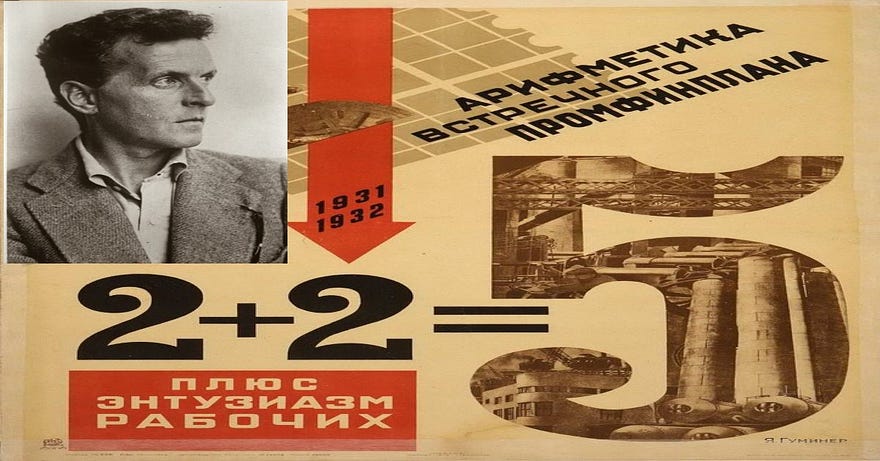
Ludwig Wittgenstein on the Arithmetical Statement “2 + 2 = 4”

The philosopher Michael Dummett called Ludwig Wittgenstein a “full-blooded conventionalist” and even an “anarchist” when it came to his philosophy of mathematics. Other philosophers — mainly Wittgensteinians — strongly reject these accusations. Nonetheless, convention — obviously! - plays a part in mathematics.

Firstly, it must be said that that it’s hard to tie all of Ludwig Wittgenstein’s positions and comments on mathematics together into a single ism. (Not that putting a philosopher in a neat and tidy box is of supreme importance.) And that may not simply be because Wittgenstein’s views are “so deep”. It may partly (or even largely) be because Wittgenstein’s prose style makes things very difficult. And it may also be because Wittgenstein is believed to have contradicted himself at various places — even during the same “period”.

Of course, it would be up to me to demonstrate all this with mountains of textual exegesis, which many Wittgenstein-obsessed writers and philosophers have indeed endlessly done over the decades (i.e., in order to advance their own hermeneutics of Wittgenstein). (See ‘Taking Wittgenstein at His Word: A Textual Study’ by Robert Fogelin.)

Conventionalism

The word “conventionalist” will be used in this essay. This is how many philosophers — and others — have seen Wittgenstein’s (“late”) philosophy of mathematics. (See ‘Convention’.) That’s certainly how the philosopher Michael Dummett (1925–2011) saw Wittgenstein’s philosophy of maths. Indeed, Dummett used the rhetorical words “full-blooded conventionalist” and even “anarchist” about Wittgenstein’s philosophy.

Dummett expressed Wittgenstein’s position in this way:

“What makes a [mathematical] answer correct is that we are able to agree in acknowledging it as correct.”

Yet Dummett’s very own verificationism seems (at least to some extent) conventionalist in nature. (See ‘Verificationism’ and ‘Dummett’s Verificationism’.) So perhaps all this is largely a dispute regarding the semantics of the term “conventionalism”.

That said, Dummett’s words (directly above) about Wittgenstein’s philosophy of mathematics may not be entirely about (mere) convention. After all, there also needs to be some kind of agreement about (what are taken to be) mathematical truths — otherwise we’d be in the situation in which an individual mathematician could have his own truths about his own mathematical statements, and even his own individual ways of establishing such truths.

So there must be some form of intersubjectivity involved here.

And in order to achieve that, conventions will be at least part of the story.

Of course, many Wittgenstein experts dispute the categorisation of “conventionalist”. (The Wittgenstein acolyte P.M.S Hacker regards it as blasphemy — see here.) That’s partly because disputes on “what Wittgenstein really meant” are legion.

Yet such experts can cite Wittgenstein’s own words to back up their positions.

For example, in Wittgenstein’s Remarks on the Foundations of Mathematics (which is largely made up of posthumously-published lectures, etc.), we have this:

“Mathematical truth isn’t established by their all agreeing that it’s true.”

As well as the following from the same book:

[I]t has often been put in the form of an assertion that the truths of logic are determined by a consensus of opinions. Is this what I am saying? No.”

So Wittgenstein-was-not-a-conventionalist philosophers may well have a point — as we shall soon see.

The Arithmetical Statement “2 + 2 = 4”

What does Wittgenstein’s general position on mathematics amount to?

To make things simpler: what about Wittgenstein’s take on a single arithmetical statement - say, “2 + 2 = 4”?

Firstly, Wittgenstein makes a distinction between a reading of a mathematical statement in terms of the (simply put) conventions it abides by, and what that statement actually means.

So is it the case that the statement “2 + 2 = 4” is taken to be true entirely because of the conventions we use?

It certainly the case that the symbols in that arithmetical statement are conventional. That is, we needn’t have used the symbols “2”, “+”, “4” and “=”. (Other cultures have different numerals and symbols for numbers.) We could just as easily have used the symbols and words “flip”, “flop”, “@” and “Kripke”.

So what about the meaning of the statement “2 + 2 = 4”?

On a simplistic, naive or even political reading, someone may say that the meaning of the statement “2 + 2 = 4” is the following:

Our society, at one point in history, decided that ‘4’ is the sum of ‘2 + 2’.

Of course this must mean that “our society” must also have decided what the word “sum” means and also what the symbols “+”, “=” and “2” mean. (That’s only if individual symbols can have a meaning outside of their statemental/sentential — and larger — contexts.)

In any case, Wittgenstein himself expressed a very simple argument against this position.

In his Philosophical Investigations, Wittgenstein wrote the following:

“Certainly, the propositions ‘Human beings believe that twice two is four’ and ‘Twice two is four’ do not mean the same.”

The meaning of the statement “2 + 2 = 4” can’t literally be, “Our society, at one point in history, decided that ‘4’ is the sum of ‘2 + 2’” (or anything similar to that).

Those words are, after all, a description of symbol-use, historical and sociological facts, etc. And such descriptions may also include facts and views about why, when and how Western culture made these decisions about these symbols.

In any case, the statement “Our society, at one point in history, decided that ‘4’ is the sum of ‘2 + 2’” could be applied to any arithmetical or mathematical statement. Or, more accurately, the clause “Our society, at one point in history, decided that […]” could be applied to any statement.

So those words (or facts) can’t be the meaning of this particular mathematical statement. That is, talk of symbols, conventions, history, etc. won’t tell us about a particular mathematical statement.

Platonism and the Techniques of Mathematics

Wittgenstein offered a position on mathematical statements which may (repeat: may) seem conventionalist. Indeed, Wittgenstein’s anti-Platonism can appear to go in a conventionalist direction.

Wittgenstein’s philosophy of mathematics can also be seen as going in a sociological, psychological and even (as some have argued) “anthropocentric” direction. (None of these things automatically contradict conventionalism.)

Yet Wittgenstein himself went way beyond mere talk of convention.

For example, Wittgenstein wrote:

“The proposition is grounded in a technique. And, if you like, also in the physical and psychological facts that make the technique possible.”

Technique?

Well, Wittgenstein himself provided an everyday example of this. He wrote:

“I say to, ‘You know what you’ve done so far. Now do the same sort of thing for these two numbers.’ [] Now everybody is taught to do it — and now there is a right and wrong. Before there was not.”

If Wittgenstein was arguing exclusively against mathematical Platonists, then surely it can’t be said that such people would have disagreed with his words directly above. (As ever with Wittgenstein, that depends on how his words are read or interpreted.)

Few mathematical Platonists — or few people — would deny that mathematics is “grounded in a technique” (or in techniques in the plural) — even if that technique is itself grounded in an abstract Platonic realm. That is, even if a Platonic realm does exist, then mathematicians and laypersons will still require techniques, skills, symbols, conventions, particular psychological states, etc. in order to (as it were) access that realm.

Moreover, who’d argue that these facts about mathematical technique/s would constitute the “sense” (or the meaning) of the statement “2 + 2 = 4” — or the meaning of anything else in mathematics for that matter?

Again, few mathematical Platonists or anti-conventionalists would deny that conventions — and what Wittgenstein called “practices” — are required when it comes to communities of mathematicians or even the many laypersons who use mathematics. And, again, it’s hard to believe that anyone believes that the facts about techniques, psychological states, symbol-use, etc. constitute the meaning (or sense) of “2 + 2 = 4”.

Of course, all this will depend on what, precisely, Wittgenstein meant by the word “sense”. Indeed, it will also depend on what Wittgenstein took other philosophers to have meant by that word.

Yet it’s clear here that Wittgenstein did believe that at least some philosophers did take the technique (as it were) behind the statement “2 + 2 = 4” to be the sense.

So all this must also mean that, on a Wittgensteinian reading, the statement “2 + 2 = 4” must also be grounded in a technique.

And that technique will also be grounded on the adder’s knowledge of the symbols, how he was taught arithmetic, etc. It will also depend on his or her psychology, psychological states, etc…

But so what?

Again, why would a mathematical Platonist — or anyone else — deny all that?

So who was Wittgenstein arguing against?

Perhaps Wittgenstein’s conclusion to the passage above answers that question. He continued:

“But it doesn’t follow that its sense is to express these conditions.”

These words seem to go against any purely conventionalist reading of Wittgenstein’s position. That is, obviously mathematical conventions exist. However, there is — or must be — more to the story of mathematics than that.

More particularly, the sense of the statement “2 + 2 = 4” isn’t merely about conventions, symbols, techniques, psychological sates, “rules”, historical facts, etc.

Yet strangely enough, Wittgenstein himself used the word “proposition” in the third-to-last passage above.

So what is a (mathematical) proposition?

Mathematical Platonists — and others — will make a distinction between the (abstract) proposition itself (say, 2 + 2 = 4) and everything else. Indeed, even Wittgenstein himself said that the proposition “is grounded in a technique”. That too hints at a separation between the proposition itself and the (later?) technique (plus everything that’s part of that technique).

Yet Wittgenstein didn’t actually believe that the statement “2 + 2 = 4” is about a proposition (or that it “states a proposition”). That is, the symbolic statement “2 + 2 = 4” doesn’t tell us about (or refer to) the abstract reality that is (supposed to be) 2 + 2 = 4 (or 2 plus 2 equalling 4).

Conclusion

In general terms, Wittgenstein appeared to conflate (or perhaps simply distinguish) convention and intersubjectivity with (mere) “opinions” and “convictions”. In Remarks on the Foundations of Mathematics, for example, he wrote:

“The agreement of people in calculation is not an agreement in opinions or convictions.”

So, instead, Wittgenstein focused on psychological habits, empirical regularities (i.e., the objects we count, things generally, etc.) and, indeed, on a “form of life”. In other words, Wittgenstein characteristically believed that mathematics isn’t about “agreement in opinions or convictions”: it’s about a form of life.

************************************

Note: What is a Statement?

The word “statement” was used many times in the essay above. That word was used instead of “proposition”. Yet some philosophers use the word “statement” as a synonym of “proposition”. That is, they argue that “different sentences can express the same statement”. Other philosophers say: “Different sentences can express the same proposition.” Thus, in that sense, a statement is taken to be as abstract as a proposition.

In the essay above, however, statements are taken to be natural-language sentences — or grammatical “strings” of symbols — which are either true or false. That is, statements aren’t taken to be abstract objects or entities in the mind or brain.

Of course all this is complicated by the fact that three (not two) distinctions have been made in philosophical literature. That is, distinctions have been made between sentences, statements and propositions.

A statement has been taken to be a sentence that’s either true or false. This conception of a statement is roughly identical to the position on a proposition. However, a statement has also been seen as the “semantic content of a meaningful declarative or descriptive sentence”. And so on and so on.