Sunday, 19 March 2023

Stephen Jay Gould on Science and Religion: The Politics of “Non-Overlapping Magisteria”

This essay doesn’t (as it were) have a go at religion. Instead, it simply highlights how poor Stephen Jay Gould’s arguments are. Indeed, it also argues that Gould’s arguments are poor precisely because his prime motivation was one of political diplomacy between science and religion. It should also be noted here that this essay doesn’t even consider Gould’s crude and simplistic advocacy of the fact/value distinction, as it applies to science and religion.
(i) Introduction: Non-Overlapping Magisteria?
(ii) Gould’s Political Stance on Science and Religion
(iii) Gould’s Diplomacy When it Came to Religion
(iv) More on Gould’s Political and Diplomatic Stance
(v) Gould’s Other Motivations

Stephen Jay Gould (1941 — 2002) was an American palaeontologist, evolutionary biologist and a historian of science.

Gould was also known for his popular essays (one of which is central to this piece) in the magazine Natural History, and also for his best-selling books.

Introduction: Non-Overlapping Magisteria?

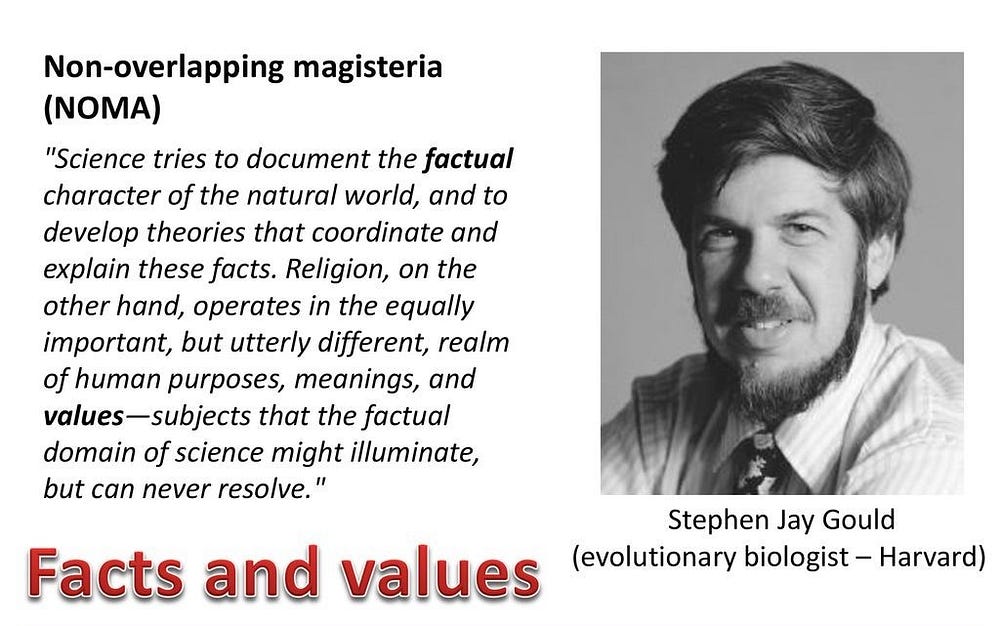
Stephen Jay Gould first expressed the position focussed upon in this essay in 1997. It can be found in an essay called ‘Non-overlapping Magisteria’, which Gould wrote for Natural History magazine. (He used it again in his 1999 book, Rocks of Ages: Science and Religion in the Fullness of Life.)

Gould’s most absolute and categorical expression of his science-religion division (abbreviated to NOMA) can be found in his simple statement that “[t]hese two magisteria do not overlap”.

Interestingly enough, the National Academy of Sciences also adopted a stance (in 1999) which was very much like Gould’s own. Its publication Science and Creationism stated the following:

“Scientists, like many others, are touched with awe at the order and complexity of nature. Indeed, many scientists are deeply religious. But science and religion occupy two separate realms of human experience. Demanding that they be combined detracts from the glory of each.”

[The National Academy of Sciences sees “political commitment” and “political engagement” as part of its remit — see here. Perhaps this was at least partly down to scientist-activists like Richard C. Lewontin — a friend of Gould and fellow member of the political group Science for the People — claiming that the NAS should take political positions on certain scientific subjects and issues. (See Lewontin’s ‘Why I Resigned from the National Academy of Sciences’, written in 1971.))

Readers may be surprised to know that Gould borrowed the term “magisterium” from Pope Pius XII’s encyclical Humani generis (1950). That’s said because Gould was a socialist. Indeed, according to many and even himself at times, he was a Marxist (see here). So note here that Gould most certainly wasn’t a Christian socialist. And he wasn’t a practising Jew either. He was an atheist (see here). That said, there’s much dispute on whether Gould was an out-and-out Marxist and an out-and-out atheist. Perhaps, then, Gould’s artful ambivalence on these classifications was politically and strategically —i.e., not philosophically — motivated. That is, it wasn’t really a result of Gould’s deep sophistication on matters of religion and science.

Gould’s politics has just been mentioned.

Gould’s Political Stance on Science and Religion

It can easily be argued that Stephen Jay Gould came up with his “non-overlapping magisteria” idea primarily for political reasons. That is, he believed that it’s far too politically dangerous to have a (as some commentators have put it) “crude and simplistic” attitude toward religion. In fact, in various and many places, Gould virtually admitted his political motivations on this subject (as we shall see throughout this essay).

Gould’s basic idea (which he sometimes stated outright) is that the various and many religions have so many adherents, have such a long history, and that religious people feel so very strongly about their chosen religion, that it would be politically crazy and (as it were) sadistic to take a strong line on them. (Professor of Psychology CiarĂ¡n Benson speaks in rhetorical terms about science being “sadistic” toward religion when it attempts to enforce “a brand of SM bondage of the others by the scientific magisterium”.) Indeed, it can even be argued that Gould believed that it would be crazy and sadistic to tell the truth about any of the many chasms and conflicts which obviously exist between religion and science.

So Gould’s position was essentially political.

Indeed, the fact that there are such chasms and conflicts between religion and science was precisely why Gould concocted his non-overlapping magisteria (NOMA) idea in the first place.

In Gould’s own words:

“Religion is too important to too many people for any dismissal or denigration of the comfort still sought by many folks from theology.”

The problem here is both simple and obvious.

Gould’s notion of non-overlapping magisteria seems to leave all religions (as well as all their claims) untouched by anyone on the outside. Or, at the very least, it leaves religions and their claims untouched by science.

It should also be said that religion would become untouchable if scientists, politicians, philosophers and everyone else followed Gould’s NOMA idea.

And, of course, if religion is untouchable by science, then it’s probably also untouchable by anything else… at least if the (as it were) touching is in any way negative or critical.

Stated in that way, then, Gould’s idea is quite incredible and indeed very dangerous. (Ironically, a cursory view of Gould’s political pronouncements — i.e., outside his NOMA idea — will show that he didn’t practice much political or, indeed, scientific diplomacy.)

It can now be said that Gould’s religion-science division is far too neat and tidy. It’s also far too convenient.

Gould’s Diplomacy When it Comes to Religion

It was just mentioned that Gould’s NOMA idea is far too neat, tidy and convenient. Indeed, Gould recognised this in the following passage:

“Each [] subject has a legitimate magisterium, or domain of teaching authority. [] This resolution might remain all neat and clean if the nonoverlapping magisteria (NOMA) of science and religion were separated by an extensive no man’s land. But, in fact, the two magisteria bump right up against each other, interdigitating in wondrously complex ways along their joint border.”

In basic terms, then, the logic of this argument is poor. After all, at one point in history (say, the late 1930s), there were tens of millions of Nazis in Europe and beyond. And, at another point in history (say, the 1940s), there were also tens of millions (perhaps over a hundred million) communists. (Many of them were full-blown supporters of Joseph Stalin.) So should we have refrained from (to change the tense of Gould’s own word) dismissing their views too?

What about today?

In 2023, there are tens of millions Islamists or “radicals”. (Some argue that there are between 180 million to 300 million Islamists or radicals.) And there are also millions of “Christian fundamentalists”. (I suspect that many people will question the terms “Islamists”, “radical” and “fundamentalist”.) So should we refrain from dismissing their views?

However, if Gould didn’t include Islamists, Christian fundamentalists, etc. in his religious magisterium, then how did he rationalise that selectivity? Would he have resorted to politics again? (Gould would have no doubt believed that my comparisons — or analogies — are unfair.)

So are (specific?) religions special?

Gould certainly believed that religion is special. And, as such, he also believed that religion should be treated as something special.

More on Gould’s Political and Diplomatic Stance

Gould’s desire for diplomacy (or at least diplomacy toward religion) was displayed when he told us that

“NOMA enjoys strong and fully explicit support, even from the primary cultural stereotypes of hard-line traditionalism”.

Gould continued by saying that NOMA is a

“sound position of general consensus, established by long struggle among people of goodwill in both magisteria”.

Gould’s political diplomacy was also based on body counts. He once stated that, according to polling data at the time, 80 to 90% of Americans believed in God. Thus, Gould concluded by stating that

“we have to keep stressing that religion is a different matter, and science is not in any sense opposed to it [if scientists don't accept that, then] we’re not going to get very far”.

… Except that Gould did not believe in diplomacy in all areas. As a political “radical”, he certainly didn’t believe in diplomacy toward the many people he deemed to be Nazis and fascists. And, arguably, Gould wasn’t known for his diplomacy toward those scientists who offered theories he believed to be (as many people on the Left often put it) “politically dangerous”. (As Gould expressed when a member of the political group Science for the People. See here.) And he wasn’t particularly diplomatic toward capitalists, Republicans, etc. either.

So, again, it’s clear that Gould gave religion a special status.

Gould’s political diplomacy was made even more clear when he described NOMA as a

“blessedly simple and entirely conventional resolution to [] the supposed conflict between science and religion”.

The words “supposed conflict between science and religion” are utterly bizarre. More particularly, the word ”supposed” is the prime offender.

Of course, there has been much conflict between science and religion. So surely Gould couldn’t have meant that there had been no conflict. Does that mean, then, that Gould believed that, in actual fact, there should be no conflict?

This depends on how strongly one takes the word “conflict” and on particular examples. In any case, perhaps there would be no conflict at all if everyone on both sides accepted and embraced Gould’s own idea of non-overlapping magisteria

But they don’t!

And why should they?

Indeed, is this truce or pact even likely on a large scale?

Gould’s Other Motivations

Gould wrote:

“NOMA also cuts both ways. If religion can no longer dictate the nature of factual conclusions residing properly within the magisterium of science, then scientists cannot claim higher insight into moral truth from any superior knowledge of the world’s empirical constitution.”

So did Gould allow religion (as it were) free reign because he wanted to secure a reciprocal freedom for science?

Again, this just seems like a purely political and diplomatic advocacy of a truce.

Not that there’s anything wrong with diplomacy or with truces.

The point here, then, is that this is what Gould was doing and that should be made clear. Indeed, it all seems somewhat obvious.

Again, NOMA is so neat and tidy precisely because it was Gould’s political attempt at a diplomatic truce between religion and science. In philosophical and even scientific terms, however, Gould’s arguments are very poor. And that, again, is primarily because his main (or even only) aim was to create a political truce between science and religion.

What’s more, Gould (kinda) admitted this in various places.

Of course, Gould didn’t use the word “political” to describe NOMA. Instead, he — at least partly — saw it as being a diplomatic position. (In his own words, NOMA is “very practical”.)

It can safely be said that Gould would have denied any accusations of being motivated exclusively by politics and diplomacy.

For example, in a speech to the American Institute of Biological Sciences, Gould said the following:

[T]he reason why we support that position is that it happens to be right, logically.”

Yet he immediately continued:

“But we should also be aware that it is very practical as well if we want to prevail.”

[Gould also stated that his position was not “a mere diplomatic stance”.]

Thus, Gould was hinting at (or simply stating) that there was a perfect and very convenient match between what is “right” and logical, and what is diplomatic.

How neat, tidy and convenient that is. Indeed, how political it really is.

Finally, if securing a truce between religion and science is so important, and it should be brought about (as the phrase has it) “by any means necessary”, then perhaps I shouldn’t have written this critical essay on Gould’s idea of non-overlapping magisteria.

********************************

Notes:

(1) The fact-value distinction is a minefield. See a critical account of Stephen Jay Gould’s own use of the distinction here.

(2) There is another way of making sense of Gould’s political diplomacy toward religion.

Take one of the reasons why many people on the Radical Left have become largely (sometimes completely) uncritical of religion.

For over a hundred years, millions of Marxists and/or communists held very strong and aggressive positions against religion. That was the case until the 1960s and beyond. Indeed, all this can be dated back to Karl Marx’s “opium of the people” and all that. It can also be said that if religion is a “mere epiphenomenon” of economic and political realities, then its claims can neither be true nor fully respected.

However, if religion is indeed the opium of all the oppressed who exist within capitalist systems (as well as “the sigh of the oppressed creature”), then there’s little point in getting angry with — or even critical about — religion and the religious. Indeed, the opposite may be a better political and strategic position for the those on the Radical Left.

So was this Stephen Jay Gould’s own position?

Some contemporary Marxists have also offered us more (so it’s argued) “sophisticated” and “nuanced” — or politically diplomatic and strategic — interpretations of what Marx and other communists said about religion.

In any case, things quickly changed.

I believe the main reason for that was demographics and ethnicity. It came to be seen that many religious people in Europe and America were not “white”. Thus, it also came to be seen that it may be (or is) politically dangerous to criticise the religions of people who aren’t white. More specifically, the term “racist” then came to be used against the critics of Islam (e.g., by the Socialist Workers Party and many other groups and individuals).

Of course, some critics of Islam are indeed racist.

The Guardian newspaper is a good example of this new trend on the Left.

Over the decades, the Guardian published very many articles which were strongly — sometimes fiercely — critical of Christianity. Then that changed — seemingly overnight. The Guardian (or at least a few Guardian journalists) came to realise that many religious people in the UK were Muslims. And most Muslims aren’t white. Thus, it concluded that attacks on Islam were often (sometimes always) what it called “racist”. (This all occurred quite recently — in the late 1990s and 2000s.)

This about-turn on religion as a whole was largely the result of the work of particular Guardian journalists. However, it also seems to have become the Guardian’s general editorial stance. (This new attitude toward religions is deemed to be more “nuanced” and “sophisticated” by those journalists and writers who expressed it.)

Of course, there are exceptions to this trend in the Guardian, as displayed by a handful of pieces which are still critical of religion.

More relevantly, Stephen Jay Gould himself would have certainly noted the ethnicity (or colour) of many religious people in the United States. And, to put it simply, he would have then concluded that this racial and religious reality had important political ramifications.

[The Guardian journalist Andrew Brown is a good example of all the above. See his ‘Why I don’t believe people who say they loathe Islam but not Muslims’. See also the paper ‘The Racialization of Muslims: Empirical Studies of Islamophobia’ by Steve Garner and Saher Selod, which explicitly states that the criticism of Islam is racist. Indeed, what came to be called “Islamophobia” was — and still is — widely deemed to be entirely racist by many of the people who use that term.]

My flickr account and Twitter account.


Wednesday, 15 March 2023

Physicist Paul Davies’s Deep — or Specious! — Questions About Life, the Universe and Everything

Physicist and popular science writer Paul Davies asks his readers a fair amount of deep questions… But are his questions deep? Perhaps Davies’s questions only seem to be deep. In any case, many people are very good at asking deep questions about life, the Universe and everything. Some people also believe that they have very good answers to these deep questions. Indeed, Davies himself has some deep answers to his own deep questions.

(i) Introduction
(ii) Paul Davies’s Deep or Specious Questions?
(iii) Kitty Ferguson’s Deep or Specious Questions?
(iv) Conclusion

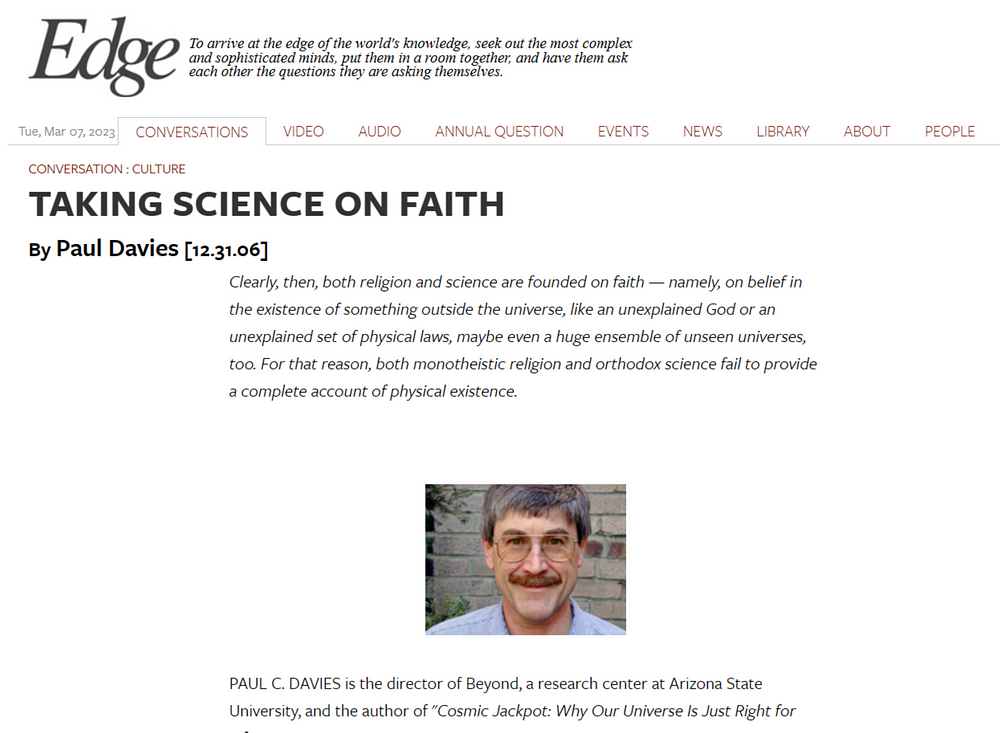
This essay is a follow-up to my previous piece, ‘Physicist Paul Davies’s Faith in His Idea That Science is Founded on Faith’. Each essay is largely a response to Davies’s own op-ed article for the New York Times, ‘Taking Science on Faith’.

But, firstly, a few things need to be said.

An obvious reaction to the overall position expressed in this essay is to say that it’s philistine, crude, tribal and/or even lazy. That is, the rejection of these deep questions (or simply the questioning of them) will be seen to be philistine, crude, tribal and/or lazy by some of the people who hold similar views to Paul Davies. (Perhaps these people would also use the word scientistic about my overall position.) Indeed, Davies himself (kinda) hints at this stance in both his position on all those scientists he believes take science on faith; and, more particularly, to some of the critics of his op-ed article (see here).

Indeed, rejecting (or simply questioning) these questions could be a sign of a crude, philistine, tribal and/or lazy mind. However, that needn’t be the case. These deep questions have, after all, been questioned by many philosophers and scientists (including Ludwig Wittgenstein) for philosophical and logical reasons. That is, they haven’t simply been questioned (or rejected) for the hell of it or because these critical scientists or philosophers couldn’t be bothered finding out the answers. In other words, such philosophers and scientists have provided reasons for — and also justified — their criticisms of the these (supposedly) deep questions.

Paul Davies’s Deep or Specious Questions?

Physicist Paul Davies (1946 — ) discussed the dearth of deep answers when he wrote the following:

“If one traces these reasons all the way down to the bedrock of reality — the laws of physics — only to find that reason then deserts us, it makes a mockery of science.”

So the following is an example of a deep question:

Why are the laws of physics the way that they are?

To put Davies’s question in its original context:

“Over the years I have often asked my physicist colleagues why the laws of physics are what they are. The favorite reply is, ‘There is no reason they are what they are — they just are.’ The idea that the laws exist reasonlessly is deeply anti-rational.”

Davies also asks the following questions:

“[W]here do these laws come from?”
“[W]hy do they have the form that they do?”

What if these deep questions are themselves problematic?

That is, what if it’s not only the answers (or lack thereof) to these questions which is problematic, but the questions themselves?

The philosopher Gordon Park Baker (1938–2002) is of some help here.

In his ‘φιλοσοφια: εικων και ειδος’ (which can be found in Philosophy in Britain Today), Baker once wrote:

“We should [] make serious efforts at raising questions about the questions commonly viewed as being genuinely philosophical. Perhaps the proper answers to such questions are often, even if not always, further questions!”

All sorts of questions have been deemed to be deep, profound and worthy of serious thought. However, perhaps it’s just as important — and indeed just as philosophical — to ask questions about these questions. Or as Gordon Baker also put it:

“The unexamined question is not worth answering.”

Baker continued:

“To accept a question as making good sense and embark on building a philosophical theory to answer it is already to make the decisive step in the whole investigation.”

In addition, another problem is summed up by Gordon Baker. Thus:

“Questions, just as much as assertions, carry presuppositions.”

For variety’s sake, another deep question can be cited here:

(1) Why does the physical give rise to consciousness?

(In David Chalmers’ own words: “How do physical processes give rise to experience?” )

Now for a question that’s more relevant to the case of Paul Davies:

(2) Why are the constants of nature the way they are? (Or: Why do the laws of physics have the numerical values which they do have?)

Question (1) is specific to the philosophy of consciousness. And question (2) is very similar to Davies’s own questions.

(1) and (2) appear to be perfectly legitimate questions. Indeed, they may also appear to be deep questions. Or in the words of the theoretical physicist Sean M. Carroll:

“Why do the laws of physics take the form they do? It sounds like a reasonable question, if you don’t think about it very hard.”

Carroll goes on to state the following:

“And these questions have sensible answers — the sky is blue because short wavelengths are Rayleigh-scattered by the atmosphere, your car won’t start because the battery is dead, and Cindy won’t answer your emails because she told you a dozen times already that it’s over but you just won’t listen. So, at first glance, it seems plausible that there could be a similar answer to the question of why the laws of physics take the form they do.
“But there isn’t. At least, there isn’t any as far as we know, and there’s certainly no reason why there must be.”

So simply because a question is grammatical and even makes (some kind of) sense, then that doesn’t also mean that it’s a philosophically (or otherwise) legitimate question.

To back these claims up with an extreme (or even silly) example, let’s use a reworking of Noam Chomsky’s well-known surreal sentence. Namely:

Why do colorless green ideas sleep furiously?

However, now let’s take a question which some people have actually asked:

Why is water H₂O?

A (possible) answer is being presupposed in my own examples and perhaps with Davies’s questions too. That is, the very asking of these questions means that the questioner must assume that there are answers — at least answers in principle.

Yet, to use the words of Baker again, aren’t these questioners “taking certain things for granted”? That is, aren’t they primarily taking for granted that their questions are legitimate and that there are answers? Moreover, aren’t these questioners also “put[ting] some things beyond question or doubt”, as well as “treat[ing] some things as matters of course”?

Kitty Ferguson’s Deep or Specious Questions?

American science writer Kitty Ferguson (1941 — ) also asked various deep questions (as found in her bestselling book The Fire in the Equations).

For example, Ferguson asked us why the “fundamental forces” are the way they are. (This question also ties in with her other questions about their necessary or contingent nature.) Ferguson writes:

[N]o scientific theory we have at present can tell us why the speed of light and the strengths of the fundamental forces of nature are what they are.”

So let’s reformulate that passage as a simple question:

Why is the speed of light, the strengths of the fundamental forces of nature, etc. the way that they are?

Can we dare to say that these values and strengths just are the values and strengths that they are?

After all, they have to be of some value and strength.

What’s more, isn’t the fact that they have the values and strengths that they have entirely contingent? (On one reading, Paul Davies isn’t necessarily denying this.)

Here Sean Carroll (again) has something to say on this subject too. He writes:

“The final possibility, which seems to be the right one, is: that’s just how things are. There is a chain of explanations concerning things that happen in the universe, which ultimately reaches to the fundamental laws of nature and stops.”

We can also use the words of Richard Feynman here.

Feynman came at this from a slightly different angle. So take Feynman's deep (if also ironic) question embedded within the following passage: He recalled:

“You know, the most amazing thing happened to me tonight. I saw a car with the license plate ARW 357. Can you imagine? Of all the millions of license plates in the state, what was the chance that I would see that particular one tonight? Amazing!”

This passage can be reformulated as a simple question:

Of all the millions of license plates in California, why did I see that particular one tonight?

Yet it’s not at all weird that Feynman should have seen that particular number plate. He had to see one number plate when he glanced at that particular time. So whichever numberplate he saw, the same astonished question could have been asked about it.

And that conclusion may also apply to any questions and astonishment people ask and display about the values the constants actually have, and also about what they might have had.

Yet perhaps there’s no deep answer — other than mundane facts about probabilities, etc. — to Feynman’s own question as to why he should have seen that particular number plate.

So, to admittedly stretch things a little, perhaps Feynman’s ironic question is similar to the following non-ironic question:

Why are the laws of physics and the constants of nature the way they are and why do they have the particular values that they have?

Basically, then, what if these deep questions don’t have answers (or solutions)? Moreover, what if these supposedly profound questions are specious, suspect or bogus in some way?

Despite saying all that, even if a question may not have an answer, reasons or explanations will still need to be given as to why that’s the case.

Take this more specific question:

Why is the speed of light exactly 299,792,458 metres per second?

The speed of light is exactly 299,792,458 metres per second because if it were slightly less (it can’t be more), then it wouldn’t be light. It would be something else.

The same goes for this question:

Why is the charge of an electron -1.6 x 10⁻¹⁹ coulomb and its mass 9.11 x 10⁻³¹ kilograms ?

The mass and charge of all electrons is x and y because if they weren’t that mass and charge, then they wouldn’t be electrons. They would be something else.

Now the tacit problem here begins to be seen when Ferguson expands her range of deep questions.

Ferguson then stated the same kind of thing about various symmetries found in the Universe. She wrote:

[W]e might ask whether there are underlying reasons why this symmetry and not another should be the one to apply in our universe.”

We can also rephrase the passage above as a simple question:

What are the underlying reasons why this symmetry and not another one should be the one which applies in our Universe?

Again, there had to be some kind of symmetry — that is, if there’s any kind of symmetry at all. Sure, other kinds of symmetry might have been instantiated. They weren’t. (Again on the anthropic view, we can say that this question couldn’t have been asked without the given symmetries.)

Thus, perhaps the hidden questions are whether or not there was something before the Universe’s symmetries, something responsible for these symmetries, and/or something more basic than these symmetries.

But Ferguson didn’t stop there.

She then asked similar questions about mathematical logic. Thus:

“It’s a question of profound importance whether mathematical consistency required an Inventor. I’ve heard it asked at the end of public lectures on physics: ‘Is mathematical consistency as we know it the only way it COULD be — or is it conceivable it could be something different?…’ If the lecturer is a scientist or mathematician, he or she may answer that mathematical consistency just is.”

This too can be put as a simple question. (This time using Ferguson’s own words.) This is her question:

“Is mathematical consistency as we know it the only way it COULD be — or is it conceivable it could be something different?”

The idea that mathematical consistency would need an inventor may strike some (or even many) people as ridiculous. Nonetheless, it may still be a legitimate question.

That said, there’s little point in going into more detail about Ferguson’s deep questions about mathematics and logic because, I hope, the critical point should already be clear.

Conclusion

Perhaps there could be answers to Kitty Ferguson’s deep questions if the values and strengths of the constants and the given symmetries were necessary features of the Universe. Is that what she was hinting at? Thus, now it can be concluded that all her questions are also tangentially — as well as tacitly — linked to the anthropic principle. Indeed, in some cases at least, her questions (or their answers) seem to depend on the existence of God.

All that said, those conclusions can’t really be aimed at Paul Davies because he actually argues against such necessity when it comes to what he calls “the laws” of the Universe.

So, firstly, Davies puts the position of “scientists” in the following way:

“The laws were treated as ‘given’ — imprinted on the universe like a maker’s mark at the moment of cosmic birth — and fixed forevermore. Therefore, to be a scientist, you had to have faith that the universe is governed by dependable, immutable, absolute, universal, mathematical laws of an unspecified origin.”

Davies is clearly wrong about all scientists. However, he seems to be right about at least some.

Take Jerry A. Coyne (again).

The following passage from Coyne (aimed at Davies’s article ‘Taking Science on Faith’) is an expression of the scientific belief (if belief without what Davies calls “faith”) in what can be called Platonic laws, and why such a belief is justified. Thus:

“Contrary to Davies’ assertion, science is not based on ‘faith’ that physical laws will apply forever, or in different places in the Universe. This is an observation — an observation that has not been contradicted by any other data. Davies is completely off base when claiming that ‘to be a scientist, you had to have faith that the universe is governed by dependable, immutable, absolute, universal, mathematical laws of an unspecified origin. You’ve got to believe that these laws won’t fail, that we won’t wake up tomorrow to find heat flowing from cold to hot, or the speed of light changing by the hour. ‘ This is not a matter of faith. It’s a matter of experience. In contrast, the tenets of religion are truly based on faith, since there is no empirical data to support them.”

As an alternative to all that, Davies envisages a two-way and reciprocal relation between the Universe and “the laws” and the laws and the Universe. In other words, he rejects the idea that “the laws are completely impervious to what happens in the universe”. Indeed, in a response to the critics of his aforesaid article, Davies also tells us that is is

“assumed that the physical world is affected by the laws, but the laws are completely impervious to what happens in the universe — they are immutable”.

This is also — roughly — the position of the theoretical physicist Lee Smolin, who often refers to the “dynamical universe”. In addition, Smolin’s theory of Cosmological natural selection fits in with some (i.e., not all) of Davies’ own ideas. (Other contemporary theoretical physicists take similarly positions too.)

Ironically, in a fierce and rhetorical response to Davies’s article, the American biologist Paul Zachary Myers puts the dynamical view. (He also makes it clear that Davies conflates what he calls “scientists with physicists.) Myers writes:

[I]n a historical science like evolutionary biology, we have no problem when we encounter a phenomenon that isn’t orderly or rational, and that has all the appearance of haphazard meaninglessness. We’re accustomed to seeing simple chance as a strong thread running throughout biological history.”

Broadly speaking, this “dynamical” and “historical” view of biology — if not of physics — is captured by Murray Gell-Mann in his book The Quark and the Jaguar. Readers can also consult Gell-Mann on what he calls “frozen accidents”. However, this latter idea contradicts Paul Davies’s position because the accidents and the history only occur after the “fundamental laws” are already set in place. Not only that: these fundamental laws stay (to use Davies’s hyperbolic word) “immutable” despite the accidents and the history!

To return to Davies’s own position.

Davies even ties this take on Platonic laws to monotheism and the idea that “a rational being designed the universe according to a set of perfect laws”.

This means that rather than Davies emphasising what he calls “faith in science” to bolster religion and downplay science (as some — or even most — of his detractors argue), Davies’s argument actually seems to be the opposite. He’s arguing that science is still somewhat beholden to certain monotheistic (or religious) ways of viewing the Universe and its laws.

Despite stating all that, Davies’s (as it were) evolutionary (or historical) and dynamical view of the laws of the Universe still doesn’t mean that his questions are (in fact) deep or that they have answers.

To sum up.

Both Paul Davies and Kitty Ferguson are asking questions about what can (or what may) explain the values of the constants and the various symmetries found in the Universe. They’re also asking questions about what is responsible for — or what may explain — them. Finally, they want to know if there’s something more fundamental than all these things which can provide us with the ultimate deep answer to life, the Universe and everything.

My flickr account and Twitter account.


Saturday, 11 March 2023

Physicist Paul Davies’s Faith in His Idea That Science is “Founded on Faith”

The following essay is a response to Paul Davies’s op-ed article ‘Taking Science on Faith’, which was published by the New York Times. The word “faith” (at least in this context) seems to have become almost (to use a word which Davies uses) meaningless. Indeed, it’s often used as a rhetorical gimmick. On the other hand, it’s much harder to use the word “faith” rhetorically against religious people or monotheists because they often use that word to refer to their own stances on what it is they believe.

(i) Introduction
(ii) Is Science “Founded on Faith”?
(iii) Paul Davies’s Rhetoric?
(iv) Paul Davies and the Absurd Universe
(v) Conclusion

Paul Davies’s article is an old one. It was published in 2007. It was also published by Edge-org under the same title. That publication included ten responses from a group of scientists called The Reality Club. The responders included Jerry Coyne, Nathan Myhrvold, Lawrence Krauss, Scott Atran, Sean Carroll, Jeremy Bernstein, PZ Myers, Lee Smolin, John Horgan and Alan Sokal. (These responses, and Davies’s original article, can be found here.)

I decided not to read any of these responses until I’d finished my own response to Paul Davies’s article. I did that because I didn’t want to be too influenced or dependent on what these scientists had written. However, I did later come to note that it was odd that all the responses are negative (or critical) in nature. (Not all the responses are equally negative.) So you’d have thought that Edge-Org (or its founder and editor John Brockman) would have included at least one positive — even if only mildly so — response to Davies’s article.

In any case, Davies himself responded to the responders, and I didn’t read that either until after I’d finished my own response.

Is Science “Founded on Faith”?

There’s a big problem with the central idea in Paul Davies’s article.

If the word “faith” is applicable to all domains, then there’s virtually no point in using that word at all. That said, Davies didn’t apply the word “faith” to all domains in his article: he applied it only to science and religion. Yet surely any reliance on faith is less likely in science than in all other domains. Indeed, isn’t that (as it were) faithlessness deemed to be a central feature of science?

Clearly, Davies doesn’t believe that.

Thus, the word “faith” (at least in this and in similar contexts) seems to have become almost (to use a word that Davies himself often uses) meaningless. It lacks any semantic content. Indeed, it’s often used as a simple rhetorical gimmick. On the other hand, it’s hard to use the word “faith” rhetorically against religious people or monotheists because they use that word to refer to their own stances on what it is they believe.

Basically, then, Davies’s use of the words “faith in science” is an example of a tried-and-tested technique which many critics of science (along with critics of materialism/physicalism and evolution) employ on a frequent basis.

To put it in its most simple form.

If a scientist, “evolutionist” or atheist accuses a religious or “spiritual” person of x, then the latter will accuse the former of being x too. Thus, we have lots of critics who’ve accused scientists, materialists, evolutionists and/or atheists of having “faith” in materialism, evolution and atheism… or, in Davies’s case, faith in science. Indeed, some people have also claimed that science, atheism, evolution or materialism “is a religion”.

This happens at a lot at infant and junior schools. That is, when a little kid accuses another little kid of being x, then that other little kid accuses the accuser of being x too. Indeed, the author and businessman Deepak Chopra is a very good example of one of the people who adopt this strategy

Yet it can be argued that few religious or spiritual persons, New Agers, etc. genuinely do believe that science, materialism, atheism or evolution is literally a religion or that people “believe in” science, materialism, atheism or evolution purely on faith. Of course, it must be admitted that there will be exceptions to this in that at least some scientists, materialists, atheists or evolutionists will use science, materialism, atheism or evolutionary theory as a literal substitute for religion. Yet these comparisons between religion and people’s commitment to science, materialism, atheism and/or evolution are often so vague, tangential and rhetorical that, in most cases, I doubt that these claims are even believed by most of the people who actually state them.

Still, to claim that scientists, materialists, atheists and evolutionists have faith in what they believe (or that “science is founded on faith”) is extremely useful and it scores many ideological and psychological points. It will also help sell books, articles, etc.

More particularly, Davies tells us that

“both religion and science are founded on faith — namely, on belief in the existence of something outside the universe”.

Davies believes that the claim above is clear. (Davies writes: “Clearly, then, both religion and science are founded on faith.”) So does Davies have faith in his idea that science is founded on faith?

In terms of detail.

It doesn’t follow that because one has no direct evidence for something (or that something hasn’t been observed), then believing in that something simply must be “founded on faith”. What’s more, it may not even be a case of believing in x: it may simply be a case of provisionally accepting x. (Unless, that is, these two phrases are taken to be synonymous.) On the other hand, religious people and monotheists (on the whole) don’t provisionally accept sacred texts, central doctrines, moral rules, the existence of God, etc. — they believe in these things. Indeed, they often take them to be categorically true.

It can be freely admitted that there are all sorts of things that non-religious people have no direct or indirect evidence for (or which we haven’t observed), but which they accept as being the case. However, can we also deem such provisional acts of acceptance to be (to use Davies’s words) founded on faith?

For example, no one can observe the historical past, the contents of other minds, numbers, the inner core of the Earth, etc. We may have indirect evidence for some of these things. However, the beliefs which most people (especially scientists) have about them still aren’t founded on faith. (Testimony is important in some — or even many —of these and similar cases.) Unless, that is, the word “faith” is being used so broadly and, perhaps, indiscriminately, that it hardly has any purchase.

All that said, some philosophers have indeed argued that most people do have (some kind of) faith in, say, “other minds”, numbers, the past, etc. (i.e., even when the word “faith” isn’t often used by such philosophers). That said, I don’t believe that Davies has these kinds of philosophical cases in mind.

So what do scientists have faith in?

Davies claims that scientists have faith in

“the existence of something outside the universe, like an unexplained God or an unexplained set of physical laws, maybe even a huge ensemble of unseen universes, too”.

Why does Davies believe that scientists believe “in the existence of something outside the universe”? More clearly, why must an “unexplained set of physical laws” be outside the universe? Has Davies logically and/or philosophically deduced that this is what scientists must (unconsciously?) believe? Alternatively, does Davies think that this is the consequence of what it is scientists do believe?

A logical (or otherwise) consequence of believing a set of things may not itself be believed. Thus, there’s little evidence that all, most or even many scientists (or physicists) believe in the existence of something outside the universe. (Unless the Platonic realm of mathematics is outside the universe — as we’ll see later.)

Another problem is that Davies often uses rhetorical and poetic words and phrases.

Paul Davies’s Rhetoric?

Paul Davies’s rhetorical and poetical words/phrases muddy the water. That is, they simply don’t help. What’s more, in this particular debate at least, words like “meaningless”, “absurd”, etc. are often thrown around like confetti.

That said, this isn’t an argument against using poetry and rhetoric in prose about science, philosophy, religion, etc. (It’s probably virtually impossible to bypass such things anyway.) And it can be freely admitted that the kind of scientists Davies is arguing against sometimes use equal amounts — or even more — rhetoric and poetry. (Jerry Coyne is a good example.) The point is that readers and writers should always be aware that rhetoric and poetry can be very unhelpful because they’re designed to tap into the readers’ emotions (as well as sell books, etc.). And, as stated, they can also muddy the water.

[Some people argue that “colourful prose” actually enables understanding when it comes to scientific and philosophical matters.]

So now take this passage from Davies:

“You couldn’t be a scientist if you thought the universe was a meaningless jumble of odds and ends haphazardly juxtaposed.”

Why did Davies use the word “meaningless”? Indeed, why did he write the words “jumble of odds and ends haphazardly juxtaposed”?

If the universe isn’t “meaningless”, then it must be meaningful.

Yet that doesn’t help either because we now need to know what a meaningful universe is.

So what is a meaningful universe?

Davies does (kinda) explain what a meaningful universe is elsewhere in his writings. (Primarily in his book The Goldilocks Enigma: Why is the Universe Just Right for Life?, also called Cosmic Jackpot.) However, he doesn’t really do so in his article for the New York Times.

In that sense, then, Paul Davies can be compared to the author and strong critic of science David Berlinski. (The two share many views on the subjects tackled in this essay.) Thus, what the biologist Jerry Coyne (who was mentioned a moment ago) wrote about Berlinski can also be applied to Davies. Thus:

“Science has no answers to ‘The Big Questions’ like ‘why is there something instead of nothing?’ (the answer that ‘it was an accident’ is fobbed off by Berlinski as ‘failing to meet people’s intellectual needs’, which of course is not an answer but a statement about confirmation bias); ‘where did the Universe come from?’; ‘how did life originate?’; ‘what are we doing here?’, ‘what is our purpose?’, and so on. Apparently Berlinski doesn’t like ‘we don’t know’ as an answer, but as a nonbeliever I’d like to know his answer! He has none; all he does is carp about science’s ignorance.”

However, Davies isn’t an outright contrarian like David Berlinski. He’s also a fine physicist and writer. What’s more, Davies’s philosophical analyses and questions have much more meat in them than anything Berlinski has ever offered the public. Indeed, Berlinski often comes across as being all about contrarianism, literary style and politics. Davies, on the other hand, does use rhetoric, but he doesn’t exclusively rely on it.

To get back to Davies’s own rhetoric.

Davies also tells us that when “he was student, the laws of physics were regarded as completely off limits”. That’s clearly false. The laws couldn’t have been off limits because they’re at the heart of all physics.

So Davies must have meant the following:

Philosophising about the laws of physics was off limits.

Davies must have known that because he also told us that philosophical questions weren’t deemed to be “scientific question[s]” by the scientists he had in mind. He also claimed that other scientists (perhaps some of the same ones) believed that “nobody knows” the answers to his philosophical questions.

He may be right about all that. It depends…

Davies also used the word “absurdity”.

Paul Davies and the Absurd Universe

Davies wrote:

“If so, then nature is a fiendishly clever bit of trickery: meaninglessness and absurdity somehow masquerading as ingenious order and rationality.”

Again, why use the word “absurdity”? (Davies also used the words “reasonless absurdity”.)

The word “absurdity” (or “absurd”) is used all the time in this debate about the nature of the Universe and our relation to it. However, it’s very easy to view it as being rhetoric or poetry.

The word “absurd” can be defined as “extremely silly” and/or “ridiculous”. Thus, it would be silly and ridiculous for Davies to say the laws of nature (or the universe’s “order”) is extremely silly or ridiculous when viewed in the way Davies is arguing against.

So perhaps Davies had something else in mind.

Take the existentialist position on “absurdity” as the Universe “having no rational or orderly relationship to human life” (see here). Yet it can be presumed that Davies would say that this isn’t his position either. That’s primarily because he doesn’t like the term “anthropic” because it focuses (too much?) on human beings and their own relation to the Universe.

[In his book The Goldilocks Enigma, Davies wrote: “The term is an unfortunate misnomer, because ‘anthropic’ derives from the same Greek root as ‘man’, and nobody is suggesting that the principle has anything to do with humans per se. [] The British astrophysicist Brandon Carter, who first use the word in this context, once remarked that had he known the trouble it would cause, he would have suggested something else — the ‘biophilic’ principle.”]

Indeed, since existentialists have just been mentioned, I can’t help thinking that Davies’s take on the absurd (or on absurdity) chimes in very well with what absurdist playwrights and authors (see here) had in mind way back in the 1950s. To them, absurdity is the “condition in which human beings exist in an irrational and meaningless universe”. What’s more, in this irrational universe, “human life has no ultimate meaning”.

Ironically, it can be argued that the Absurdists were simply embracing religious ways of thinking. And, in parallel, Davies believes that the nature of the Universe is indeed absurd if what he believes is false. This means that the absurdists and/or existentialists embraced absurdity. Davies, on the other hand, is attempting to find an alternative to it. That is, he is searching for the Universe’s meaning.

Perhaps, then, Davies’s word “absurdity” is a simple synonym for “unreasonableness” or “reasonlessness”. Indeed, that may chime in with his position because he uses these words too.

Yet the word “absurd” isn’t often used as a simple synonym of “unreasonable” or “reasonless” — and Davies knows that.

[I personally don’t believe that absurdity should be either embraced or rejected. The word “absurdity” simply isn’t useful or accurate in this context.]

Davies use of the word “absurdity” can also be tied in with his broader position on monotheism and its equally unacceptable (to him) alternatives.

Conclusion

Paul Davies’s overall aim is to offer us a cosmological alternative to both (religious) monotheism and absurd atheism. He writes:

“It seems to me there is no hope of ever explaining why the physical universe is as it is so long as we are fixated on immutable laws or meta-laws that exist reasonlessly or are imposed by divine providence.”

Then, immediately, Davies offers his own alternative:

“The alternative is to regard the laws of physics and the universe they govern as part and parcel of a unitary system, and to be incorporated together within a common explanatory scheme.”

More clearly, Davies says that “the laws should have an explanation from within the universe and not involve appealing to an external agency”. This clearly rules out any reliance on a monotheistic (or even Deistic) God. Yet many scientists, philosophers and others see Davies’s position as one which simply masquerades as not being religious or monotheistic. In other words, his detractors claim that Davies smuggles monotheism and religion back in through the back door…

That’s not a surprising position to take when seen within at least certain contexts. That’s primarily because “design arguments” have, after all, been used by theologians and religious scholars for centuries. (See ‘The Fine-Tuning Design Argument’ from the Discovery Institute, which classes all the positions which reject fine-tuning and the reality of design as “atheistic”.) Of course, Davies doesn’t believe that his arguments rely on God’s design. Yet, arguably, the long tradition which emphasises design is what Davies is attempting to update with new science and even new data.

My flickr account and Twitter account.