Wednesday, 14 February 2024

Dear David Chalmers, Is it logically possible that logical possibilities mislead us?…

And also waste our time? More accurately, is it logically possible that a fixation on logical possibilities could mislead us and/or waste our time?

(i) Introduction
(ii) Why Fixate on Logical Possibilities?
(iii) Not All Logical Possibilities Are Equal
(iv) Schrödinger’s Cat
(v) Philosophically Necessary Logical Possibilities

The following essay will mainly be considering David Chalmers’ paper ‘Absent Qualia, Fading Qualia, Dancing Qualia’. However, absent, fading and dancing qualia won’t actually be tackled in detail. Instead, the subject of logical possibility will be discussed (as it were) in the abstract.

There is one bizarre passage (at least when taken out of context) in Chalmers’ aforesaid paper which summarises everything that will be tackled here. (It’s broken up into three parts.) It goes as follows:

[W]e have established that if absent qualia are possible, then fading qualia are possible; if inverted qualia are possible, then dancing qualia are possible.”

However:

“But it is implausible that fading qualia are possible, and it is extremely implausible that dancing qualia are possible. It is therefore extremely implausible that absent qualia and inverted qualia are possible.”

Chalmers concludes:

“It follows that we have good reason to believe that the principle of organizational invariance is true, and that functional organization fully determines conscious experience.”

That passage has it all!

It displays a (as it were) fixation with logical possibility, along with the strong belief that considering (or analysing) such possibilities leads to very real and important philosophical conclusions. Indeed, perhaps, non-philosophical conclusions too!

Why Fixate on Logical Possibilities?
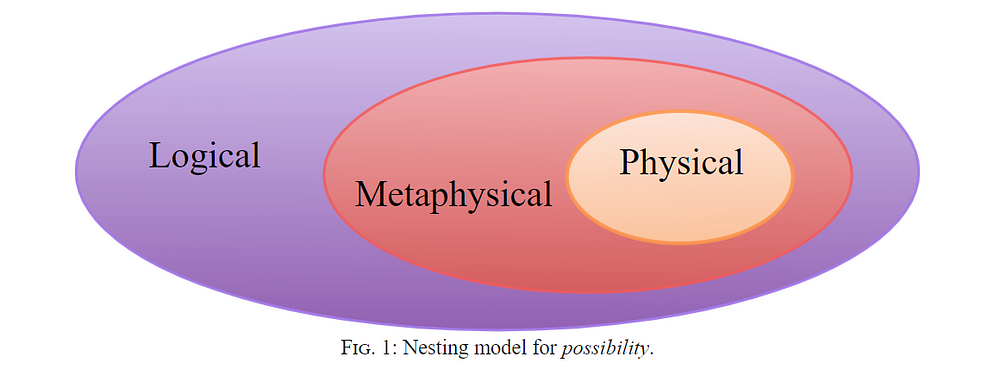
It’s not only the paper ‘Absent Qualia, Fading Qualia, Dancing Qualia’ which focuses so much on logical possibility. David Chalmers’ well-known and brilliant book The Conscious Mind also seems to introduce one logical possibility or another on almost every page. Specifically, in that book Chalmers discusses “an angel world”, “flying telephones”, “ectoplasm”, and a monkey who writes Hamlet. Admittedly, most of these logical possibilities are of little (philosophical) interest to Chalmers.

So why is that?

It’s only partly because such logical possibilities are hugely improbable. However, the main reason why Chalmers has no deep interest in them is that they don’t help him philosophically.
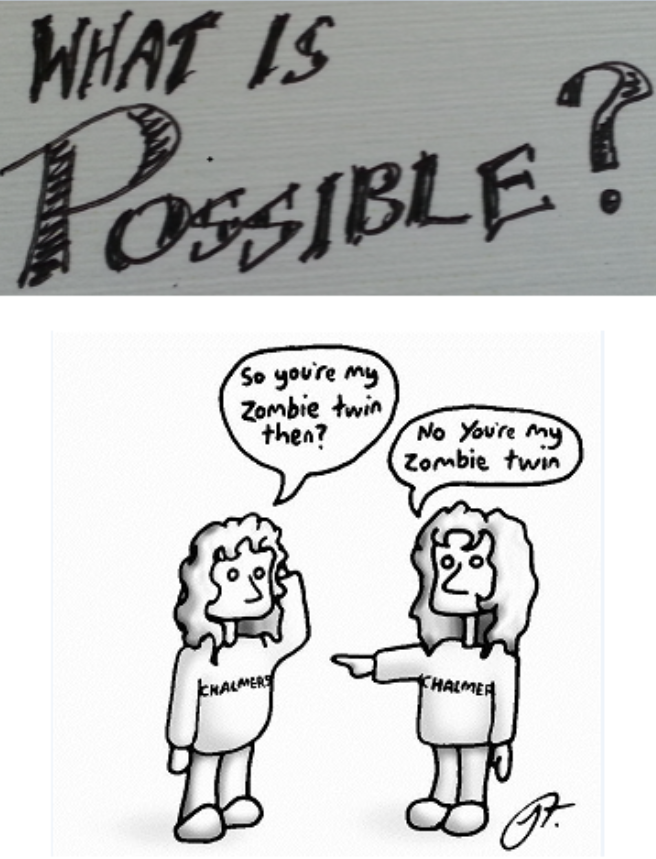
The logical possibilities of an angel world, flying telephones, ectoplasm, and a monkey who writes Hamlet have just been mentioned. However, and as many readers will know, it’s primarily (philosophical) zombies which Chalmers (as it were) specialises in. And it’s these logically-possible beings who (or is it which?) help him philosophically.

So despite all the logical possibilities which Chalmers does discuss, almost his entire philosophical project is motivated by it being (to use his own words)

“logically possible that a *physical* replica of a conscious system might lack conscious experience”.

Thus, all the other logical possibilities Chalmers discusses are but a means to add meat to that specific logical possibility. And that specific logical possibility, in turn, serves the purpose of showing readers that (to use Chalmers’ own words) “materialism is false”. In other words, if it’s “logically possible that a physical replica of a conscious system might lack conscious experience”, then materialism can’t be true…

Or so the argument goes.

[See note 1 for the full argument.]

To quote Chalmers himself:

“I am not the first to use the argument from logical possibility against materialism. Indeed, I think that in one form or another it is the fundamental anti-materialist argument in the philosophy of mind.”

So citing logical possibilities isn’t just another philosophical tool — it is (arguably) the philosophical tool to fight materialism. (Perhaps much more too.) Yet Chalmers also suggests that we shouldn’t get “too worried about odd things that happen in logically possible worlds”. That said, he then immediately takes that back by adding that “there is room to be perturbed by what is going on”.

In more detail.

Chalmers and certain other philosophers require logical possibilities in order to advance their case against materialism. What’s more, their arguments only work if one deeply considers all sorts of strange logical possibilities. Of course, this isn’t to say that materialists (as well as other kinds of philosopher) don’t themselves rely on (or simply use) logical possibilities in various ways. [See Joseph Levine’s words quoted in note 2.] However, they don’t do so nearly so often as philosophers like David Chalmers.

Now let’s forget anti-materialism and speak in broader terms.

When a philosopher cites various logical possibilities, all sorts of philosophical positions become available… or become possible. That’s primarily because once a given philosopher sets a particular logical possibility among the pigeons, then it’s surely the duty of other philosophers to tackle that logical possibility. However, if they don’t do so, then surely (some philosophers may argue) they’re philosophical (as it were) philistines.

To repeat. Chalmers’ main use of logical possibilities is to argue against materialism. That said, in the paper ‘Absent Qualia, Fading Qualia, Dancing Qualia’, Chalmers’ main purpose it to show his readers that (as already quoted) “functional organization fully determines conscious experience”.

[On the surface at least, that last quoted claim seems to work against Chalmers’ anti-materialism. However, that issue can’t be tackled in this essay either. See note 3.]

Not All Logical Possibilities Are Equal
David Chalmers argues that all the logical possibilities he discusses are “intelligible”. However, he also believes that some of them are “implausible”. In more detail, Chalmers states the following:

“Mere intelligibility does not bear on this, any more than the intelligibility of a world without relativity can falsify Einstein’s theory.”

Chalmers doesn’t believe that such logical possibilities are implausible because they’re merelylogical possibilities. Instead, it’s only specific logical possibilities which Chalmers finds implausible.

Chalmers also states (in one place) that the “hypotheses here are coherent, but there is little reason to embrace them”. In other words, coherency alone won’t force his readers to embrace such hypotheses. Yet elsewhere Chalmers also says that

“the question is not whether it is plausible that zombies could exist in our world, or even whether the idea of a zombie is a natural one; the question is whether the notion of a zombie is conceptually coherent”.

To Chalmers, “the notion of a zombie” is indeed “conceptually coherent”.

What’s more, the notion of a philosophical zombie has many other philosophical things going for it.

So Chalmers does argue that a lot can be derived from something’s “intelligibility”. This means that Chalmers stance on these “scenarios” (or logical possibilities) doesn’t entirely depend on mere intelligibility — it also depends on where these scenarios lead.

Basically, then, Chalmers isn’t questioning all modal speculations (or the use of thought-experiments) — clearly not! To Chalmers, it depends on which precise logical possibility he’s discussing.

Chalmers goes further on the subject of logical possibility.

He also believes that some of possibilities he discusses could (which is another modal term) also be “actual”. Yet this isn’t entirely clear because — as already stated — Chalmers does admit that some (even many) of the logical possibilities he discusses are “implausible”. That said, Chalmers must believe that such logical possibilities still need to be philosophically analysed (or dissected) in order to justifiably conclude that they’re implausible.

What’s more, even when logical possibilities can’t (or don’t) lead to actualities, then they may still be worth discussing — at least from a philosophical point of view.

Schrödinger’s Cat

David Chalmers discusses Erwin Schrödinger's famous thought-experiment about a cat in a box (i.e., Schrödinger’s cat). He does so in order to compare what he’s doing to what Schrödinger did way back in 1935.

Chalmers writes:

“Perhaps it is useful to see these thought-experiments as playing a role analogous to that played by the ‘Schrodinger’s cat’ thought-experiment in the interpretation of quantum mechanics.”

Chalmers then explains this analogous role in the following way:

“Schrödinger’s thought-experiment does not deliver a decisive verdict in favour of one interpretation or another, but it brings out various plausibilities and implausibilities in the interpretations, and it is something that every interpretation must ultimately come to grips with.”

Chalmers finally concludes:

“In a similar way, any theory of consciousness must ultimately come to grips with the fading and dancing qualia scenarios, and some will handle them better than others. In this way, the virtues and drawbacks of various theories are clarified.”

Schrödinger’s thought-experiment never became an actual experiment. That is, it has never been carried out… on a cat. In addition, Schrödinger himself never believed that a cat could be both alive and dead at one and the same time. On the other hand, other physicists — such as the theorists of many worlds— do believe that. (Such physicists believe that the possible alive-and-dead-cat superposition would be actual if the experiment were ever successfully carried out.)

In basic terms, Schrödinger intended his thought-experiment to illustrate the bizarre nature of the Copenhagen interpretation of quantum mechanics. Indeed, Schrödinger took it to be a reductio ad absurdum.

So Schrödinger was categorically against the Copenhagen interpretation, whereas Chalmers sees himself as considering various logical possibilities, and (as it’s often put) seeing where they all lead.

Oddly enough, Schrödinger can be seen as actually arguing against taking outlandish possibilities (in this case, quantum superpositions) seriously. Yet, ironically, he concocted a though-experiment (which includes the logical possibility of a cat being both alive and dead) to advance his case.

All that said, it can now be acknowledged that both Schrödinger’s thought-experiment and Chalmers’ many logical possibilities do indeed (as Chalmers puts it) “bring out various plausibilities and implausibilities”.

Philosophically Necessary Logical Possibilities?

It’s also odd that Chalmers states that

“any theory of consciousness must ultimately come to grips with the fading and dancing qualia scenarios”

when the vast majority of theories of consciousness haven’t done so. Indeed, many theorists and philosophers of consciousness have hardly considered these “scenarios” at all. That’s primarily because the interest in fading, inverted and dancing qualia has been an obsession of (only certain) analytic philosophers for only a limited period of philosophical history. (Roughly, since 1982 and onward. See here.)

So can we now also conclude that many theorists and philosophers of consciousness don’t consider inverted, dancing and fading qualia because they don’t place such a high premium on the status of (mere) logical possibilities?

Alternatively, perhaps it’s just these logical possibilities (i.e., inverted, dancing and fading qualia) which they don’t care too much about.

Finally, it does seem a little over the top when David Chalmers states that “any theory of consciousness must ultimately come to grips with the fading and dancing qualia scenarios”. Indeed, is that even the case when it comes to Chalmers’ famous and endlessly-discussed phil-zombies?


Notes:

(1) David Chalmers’ precise argument is the following:

“ 1. In our world, there are conscious experiences.
2. There is a logically possible world physically identical to ours, in which the positive facts about consciousness in our world do not hold.
3. Therefore, facts about consciousness are further facts about our world, over and above the physical facts.
4. So materialism is false.”

2) Is there no escape from logical possibility? The American philosopher Joseph Levine believes so — at least in the case of qualia. He wrote:

“Would could just deny that what is conceivable is possible. [] But now we have an answer as well to the multiple realizability argument. After all, what makes us so confident that QR [a particular “property of experience”] could be realized in a variety of different ways? Isn’t it just the same conceivability we appealed to in the conceivability argument?”

(3) David Chalmers’ mitigated functionalism is well summed up by the German philosopher Thomas Metzinger:

“Although the appropriate functional states are *nomologically sufficient* for conscious experience, they need not be *constitutive* of conscious experience. This leads to an interesting position which Chalmers calls non-reductive functionalism*, which is compatible both with property dualism and with some forms of physicalism.”



 

The Sociology and History of Qualia


In an earlier essay (called ‘Consciousness & Qualia: Who Cares About ‘How They Seem To Us’?’) I discussed Philip Goff’s words, “consciousness is a datum in its own right”. I asked how Goff’s datum that is consciousness stands within the context of all the books and papers which he — and other people — have read on the subject of consciousness.

The English philosopher Philip Goff.

Basically, I asked whether any clear distinction at all can be made between such a datum and all the things philosophers and laypersons have written and said about such a thing.

My point was that if (as some people put it) qualiaphiles have read lots of (or even just some) books on consciousness (or, alternatively, if they’ve come across the word “qualia” many times), then surely that will impact on how they describe and/or theorise about any ostensibly (to use Goff’s words again) “private seemings” they may have.

The entire issue was summed up by saying that as soon as a (as it were) layperson starts to use the word “qualia”, then that’s precisely the moment that he or she stops being a layperson (i.e., at least when it comes to qualia). More to the point, the philosopher Patricia Churchland once said that the word “‘qualia’ is a term of art, which was introduced by philosophers”. [See note 1.]

Of course, such a layperson doesn’t need to be an expert, or to have read lots of academic papers on qualia.

All the above was put in more technical terms by Daniel Dennett in 1991.

Dennett argued (as quoted by Martin Kurthen) that talk of “consciousness” was largely down to a “huge complex of memes”.

In addition, the American philosopher Richard Rorty (also quoted by Kurthen) argued that

“to become aware of qualia is the same thing as learning how to make judgments about qualia”.

Of course (as we’ll see), qualiaphiles may well happily admit that “qualia” is a term which was indeed “introduced by philosophers”. However, they may add: So what! They may then argue that “qualia” is a term that was simply introduced to capture something that is real, and which has a reality regardless of the recent history of the term itself.

In any case, there are many ways to approach our descriptions of qualia. However, the whole issue is summed up by the neuroscientist and philosopher Martin Kurthen (who’ll be featured in this essay) when he tells us that

“[i]t is not helpful to view *the way things seem to us* as stable elements of our inner mental lives and thus as mental sub entities with a constant constitution at all”.

[See note 2.]

Kurthen then offers his readers his own alternative to this. He argues that the ways things seem to us are

“rather ephemeral phenomena, dependent on cultural, historical, evolutionary, linguistic, etc. — preconditions — and they can change with a modification of any of these preconditions”.

All the above ties in with another theme to be tackled in this essay: the distinction which can be made — and which has been made — between our descriptions of qualia, and qualia as they are (as it were) in themselves.

Qualia and Descriptions of Qualia

Martin Kurthen tells us that how we describe qualia may well

“crucially depend on a very special history and a very special constitution of a linguistic or, more general, social community”.

The claim that that qualia “depend on” these things may seem odd (or even bizarre) to some readers. Thus, such readers may ask the following question:

Do qualia themselves really depend on such descriptions?

In other words, perhaps qualia are as they are regardless of our descriptions.

Indeed, perhaps qualia are as they are regardless of (to use Kurthen’s terms again) history, language and our social community.

What can now be said is that to believe that there is a quale (to use Kant’s terms) Ding an sich is also to be a qualia realist.

The neuroscientist and philosopher Martin Kurthen.

Kurthen himself tackles this distinction when he refers to Richard Rorty’s position on “judgments about qualia”. He then notes what the qualiaphile may say in response:

“I also think it would be a short-sighted reply to this to say that by making judgments about qualia, we only reach *descriptions* of qualia as opposed to qualia *themselves*, namely their like-to-be-ness.”

Kurthen also uses the term “given” to classify qualia when they’re (supposedly) taken as they are in themselves. However, he then argues that such givens may change even if they’re still taken to be givens. Kurthen writes:

“If qualia intuitions change with social, cultural historical and evolutionary contexts, then the features of qualia (as seeming ‘*givens*’) themselves might be overformed by these outward social, etc. modifications of how the subject of consciousness *takes* these seemings. Wouldn’t this be just another example of how cognitive preconditions influence the further cerebral processing and thus the conscious appearance of sensory or cerebral activation patterns?”

As opposed to this sociological and historical take on qualia, we have an/the alternative, which Kurthen calls “cultural transcendentalism”.

Cultural transcendentalism isn’t just a realism in the sense that qualia are taken to be real (or to exist). It’s also a realism in the sense that it’s argued that we get qualia as they’re given — even if we do later describe them!

So can we really make the (as it were) anti-realist move from stating that our descriptions of qualia

“depend on a very special history and a very special constitution of a linguistic or, more general, social community”

to also stating the following? -

Qualia themselves (i.e., regardless of our descriptions) depend on a very special history, and a very special constitution of a linguistic or, more general, social community.

Qualia Within Total Cognitive Systems

Martin Kurthen then approaches this issue from another angle.

He argues that qualia (or what we say about qualia) must surely be a result of what he calls our “total cognitive systems”. In other words, how we describe qualia isn’t just a historical and sociological issue.

How could anyone dispute that?

After all, qualia don’t occur in literal isolation.

What’s more, qualia certainly aren’t described in isolation.

Instead, according to Kurthen,

“qualia as phenomena occur in the same total cognitive system that is also subject of qualia intuitions and judgments about qualia, so that features of qualia might well be overformed by modifications of how the subject of consciousness *takes* these seemings”.

Thus, two things occur within the total cognitive systems of human subjects:

(1) Human subjects have “qualia intuitions”. 
(2) Such subjects make
judgments about their qualia.

Now as far as (1) is concerned: how seriously should we take people’s intuitions about qualia in the first place? And (2) was discussed earlier: can we truly separate people’s judgments about qualia from qualia in themselves?…

So what are qualia in themselves?

Tell me something about them.

When (or if) a qualiaphile answers that question, then he must surely make judgments about his and other people’s qualia. Thus, aren’t we back to judgments-about-qualia again?

Qualia Narcissism

In much broader terms, Martin Kurthen expresses his somewhat rhetorical — and even psychoanalytic — position on why qualia are discussed so much (i.e., both inside and outside philosophical literature). He writes:

“There certainly is such an aspect of narcissism and inflation of the subject in our incessant re-flection on subjectivity and the ‘genuinely subjective’ features of the mind.”

Of course, even if Kurthen’s claim in the above passage is true, there still may be serious epistemological and metaphysical problems with qualia — at least as far as naturalism is concerned. That said, Kurthen does (at least implicitly) note this (as we’ll now see).

Kurthen then reins himself in and adopts a (as it were) metaphilosophical approach. He writes:

“The propensity to assign a sort of epistemological or ontological significance to phenomenality is, in my opinion, an expression of our modern tendency to view our own subjectivity with all its phenomenal *presence* and *immediacy* an epistemologically and/or ontologically exceptional entity or constitution.”

It can be said that there is indeed a “modern” obsession with subjectivity. Yet, as stated a moment ago, there may still be a problem for the naturalisation of qualia and/or subjectivity.

So readers must now note that Kurthen doesn’t state the following:

There has been a modern propensity to assign significance to phenomenality.

Instead, he states this:

“The propensity to assign a sort of epistemological or ontological significance to phenomenality [].”

Here the relevant and important words are “epistemological or ontological”. So everyone can happily accept that qualia are important to us. After all, if qualia exist as the qualiaphiles say they do, then we’re experiencing qualia almost all our waking hours. Indeed, some people even deem qualia to be at the heart of what makes human subjects persons.

So, in this story at least, it’s no wonder that human persons assign significance to qualia…

However, what about the epistemological and metaphysical conclusions and theories of those philosophers and laypersons who’re also qualiaphiles?


Notes:

(1) At first glance at least, what Patricia Churchland says about “qualia” must surely be true of many — even all — other philosophical terms too!

(2) In the above, all the quotes from Martin Kurthen come from his paper ‘On the Prospects of a Naturalistic Theory of Phenomenal Consciousness’.


Monday, 5 February 2024

Abusive and Tribal Responses to My Essay on Bernardo Kastrup


The word “tribal” is used in the title above partly because many self-described “spiritual” people themselves have used the word “tribe” about the “communities” they belong to. [See here.]

As for the word “abusive”. I doubt that such spiritual people could ever admit that they were abusive to opponents, and to those they disagree with. In addition, I’m not offended by the abuse. The abuse is simply something which I’ve noted. And I probably wouldn't have noted it at all if it hadn’t come from those people who see themselves as spiritual.


(i) Introduction
(ii) Bernardo Kastrup’s Defenders
(iii) Bernardo Kastrup’s Disciples
(iv) What Bernardo Kastrup’s Disciples Believe

The level of abuse, tribalism, and even viciousness I’ve received in response to my last essay on Bernardo Kastrup (‘Bernardo Kastrup: ‘The brain does not generate the mind.’’) is telling. This is ironic really because in that essay I wrote the following words:

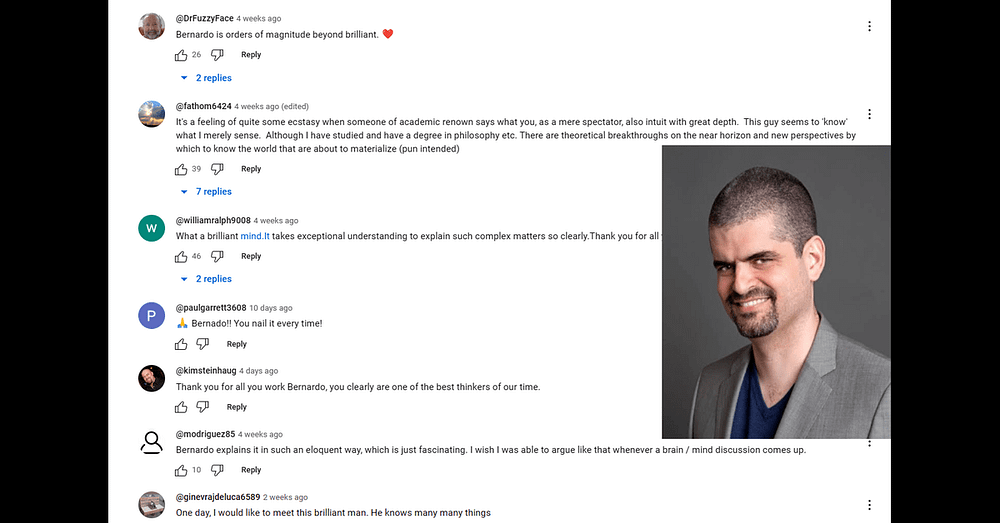
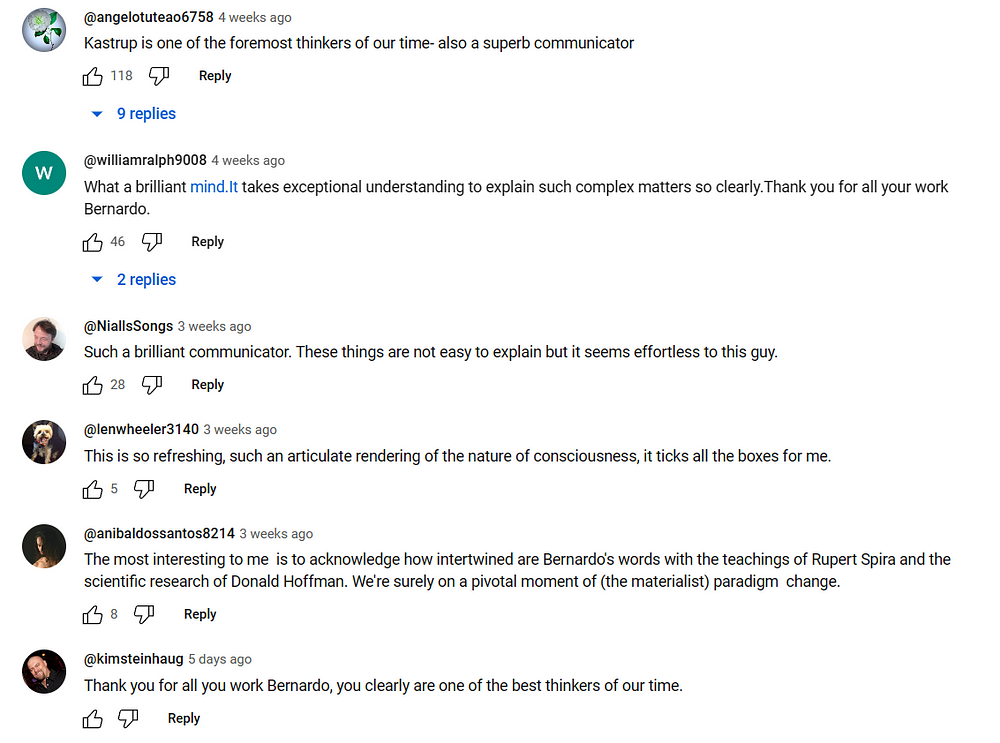
“The screenshot above is a reply to the YouTube interview on which this essay is based. Indeed, virtually all the replies under the video take on this form. In other words, there isn’t a single criticism of Bernardo Kastrup’s views to be found there. (There isn’t even a reply that’s mildly questioning.) This mass uniformity almost never occurs with other YouTube videos on philosophical issues.”

[See note at the end.]

The responses to my ‘Bernardo Kastrup: ‘The brain does not generate the mind.’ also display such uniformity, as well as aggression and tribalism.

This is odd because spiritual idealists and self-described “spiritual” people make a very strong effort to distinguish themselves from what they deem to be “conventionally” (or “traditionally”) religious people. [See ‘Spiritual but not religious’.] Yet, if anything, these spiritual people often come across as fundamentalists…

So perhaps they should be called spiritual fundamentalists.

In any case, these spiritual people replicate so much of the verbal behaviour which they’re supposed to be against when it’s displayed by traditionally or conventionally religious people.

Thus, there’s a dissonant clash between the self-image of many of these spiritual people… and the reality of who they are, how they behave, and what they actually say.

Of course, this conclusion is hardly original.

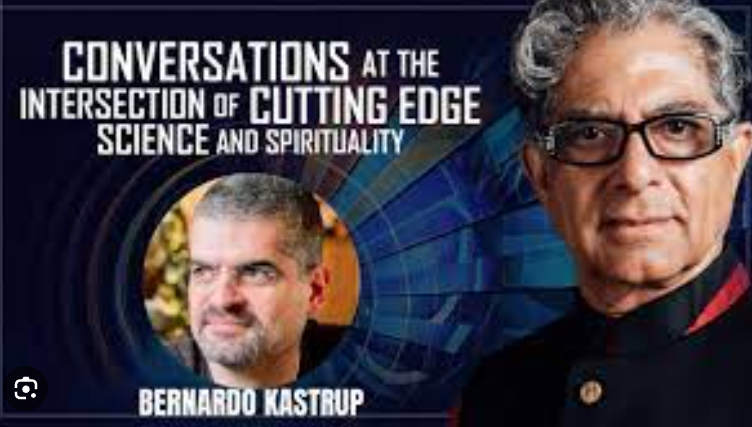
Much has been written on, for example, “spiritual narcissism”, Deepak Chopra’s various money-making endeavours (see link directly below), the huge egos of “spiritual leaders” and even their followers (which hide under an image of “selflessness”), spiritual aggression under the guise of peacefulness, spiritual tribalism under the guise of “spiritual universalism”, the exploitation and abuse of “spiritual” consumers and customers, etc.

[See ‘Deepak Chopra Is Selling $350 Meditation Glasses. Deepak Chopra Is A Fraud’ on Medium.]

On “spiritual narcissism” specifically.

It’s worth quoting something from the many publications on this subject. Hopefully, this will help put Bernardo Kastrup and some of his disciples and defenders in context.

The following words are from a piece called ‘Spiritual Narcissists’:

“Spiritual narcissists boast about their spiritual accomplishments [] Just as narcissists believe that they are better than everyone else, spiritual narcissists believe that their spiritual wisdom and development is superior to others’. Spiritual narcissists boast about their spiritual or religious endeavors, including practices such as yoga, prayer, meditation, or knowledge of spiritual texts. Their presumption of superiority leads them to treat others with condescension. They manipulate others through twisting faith-based tenets, belief systems, or wield ‘forgiveness’ as a weapon with those who question their beliefs.
[] They may try to proselytize their friends and encourage them to join their practice or they may castigate others for their lack of self-awareness and enlightenment. Spiritual narcissists construct a barrier between those who ‘know the way’ and those who refuse to ‘follow the path.’ Just like any narcissist, they are consistently working to set themselves apart from everyone else and see themselves as existing on a level that no one else can easily attain.
“Spiritual narcissism is based on the ego driving the practice as a false means of achieving spiritual superiority.”

In Bernardo Kastrup’s case, he doesn’t only believe that he’s “spiritually superior”: he believes that he’s intellectually, politically and morally superior too.

And all this — and much else — has led me to conclude the much idealism is in fact religious in nature. Specifically, Bernardo Kastrup’s own idealism is a religion.

Yet this shouldn’t be a surprise because many idealists themselves have explicitly tied their own work to religion. (Such people just don’t usually tie their idealism/s to Christianity or to “Western monotheism”.)

Anyway, here are some passages from the response section to my essay.

Bernardo Kastrup’s Defenders

Firstly, here’s someone called Cosmic Keith:

“This whole thing, the article and your responses, read like a mash of unclear complaints, undirected anger, confusion and rants. I found your ‘analysis’ shallow and lacking any real substance []
“The one position you did convey to me was ‘How dare he say something that I can’t wrap my head around and I am just totally buggered and lashing out to diminish a challenge to my underlying suppositions!’ ‘Blah blah blah, (ego protective mechanisms). He’s just wrong! See!?’
[] And the ranting continues. Sure you will issue the same kind of response to this comment.
“My first thoughts while reading your article were: has the author bothered to dive more deeply into Kasteups positions or did he just watch one YouTube, feel offended and try to dutifully issue a takedown article to protect his now scrambled thought-stream?
“And my second thought was : where the hell is this going?
“Down, down, to Nowhere… fast.
“It’s odd-funny to read articles (poorly formed opinion pieces) in defense of Physicalist/Materialist ideology that triy to be reasoned and rational but are just temper tantrums arise from lack of contemplation (?) …or understanding(?). And when others point out the incoherency, the autbors just lash out, and further the impression that it is indeed a tantrum…
In the defense of ‘scientific’ philosophical axioms that those authors don’t appear to have examined, or even be aware that their thinking is operating from. (wholesale ideologcal adoption)”

Oddly enough, the passage above is a philosophy-free version of some of the subjects that Bernardo Kastrup himself has actually written on. Indeed, the defenders (or disciples) of Kastrup actually replicate Kastrup’s frequent use of abuse, as well as his disturbing Manichean worldview. (This is a worldview which is not only aimed at what Kastrup calls “materialists”.)

Another fan of Kastrup (a Øystein Haltbakk) offered his readers these words about a previous essay I’d written on Kastrup:

“The author provides a compelling example of the consequences that may arise when the unconscious facets of one’s personality diverge from the ego ideal. However, it’s possible that the author is unaware of this dynamic.”

I mentioned the fact that the response from Cosmic Keith above tackles the same targets as Kastrup, but his prose style is very much unlike Kastrup’s own. However, this response from Øystein Haltbakk is almost identical to both the style and the content of Kastrup’s own prose.

In any case, let’s now take some examples from Kastrup himself.

Let’s start with the most recent one I’ve come across, written by Kastrup in October 2023:

[Tim] Maudlin’s unbecoming, unacademic and rude behaviour made it clear that such was not the case. He came across to me as a nasty and crass street brawler, not a thinker. [] Nor do I find his ungrounded, tendentious, hand-waving and wishful technical statements worthy of in-depth discussion in debate format. I am sure he can continue to believe in his unfalsifiable, pseudo-scientific fantasies without my help.”

[See Kastrup’s own ‘My unfortunate attempt at debating Tim Maudlin’. Tim Maudlin is a philosopher of science.]

And now there’s the following examples:

“Dim-witted biologist [].”

[This is a reference to the biologist Jerry Coyne.]

[] Sabine [Hossenfelder] has a big mouth and seems to be willing to almost flat-out lie in order to NOT look bad when confronted on a point she doesn’t have a good counter for. [] Her rhetorical assertiveness is, at least sometimes, a facade that hides a surprising lack of actual substance.”
“What makes the profound ignorance betrayed by the ‘review’ even worse is the conceitedness and pretentiousness that oozes through it.”
“How can a magazine with ambitions to ‘promote scientific inquiry, critical investigation, and the use of reason’ publish this kind of juvenile garbage?”
“Since he [Philip Goff] was a cosmopsychist just a couple of years ago, then a constitutive panpsychist for the duration of one book, and now seemingly something else already again, who knows what his position will be by the time we debate?”
[] there is little of substance in [Massimo] Pigluicci’s essay to actually rebut or respond to. [] Unlike Pigliucci, I shall comment based on substance. Yet, I shall also comment vigorously and honestly, not through a smokescreen of passive aggression.”
“Many academic philosophers love to indulge in these tortuous conceptual games that achieve lift off from the firm ground of reality and end up in some other galaxy. This is no news. But I confess to feeling disappointed at Philip [Goff], an academic philosopher I thought would see through this nonsense. I regret that so much energy and time was wasted, during the debate [].”
“I am not doing this just to gratuitously and repeatedly stick my finger in the wound; I’m not trying to do character assassination. But during the debate [Sabine] Hossenfelder attempted (and probably succeeded, in the eyes of many viewers) to make me look like an ignorant fool by flat-out misrepresenting her own output. I ought to defend myself against that overt suggestion, which I consider to have been rhetorical and dishonest, violating all basic debate ethics.”
“Again, [Sam] Harris seems to be, at best, confused and ignorant of the facts; or, at worse, wilfully biased in his appraisal of the available data. [] The irony would be sweet if it weren’t concerning as far as what it seems to say about Sam Harris.”
[S]ome seem to react to what I have accomplished with covetousness — as opposed to the objectivity that academics are expected to embody — is both a serious problem and a missed opportunity for desperately-needed change. [] Many academic philosophers have abandoned reality and now spend their time playing entirely abstract conceptual games of no relevance to you and me. But they still insist that what they do is ‘real’ philosophy. []
“And [Daniel] Dennett isn’t alone. Others, like psychologist Nicholas Humphrey, suggest the same thing [] Despite being a surreal display of in-your-face incoherence, the fact that the video is cladded with the gentle and trust-inspiring demeanor of an affable old man [].”
“There is a significant way in which fundamentalist atheists may be unconsciously attributing to others their own cognitive limitations. In psychological terms, this is called a projection. By passing judgment onto their own projections according to the rules of their own private games, they reveal parts of their psychological makeup but assert nothing of relevance about the nature of reality.”
[W]hat kind of psychological disposition makes one feel entitled to publicly criticize something one has admittedly not understood?”
“This is one of those embarrassing passages in which Jerry Berry [Jerry Coyne] unwittingly makes painfully clear to the whole world the depths of his philosophical ignorance.”
[Keith] Frankish has accomplished precisely nothing in his long essay; at least nothing more than tortuous obfuscation and hand-waving.”

Oddly enough, one of Kastrup’s defenders (a Greg Sotiropoulos) defended Kastrup with these words:

“Now show us where exactly the persons, rather than their ideas, were attacked?
1. ‘babble incoherently’: not AH
[ad hominem]; he’s talking about the incoherence of the babble
2. all the ‘emperor has no clothes’ quotes — how exactly are the people attacked? Can you explain what exactly constitutes an AH here?
3. ‘heir
[Graziano and Frankish] nonsense is toxic, corrosive and pernicious’: again, it’s their nonsense that is judged/attacked, not the people.[]
“I scrolled down to the end of the article thinking that there might be something there, but still no luck. The closest I could find is ‘unwittingly makes painfully clear to the whole world the depths of his philosophical ignorance’
but that’s still not an AH.”

Greg Sotiropoulos’s point is that Kastrup didn’t actually use any ad hominems. Technically, perhaps Sotiropoulos is right. However, what would he call Kastrup’s rather obvious abuse of other people? (I suspect Sotiropoulos would have a problem with my word “abuse” too.) And whatever Sotiropoulos calls these words and phrases, he certainly defends what Kastrup says.

In any case, here are some much-milder responses to my ‘Bernardo Kastrup: ‘The brain does not generate the mind.’’ essay.

The following is from Prudence Louise:

“I read the whole article and still don’t know what your point is.”

In most cases, when people use the phrase, “I don’t know what your point is” (as well as variations on it), they really mean this: I don’t like your point. (In other words, the phrase “What is your point?” is rhetorical.) This was especially true of Prudence Louise since she then went straight ahead and told me — along with other readers — what she took my point to be. And then she gave many reasons as to why she didn’t like my supposed singular point.

As it is, Prudence Louise never quoted — or even paraphrased — a single syllable from my actual essay. She simply told readers why she doesn’t like materialists, and why she doesn’t agree with materialism.

So here’s some more (tribal) uniformity from Mark D Rego:

“I must agree with Prudence below. There is a lot of rambling.”

Mark D Rego then admittedly moved away from stating that I ramble, to stating that the “worlds” of materialist scientists are “about to crumble”. In full:

[] Deep down I hope Kastrup is right about most things. [] The youngish scientists are soooo sure it’s not this way. We have it all almost figured out they believe. They do not know that their worlds are about to crumble. The biological consensus is falling apart. We are not wet robots but something else entirely. []

Now that passage really does sound like religious prophesy.

Bernardo Kastrup’s Disciples

Finally, here are some replies under the video (called ‘‘Your Consciousness is Not in Your Head.’ | Interview with BERNARDO KASTRUP, PhD’) I actually wrote my essay on:

“I feel something akin to spiritual bliss whenever I listen to the words of Bernardo Kastrup.”

— Patrick Thompson

“Bernardo is orders of magnitude beyond brilliant.”

— Kim M. Clark, OD

“Absolutely marvellous expose of this gentleman. It lifts a veil from our eyes. Very coherent.”

— kosmotrekker

“It’s a feeling of quite some ecstasy when someone of academic renown says what you, as a mere spectator, also intuit with great depth. This guy seems to ‘know’ what I merely sense. [].”

— Fathom

“What a brilliant mind. [] Thank you for all your work Bernardo.”

— William Ralph

“Wow. I love this guy. I wonder does he realize this view resolves the paradox of free will vs determinism.”

— Fathom

“Bernado!! You nail it every time!”

— Paul Garrett

“One day, I would like to meet this brilliant man. He knows many many things.”

— Ginevra J De Luca

“Bernardo is a. Intellect personified.”

— Sharpo

“I live in a place called Kastrup….this is weird…”

— Bugzy Hardrada

“Bernardo is the Galileo of Consciousness in my humble and insignificant opinion.”

— Michael Dillon

“Thank you for all you work Bernardo, you clearly are one of the best thinkers of our time.”

— Kim Steinhaug

What Kastrup’s Disciples Believe

The following are some replies (under the same YouTube video) which don’t actually mention Kastrup himself, but they’re informative anyway:

“The status quo have deliberately repressed what Buddhist teachings have know for over 2500 years that the universe is itself a conscious field of energy we experience the universe through our self awareness.”

— Pi 3 times 14 is 42

“well if you implicate his philoshopy ot fullest degree, actualy he is saying that we are center of universe. That would be shown if you ask him what happen after consciousness is dissociated from body. On the other hand, fact that we are eternal individual localized consciousness has far rich implication.”

— AntimaterialWorld

“I would love to believe consciousness is always there and our brains tap into the infinite consciousness and when our lives end we use this consciousness again maybe in another dimension or as a reincarnate? But it sounds like no one really dies.”

— Benedetto Salerno

“I am the holy ghost…. science meets spirit… one begets the other, about time :)”

— stevefrompolaca

“Sure psychedelics are incredible tools. I recommand 1P-LSD which is still legal in some countries like Netherland (1/2 a blotter is enought to shake your mental ground). I still listening again and again BK to understand in depth all his odd ideas. Peace & love Thanx for the video.”

— 1sanremy

“Can this be the reason why everyone that has died never gets to come back to the Earths state of consciousness but are using this infinite consciousness in another realm still living on.”

— Benedetto Salerno

“In other words, Vedanta (Hinduism).”

— J S

“In translation — we are immortal spiritual beings who wear this meat suit for some time.”

— Petar Lukovic

“Your Matrix is in Your Head. It makes everything look separate. In reality, the universe is one entity.”

— apparent being

“We are all mental manifestations in the mind of The All.”

— Hermes.T


Note:

(1) I must now amend that passage. When I went back to this reply section under the video interview with Bernardo Kastrup, I did find a 2 or 3 critical replies — among dozens of obsequious ones.

Perhaps the main reason why Kastrup does so many interviews (most of which can be found on YouTube) is in order to build up his own cult following. He has succeeded in that task, as the quoted replies show.