Monday, 25 April 2022

Bernardo Kastrup (the Well-Known Cosmic Idealist) and His Afterlife

Bernardo Kastrup will still be Bernardo Kastrup when he merges with Cosmic Consciousness in the Afterlife.
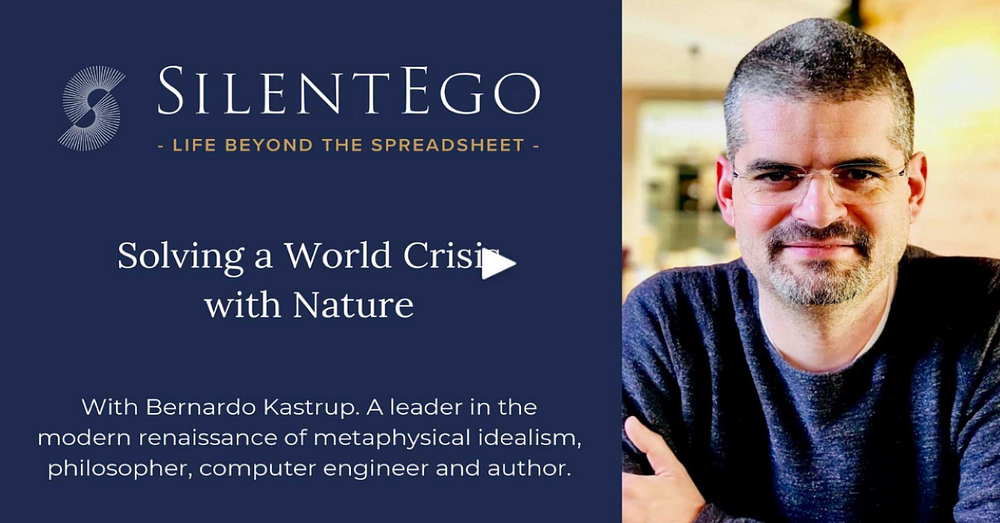
The philosopher Bernardo Kastrup believes that it is his “ego” and body which will die, not his consciousness or his “soul”.

Take this passage from Kastrup:

“It is reasonable to assume that the mental process we call physical death ‘makes the unconscious more conscious,’ because it eliminates a source of obfuscation; namely, the egoic loop.”

Kastrup continues:

“The sense of novelty here is merely the illusion of an ego going through dissolution. Once the ego is gone and all is remembered, the sense of novelty will disappear. [] As such, maybe life and death are entirely analogous to dreaming and waking up, respectively.”

So it’s clearly important to note how important what Kastrup calls the “unconscious” is to his Cosmic Idealism; and, more relevantly, to his positions on the afterlife. (Kastrup is much indebted to Carl Jung — see here.) Thus when Kastrup refers to “consciousness”, he’s often actually referring to the (Jungian) unconscious. And that clearly complicates matters.

As it is, in this essay I have no desire to tackle Carl Jung’s psychiatry/psychoanalysis or Kastrup’s 21st-century interpretation of it.

But, firstly, what if there is an afterlife?

Six Impossible Things Before Breakfast
When it comes to discussions of the afterlife (specifically as it’s supposedly encountered during near-death experiences), one often hears (or reads) the following words (or variations thereon):

“There is more out there than we know.”

The problem here is that people can claim literally anything and then justify their claim by stating: “There is more out there than we know.” So I could claim, for example, that there are green goblins, cats floating around Venus or aliens living in the earth’s core. And then, if someone criticises my claim, I can simply reply: “There is more out there than we know.”

All this may make the people who state “there is more out there than we know” seem open-minded. That’s primarily because such people appear to considering (as it were) “six impossible things before each breakfast”… Except that, more often than not, many of the people who state “there is more out there than we know” aren’t really open-minded at all. That’s primarily because they often artfully select precisely which possibilities to consider. And their very-well-chosen possibilities just happen to be perfectly in tune with their prior “spiritual” beliefs. Thus the possibility of, for example, zombies or mile-high tricycles (to take two possibilities from David Chalmers) are never considered by such people precisely because they don’t serve any spiritual (or personal) purpose.

But what about these six possibilities before each breakfast?

Those who cite possibilities need to supply evidence and arguments for taking each possibility seriously. So considering a possibility is fine — but not when simply stated without much (or even any) detail…

… But there still could be an afterlife.

And there is, indeed, more than we know.

Yet there’s still no reason to believe that the afterlife and many other possibilities are actually real or that the claims about them are true. In other words, there’s often no reason to take them seriously.

In any case, there are literally infinite other possibilities we could — or even should — also consider. But we can’t because we haven’t got the time. And, in most cases, there is no reason why we should anyway.

Ironically, many people do actually believe that they know (if only in a non-strict, non-epistemological sense) about the afterlife. Indeed that’s why they frequently talk about it. In other words, such people do not believe that the afterlife is beyond what we can know.

Of course some people also claim to be (as already stated) “open-minded” about the afterlife. Yet when you read just a couple of their comments, you quickly realise that they do believe in the afterlife. Indeed they seem to believe that they know it exists.

So all this has very little to do with being open-minded.

In any case, it is true that there are obviously many things that we don’t know. And?

Now, if someone says “your consciousness survives” in the afterlife, then what is it that survives?

What Survives Death?
What do the words “our consciousness continues after death” mean?

What is it, exactly, that survives death and how does it do so?

To Bernardo Kastrup, individual consciousnesses are part of Cosmic Consciousness. Yet even if this were true, then surely once we die there is still no “we” (or human persons) left to “survive”.

It is indeed the case that the particles which the physical and biological brains (of dead people) were made up of will (as it were) “survive” — but not individual minds or persons themselves. This is the frequent mistake of conflating the particles, fields and forces which constitute brains with minds — and indeed human persons — themselves surviving. How on earth could persons or minds survive? Such things are embodied in particular brains, bodies and environments. Without those brains, bodies and physical environments, what is this “we” that survives? How can there be persons (or “we”) without memories (see later section), cognitive functions, beliefs, etc. — all of which required physical brains?

So are these claims about the afterlife purely poetic? Are they designed to appeal to the emotions and also appease the intense and omnipresent fear of death which so many people experience? Or are these claims simply religious and therefore based on faith? Perhaps all of these things?

So most — perhaps all — these references to the afterlife (or persons/selves continuing to ? once their bodies and brains die) don’t really explain what exactly it is that survives. At least that’s the case in 9 out of 10 examples of talk of the “afterlife”.

Again, what is this consciousness which survives and why is it a person’s consciousness rather than some abstract or vague input into a “space-time storage bank” (or into Cosmic Consciousness)? How is some individual human person (who had a physical body and brain) still in the universe when he or she has no body and brain? What is left after death? And why is what is left — if anything — still deemed to be “your consciousness” or a human person? Moreover, why is what “survives” death deemed to be exactly the same person (psychologically speaking) than the person who existed when embedded in a particular brain and who had a particular body? What provides this continuity between the person with a body/brain and this “consciousness” in the Cosmos?

More to the point, why are these details very rarely — i.e., virtually never — mentioned by the believers in an afterlife or in Cosmic Consciousness?
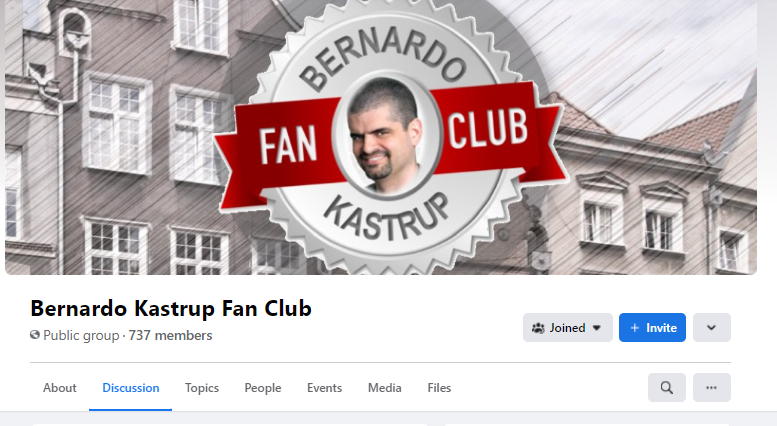
An image from Kastrup’s “fan club”. (See ‘Bernardo Kastrup’s Fan Club’ on Facebook here.)

Now let’s take Kastrup’s own afterlife.

Will Bernardo Kastrup’s consciousness (as it’s put by many Cosmic Idealists) “expand” when he dies?

How will it expand and how will it still remain Kastrup’s consciousness?

If not embodied in a brain, body and in particular physical environments, then how does the non-embodied Kastrup distinguish himself from the rest of the Cosmos (or from Cosmic Consciousness)? In other words, if Kastrup simply “merges with the universe”, then why talk about Kastrup’s — or anyone else’s — “afterlife” at all? Surely merging with the Cosmos is the end of Kastrup and everyone else who dies.

So, in basic terms, all that must happen (at least according to the logic of this theological or spiritual story) is some kind of super-fusion of Kastrup’s mind and billions of other minds into the single melting pot that is both the Cosmos and Cosmic Consciousness.

Now take the very specific case of human memory.

Human Memory
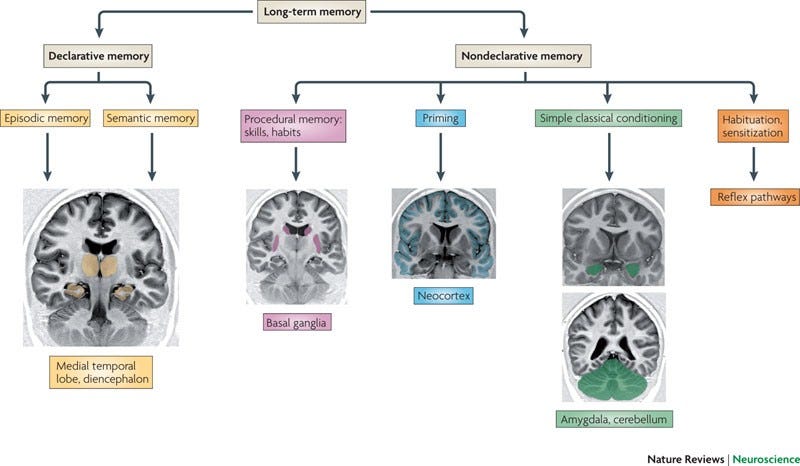
Human memories are literally encoded in the brain (see here and here).

There’s a vast amount of evidence of this and most/all neuroscientists agree. Of course this isn’t an argument that all memories, of all kinds, need to be encoded in human brains. It’s an argument that human memories are encoded in human brains. That is, whenever there has been a human memory since the beginning of our species, that memory has been encoded in brains — tens of billions of times.

And now Cosmic Idealists come along and say otherwise.

So it can be — provisionally — accepted that there may be computer memories or alien memories or even paramecium memories. That said, all these other examples bring up the issue of the precise implementation of these other memories in — some kind of — physical medium. And this is an issue which Cosmic Idealists either bypass or ignore by vaguely talking about “consciousness”. However, sometimes idealists may add a tiny bit more detail when they say that “consciousness is fundamental” (see my next essay).

That’s the issue of memory alone and its (as it were) wetware (see here, here and here).

Now what about the implementation of entire selves or persons?

Memory is also vital for a person to be a person. Thus how is memory encoded when the “mind” leaves the body and “becomes one with the universe”? How is that personhood (or selfhood) established? Is it simply another of the Cosmic Idealists’ fundamental (as it were) facts?

Quantum Foam as a “Soul Vehicle”
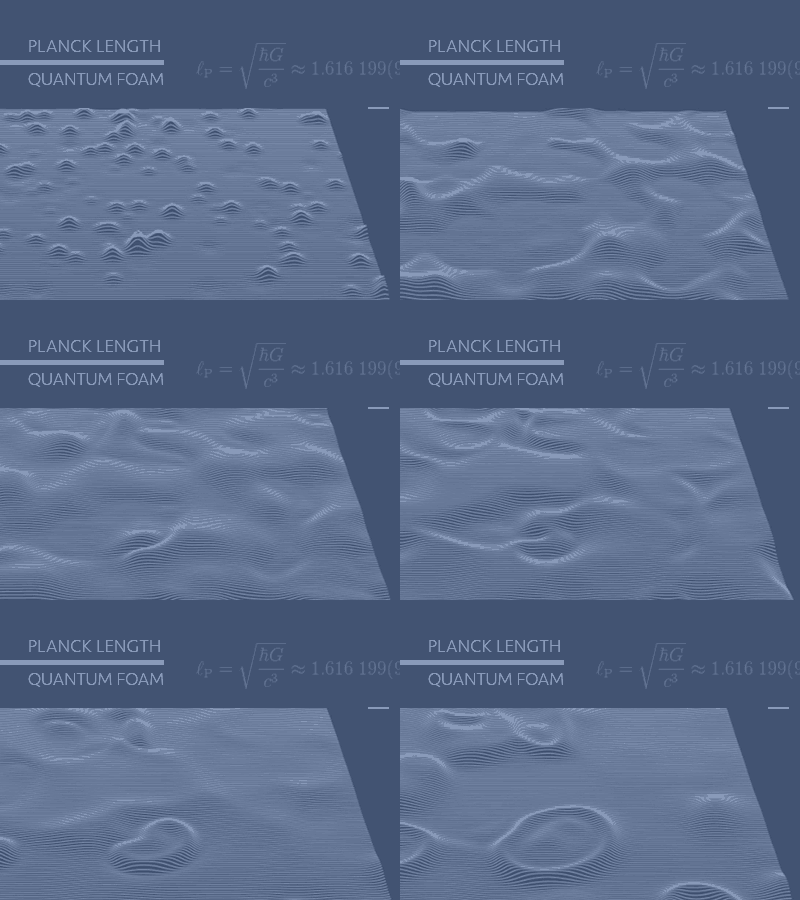
It’s worth noting here that some Cosmic Idealists don’t believe that consciousness is fundamental in precisely the same way as Kastrup and others do. Instead, they believe that consciousness is a (as it were) secondary fundamental in that it requires a medium which is even more fundamental.

Take these words from James Vaughn:

[T]he ‘soul vehicle’ is Quantum Foam -which I think represents a fair concept of consciousness being a living yet somehow unquantifiable structure beneath all reality.”

The position — and the others like it — that quantum foam (or spacetime foam) is a “soul vehicle” and therefore fundamental is no better (or no worse) than believing consciousness itself is fundamental.

As with Kastrup’s Cosmic Consciousness, if any given x is truly an “unquantifiable structure”, then how can it be known that it is “beneath all reality”, “a fair concept of consciousness”, “living”, etc? This suggests that a lot is actually known about quantum-foam-as-a-soul-vehicle — and that’s apart from it actually being a soul vehicle!

In any case, how does quantum foam (even if a correct theory in physics) help when it comes to consciousness, the afterlife, etc?

One important point about quantum foam (as well as fields) is that it is taken to be fundamental. (In this case, perhaps the fundamentality of spacetime has been replaced by the fundamentality of quantum foam.) So how does something so basic, so simple, and so fundamental as quantum foam (or spacetime or fields) have any relation whatsoever to human selves or persons surviving in an afterlife as “pure consciousness”? This means that the precise relation between quantum foam (or, for that matter, Cosmic Consciousness) and human persons (or selves) must be explained.

Human persons (or selves) are a product of brains and bodies which exist in particular (physical) environments and have had particular (physical) histories. The creation of what we are (as persons) and what we believe (as persons) occurred because of our brains.

So how does all that connect to quantum foam?

What is the precise tie between something complex and firmly outside of fundamental physics (i.e., human persons and their nature) and something else (i.e., quantum foam) which is firmly within fundamental physics? How can quantum foam (as it were) implement the minds (or consciousnesses) of human persons once they are free of their bodies, brains and physical environments? What are the technical details of this supposed implementation of human persons in quantum foam?

What’s required here is not the detailed physics of quantum foam: what is required is the detailed physics of the precise tie between quantum foam and human persons (as the latter supposedly exist in the afterlife).

Cosmic Idealists: Egos and Spiritual Narcissism
“Ego is able to convert anything to its own use, even spirituality.”

Chögyam Trungpa (source here)

Here we have a problem with the “spiritual” element of Cosmic Idealism, at least as it relates to the afterlife.
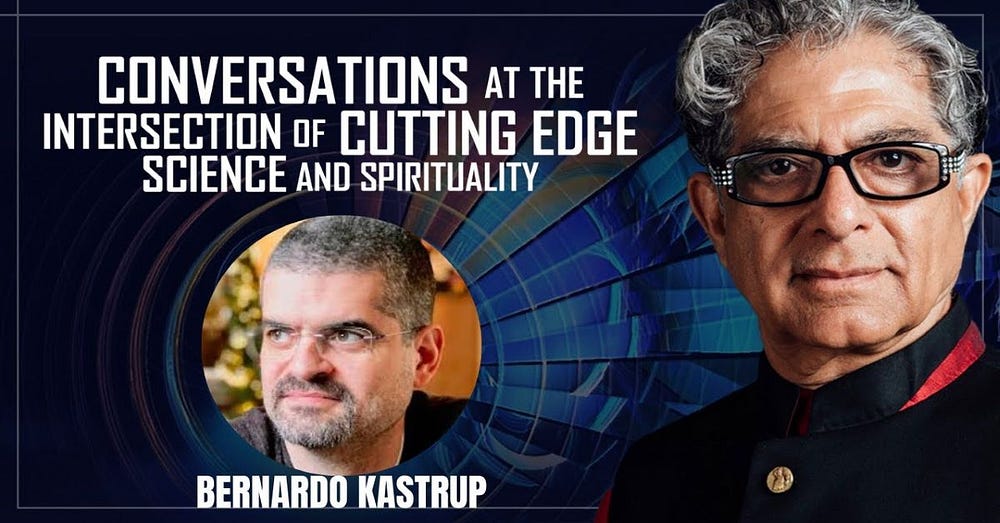
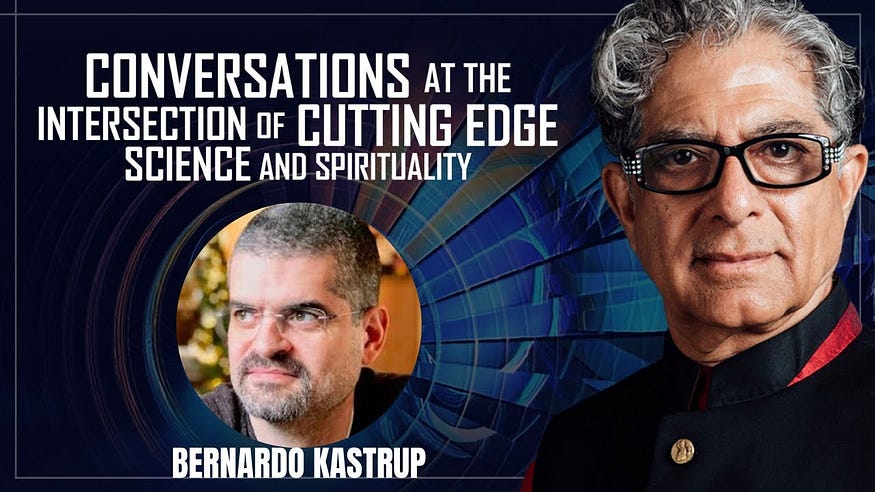
Deepak Chopra and Bernardo Kastrup

On the one hand, the “spiritual” benefits of merging with Cosmic Consciousness are often stressed. On the other hand, it is always very clear that it is individual human persons or selves (such as Kastrup himself) who do the merging. Thus these disembodied persons merge with Cosmic Consciousness at the very same time as keeping their entire identities — along with the memories which aren’t encoded in brains — which just (as it it were) float around in spacetime or the Cosmos. (See note (1).)
To be rhetorical, it is actually the individual egos (such as Kastrup’s own) of Cosmic Idealists that are kept firmly and completely intact when this so-called “oneness with the Cosmos” occurs or is brought about. Thus we have all the grandstanding rhetoric of the Cosmic Idealist being at-one-with-the- Cosmos. Yet in the process most of the Cosmic Idealists you read or listen to (Bernardo Kastrup and Deepak Chopra simply being the most obvious examples) see themselves as becoming superior intellects and more moral persons through such a merging. Thus, after achieving Oneness-With-the-Cosmos, such Cosmic-Idealist egos remain fully intact and, in most cases, actually become more “egotistical” than many non-idealists — and even materialists. Indeed these enlargements of the egos of Cosmic Idealists is a direct consequence of their supposed merging with Cosmic Consciousness. Such things are also, bizarrely enough, a consequence of the (to use Kastrup’s words) “ego dissolution” (or ego death) of Cosmic Idealists! (See note (2).)

So take these words from one of Kastrup’s fellow Cosmic Idealists:

“Some people are stuck only in the body-mind system as they’re are polarized in this way, since they are materialists.”

This is simply an example of spiritual and intellectual grandstanding in the guise of what’s often called “spiritual philosophy”.

****************************

Notes:

(1) Bernardo Kastrup’s very personal and strong words on just about every person and position he doesn’t fully endorse clearly display his huge ego. Take his highly personalised and very-smug criticisms of Philip Goff (see here and here), Sabine Hossenfelder (see here and here), Sam Harris (see here and here), Massimo Pigliucci (see here and here), all “materialists” (see here and here), “our culture” (see here and here), etc. etc. etc.

(2)
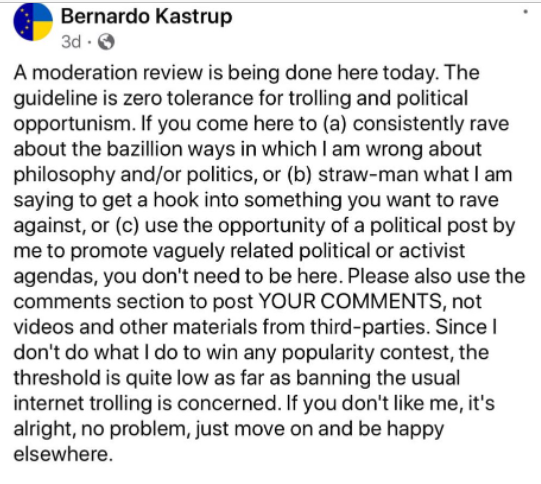
Kastrup appears to an admin in his own “fan club”. See image above and his club here.

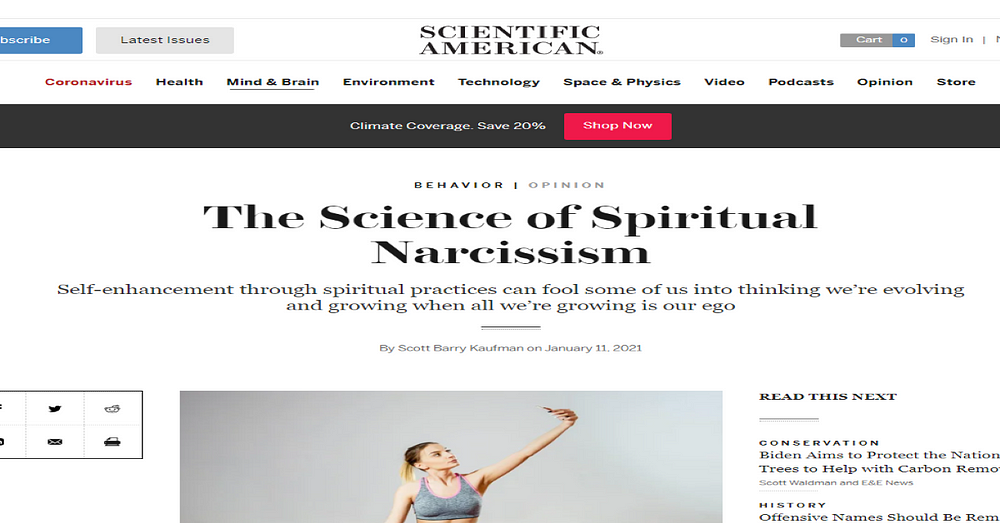
See ‘The Science of Spiritual Narcissism’, at Scientific American. See also a psychologist on “spiritual narcissism” here. Finally, this piece is on the direct link between being supposedly “egoless” and having a huge… well, ego — something that the writer admits to and thinks is a good thing.

(3) See my essays ‘Bernardo Kastrup’s Spiritual Take on Psychedelic Experiences and Cosmic Consciousness’ and ‘The Idealist Philosopher Bernardo Kastrup vs. Materialism’.


Saturday, 23 April 2022

‘Moral Facts?’, ‘The Copenhagen Interpretation is Woo?’, and ‘The Point of C.S. Peirce’


Selected (mainly critical) responses to my essays on Medium — and my replies to them. (2)

Are There Moral Facts?

“Moral realists will say there are moral facts. The imperatives, like those you cited, may not be true or false, by grammatical structure. Yet, moral realists will say a declarative form of those imperatives, ‘the right thing to do is X,’ does admit of being true or false.”

Is the Copenhagen Interpretation “Woo”?


“The problem doesn’t arise in describing quantum phenomena using classical concepts; it arises because most theorists refuse to use classical concepts to understand the nature of quantum events.”

“I take the exact opposite view. Most theorists do use classical concepts to understand and explain quantum events. Indeed their explanations and interpretations are full of classical concepts and terms: ‘wave’, ‘particle’, ‘spin’, ‘tunneling’, etc.

“Instead they try to interpret a mathematical formalism, the wavefunction, in physical terms and the result is a lot of nonsensical babbling (about superposition of states and wave-particle duality).”

“I’m not sure about ‘nonsensical babbling’ and what, exactly, you believe falls under that description. Also, if they used ‘physical terms’, didn’t you just state that they refuse to use ‘classical concepts’? Unless you’re referring to physical terms which are in no way classical.”

“There is nothing compelling about the so-called Copenhagen interpretation. It seems that its primary attraction is its very incoherence which allows adherents to wrap themselves in an aura of modern day mysticism; only true initiates can understand (but not explain) quantum inscrutability.”

“Again, I take the opposite view. The Copenhagen interpretation is the least ‘mystical’. But that depends on what you mean because there’s a lot of literary rhetoric in your statements. For example, why is the Copenhagen interpretation ‘incoherent’ and why is it an example of ‘mysticism’?”

“Bohmian mechanics, where a wave is a wave and a particle is a particle, makes sense of quantum mechanics employing classical concepts but is generally disfavored, likely because it makes sense and strips the field of its woo-woo exoticism.”

What’s the Point of C.S. Peirce?

“It just seems like a muddled version of Poppers falsification methodology, which at least gives scientists a consistent framework to conduct their investigations.”

“I don’t see how this concept of abduction is in any way useful or explanatory of anything.”

“explanations who is not shedding more light on how we do come by those tentative statements…”

“That isn’t really the point of the essay or Peirce’s abductions. You’re criticising an apple for not being an orange. You say ‘shedding more light on how we do come by those tentative statements’ — that could be an issue in psychology and may have nothing to do with either science or logic. People may come to ‘tentative statements’ because they were on drugs, because they were reared in the wild, because they had read only Medium stories, etc — so? Peirce was battling against what he saw as a wrong and prevalent view of science (or scientific methodology) — the view that it’s all an essentially inductive. That is made clear in the essay and you’ve completely ignored it. The most I would admit is that this is now a — at least partly — historical issue. Yet that is also clear in the essay. Again, the essay is about oranges, not your apples.”

“Anyone can frame a a process, coin fancy terminology for whatever it is and write a thick tome about it. It’s just not worth reading them if they don’t add anything.”

“A lot of vague rhetoric there. I don’t like responding to rhetoric because it tends to be a waste of time. That’s primarily because the responder will usually come back with yet more of the same kind of rhetoric.”

[I can be found on Twitter here.]


Friday, 15 April 2022

Bernardo Kastrup’s Spiritual Take on Psychedelic Experiences and Cosmic Consciousness

 Philosopher Bernardo Kastrup believes that psychedelic experiences run free of the brain. And that’s because the trippers who have them are tapping into Cosmic Consciousness.

“There is something very wrong with this story that brain activity generates conscious experience.”

— Bernardo Kastrup’s last words in his video presentation.

The Dutch computer scientist and philosopher Bernardo Kastrup’s central thesis is that human consciousness (or experience) doesn’t require the physical and biological brain. Indeed that thesis is the backdrop to his scientific claim that during psychedelic experiences there is less brain activity than during (as it were) normal (or waking) conscious states. The conclusion being that such psychedelic experiences — and indeed all conscious experience — must ultimately run free of the brain.

So, in order to establish this radical position, doesn’t Kastrup need to establish zero brain activity during psychedelic experiences?

An important corollary to Kastrup’s ideas is that because the brains of the subjects of psychedelic experience are not relying on the brain for their experiences, then they must be relying on something else. And that something else is (to use Platonic capitals) Cosmic Consciousness (sometimes called Universal Consciousness). That is, Cosmic Consciousness is responsible for the (as Kastrup puts it) “richness” of psychedelic experience.

However, in the video which is the basis of this essay, Kastrup doesn’t put his position quite so simply and/or explicitly. Indeed, his presentation is replete with technical terms, images, graphs and much academic hedging. Yet he most certainly does put his broad philosophical position simply (i.e., as it relates to psychedelic experiences and much else) elsewhere.

(For example, see Kastrup’s blog post here in which he tells us that he has “cultivated psychedelic-containing organisms at home” and that the “experiences they provided me with years ago have been of tremendous learning value and considerably helped [his] personal development”.)

The Video Presentation

Deepak Chopra and Bernardo Kastrup

The featured video: ‘Dr. Bernardo Kastrup: what neuroscience actually shows about consciousness’

Bernardo Kastrup isn’t a neuroscientist. Yet in the video featured in this essay he spends much time on the (as it were) hard data of neuroscience. Indeed, it’s obvious that Kastrup wants to make it crystal clear to everyone that he knows much neuroscience back-to-front and in great detail — hence his many uses of technical terms from neuroscience, his use of graphs, brain imagery and his almost — deliberately? — impenetrable academic detail.

In other words, is Kastrup fudging the philosophical issue with largely irrelevant and often trivial neuroscientific detail?

All this is the very-hard “data” on which Kastrup’s “analytic idealism” (or Cosmic Idealism) is supposedly based. And this is also how Kastrup hopes to differentiate his own brand of idealism from all the other brands on sale in the commercial marketplace (e.g., the book companies which publish philosophy). Indeed, Kastrup is explicit about his scientific idealism in various places.

For example, the following is an Essentia Foundation entry (probably written by Kastrup himself) for “analytic idealism”:

[Analytic idealism] is a formulation that will appeal to intellectually hard-nosed, left-brained, science-oriented people [].”

In the video focussed upon in this essay, Kastrup particularly cites (what he calls the) “multiple papers” which he believes back up his position. Yet do these papers really back up Kastrup’s philosophical position? And do even their scientific claims perfectly square with Kastrup’s? Alternatively, is Kastrup simply interpreting the scientific data though the lens of his philosophical and spiritual idealism?.

(The words “spiritual” and “religious” have just been used. They aren’t rhetoric or whatever. They’re used because Kastrup himself frequently uses such words — see herehere, here and here - about his own position. Indeed, it’s difficult to interpret Kastrup’s overall philosophy in any other way.)

More particularly and as a result of the above, Kastrup spends more time in this particular video on what he calls the “abundant strong correlations” between brain states and experiences (which he doesn’t deny), than he does on his own philosophical conclusions about this hard data. Kastrup doesn’t explicitly state his philosophical position on all that hard data until 29 minutes into a 34 minute video. And that was in response to a question asking for an “alternative” take on the data.

It can easily be argued that all of Kastrup’s words on the neuroscientific data are but a prelude to his philosophical and spiritual gloss on that data. Alternatively, Kastrup’s philosophical and spiritual positions (or beliefs) might well have been the motivation for finding the scientific data to back them up in the first place. Thus, Kastrup’s  spiritual philosophy might have been wagging the scientific dog all along.

(In one case Kastrup almost(?) admits as much in an interview with the science writer John Horgan in which he states that he took an immediate and intuitive position against the possibility of — strong? - artificial intelligence and only after that did he begin — what he calls - “refining” that position with actual scientific data.)

Finally, even if all of the neuroscientific data Kastrup relies on is partly — or or even entirely — true, it still doesn’t (automatically) lead to anything that would establish the existence of Cosmic Consciousness or the position of Cosmic Idealism. And that’s simply because Kastrup’s position is philosophical, not scientific. Moreover, using scientific data to back up a philosophical and spiritual position doesn’t thereby render that position scientific. It certainly won’t suddenly become a part of science. Indeed, this is just as true of materialism (as Kastrup himself often tells us) as it is of Kastrup’s Cosmic Idealism.

Now a few words on Kastrup’s video presentation itself, which is the basis on this essay.

Kastrup’s Video Presentation Itself

Kastrup’s video presentation is from a conference which has the surface appearance of being an event which included many different viewpoints. Yet it’s actually hosted by member of the Essentia Foundation (Professor Sarah Durston — who’s on the Academic Advisory Board of the Essentia Foundation), of which Kastrup is the executive director. Added to that fact is that the host doesn’t critically — or otherwise — question Kastrup on anything he says. And even the three speakers (Professor Henk Barendregt, Professor Heleen Slagter and Steve Taylor, PhD) all have strong affinities to Kastrup’s philosophical work.

More relevantly, the following words can be found directly under the YouTube video:

“In his opening presentation of the ‘Science of Consciousness’ conference 2021, Essentia Foundation’s executive director Bernardo Kastrup reviews the neuroscientific evidence and discusses what it actually tells about consciousness. He also discusses, in explicit and specific detail, what he perceives as widespread physicalist confirmation bias in both academia and mainstream media.”

Kastrup’s Response to a Guardian Article

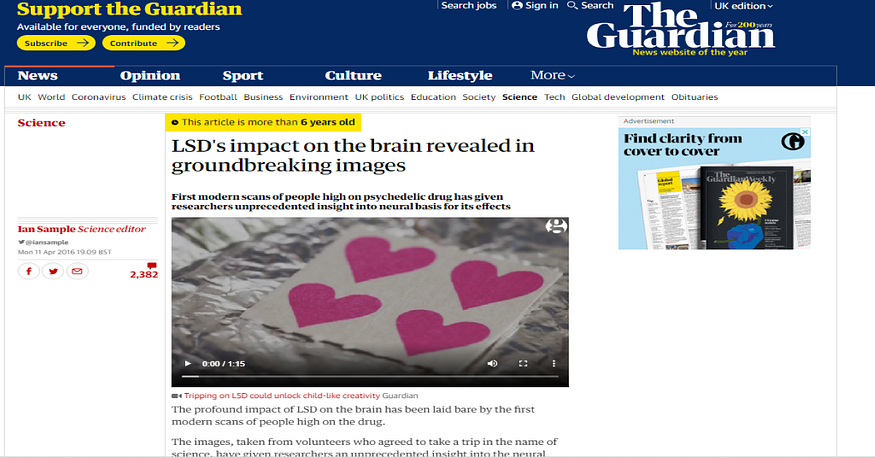
Bernardo Kastrup focuses much on a Guardian article and severely criticises it. (The article: ‘LSD’s impact on the brain revealed in groundbreaking images’ | Science | The Guardian.) Kastrup’s position is summed up by the last words of the passage above:

“[Kastrup] also discusses, in explicit and specific detail, what he perceives as widespread physicalist confirmation bias in both academia and mainstream media.”

As can be seen above and elsewhere, many of Kastrup’s criticisms of other philosophical — and indeed scientific — positions are quite conspiratorial in nature, as well as being highly personalised, somewhat arrogant and rhetorical. (On videos and in interviews, Kastrup comes across as having a almost narcissistic belief in himself and in his own views.)

(Note: Kastrup has a go at the Washington Post, The Conversation and CNN. He uses the words “gratuitously misleading”, “Why don’t they just tell the truth?” and “in your face bias”. He also accuses these newspaper journalists of being “physicalists”. Added to all that are his strong words on Sabine HossenfelderSam Harris and even on the mild-mannered Philip Goff - of whom he says: I have lost a great deal of intellectual respect for Philip’s positions and arguments. Therefore, I have little motivation to continue the engagement with him.” Kastrup’s comments on Harris and Hossenfelder, however, are far worse than that.)

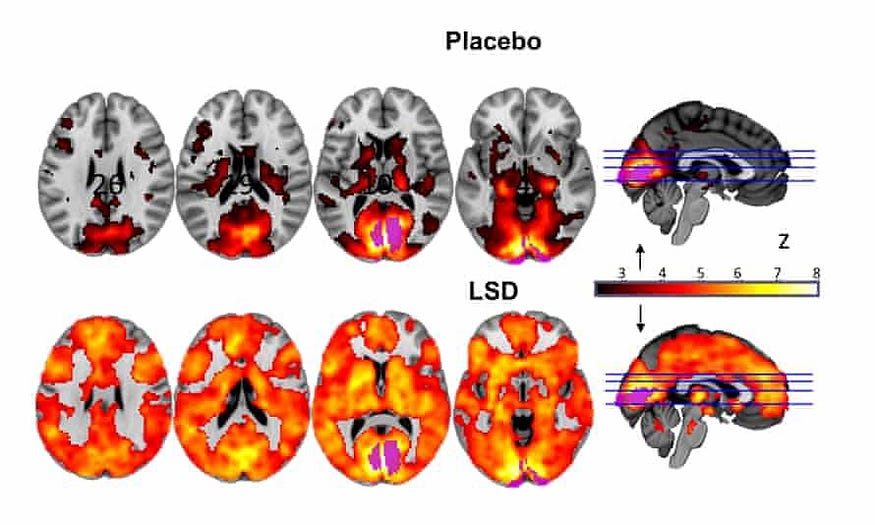
More relevantly to this essay, Kastrup sneers and literally laughs at much — or even all — of the Guardian article he focusses on. He specifically laughs at a Guardian image (see below) in which the journalist supposedly mistakes the parts of the brains which are coloured orange (in the mage) with increased activity, rather than decreased activity. (The image is accompanied with the words “lots of orange”.) This may well be a simple and honest mistake — that’s if it’s a mistake at all. Yet Kastrup gives the image and entire article an embarrassingly conspiratorial interpretation and boils in all down to a commitment to “physicalism”, which he claims is “a failing paradigm”.

The aforementioned image doesn’t matter that much anyway because the scientists quoted in the article — as we shall shortly see — make it very clear that there is much brain activity during psychedelic experiences.

In any case, Kastrup is definitely demanding that newspaper articles be written in the manner and style of academic papers… at least in the cases which he cares about.

Yet Kastrup himself isn’t a neuroscientist.

Indeed (as far as I can see) he’s never formerly studied neuroscience at a university. That said, the Guardian writer Kastrup tackles, Ian Sample, isn’t a neuroscientist either. However, he was a journalist at New Scientist and worked at the Institute of Physics as a journal editor. (He also has a PhD in biomedical materials.) Of course Kastrup has a strong scientific background too. So the fact that both Kastrup and Sample have such backgrounds doesn’t make either of them the last word on any scientific subject. And this is especially the case because, if we read Bernardo Kastrup right, the Guardian’s Ian Sample has got it all wrong when it comes to psychedelic experiences.

Kastrup’s Detail on the Guardian Article

This image was used by the Guardian newspaper and then scrutinised by Bernardo Kastrup. It’s accompanied by the following words: “A second image shows different sections of the brain, either on placebo, or under the influence of LSD (lots of orange).”… Kastrup laughs at this mention of “lots of orange” even though there’s no mention — at least here — that the orange simply and plainly signifies “increased” brain activity. It may, instead, simply signify differences in brain activity.

Kastrup is emphasising (what he takes to be) the fact that there is less brain activity during a psychedelic “trip” than in normal states. The thing is that the Guardian article Kastrup laughs can be interpreted as not exactly stating the opposite of this. (That is, that there is more brain activity during a trip.) Instead, it simply highlights the different kinds of brain activity which occur during psychedelic trips.

Thus the central theme here are the distinctions which can be made between increased brain activity, decreased brain activity and what Kastrup calls “activity variability”.

The Guardian’s (or Ian Sample’s) position is summed up in this way:

“A dose of the psychedelic substance — injected rather than dropped — unleashed a wave of changes that altered activity and connectivity across the brain.”

The Guardian concludes with these words:

“This has led scientists to new theories of visual hallucinations and the sense of oneness with the universe some users report.”

So, according to the Guardian, this “oneness with the universe” is actually a result of the “wave of changes that altered activity and connectivity across the brain”. Kastrup, on the other hand, believes that this oneness with the universe — along with much else! — is down to the subjects’ actual (or real) oneness with the universe. That is, Kastrup believes that the minds of the subjects experiencing psychedelic experiences disengage from the physical brain and become one — or at least attempt to become one — with Cosmic Consciousness.

In fact Kastrup may be right (at least in a weak sense) about a “materialist bias” because the neuroscientist and professor Robin Carhart-Harris (as quoted in the Guardian article) states the following words:

“This experience is sometimes framed in a religious or spiritual way, and seems to be associated with improvements in wellbeing after the drug’s effects have subsided.”

To Kastrup, on the other hand, “[t]his experience” isn’t actually about these experiences being “framed in a religious or spiritual way” at all. It’s about this experience actually being religious or spiritual. That is, it’s about psychedelic subjects tapping into Cosmic Consciousness.

(In Kastrup’s general philosophy, this tapping into Cosmic Consciousness comes with a hell of a lot of extra spiritual and indeed political baggage. See, for example, here.)

Moreover, the Guardian spreads yet more of the (what Kastrup calls) “materialist paradigm” here:

“Further images showed that other brain regions that usually form a network became more separated in a change that accompanied users’ feelings of oneness with the world, a loss of personal identity called ‘ego dissolution’.”

More technically, the following is just one more example of brain activity (again, as cited by the Guardian) which occurs during a psychedelic trip:

“The brain scans revealed that trippers experienced images through information drawn from many parts of their brains, and not just the visual cortex at the back of the head that normally processes visual information. Under the drug, regions once segregated spoke to one another.”

Added to all that, Robin Carhart-Harris is quoted again stating the following:

“We saw many more areas of the brain than normal were contributing to visual processing under LSD, even though volunteers’ eyes were closed.”

So are all the words above (both from the Guardian and the neuroscientists cited in other newspaper articles) simply yet more examples of the (as the Essential Foundation puts Kastrup’s position)

“widespread physicalist confirmation bias in both academia and mainstream media”?

Ironically, both the Guardian and Kastrup may well be working from the same hard data… Or at least that is something that Kastrup would like to stress. And he does so, for example, when he judgmentally and sternly claims that the Guardian (or Ian Sample) has simply misinterpreted that data!

In any case, it’s unequivocal that, at least according to the Guardian and the scientists it quotes, there is much brain activity during psychedelic experiences!

Case Studies and Details

Bernardo Kastrup argues (or merely hints at in this particular video) that a decrease in brain activity in the brain (during a session of hallucinogenic drugs) means that the brain isn’t involved at all when it comes to such hallucinogenic experiences. (It will be explained why this extreme expression of Kastrup’s position is implicit in what he says.)

Yet a reduction in some areas of brain activity (during psychedelic experiences) doesn’t mean a reduction in all areas of brain activity. It certainly doesn’t mean that the brain isn’t involved in any way in such experiences.

What these (what Kastrup calls) “deactivations” of brain activity may simply mean, for example, is that the psychedelic subjects’ cognitive processes are less prevalent during their psychedelic experiences. Thus, the subjects allow themselves to be (as it’s sometimes put) “immersed” in their experiences. (This is how the advocates and takers of hallucinogenic substances themselves often put it.) Hence the lack of activity in certain parts of the brain.

At one point in the video Kastrup explicitly states that “not a single part of the brain becomes more [my italics] active” during a psychedelic trip. That may well be true. Yet the brain is still active at such a time. And there’s certainly no demonstration of any independence of psychedelic experiences from the brain.

Kastrup also compares what happens during a psychedelic trip to “the brain going to sleep”. Yet, as far as can be seen, no neuroscientist has claimed that dreams — or simply sleep — are independent of the brain or ever concluded such a thing. And neither do they claim that there is zero brain activity during sleep. (As earlier, this is a reference to zero activity when it comes to dreams and other states of sleep; not to the general functioning of the brain when subjects are asleep.)

Kastrup knows that that there is much brain activity even during deep sleep because he actually mentions it. ( See the scientific detail here. ) The words “much” was just used. So it can be conceded that even though there is much brain activity during sleep, there may still be less brain activity than when awake. And this may indeed parallel what happens during psychedelic experiences. That is, there is much brain activity during psychedelic experiences, but still less than there is during non-psychedelic states.

This means that Kastrup bringing up sleep doesn’t seem to do the job he wants it to do.

So what does all of the data show Kastrup?

It doesn’t show that experience or consciousness has any kind of independence from the brain or from brain activity. It simply shows that different things occur in the brain during hallucinogenic experiences than which occur at other times. And that fact has the air of the obvious about it.

This means that Kastrup’s “black swans” (his term for the cases which he believes show us that not all experiences are “correlated” with activity in the brain) are not black swans at all. They’re simply different types of white swan — that is, different things occur in the brain when under a hallucinogenic substance than which occur when not under such a substance.

So how does Kastrup draw his very broad philosophical conclusions from his supposed black swans?

All this is pretty obvious: (1) Different experiences will involve different parts of the brain and different levels of activity in the brain. (2) Some parts of the brain will be less active and other parts will be more active during different experiences. (3) It may indeed be the case that, overall, the brain is less active during a psychedelic trip.

Kastrup also focuses on the “rich experiences” which are had during psychedelic trips. In Kastrup’s own words:

“Psychedelic substances have been known to induce highly complex, intense, non-local, transpersonal experiences.”

To Kastrup, this demonstrates that there is something very weird or spooky about rich experiences running alongside decreased brain activity.

Yet Kastrup fails to say (or realise) what a psychedelic “rich experience” actually is. He conflates what the subject makes of his experiences under the influence of a hallucinogenic substance and the experiences themselves. Of course, those who take such substances make a lot of their experiences under their influence. (This is well documented.) But that doesn’t mean that the experiences actually are “richer” in anything other than a vague (or purely personal/psychological) sense. And it certainly doesn’t mean that the experiences are (as Kastrup puts it) “non-local” just because certain (i.e., not all) subjects take them to be non-local.

(Not that any of the psychedelic subjects would have used the highly-technical term “non-local” — unless, that is, they already had an interest in these areas of philosophy and science. See quantum non-locality.).

Conclusion

To repeat.

In order to establish his radical position, doesn’t Kastrup need to demonstrate that there is zero brain activity during psychedelic experiences? Note that this isn’t a demand that Kastrup should demonstrate zero brain activity simpliciter. It simply means that he should demonstrate zero brain activity in relation to the psychedelic experiences themselves..

More technically, what Kastrup calls “deactivation” doesn’t mean that there’s zero brain activity during psychedelic trips. Yet that’s precisely what Kastrup would need to establish both his scientific position and his philosophical conclusions (or speculations). Indeed, Kastrup even admits that brain “activity does remain” during psychedelic experiences (i.e., as that activity relates to those experiences). Kastrup also uses the words “reduced activity”, “less active”, “residual activity” and “activity variability” in reference to what occurs during psychedelic experiences. In other words, Kastrup’s “activity variability” (which Kastrup pits against what he believe are the many false claims about increased brain activity) obviously doesn’t equal zero brain activity.

In a strong sense, then, if Kastrup isn’t making these very radical claims about zero brain activity (which may be hidden beneath his very-academic and technical prose), then he simply can’t establish his radical philosophical position of Cosmic Idealism. Moreover, if he isn’t claiming that there’s zero brain activity during psychedelic experiences, then what, exactly, is he claiming?

In other words, simply arguing that the brain is slightly less active (or whichever technical wording Kastrup prefers to use) during psychedelic experiences clearly doesn’t establish Kastrup’s central philosophical thesis — i.e., that psychedelic trippers are tapping into Cosmic Consciousness and thereby freeing themselves from the biological and physical brain.

*) See my essay, ‘The Idealist Philosopher Bernardo Kastrup vs. Materialism’.

[I can be found on Twitter here.]