Friday, 4 November 2022

The Fact that Philosophy Isn’t Physics Annoys Some Popular Physicists

Some best-selling physicists really dislike philosophy and see it as a complete waste of time. Is this largely down to the very-simple fact that philosophy isn’t… well, physics?
(i) Introduction 
(ii) Philosophers Aren’t Physicists 
(iii) Stephen Hawking 
(iv) Lawrence Krauss and Sabine Hossenfelder 
(v) Some Physicists Have Been Right About Philosophy 
(vi) History

Some physicists (especially the ones who write best-selling books) have a big problem with philosophy. That problem is that they don’t like the fact that philosophy isn’t physics.

Of course they never put it quite so simply or honestly.

And, yes, such physicists have also given reasons for their anti-philosophy stances. Indeed a handful of the reasons they’ve given are subtle. However, most are crude and ignorant…

Yet it’s still essentially all down to philosophy not being physics.

The claims above may themselves seem as simplistic as the anti-philosophy positions of the aforementioned physicists. However, if you read the actual words of these physicists on this issue, then you’ll quickly note the lack of names of any actual philosophers or any details about what they argue.

The anti-philosophy physicists’ other big problem (which, of course, follows from their main big problem) is that philosophers aren’t physicists.

Philosophers Aren’t Physicists
One can guess (i.e., from the overall context) that the claims of anti-philosophy physicists basically amount to the fact that (most? all?) philosophers don’t understand the mathematics of physics and all the precise technical details involved in physical theories.

To put it more simply. Anti-philosophy physicists are basically saying that philosophers don’t know as much about physics as they do.

Of course no single physicist knows all the maths and all the technical details of physics either. Indeed most physicists have extremely narrow specialisms.

In addition, if philosophers knew as much about physics as physicists do, then they’d probably actually be physicists.

So it can be argued that such anti-philosophy physicists are replicating sociologist Steve Fuller’s own position against… physicists and biologists. (Specifically, against Murray Gell-Mann, Roger Penrose, Steven Jay Gould, etc.)

Steve Fuller’s basic problem (at least as I see it) is that physicists and biologists aren’t as emersed in sociology (or the social sciences generally) as he is.

Fuller wrote the following:

[T]o a sociologist, it will be apparent that many of the ‘deep puzzles’ that these scientists brood over could be solved, or at least dissipated, by a dose of social science [].”

So that can be rewritten in this way:

To a physicist, it will be apparent that many of the ‘deep puzzles’ that these philosophers brood over could be solved, or at least dissipated, by a dose of physics and science generally.

Indeed some physicists have said precisely that!

Fuller also stated this:

[T]he most disturbing feature of these interviews is that despite their interdisciplinary pretensions, none of the scientists ever feels the need to refer to theories or findings of the social sciences (except for a few derogatory remarks about economists). When [Steven Jay] Gould wants to flaunt his well-roundedness, he quotes Horace and Shakespeare, not Marx and Weber [].”

This can also be rewritten as follows:

The most disturbing feature of philosophers is that none of them ever feels the need to refer to the theories or findings of physics (except for a few derogatory remarks about [this is my addition] the lack of philosophical sophistication of physicists).

So Fuller himself is (if implicitly) asking his readers why biologists and physicists aren’t as immersed in sociology as he is. And anti-philosophy physicists are (more explicitly) asking their readers why philosophers aren’t as immersed in physics as they are.

In terms of Steve Fuller’s stance.

If physicists were as immersed in sociology as Fuller himself is, then they’d basically be sociologists.

In more detail.

Fuller mentioned various artfully-selected theories which his targeted biologists and physicists didn’t themselves mention or didn’t know anything about. And then Fuller went on to simply assume ignorance on the part of his targeted scientists for not knowing — or simply mentioning — these things…

So doesn’t that sound familiar?

It can now be said that there’ll be many other (relevant) things which these biologists and physicists know (or knew), and which Fuller himself doesn’t know. So perhaps such scientists show now repay the compliment and arbitrarily namedrop the theories and ideas which Fuller himself doesn’t know.

And that’s what anti-philosophy physicists sometimes do when criticising philosophy. (“You comment on physics, yet you haven’t mastered differential geometry, multilinear algebra, manifold theory and functional analysis!”)

To change tack a little.

A YouTube video called ‘Scientists vs Philosophers’ opens up with the host (a Steve Paulson) asking this question:

“Why is it that so many physicists are bashing philosophers nowadays?”

So now let’s single out the well-known case of Stephen Hawking.

Stephen Hawking
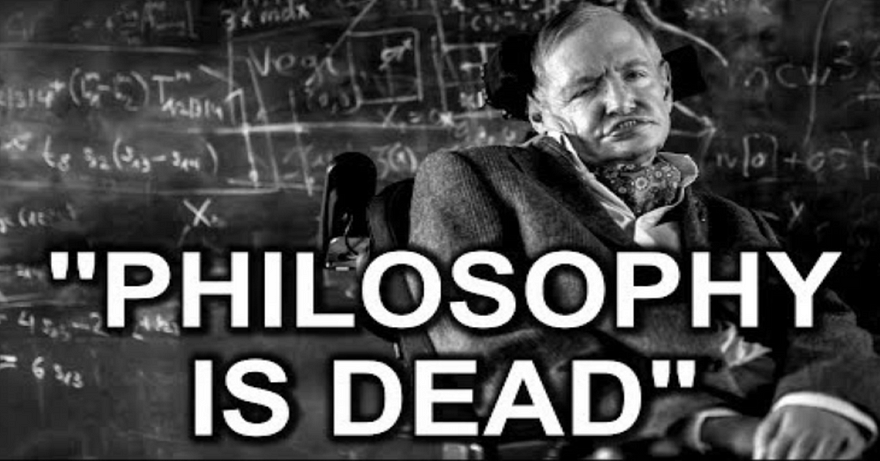
Stephen Hawking one stated that “philosophers haven’t kept up with physics”. Indeed (in his book The Grand Design) Hawking went into more detail in the following passage:

“Traditionally these are questions for philosophy, but philosophy is dead. Philosophy has not kept up with modern developments in science, particularly physics. Scientists have become the bearers of the torch of discovery in our quest for knowledge.”

Stephen Hawking is actually both a bad and an ironic example of an anti-philosopher. That’s for the simple reason that what he said about philosophy is very naive. That’s the bad part. More ironically, Hawking offered the world his very own philosophical position on physics, which he called model-dependent realism. Indeed Hawking even borrowed a technical term from philosophy — “realism”.

(“Realism” isn’t a term of — or in — any branch of physics I know. However, it is sometimes used in the interpretations of quantum mechanics.)

Now how bizarre is all that?

So here’s a taster of Hawking’s very own philosophy:

“There is no picture- or theory-independent concept of reality. Instead we will adopt a view that we will call model-dependent realism: the idea that a physical theory or world picture is a model (generally of a mathematical nature) and a set of rules that connect the elements of the model to observations. This provides a framework with which to interpret modern science.”

Sure, it might have been the case that Hawking didn’t see his model-dependent realism as a philosophical position. He might have seen it as, say, a simple description of “the facts” or a description of the methodologies of physics. Yet that too would have been very naïve.

In addition, since Hawking classed himself as “a positivist” on more than one occasion, then his complete rejection of philosophy was even more ridiculous and naïve that so far characterised.

Many of the words above may also apply to Lawrence Krauss.

Lawrence Krauss and Sabine Hossenfelder

In an interview with Ross Anderson, American theoretical physicist and cosmologist Lawrence Krauss (1954-) said:

[T]he worst part of philosophy is the philosophy of science; the only people, as far as I can tell, that read work by philosophers of science are other philosophers of science.”

Despite that, Marcus Munafo (a professor of biological psychology) and George Davey Smith (the director of the MRC Integrative Epidemiology Unit at the University of Bristol) have written the following words:

“Richard Feynman once claimed that the ‘philosophy of science is as useful to scientists as ornithology is to birds.’ We disagree.”

Sure, that’s an example of only two scientists mentioning the philosophy of science. That said, perhaps I don’t need any examples for my general argument here.

In any case, perhaps physicists would pick up on the fact that these two pro-philosophy scientists aren’t physicists. (Biological psychology isn’t physics and epidemiology isn’t physics either.) So are such anti-philosophy physicists Sheldon Cooper-type characters in that they too have very little respect for any discipline — other than mathematics — that isn’t theoretical physics? (Shelden Cooper is — or was — a young and “eccentric” theoretical physicist in the American sitcom The Big Bang Theory.)

This state of affairs was also perfectly captured by the German theoretical physicist and YouTube presenter Sabine Hossenfelder.

Hossenfelder wrote an article (called ‘Electrons Don’t Think’) on the philosophical position of panpsychism. In that article she doesn’t quote a single panpsychist, tackle a single argument in support of panpsychism or even paraphrase a single panpsychist’s words. (See my ‘Sabine Hossenfelder Doesn’t Think… About Panpsychism’.)

Hossenfelder may argue that she hasn’t the time to do any research on panpsychism or on philosophy generally. Yet she had the time to write this article on panpsychism.

Some commentators and readers may also argue that it’s only the philosophy of science that physicists like Krauss and Hossenfelder have a problem with. Yet that obviously doesn’t apply to Hossenfelder’s words on panpsychism.

So if Krauss and Hossenfelder already believe that “philosophy hasn’t kept up with science” (and therefore that philosophy has nothing to offer science/physics), then no wonder they have such a naïve view of philosophy. That is, Krauss and Hossenfelder are taking part in some kind of self-fulfilling prophecy here:

i) Because Kraus and Hossenfelder already believe that philosophy has nothing to offer science,
they never read philosophy.
ii) And because they never read philosophy,
they consequently believe that philosophy has nothing to offer science.

That said, it can be assumed that both Kraus and Hossenfelder would argue the following (though perhaps they wouldn’t even bother doing so):

Because we’ve already read philosophy, then that’s why we believe that philosophy has nothing to offer science.

There are many reasons to strongly believe that isn’t the case. (Some of those reasons are mentioned in this essay.)

Thus, all Krauss and Hossenfelder are really showing us here is their own ignorance of philosophy. They aren’t showing us that (all? some?) philosophers are ignorant of physics and science generally.

To sum up.

One gets the impression (which can be backed up with fact) that people like Krauss and Hossenfelder simply haven’t read much — or even any — contemporary philosophy. What’s more, at various places and at various times (if in roundabout ways), they’ve freely admitted this! After all, why should Krauss, Hossenfelder and other anti-philosophy physicists read philosophy if they already believe (as just argued) it’s a waste of time?

Some Physicists Have Been Right
Not to be entirely one-sided and biased, it’s worth stating that some of the criticisms of philosophy from physicists have been worthwhile, apt, and… philosophical.

Indeed many philosophers have themselves claimed that philosophy is dead (if not in those precise words).

Why “dead”?

Again, it’s because some (i.e., not all!) philosophers haven’t kept up with physics and science generally. (As stated, however, it depends how the words “kept up with science” are read.)

Ontic structural realists are a clear example of this. (They too don’t have every philosopher under the sun in mind.)

And a few other philosophers (such as Daniel Dennett — see here) are also critical of philosophers for many of the same reasons cited by anti-philosophy physicists.

On a related theme.

One can understand how certain physicists are irked by philosophers if the American philosopher of physics, David Z. Albert, was correct when he stated (in the video cited above) the following:

“There have been instances of philosophers telling physicists that they’re not doing their jobs properly.”

That may explain why these anti-philosophy physicists get so pissed off by philosophers. At least David Albert’s words may offer us a partial explanation of that.

So now take on board the following passage (which is in tune with what Albert just said) from the philosopher of science, Wesley Salmon. He wrote:

“While the philosopher of science may be basically concerned with abstract logical relations, he can hardly afford to ignore the actual methods that scientists have found acceptable. If a philosopher expounds a theory of the logical structure of science according to which almost all of modern physical science is methodologically unsound, it would be far more reasonable to conclude that the philosophical reasoning had gone astray than to suppose that modern science is logically misconceived.”

The host of the previously-cited video debate also tells us that physicists claim that “philosophers don’t add any knowledge to the world”. That’s very ironic because it was philosophers themselves (e.g., the logical positivists and Ludwig Wittgenstein — see here) who first made precisely that point in the 1920s and 1930s.

Yet this also means that in order for physicists to claim that philosophy doesn’t add any knowledge to the world, then surely they must do some philosophising themselves. Among other things, anti-philosophy physicists must do the following:

1) Explain what they mean by the word “knowledge”.
2) Tell us why philosophical claims aren’t examples of knowledge.
3) Tell us why scientific knowledge is actually the only kind of knowledge. 
4) And finally tell us why scientific knowledge (or science itself) must have such a preeminent status in society.

None of the positive or negative answers to those questions will be scientific in nature. And they certainly won’t be part of physics!

One would hope, then, that anti-philosophy physicists won’t argue that such questions shouldn’t even be asked.

However, if any physicists did argue (or simply believe) that these questions are a waste of time (i.e., precisely because they’re philosophical), then that extreme position would itself need to be philosophically defended and backed up. And if such scientists didn’t defend it (or if they believe that they aren’t required to defend it), then that stance will — again — need a philosophical defence.

Ironically, it can just as easily be said that much physics is dead because physicists haven’t kept up with philosophy.

History
Historically, it was the case that nearly all scientific advances had their roots in philosophical ideas and theories. And as a consequence of that, it can now be said that the revolutionaries of physics have always been both philosophically inclined and aware of much philosophy.

So although there have indeed been critical remarks about philosophy from physicists, there haven’t been as many as some readers may think.

Albert Einstein, to take just one example, owed a strong debt to Ernst Mach, Immanuel Kant and Baruch Spinoza (as well as others). Even Isaac Newton was well-schooled in philosophy and his own physics was called (as is often pointed out) “natural philosophy”.

In terms of contemporary — as well as somewhat less recent — philosophical physicists and physicists who don’t diss philosophy (though they do, of course, diss particular philosophical positions or theories), we have Lee Smolin, Roger Penrose, Carlo Rovelli, Murray Gell-Mann, Sean Carroll, Brian Greene, Julian Barbour, Paul Davies, Freeman Dyson, John Wheeler, Martin Rees, Steven Weinberg, etc. But if we go back in history, there’ve been many other philosophical physicists (from Isaac Newton to Niels Bohr and Werner Heisenberg); many of whom were also very knowledgeable about philosophy.

One must also admit here that being a philosophical physicist doesn’t necessarily mean that such a physicist must also be a very-big fan of philosophy. They don’t need to, say, keep bang up-to-date with all the top academic philosophy journals.

In any case, many physicists have only ever mentioned dead philosophers (i.e., not contemporary ones). The American philosopher and journalist Jim Holt, for example, tells us that when the philosophy of science is brought to the attention of physicists, they always say: “Oh, you mean Karl Popper?”

So is that (at least partly) why these anti-philosophy physicists believe what they believe about philosophy? That is, perhaps they believe that philosophy of science = Karl Popper. Indeed was Popper himself an example of one of those philosophers who (to use Wesley Salmon’s words again) “ignore[d] the actual methods that scientists have found acceptable”?

As stated earlier, it’s very hard to say because most (or all) anti-philosophy physicists rarely cite any details about the philosophy they dislike or see as being “irrelevant”.

In addition, none of the above is to claim that the physical theories of these philosophical physicists were actual examples of philosophy.

Some critics of philosophy have been keen to point this out. Yet the statement that theories in physics aren’t themselves expressions of philosophy is a statement of the obvious.

In detail.

Critics of philosophy (i.e., not only physicists) have felt the need to point out to me the irrelevance of the “context of discovery”. One such critic cited Albert Einstein as an example of this.

He pointed out that Einstein loved playing the violin and that this hobby didn’t impact on his actual physics.

Sure!

But what about Einstein and philosophy?

As if Einstein’s philosophical positions and influences were equivalent to his playing the violin, drinking wine while theorising about physics or being a penniless member of the bourgeoisie.


Tuesday, 1 November 2022

Is Every Richard Feynman Quote Really Profound and Wise?

The late and great Richard Feynman once famously declared: “Snow is white.” Feynman also quipped that “drinking Earl Grey tea is like making love to a beautiful woman”. Now all that is precisely why The Dick was both a great and a late man.

Why do so many of Richard Feynman’s fans believe that every sentence he ever uttered was profound and deep and worth quoting at every opportunity? In addition, why do so many of Feynman’s words end up in memes and images, which are then spread around Facebook and Twitter like confetti?

(On the goodreads website, there are 24 pages of quotes from Feynman. Each page has at least 23 different quotes on it.)

It’s worth noting immediately that previously (in response to an earlier essay) I discovered that Feynman’s fans often get very angry when someone points out that his fans get very angry when Feynman is criticised. I also noted that many of the writers who actually got around to mentioning the fact that the hero-worship of Feynman really does exists, then go straight ahead and indulge in a bit (or even a lot) of it themselves. (Perhaps to prove that they aren’t philistines or luddites — see here and here. Note that this isn’t a reference to those negative articles which have been written about Feynman’s private life, behaviour and personality.)

In any case, the hero worship of Feynman is very deep and widespread. Of course very few people would deny that he was a great physicist. (Although non-physicists can only believe that Feynman’s physics is great via what philosophers call testimony.) Yet, ironically, most of the Feynman memes and quotes just mentioned are posted by non-physicists. What’s more, nearly all of them are not actually about physics (or even science as a whole) at all.

(I had a problem finding a single meme or image about Feynman’s work on quantum electrodynamics (specifically, Feynman diagrams) and the path integral formulation, which are, after all, what made Feynman famous within physics. Of course this isn’t to deny that he did much other important work too. And perhaps it’s difficult to create a sexy meme about QED, etc.)

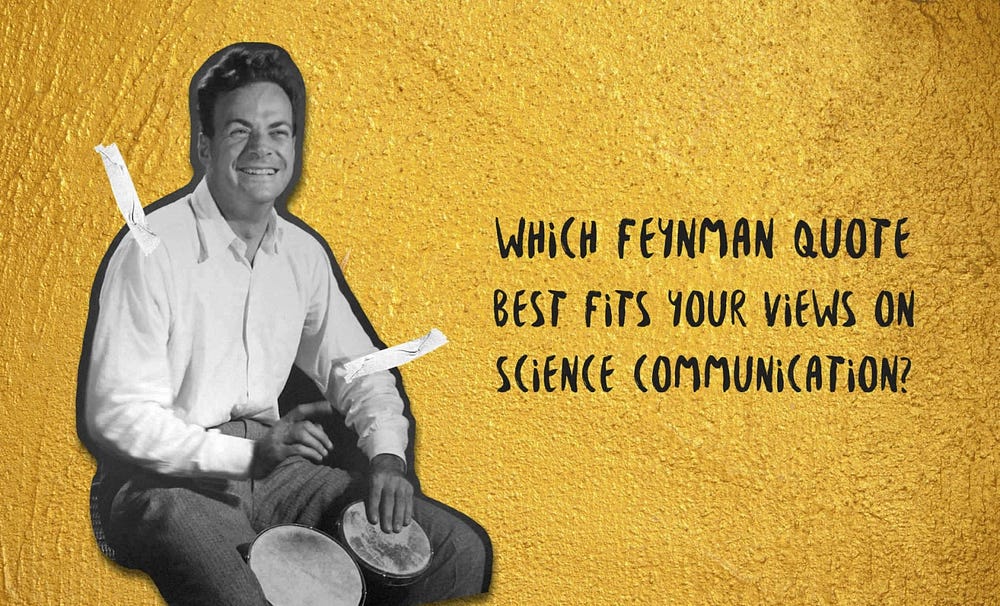
It can be argued that Feynman’s fame (at least as it manifests itself outside of physics and physicists) often simply boils down to the fact that he was, well, cool and/or hip. Or, more correctly, it boils down to the fact that Feynman is deemed by many of his fans (often self-described nerds and geeks) to be cool and/or hip. So why was Feynman cool and hip? It seems that Feynman was cool and hip because he played the bongos, “liked a laugh”, was a womaniser, and even had a somewhat quirky face and way of dressing (see here and here).

Thus, Feynman’s image alone (as with many of the fans of James Dean, Che Gevara, Malcolm X, Marlon Brando, Sid Vicious, Kurt Kobain, etc.) is a strong part of the appeal.

Specifically on the endless mentions of Feynman’s bongo-playing. (There are over 7 pages of Google links about Feynman and his penchant for bongos.) The television series The Big Bang Theory accurately summed this up when one of its main characters, Sheldon Cooper (one of the nerds I just mentioned), often emulated Feynman (i.e., in more than one episode) by playing the bongos.

So what about other famous physicists?

The Wise Words of Other Famous Physicists

Why do far too many people (at least those who admire physicists) simply assume that famous physicists (i.e., not any unknown ones) will have insightful things to say on almost (or literally) all other subjects? (I have in mind Michio Kaku, Brian Cox, etc., but especially the highly self-conscious performer Neil deGrasse Tyson.)

I first noted this with Albert Einstein.

Einstein’s non-scientific words are quoted left, right and centre. Yet much of what he said on politics, religion and God is fairly standard stuff. And even when true or fairly insightful, his words would probably have been ignored if said by a layperson or even by an unknown physicist.

Thus, we give the superstars of physics (if not physicists generally) leeway to comment on all sorts of stuff that’s a million miles away from physics. (This is a little like asking pop stars or actors to offer their profound insights on politics.) It’s also a case of a positive ad hominem in that the aforementioned bigged-up men or women are automatically deemed to be saying insightful things simply because they are famous actors, pop stars… or physicists.

In terms of theoretical physicists, I believe that this is primarily because they’re seen as being the “brainiest” of all people — perhaps just behind brain surgeons. (Are brain surgeons “brainy” simply because they carry out surgery on the brain?) Sure, many of them are indeed brainy and even highly imaginative. Yet, again, why does that give them a special insight into Donald Trump, Jeremy Corbyn or “the meaning of life”?

So do economists, psychologists, social scientists, etc. also have some insightful and deep angles on quantum mechanics, string theory or wormholes? It can be accepted that such people could do. However, there’s no reason to simply assume that they do.

The English physicist Stephen Hawking (1942–2018) was a good example of all this.

Hawking talked about politics (see here), religion and, of course, God (see here).

More specifically, Hawking commented on, and was extensively quoted commenting upon, the Iraq War, euthanasia, women in science, Brexit, nuclear weapons, animal testing, Donald Trump, the NHS, the Labour Party, etc. However, as far as I know, none of these comments appeared in his actual books or publications. Thus, if Hawking was asked a question on any given x, then of course he had the right to answer it and offer his view.

So all this is very different from a physicist superstar (such as Michio Kaku, Neil DeGrasse Tyson and, well, Richard Feynman) discussing Black Lives Matter or tax policy in his actual books or articles. In other words, Hawking and others can’t help but answer the questions they’re asked by journalists and others. And there’s no reason that they shouldn’t answer them. After all, physicists are voters, members of society, human beings, etc.

So shouldn’t we expect a little more modesty from such superstar physicists?

That said, since literally millions of people are buying their books, and these books tend to stray way beyond physics, astrophysics and cosmology, then why should such physics superstars stop doing what they do? That is, these theoretical physicists firstly created a niche in (obviously) theoretical physics, etc., and then they branched out… And the more they wrote and got published, the farther and farther out they branched.

Now it must be said that this branching out isn’t always unsuccessful. Indeed sometimes it may even be insightful. However, why do so many of the fans of these physics superstars simply assume that all the examples of this branching out will be interesting, let alone insightful or profound?

Part Two: The Quotes

It can happily be conceded that Feynman might have had extremely insightful things to say about sexual intercourse or Richard Nixon (see later section). However, why should his fans (or anyone else for that matter) simply assume that he did so? What is it about famous theoretical physicists that gives them an insight into tax policy or “the meaning of life”?

It must also be said here that I too can appreciate at least some of Feynman’s words on subjects which have nothing (directly or even indirectly) to do with physics.

Take this (possibly) unanswerable (if ironic) question asked by Feynman. He recalled:

“You know, the most amazing thing happened to me tonight. I saw a car with the license plate ARW 357. Can you imagine? Of all the millions of license plates in the state, what was the chance that I would see that particular one tonight? Amazing!”

This passage can be reformulated as a simple question:

Of all the millions of license plates in the state, why did I see that particular one tonight?

Yet it’s not at all weird that Feynman should have seen that particular number plate. He had to see one number plate when he glanced at that particular time. So whichever numberplate he saw, the same astonished question could have been asked about it.

So, to admittedly stretch things a little, perhaps Feynman’s ironic question is similar to the following non-ironic question:

Why are the laws of physics and the constants of nature the way they are and why do they have the particular values that they have?

Yet perhaps there’s no deep answer — other than mundane facts about probabilities, etc. — to Feynman’s own question as to why he should have seen that particular number plate.

Basically, then, what if these deep questions don’t have answers (or solutions)? Moreover, what if these supposedly profound questions are suspect or bogus in some way? Despite stating that, even if a question may not have an answer, reasons or explanations will still need to be given as to why that’s the case.

No One Understands Quantum Mechanics

There’s only a single well-known quote from Richard Feynman which I’ll spend a little time on. However, I have no idea where this quote comes from. That’s because, like so many other people, I’m simply quoting the quote. So here goes:

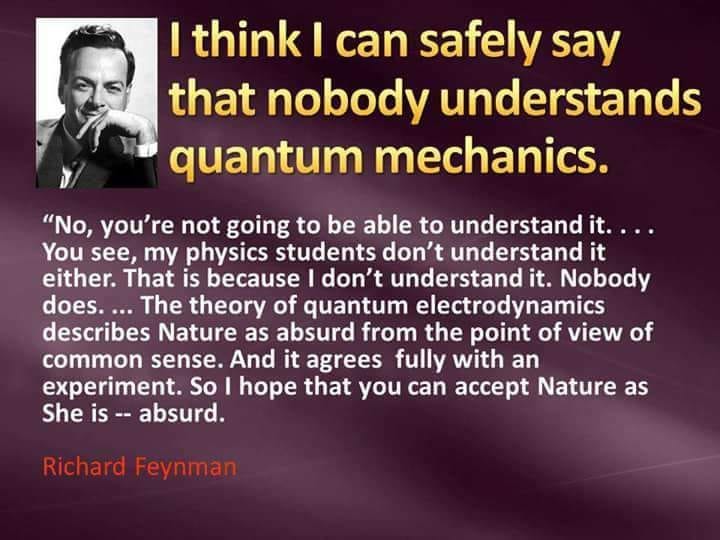
“I think I can safely say that no one understands quantum mechanics.”

To be honest, I find Feynman’s remark to be almost purely rhetorical. After all, it’s fairly well-known that Feynman didn’t have too much time for the interpretations of quantum mechanics, let alone for the philosophy of quantum mechanics. In other words, Feynman knew all of the relevant maths. “The trouble was”, as science writer Philip Ball put it, “that’s all he could do”.

The physicist Christopher Fuchs (also quoted by Philip Ball) expressed the problem with quantum mechanics in terms of “all the posturing and grimacing over [its] paradoxes and mysteries”. Indeed, for many laypersons especially, that posturing and grimacing seems to have become the very essence of quantum mechanics. And perhaps this is even the case for some physicists too…

And from that quantum weirdness there follows the no-one-understands-quantum-mechanics refrain.

So Ball picks up on the bizarre nature of Feynman’s statement when he says that “[a]t that point, no one alive knew more than Richard Feynman about quantum mechanics”. He concluded: “What hope is there, then, for the rest of us?”

On the other hand, it’s easy to agree with Feynman. So it’s not a surprise that Ball says that “[s]ome scientists feel the same way today”. Many scientists, in the words (quoted by Ball) of the physicist David Mermin, also say “shut up and calculate”.

Now for some more Feynman quotes which aren’t technical or even about physics.

Ten More of Feynman’s Oft-Quoted Words

(1)

“Nobody ever figures out what life is all about, and it doesn’t matter. Explore the world. Nearly everything is really interesting if you go into it deeply enough.”

That’s okay advice. However, it’s still pretty banal. Indeed it could have been said by very many science teachers and physicists — and probably has been. (Perhaps some of Feynman’s fans wouldn’t deny that.) And it also assumes that “life” (whatever that is) is “about” something, even if we can’t discover what it is about. That said, Feynman did concede that it “doesn’t matter”. In addition, I don’t believe that many (or even any) people are psychologically constituted to find “nearly everything” interesting.

(2)

“Religion is a culture of faith; science is a culture of doubt.”

That has been said (if in different ways) by countless scientists (countless times) over the centuries (though especially since the 19th century).

(3)

“I would rather have questions that can’t be answered than answers that can’t be questioned.”

Ditto.

(4)

“If you thought that science was certain — well, that is just an error on your part.”

Ditto.

(5)

“It doesn’t make a difference how beautiful your guess is. It doesn’t make a difference how smart you are, who made the guess, or what his name is. If it disagrees with experiment, it’s wrong.”

Ditto.

(6)

“I’m smart enough to know that I’m dumb.”

That’s fairly witty. However, it could well be a witty variation on Socrates’ well-known words — “I believe that I know nothing”. It also includes an obvious bit of vanity, which is, nonetheless, hidden underneath the false modesty. That is, Feynman seemed to really be saying this:

I’m so damn clever that I’ve also realised that I’m not omniscient.

So now read these words from Peter Woit:

“I avidly read the Feynman anecdote books when they came out and was suitably entertained, but I also found them a bit disturbing. Too many of the anecdotes seemed to revolve around Feynman showing how much smarter he was than someone else.”

(7)

“Physics is to math what sex is to masturbation.”

It’s probably quotes like this which appeal to many of the non-physicist fans of Feynman. It’s witty and sexy, sure. However, if taken literally, then its meaning — or even truth — would quickly evaporate.

(8)

“Philosophy of science is about as useful to scientists as ornithology is to birds.”

Physicists love quoting this. And those who dislike philosophy can’t resist quoting it either.

There are so many problems with that — yes, witty — statement that it would take an entire article to tackle it. (Indeed I have done so.) But, then again, I’m probably as biased on this subject as Feynman was.

(9)

“The highest forms of understanding we can achieve are laughter and human compassion.”

I have absolutely no idea what that means. Even in purely grammatical terms, it’s almost meaningless. So perhaps it’s poetry. Perhaps only someone as wise as Feynman (or one of his fans) could know what it means.

(10)

“Physics isn’t the most important thing. Love is.”

Pass the sick bag.

And so on… ad infinitum.

*************************

Note:

It’s worth saying that some physicists and commentators have said that Richard Feynman’s contribution to physics has been overexaggerated. (Indeed some have gone even further than that.) Personally, I’m not one of these people. However, that may simply be because I’m not a physicist myself. Thus, I’m not really qualified to say either way. That said, my not being qualified to comment on Feynman’s actual physics (at least not with any original or insightful words) puts me in exactly the same position as many — or even most — of his fans.

*) See my ‘Why Richard Feynman (the Superstar Physicist) Hated Philosophy and Philosophers’.

Thursday, 27 October 2022

I’m Sick of Philosophical Zombies!

In the last twenty years (or even longer), philosophical zombies have been very popular in philosophy. The exotic and sexy appeal of “p-zombies” has even spread to those people who don’t usually care about philosophy or (particularly) consciousness. So has far too much time been spent on entities which are, after all, only meant to be (even by their adherents) logical possibilities?

So what is a philosophical zombie? This is one account:

“A philosophical zombie or p-zombie is a hypothetical being that is physically identical to and indistinguishable from a normal person but does not have conscious experience, qualia, or sentience. [] Proponents of philosophical zombie arguments, such as the philosopher David Chalmers argue that since a philosophical zombie is by definition physically identical to a conscious person, even its logical possibility would refute physicalism, because it would establish the existence of conscious experience as a further fact.”

The Australian philosopher David Chalmers (1966-) argues that it’s logically possible that philosophical zombies could exist.

So what does this claim amount to?

Does it amount to much and should we spend much (or even any) time on it?

Essentially, much (or all) zombie-talk involves philosophical thought experiments. Such thought experiments can irritate people — even some philosophers. That said, thought experiments certainly serve some purpose.

Thought experiments have certainly been very important in theoretical physics. However, many historical thought experiments in physics later came to be backed up by experiments/tests, confirmed predictions and/or actual observations. Yet this certainly hasn’t been the case when it comes to most (or even all) philosophical thought experiments. Such experiments, almost by definition, can never be confirmed or disconfirmed. Indeed, they seem to be designed to have no (ironically) experimental, testable or observational element to them.

And all that is certainly true of thought experiments about philosophical zombies.

In that respect, then, perhaps the well-known and ironic question

“How many angels can dance on the head of a pin?”

is just as acceptable as — at least some — philosophical thought experiments.

So, as just stated, many people are bemused — and sometimes annoyed — by the various zombie scenarios. Perhaps that’s because they believe that such scenarios involve natural or metaphysical claims; whereas, in fact, they’re often only about logical possibility.

That basically means that they’re only about possibilities — not actualities or realities. That said, most people already know that there are no zombies in this world. Thus, the purely logical nature of these thought experiments should already be apparent…

Yet these zombie scenarios are about much more than mere logical possibility. They’re also about logical possibility leading in all sorts of other non-logical and (apparently) important directions.

Almost Everything is Possible

The English philosopher Bertrand Russell (1872–1970), in his The Problems of Philosophy, wrote the following words about another well-known logical possibility:

“No logical absurdity results from the hypothesis that the world consists of nothing but myself [] and that everything else is mere fancy. But although this is not logically impossible, there is no reason whatever to suppose that it is true; and it is, in fact, a less simple hypothesis, viewed as a means of accounting for the facts of our own life, than the commonsense hypothesis that there really are objects independent of us, whose action on us causes our sensations.”

When I woke up this morning, it was logically possible that I was still asleep. And when I moved over to the tap, it was logically possible that poison (not water) could have come out of the tap. (If it were only water, then it was still logically possible that I might have choked on it.) Then I looked out of the window, and it was logically possible that the town I saw in front of me was a projected simulation of what I’d seen the day before. And so on and so on and so on.

Despite these over-the-top (or simply silly) scenarios, David Chalmers believes that p-zombies are worth discussing because (to use his own words) “there seems to be no a priori contradiction in the idea” of them. Yet there’s also no a priori contradiction in a human being having 107 legs. However, such a possibility won’t really tell us much — at least not outside human biology and anatomy.

Well, Chalmers believes that it’s not just about the bare possibility that philosophical zombies could exist. It’s that this possibility can tell us something about consciousness, and, perhaps, much else too.

In more detail. Chalmers argues that we can conceive of a physical system that’s note-for-note identical to a normal human being, but which doesn’t instantiate consciousness. Such as system would therefore be a philosophical zombie.

Alternatively, it may be a “zombie-invert” in that some of its experiences (usually those of colour) could be inversions of those of a normal human being. Yet the invert-zombie still has the same nuts and bolts as a normal human being. However, it/she/he has different experiences.

So the zombie-invert is still allowed his/her/its experiences.

There’s also a partial zombie who/which also instantiates experiences. However, it/she/he doesn’t have as many experiences as normal human beings. (Perhaps he/she/it can only feel pain or experience orgasms.)

The point is that all these zombies are physically identical to normal human beings from the third-person point of view. That is, the behaviour and physical constitution of p-zombies is indistinguishable from that of normal human beings.

So what about the first-person point of view of such zombies?

In other words, “what is it like” to be a philosophical zombie?

Well, there’s nothing it’s like to be such a zombie! (Except, of course, in the partial and inverted zombie cases.)

On a larger scale. What about a physically identical universe which doesn’t give rise to consciousness, though which does give rise to p-zombies? Can we therefore argue that such zombies are (to use Chalmers’ words) “naturally possible” (see here)? That said, the usual argument against this particular scenario is that according to our own laws of nature, such p-zombies (probably?) couldn’t exist. That is, given identical physical, bodily and environmental facts, then such a universe couldn’t help but give rise to consciousness. (All these subjects have been debated to death by analytic philosophers, so I won’t even attempt to add anything here.)

So what is the actual link between possibility and actuality?

Chalmers — for one — never really discusses coming across real (or actual) p-zombies because the whole point of his thesis hinges on the importance of simply and purely conceiving of them. He’s also keen to show us how that very conceiving establishes certain other(!) philosophical positions. In the main case, then, one other philosophical position is that consciousness (or experience) is over and above everything physical and functional. In other words, even though this conceived of (or even real) p-zombie behaves and looks just like a normal human being, it still may not (or does not) instantiate consciousness at all. This means that, for all intents and purposes, a p-zombie is a (as it were) robot or machine in human clothing.

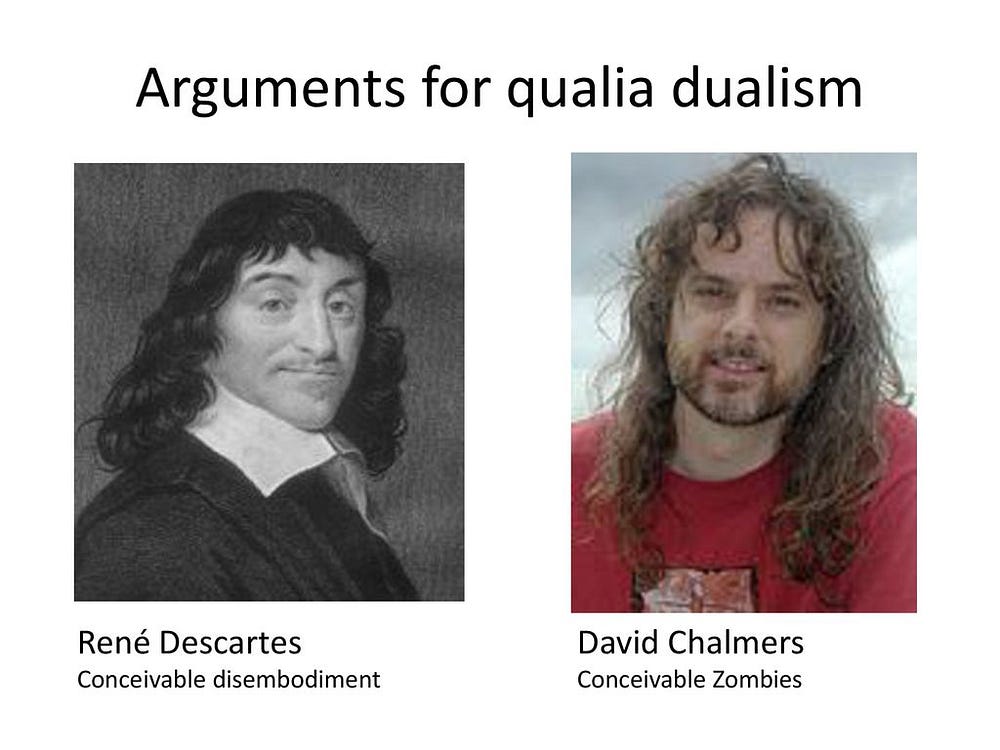
In broader terms, thought experiments about philosophical zombies stem from the philosophical, logical and psychological move from conceivability to possibility (as with Descartes’ reliance on his own conceivings — see here). So these notions shall now be tackled.

The Arguments

Clearly, possibilities can be a thousand miles away from actualities. Indeed, the zombie scenario appears to be a good example of this. However, Chalmers believes (as already stated) that p-zombies tell us something about the limits of physicalism.

In more detail, p-zombies are (in Chalmers’ own words) “microphysically identical to us without consciousness”. Thus:

(i) If zombies are physically and behaviourally identical to normal human beings,
(ii) then consciousness must be something over and above the physical.

In addition, Chalmers explains this disjunction between logical possibility and actuality (in relation to qualia) in the following ways.

Firstly, Chalmers argues that absent qualia and inverted qualia are “logically possible”. However, they’re still “empirically and nomologically impossible”. In terms of science and the problem of consciousness, it can be intuitively said that if any given x is both empirically and nomologically impossible, then why should we care that it’s still also logically possible? What do we gain (scientifically, and, perhaps, philosophically) from thinking about scenarios which involve logical possibility, yet, at the very same time, also involve empirical and nomological impossibility?

In any case, if there could be an identical universe to our own which didn’t give birth to consciousness, then, Chalmers concludes, consciousness must be something above and beyond the physical.

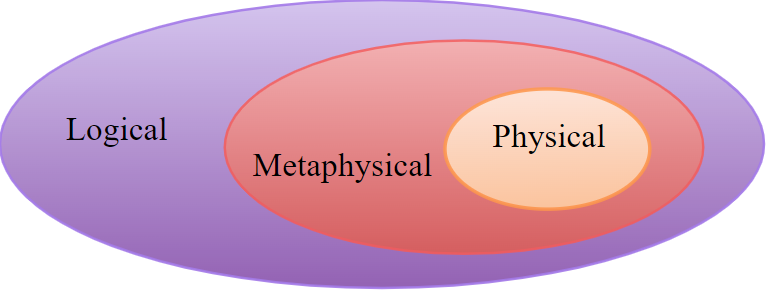
So this is where conceivability and metaphysical possibility will be discussed in detail.

Zombies and Conceivability

Conceivability and possibility are central to David Chalmers’ work on zombies, panpsychism, physicalism, and all sorts of other stuff too. More relevantly, conceivability-leading-to-metaphysical-possibility is central to much of Chalmers’ work.

Chalmers states that “a claim is conceivable when it is not ruled out a priori.

However, there are an indefinite (even infinite?) number of states of affairs (or claims) which can’t be ruled out a priori. Even the existence of sharks with legs or mushrooms with a sense of humour can’t be ruled out a priori. In other words, the only things which can be ruled out a priori are claims or states of affairs which break known logical laws or which contain contradictions. Thus, the (as it were) conceivable universe is highly populated with strange and bizarre entities, conditions, events, etc.

To put some meat on all this. Chalmers offers his own example of the conceivable. He tells us that it’s “conceivable that there are mile-high unicycles”. So what are we supposed to conclude (or philosophically achieve) by saying that mile-high unicycles are conceivable and therefore possible? Where does it take us?

In detail, Chalmers argues:

(i) If we can conceive of zombies in our world (or at other worlds),
(ii) then zombies are metaphysically possible.

Chalmers (in his own words) supports his conceivability argument by arguing thus:

“If P & -Q is conceivable, [then] P & -Q is metaphysically possible [as well as being] supported by general reasoning.”

Is there such a link between conceivability and possibility? If there is, then what kind of link is it?

Is that link itself grounded in conceivability, possibility or both?

Chalmers codifies all this with a logical argument:

i) It is conceivable that P & not-Q.
ii) If it is conceivable that P & not-Q, then it is metaphysically possible that P and not-Q.
iii) If it is metaphysically possible that P & not-Q, then materialism is false.
iv) So materialism is false.

In the above, Chalmers’ slide here from conceivability to metaphysical possibility can easily be seen.

The argument above can be made even clearer (as well as more blatant or obvious) in the following way:

i) Can we conceive of a round square? No.
ii) Then a round square isn’t metaphysically possible.
iii) Can we conceive of a man with 105 legs? Yes.
iv) Then a man with 105 legs is metaphysically possible.

Yet, again, what are we supposed to philosophically gain (or achieve) by saying that x or y are conceivable and therefore possible? Where does it take us?

In any case, logical possibility excites philosophers like Chalmers. So should readers conclude in the same way as Bertrand Russell above? That is, should readers state the following? -

Even though x (or a zombie) is not logically impossible, then there is still no reason to suppose that claims about x are true or that x is real or can be instantiated.

Put simply: something that’s logically possible may not be actual (or the case). Indeed, what’s logically possible is often not the case. So why contemplate the logically possible at all — even in philosophy? Where will it get us?

***********************

Part Two: The Psychology of Conceiving

How could a philosopher or anyone else (in a strict sense) know that he’d conceived of a philosophical zombie? What if some readers of these words can’t conceive of a phil-zombie — even if other people can do so? And even if some readers of these words can (seemingly) conceive of a p-zombie, then how could other people know that they’d done so? Indeed wouldn’t the best philosophical policy be to accept (or believe) that such people hadn’t actually conceived of a p-zombie?

Moreover, isn’t the very notion of conceiving of any given x far too psychologistic (or mentalistic) an idea to be sustaining metaphysical theses? What’s more, if other minds are a philosophical “problem”, then other minds conceiving of p-zombies (or anything else for that matter) is a problem within an already-existing problem.

More concretely, if any readers of these words actually came across an entity which acted and looked — in every single detail — like an ordinary human being (which is the whole point of the p-zombie thought experiment), then how could they extract from all this that it may, in fact, be a p-zombie? In addition, if such readers ever did come across a p-zombie which acted and looked just like them, then surely the obvious conclusion would be that it instantiated consciousness (or experiences) just like them. In other words, wouldn’t these people simply assume that this “zombie” (or x) felt pain, sometimes gets angry, could smell garlic, etc?

It can also be asked if when Mary supposedly conceives of a p-zombie, then how does it differ from her conceiving of her mother, father or her best friend? After all, when she conceives of any of the latter three, she can’t literally conceive of his/her consciousness or of his/her actually being conscious. Instead, all she’s got to go on is the physical and verbal behaviour of her mother, father or best friend. And that’s also true of p-zombies.

So perhaps that’s Chalmers’ point!

If it is Chalmers’ point, then let’s spell it out again.

Conceiving of a p-zombie is no different from conceiving of your mother, father or best friend.

Again, perhaps that’s partly why Chalmers believes conceiving of a p-zombie is possible. And if conceiving of p-zombie is possible, then its actual existence must also be (metaphysically) possible.

But does all that actually work?

When people conceive of a p-zombie (just as when people conceive of their mothers, fathers or best friends), perhaps they don’t conceive of an entity (or being) actually lacking consciousness. Perhaps that’s because such a thing can’t be conceived of in the first place. Yet the argument is that a person is supposed to be capable of conceiving of a being (or entity) behaving like his mother, father or best friend — though which doesn’t instantiate consciousness. However, how is that different to that very same person conceiving of his mother, father or best friend? And perhaps it’s no different because he can neither conceive of the consciousness of a fellow human being nor of a p-zombie.

Basically, then, consciousness is (as it were) known because it’s behaviourally or physically expressed. Unexpressed consciousness, on the other hand, is not conceivable. This means that it’s just as hard to conceive of another being’s consciousness as it is to conceive of its lack of consciousness (or vice versa).

Despite all the above, can the contrary ever be categorically stated?

That is, can it really be argued that no one could ever conceive of a p-zombie (or a “p-zombie world”)? In other words, if Chalmers, etc. can’t categorically claim that they have conceived of a p-zombie, then perhaps we can’t categorically claim that they haven’t done so. How could you, I or anyone else know that Chalmers hasn’t conceived of a p-zombie or anything else? Consequently, this may mean that all the sceptical questions aimed at such conceivings can now be aimed at the sceptics about such conceivings.

Yet that last conclusion surely demonstrates the central point of this issue.

That point being that since we’re talking about mentalistic (or psychological) conceivings, then whether or not subject S has truly conceived of a p-zombie can never be established. And if it can never be established, then how can such conceivings provide the basis of a philosophical thesis?

So, again, what is it to conceive of a philosophical zombie? What is the mental or abstract (mental) content of such an act of conceiving?

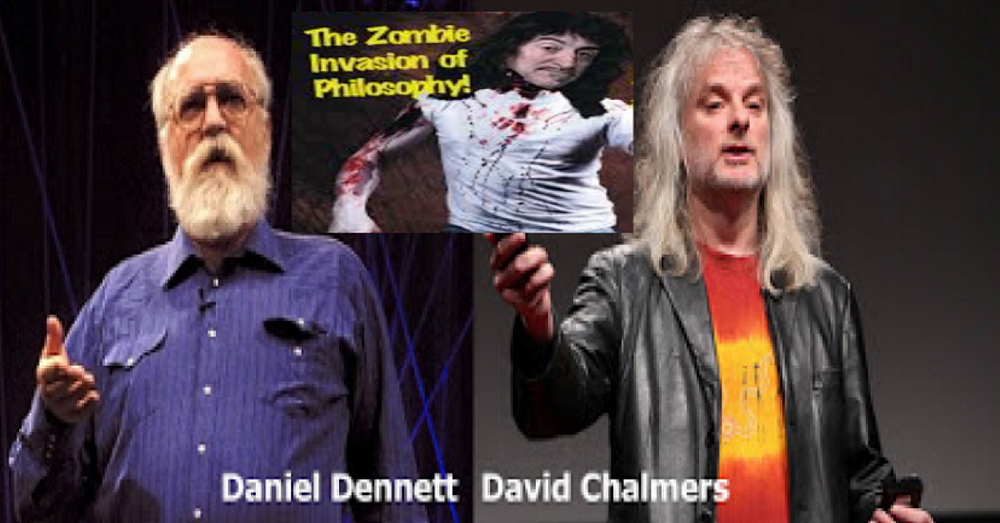
The American philosopher Daniel Dennett has also discussed all of this.

Daniel Dennett’s Zimbo

Dennett (1942-) has a big problem with David Chalmers’ philosophical zombies.

Specifically, Dennett, too, focusses on the notion of conceiving. (He does so in the ‘Zombies and Zimboes’ chapter of his book, Intuition Pumps and Other Tools for Thinking.)

For Dennett, the main point of what he calls a ‘zimbo’ is that there’s no way of knowing if it/she/he instantiates — or doesn’t instantiate — experiences or consciousness. And if there’s no way of knowing that (at least according to Dennett’s behaviourist and verificationist position), then why deny less to the zimbo than one would do so to a normal human being?

There’s a problem here.

If Dennett’s zimbo were literally identical — in every respect — to a normal human being, then how could we say that there’s either something less — or, indeed, something more — to it/him/her? And that’s because we could never know that we were actually confronting a zimbo. That said, this is part of the very point of Dennett’s thought experiment: a thought experiment which is itself a response to other philosophers’ thought experiments.

Dennett puts it this way:

“When people say they can conceive of (philosophical) zombies, we are entitled to ask them how they know. Conceiving is not easy!”

More particularly, how does a dualist, anti-physicalist or anyone else know that he’s conceived of a philosophical zombie? How do the readers of these words know that such a person has conceived of a philosophical zombie? In addition, how does any conceiver-of-a-zombie (to use Michael Dummett’s term) “manifest” his act of conceiving to others? What if it’s a thoroughly private act? And, if it is private, then what status could it possibly have when it comes to establishing a metaphysical position or thesis?

We can get even more fundamental here:

What is it to conceive of… anything?

This isn’t to argue that people don’t conceive of things. (They obviously do.) It’s just a demand for some kind of account of the act of conceiving-of-a-zombie.

In any case, Dennett gave some examples of things which he believes are difficult to conceive. He writes:

“Can you conceive of more than three dimensions? The curvature of space? Quantum entanglement?”

The least that can be said here is that Dennett’s examples are all very different.

So perhaps we can’t actually imagine (or, more literally, picture) more than three dimensions, the curvature of space and quantum entanglement. However, can we conceive of them?

Dennett continues:

“Just imagining something is not enough — and, in fact, Descartes tells us, it is not conceiving at all.”

The thing is that the existence of more than three dimensions, the curvature of space and quantum entanglement surely must have been conceived of — many times — because they’re accepted notions in physics. Indeed they’re even accepted aspects of the physical world (or at least two of them are). That is, no one has ever seen or observed these things. And, depending on definitions, not one has ever imagined these things either. So all we have left is to conceive of more than three dimensions, the curvature of space and quantum entanglement.

Thus, Descartes and Chalmers may be onto something here!

Yet even here conceiving of these things may be in a different logical space to conceiving of a philosophical zombie. After all, there are a lot of equations, natural laws, theories, indirect/direct observations, experiments, tests, etc. to account for the curvature of space and quantum entanglement (if not extra dimensions).

So are there a lot of equations, natural laws, theories, experiments, tests, indirect/direct observations, etc. to account for philosophical zombies? It can be supposed, however, that someone like David Chalmers wouldn’t claim that there are…

After all, philosophical zombies are only a possibility.