If consciousness is a natural phenomenon, then it must also be a scientific phenomenon.
So isn’t it the case that all human beings — and probably many animals — instantiate (or “have”) what we call consciousness?
Yet it can be supposed that even the former seemingly innocent set of statements and questions may be problematic. That’s primarily because it largely depends on what we take consciousness to be in the very first place!
For example, on certain accounts, it is indeed the case that consciousnesses is a natural phenomenon. However, on other (supernatural, religious, etc.) accounts, consciousness is not deemed to be natural at all.
All this brings on board the parallel problem of defining the word “natural” (at least within this limited context).
Naturalisation
So is it that consciousness must be naturalised in order for it to be a fit subject for science?
However, can consciousness be a natural phenomenon and still be a tricky thing to (fully) naturalise?
Indeed, isn’t it conceivable that a given natural phenomenon can be recalcitrant to naturalisation?
If one is a philosophical naturalist, then literally every thing is natural because there’s nothing else for it to be. Yet naturalising any given x may still be problematic or difficult.
Of course, all these statements and questions seem to be perfectly applicable to consciousness.
In any case, it will certainly be argued that consciousness isn’t like other natural phenomena (such as photosynthesis, combustion, cognition and even life itself). Indeed, even most naturalisers of consciousness will freely admit that consciousness isn’t really like other natural phenomena. However, and in many respects, no given natural phenomenon is like any other natural phenomenon. (Think here of an electron’s charge, and then compare that to the mating habits of a baboon.)
Consciousness most certainly does have distinct features…
Yet so too does every other natural phenomenon. (Now think of how high a flea can jump relative to its size, or consider superfluidity.)
So are the distinct characteristics of consciousness more distinct than all these other examples of (as it were) natural distinctness?
How on earth could a question like that be answered?
And isn’t it actually the case that we adult human beings take consciousness to be ultra-distinct and ultra-special simply because consciousness is very important to us? In addition, isn’t all this at least partly down to the fact that we have (at least on most accounts) first-person access to our own consciousness?
Consciousness and Science
It may not be that consciousness is unnatural, supernatural or even weird: it may simply be that it’s not amenable to the scientific methods scientists use for other natural phenomena.
Yet, here again, most natural phenomena aren’t analysed, tested or observed by the same scientific methods or in the same scientific ways either.
For example, what is done to discover the wave function of an electron is worlds away from what’s done to discover why birds flock together. Or, on a broader scale, the scientific methods and ways of biology and neuroscience are worlds away from the scientific methods and ways of quantum mechanics and sociology.
In any case, it’s probably the reality (or fact) of (the lack of) observation that clinches it when it comes to consciousness.
A human subject can’t observe another subject’s consciousness. Yet he can observe his own own consciousness. (There’s a problem here with the word “observe” when it comes to observing one’s own consciousness.)
Yet, here again, this human distinctness in deflated in the sense that physicists don’t actually observe electrons, quarks or fields either. Neither do scientists actually observe the Earth’s inner core or all the most distinct stars in the most distant galaxies. Less grandly, there are a whole host of natural phenomena in psychology, biology, chemistry, astrophysics, sociology, history, etc. which aren’t literally observed in any obvious — or literal — sense.
Moreover, without theory, such natural phenomena wouldn’t be the subject matter of these sciences at all. And, of course, the same may well be true of consciousness. Thus, the least we can say is that it’s observation + theory (or theory + observation) which accounts for nearly all the natural phenomena of the sciences — and that includes consciousness itself.
(1) “Whatever is green is coloured.” (2) “Whatever is square is rectangular.” (3) “The sum of three and two is five.” (4) “Necessarily, if ‘p or q’ is true and q is false, then p is true.”
Intuitively, the statements directly above do seem to be known to be true without evidence, observation, experience, data, etc. That is, they seem to be a priori in nature.
However, readers will now need to know what the word “intuitively” (in this context at least) means and whether intuition is reliable at all.
More technically and relevantly, the very idea of a prioriknowledge will need to be tackled.
The first thing to say about statements (1) to (4) is that even if they can be known to be true a priori, then they’re still very different from each other.
For a start, (1) and (2) seem to be conceptual statements — even if (2) is geometrical and (1) isn’t. (4) Is a logical statement in which the symbolic letters don’t count (i.e., their semantic content doesn’t need to be known). And (3) is an arithmetical (possibly metamathematical — see later section) statement.
What’s more, because we’ve brought on board conceptual, arithmetical, geometric and logical truths, can it still be argued that all these statements can be known to be true in exactly the same way?
(1) “Whatever is green is coloured.”
Two immediate things can be asked about this statement:
(1) Is it about the world? Or: (2) Is it about the concepts [green] and [coloured]?
Two further statements (i.e., rather than questions) can now be made:
(1) Whatever is green (i.e., any green thing in the world), must also be coloured. (2) Contained in the concept [green] is the concept [coloured].
At first sight, the statement “Whatever is green is coloured” appears to be a purely conceptual truth. That is, if something is green, then it must be coloured. That’s simply because green is a colour.
If we taken on board (2) above, then, it can be said that if the concept [coloured] is contained in the concept [green], then we don’t need to (as it were) check the world to see if this statement is true. Thus, surely it’s ana prioritruth.
That said, questions have been asked about the a priori status of this precise statement (i.e., “Whatever is green is coloured”), as well as about others like it (such as “Whatever is square is rectangular”, which will be discussed in a minute).
So what is it for one concept to be contained in another concept?
Surely the word “contained” is purely metaphorical. (Can it be anything else?)
The philosopherW.V.O. Quine famously denied that the statement “Whatever is green is coloured” (as well as others like it) is what is calledanalytic. Or, more correctly, Quine argued that the word “analytic” (or “analyticity”) was never satisfactorily explained (or defined) in ways which weren’t circular. (See Quine’s ‘Two Dogmas of Empiricism’.)
So do we require the notion of analyticityin order to claim that the statement “Whatever is green is coloured” is an a priori truth?
This position on analytic statements was also supposed to have the important consequence that even though an analytic statement is known to be true a priori, a special faculty of intuition isn’t actually required in order to know that. Instead, it is known to be true (at least partly) because the meanings of the words within the analytic statement are already understood.
Thus, there doesn’t seem to be anything intuitive about understanding the terms “green” and “coloured”. Consequently, there’s nothing intuitive about understanding the whole statement (i.e., “Whatever is green is coloured”) either . Such understanding is simply a consequence of understanding the meanings of the words and the nature of the grammatical (or syntactical) construction of the whole sentence.
Still, in our case, the statement “Whatever is green is coloured” does indeed seem to be true by virtue of meanings and independently of fact.
As already hinted at, it is evident that the person who knows that the statement “Whatever is green is coloured” is true must have already learned the English language and must therefore understand what the statement means. So he must also know the meanings of the words “green” and “coloured”, as well as the words “whatever” and “is”.
Of course, all apriorists happily accept all this.
Apriorists believe that a priori knowledge is about what occurs only after human beings have acquired a language, and then also understood the meanings of individual words and whole sentences.
This was (at least partly) summed up by Immanuel Kant (1724–1804). He wrote:
“Although all our knowledge begins with experience, it does not follow that it arises from experience.”
So, in simple terms, a priori knowledge is independent of current experience or any requirement for new (or further) knowledge. Yet apriori knowledge still isn’t independent of all experience.
So, having acquired the English language, etc., such a person doesn’t need to (as it were) go elsewhere to know that the statement “Whatever is green is coloured” is true.
On this account, then, acts of deduction, the recognition of tautologies, the truths of basic mathematical statements, etc. don’t require new knowledge or new experiences either.
More relevantly, all this also applies to statements (1) to (4) above.
(2) “Whatever is square is rectangular.”
This is similar to (1) above.
Just as it’s the case that if something is green, then it must also be coloured. Similarly, if something is square, then it must also be rectangular.
[The fact that all squares are rectangles, but not all rectangles are squares, doesn’t impact on this statement’s a priori status.]
It is impossible for x to be square and not be a rectangle.
So is this a truth about the world?
Yet, even if it is a truth about the world, then human beings have still created contingent natural-language terms to describe these aspects of the world. Humans have also made it a geometrical (even grammatical) rule that all squares must be classed as rectangular.
What’s more, and in a Platonistsense, there are no perfect squares in the world (or in nature). Thus, does that mean that such terms and rules are (as it were) abstractions and/or simplifications? And is it these factors which determine the a priori nature of the statement “Whatever is square is rectangular”?
These are complex metaphysical questions.
However, these questions don’t seem to impact on the a priori status of the statement, “Whatever is square is rectangular”. That seems to be because whatever the correct metaphysics of squares is, this statement can still be known to be true without consulting the world. That is, no reader of this statement (if he or she understands it) need actually check any squares (or what are taken to be squares) out there in the world. Thus, in that sense, the reader must assume (as it were) Platonic squares, as well as Platonic rectangles.
(3) “The sum of three and two is five.”
Interestingly, what’s being discussed here isn’t this example of arithmetic:
3 + 2 = 5
It’s this statement:
“The sum of three and two is five.”
This means that it’s not only the arithmetical equation embedded with the sentence (i.e., “three and two is five”) that’s known to be true a priori, but the entire sentence (i.e., “The sum of three and two is five”).
In any case, there are many philosophical takes on mathematical truth, and whichever one is adopted, it doesn’t seem to have any impact on the a priori status of this statement.
For example, say that one believes in the mathematical constructionist (i.e., rather than the narrower and more precise mathematical constructivist) position which has it that the statement “The sum of three and two is five” (or even the statement “3 + 2 = 5”) is taken to be true purely because of the meanings we give the words “two”, “three” “sum” and “equals” (or the meanings we give the symbols “2”, “3”, “+” and “=”), and the rules we’ve established (via convention) which make it the case the 5 is the sum of 3 and 2. Thus, this statement is still known to be true a priori regardless of one’s metaphysics. Soeven within a constructionist philosophy, there may still be a place for a priori knowledge — or even a priori truth.
Thus, whenever anyone who knows a little arithmetic reads this statement, he will know that it’s true. It doesn’t seem to matter that he may also believe that it’s true-by-convention (or due to “historical accident”): he still doesn’t need to consult the world to establish its truth (or, perhaps, only its correctness).
(4) “Necessarily, if ‘p or q’ is true and q is false, then p is true.”
This can be seen to be true even without knowing what the letters p and q stand for (or what their semantic content is). In fact, it doesn’t even matter what they p and q stand for, as long as they stand for propositions (or statements) which are taken to be either true or false.
Thus, the a priori reasoning here is purely logical.
That is, the statement “p or q” means that either p or q is true. That is, p and q aren’t both true. Similarly, it isn’t the case that both p and q are false.
Thus, since we’re then told that q is false, and either p or q must be true, then p must be true.
So what about the opening word “necessarily”?
The word “necessarily” is modal in nature. It tells us that the statement which follows it must be true. That is, there’s no possibility of it being false. It is, therefore, atautologyor a logical truth. In other words, the statement is true simply because of its logical formor grammar.
In terms of a priori knowledge, then, this statement can be known to be true simply by reading and understanding it. That is, the semantic content of the symbols p and q needn’t be known. More mundanely, one needn’t check the world, do research, find evidence, observe anything, read a history book, etc. in order to establish the truth (or falsehood) of this statement. However, (as argued earlier) one must have previously learned a little logic, the English language, etc. in order to understand the sentence which expresses the statement under consideration.
Yet, in a sense, all this also applies to the statement “Snow is white”.
After all, once one learns that snow is [always?] white, then when one comes across the statement “Snow is white”, we can say it is “true” without further research, finding evidence of new snowfalls, “checking the facts”, etc.
In that case, then, how does the statement “Snow is white” differ from the statement “Necessarily, if ‘p or q’ is true and q is false, then p is true”?
Well, the statement “Snow is white” isn’t logical. It’sempirical. It’s also contingently true, rather than necessarily true. In other words, it could have been the case that snow isn’t white. (Or could it?)
On the other hand, there is no situation in which the statement “Necessarily, if ‘p or q’ is true and q is false, then p is true” could be false. This statement, then, is necessarily true in that its negation would be self-contradictory. Or, in a different jargon, the logical statement is true at every possible world.
So although the statement “Snow is white” can be assented to without further evidence, it still required evidence to be established in the first place. Yet that doesn’t apply to the statement with p’s and q’s in it. That statement isn’t empirical in nature — even if the semantic content of both p and q can be taken to have empirical content.
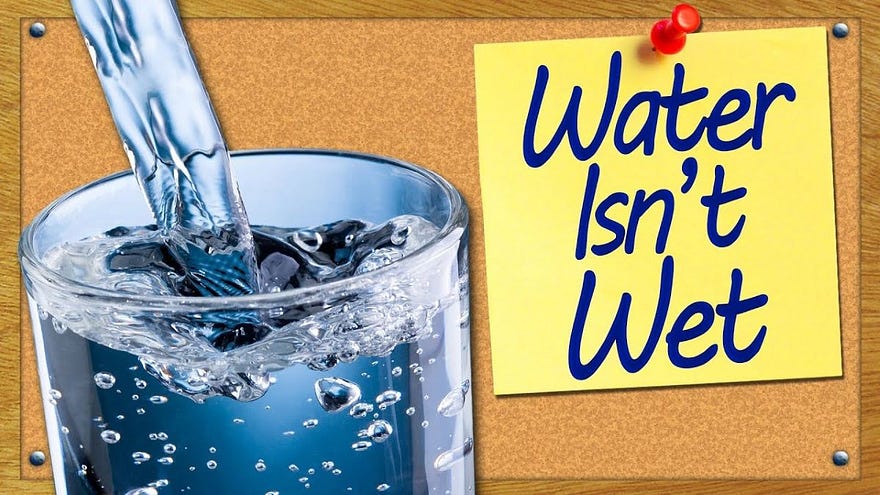
There’s a YouTube video called ‘Water Isn’t Wet’ in which the presenter discusses various definitions of water which have it that “water isn’t wet”. Then, at the end of the video, he solemnly says that “the science” is where the true answer can be found. Yet, arguably, the chemist who gives the true answer simply tells us what must chemically underpin the H₂Omolecules in order for them to bring about human/animal experiences of wetness.
[Note: The quoted scientific descriptions of water and its properties in the following are taken from Quora. They were chosen primarily because of their colloquialsimplicity. That may mean that they’re not entirely accurate. However, that doesn’t really matter because even a perfectly accurate (technical) account of water and its properties wouldn’t change — or impact upon — any of the arguments in the following essay.]
(i) Introduction: Water Isn’t Wet!
(ii) Semantic and Conceptual Stipulation
(iii) David Chalmers on Stipulation
(iv) Reprise: Water isn’t Wet or Transparent
(v) Conclusion
Introduction: Water Isn’t Wet!
There’s a YouTube video called ‘Water Isn’t Wet’ in which the presenter discusses various definitions of — and positions on — water. They all have it that “water isn’t wet”. Relevantly, none of these definitions (or descriptions) are the same as the ones which will be advanced in this essay.
For example, one argument is that water isn’t wet because “only something that can also be dry, can be wet” (i.e., wetness is a “temporary state of being”). The video also cites various dictionary definitions which support the argument that water itself can’t be wet.
Then, at the end, the presenter solemnly says that “the science” is where the true answer can be found.
Indeed, all the definitions and arguments the presenter tackled were basically deemed — by him — to be a waste of time. He states that “none of this is getting us anywhere”. And that’s because it was all simply “arguing semantics”.
Thus, the Science must have the last word on this issue.
The video then cuts to the Scientist giving that last word on water and wetness.
Professor of Chemistry Richard J. Saykally offers the viewers a highly-technical account of water which includes references to “strong tetrahedron hydrogen bonding”, the “interaction of dipoles” and “quantum theory”.
Yet never once does he mention the word “wet” or “wetness”.
Neither the Scientist nor the presenter of this video see the problem here.
If only in my own argument, all Richard Saykally is doing is describing what is chemically required to bring about experiences of wetness. Alternatively, the Scientist is simply telling us what chemically underpins such experiences. In other words, a purely chemical account of H₂O molecules needn’t include the additional non-scientific concepts of [wetness] or [wet].
Another way to put all this is to state that wetness can’t literally be identical to even a complete chemical description of H₂O molecules (or a complete description of the relevant aspects of H₂O molecules) because then we’d have this simple identity:
wetness = H₂O molecules
Yet that can’t be right. After all, isn’t this the true identity? -
water = H₂O
So wetness (or something’s being wet) could never simply be a matter of a complete description of H₂O molecules (or a complete description of the relevant aspects of H₂O molecules). And that’s precisely because there could never be a literal identity between wetness and such a complete description.
All that will hopefully be shown in the following.
In any case, the presenter of that video discusses various dictionary definitions of “wetness” (or “wet”), some of which imply (though don’t state) that water isn’t itself wet. And other definitions (plainly) contradict each other.
All this annoys the presenter. And he may — at least partly — have a point. Indeed, he even raises the issue of stipulation (ifwithout actually using that word).
Semantic and Conceptual Stipulation
When it comes to water’s properties of wetness and transparency, the problem of conceptual and semanticstipulation (see here) is encountered.
For example, one can argue that wetness is due to what happens when parts of the human body come into contact with water and what that impact has on human sensory systems and the human mind.
Alternatively, one can define and describe wetness entirely in terms of the structure and composition of H₂O molecules . Thus, one needn’t mention human beings or their sensory systems at all.
So is water’s wetness actually dependent on human sensory systems and human minds? Indeed, is this also true of water’s transparency?
After all, water is transparent to visual systems. (It is transparent to human beings and some other animals.) Thus, if there were non-sensory beings which also had brains and intelligence, then would they class water as “transparent”?
In purely chemical accounts, perhaps what’s really being described are the chemical underpinnings of (or what is required for) transparency and wetness. However, can transparency and wetness themselves be so described without bringing on board things which are external to H₂O molecules and their chemical nature?
That said, even various chemical accounts of H₂O molecules still mention what our eyes see or what we feel (or experience).
To take quick example, on one account it’s said that because human eyes can only see the visible light portion of the entire electromagnetic spectrum, then we can’t see any colour in water. However, the excited electrons in H₂O’s atoms do emit radiation in the ultraviolet region of the electromagnetic spectrum.
Thus, to human beings, water is transparent.
Interestingly, some readers might have already noted that this broad discussion is very similar to the ones which undergraduate philosophy students encounter when discussing sound and colour. For example:
(1) Does a felled tree make a sound when no one is around to listen to it?
(2) Is a rose actually red (or any other colour) when no one is looking at it?
Perhaps, then, these matters are at least partly stipulational in nature.
Thus, the Australian philosopherDavid Chalmers is helpful here.
David Chalmers on Stipulation
David Chalmers stresses the importance of what he calls “stipulation”.
His basic point is that if we stipulate what we mean by a particular word (or concept), then the answers to any questions (as well as answers) we have about the facts, data, etc. regarding that word and its referent, must — at least partly — follow from such stipulations.
Of course, some readers may be shocked by the idea that acts of stipulation are important — or even decisive — when it comes to what we take to be matters of fact.
Yet it’s not that simple.
It can be agreed that there is a problem with overstressing the importance of stipulation. (There may even be a problem with simply emphasising stipulation.) Chalmers himself sums up this problem with a joke. He wrote:
“One might as well define ‘world peace’ as ‘a ham sandwich.’ Achieving world peace becomes much easier, but it is a hollow achievement.”
Clearly, even someone who argues that stipulation is important won’t also accept that we can define the words “world peace” as “a ham sandwich”. In turn, some philosophers and laypersons will feel just as strongly about claiming that, for example, “a computer virus is alive” (see here) or that “bacteria learn”(see here).
More relevantly, some readers may also argue that water is both wet and transparent regardless of human sensory receptors and human minds.
So perhaps Chalmers’ words can be equally applied to water’s properties of wetness and transparency.
Technically, then, if x, y and z constitute what it is for something to be wet or transparent (or to be world peace or a ham sandwich), then if something displays (or instantiates) x, y and z, then that something simply is wet or transparent.
That is, of course, a simplified story.
That’s primarily because agreement will also have to be secured on what precisely x, y and z are, and then on whether or not x, y and z are necessary and sufficient for wetness or transparency (or for being world peace or a ham sandwich).
Yet however complicated this story turns out to be, stipulation will still be a part of it.
To repeat. David Chalmers is still keen to stress the importance of stipulation when it comes to such decisions.
[More broadly, Chalmers also believes that much that passes for metaphysics (i.e., in contemporary analytic philosophy) is merely what he and others call “verbal dispute”.]
Reprise: Water isn’t Wet or Transparent!
The following is just a single account of water:
“Water isn’t wet. Wetness is a description of our experience of water; what happens to us when we come into contact with water in such a way that it impinges on our state of being.”
If readers recall the discussion about stipulation, then it can now be argued that this passage isn’t either necessarily false or necessarily true.
Now take this accountof water’s wetness:
“There are in water many free charged hydroxyls (-OH-, negatively charged) and hydrogen ions (H+ positively charged). These charged particles retain the ability to attract other charged particles (with the opposite charge) just as magnets do. In this way they stick or cling, involving other neutral H₂O molecules at the same time. If water was made up entirely of neutral particles it would not cling, or wet, because the component elements would ‘prefer’ to stick to each other rather than to make bonds with other substance.”
This passage doesn’t mention either human beings or their sensory systems at all.
Some readers will also be able to detect the silent scare quotes around the single use of the word “wet”. Yet even if this account is entirely correct, one can still ask why the word “wet” is used in the first place for these purely chemical descriptions.
So is it that chemists don’t ordinarily use the words “wet” and “wetness” when analysing the properties of H₂O molecules — even qua water?
Yet, if that’s the case, then in what way are H₂O molecules wet at all?
After all, the description directly above could stand on its own without any mention of something’s being wet or wetness.
Perhaps what is (chemically) described above isn’t wetness at all.
Now here’s anotherdescription of water’s wetness:
“The cohesive forces of water (the force holding individual water molecules together) or the intermolecular forces holding the H₂O molecules such as hydrogen bonding and van der Waals are weaker than the adhesive forces (how the surface of the glass attracts water molecules, which makes the water droplet spread out and in turn ‘wet’ the surface).”
Here, again, there’s only a single use of the word “wet”. And this time it is put in scare quotes.
In the introduction it was written that perhaps what’s really being described (i.e., in the purely chemical accounts) are the chemical underpinnings of (or what is required for) transparency and wetness. Thus, it can also be argued that the description of wetness (or what wetness is) directly above is actually an account of what needs to chemically underpin (or bring about) human and animal sensory experiences of wetness and transparency.
However, can transparency and wetness themselves be so described?
Now recall the discussion of conceptual and semantic stipulation.
It can be argued that it is a description of wetness if chemists (such as Professor Richard J. Saykally) — or others! — decide (or stipulate) that it is.
So no one need dispute a perfect chemical account ofH₂O and its properties. Instead, this debate is simply about the nature and role of the concepts [wetness] and [transparency].
Let’s go into more detail on water’s transparency, rather than its wetness.
Take this account:
“Electrons in water act in a similar way to visible light so they don’t absorb or reflect most of the light. Instead they allow it to pass through relatively unimpeded, absorbing wavelengths like infrared and reflecting invisible UV.”
This description has it (if when simplified) that the nature of electrons (among other things) and their interactions basically bring about (however those two words are interpreted) transparency.
Now, for variety, in the following we alsohaveanevolutionary- and sensory-basedaccountof water’s transparency:
“Water is transparent because eyes first evolved in water. The range of the EM spectrum we detect corresponds to the spectrum for which water is transparent (absorbs the least). Had we evolved in mercury, we would think mercury is transparent and detect EM waves that pass through mercury.”
Like wetness earlier, it can now be stated that the two descriptions above are about what needs to chemically underpin (or bring about) the sensory experiences of transparency which humans beings and other animals have.
On this picture, then, the purely chemical stories alone aren’t actually descriptions of transparency at all.
However, they are if chemists and the Science decide that they are.
In any case, thisstory is even more (non-scientifically) complicated than what’s been written so far.
Conclusion
Even if we dispense with the philosophical termemergence, it can still be argued that water’s transparency and wetness aren’t only about H₂O molecules and their nature alone. After all, on one account at least,transparency is — at least partly — determined by how much of the incoming electromagnetic wave is absorbed and re-emitted by the relevant molecules.
Such incoming waves are external to the molecules.
Unless, that is, these seemingly external additions (i.e., external to the H₂O molecules) aren’t actually deemed to be a part of the H₂O story.
More technically, if molecules (or any kind of matter) absorb all the incoming electromagnetic wave, then it will be opaque. However, if the electron orbitals within the atoms — which are themselves within the H₂O molecules — start reemitting the formerly absorbed electromagnetic wave, then that wave can keep (as it were) jumping through the molecules (or through the matter).
Thus, we have water’s transparency.
What’s more, an individual H₂O molecule is neither transparent nor wet. Transparency and wetness occur — and only then, arguably, when in conjunction with brains, sensory receptors, minds, etc. — when we have alarge enough collection ofH₂O molecules. (Exactly how many H₂O molecules? See ‘the Heap’.) So the properties of wetness and transparency may still not be entirely explained by a chemical description of a single H₂O molecule or even by a small collection of H₂O molecules. That is, transparency and wetness can still be deemed to be over and above the nature of H₂O molecules.
Finally, when the transparency and wetness of water are described in purely chemical terms, then all we are really given is a complete chemical description of H₂O molecules (as well as, perhaps, some non-biological environmental facts). However, do these chemical facts alone really lead to transparency and wetness? If not, then surely we must then move onto sensory receptors, brains, minds and all the other relevant things which are external to H₂O molecules and their interactions.
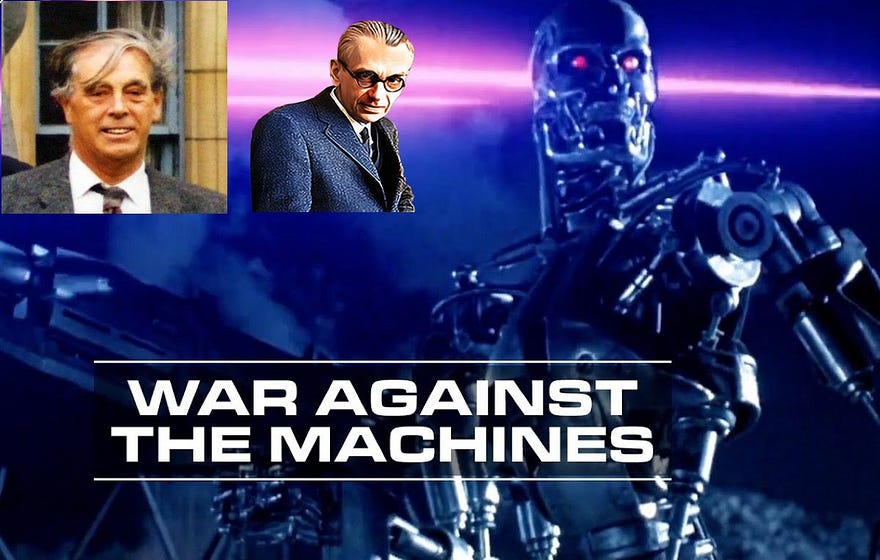
The philosopher J.R. Lucas argued that all minds must be “alive” and (it can safely be assumed) human, not “dead” and “ossified” like “machines”. Lucas’s position is almost entirely dependent upon Kurt Gödel’s first incompleteness theorem.
J.R. Lucas (left) and Kurt Gödel.
(i) Alive Minds: Dead and Ossified Machines
(ii) J.R. Lucas’s Many Assumptions
(iii) A Single Theorem Destroys AI?
(iv) Conclusion
John S. Lucas (1929–2020) is well known for his paper ‘Minds, Machines and Gödel’, which will be focussed upon in this essay. More accurately, an often-quoted single passage from that paper will be discussed.
So could it be that artificial intelligence - perhaps simplystrong AI— is rendered impossible by Gödel’s theorem?
However, the technical details of this theorem won’t be tackled in this essay. Instead, an often-quoted passage from J.R. Lucas will be focussed upon. This is done primarily because this passage clearly puts the whole debate in its purely philosophical (i.e., rather than logical and metamathematical) context…
Indeed, it’s not only the wider philosophical context of Lucas’s paper which needs to be tackled: it’s simply its wider… context. Full stop.
Here’s the passage from J.R. Lucas:
“We are trying to produce a model of the mind which is mechanical — which is essentially ‘dead’ — but the mind, being in fact ‘alive,’ can always go one better than any formal, ossified, dead system can. Thanks to Godel’s theorem, the mind always has the last word.”
The first thing that can be noted about this passage is how rhetorical and poetic it is, at least when bearing in mind that it’s part of Lucas’s academic paper,‘Mind, Machines andGödel’ (which was first published in 1959).
[Lucas concluded his paper with these words: “We can even begin to see how there could be room for morality [] No scientific enquiry can ever exhaust the infinite variety of the human mind.”]
Of course, some readers may see such phrases as “essentially ‘dead’”, “the mind, being in fact alive’”, “ossified”, “dead system”, “[t]hanks to Gödel’s theorem”, “the mind has the last word”, etc. as not being rhetorical at all. Such readers may believe that these phrases are simple (as it were) statements of fact. After all, machines are indeed dead and ossified, aren’t they?
On a different level, the words “thanks to Gödel” clearly show that Lucas had something to thank Gödel for.
So what was that?
Lucas thanked Gödel for proving that all minds must be alive (must be human?). And, to Lucas at least, much else followed from that.
Of course, we can accept that human minds must be alive — even if that’s an odd way of putting it. This means that Lucas was indirectly assuming that because human beings are alive, and minds (as it were) belong to human beings, then all minds (of whatever kind) must be alive too.
What’s more, Lucas would have presumably argued that after carefully analysing Gödel’s theorem and its repercussions, only then did he conclude that all minds must be alive. However, that line of reasoning doesn’t really show up in the passage above or even in his entire paper. Instead, it seems to be an inbuilt assumption on Lucas’s part.
In any case, perhaps Lucas’s rhetorical phrases above are of the kind you’d expect from (to use Lucas’s own words) “a dyed-in-the-wool traditional Englishman” who was also an Anglican, and the son of a Church of England clergyman. Of course, that can be taken as either being an ad hominem or as simple biography. Alternatively, it can be seen as a rhetorical response to Lucas’s very own rhetoric.
[Whatever it is, it’s only one sentence of an essay of2,000 words. Incidentally, Douglas Hofstadter (in his famous book Gödel, Escher, Bach), commenting on the very same passage from Lucas, claimed that J.R. Lucas was expressing his “transient moment of anthropocentric glory”.]
It’s also worth noting, in this “anthropocentric” respect, that Lucas also applied Gödel’s theorem against the anthropic mechanism thesis; and, more specifically, against determinism as it’s applied to human beings (or to human minds).
The basic argument here is that precisely because (as we shall see later) “the mathematician” (whoever that is) can “see” Gödelian (unprovable) truths, then J.R. Lucas took that to mean that there must be at least one thing about human beings (or human minds) which can’t be predicted by computers… or by anything else (except God?).
[Why does it follow that even if a “logical system” (or computer) can’t “reliably predict” a human being’s actions, then that human being must have free will? Is free will really all about whether an individual’s actions can be predicted by a computer or by anything else? Of course, this much-discussed issue won’t be tackled here.]
J.R. Lucas’s Many Assumptions
In the introduction, the philosophical context of the quoted passage from John Lucas was mentioned. Indeed, Lucas realised that some of his words had a somewhat obvious wider philosophical context — if only some nine years after writing them. In other words, there’s little actual philosophy in his paper‘Minds, Machines and Gödel’ (of 1959).
As already stated, the simple wider context of Lucas’s claims also needs to be tackled, regardless of his — hidden — philosophical assumptions.
So now it can be argued that the philosophical and moral positions and beliefs which motivated Lucas’s technical paper are hidden under a forest of metamathematical and logical terms and arguments which may not — or do not — have the philosophical, and, indeed, material consequences he believed they have.
“The application of Gödel’s theorem to the problem of minds and machines is difficult. Paul Benacerraf makes the entirely valid ‘Duhemian’ point that the argument is not, and cannot be, a purely mathematical one, but needs some philosophical premises to be able to yield any philosophical conclusions. Moreover, the philosophical premises are of very different kinds.”
So it can now still be said that Lucas did seem to assume much in the passage quoted at the beginning of this essay. That is, in order to have made such categorical claims, much else must have already been taken to be true and/or well defined. (Again, Lucas’s mathematical, metamathematical and logical analysis of Gödel’s actual theorem may well be fine and dandy.)
So there seem to be assumptions about the “mechanical”, about what it is to be “alive”, what work the word “ossified” is doing, etc. And, more importantly, assumptions about the applications and/or consequences of Gödel’s theorem.
To put it basically. In Lucas’s picture, if something isn’t a human mind, then it must dead and/or ossified. Or, to give him the benefit of the doubt, only the brains of biological creatures (or animals) can be “alive”.
Well, all that seems obviously true. No problem.
Yet we will see later that not all human minds can see the truth of anyGödelsentence. So what hope have cats and dogs, let alone worms, got?
So perhaps Lucas’s motivating stance wasn’t really about biological brains at all. (As it is with Roger Penrose — see my‘Is Physicist Roger Penrose a (Tacit) Panpsychist?’.) It was actually about human brains. Indeed, it might not even have been about human brains. It might purely have been about (Cartesian?) human minds! (So was Douglas Hofstadter right about Lucas’s “transient moment of anthropocentric glory”?)
A Single Theorem Destroys AI?
In my view, John Lucas’s paper was a classic example (or case) of Gödel’s theorem being overstretched.
It’s also another case of the theorem being used to advance philosophical and moral positions which the upholders seemed to have held anyway (or regardless).
Ironically, Lucas himself was fully aware of all this — at least after writing his well-known paper, ‘Minds, Machines and Gödel’. Elsewhere, he wrote:
“Gödel’s theorem itself, like many other truths, can be taken either way: it can be taken as a formal proof sequence yielding certain syntactical results about a certain class of formal systems, but it can also be taken as giving us a certain type or style of argument, which we can understand, and, once having got the hang of it, adapt and apply in innumerable different circumstances.”
To return to the theme of this essay and to repeat part of the introduction.
In essence, Lucas’s argument is all about how a single theorem — Gödel’s incompleteness theorem — destroys the possibility of artificial intelligence.
So could it possibly be that artificial intelligence — not even strong artificial intelligence — is rendered impossible by Gödel’s theorem?
Firstly, doesn’t Lucas’s Gödel-based argument — at least in a strong sense — render the minds of all non-mathematicians suspect too?After all, most human minds can’t recognise the truth of Gödel sentences! In fact, most mathematicians aren’t metamathematicians, so they too can’t recognise them.
So, if this is the right way of looking at this, then it also means that only some minds can discover unprovable truths. Or, more correctly, only some minds can find the truth of some Gödel sentences, but not the truth of other Gödel sentences.
Unless, that is, Lucas simply meant that all human minds have the potential to recognise (or see) Gödel truths.
So do all human minds have that potential?
But what does that mean?
And how could we know this?
What’s more, some commentators (philosophers, cognitive scientists, psychologists, etc.) are even suspicious of the notion of minds — or individual minds — gaining the unequivocal truth of formally unprovable Gödel sentences in the first place. And they’re certainly suspicious about the seeing of Gödel truths as having much — or even any — relevance for all minds.
The bottom line is that if a human or a computer/machine is consistent, then Gödel’s incompleteness theorems apply to it. So does Lucas’s argument depend on the existence (or reality) of perfectly consistent (indeed rational) mathematicians?
Well, many scientists and philosophers believe that human reasoning is inconsistent.
More importantly, doesn’t Lucas’s argument depend on the minds of only those metamathematicians who study Gödel’s theorems being fully consistent?
In addition, it’s not clear what the clause “a human mind cannot [or can!] formally prove its own consistency” means.
Prove in which sense? Prove in regards to what? Prove how a human mind deals with… everything? How a human mind deals with the whole of mathematics? A part of mathematics? Prove how a human mind can show the consistency and/or completeness (or lack thereof) of only logical and mathematical systems?…
Or is this simply about proof as it relates to human minds when they see Gödel truths?
Again, doesn’t Lucas’s argument actually depend on a tiny number of metamathematicians being able to see some (i.e., not all) Gödel truths?
[Lucas himself argued that women and politicians are inconsistent, as can be seen from this qualified version of an earlier claim of his. (See Lucas’s paper ‘Against Equality Again’, in which he says the same thing.) However, as can be seen in my essay: Lucas’s argument is more specific than that. On my reading at least, the only people who can transcend “machines” — at least in this Gödelian sense — is a tiny subset of mathematicians… like Lucas himself.]
Moreover, and as the philosopher Judson Webb argued (in his 1968 paper ‘Metamathematics and the Philosophy of Mind’), one also needs to ask questions about whether human beings (well, a small subset of mathematicians) can really see the truth of a Gödelian statement G (in this case, as it applies tooneself).
Perhaps a better questions would be: What is it to see a Gödel truth?
Immediately before the passage quoted at the beginning of this essay, J.R. Lucas wrote the following:
“However complicated a machine we construct, it will, if it is a machine, correspond to a formal system, which in turn will be liable to the Godel procedure for finding a formula unprovable-in-that-system. This formula the machine will be unable to produce as being true, although a mind can see it is true.”
So must all machines and/or computers “correspond to a formal system”?
That depends. There may be much more to it than that.
Different philosophers and even different logicians/mathematicians (or at least philosophers of logic and metamathematicians) take different views on all this.