Tuesday, 2 May 2023

Are We All “Sheeple” Who Can’t Escape Our Conceptual Schemes or Epistemes?

The philosopher Michel Foucault argued that (most? all?) people don’t realise that the epistemes they exist within determine their experiences, “discourse”, beliefs and even behaviour. (According to Foucault, epistemes constitute “the historical a priori.)… So how did Foucault and similar theorists (e.g., Marx, etc.) escape from the conceptual schemes and/or epistemes they found themselves within? Indeed, did they really escape? More relevantly, do conceptual schemes and epistemes exist in the first place?
(i) Introduction: Conceptual Schemes
(ii) Michel Foucault on Epistemes
(iii) How Did Foucault Escape From His Episteme?
(iv) Hilary Putnam on Conceptual Schemes

Firstly, the title above may be a little misleading to some readers. That’s mainly because the essay itself doesn’t discuss specific political positions or specific political/social groups. In other words, there’s no claim here that a particular set of people are (or are not) sheeple because they believe x or y. Instead, this essay is (to quote Donald Davidson) “on the very idea of a conceptual scheme”.

This explanation is given because it sometimes seems as if many politicised young people (mainly males under the age of 22 and teenagers) are accusing everyone else — i.e., outside their own political flocks — of being “sheeple” (see here).

So why is that?

It’s surely because such young people deem sheeple to be the mindless (as it were) members of various conceptual schemes and/or epistemes (i.e., as these schemes and/or epistemes are embedded in specific nations/states and societies)… Not that that these two particular technical terms (i.e., “conceptual schemes” and “epistemes”) are ever actually used by most of those who refer to other people as sheeple.
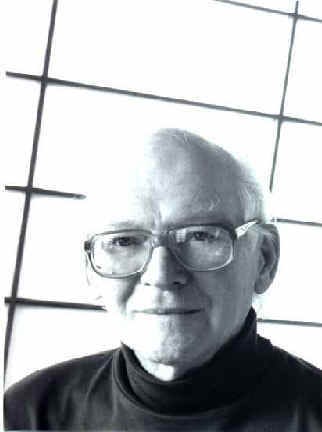
Donald Davidson

More relevantly, in this essay the term “conceptual scheme” is used in pretty much the same (largely non-political) way in which the American philosopher Donald Davidson (1917–2003) used it.

Davidson (in his paper ‘On the Very Idea of a Conceptual Scheme’) wrote that conceptual schemes are “ways of organizing experience”, as well as “systems of categories that give form to the data of sensation”. More generally, they are “points of view from which individuals, cultures, or periods survey the passing scene”.

Yet despite just telling us what conceptual schemes are, Davidson didn’t actually believe that such things exist! [See my own essay, ‘There Are No Conceptual Schemes’.]

A more standard definition of a conceptual scheme is the following:

“The general system of concepts which shape or organize our thoughts and perceptions. The outstanding elements of our everyday conceptual scheme include spatial and temporal relations between events and enduring objects, causal relations, other persons, meaning-bearing utterances of others, and so on. To see the world as containing such things is to share this much of our conceptual scheme.”

Despite this definition, this essay is largely about Foucauldian conceptual schemes. It also notes Davidson’s earlier (critical) definitions of the notion.

More broadly, it can be argued that the belief in (or acceptance of) the very idea of a conceptual scheme (or at least the strong political and sociological stress on such a thing) led to a belief in linguistic relativity (or the Sapir-Whorf hypothesis). Indeed, it also — at least partly — led to various varieties of moral and political relativism generally. (Note, again, Davidson’s idea that conceptual schemes are “points of view from which individuals, cultures, or periods survey the passing scene”.)

All that said, conceptual schemes can either be seen as vague abstract entities, or, indeed, as real concrete entities.

This means that some of the conceptual schemes referred to in the following don’t strictly abide by any of Davidson’s own definitions and analyses. However, that doesn’t matter because his broad account will still give readers a way (or means) to discuss whether the entities provisionally deemed to be conceptual schemes — i.e., by other people — really do have such a determining and powerful impact on the minds of all those people who’re supposed to be under their spell. (Hence, the rhetorical use of the word “sheeple” in the title.)

It will now be seen that an episteme (at least as described by Michel Foucault) has various similarities with the notion of a conceptual scheme.

Michel Foucault on Epistemes
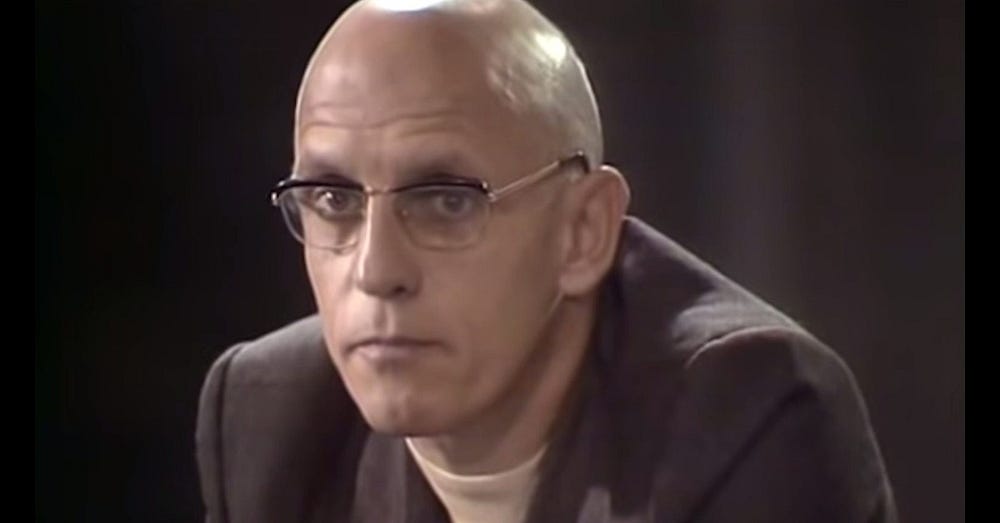
Michel Foucault

The French philosopher Michel Foucault (1927–1984) used the term épistémè in his book The Order of Things. He defined the word in the following way:

[T]he historical a priori which i[n] a given period, delimits the totality of experience [of] a field of knowledge, defined the mode of being of the objects that appear in that field, provides man’s everyday perception with theoretical powers, and defines the conditions in which he can sustain a discourse about things that [are] recognised to be true.”

And elsewhere in the same book, Foucault also wrote:

“In any given culture and at any given moment, there is always only one episteme that defines the conditions of possibility of all knowledge, whether expressed in a theory or silently invested in a practice.”

It seems clear that Foucault had a view of epistemes which made them deterministic in nature. (He did qualify, in various places, this charge of conceptual and cognitive — hence also political — determinism.) That is, Foucault believed that (most? all?) people don’t consciously adopt their epistemes. What’s more, they don’t realise (or know) that their epistemes determine their experiences, “discourse”, beliefs and even behaviour. Thus, according to Foucault, epistemes are (among other things) “the historical a priori. That means that (if this term is taken in its almost Kantian sense) each episteme literally comes before experience (at least for a particular historical or social group) and therefore it forms and shapes all experience.

Kant was just mentioned in parenthesis a moment ago. Foucault himself used the phrase “historical a priori” (as already quoted) in homage to the 18th century German philosopher.

So let’s take Kant’s arguments for his own (as it were) conceptual scheme as true, at the same time as noting that it’s very different to a Foucauldian episteme.

It can be said that literally no one can escape from Kant’s mental and/or cognitive a priori categories and concepts. Indeed, in the language of 21st century neuroscience and cognitive science, that’s because whatever it is that’s responsible for our Kantian categories and concepts, it must be physically hardwired — i.e., from birth — into the brains of all human beings.

Thus, in the Kantian story, we must see objects as objects. We must see things in terms of cause and effect. And we must see things in terms of internal time and external space. Etc.

Thus, in a strict sense, some of the examples offered below can’t be a priori in this strict Kantian sense. (This is true, for example, of class consciousness.) The closest which some conceptual schemes (if that’s a suitable term at all) come to the Kantian a priori include Chomsky’s universal grammar, the deep structures of Lacan and Lévi-Strauss, Freud’s subconscious, etc. However, even deep structures were seen to be limited to specific cultures at specific times. (There were also, admittedly, deemed to be “universal” and “timeless” threads to such structures.) And each Freudian subconscious is specific to each individual person. (Here again, there are said to be universal and timeless threads to the human subconscious.)

To return to Foucault.

A Foucauldian episteme is far more broad (as well sociological, political and historical) than Kantian a priori concepts and categories. Indeed, Kant’s categories and concepts (if taken to be real things) apply to all human beings at all times (i.e., they can’t constitute Foucault’s historical a priori). That said, some of Foucault’s statements about epistemes do have Kantian resonances.

For example, according to Foucault, an episteme defines “the mode [] of the objects that appear”. It also “determines the totality of experience”. And so on. However, Foucault appeared to have overstepped the Kantian mark when he argued that an episteme determines certain epistemic constraints on our “discourse about truth”.

[Note here that the Swiss psychologist Jean Piaget argued — see here — that Foucault’s use of the term épistémè was similar to Thomas Kuhn’s notion of a paradigm. Perhaps, too, R.G. Collingwood’s notion of historical “absolute presuppositions” chimes in with Foucault’s historical take on epistemes.]

So what about Foucault’s very own escape from what he called the “contemporary episteme”?

How Did Foucault Escape From His Episteme?
“The [flock] of independent minds.” In that link, Noam Chomsky quotes this line (i.e., it’s not his own). Of course, it’s also a perfect description of many of Chomsky’s own followers. That is, Chomsky has a very independent mind. However, many of his followers most certainly do not. And perhaps that’s primarily because they are just that — his (loyal) followers. All this was also true of Foucault and many of his followers. Interestingly, Foucault and Chomsky both debated and clashed on various occasions (see here).

In 1971, Michel Foucault wrote the following:

[] I am trying to grasp the implicit systems which determine our most familiar behaviour without our know it [] to show the constraints they impose upon us. I am therefore trying to place myself at a distance from them and to show how one could escape.”

Note also here the Marxist’s escape from false consciousness or Karl Marx’s own escape from the “bourgeois ideology” of both his own family and his overall background. (Interestingly, Foucault once wrote the following: “Marxism exists in nineteenth-century thought like a fish in water: that is, it is unable to breathe anywhere else.”)

In any case, perhaps some people don’t actually want to escape (or transcend) their conceptual scheme or episteme. That may be because they might have reflected on the concepts, beliefs, norms, etc. of their conceptual scheme, and not found them wanting. However, Foucault seemed to have assumed that because people were (as it were) happy with their episteme (or conceptual scheme), then they mustn’t in fact have recognised that they’re living, working and thinking within one.

So how did Foucault himself escape from his own episteme?

Perhaps this isn’t a philosophical question. Perhaps it’s a question about Foucault himself. That is, this may not be about how Foucault philosophically and/or intellectually transcended his own episteme (note the quote earlier). Instead, it may about why he believed he had done so.

In the past there have been many people with such special powers. Such people argued there were no alternative ways of escape other than their own. What’s more, if someone believed that he has escaped via another route, then he or she mustn’t have really escaped at all. Indeed, it wouldn’t be a genuine episteme (or the subconscious, or class consciousness) otherwise. Thus, it’s no use stressing conceptual schemes or epistemes if people can escape from them willy-nilly.

All this, of course, raises a self-referential question. Namely:

How did such philosophers and theorists (such as Foucault, Marx, Freud, etc.) themselves escape from their conceptual schemes or epistemes?

Did they do so by choosing the true path of escape?

This means that if the rest of us don’t choose the true path (specified by Foucault or, say, Marxists), then we can’t (by definition) have escaped.

That said, perhaps some of these philosophers and theorists happily acknowledged that at least a small number of people can be conscious of their own conceptual scheme. However, unless they’re conscious of it in the true way, then they can’t (really) escape (or transcend) it at all.

This means that it’s not enough to have knowledge, insight and intelligence about our own conceptual scheme: we must have true (i.e., Foucauldian or Marxist) knowledge, insight and intelligence about it. On the other hand, even if a follower of Foucault (or Marx) were an intellectual imbecile and had only being a loyal reader of Foucault’s (Marx’s) works for one single month, then he could still escape his conceptual scheme simply by fully embracing Foucault’s (or Marx’s) analyses, ideas and theories. (Personally, I experienced such a thing many times in my late teens and early twenties.)

As with this essay itself, the American philosopher Hilary Putnam (1926–2016) came at the issue of a conceptual scheme from an angle very different to both Donald Davidson and Michel Foucault.

Hilary Putnam on Conceptual Schemes
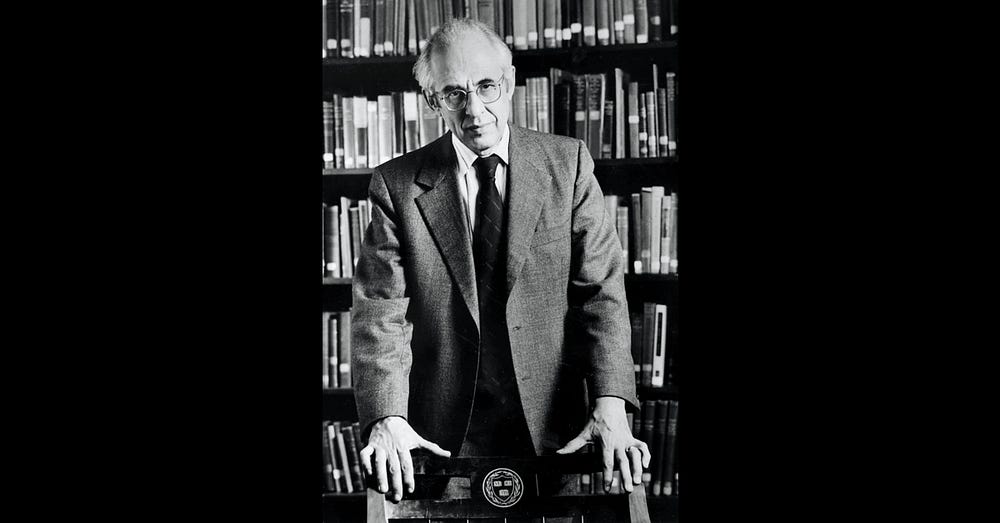
Hilary Putnam

Hilary Putnam argued that the very fact of recognising (let alone criticising or rejecting) a conceptual scheme surely means that it has, at least to some extent, been (to use Putnam’s word) “transcended”.

In more detail.

According to Putnam (in his paper ‘Why Reason Can’t Be Naturalised’), the fact that persons can criticise a (or their own) conceptual scheme casts doubt on any notion of such an (abstract) self-contained and self-enclosed structure.

Putnam himself mentioned Michel Foucault. [See also Putnam’s ‘Beyond Historicism’ in his Philosophical Papers.]

According to Putnam, Foucault and other conceptual-scheme determinists (words Putnam didn’t use) claim that we “mechanically apply cultural norms”. In actual fact, however, Putnam argued that many people “interpret” and “criticise” them. (Well, Foucault himself certainly did.)

Putnam’s critique of such determinism — he referred specifically to rationality — can be expressed in this way:

a conceptual scheme
 ↓
determines
 ↓
rationality
 ↓
and rationality
 ↓
transcends (through criticism, self-reflection, etc.)
 ↓
that conceptual scheme

Putnam’s internal realism can also be applied to the notion of a conceptual scheme — and the parallel stress on language — in the following way:

position A (which Putnam says is “language-determined”)
 ↓
gives rises to
 ↓
position B (which is also
language determined)
 ↓
Thus, “we make new versions [of language] out of old ones”.

However, one might have asked Putnam this question:

If a conceptual scheme — or a given language — is so easy to transcend, then why talk in terms of a conceptual scheme at all?

(This seemed to have been at least part of the gist of Davidson’s argument.)

It can be doubted that Putnam did argue that it’s easy to transcend a conceptual scheme. It may take a lot of hard work. Alternatively, such transcendence may be — at least partly — fortuitous.

The point is, however, that not all the conceptual schemes (or epistemes) are equivalent to, say, the a priori categories and concepts of Kant (or, say, to Chomsky’s language faculty). In non-Kantian terms, then, conceptual schemes can be — or actually are — contingent. Indeed, Foucault himself argued that epistemes are contingent in that they might have been otherwise. However, once an episteme becomes a (as it were) reality, then it non-contingently determines experience, “discourse”, and knowledge.

(Remember here that Foucault argued the following three things: (1) “In any given culture and at any given moment, there is always only one episteme.” (2) That an episteme determines the “conditions of possibility of all knowledge”. (3) That a conceptual scheme “delimits the totality of experience [of] a field of knowledge”.)

Of course, there are lots of contingent psychological, social and political phenomena which are, nonetheless, long-lasting and very hard to escape. However, this doesn’t make them any less contingent.

On the other hand , many things which were once deemed to be necessary or a priori turned out to be no such thing at all. And, of course, some philosophers have questioned the very existence of any form of a priori or necessity.

Thus, Foucault’s own notion of a historical a priori must itself become — and indeed has become — a victim of history and of philosophical criticism.

My flickr account and Twitter account.

Wednesday, 26 April 2023

David Chalmers’ Reality+… and The Matrix

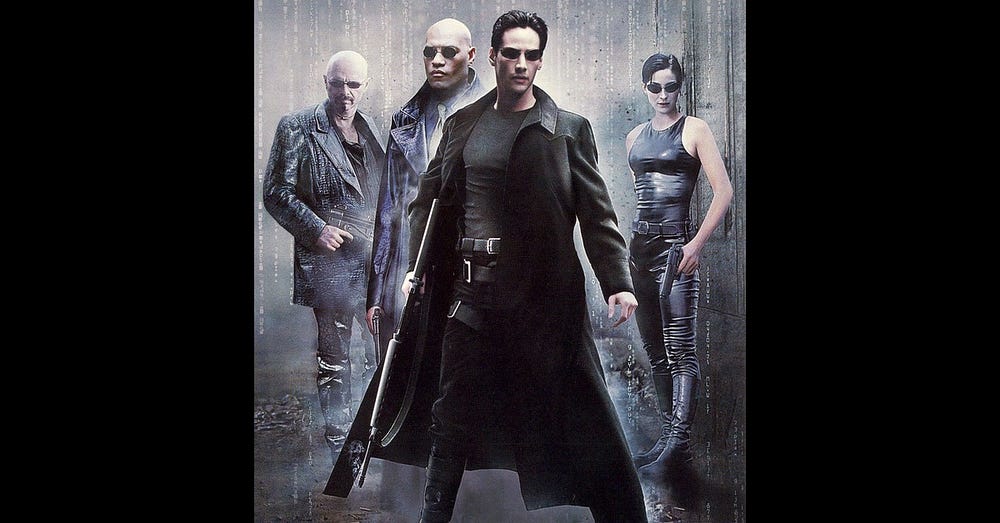
The main character in The Matrix (Neo) experienced a reality which was entirely an illusion. Yet, on David Chalmers’ take, his reality+ idea is mainly about what does — and what will — happen when individuals, groups and entire societies consciously (or willingly) create virtual realities. Thus, in that strong sense, Chalmers isn’t offering us his own 2023 (or 2022) version of The Matrix and other sceptical scenarios. Instead, his reality+ idea is largely about “extending our sense of the real”.

(i) Introduction
(ii) The Matrix
(iii) Simulations are Real Fakes
(iv) Proof?
(v) Illusions All the Way Down?

Philosopher David Chalmers’ own take on virtual reality isn’t like The Matrix scenario or René Descartes’ evil demon thought experiment. Indeed, his own term “reality+” actually captures that difference.

Basically, in his book Reality+: Virtual Worlds and the Problems of Philosophy, Chalmers discusses the many implications of our living with (as well as living in) nonvirtual worlds… + virtual worlds.

The Matrix

As many commentators have already pointed out, The Matrix can be viewed as a new-fangled take on Descartes’ evil demon story (or thought experiment). Of course, this isn’t to say that The Matrix is identical to Descartes’ evil demon — just with added contemporary knobs on.

It’s also worth saying that The Matrix owes just as much to the many and various brain-in-a-vat scenarios which have been offered to the public over the last five decades.

For example, way back in 1968 (some 31 years before The Matrix), the philosophers James Cornman and Keith Lehrer suggested that what they called the “braino machine” could do the following things:

[It could] operate by influencing the brain of a subject who wears a special cap, called a ‘braino cap.’ When the braino cap is placed on a subject’s head, the operator of the braino can affect his brain so as to produce any hallucination in the subject that the operator wishes. The braino is a hallucination-producing machine. The hallucinations produced by it may be as complete, systematic, and coherent as the operator of the braino desires to make them.”

The scenario above is now very familiar to many people.

Ironically, the philosopher Hilary Putnam argued — over many years — that

“the supposition that we are actually brains in a vat, although it violates no physical law, and is perfectly consistent with everything we have experienced, cannot possibly be true”.

Why is that?

Well, “[i]t cannot possibly be true, because it is, in a certain way, self-refuting”.

Of course, there’s a vast literature on this brain-in-a-vat story which can’t be tackled in this essay! (See here.)

So if we return to Descartes’ evil demon.

David Chalmers himself writes:

“I first argue that we can’t know we’re not in a simulation like the Matrix. This is a modern-day version of Rene Descartes’s idea that we might be in the grip of an evil demon producing sensations of an external world.”

More relevantly:

“We can never prove we’re not in a computer simulation because any evidence of ordinary reality could be simulated.”

So The Matrix is — at least partly — about what philosophers call global scepticism

However. The Matrix story may not actually be an artistic take on global scepticism at all.

That’s because global scepticism has it that we can’t know anything at all. The Matrix, on the other hand, is only about our perceptions of the world and the possibility that we can’t know if they’re all illusions. This may mean that Matrix-scepticism is only global when it comes to our perceptions. Indeed, this may actually make it a case of local scepticism

Yet surely scepticism about all our perceptions (if broadly construed) will pass over to scepticism about… everything.

After all, it may not only be that what we see, hear, smell and touch is illusionary: what we think and believe may be illusionary too. Indeed, what we perceive has often been closely tied — by many philosophers and scientists — to what we both believe and think. Thus, on this picture, perceptions are parts of a package deal which also includes thoughts, beliefs and memories. [See note 1.)

Of course, not all viewers of The Matrix need to be aware of all this philosophical stuff. (I suspect that most viewers haven’t been.) That is, they may not have even thought about scepticism in this explicitly philosophical sense. That said, perhaps this simply means that most viewers have never used the words “scepticism”, “global scepticism”, “evil demon”, etc. when thinking (or talking) about The Matrix

But who cares about that (almost) irrelevant fact about word usage?

So The Matrix can be used for one’s own ends, as indeed David Chalmers and many others have done over the last 24 years. (The Matrix was released in 1999.)

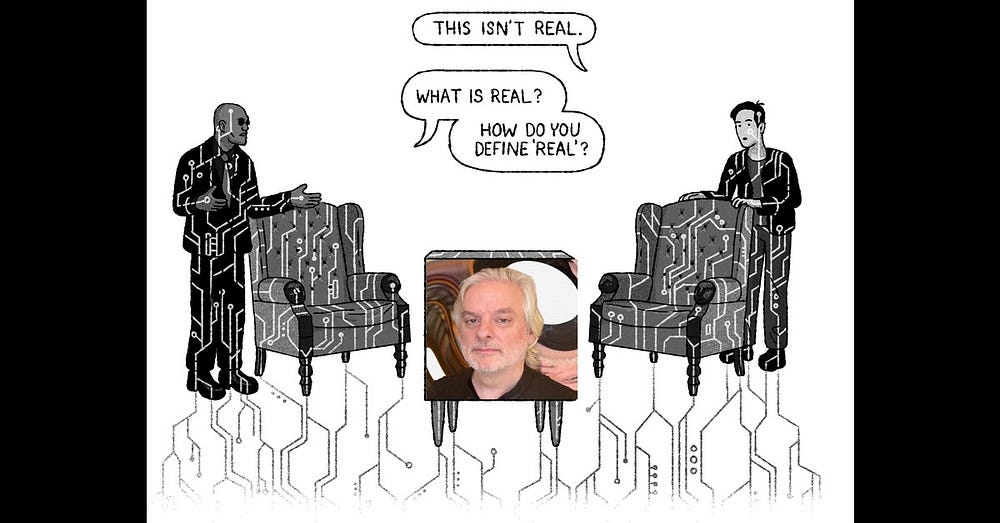
Now - what is real?

Simulations are Real Fakes

The philosopher Jean Baudrillard. The entire cast of The Matrix was asked to read Baudrillard’s Simulacra and Simulation

David Chalmers writes:

“Simulations are not illusions. Virtual worlds are real. Virtual objects are real.”

In fact, the rebel leader Morpheus (played by Laurence Fishburne) makes these points in The Matrix:

“How do you define ‘real’? If you’re talking about what you can feel, what you can smell, what you can taste and see, then ‘real’ is simply electrical signals interpreted by your brain.”

In a strong and very simple sense, a visual simulation, and even an entire package of simulations occurring together to create a virtual reality, can’t be an illusion in and of itself. After all, what you see, hear, touch, etc. is still real.

This means that it must be what people make of a simulation which may (or which will) involve illusion.

For example, if you believe that the unicorn in front of you is real and not a simulation (or an hallucination), then you’ve swallowed that particular illusion. On the other hand, since most people know when they’re witnessing a virtual reality, then the word “illusion” simply isn’t appropriate.

What’s more, such supposed illusions even have (or simply may have) a physical basis in that the software for the images is instantiated in physical hardware. In addition, whatever is going on in the human sensory system and brain when such things are stimulated (i.e., not simulated) must also be physical.

In any case, David Chalmers extrapolates from these points about (as it were) real fakes by stating the following:

“The central thesis of the book is virtual reality is genuine reality. This applies both to full-scale simulated universes, such as the Matrix, and to the more realistic virtual worlds of the coming metaverse.”

Chalmers adds:

“But I argue that even if we’re in a simulation like the Matrix, the world around us is perfectly real. There are still tables and chairs, planets and people.”

Indeed, on a more psychological, sociological and even political level, the following passage expresses how Chalmers sees things when they’re placed in a much broader context:

“These worlds needn’t be illusions, hallucinations, or fictions. Our time in them needn’t be escapism. People already lead complex and meaningful lives in virtual worlds such as Second Life, and VR will make this commonplace.”

That quoted, these wider psychological, sociological and political contexts won’t be tackled here. (Chalmers himself does tackle them in his book Reality+: Virtual Worlds and the Problems of Philosophy.)

Proof?

Let me reuse a passage from David Chalmers which was quoted at the beginning of this essay:

“We can never prove we’re not in a computer simulation because any evidence of ordinary reality could be simulated.”

Some readers may wonder how we should take the word “prove” here.

As ever, most times the word “prove” (or “proof”) is used in its loose — or everyday — sense. And, at other times, it’s used in its strict mathematical and logical senses. (Perhaps most uses of the word “prove” fall somewhere in between these demarcations.)

In any case, it can be doubted that there could ever be a strict proof that a Matrix-like simulation… is a simulation. (In accordance with the last section, this is better than saying that the simulation is “unreal”.)

For example and crudely, if I were to discover a hidden Wi-Fi connection which connected a computer to my brain, then that still wouldn’t be a proof that my perceptions are simulations. This would simply be (empirical) evidence (i.e., not proof) that my perceptions may be (or even are) simulations.

[The Matrix scenario is, of course, much more complicated than my own simply story.]

So finding evidence of computer-to-brain Wi-Fi connection still wouldn’t be a philosophical or logical proof of my living in a simulation. That’s mainly because my (seemingly) evidential and empirical discoveries could also be simulations. Thus, I could be experiencing a simulation which seems to show me that all my experiences are simulations.

Put simply, then, whatever evidence (at least sensory or observational evidence) I find could also be a simulation. Indeed, we can ratchet this sceptical scenario up and say that sentient machines (or evil demons) are making me believe and think that I’m finding evidence that I’m being stimulated to believe certain things about both myself and my environment. What’s more, my discovering that that my very thought (i.e., that all my perceptions are simulations) could itself be the result of a simulation or a manipulation of my brain. And so on and so on.

Illusions All the Way Down?

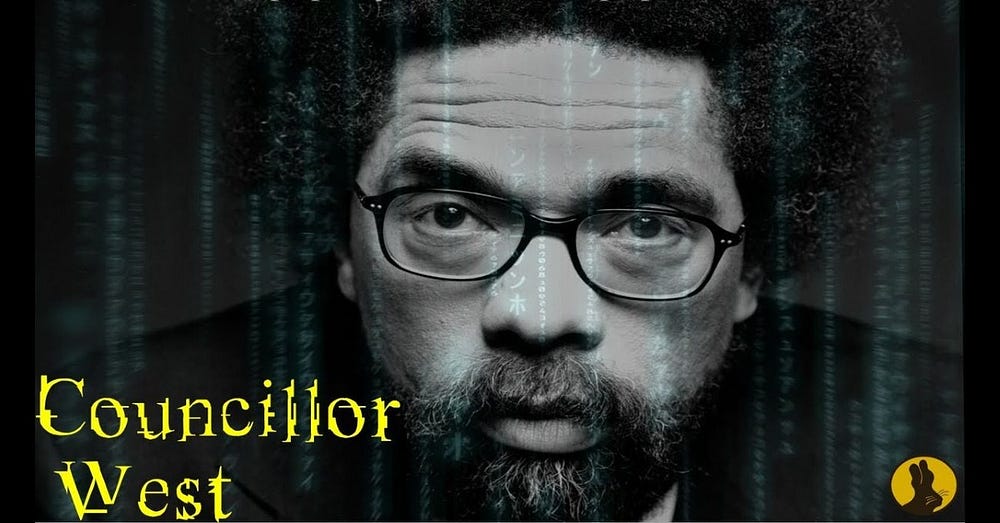
Professor Cornel West (who played Councillor West of Zion in The Matrix Reloaded) expressed the overall gist of The Matrix — and perhaps life generally! — in this way:

“It’s illusions all the way down.”

There’s a problem with West’s claim that it’s illusions all the way down.

This claim is like saying that everyone in a class, or even in the entire world, is brave. Thus, if everyone is brave, then no one is brave. Similarly, if everything is an illusion, then there’s nothing to compare any single illusion to — except other illusions. That is, in The Matrix — and in other (globally) sceptical scenarios — there are no non-illusions to compare each and every illusion to. So if literally everything (we’d need to state what’s meant by “everything”) is an illusion, then nothing is an illusion. [See note 2.]

All this is a similar to Ludwig Wittgenstein’s doubts about doubt. Or, more accurately, it can be compared to Wittgenstein’s doubts about global doubt.

In simple terms, Wittgenstein argued that if literally everything is doubted, then nothing can be doubted. He wrote:

“The questions that we raise and our doubts depend on the fact that some propositions are exempt from doubt, are as it were like hinges on which those [doubts] turn. []
“My life consists in my being content to accept many things.”

To paraphrase Wittgenstein. Wittgenstein argued that the very act of doubting anything requires us to leave at least some things free from doubt. Indeed, if this suspension-of-doubt isn’t carried out, then the language game of doubting can’t even begin. (See Wittgenstein’s On Certainty.)

In any case, the it’s-illusions-all-the-way-down hypothesis (or possibility) is actually written into this example of global scepticism. That’s primarily because there’s no way of finding out if it is actually illusions all the way down. Again, the possibility (or reality) of never being able to find out that it’s illusions all the way down is deliberately — and obviously — written into this sceptical story…

To repeat. If everything is an illusion, then we have no purchase on that very fact (or possibility). That’s because up until realising that everything is an illusion (that’s if this realisation doesn’t itself contain a contradiction), everything we’d previously experienced (or even believed we knew) had been an illusion too.

Of course, if a globally-sceptical scenario is deliberately designed to preclude all possibilities of discovering that “reality is an illusion”, then that doesn’t also mean that it can’t be discovered that the sceptical scenario itself is (as it were) an illusion. It simply means that the sceptical philosopher (or film director/writer) wanted to create a scenario that was without any holes. However, that needn't also mean that his scenario is without holes.

Despite all that, and in the case of The Matrix at least, the main protagonist (Neo, who was played by Keanu Reeves) was offered a red pill — which was, indeed, a way out of the prison of illusions!

However, even in this singular case of escape from the prison of illusions, the red pill had to be offered to Neo by someone else — by the rebel leader Morpheus. Yet when it came to Neo himself, and had he been left entirely to his own (epistemic) devices, then he would (or could) never have discovered that it’s illusions all the way down.

*************************

Notes

(1) It’s worth noting here that all this doesn’t really have anything to do with what’s usually called external world scepticism. This idea is primarily generated by the fact — or claim — that material knowledge can only be attained through our perception of the world. What’s more, our (to use the British Empiricists’ term) sense impressions do not — Bishop Berkeley argued that they cannot — correspond with any physical state of affairs.

(2) “Everything”? “Nothing?” Some philosophers have emphasised the importance of limited — or contextual — quantification. That is, quantification over specific domains. The philosopher and logician Graham Priest, on the other hand, believes that “it’s okay to use a quantifier with the widest possible scope”. That is, it’s fine to quantify over literally everything.

My flickr account and Twitter account.


Wednesday, 19 April 2023

A Religious Physics and Cosmology for the 21st Century?

Paul Davies is a physicist and writer of popular books on science. To use Davies’s own words about the theoretical physicist John Archibald Wheeler, he is “not afraid to tackle deep philosophical questions”. He’s also not (to use Davies’s words again) “conventionally religious” or “traditionally religious”… However, this essay argues that the relevant positions Davies takes on physics and cosmology are, indeed, unconventionally religious.

(i) Introduction
(ii) Paul Davies Against Other Scientists
(iii) Paul Davies’s Rhetoric and Ideology
(iv) Is Paul Davies Religious?
(v) Paul Davies’s Teleology for the 21st Century
(vi) The Life Principle

“Brandon Carter has frequently regretted his own choice of the word ‘anthropic’, because it conveys the misleading impression that the principle involves humans specifically, rather than intelligent observers in general.”

(See source of this passage here.)

Paul Davies sees himself as being in the mould of the American theoretical physicist John Archibald Wheeler (1911 — 2008).

Firstly, Davies tells us that John Wheeler was

“not afraid to tackle deep philosophical questions”.

In addition, he was

“not conventionally religious, but inspired by a reverence for nature and a deep sense that human beings are part of a grand scheme which we glimpse only incompletely”.

Finally, Davies tells us that Wheeler was

“bold enough to follow the laws of physics wherever they lead”.

It’s surely not unfair to say that Davies is also talking about himself here.

It’s not unfair to say that because Davies “is not afraid to tackle deep philosophical questions”. He’s not “conventionally religious”, but he still has a “deep sense that human beings are part of a grand scheme”. Finally, Davies believes that he is “bold enough to follow the laws of physics wherever they lead”.

In more detail.

Davies raises all sorts of philosophical questions which he deems to be very deep. He also often says that he’s not “traditionally religious” or “conventionally religious”. This basically means that Davies is still religious — just not traditionally or conventionally so. And, in terms of physics alone, Davies is bold enough to argue that the laws of physics may not be “immutable” after all.

This last idea is something which Davies took directly from John Wheeler.

Davies himself told the following story:

“I once asked Wheeler what he considered his most important achievement, and he answered ‘Mutability!’”

What’s more, neither would it be unfair to say that in the following passage Davies is talking about himself again. Thus:

“Throughout history, prominent thinkers have been convinced that the everyday world observed through our senses represents only the surface manifestations of a deeper hidden reality, where the answers to the great questions of existence should be sought.”

More tellingly, Davies continued:

“The word ‘occult’ originally meant ‘knowledge of the concealed truth’ [].”

These charges are levelled against Davies because he often talks in terms of deep questions, and the— or his! — deep answers “to the great questions of existence”.

Paul Davies Against Other Scientists

Paul Davies sometimes has a problem with people picking up on what they take to be his religious views. However, this often depends on Davies’s questioner and/or his audience at the time.

For example, Davies wrote:

“Many scientists will criticise my E/F inclination as being crypto-religious”.

[E = “a life principle”. F = “the self-explaining universe”.]

Of course, Davies also tells us why many scientists deem his inclinations to be crypto-religious.

For example, the following is what such scientists (supposedly) don’t like about Davies’s position:

“The fact that I take the human mind and our extraordinary ability to understand the world through science and mathematics as a fact of fundamental significance [].”

Davies adds that such scientists believe that this position

“betrays [] a nostalgia for a theistic world view in which humankind occupies a special place”.

This shows that Davies has as much of a problem with other scientists’ views as some scientists have with his own… as we shall see.

So now let’s get something straight out of the way:

I too deem many of Davies’s positions to be… well, crypto-religious.

Actually, I wouldn’t even use the prefix “crypto”. And that’s because Davies’s religious positions don’t seem to be hidden.

For example, Davies himself says that

“if I am honest I have to concede that this starting point is something I feel more in my heart than in my head”.

He finishes off with these words:

“So maybe that is a religious conviction of sorts.”

And, elsewhere, Davies talks in terms of his “cosmic religious feeling”.

[See Paul Davies’s book God and the New Physics, which was published way back in 1983. Davies’s views can also be tied to theosophy. Particularly, theosophy has it that the evolution of Homo sapiens is an expression of the wider evolution of the Universe. See here. See ‘Paul Davies: What I believe about God’.]

Paul Davies’s Rhetoric and Ideology

Paul Davies indulges in a fair bit of psychological — and even political — theorising about those scientists who oppose his views (as well as those who oppose views very similar to his own). However, he doesn’t seem to like it when people do the same thing to both himself and his own views.

For example, Davies says that his views — and views he’s sympathetic to — are met with a “hostility” which “does carry the hallmarks of an extra-scientific agenda”. He also states that the criticisms of his ideas “carry barely concealed overtones of an ideological agenda”. …

Surely Davies must be able to guess the responses to such accusations. Here’s one:

Paul Davies, along with those people who take similar positions to himself, often show hostility to what they call “atheism”, “materialism”, “reductionism” and “scientism”. And their hostility shows all the hallmarks of an extra-scientific, ideological and/or religious agenda.

So perhaps readers should (or at least they could) simply ignore all the psychologising and politicking on both sides. That said, this rising-above-the-intemperance would surely be an artificial (or contrived) stance. And that’s primarily because everyone interested in this debate would still be well aware of the various elephants in the room.

All that said, is Davies actually religious?

Is Paul Davies Religious?

Superficially, Paul Davies’s acknowledgment that Homo sapiens are no more than a (mere?) “accidental by-product of haphazard natural processes” (this expression seems to have become a cliché — see here) is certainly not a position that’s easily squared with Christianity (though many Christians have accepted evolution) or with any other specific monotheistic religion…

However, no one I know has ever accused Davies of being a closet Christian or even a closet monotheist… at least not one of a (to use Davies’s own word) “traditional” kind.

In any case, in one breath Davies stated that Homo sapiens are a “accidental by-product of haphazard natural processes”. Yet, in the next breath, he talks poetically about “life and mind” being “etched deeply into the fabric of the cosmos” (i.e., through what he takes to be “a life principle”).

All this seems like neat and tidy shift from what Davies calls “traditional religion” into a… non-traditional religion.

Indeed, it seems like Davies has almost created his own physics-clad religion…

A new religion that, Davies must believe, just happens to be in tune with certain strands in late 20th century and early 21st century physics and cosmology.

Of course, this kind of thing has happened countless times throughout the long history of the many religions of the world. What’s more, it’s a truism to say that religion must keep on reinventing itself. Indeed, even so-called “fundamentalist” religions have carried out— historically — much reinvention, and they still do so today (as have traditional religions).

[Think here of the Church of England attempting to make its values and beliefs perfectly mimic the political and social fashions of 2023 — or at least those of the early 21st century — see here. Of course, representatives of the C of E will strongly deny this and attempt to tie the political peculiarities and specificities of 2023 to specific theological and religious texts written well over a 1000 years ago. Perhaps religions must do this kind of thing simply in order to survive.]

Paul Davies’s Teleology for the 21st Century

Paul Davies’s central teleological position (along with his adherence to the Life Principle) can be deemed to be anthropocentric. Ironically, Davies himself uses the term “homocentrism” to refer — in a negative manner — to this fundamental position of what he calls “traditional religion”.

So Davies tries very hard to extricate himself from homocentrism.

Davies also uses the word “teleology”. He tells us that teleology

“represents a decisive break with traditional scientific thinking, in which goal-oriented or directional evolution is eschewed as anti-scientific”.

Davies has his own take on teleology. That is, it isn’t a traditional teleology. It’s a teleology that’s been updated with added strands from late 20th century and early 21st century physics and cosmology.

Davies put his own teleological position in the following way:

“In this theory, the bio-friendliness of the universe arises from an overarching law or principle that constrains the universe/multiverse to evolve towards life and mind. It has the advantage of ‘taking life seriously’, treating it neither as a completely unexplained bonus [] nor as a mere passive selector [].”

He continued:

“In short, it builds purpose into the workings of the cosmos at a fundamental (rather than an incidental) level, without positing an unexplained pre-existing purposive agent to inject purpose miraculously.”

Davies began the first passage above with the three words “in this theory”. These words are used in a third-person-kinda-way. However, it’s clear from Davies’s writings that this theory is, in fact, his theory.

As just stated, Davies frequently attempts to distance himself from traditional religion. And, concomitantly, he distances himself from homocentrism. Yet what are we to make of Davies’s claim that his theory advances the idea of an

“overarching law or principle that constrains the universe/multiverse to evolve towards life and mind”.

In addition, we have Davies’s claim that his theory

“builds purpose into the workings of the cosmos at a fundamental (rather than an incidental) level”.

How can talk of “life and mind” — and, less strongly, “purpose” — be anything other than homocentric?

Now surely this isn’t simply a merely anthropic theory — it’s outrightly anthropocentric.

Importantly, Davies — or anyone else — being homocentric isn’t the criticism here. The point is that Davies strongly denies that his overall position is homocentric.

That last claim is stated largely because Davies ties “understanding” and “comprehension” to his theory. This means that he can’t be talking about all lives and even all minds. Instead, he must actually be talking about the lives and minds of Homo sapiens. Indeed, it can be argued that Davies is actually talking about (or privileging) a tiny subset of Homo sapiens: particular physicists (such as himself), cosmologists and, perhaps, mathematicians.

Thus, Davies has selected a tiny group of Knowers or Understanders as the basis of a theory which he claims isn’t traditionally religious. Yet these Knowers or Understanders must surely constitute something very much like a traditional priest class.

Again, how can Davies’s position not be homocentric (or anthropocentric) when he comes out with passages such as the following? -

“Somehow the universe has engineered, not just its own awareness, but its own comprehension. Mindless, blundering atoms have conspired to make, not just life, not just mind, but understanding. The evolving cosmos has spawned beings who are able not merely to watch the show, but to unravel the plot. What is it that enables something as small and delicate and adapted to terrestrial life as the human brain to engage with the totality of the cosmos and the silent mathematical tune to which it dances?”

Apart from the fact that this passage comes across like a religious homily (or even a religious incantation), how can all those claims not be homocentric?

Davies even uses the words “beings” and “the human brain”.

Yes; in Davies’s story, it is beings who “unravel the plot”. Indeed, it’s not even all beings who unravel the plot. It’s a tiny subset of beings who do so— i.e., particular physicists (such as himself), cosmologists and, perhaps, mathematicians. In other words, Davies must surely be referring to a tiny group of Knowers or Understanders — those people he seems to set up as a priest class.

So why use the strong term “priest class”?

Firstly, most human minds do not (or even cannot) “understand the world through science and mathematics”.

All this must mean that Davies replicates the position adopted by fellow physicist Roger Penrose on the importance of “seeing” (what can be called) Gödel truths. (See my ‘Platonist Roger Penrose Sees Mathematical Truths’ at Cantor’s Paradise.)

Yet 99.9% of people wouldn’t recognise a Gödel truth even if it were pushed in their faces. Thus, the specialness of what Penrose calls (human!) “understanding”, and what Davies also calls “comprehension”, must be something that all human beings could only achieve (as it’s often put) in principle. That understanding (or comprehension), then, must only be latent in the majority of human minds or brains.

But is it?

In addition, what does this reliance on a human potentiality (but 99.9% non-actuality) amount to?

Are both Davies and Penrose conflating all Homo sapiens with… themselves?

Or, at the least, are they conflating all Homo sapiens with a tiny subset of them: particular physicists (such as themselves), cosmologists and (in Penrose’s case) mathematicians?

Davies also makes much of what he calls “a life principle”.

The Life Principle

Paul Davies (almost?) comes clean about his commitment to the Life Principle. However, he doesn’t use the definite article (i.e., “the”) or my own Platonic capitals. Instead, he uses the words “a life principle”.

And, in tandem with the Life Principle, Davies also comes clean about his commitment to what he calls “directional principles” and/or “teleology”.

What’s more, Davies certainly has faith in the Life Principle, at least according to Brian Miller. (See my ‘Physicist Paul Davies’s Faith in His Idea That Science is Founded on Faith’.) Miller wrote:

[Paul Davies] also honestly stated that the reason he still had faith that such a principle or process must exist is his unwillingness to consider the possibility of a supreme intelligent agent, as assumed by most world religions, who acts in the world.”

This is Miller’s reaction to a YouTube video (‘Paul Davies & Jeremy England • The Origins of Life: Do we need a new theory for how life began?’) in which Davies does say that he has faith in the Life Principle. (Davies also says: “I would like to believe in a [life principle]…”)

Of course, Davies does offer his readers criticisms of his own position/s.

For example, he wrote:

“A life principle also suffers from the problem of singling out life and mind as the ‘aim’ of cosmic evolution, without explaining why. One could just as well nominate any distinctive and complex state of matter and enshrine its emergence in a teleological principle.”

However:

“This objection is readily removed if one combines a teleological principle with the multiverse, because only universes with life principles built into their laws get a chance to be observed.”

That said, Davies then voices problems with that too!…

And, as a scientist, so he should.

All this is a roundabout way of saying that many of the scientists who endorse a particular theory will be well aware of many of the criticisms of that theory. Thus, in various contexts, such scientists — just like Davies — will articulate those criticisms (i.e., in their papers, books, etc.) without also endorsing (or agreeing with) them.

So Davies knows that scientists should be aware of counterarguments and any opposing data.

In any case, after raising the arguments above against the Life Principle, Davies informs his readers about a way out. Thus:

“One way to avoid this trap is to appeal to a closed explanatory or causal loop. In effect, the universe (or multiverse — it can work at both levels) explains itself.”

And, elsewhere, Davies writes:

“Or, perhaps better still, perhaps existence isn’t something that gets bestowed from outside, by having ‘fire beathed’ into potentiality by some unexplained fire-breathing agency [] but is something self-activating. I have suggested that only self-consistent loops capable of understanding themselves can create themselves, so that only universes with (at least the potential for) life and mind really exist.”

All of Davies’s positions above — to repeat — will have been articulated despite his awareness of the arguments and data against them.

To sum up. Most readers of Paul Davies’s books will be left in no doubt at all as to exactly where he stands — from a religious point of view. And such readers will also be aware of what Davies borrows from late 20th century and early 21st century physics and cosmology in order to back up his religious positions.

****************************

(*) Most of the passages from Paul Davies — in the essay above — can be found in his book The Goldilocks Enigma: Why is the Universe Just Right for Life?, which also goes by the name Cosmic Jackpot.)

(**) See my related essays ‘Physicist Paul Davies’s Deep — or Specious! — Questions About Life, the Universe and Everything’, ‘Physicist Paul Davies’s Faith in His Idea That Science is “Founded on Faith”’, and ‘Isaac Newton’s Religious Physics?’.

(***) My flickr account and Twitter account.