Saturday, 9 December 2023

The Weird Case of Wolfgang Pauli: Hardcore Positivist and “Mystic”

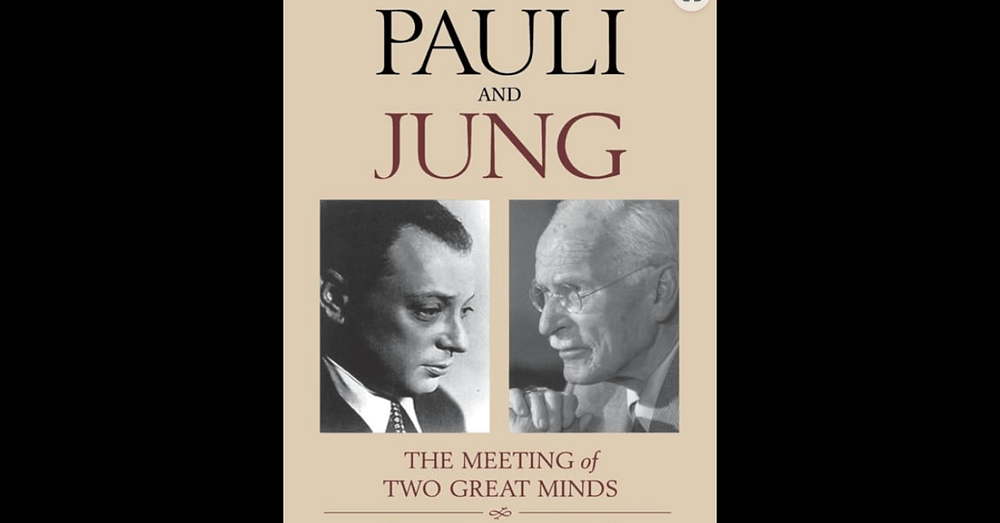
Religious/“spiritual” commentators, New Age “scientists”, and self-described “anti-materialists” often cite the case of Wolfgang Pauli and his (what they call) “mystical” views. They also note that Pauli admired — and was inspired by — the Swiss psychoanalyst Carl Jung. Yet Pauli was a physicist —indeed, a great physicist. So it’s not much of a surprise that virtually none of his writings on mystical matters were published in his lifetime — certainly not as academic papers or books. However, various books on Pauli’s mysticism and his relationship with Jung were published long after his death in 1958.
(i) Introduction
(ii) False Authority: Name-Dropping Various “Great Scientists” 
(iii) Gerald R. Baron on Wolfgang Pauli and Carl Jung
(iv) Part Two: Wolfgang Pauli’s Positivism

To put it at its most extreme: a person may be serial killer and still be a great scientist. Similarly, a person may (i.e., in his private life) believe in pixies, white/black supremacy, or alien lizards and still be a great scientist.

Indeed, there’s a long list of great scientists and mathematicians who held very peculiar views outside their scientific and mathematical work. [See ‘The ‘Maddest’ Scientists In History’, which doesn’t even include Kurt Gödel starving himself to death.]

To state the obvious: these people weren’t great scientists and mathematicians for the stuff they believed, theorised about and stated outside their respective scientific and mathematical work.

In even more simple terms. These scientists and mathematicians were flesh and blood human beings. Thus, they had particular psychologies, particular backgrounds, particular prejudices, and particular quirks.

But none of that should be a surprise.

As for the particular psychology, particular background, particular prejudices and particular quirks of Wolfgang Pauli himself.

Even fans of Pauli’s “mystical” views (i.e., his views outside physics) stress his personal details.

For example, Gerald R. Baron (to be discussed later) writes:

“In 1930 [] one of the pioneers of the rapidly advancing science of quantum mechanics had a personal crisis. Troubled by a divorce and his mother’s suicide, he consulted one of the leading lights of the new science of psychology [Carl Jung].”

Elsewhere, Baron also wrote:

“Pauli and Jung came together in late 1930 after Pauli divorced his cabaret-singer wife and Pauli’s mother committed suicide. His personal crisis and cry for help from one of the most famous psychoanalysts of his time [].”

To readers firmly outside both religion and psychoanalysis, this may simply seem like a rather typical example (even a caricature) of a person embracing Jungian psychology and/or mysticism due to very negative personal circumstances.

We can add to all that the fact that Pauli’s father had even encouraged his son to develop an interest in Jung. And, in a more personal light, Pauli loved having his dreams analysed.

So it can now be argued that had Pauli lived at any other time, and in any other environment, then there would have been a very strong chance that he simply wouldn’t have been attracted to the work of Carl Jung. Philosophically (or logically) speaking, of course, had Pauli been born at any other time, and lived in any other environment, then such a person wouldn’t actually have been Wolfgang Pauli in the first place.

In any case, now let’s place Pauli’s mysticism in its philosophical context.

Wolfgang Pauli (just like Erwin Schrödinger) was influenced by the philosopher Arthur Schopenhauer (1788–1860). And, of course, Schopenhauer’s own views were influenced by “Eastern” religions. [See here.]

So what of the broader historical context?

In his ‘Mysticism in quantum mechanics: the forgotten controversy’, the historian of science Juan Miguel Marin explains the culturally contingent nature of this fixation with mysticism within a context which is wider than just Pauli himself.

In detail.

Marin stresses that up to World War Two, quantum mechanics existed in a mainly German — and Austrian (?) — context. And, in that context, there was a “mystical zeitgeist”. Yet, Marin adds, all that ended in the 1950s, when physics became (as he puts it) “Anglo-American”.

[Sure, a historian or a sociologist can now say that this Anglo-Saxon “hegemony” also expresses cultural and historical contingency when it came to physics.]

Marin then tells us that this mystical zeitgeist was a culturally short-lived phenomenon. He also tells us that Schrödinger’s lectures of 1958 were virtually the end of mysticism in physics. Needless to say, this doesn’t also mean that there weren’t isolated “mystical physicists” still around after 1958. (When the American hippies arrived in the mid-1960s, then the fashion for mysticism and “Eastern” religions arose again.)

In any case, Wolfgang Pauli was a great physicist who also believed in mysticism (see Quantum Mysticism: Gone but Not Forgotten’), the ideas and theories of Carl Jung, numerology (see Cosmic numbers: Pauli and Jung’s love of numerology’), synchronicity, etc. More relevantly, Pauli used the term “lucid mysticism” to refer to his own general stance on these matters. (That stance being the “synthesis between religion and rationality”.)

Yet despite all the above, it should be kept in mind here that Pauli had very little (almost nothing) published on these mystical subjects. [See note 1.]

False Authority: Name-Dropping Various “Great Scientists”

If writers and commentators can mention a great scientist like Wolfgang Pauli (or, indeed, Erwin Schrödinger) to back up their prior philosophical and/or religious views, then other “anti-religious” commentators and writers can quote other great scientists to back up their own prior anti-religious, anti-Jungian, etc. positions too.

Who knows, perhaps the fans of Pauli’s mysticism would say that this argumentative toing and froing is a good thing.

What’s more, for every Pauli, there are hundreds — or even thousands — of scientists who would have no time at all for Jung, religion, mysticism, synchronicity, idealism, etc. Indeed, some of these names also include great scientists. [See note 2 for a long list.]

As it is, it’s probably wise not to rely on scientists (even the great ones) to back up (or at least attempt to clinch) any philosophical views or positions (say, for or against panpsychism, idealism, etc.). And that’s mainly because these views or positions aren’t actually within physics in the first place.

That said, philosophical “materialists”, atheists, etc. could name-drop all sorts of scientists to back up their own materialism, atheism, etc.

Perhaps some of them do.

In more detail.

Name-dropping (or name-checking) various artfully-selected scientists doesn’t do much of a job when it comes to attempting to sell a particular philosophical and/or religious (or “mystical”/“spiritual”) position. Or, at the very least, name-dropping on its its own doesn’t do much work.

What’s more, doing so is often simply to indulge in the false authority fallacy.

The philosophers Carl Cohen and Irving Copi, for example, captured the case of quoting and mentioning physicists like Wolfgang Pauli, Albert Einstein and Erwin Schrödinger (i.e., on subjects outside physics) when they said that the false authority fallacy occurs

“when the appeal is made to parties having no legitimate claim to authority in the matter at hand”.

Copi and Cohen then added:

[W]hen an authority is appealed to for testimony in matters outside the province of that authority’s special field, the appeal commits the fallacy of argumentum ad verecundiam.”

More relevantly, take the words of Gerald R. Baron on Wolfgang Pauli and Carl Jung.

Gerald Baron on Wolfgang Pauli and Carl Jung

Gerald Baron wrote:

“What is most important for our discussion here is how so many of the great minds of yesterday and today are converging in their thoughts about these questions.”

Sure.

Many great minds converged on many other “questions” too — and some of their answers were downright false. They also converged on mutually-contradictory positions and theories.

Baron then does the same kind of thing (i.e., which he’d just done with Wolfgang Pauli) with John Polkinghorne (i.e., with the addition of the “Sir” before his name).

Baron tells us that Polkinghorne was “one of Britain’s greatest theoretical physicists”. Indeed, Polkinghorne was a physicist who also

“saw a strange similarity between the role that consciousness plays in affecting physical reality — the quantum measurement ‘problem’ — and the interchange between the unconscious and conscious in the mind”.

This, again, just seems like an attempt to get some well-known physicists on board the mystical or religious train. And, as already stated, for every Pauli or Polkinghorne, there are a hundred — or even a thousand — physicists (some great ones too) who would never state some of the things that Pauli and Polkinghorne stated.

All that said, the words “scientific heretics” crop up a lot in these discussions. In other words, because Pauli, Polkinghorne, Schrödinger, etc. attempted to tie physics to religion (or to mysticism), and most other scientists don’t do so, then the former are often classed as “heretics” by their supporters and fans. [See my Rupert Sheldrake’s ‘Heretical’ Caricatures of Scientists and Science’.]

In any case, is Sir Polkinghorne a “great physicist” anyway?

Rather, wasn’t he just an fairly important physicist working in the strict and limited context of British physics between the late 1950s to the 1970s? Indeed, in the Wiki article on Polkinghorne, almost all of it is about him being a “leading voice explaining the relationship between science and religion”.

Of course, it obviously can’t be denied that Polkinghorne wrote academic papers on physics (as with every physics postgraduate who has ever lived), and that he also had some kind of institutional role within parts of British physics. However, none of this amounts to making him a great physicist. Again, most of the entries on — and short accounts of — Polkinghorne don’t spend any time at all on his purely physics-based ideas and theories. Instead, religion is mentioned in almost every paragraph.

So it can also be strongly suspected that Gerald Baron would never have felt the need to mention Polkinghorne (let alone call him “one of Britain’s greatest theoretical physicists”) if he couldn’t also connect him to his own philosophical and religious views. In other words, it can be doubted that Baron would have had any interest at all in Polkinghorne exclusively as a physicist.

Baron concludes by stating the following:

“If nothing else, the collaboration of a Nobel laureate physicist [Wolfgang Pauli] and a leading thinker on the mind and human experience [Carl Jung] demonstrates the value of approaching the question of reality in a holistic way, meaning from more than one field of study.”

So how deep and wide should such holism go?

Should everything under the sun be mentioned when discussing a particular subject or problem? (Even mutually-contradictory views?)

Would it be holistic to mention urban architecture when writing about set theory? What about horticulture when writing about quantum entanglement? Or soccer when discussing genetic mutations?

Indeed, holism can result in an obvious free-for-all (i.e., a kind of philosophical free improvisation) in which anything can be connected to anything if the poetic, analogical and/or religious urge to do so arises.

Sure, the examples above may seem extreme or even simple jokes. However, Pauli himself did connect particles to what he called “souls”. [See here.]

[The technical details of Pauli’s (as it were) scientific-mystical theories will be discussed in a future essay.]

Part Two

Wolfgang Pauli’s Positivism
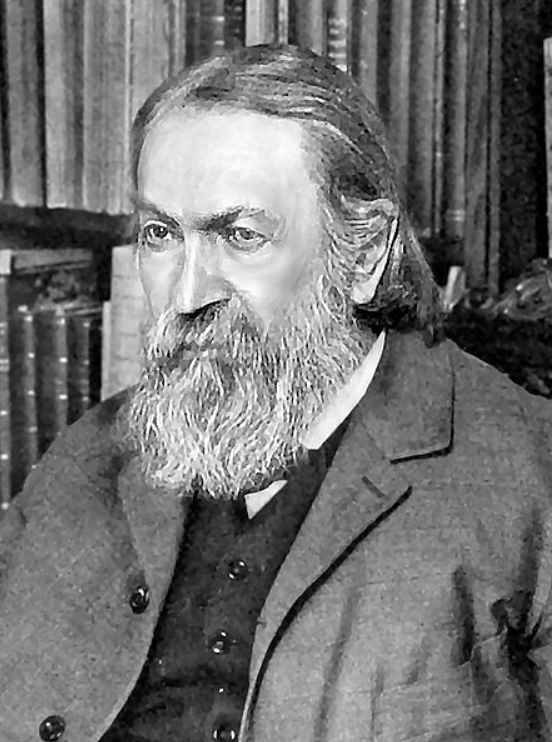
Ernst Mach

Those commentators and writers who emphasise Wolfgang Pauli’s mysticism won’t also be too keen on stressing his (extreme) positivism (i.e., his general anti-metaphysical attitude) too. Or, at the very least, they may say that Pauli was a positivist only up to a point: that point being (more or less) when he met Carl Jung.

This general standpoint is put by the science historian Karl von Meyenn when he wrote:

“Pauli grew up under the influence of Ernst Mach, but — like Einstein — he turned away from the radical positivism of most of his contemporaries quite early.”

Arguably, Pauli didn’t turn away from positivism “quite early” at all. He did so when he was 32. And that was after much of his important work in physics had already been done. What’s more, Pauli’s well-known positivist quote about “how many angels are able to sit on the point of a needle” was written in 1954, some 22 years after first meeting Carl Jung. (This will be discussed again in a moment.)

Various articles and papers which reflect upon Pauli’s positivism basically argue that he was a positivist until (roughly) 1932 — when he was 32. In Pauli’s own words:

“It so happened that my father, then intellectually completely under Mach’s influence, was very friendly with his family. Mach had affably expressed his willingness to play the role of my godfather. He was, no doubt, a stronger personality than was the Catholic priest. The result seems to be that, in this way, I was baptized as ‘Antimetaphysical’ instead of Roman Catholic.”

And, in a letter from 1953, we can even read Pauli mentioning Mach and Jung in the same breath. He wrote:

“I imagine him [Ernst Mach] amiably shaking your [Carl Jung’s] hand, welcoming your particular definition of physics as a pleasing, if somewhat belated, sign of insight. [] Finally, he expresses his satisfaction that you have banished all metaphysical judgments (as he was fond of saying) ‘into the shadow realm of a primitive animism.’”

So most of Pauli’s important work was done in that pre-1932 period. Of course, that isn’t also to say that Pauli didn’t do substantial work after 1932. For example, there was his spin–statistics theorem of 1940, and his CPT theorem of 1954. (It’s not clear to me, as a non-physicist, how much of these theorems was purely Pauli’s work.)

So it’s worth noting here that at the age of 21, the precocious Pauli had his well-known article on special and general relativity published. (It was published in the Encyclopedia of the Mathematical Sciences, and it now appears as a book called Theory of Relativity.) This is an article of 237 pages, and 394 footnotes. Many commentators still regard it as one of the best things ever written on both relativity theories.
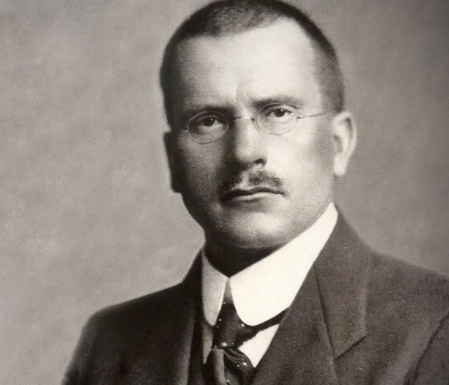
Carl Jung at roughly the same time he first met Wolfgang Pauli.

But let’s cite more details on Pauli’s positivism.

In an interview published in In Our Time: Celebrating Twenty Years of Essential Conversation), the particle physicist Frank Close said:

[Ernst Mach] was a philosopher who influenced the Vienna Circle of logical empiricists with his well-known anti-metaphysical attitude. [] When Pauli was born, Mach was invited to become his godfather. The story goes, that many years later, Pauli said, jokingly, that, because Mach was such a great influence on him, he was baptised not so much Catholic but anti-metaphysical, a line of reasoning that remained for the rest of his career.”

Thus, it was no surprise that Pauli once stated (in a letter to Max Born) the following often-quoted words:

[O]ne should no more rack one’s brain about the problem of whether something one cannot know anything about exists all the same, than about the ancient question of how many angels are able to sit on the point of a needle.”

It must be noted here that Pauli wrote these words in 1954 — long after the “quantum revolution” of the 1920s and 1930s, and some 22 years after he first first met Carl Jung.
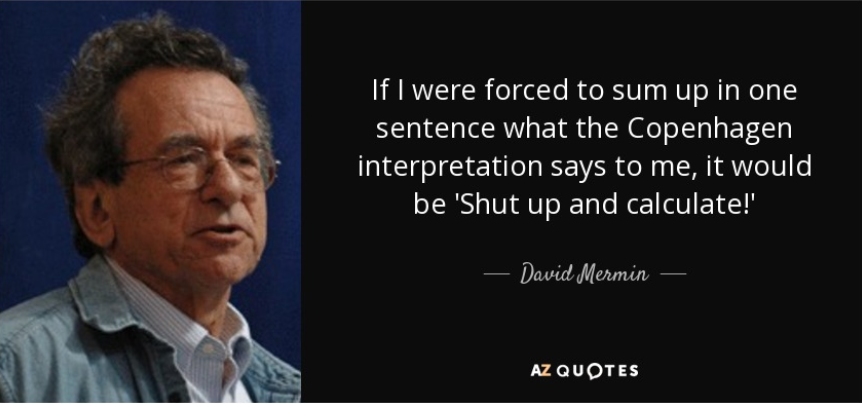
The passage from Pauli directly above can be interpreted as him shouting “shut up and calculate!” long before these well-known words were ever uttered (i.e., by N. David Mermin in 1989).

So now take Carl Jung’s idea (as expressed by Gerald R. Baron) that “the unconscious is in the realm of objective reality while the conscious [mind] is not — it is subjective”. (It’s worth noting here that Pauli offered criticisms of Jung’s work, particularly of the notion of synchronicity.)

In the light of Jung’s reference to “objective reality”, it can be said that Pauli rejected the opposition between objective reality itself (or “ultimate reality”), and what we can can know about reality (as did Niels Bohr). In other words, knowing “how Nature is” amounts to no more than a metaphysician’s dream. All we actually have is “what we can say about Nature”. And, at the quantum-mechanical level at least, what we can say is what we can say with the mathematics — in conjunction with experiments, tests, observations, etc. Consequently, just about everything else is interpretational, analogical and/or imagistic in nature. Indeed, the analogical, imagistic and interpretational stuff can — and often does — mislead us. It also causes endless insoluble controversies.

More relevantly, Jung’s theories and ideas seem to fall into all the (metaphysical) traps which Niels Bohr, Werner Heisenberg, and, indeed, Wolfgang Pauli warned others about.

In terms of Pauli himself.

Perhaps Pauli came to believe (i.e., roughly after 1932) that only physicists (as physicists) should shut up and calculate, or stop talking about objective reality. However, physicists in conjunction with, say, Carl Jung shouldn’t shut up. Alternatively, physics (qua physics) has nothing to say about objective reality. However, physicists working with mystics, psychanalysts, theologians, religious leaders, etc. may speak freely about objective reality.

All that said, defenders of Pauli may point out that his mysticism, the ideas of Jung, etc. don’t contradict (or clash with) Pauli’s prior physics — or, indeed, contradict (or clash with) any (established) physics of any kind.

In any case, there’s no doubt at all that Pauli himself did attempt to tie his physics to his mysticism.

So tying physics and mysticism together doesn’t make them the same thing. More importantly, it doesn’t mean that we have to accept all attempts at tying these two very different things together.

So it’s complicated.

In terms of examples. Biographers and commentators have argued that Pauli drew on nonlocality, complementarity, and the observer effect in order to (as it were) back up his mysticism.

More specifically, physicist Thomas Filk has argued that quantum entanglement (“a particular type of acausal quantum correlations”) was taken by Pauli to be “a model for the relationship between mind and matter in the framework [which] he proposed together with Jung”.

[As already stated, the technical details of Pauli’s scientific-mystical theories will be discussed in a future essay.]

More simply, quantum entanglement was deemed to be a physical phenomenon which “most closely represents the concept of synchronicity”

However, note the words “model” and “represents” in the quoted lines above.

As far as can be seen, all that we have here is (often vague) talk of resemblances, analogies, metaphors, (Gerald Baron’s) “strange similarities”, etc. And all that is stock in trade when it comes to writers of “woo” and “New Age science”. Of course, this isn’t (necessarily) to argue that Pauli’s mystical writings are at the same level as all this very amateur stuff. However, perhaps we still merely have resemblances, metaphors, analogies, strange similarities, etc. between the theories and details of physics, and all the popular (mystical) stuff which is firmly outside physics.


Notes:

(1) As with most of the other great scientists endlessly memed and mentioned (such as Einstein, Schrodinger, Planck, etc.) to back up mystical and religious views, Wolfgang Pauli didn’t actually write any academic papers on Carl Jung, mysticism, etc. In other words, for every quoted passage on Jung, etc., Pauli wrote entire papers on physics which never mention any of this mystical stuff.

This situation is summed up by John R. Gustafson in the following words:

“Because Pauli was in a difficult individuation process during his early years, his own writings on philosophy tend to be sparse and often contradictory.”

The science historian Karl von Meyenn also makes a strong distinction between Pauli’s papers on physics, and the rest of his writings.

For example, in the following passage (from a paper called ‘Wolfgang Pauli’s Philosophical Ideas Viewed from the Perspective of His Correspondence’), Meyenn writes:

“While his publications present the results of more or less longsome searches for insight, his methodical flow of work and the gradual emergence of understanding become visible only in his rich correspondence.”

Indeed, Gerald R. Baron (mentioned earlier) admits that he’s not relying on Pauli’s books and academic papers on Jung, synchronicities, etc. And that’s simply because he didn’t write any. Instead, Baron refers to “collaboration” between Pauli and Jung which included “many letters and conversations over the years”. What’s more, most of the other writers who emphasise Pauli’s mysticism and his belief in Jung’s ideas also stress his “correspondence”.

It’s also worth noting that the popular books Writings on Physics and Philosophy and Atom and Archetype weren’t actually written as books by Wolfgang Pauli. Instead, these books are collections of Pauli’s articles and letters, which were written over many years. (Writings on Physics and Philosophy was edited and put together by Charles P. Enz and Karl V. Meyenn, and published in 1994. Atom and Archetype was edited by C. A. Meier, and published in 2014.)

(2) For example, Pierre and Marie Curie, Peter Higgs, Paul Dirac, Richard Feynman, Enrico Fermi, Murray Gell-Mann, Gerard ‘t Hooft, Subrahmanyan Chandrasekhar, Louis de Broglie, John Bell, Steven Weinberg, etc. etc. etc. never had any time for any mystical and/or religious stuff. What’s more, they’ve all also been classed as “atheists” by their critics.

Saturday, 2 December 2023

Politico-Religious Anti-Materialism: Intelligent Design and Spiritual Idealism

There are many self-described “anti-materialists”, religious people and spiritual idealists who don’t just offer metaphysical arguments against what they call “materialism”: they also vocally express their hatred of it. And they hate it for primarily religious, moral and political reasons. Indeed, such people are often very open and honest about all this — as the passages quoted later will show. [See note 1.]

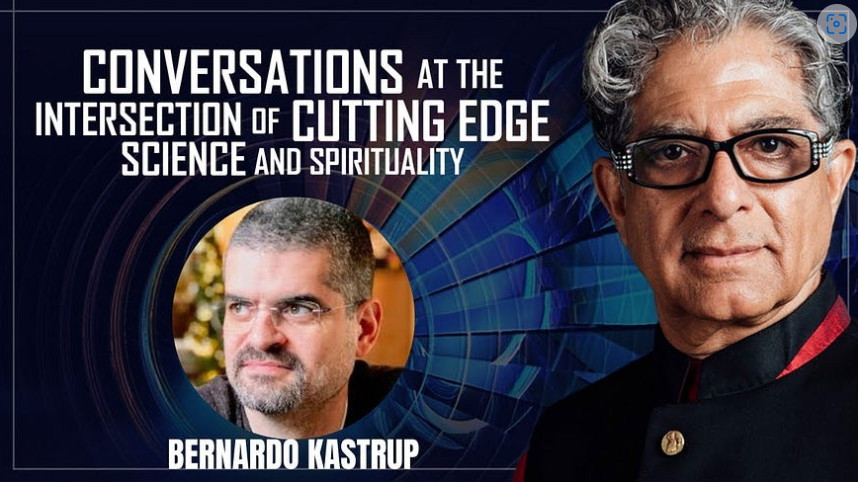
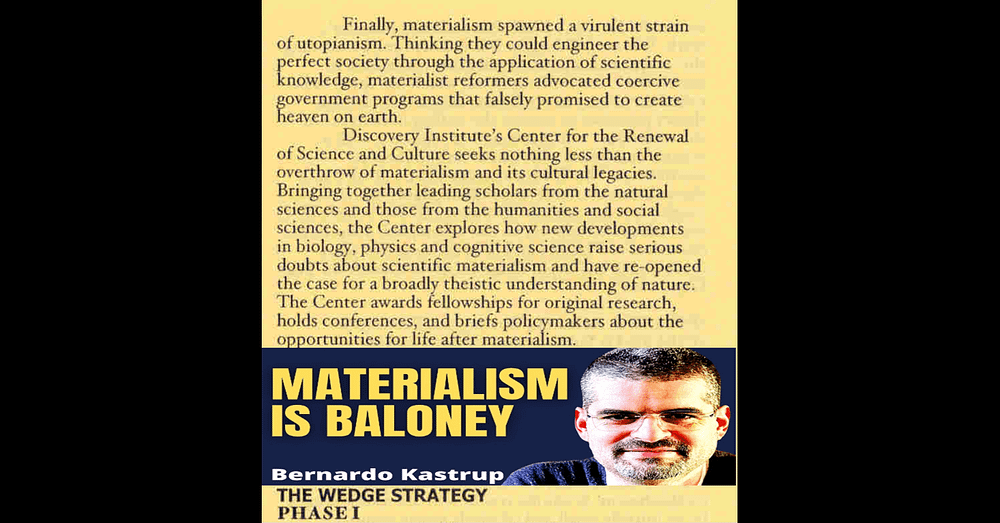
An extract from ‘The Wedge Document’, and Bernardo Kastrup inset. In the following essay, it’s not being argued — or even implied — that Kastrup believes in Intelligent Design. [See note 2.] Idealism is very different to the notion of Intelligent Design. However, the political, religious and moral problems which Kastrup has with materialism are often virtually identical to those which Intelligent Designers have also expressed. Indeed, both Kastrup and Intelligent Designers express their views on materialism and materialists in the same rhetorical, polemical and (in Kastrup’s case particularly) abusive ways.

Of course, anti-materialists, spiritual idealists and religious people can — or actually will — now say that “materialists” are just as vocal, forthright and rhetorical when it comes to their own criticisms of religion. And there is some truth to that… at least when it comes to religion. However, there is very little truth to it when it comes to the criticisms of the (strictly) metaphysical positions of anti-materialism and idealism. [See note 3.]

(i) Introduction
(ii) Intelligent Design and Materialism
(iii) Bernardo Kastrup on Materialism and Materialists
(iv) Philip Goff and John Eccles on Materialism

Part Two: Leftwing (i.e., Non-Religious) Politicised Science
(v) Leonard Susskind on Right-Wing Anti-Science
(vi) Stephen Jay Gould’s Radical Science
(vii) Elizabeth Anderson on Politically-Correct Science

Intelligent Design and Materialism

Now take the following passage from ‘The Wedge Document’, as published by the Discovery Institute in 1998:

“The social consequences of materialism have been devastating. As symptoms, those consequences are certainly worth treating. However, we are convinced that in order to defeat materialism, we must cut it off at its source. That source is scientific materialism. This is precisely our strategy. If we view the predominantly materialistic science as a giant tree, out strategy is intended to function as a ‘wedge’ that, while relatively small, can split the trunk when applied at its weaker points. [] Design theory promises to reverse the stifling dominance of the materialistic worldview, and to replace it with a science consonant with Christian and theistic convictions.”

That passage reads like the political manifesto of some kind of “radical” Far Left or Far Right political groupuscule. [See ‘Red Wedge’ as a comparison, note 4.] Yet some readers may think that using such quotations from Intelligent Designers is to pick out straw targets. This isn’t the case. That’s because the rhetoric and (well) honesty of IDers’ positions (such as the one above) can be found in the words of many other self-described (non-ID) “anti-materialists” too. (Bernardo Kastrup and Deepak Chopra are good examples of this — see later.)

Here’s another very similar example:

“Father’s [Reverend Moon’s] words, my studies, and my prayers convinced me that I should devote my life to destroying Darwinism, just as many of my fellow Unificationists had already devoted their lives to destroying Marxism. When Father chose me (along with about a dozen other seminary graduates) to enter a PhD program in 1978, I welcomed the opportunity to prepare myself for battle.”

[This is a good example of what may well be called the political strategy of entryism.]

Those are the words of the American theologian and advocate of Intelligent Design Jonathan Wells (from his ‘Darwinism: Why I Went for a Second PhD’).

In terms of relevant detail. Jonathan Wells joined Phillip E. Johnson (founder of Intelligent Design) at the Discovery Institute. Wells is now a fellow at the Discovery Institute’s Center for Science and Culture. [See Wells at the center here.]

Bernardo Kastrup on Materialism and Materialists

The two quoted passages above read like much of the stuff that the spiritual idealist Bernardo Kastrup has written. Indeed, all you’d really need to do is delete the words “Christian and theistic” from the first passage.

So compare the ID passages above with the following words:

“But science-as-you-know-it implicitly adopts the materialist ontology. Perhaps not all scientists do this; perhaps even only a minority does. But this minority is vocal and influential. They clearly control where the research funding goes, for projects that do not assume the materialist metaphysics collectively get much less funding than projects that do. [] Moreover, this vocal minority also controls how science-as-you-know-it is presented in the media, in school curricula, and to the culture at large. Just think of people like Lawrence Krauss, Richard Dawkins, Neil deGrasse Tyson, Stephen Hawking, and others such specialized prodigies of rhetoric and intellectual puzzles, who cavalierly ignore rigorous logic, epistemology, and ontology.”

All the words above are from the Dutch philosopher and idealist Bernardo Kastrup. [There are more passages from Kastrup to be found in note 5 at the end of this essay.]

In addition, in a commentary on Kastrup’s Why Materialism is Baloney, Deepak Chopra (the businessman and “alternative medicine advocate”) writes:

“Bernardo Kastrup’s book is another nail in the coffin of the superstition of materialism.”

As with IDers, Kastrup isn’t just concerned with getting the metaphysics of “reality” right. Kastrup is primarily concerned with what “our culture embrace[s]”, and the fact that, in his eyes at least, “our culture [has] embraced [] materialism”.

What did Kastrup mean by that?

Kastrup once wrote a piece called ‘Materialism as a political weapon’. One can suppose, then, that Kastrup believes that the politics of materialism must be battled against with the politics of his own spiritual idealism.

As it is, in terms of day to day politics, materialists hardly share any political or ideological views — well, no more than any other group. Some materialists are Marxists. Others are anti-Marxists. Some are liberals. Others are on the Right. Some are Republicans and Conservatives. Others are supporters of the Labour Party and socialists.

Kastrup and other idealists, on the other hand, do seem to share much outside the actual metaphysics of idealism, and not just a commitment to religion and spirituality.

However, to be fair to Kastrup, his piece ‘Materialism as a political weapon’ is what he takes to be a political history of materialism. (Kastrup wrote: “The historical, sociopolitical, and psychological convenience of the physicalist fiction is almost impossible to overestimate.”)

In any case, Kastrup doesn’t even attempt to hide his hatred of materialism. Indeed, he uses the words “materialism” and “materialist” in almost everything he writes and broadcasts.

Basically, Kastrup is waging his own personal Manichean war against the Evil that is materialism. And, needless to say, Kastrup believes that he represents the Good. [See Kastrup’s very many titles which include the word ‘materialism’ here.]

If we return to Intelligent Design.

Kastrup rarely mentions Christ, but he does mention Christianity.

So, firstly, take this passage from William A. Dembski (as found in his book Intelligent Design: The Bridge Between Science and Theology):

[A]ny view of the sciences that leaves Christ out of the picture must be seen as fundamentally deficient. [] [T]he conceptual soundness of a scientific theory cannot be maintained apart from Christ.”

As just stated, Kastrup isn’t a Christian. However, he most definitely is religious. Despite that claim, Kastrup did once write the following:

“Who am I to talk about religion? I am no theologian or religious scholar. Heck, I’m not even religious.”

This is an incredible statement when set within the context of both all the religious words Kastrup has uttered, and all the things he’s published on religion. However, Kastrup says different things to different audiences. In addition, it also largely depends on how Kastrup is using the word “religious” when he refers to himself.

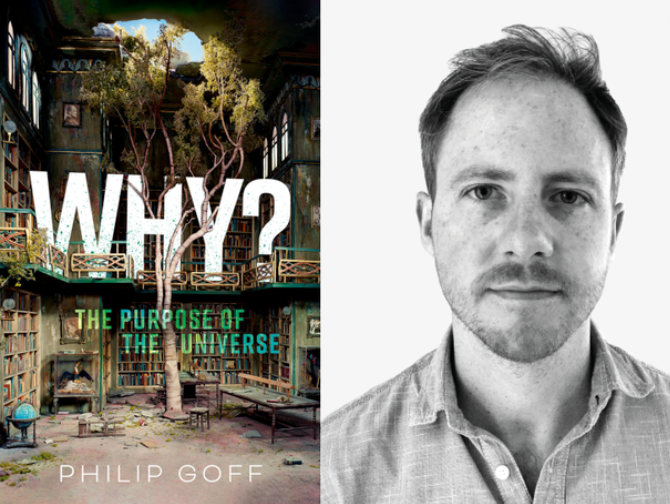
Like the panpsychist Philip Goff, Kastrup finds “traditional religion” and the “Omni-God” (or the “perfectly good, creator that Christians, Muslims and Jews believe in”) to be too politically and morally incorrect. In Kastrup’s own words:

“I could go on to explore the implications of everything I said above, and to relate it to the appalling state of religion in today’s society.”

So, in basic terms, Kastrup (like Goff) generally believes that such a “Abrahamic God” is not in tune with the moral and political (“progressive”) vibes of the 21st century.

Kastrup also defended what he called “natural theology” (see ‘Natural theology’) in an article on the American biologist Jerry A. Coyne. He wrote:

[T]here is a place for natural theology. [] [I]f one looks past the pedestrian literal appearances of different religions, one finds significant, quite fundamental, and even altogether amazing commonalities, as many theologians know.”

Kastrup says that he’s not religious in one context, and virtually admits that he is in others. Again, it also depends on how he uses the word “religious” in different contexts. More relevantly, many of his followers most certainly do believe that Kastrup is religious. Indeed, many of them even believe that Kastrup is a “spiritual leader”!

So take the following words from Prof. Jeffrey J. Kripal (as found in his essay ‘Reading Inside God’s Brain’):

[I]f Bernardo Kastrup and the idealist mystical literatures of the world are pointing us in the right direction — and I think they are — the materialist hypothesis is the exact opposite of the truth. It is fantastically wrong.”

As an idealist, Kastrup has much to say about consciousness. Thus, it’s no surprise that consciousness is very heavily tied to religion. So here’s Jeffrey J. Kripal again on Kastrup’s “philosophy of consciousness”:

[A]ny future, truly adequate philosophy of mind or science of consciousness will have to go through the study of religion, and in particular the comparative study of mystical literature.”

Let’s get back to Kastrup himself.

Few things are so closely connected to religion than a belief in the afterlife. And, guess what, Kastrup believes in the afterlife.

In a YouTube video called ‘When We Die and The Meaning of Life’, Kastrup offers his followers the following (as one of them puts it) “very reassuring” words:

“Under analytical idealism, your core subjectivity remains as you as you go through the process of death, and even after. Because your core subjectivity is the core subjectivity of nature. It’s what exists. Where is it going to go? Life and death happen to it — within it. Life and death are events in core subjectivity, not at the beginning and end of core subjectivity.”

An idealist like Kastrup may argue that a belief in the afterlife need not necessarily be tied to religion at all. In other words, a belief in the afterlife may simply be a result of Kastrup’s idealism and his views on consciousness. Yet, of course, in 99 cases out of a 100 (both today and historically), the afterlife has most certainly been tied to religion. Indeed, Kastrup himself ties the afterlife to religion. [See here.]

Now let’s move away from the spiritual idealist Bernardo Kastrup, and move on to the spiritual panpsychist Philip Goff.

Philip Goff and John Eccles on Materialism

The English philosopher Philip Goff once said that “materialism is a pretty dismal worldview”.

As an example of that (as it were) dismalness, Goff (in his book Galileo’s Error: Foundations for a New Science of Consciousness) wrote:

[] One can’t help wondering whether the Churchlands’ [Paul and Patricia] early courtship involved poetry expressing the strength of their neuronal activations for each other. []

That passage from Goff also echoes what the Australian neurophysiologist John Carew Eccles (in his book How the Self Controls Its Brain) said many years before. Eccles wrote:

“I maintain that the human mystery is incredibly demeaned by scientific reductionism.”

In his book Evolution of the Brain: Creation of the Self, John Eccles also wrote the following

“This belief must be classed as a superstition [] [W]e have to recognize that we are spiritual beings with souls existing in a spiritual world as well as material beings with bodies and brains existing in a material world.”

So some materialists — and many others — have classed views like Eccles’s own as being “superstitious”, and also driven by “prior religious beliefs”. That is, such beliefs are prior in the sense that many (even most) anti-materialists held them long before they indulged in any science or philosophy. This is certainly true of Eccles himself. Take this bit of biography:

“A ‘sudden overwhelming experience’ [] during [John Eccles’s] first year at medical school took the form of a mystical feeling of existential wonder that owed much to his devout Catholicism and inspired him to be a neuroscientist.”

Elsewhere, we also have the following:

“Eccles was, for much of his life, a practicing Roman Catholic []. [H]e retained a deep sense of the reality of mystery, and of a spiritual realm, that for him left scope for theology in addition to science. Unlike many scientists, he did not think that science alone could fully understand the universe, or the mystery of life.”

Now guess what. Many anti-materialists return the favour by saying that the belief in materialism is itself (or is also) a “superstition”. (Readers may remember Deepak Chopra using the word “superstition” about materialism earlier.) Eccles elaborated here:

“Promissory materialism is simply a superstition held by dogmatic materialists. It has all the features of a Messianic prophecy, with the promise of a future freed of all problems — a kind of Nirvana for our unfortunate successors.”

How should we take Eccles’s words “the materialist superstition”, “dogmatic materialists”, “Messianic prophecy”, “a kind of Nirvana”, etc?

Eccles was using a tried-and-tested technique which many self-conscious anti-materialists — along with those who reject Darwinian evolution — employ whenever they can.

This is the trick.

If a materialist, “evolutionist” or atheist accuses a anti-materialist, spiritual idealist or religious person of x, then the latter three will accuse the former of being x too. Thus, there’ve been lots of anti-materialists, spiritual idealists and religious people who’ve accused materialists, evolutionists and/or atheists of having “faith” in materialism, evolution and atheism. Indeed, they’ve also stated that “materialism [or atheism or evolution] is a religion”.

This kind of thing happens at a lot at infant and junior schools. That is, when a little kid accuses another little kid of being x, then that other little kid then accuses the accuser of being x too.

Yet it can be argued that very few anti-materialists, spiritual idealists and religious people genuinely do believe that materialism, atheism and evolution are religions, or that people believe in materialism, atheism and evolution purely on faith. Thus, the comparisons between religion and materialism, atheism and evolution are often so vague, tangential and rhetorical that, in most cases, I doubt that these claims are even believed by most of the people who actually state them.

All that said, to claim that materialists, evolutionists and atheists have faith in what they believe is extremely useful, and it scores many strategic and rhetorical points.

Part Two

Leftwing (i.e., Non-Religious) Politicised Science

Since its new editor, Laura Helmuth, took over in 2020, Scientific American has seen at least part of its role as advancing various leftwing and/or progressive (some say “woke”) causes and goals. Sometimes explicitly so. (A couple of years back, an entire edition was devoted to political issues.)

Many leftwing scientists and academics have had much to say about Intelligent Design being almost entirely motivated by Christian and rightwing political concerns. They are exactly right. However, the problem here is that these very same scientists and academics rarely (if ever) mention that there’s a similar much-more-widespread problem on the Left, as displayed in academic work and in various sciences.

[I’ll ignore Nazi racial science, Soviet Lysenkoism, etc. here. Save to say that there certainly isn’t only a problem from Christians or religious people on the Right when it comes to the abuses and political manipulations of science.]

To put things simply.

Whereas IDers want science to serve Christianity and right-wing politics, many other scientists and academics want science to serve leftwing and/or “progressive” politics. (More specifically, to serve leftwing political causes and goals.) Indeed, many leftwing scientists and academics have been explicit about their view that much (even all) science should serve “radical” or “progressive” politics.

So this problem doesn’t just come from one direction.

Thus, it’s odd (or even perverse) that some of the most vocal scientific and academic critics of Intelligent Design also believe that science should serve politics. In addition, surely to say that this kind of thing only occurs on the Right and with “right-wing evangelicals” (or with IDers) is simply to display a politically-tribal position of the most obvious kind.

Take the words of the American theoretical physicist Leonard Susskind.

Leonard Susskind on Right-Wing Anti-Science

In an article on Intelligent Design called ‘The Good Fight’, Leonard Susskind is at pains to single out only rightwing abuses and manipulations of science. Oddly, this occurs straight after Susskind warns his readers about tribalism and “the ability to divide the world into ‘Us’ and ‘Them’ and then dehumanize”.

For example, Susskind tells us that a

“well-respected scientific community can be a major inconvenience if one is trying to ignore global warming, or build unworkable missile-defense systems”.

Elsewhere, Susskind adds:

“Even more disasters will result from ignoring the warnings of climatologists about global warming, or the advice of numerous scientists about how best to stem nuclear proliferation.”

Susskind then singles out yet more exclusively right-wing suspects:

[T]he attacks of Senator Joseph McCarthy resulted in a deep suspicion of the motives of those scientists who lobbied for nuclear sanity. [] Today we have the ridiculous comedy of a Yale- and Harvard-educated U.S., president [George Bush] who plays to his audience by (deliberately?) mispronouncing the word ‘nuclear’.”

All this is precisely what you’d expect to read from a New York “liberal” - if one who also happens to be a well-known theoretical physicist.

However, a far more blatant case is that of Stephen Jay Gould.

Stephen Jay Gould’s Radical Science

The American palaeontologist and evolutionary biologist Stephen J. Gould was keen to point out that various scientists had advanced “right-wing”, “racist”, “capitalist”, and even “fascist” interpretations of various evolutionary and biological theories and data.

So what did S.J. Gould do in response?

He often put a leftwing (or even Marxist) interpretation of the very same evolutionary and biological theories and data.

More specifically, take Gould’s case against evolutionary “progress”.

Gould’s stance on evolutionary progress is deeply infused with his leftwing politics. Take this highly political and rhetorical passage from Gould:

[E]volution has been saddled with a suite of concepts and meanings that represent long-standing Western social prejudices and psychological hopes, rather than any account of nature’s factuality.”

More relevantly, Gould concluded:

“Most pernicious and constraining among these prejudices is the concept of progress [].”

All that shouldn’t be a surprise because Gould was a self-described “Marxist” (see here) who was part of the Radical Science Movement. (Many other commentators — both positive and negative — have connected Gould’s views on punctuated equilibrium to his Marxism too — see here.)

Ironically and despite the many denials, many of those who’re sympathetic to Gould have also freely admitted that his politics influenced his science. However, they believed that his politics influenced his science in only entirely positive ways. [See here from www.marxists.org.]

So there seems to be a contradiction here.

What I mean by contradiction is that it’s often the case that some of those who speak out against the political nature of science don’t do so because they believe that science should be apolitical: they do so because they believe that science should be political in correct ways. (See Elizabeth Anderson later.)

Take Science for the People and the Sociobiology Study Group in the 1970s and 1980s.

Stephen Jay Gould — again — was a member of these two groups. So too was Steven Rose (an important member of the Socialist Workers Party — see here) and Richard Lewontin (“the Marxist geneticist”).

The members of these two groups didn’t want to make sure that scientific theories were apolitical or that scientists kept out of politics. They wanted to make sure that scientific theories and scientists themselves were political in the correct (i.e., Marxist) ways.

[See ‘Radical Science and its Enemies’, by the Marxists Steven Rose and Hilary Rose.]

Thus, it was no surprise that the International Committee Against Racism (INCAR) grew out of this Far Left atmosphere of scientific intolerance. Specifically, INCAR attacked yet another scientist Gould had serious problems with — E.O. Wilson. [See here.]

In detail, just before Wilson gave a talk, the microphone was taken over by members of INCAR. They chanted:

“Racist Wilson you can’t hide, we charge you with genocide.”

Then these same activists rushed Wilson and poured a pitcher of ice water over his head.

Now let’s move away from scientists (palaeontologists, biologists, geneticists, etc.) to a philosopher of science.

Take the case of Elizabeth Anderson, who is a Professor of Philosophy and Women’s and Gender Studies at the University of Michigan.

Elizabeth Anderson on Politically-Correct Science

In a paper called ‘Feminist Epistemology: An Interpretation and a defence’, Elizabeth Anderson argues that feminist naturalised epistemology

“rejects the positivist view that the epistemic merits of theories can be assessed independently of their ideological applications”.

Here again (as with S.J. Gould and his Marxist friends) it’s not the case of Anderson discovering the political and ideological positions of scientists (i.e., those which impinge on their accounts of the “the epistemic merits” of their scientific theories). It’s more a case of Anderson arguing that ideological and political considerations should impinge on the accounts of the epistemic merits of scientific theories…

But not so quick.

It should only be ideologically and politically correct considerations which do so.

So this particular expression of feminist philosophy of science isn’t about discovering — or simply acknowledging — the role and importance of ideology and politics in science. It’s an expression of the normative and political view that scientists should be fully ideologically and politically aware — all the way through their scientific work.

To be more specific.

Anderson believes that all scientists should always keep their eyes firmly fixed on all possible future (Anderson’s words) “political applications” of their scientific theories. (This ties in why what Leonard Susskind said earlier about “nuclear proliferation”, “missile-defense systems” and “global warming”.)

If Anderson is correct to argue that ideology and politics pervade all science, and that such politics and ideology should be politically acceptable (to whom?), then science (as well as the philosophy of science) effectively becomes a political battleground. More technically, science becomes a battleground in which, according to Antonio Gramsci (writing in the 1930s), scientists and academics (like Anderson herself) take part in a “war of position” to establish their own scientific and political “hegemony”.

So Anderson advances the position that all science is inherently political. (Historically, this was also the position of both the Nazi and Soviet states. See ‘Ideologically Correct Science’.) Thus, it follows (at least to her) that scientists and philosophers of science (or at least those who share her own politics) must make sure that all science is both ideologically acceptable and politically correct.


Notes:

(1) Some of these self-described “anti-materialists” — Bernardo Kastrup is a very good example — class all sorts of different positions as “materialist”, and very many different people as “materialists”. [See here.]

(2) Here is Bernardo Kastrup on Intelligent Design:

[] I equated intelligent design with the notion of a supernatural being standing outside of nature and designing it like an architect designs a building. [] I have always had, and still have, a strong tendency to reject this story as simplistic, logically inconsistent, and somewhat arbitrary.”

Oddly enough (or perhaps not), I could only find one blog post (the one just quoted) in Kastrup’s entire blog which discusses Intelligent Design.

(3) It can also be said that an idealist like Donald Hoffman is rarely (if ever) rhetorical about the matter of materialism. Yet most anti-materialists most certainly are. (Although Donald Hoffman is a strong critic of materialism, he often uses the term physicalism instead. See Hoffman’s uses of the term “physicalism” here.)

(4) On Red Wedge:

“Red Wedge was a collective of musicians formed in the UK in 1985 who attempted to inculcate youth with the policies of the Labour Party leading up to the 1987 general election in the hope of ousting the Conservative government of Margaret Thatcher.”

(5) More quotes from Bernardo Kastrup on materialism:

Take these words:

[] Materialism is so blatantly absurd that most materialists — I strongly suspect — replace it with one or another private, implicit misapprehension of it in their own minds, which circumvents some of the absurdities at the price of internal contradictions conveniently overlooked. In other words, it is the naked implausibility of materialism that — ironically — makes it seem credible [].”

And these:

“All in all, it is useful to engage militant materialists from time to time. It gives striking insight into how a worldview that is so wrong manages to keep such a hold on the intellects of so many: it blinds you, immerses you in an unfathomable but insidious network of abstractions, hidden assumptions, and prejudices that infects every aspect of your thinking and judgement. It literally makes you unable to see simple and self-evident things right under your nose. It makes you project your own preconceptions, expectations, and misunderstandings onto everything others are saying, so you also become unable to listen. Deaf and blind, one can’t escape the cage. It’s surreal.”

This:

“Throughout the two or three centuries of materialist hegemony in academia, religious and spiritual movements have competed for the hearts and minds of ordinary people. New Age, non-dualism, Buddhism, and a host of other related worldviews have certainly achieved a degree of influence in our culture. [] The metaphysics underlying these spiritual traditions, however, has achieved no recognition in academia [].”

In a piece called ‘Dim-witted biologist: consciousness is accidental’, Kastrup writes:

“Jerry Coyne just isn’t a serious participant in any discussion regarding the nature of mind and reality. [] It doesn’t take Coyne long to run the entire gamut of faulty logic; it’s quite remarkable. I suspect he is just too dim-witted in regard to philosophy to realize how dim-witted he is in regard to philosophy (the Dunning–Kruger effect).”

Kastrup excused the abuse and rhetoric in this post by writing the following words:

“(Important observation: the demeaning tone of this post, including the mildly disparaging use of a nickname [Jerry Berry], has been carefully studied — sometimes down to specific sentence structures — to exactly match the tone with which Jerry Coyne writes about other people and their respective ideas, including myself. [] If you think my tone goes too far, then please remember that this is precisely my point.”

Yet Kastrup doesn’t also inform his readers that he uses exactly the same kind of rhetorical and abusive language about virtually all his critics, as well as those people who have views he doesn’t like. That long list includes the following names and positions: Philip Goff, Sam Harris, Tim Maudlin, Daniel Dennett, Sabine Hossenfelder, Michael Graziano, Keith Frankish, Massimo Pigluicci, academic philosophers generally, literally all materialists, “our materialist culture”, etc.