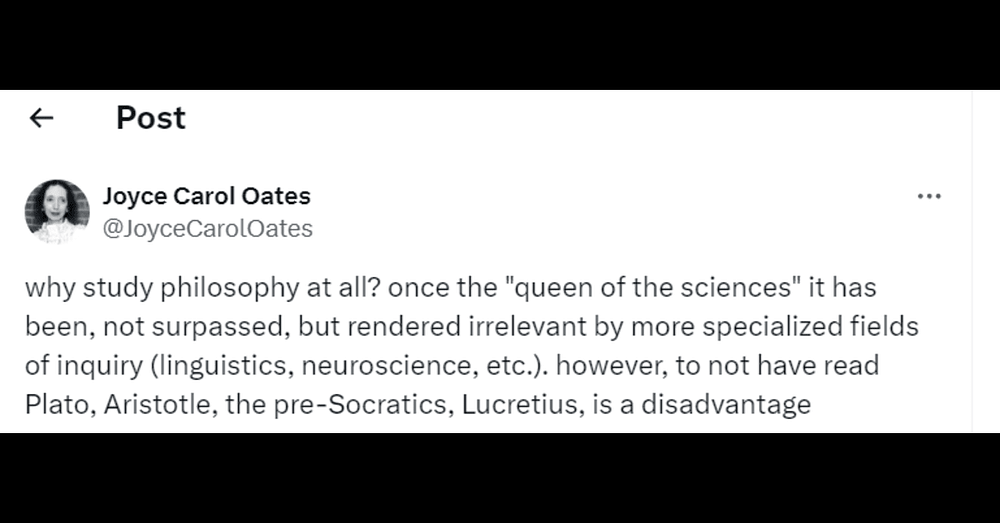
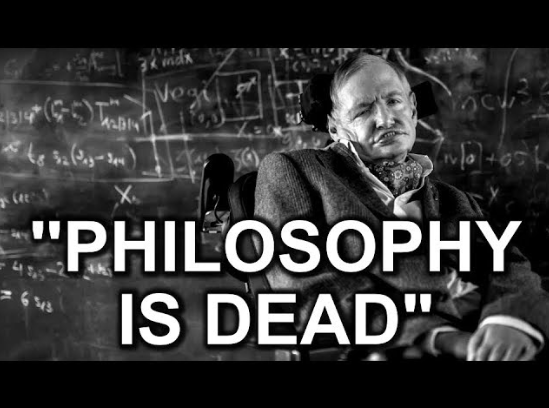
The American writer Joyce Carol Oates offers her ‘Followers’ (on X) the words in the screenshot below. They seem to be a variation on Stephen Hawking’s often-quoted “philosophy is dead” mantra.
Why did Stephen Hawking believe that philosophy is dead?
He did so mainly because he believed that “philosophers haven’t kept up with physics”. The following is the passage in full:
“Traditionally these are questions for philosophy, but philosophy is dead. Philosophy has not kept up with modern developments in science, particularly physics. Scientists have become the bearers of the torch of discovery in our quest for knowledge.”
For a start. Philosophy isn’t just about “our quest for knowledge”. (If by “knowledge” Hawking meant data, facts, evidence, tests, experiments, “empirical theories”, etc.) Philosophers are just as likely to ask the following question: “What is knowledge?” In other words, philosophers are just as likely to ask questions about knowledge than offer an endless array of (as it were) scraps of knowledge.
Oddly enough, the above also means that in order for physicists — as well as scientists generally — to justifiably claim that “philosophy doesn’t add any knowledge to the world”, then they must do some philosophising themselves:
i) Such scientists need to explain what they mean by “knowledge”. ii) Such scientists need to tell us why philosophical claims aren’t examples of knowledge. iii) Such scientists need to tell us why scientific knowledge is the only kind of knowledge. iv) And such scientists need to tell us why they give scientific knowledge (or science itself) such a preeminent status.
None of the positiveor negative responses to those statements will be scientific in nature.
One would hope, then, that scientists will never argue that such questions shouldn’t even be asked. However, if any scientists did argue (or simply believe) that such questions shouldn’t be so much as asked, then that extreme position itself would need to be philosophically defended. And if such scientists didn’t defend it (or if they believe that they aren’t required to defend it), then that somewhat elitist and arrogant stance will itself — again — need a philosophical defence.
It’s also worth noting here that it’s often been said that “philosophers don’t add any knowledge to the world”.
In any case, Stephen Hawking is actually a bad example of an anti-philosopher. That’s primarily because Hawking himself offered the world his very own philosophical position on physics, which he called model-dependent realism…
“There is no picture- or theory-independent concept of reality. Instead we will adopt a view that we will call model-dependent realism: the idea that a physical theory or world picture is a model (generally of a mathematical nature) and a set of rules that connect the elements of the model to observations. This provides a framework with which to interpret modern science.”
Sure, it might have been the case that Hawking didn’t see his model-dependent realism as being a philosophical position. He might have seen it as a simple description of the (as it were) facts and methodologies of physics.
However, that too would have been monumentally naïve.
In addition, since Hawking classed himself as “a positivist”, then his rejection of philosophy is even more ridiculous and/or naïve than it may at first seem.
But it wasn’t just Hawking who took a naive and critical philosophical view of philosophy, so too did the well-known biologist and naturalist Edward O. Wilson.
Wilson once stated almost exactly the same things as Hawking in the following passage:
“It appears to me that professional philosophers have not kept up with the foundational disciplines of neuroscience, behavioural genetics, and evolutionary biology, and as a result they have surrendered their franchise to the scientists. The scientists, not the philosophers, now address most effectively the great questions of existence, the mind, and the meaning of the human condition. This surrender seems to be permanent, and professional philosophers have begun a diaspora into other vital and challenging disciplines that include theoretical neuroscience, evolutionary theory, intellectual history and bioethics.”
Of course, I could be biased in that I read philosophy, and write on philosophy. Then again, I read a lot of scientific stuff too.
Did Hawking and Wilson read a lot of contemporary philosophical stuff?…
Oh!
Why should they have even bothered?
After all, “philosophy is dead”… remember?
In terms of detail. There’s evidence that Hawking never really got passed Karl Popper when it came to 20th century philosophy. He certainly never quoted (or even paraphrased) any contemporary philosophers — at least as far as I’m aware. Indeed, if Hawking had read contemporary philosophers, then he’d have quickly realised that many of them have (to quote his own words) “kept up with modern developments in science, particularly physics”.
Joyce Carol Oates
Joyce Carol OatesThere’s no shortage of prophetic and sexy statements like this.
The American writer Joyce Carol Oates too could do with studying more contemporary philosophy.
For a start. She doesn’t even bother telling her followers why philosophy has been “rendered irrelevant by more specialized fields of inquiry”. In fact, at face value at least, it’s hard to know what that even means. It’s almost like saying that tennis has been rendered irrelevant by rugby.
Joyce Oates actually seems to be criticising philosophy for not being science. Or, to cite her own examples, she seems to be criticising philosophy for not being “linguistics, neuroscience, etc.”.
What’s more, most philosophers themselves haven’t read Lucretius — at least not in any detail. So that Roman philosopher is an oddly personal choice on Oates’s part…
As for the “pre-Socratics”…
So is Joyce Carol Oates simply attempting to show her followers how widely read she is in philosophy — i.e., in order to lend credenceto her categorical and vague pronouncements about philosophy (as it is today?!) being “surpassed”?…
Sure, in Oates’s own favour, it’s only a tweet, not a paper or article.
The thing is, many other tweeters don’t go much further than such slogan-filled posts either.
(ii) A Christian Apologist on Methodological Naturalism
(iii) A Christian Apologist on Materialism and Reductionism
(iv) A Christian Apologist’s False Claims
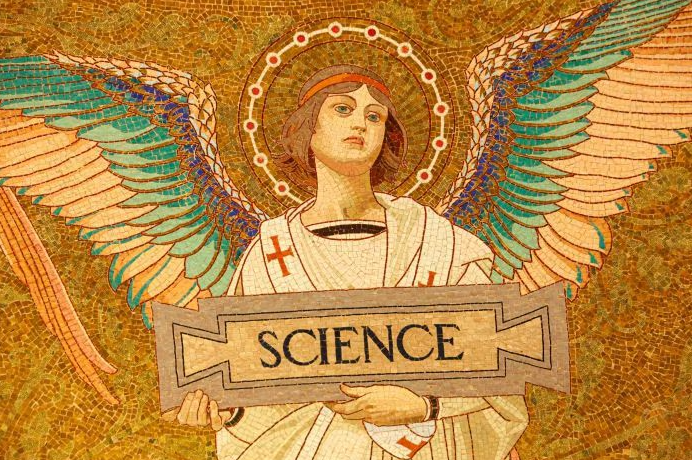
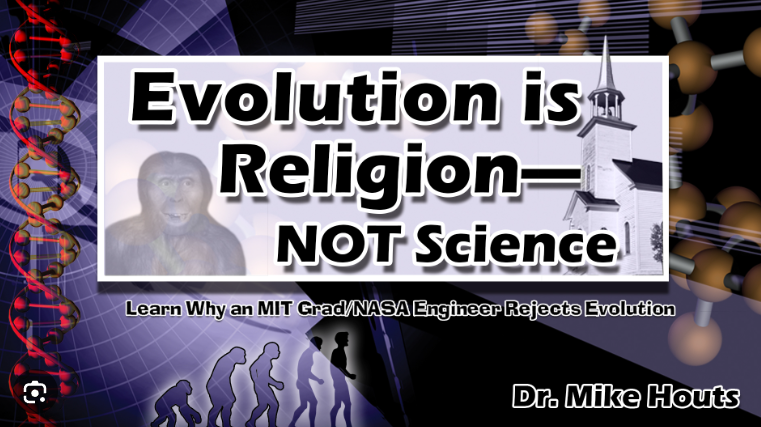
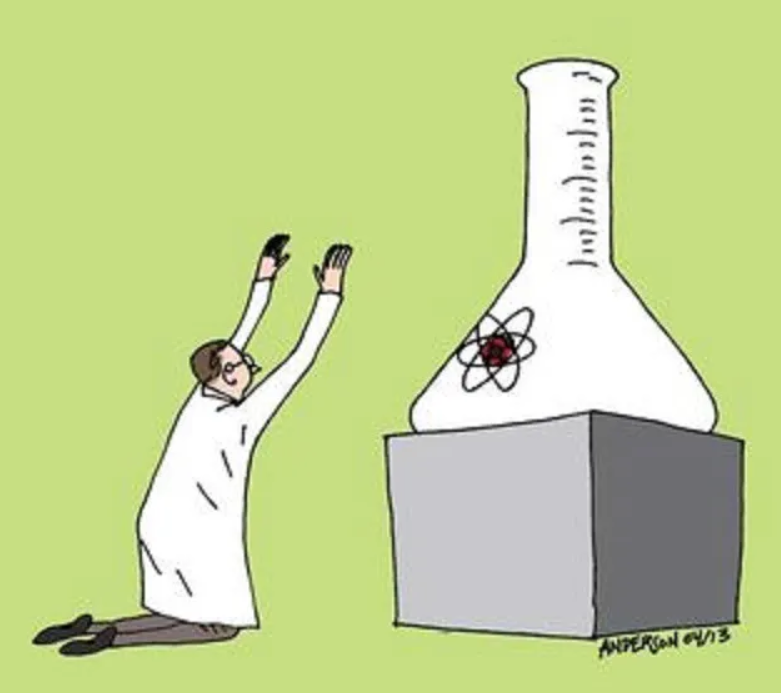
Science as a Religion?
This Christian apologist offers his readers a warning against what he deems to be another — rival — religion, which goes as follows:
“Endeavoring to use science to explain and describe our world is a noble undertaking. But when scientists go so far as to deny a basic sense of self or even a sense of pain, it’s an indication their desire for pure science has developed into a religion.”
It’s worth noting here how quickly and smoothly (i.e., without any changes of arguments or terms) this Christian apologist switched from criticising naturalists to criticising scientists themselves.
So perhaps classing science (as is also the case with naturalism, materialism, Darwinism and atheism) as a religion is just a cheap, easy and childish gimmick.
In any case, surely naturalism “develop[ing] into a religion” should be a good thing to a religious person.
Put another way.
If science (as well naturalism, materialism, Darwinism, and atheism) can really become genuinely religious in nature, then shouldn’t that be a good thing to this particular Christian apologist?
Yes and no.
Sure, religion is a good thing. But the True Religion — in this case Christianity — is a far, far better thing.
Incidentally, whereas here it’s said that science can “develop[] into a religion”, the usual religious argument is that science, naturalism, evolution, materialism and atheism are religions from the very beginning.
So it can be supposed that when religious people say that science, naturalism, atheism, evolutionary theory, materialism and physicalism are religions, they also mean that the believers in these isms aren’t being honest with themselves. That is, these various ists are criticising religion at the very same time as upholding their own religion…
Except that these accusations are, as already stated, very cheap, easy and childish. In other words, it’s something readers will have come across in school playgrounds.
Let me explain that.
If a scientist, naturalist, materialist, “evolutionist” or atheist accuses a religious person of x, then the latter will accuse the former of being x too. Thus, we have lots of religious people who’ve accused scientists, naturalists, materialists, evolutionists and/or atheists of having “faith” in science/naturalism/materialism/evolution/atheism. Indeed, they’ve also stated that science/evolution/naturalism/atheism/materialism “is a religion”.
This happens at a lot atinfant and junior schools. That is, when a little kid accuses another little kid of being x, then that other little kid accuses the accuser of being x too.
The apologists’ bottom line is this.
You accuse us of being x, yet you don’t even realise that you’re x too.
It can be easily argued that very few religious persons genuinely do believe that science, naturalism, materialism, atheism or evolution is a religion, or that people believe in science, naturalism, material, atheism, evolution purely on faith.
Of course, it must be admitted that there will be exceptions to this in that a very small number of people may well use science, naturalism, materialism, atheism and evolutionary theory as a literal substitute for a religion.
That conceded, the comparisons between religion and people’s commitment to science, naturalism, materialism, atheism and/or evolution are often so vague, tangential and rhetorical that, in most cases, I doubt that these claims are even believed by most of the religious people who actually state them.
Still, to claim that scientists, naturalists, materialists, atheists and/or evolutionists have faith in what they believe is extremely useful, and it scores many points.
In any case, manyother people have gone into great detail as to why science, naturalism, evolution, materialism and atheism aren’t religions. [See here,here,here, and here.]
A Christian Apologist on Methodological Naturalism
As with other parts of this Christian apologist’s account of naturalism, there are indeed passages from it which I have no problems with.
“Methodological naturalism is a system of scientific study wherein nature is assumed to have a natural basis. Divine intervention (miracles) is not taken into account in the investigation of natural phenomenon.”
Finally, I have no deep problem (apart from wording — see note 1) with this:
“[N]aturalists also believe that everything we think we feel has a corresponding neurological basis that will one day be interpreted — mapped out on an MRI. The phenomenon we call consciousness is merely the complexity of our physical matter.”
However, the concluding passage is a somewhat more controversial account of what scientists believe. It goes as follows:
“As the supernatural is beyond our abilities of description, explanation, and prediction, scientists believe the possibility of the supernatural should not influence the scientific work of description, explanation, and prediction.”
Personally, I would never say that
“the supernatural is beyond our abilities of description, explanation, and prediction”.
That (well) acknowledgment hints at the fact that there are indeed supernatural things: it’s just that they transcend “description, explanation, and prediction”. In other words, the supernatural domain does actually exist (or is real), but it simply isn’t within the remit of science. Instead, it’s in the remit of religion. (This is a hint at the two “non-overlappingmagisteria”of Stephen Jay Gould?)
So God, gods, ley lines, pink pixies, holy cows, virgin births, morphic resonance,clairvoyance, precognition, telekinesis, levitation, extrasensory perception, poltergeists, ectoplasm, invisible men, etc. all exist (or are real), it’s just that they’re all beyond our scientific “abilities of description, explanation, and prediction”.
Thus, if you simply state that “x is supernatural”, then, by faith and definition, you automatically place x beyond science.
Yet almost anything can be the value of the variable x!
And that literally includes almost anything — e.g., ley lines, pink fairies, astral travelling, holy cows, virgin births, clairvoyance, precognition, telekinesis, levitation, extrasensory perception, poltergeists, ectoplasm, invisible men, etc.
Thus, the only way to exclude any given x from the domain of the supernatural is to adopt a particular religion which doesn’t include or even allow such a given x within its supernatural domain.
A Christian Apologist on Materialism and Reductionism
“There is no such thing as the supernatural, including souls, spirits, and God.”
Much is made of made of what “materialists” (if not always naturalists) take “physical stuff” to be by religious people. They believe they’ve scored some kind of scientific or philosophical (i.e., not religious) point when they tell us that physicists have gone beyond, say, a fixation on “hard particles” and“tangible stuff”, whereas materialists haven’t. Thus, they conclude, materialism should now be a dead-and-buried philosophy.
Of course, this is a caricature of materialism.
It’s certainly a caricature of physicalism. (That’s if we don’t see the words ‘materialism’ and ‘physicalism’ as synonyms.) That’s because this is actually the position of 19th century materialism. Thus, it’s a clear and obvious straw target.
Literally all the naturalists (if not all the materialists) I’ve read accept the existence of forces, fields, spacetime, dark matter, dark energy, etc. and whatever else is in the general consensus in contemporary physics.
That is what makes them naturalists.
To go into more detail.
Some religious people seem to conflate naturalism and materialism with what many naturalists and materialists believed in the 19th century and before — or at least up until (roughly) the 1920s. In other words, they have a view of naturalism and materialism that might have been correct in the early 20th century. Yet even by the 1920s — if not before — this stereotype of naturalism and materialism was no longer the case when it came to naturalists and most materialists.
All this largely boils down to religious apologists claiming that naturalists and materialists believe that all matter — and indeed everything else — is what they call “tangible stuff”. Indeed, the frequent claim used to be — and sometimes still is — that materialists (if not naturalists) believe that everything is made up of “hard particles”.
Yet all that began to change with field physics in the 19th century — which all naturalists almost immediately took on board.
Why was that?
It was largely because such naturalists weren’t mindlessly committed to tangible stuff or to anything else like that — they were committed to the findings of physics and the other sciences. And physicists discovered fields (other than gravity) in the 19th century. [See here.]
In addition, when Einstein showed that matter and energy are interchangeable, naturalists immediately took that on board too. Thus, as an obvious consequence of that, naturalists also came to believe that energy — not matter — is (as it were) prima materia. Or at least they came to believe that matter is a form of energy.
Again, naturalists (almost by definition) took quantum field theory on board. That is (as with Einstein’s equation of matter and energy), naturalists came to see that fields — not energy — are prima materia; and therefore that energy is a property of such fields.
Again, the important point here is (even if the technical details of physics are wrong or misinterpreted) that although there were (radical) shifts in parts of physics, most naturalists still took on board these new findings, commitments and theories.
(‘What is Naturalism?’ specifically mentions dark matterand dark energy.)
Reductionism?
It was stated in the first essay that I had no deep problem with some of the accounts of naturalism. However, in the following section, things go askew. Heregoes:
“Everything can (eventually) be explained using the hard sciences — biology, chemistry, and especially physics. Softer ‘sciences,’ such as psychology, sociology, and anthropology, can be reduced to the harder sciences.”
The first problematic word above is “everything”.
Does everything include… literally everything?
What about sets, numbers, thepast, music, etc.?
Can they be explained by “biology, chemistry, and especially physics”?
No, naturalists don’t believe that everything can be “explained” by “the harder sciences”.
There’s also an assumption here that all naturalists are reductionists.
It certainly isn’t the case that all naturalists believe that the
“softer ‘sciences,’ such as psychology, sociology, and anthropology, can be reduced to the harder sciences”.
This is actually an account of fictitious reductionism, not of naturalism. Indeed, it’s even a caricature of reductionism itself.
Among naturalists and physicalists, for example, there’s been much debate about the precise relation between what many of them call the “special sciences” and physics. Again, it certainly isn’t the case that all naturalists — or even most naturalists — believe that such reductions could be successfully carried out. [See my‘ Murray Gell-Mann on Scientific Reductionism’.]
So it would have helped if this Christian apologist had actually read some works by contemporary naturalists and physicalists. Perhaps he never quotes — or even paraphrases! — such works because it would complicate matters too much for him.
A Christian Apologist’s False Claims
I’ve said that some of the basic accounts of naturalism in the Christian apologist article ‘What is Naturalism’ are perfectly okay… at least as they stand. However, there are some passage that state things that are just plain false. Yet this isn’t a case of having a rival view on naturalism or on something else (such as emotion, the self, “the meaning of life”, etc.). This is a case of this Christian apologist clearly getting things wrong. And he gets things wrong because he clearly hasn’t read any works by contemporary naturalists or physicalists.
So here are just a couple of false claims to end with.
Dennett actually accepts that “we have an independent, subjective, first-person view of ourselves and our experiences”. He even believes these views should be studied.
Dennett believes that the “verbal reports” we give about our subjective, first-person views of ourselves and our experiences should be studied…
However!
Not everything we say about such things should be taken as gospel.
Another way of putting that is to say that subjective or first-person experiences aren’t studied: the verbal reports on (or claims about) such things are studied.
So Dennett believes that there is the first-person view of ourselves and our experiences. He just has problems with how these experiences are philosophically interpreted, and he also analyses what we say about them.
There are more claims in ‘What is Naturalism?’ which are blatantly false. I will tackle just one more here.
This Christian apologist states that naturalists believe that “life has no meaning”.
This is a contextless and categorical claim on this apologist’s part.
Naturalists will simply claim that individuals or groups create the meaningS of life. In other words, life’s meanings don’t pre-exist. Therefore, they aren’t (as it were) found in the aether (or in religious texts).
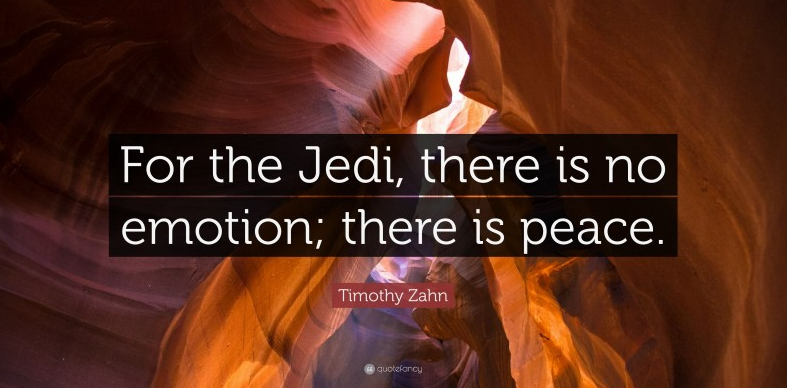
So as with the earlier discussion about this Christian apologist’s claim that naturalists believe that “there is no emotion”, all this amounts to is that naturalists have different (i.e., non-religious) accounts of life’s meaning and emotion, not that they deny such things.
Thus, this Christian apologist is implicitly arguing that if you don’t adhere to his own Christian account of life’s meaning and emotion (to take only two examples), then you simply must believe that these things don’t exist (or aren’t real).
Now is this sheer arrogance, or simple philosophicalcrudity?
Note
(1) I used the words “apart form wording” in parenthesis. So take the phrase “consciousness is merely the complexity of our physical matter”. Why merely? Complexity isn’t a mere thing. Sure, it isn’t a supernatural thing either. But there is no (well) mereness about it.
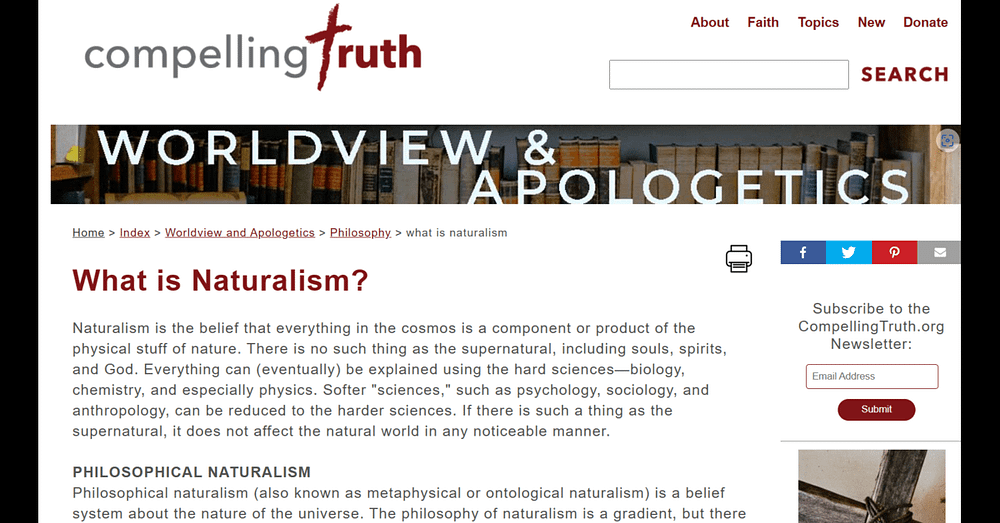
The words “Christian Apologist” are used in the title above because the passages quoted within the following essay come from the website ‘Compelling Truth: Worldview and Apologetics’. So the article I’ll be discussing (‘What is Naturalism?’) is an example of “apologetics” written by someone who states that he’s “presenting the truth of the Christian faith”.
[Part Two will follow shortly. This will be on this Christian apologist’s account of materialism and reductionism, as also seen within the context of naturalism.]
(i) Introduction: What Is Naturalism?
(ii) Do Naturalists Believe That There Is No Emotion?
(iii) The Natural and the Supernatural
(iv) Science + Religion (the Natural + the Supernatural)
“The purpose statement of CompellingTruth.org is: ‘Presenting the truth of the Christian faith in a compelling, relevant, and practical way.’”
This website’s general introduction continues as follows:
“[] Our mission is to take the questions, issues, struggles, and disagreements that exist within the Christian faith and shine the truth of God’s Word on them. We believe the truth of God’s Word is compelling. []”
So it’s interesting to see how a Christian apologist sees naturalism.
“Naturalism is the belief that everything in the cosmos is a component or product of the physical stuff of nature. There is no such thing as the supernatural, including souls, spirits, and God.”
I personally do believe that almost “everything in the cosmos is a component or product of the physical stuff of nature”. [See thenext essayon ‘What is Naturalism?’,and its section on materialism and reductionism.] I also believe that “[t]here is no such thing as the supernatural, including souls, spirits, and God”.
So I’m fairly happy with this definition from a Christian apologist. However, I’ll still make some points and qualifications.
For example, the words “component or product” (as “is a component or product of the physical stuff of nature”) need to be unpacked. In addition, words like “soul”, “spirit” and even “God” can be defined in ways which square with at least some kinds of naturalism. [See ‘Religious naturalism’.] However, the way that this Christian writer himself defines these words certainly doesn’t square with any kind of naturalism.
Finally, I can’t (as it’s often put) “prove” that souls, spirits, God, etc. don’t exist. That’s because these kind of things can’t be proved (or disproved) in any strict logical or mathematical sense. In fact, it’s a category mistake to ask for proofs or disproofs of thesethings.
Do Naturalists Believe That There Is No Emotion?
This account has it that, according to naturalism, “there is no emotion”.
Now even the Christian apologist who wrote this must know that naturalists don’t actually believe that.
Clearly, this writer is confusing disagreeingwith a supernaturalist account of emotion, with naturalists actually believing that there is no such thing as emotion.
The problem is that this supernaturalist offers his readers a supernaturalist account of emotion (as well as other things), which, obviously, the naturalist doesn’t agree with. Yet that doesn’t mean that the naturalist actually believes that there’s no such thing as emotion.
The writer also includes “free will, purpose, soul, God” in the list of things which naturalists believe don’t exist…
Yet this list is problematic too.
There are certain naturalistic accounts of free will, purpose, the soul, and even God. Indeed, this Christian apologist admits as much when he tells us that
“although [naturalists] do allow for ‘purpose’ in human interaction, purpose that is driven by the survival of our DNA is not truly free will”.
What’s more, even though this is an acknowledgment that there are indeed different non-religious accounts of emotion, purpose, free will, etc., these are still not very honest descriptions of those non-religious accounts. (For example, what does the clause “purpose that is driven by the survival of our DNA is not truly free will” even mean?)
Now let this Christian apologist himself make his own distinctions when it comes to what he calls “the human soul”.
Here the Christian writer distinguishes the human soul from “consciousness, mental thought, and value (both in preferences and morality)”, and concludes that (even?) naturalists believe that these things “do exist”.
However, to this Christian apologist, the human soul is above and beyond consciousness, mental thought, and value.
So what exactly is above and beyond all these things?
The answer is simple: the supernatural.
The Natural and the Supernatural
The next bit of ‘What is Naturalism?’ is fairly uncontentious. It goes as follows:
“If there is such a thing as the supernatural, it does not affect the natural world in any noticeable manner.”
It can be conceded that it is possible that some naturalists have used the same words as those quoted directly above. In other words, some naturalists might well have said that the supernatural “does not affect the natural world in any noticeable manner” (i.e., even if “there is such a thing” as the supernatural).
Yet how can something which doesn’t affect the natural world even be so much as a “thing”?
How could we know that something supernatural exists — or has any kind of reality — if it doesn’t impact on the natural world?
[The naturalist does face the problem of abstracta, at least in these respects.]
Of course, religious and “spiritual” people believe that what is supernatural does indeed impact on the natural world. This is the case with miracles, people being affected (or “moved”) by God, “religious experiences” generally, ley lines, clairvoyance, precognition, telekinesis, levitation, extrasensory perception, poltergeists, ectoplasm, invisible men, etc…
All these things are believed to impact on the natural world.
Thus, religious people obviously do believe that the supernatural affects the natural. Indeed, without such a relation, there wouldn’t even be such a thing as religion. In other words, all religions strongly and frequently stress the relation between the natural and the supernatural…
And that’s why scientists can’t help but have something to say about the religious accounts of the supernatural (or “the transcendent”).
In other words, there can’t really be two (as Stephen Jay Gould puts it) “independent magisteria” of science and religion. And that’s precisely because religions have it that the supernatural has a frequent and very important impact upon the natural. [See Non-overlapping magisteria.]
Science + Religion (the Natural + the Supernatural)
One common way that some (perhaps even many) religious people (a Christian apologist in this case) attempt to square science with religion is by stating passages similar tothe following:
“[T]here is merit in attempting to discover God’s creation through the laws He has put into place.”
“But, as God has created the cosmos, it also makes sense to take His work and His character into consideration.”
Those two sentences are only the beginning. We then have the following passage:
“The Bible has specific things to say about geology and cosmology. Job 38 clearly shows that we cannot understand our world outside of the influence of God. Although a thorough scientific study will eventually bring us back to God’s written account, it would save time if we’d just believe Him in the first place.”
So here we have the natural (or what is studied by science) + the supernatural.
In other words, both science and religion are taken together as being part of the same package… Except, of course, that it can’t also be naturalism if we have + the supernatural. That would obviously defeat the object of naturalism. Quite simply, anything that includes + the supernatural can’t, by definition, be naturalism…
But can it be scientific?
Well, if we take science + the supernatural as part of the same equation, then obviously the science part is, well, scientific. And it’s equally obvious that the + the supernatural isn’t scientific.
So if the + the supernatural is acceptable, then surely anything deemed to be supernatural is also acceptable. Thus, we’ll have science + anything supernatural. After all, what grounds has, say, a Christian got for rejecting science + ley lines, or science + multiple gods, or science + pink pixies, or science + ectoplasm, or science + reincarnation, etc. other than scientific grounds?…
Well, he actually has religious grounds for rejecting these many denizensof the supernatural realm.
So someone — say, a Christian again — may have his own religious grounds for rejecting ley lines, polytheism, pink pixies, reincarnation, clairvoyance, precognition, telekinesis, levitation, extrasensory perception, poltergeists, ectoplasm, invisible men, monsters, extraterrestrial creatures, legendary creatures, etc…
But why should the Christian’s preferences when it comes to the supernatural realm concern the naturalist?
This would be a dispute between those who, say, on the one hand, believe in the virgin birth and the Trinity, and, on the other hand, those who believe in ley lines, polytheism or pink fairies. Thus, the only way that a naturalist — or anyone else for that matter - can enter this debate is by adopting a particular religion, and then battling it out from that particular religion.
Conclusion
The writer of the article ‘What is Naturalism’ effectively uses the word ‘naturalism’ as a synonym of the word ‘scientism’.
Despite the self-designation ‘apologetics’, the article ‘What is Naturalism?’ is closer to being a political pamphlet (or a political opinion piece) than it is to being a philosophical or scientific article. That said, it was chosen because it’s actually quite faithful to most of the critical (or negative) accounts of naturalism I’ve read over the years — even form those who don’t explicitly defend religion.
So this account of naturalism does indeed often verge into political-pamphlet mode.
For example, it does so when it uses such phrases as “the horrifying consideration that…”, “the Bible refutes…”, (naturalists believe that) “psychology, sociology, and anthropology, can be reduced to the harder sciences”, (naturalism has it that) “the experiences of life such as pain, preference, desire, or emotion, also do not exist”, “scientists go so far as to deny a basic sense of self or even a sense of pain”, etc.
All this is straw-target (or even cartoonish) stuff.
What’s more,Compelling Truth portrays naturalists (as well as “materialists”) as almost literal demons who’re out to destroy everything of value.
It also claims that naturalists believe things which they clearly don’t actually believe.
Indeed, this account of naturalism doesn’t even attempt to argue that these (supposedly) extreme naturalist positions (or ideas) are the logical conclusion of naturalism. Instead, it deems them to actually be an explicit part of naturalism.
However, none of this is a surprise.
This account of naturalism (i.e., ‘What Is Naturalism?’) doesn’t actually quote a single naturalist, or quote a single sentence from a work on naturalism. Yet, and as already stated, not everything this account says about naturalism is false.