Monday, 10 August 2015

Advocates of Artificial Intelligence as Behaviourists


In extremely general terms, it can said that behaviourism was a response to the Cartesian (or, even more widely, Western) philosophical tradition in which behaviour, actions, and what is done by persons was seen as the outward expression of what goes on in the mind. Thus, in that sense, many of those who were initially involved in artificial intelligence (AI) were following in behaviourism's footsteps in that they believed that if a computer (or robot) behaved as if it had intelligence (or had a mind), then, almost by definition, it must actually be intelligent (or have a mind).


Many other currents in post-World War Two philosophy played-down the innards of the mind and, consequently, played-up behaviour. We had the work of the late Wittgenstein in which private mental states were seen as nothing more than "beetles in boxes". We also had Gilbert Ryle's The Concept of Mind and Quine saying that all there is to meaning is “overt behaviour”. And then functionalism (in the philosophy of mind) followed all that.


Specifically in terms of AI: it can fairly safely be said that many of the defenders of AI denied (or simply played-down) the distinction between actions (or behaviour) and what's supposed to be “behind” action (or behaviour). Thus if that "binary opposition" is rejected, then all we have to go on are the actions (or behaviour) of computers. And if computers pass the Turning test, then they're intelligent. Full stop. Indeed it's only a few behavioural steps forward from this to argue that computers actually have minds.


Of course if we follow this line to the letter, then it can be said that Zombies also have minds; as well as consciousness. And a thermostat has a little bit of a mind too.


If you think my last inclusion of a thermostat is ridiculous, then here's John Searle talking about the inventor of the term "artificial intelligence", John McCarthy. Searle writes:


“McCarthy says 'even a machine as simple as a thermostat can be said to have beliefs.' I admire McCarthy's courage. I once asked him 'What beliefs does your thermostat have?' And he said 'My thermostat has three beliefs – it believes it's too hot in here, it's too cold in here, and it's just right in here.'...” (1984)


Weak and Strong AI


This is where the distinction between strong and weak AI comes into play.


Weak AI proponents argue that it's unquestionably the case that some computers (or all computers?) act as if they're intelligent (or have minds). Though the operative words here are “as if”. Thus, they continue, it may take a little bit more time to develop computers which have "genuine intelligence" (whatever that is) or have minds. In other words, there has to be more than behaviour (or actions) to intelligence or mind.


Alan Turing himself put the weak AI position when he argued that it doesn't matter if a machine has a mind in the human sense: what matters is whether or not it can act in the way that human beings act – i.e. intelligently. (In those days that basically meant answering questions and solving mathematical problems.) In fact that was the crux of the Turing test which resulted in the Dartmouth proposal. Namely:


"Every aspect of learning or any other feature of intelligence can be so precisely described that a machine can be made to simulate it." (1955)


John Searle states the strong AI hypothesis (with all its behaviourist trappings) in the following way:


“The other minds reply (Yale). 'How do you know that other people understand Chinese or anything else? Only by their behaviour. Now the computer can pass the behavioural tests as well as they can (in principle), so if you are going to attribute cognition to other people you must in principle also attribute it to computers.'...” (1980)


Strong AI bites the bullet and denies the distinction between behaviour and mind/intelligence: 


If a computer acts (or behaves) as if it's intelligent (or has a mind), then it is intelligent (or has a mind). 

In other words, even though I've just written the words “as if”, there's no actual as if about it.


So why worry our pretty little heads about what must lie behind these expressions of mind or intelligence? In true behaviourist fashion, all we really need (or have!) is behaviour.


Sentience and Sapience


When it's said that there's no way that we can know (or tell) that a computer is sentient, it seems incredible. This is usually said about animals or even about other human beings. However, logically the same thing can indeed be said about computers; though, admittedly, not with the same force or implications.


Of course other human beings can tell us that they're sentient (even if they don't use the words “I'm sentient”). Animals, on the other hand, can hint (as it were) at their sentience. Then again, it's also possible that a future computer could do the same.


So let's get a little but more concrete about all this. 

I just mentioned that the display of intelligence (or mind) is deemed to be intelligence (or mind). And computers certainly display intelligence. For example, computers can solve problems, play games (e.g., chess), prove mathematical theorems, diagnose medical problems, use language and so on. What more do we want?


All these things are undoubtedly displays of intelligence; though are they also displays of mind? However, just as I mentioned the mind-behaviour binary opposition; so we have the intelligence-mind opposition too. That means we can construct an argument which takes us from behaviour to intelligence; and then from intelligence to mind. Thus:


         i) If a computer behaves intelligently,
        ii) then it is intelligent.
       iii) If computer is intelligent,
        v) then it must have a mind.


Prima facie, it does seem to be the case that when other people do intelligent things, then we (as good behaviourists) say that they're intelligent; whereas when the same actions are done by a computer it rarely evokes the same response (or, at the least, not exactly the same kind of response). After all, doesn't winning a game of chess match, etc. most people's criteria of a genuine display of intelligence?


References


Searle, John. (1984) Mind, Brains and Science. London: BBC Publications.
-- (1980) 'Minds, Brains, and Programs'. Behavioural and Brain Sciences 3.
J. McCarthy, M. L. Minsky, N. Rochester, C.E. Shannon. (1955) 'A Proposal for the Dartmouth Summer Research Project on Artificial Intelligence'

Holisms (2) – Donald Davidson


We have many versions of semantic holism in the philosophy of language and the philosophy of thought.

Take Donald Davidson.

Davidson believed that the

account of the truth-conditions for any one sentence is systematically related to the account of the truth-conditions for a whole range of other sentences”.

(We can now ask: How large must this range of other sentences be?)

We can clarify Davidson’s semantic holism in terms of the systematicity of a concept-expression and its possession. As Michael Luntley puts it:

The axiom governing any single concept expression does not itself specify the meaning of the expression; it does so only in the context of an overall theory that employs that axiom in a systematic manner to compute the meaning of whole sentences in which the concept expression figures.” (1999)

The starting point of Davidson’s theory is Frege’s Context Principle in which the meaning of an expression is determined by its context and place within a truth-valued sentence. Davidson extends Frege’s Context Principle to include other sentences in which the said expression occurs. It's from this group of sentences (large or small) that we can compute the expression’s meaning within the context of an overall theory.

We also have a well-known statement from Davidson on meaning-holism that's sometimes taken as a criticism of holism; though, at other times, simply taken as an explanation of the phenomenon.

In his paper, ‘Truth and Meaning’, Davidson writes:

If sentences depend for their meaning on their structure, and we understand the meaning of each item in the structure only as an abstraction from the totality of sentences in which it features, then we can give the meaning of any sentence (or word) only by giving the meaning of every sentence (and word) in the language.” (1967)

This may not mean that the individual speaker (or thinker) need understand (or know) every word and sentence in the language at the moment of his understanding: only that in effect the meaning of a word or sentence is ultimately determined by - and depends upon - the entire language (regardless of the complete understanding of the individual speaker or thinker).

For example, the possible moves in a game of chess are finite though very large. It needn't be the case that the individual chess-player understands (or knows) all the possible moves in the game of chess in order to make a single move (or understand the rules of chess generally).

The same with definitions.

There will come a time that the indefinite regress of definitions (or definitions of definitions) will come to end when the original definiendum comes back on the scene. However, it doesn't follow that the individual speaker (or thinker) need go through this indefinite regress in order to use (or understand) the word under definition - even if an indefinite regress is entailed by the original definition.

The individual speaker (or thinker) needs to begin somewhere; just as the epistemologist won't attempt to justify all his premises in an argument of justification. Even the semantic sceptic needs Wittgenstein’s ‘hinges’ to turn on in order to get his sceptical show on the road.

References

Davidson, Donald, 'Truth and Meaning' (1967)
Luntley, Michael, Contemporary Philosophy of Thought: Truth, World, Content (1999).

Holisms (1)


We can find non-semantic holisms in various areas of philosophy. For example, here's Christopher Peacocke giving an account of what may be called thing holism:

Sometimes, perhaps always, a thing (property, relation) is individuated in part by its relations to other things, properties or relations.” (243)

Peacocke then goes into detail about what can also be called locational holism. He writes:

First, what it is to be a particular place cannot be explained without mentioning the network of spatial relations in which the place stands.” (243)

This is why many philosophical atomists have been suspicious of holism/s in that if all an object (or word’s) relations are constitutive of its identity (or meaning), then such relations will be indefinite - if not infinite - in number. Thus, in order to identify an object (or understand a word) we'd have to take into account the whole universe (or every single other word in the language) in order to do so. In that case, we're not too far from the 19th century idealist’s Absolute.

An individual speaker or thinker needn't understand or know every word that has a definitional relation to the word he's thinking or speaking about. Similarly with holism about objects. In order to successfully identify, locate or individuate an object, we simply don't to identify or know all its relations (or relational properties) - even if such things are indeed indefinite - or even infinite - in number.

In the first case of holism about language: we have a question about the individual speaker or thinker and then another question about the language itself. Similarly with the person who identifies an object. At first we have a question concerning the way in which he identifies the object (in a single act of identification) and then we have a further question as to the entire set of relations (or relational properties) which the identified object may or may not possess. In both the language and object cases, the situation of the subject and the language or object as they are in themselves are different matters which shouldn't be confused.

Reference

Peacocke, Christopher, 'Holism' (1999), in A Companion to the Philosophy of Language, edited by Bob Hale and Crispin Wright.


Thursday, 6 August 2015

Endless Extrinsic & Intrinsic Properties


Endless Extrinsic & Intrinsic Properties

The thing about extrinsic properties is that they appear to be indefinite - or even infinite - in number. One could argue, then, that if extrinsic properties are indeed indefinite in number, then what's the point of the classification? Wouldn't you need to make a somewhat arbitrary (or random) choice as to which ones to include and exclude?

For example, Mary's being a friend of John is an extrinsic property of Mary. Then again, Mary's being near a sewage works is also an extrinsic feature of Mary.

Similarly, if having a mass of 200kg is an intrinsic feature of object a, then having a mass of 201kg can be an intrinsic feature of object b. What's more, object a may have a intrinsic mass of 200kg at time t and an intrinsic mass of 2001kg at t2. Thus a and b may change positions when it comes to their intrinsic masses.

Take this other problem.

Why would Mary's extrinsic property of being related to John be deemed more important than Mary's having a daily causal relations with professors? In fact, in order to decipher which extrinsic properties are important/fundamental and which aren't, we'd surely be raising the former to the category of intrinsic properties. Thus the closer extrinsic properties come to being important/fundamental, the more they resemble intrinsic properties.

Can we invert this argument by doing the same with intrinsic properties? Are there levels of intrinsicality (as it were) between intrinsic properties?

In other words, are some intrinsic properties more fundamental/important than others? And if that's the case, then perhaps some intrinsic properties are closer to fundamental/important extrinsic properties than to other intrinsic properties. So much so that they may as well be classified as extrinsic properties.

Similarly (as already said) with fundamental/important extrinsic properties, they too may as well be classified as intrinsic properties.

Or, better still, why not jettison the intrinsic/extrinsic distinction altogether and stick with the fundamental/not-fundamental (or important/not-important) distinction instead (as Quine once did in relation to essential properties)?

Endless Relational Properties

You have to also wonder what's the point of some relational properties; just as we've just wondered about the nature of some extrinsic properties.

For example, take the relational human property having more cells than fingers. Now that can be seen not only as a relational property, but also as an intrinsic property in that any all human beings will have the property having more cells than fingers. (That's because there must be more cells in one finger than there are fingers.) However, if it's a unprofitable relational property, then surely it's even more unprofitable as a intrinsic relational property.

Despite saying that, we can deny the property having more cells than fingers its intrinsic nature by saying that both fingers (of whatever number) and cells (of whatever number) aren't themselves intrinsic in the first place. Thus the relation between the two can't be deemed intrinsic either. And here, yet again, is another good reason to reject the intrinsic-extrinsic (or, in this case, intrinsic/relational) distinction entirely.

Here we can add that having X as a “proper part” is also seen as being intrinsic by some philosophers. Thus both fingers and cells can be deemed to be proper parts of human beings (or homo sapiens). If they are, then perhaps they're also intrinsic in nature.

Are they relational?

Well, a human being certainly has some kind of relation to his or her own fingers or cells. Though is it right to call this an intrinsically relational property? Isn't it best to say that fingers or cells are part of the package which constitute a human being? What does it mean to say that a human - or even a person - has a (intrinsic) relation to his cells or fingers? Sure, there's some kinds of causal relations that can be established between a human being and his/her cells and fingers; though is there an intrinsic (essential) relation?

In that case, what is related to what?

If we take away fingers, cells and similar properties, what would be left of a human being so that it could have a relation to what remains? What I mean by that is if one takes away all these kinds of properties, perhaps there's no human being left. And if that's the case, then it may not make sense to speak of a human being having a relation to such things as his cells or fingers. It would certainly make the notion of an intrinsic relation between such proper parts and a human being problematic.
 

Against David Lewis's Intrinsic Properties

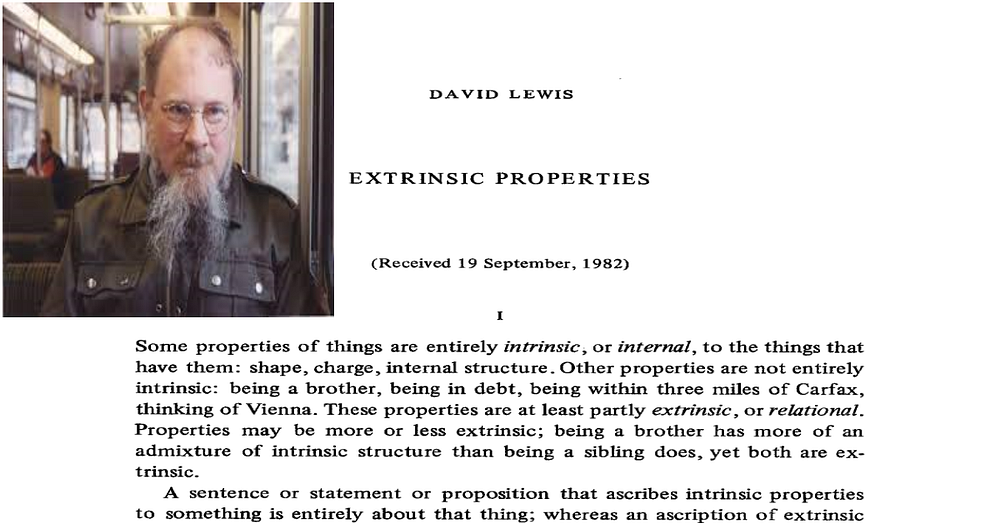
American philosopher David Lewis (1941–2001) wrote: “A thing has its intrinsic properties in virtue of the way that thing itself, and nothing else, is.”

[All the quotes from David Lewis come from his papers ‘Extrinsic Properties’ (1982) and ‘Redefining ‘intrinsic’’ (2001).]

****************************

At first sight, the word “intrinsic” appears to be a virtual — or even literal — synonym of the word “essential”. Indeed it’s tempting to use the latter — rather than former — word. However, as often happens in analytic philosophy, there are indeed (slight?) differences between these two ontological categories. Or, at the very least, there are different definitions of the words “intrinsic property” and “essential property”. Nonetheless, it can still be said that the two categories are very-closely related. To put that another way: this (possibly) insubstantial or even empty (to use Derrida’s term) “sign-substitution” of “intrinsic” for “essential” would never have happened if essentialism and anti-essentialism had never been such important parts of the Western philosophical tradition.

In any case, some metaphysicians tell us that there’s a difference between properties which object O has independently of any external factors acting upon it (i.e., intrinsic properties) and O’s properties which are deemed to be the way they regardless of what’s external to it (i.e., essential properties). Despite saying that, can’t that account of intrinsic properties also be applied to essential properties? In addition, can’t we also say that essential properties are those properties which are independent of any — or all — external factors?

If all that’s the case, then what has happened here isn’t the discovery of another ontological category: it’s a new way of accounting for an old ontological category. That is, when essential properties are defined in such a way as to emphasise their independence from all external factors, then those properties become intrinsic in nature — even though they’re essentially the same as essential properties! Again, the only things that seems to have changed are the new technical terms and their definitions.

David Lewis on Intrinsic Properties

This is David Lewis’s own definition of intrinsic properties from 1982:

“A thing has its intrinsic properties in virtue of the way that thing itself, and nothing else, is.”

Could there ever be such a state as “the way that a thing itself []is” regardless of literally everything else? That is, regardless of its (actual, not possible) relations to properties/objects, events, conditions, etc. which are (as it were) outside itself; as well as regardless of its place in time and space?

This position can be taken to its most extreme (or perhaps ridiculous) in the following statement:

Object O would still have intrinsic property P if after the world around it disappeared, O would still have P.

(This is a little like Max Black’s two-sphere universe; as discussed in his paper ‘The Identity of Indiscernibles of 1952.)

Can we say that there are intrinsic properties which still have vital (or important) relations to extrinsic properties? Alternatively: object O’s extrinsic proprieties may determine — to some extent at least —its intrinsic properties. However, it may be countered that because objects are such-and-such-a-way, then they can only be determined (or affected) in particular ways precisely because they have the intrinsic properties which they do have. So that may mean that there are mutual relations between intrinsic and extrinsic properties. Indeed, as just stated, there may not even be a “way” an object is regardless of its relations to other things or to extrinsic properties.

David Lewis also cited “internal structure” as being intrinsic to objects. Yet if such a structure is defined in terms of its relations, then surely it must also be defined (at least partly) in terms of extrinsic properties. This would mean that Lewis’s internal structure would also be defined — or even constituted — by its relations to extrinsic properties.

That would also mean that internal structures determine an object’s relations and therefore also determine the extrinsic properties themselves. Then again, it can also be argued that external properties determine internal structures.

Here again the boundaries between what is intrinsic and what is extrinsic seems to be somewhat blurred.

Of course it can now be asked what would be the metaphysical point of a Lewisian internal structure if it weren’t primarily a crutch (or framework) for intrinsic properties which have no such relations at all to external properties.

Different Surroundings and Shape

David Lewis claimed something about an intrinsic property which isn’t entirely helpful unless one’s already sure what a property actually is. He wrote:

[] If something has an intrinsic property, then so does any perfect duplicate of that thing; whereas duplicates situated in different surroundings will differ in their extrinsic properties.”

The problem with that definition (a mere stipulative definition?) is that if the very same “thing” is in “different surroundings”, then it may also have different intrinsic properties to the ones it had in its previous surroundings (what Lewis called “temporary intrinsics”). To put that more clearly:

1) Object O has set of intrinsic properties I¹ in surrounding S.
2) Object O has set of intrinsic properties I² in surrounding S².

To put that in more basic words: object O may change its intrinsic properties (not only its extrinsic properties) in different places. And that, surely, will depend on its relations to other objects; as well its relations to (external) properties.

Lewis also argued that the shapes of objects are intrinsic to such objects. However, don’t the shapes of many — or all — objects change through time?

One (as it were) shape-changer is space itself.

More correctly, objects with mass (at least to some minute degree in many cases ) curve spacetime and spacetime shapes objects. Thus shape will depend on the curvature of space in a specific region. What’s more, the curvature of space will be continuously working as a shape-changer.

But what if spacetime never has an impact on the shape of (as J.L. Austin put it) “medium-sized dry goods”? That said, the curvature of space does indeed have an impact on how such objects travel through space (as well as vice versa); though even here the impact is minuscule. (Massive objects, such as the earth, are a different matter.)

So what about particles and other micro-phenomena? Is it the case that the curvature of space doesn’t have any impact at the quantum level? (This ties in with the issue of quantum gravity.)

In any case, what if object 0’s shape at time t¹ is intrinsic and object O’s (slightly different) shape at t² is also intrinsic to it? However, if O’s shape were always changing, at least one of its intrinsic properties would also be changing. That’s because it would have two supposedly intrinsic shapes at two different times. And that seems to go against the notion of intrinsicality.

Intrinsic Relations

An interesting addition to the notion of intrinsic properties would be the category of intrinsic relations.

Intrinsic relations are said to determine — or even constitute — the nature of objects. In other words, they’re fundamental (why not say essential?) to the objects which have them.

This is primarily the case because it can be argued that object O’s intrinsic relations to other objects (or set/s of properties) are actually constitutive of what O actually is. So aren’t an object’s relations constitutive — or part — of that object’s fundamental (or essential) nature?

For example, the property [being two miles away from] can be deemed to be an intrinsic relation between two objects. Similarly, the property [being the same species as] can be seen that way too.

Clearly, if object O is two miles away from another object, then that other object must also be two miles away from O. So, in this case at least, the property [two miles away from] is symmetrical in regards to O and that other object.

Similarly with the property [being the same species as]. If object O is the same species as another object, then that other object must be the same species as O.

So can relational properties really be deemed to be intrinsic?

It may seem counterintuitive (to some) to argue that the relation [being two miles away from] could be an intrinsic property of object O. Indeed can it even be any kind of property at all?…

What about the property [being the same species as]?

Surely in the case of object O we can say that its being a member of species S is intrinsic. However, why should we say the same about the property [being the same species as] itself? That seems to be a needless addition to one’s ontology.

In any case, it can be argued that a pair of subatomic particles can display (or partake of) intrinsic relations.

For example, say that electron a and proton b (always?) stand in relation R to one another. Thus:

R is an intrinsic relation between a and b iff a (always) stands in R to b and b (always) stands in R to a.

That relation will also determine the natures of both a and b. In fact it can be argued that the intrinsic relation (or mutual relations) is (or are) actually constitutive of the natures of both a and b.

Electron a and proton b (or any other pair of objects), on the other hand, may also be related to all sorts of other objects, properties or events which don’t help constitute their fundamental natures or intrinsic properties.

In ontic structural realism, for example, this category of intrinsic relations is certainly taken to be true of subatomic particles (though ontic structural realists neither use that term nor accept it). Yet, perhaps ironically, this leads ontic structural realists to deny that there are any (only?) subatomic “things” at all (i.e., as in “every thing must go”).

So could all this be applied to macro-objects such as persons or trees too?

And need we follow the ontic structural realists in denying that there are things (or objects) simply because they always have (fundamental?) relations to — or indeed are partly constituted by — other objects, events, external properties, etc?

Lewis also mentioned a “perfect duplicate”.

Duplicates?

According to Lewis, if there were a perfect duplicate of Davy Boy, then that duplicate and Davy Boy would share the same intrinsic properties.

This means that the idea of a perfect duplicate sharing all intrinsic properties is helpful for a possible-worlds theory in which counterparts share such intrinsic properties. Thus:

If objects a and b are duplicates, then they must share all their intrinsic properties (i.e., even if they have different extrinsic properties).

It’s also argued that objects and even persons must have intrinsic properties in order to exist — over time — as the objects and persons that they are. In other words, if there were no intrinsic properties, then a given object or person would only last for a second… or even less… and would therefore not be a object or person at all.

What’s more, if there were a duplicate of Davy Boy, wouldn’t that duplicate also share all his extrinsic properties? To put that more simply: wouldn’t he (or it) share all his properties by virtue of him (or it) being a duplicate? After all, on Lewis’s picture, counterparts only duplicate the intrinsic (or essential) properties of the objects they’re counterparts of.

Yet wouldn’t all that be to simply assume certain things?

Counterpart theory is (in part) used to distinguish intrinsic from extrinsic properties. However, in order to have duplicates one must already be committed to intrinsic properties in order to define — or even understand — what it is that’s being duplicated. So rather than discovering intrinsic properties through counterpart (or duplicate) theory, one must actually assume them. Moreover, not only is the existence (or reality) of intrinsic properties assumed, so is what is and what isn’t an intrinsic property.

To sum up some of the above in argument form:

i) If object O changes its intrinsic properties in (to use Lewis’s words) “different surroundings”
ii) then any distinction between intrinsic and extrinsic properties (at least in the case of
O) will be difficult (or even impossible) to make.
iii) Therefore get rid of the distinction between intrinsic & extrinsic properties entirely.

There’s an additional way of looking at conclusion iii) above. Thus:

i) If the intrinsic/extrinsic distinction fails for objects (or Lewis’s things),
ii) and the having of intrinsic properties is said to be fundamental for the
discernibility, individuation, etc. of objects,
iii) then the ontological reality of objects itself may be questioned.

Surely the conclusion to all this is that it’s very hard to distinguish intrinsic from extrinsic properties. And, if that’s the case, then why not give up on the distinction altogether?


(*) See also: ‘Rearrangement of Particles: Reply to Lowe’ (1988)