Saturday, 26 September 2015

Ladyman and Ross's Philosophy of Physics: Particles (4)

James Ladyman and Don Ross argue that particles can’t be individuated without reference to external and relational factors. (All particles are parts of package deals.) So, to them, this means that particles simply aren’t “things” at all.
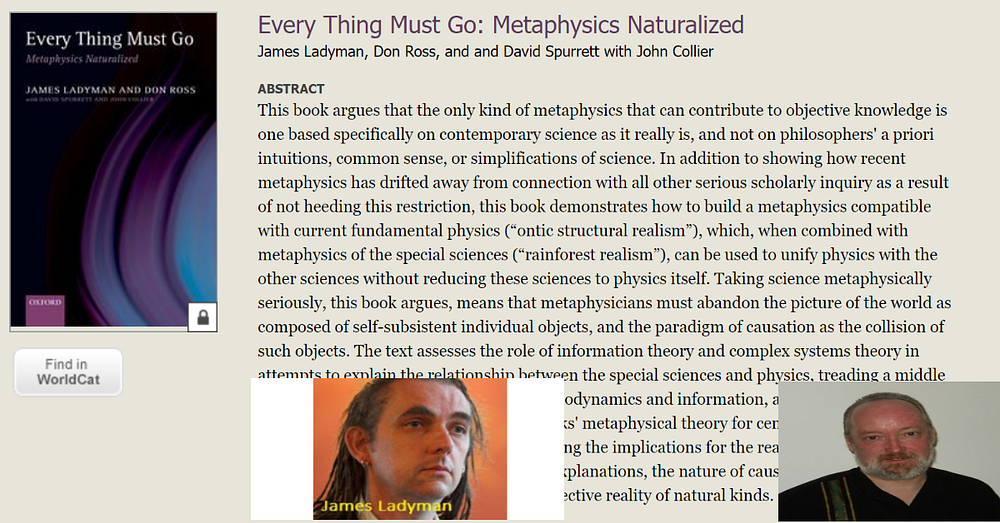
This essay is a commentary on the ‘Ontic Structural Realism and the Philosophy of Physics’ chapter of James Ladyman and Don Ross’s book Every Thing Must Go: Metaphysics Naturalised. (There are also a handful of references to — and quotes from — other parts of that book.)

The rather pompous term “ontic structural realism” basically refers to a realism about structures, not a realism about what the authors call “things” (i.e., things such as particles… or anything else other than structures).

*********************************

The philosophers James Ladyman and Don Ross’s philosophy of physics is primarily motivated by the findings and theories of quantum mechanics. Elements of their position can be traced back to — among others — the German philosopher Ernst Cassirer (who died in 1945).

Ladyman and Ross have much to say about Cassirer. For example, they wrote the following:

“OSR [ontic structural realism] agrees with Cassirer that the field is nothing but structure. We can’t describe its nature without recourse to the mathematical structure of field theory.”

Some readers may wonder what the words “nothing but structure” actually mean.

The usual assumption is that there can only be a structure if there are things (of some kind) that make up (or are part of) that structure. That said, this may be one of those everyday “intuitions” which the authors warn us against. Hopefully, Ladyman and Ross’s position on the nature of structure will become clear in the following. In addition, the phrase “[w]e can’t describe [a field’s] nature without recourse to the mathematical structure” is fairly commonplace — at least within physics — and has been since the late 19th century.

What Ladyman and Ross say about Ernst Cassirer’s position on objects (or “things”) is almost exactly the same as their own position on objects. Indeed it was also quantum mechanics which provided Cassirer himself with the motivation to reject (what Ladyman and Ross call) “individual objects”. Ladyman and Ross write:

“Ernst Cassirer rejected the Aristotelian idea of individual substances on the basis of physics, and argued that the metaphysical view of the ‘material point’ as an individual object cannot be sustained in the context of field theory. He offers a structuralist conception of the field.”

It may seem odd that, at least within the context of 20th-century physics, an “Aristotelian idea” is being discussed at all. Not only that: we also have the technical philosophical term individual substance too. That said, these are the words of two philosophers of physics, not the words of two physicists.

One can firstly ask whether or not a commitment to the existence of objects (or things) is also automatically a commitment to “individual substances”; as well as to intrinsic (or essential) properties. After all, the bundle theory (among other theories) rejects the notion of substance; though not that of an individual.

We can also ask whether or not these positions are equally applicable to objects in the “classical” (or macro) world. Let’s put it this way. Cassirer’s, Ladyman’s and Ross’s positions are far more acceptable when applied the the quantum world than when applied to the classical world. More precisely, all this is far easier to swallow in the (to use Ladyman and Ross’s words) “context of field theory” than it is in relation to human persons, cups or trees.

Essential and Intrinsic Properties?

It does seem strange (if only intuitively strange) that all “quantum elementary particles of a given type” are deemed to “have the same mass, size, and shape (if any), charge, and so on”. As it is, mass, size and charge are (essentially) seen as intrinsic properties. In fact it’s hard to imagine elementary particles having other (i.e., inessential) properties. After all, we’re not talking about classical objects here. So one can also easily imagine a natural kind having essential properties; though, when it comes to a particular member of that kind, having contingent properties too.

Can we also imagine an elementary particle having contingent properties?

If such particles don’t have such contingent properties (due to the nature of the micro-world), then it may literally be the case that the set {mass, size, charge} is all there is to them. Thus essentialism of some kind may be an easier option to uphold for particles than it is for classical objects such as lions or even a given sample of water.

That said, Ladyman and Ross do cite examples of what can be taken as a particle’s accidental properties. They cite “velocity or position at a particular time”. Indeed, in commonsense terms, it can be doubted that anyone would take the position or velocity of a particle at a particular time as being anything other than an “accidental” property. (Could it be that physicists could take a particular velocity — or at least mean velocity — of a type of particle to be essential to it?)

From what’s just be said, it’s therefore no surprise that different particles of the same type can be seen as what Ladyman and Ross call “indistinguishable”. However, particles may still have properties which aren’t intrinsic. That is, they may have properties which are relational or extrinsic.

Ladyman and Ross cite “spatio-temporal or other state-dependent properties” as examples.

In terms of spatio-temporal properties.

Does that mean that particles are even more likelier candidates for being four-dimensional objects than classical objects (see ‘Four-dimensionalism’)?

As for state-dependent properties .

That must mean that the nature of a particle must necessarily depend on the parallel (or corresponding) nature of the “state” (or system) to which it belongs.

Individuals?

Ladyman and Ross give a very concrete example of the physics which underlies the problematic nature of seeing elementary particles as single entities.

Firstly, they put the position of classical physics:

[C]lassical physics assumed a principle of impenetrability, according to which no two particles could occupy the same spatio-temporal location. Hence, classical particles were thought to be distinguishable in virtue of each one having a trajectory in spacetime distinct from every other one.”

Clearly, in quantum mechanics, many — or all — the assumptions in the classical picture above are rejected. (At the least, on some interpretations of quantum mechanics all these assumptions are rejected.)

Firstly, the “principle of impenetrability” is either questioned or rejected.

On the classical picture, if particles are impenetrable, then that means that “no two particles could occupy the same spatio-temporal location”. On the other hand, if particles are penetrable (or if the notion of penetrability does make sense), then one can conclude that two particles “could occupy the same spatio-temporal location”.

Thus one can immediately ask the following question:

If two particles occupy the same spatiotemporal location, then is it correct to talk about two particles in the first place?

In consequence, the second part of the classical picture is either rejected or questioned. That second part (which follows from the first) is that

“classical particles were thought to be distinguishable in virtue of each one having a trajectory in spacetime distinct from every other one”.

Clearly, if the penetrability argument is true and two particles may occupy the same location, then each particle can’t be seen to have its own trajectory in spacetime. In other words, it will share that trajectory with other particles.

This has the result that the Leibnizian picture breaks down in the case of quantum mechanics. Or as Ladyman and Ross put it:

“Thus for everyday objects and for classical particles, the principle of the Identity of Indiscernibles is true [].”

It can now be shown that the notion of a field plays an important part in Ladyman and Ross’s philosophy.

Particles as Package Deals

The central argument is that fields and particles are intimately connected. Indeed they’re so strongly connected that a distinction between the two hardly seems warranted.

Firstly, there’s the problem of distinguishing a particle from the state it (as it were) belongs to. Thus, in an example given by Ladyman and Ross, we can interpret a given field/particle situation in two ways:

1) A two-particle state.
2) A single state in which two “two particles [are] interchanged”.

Since it’s difficult to decipher whether it’s a two-particle state or a single state in which two particles are interchanged, Ladyman and Ross adopt the “alternative metaphysical picture” which “abandons the idea that quantum particles are individuals”. Thus all we have are states. This means that the “positing individuals plus states that are forever inaccessible to them” is deemed (by Ladyman and Ross) to be “ontologically profligate”.

Ladyman and Ross back up the idea that states are more important than individuals (what’s more, that there are no individuals) by referring to David Bohm’s theory. In that theory we have the following:

“The dynamics of the theory are such that the properties, like mass, charge, and so on, normally associated with particles are in fact inherent in the quantum field and not in the particles.”

All this means that mass, charge, etc. are properties of states, not of individual particles. However, doesn’t this position (or reality) have the consequence that a field takes over the role of an individual (or of a collection of individuals) in any metaphysics of the quantum world? Indeed doesn’t that also mean that everything that was said about particles can now be said about fields?

On Bohm’s picture ( if not Ladyman and Ross’s), “[i] t seems that the particles only have position”. Yes; surely it must be a particle (not a field) which has a position. Indeed particles also have trajectories which account for their different positions at different times.

To Bohm, “trajectories are enough to individuate particles”. It’s prima facie strange how trajectories can individuate. Unless that means that each type of particle has a specific type of trajectory. Thus the type of trajectory will tell us which type of particle is involved in that trajectory.

Ladyman and Ross spot a problem with Bohm’s position. That problem is summed up in this way:

If all we have is trajectory (as with structure), then why not dispense with particles (as individuals at least) altogether?

This is how Ladyman and Ross explain their stance on Bohm’s theory:

“We may be happy that trajectories are enough to individuate particles in Bohm theory, but what will distinguish an ‘empty’ trajectory from an ‘occupied’ one?”

Here again Ladyman and Ross are basically saying that if all we’ve got are trajectories (which is part of the structure?), then let’s stick with trajectories and eliminate particles (as individuals) altogether.

Ladyman and Ross go into more detail on this by arguing that

[s]ince none of the physical properties ascribed to the particle will actually inhere in points of the trajectory, giving content to the claim that there is actually a ‘particle’ there would seem to require some notion of the raw stuff of the particle; in other words haecceities seem to be needed for the individuality of particles of Bohm theory too”.

Of course most physicists would have no time for a term like “haecceities”, but if Ladyman and Ross’s physics is correct, then what they say makes sense. Positing particles seems to run free of Occam’s razor. In other words, Bohm was (to mix two metaphors) filling the universe’s already-existing ontological slums with yet more superfluous entities .

One way of interpreting this position is by citing two different positions. Thus:

1) The positing of particles as individuals which exist in and of themselves.
2) The positing of particles as part of package deals which include fields, states, trajectories, etc.

Then there’s Ladyman and Ross’s position.

3) If there are never particles in splendid isolation (apart from fields, etc.), then why see particles as individuals in the first place?

Ladyman and Ross are a little more precise as to why they endorse 3) above. They make the metaphysical point that “haecceities seem to be needed for the individuality of particles of Bohm’s theory too” (see ‘Haecceity’). In other words, in order for particles to exist as individuals (as well as to be taken as existing as individuals), such particles will require what Ladyman and Ross call “individual essences” in order to be individuated. However, if the nature of a particle necessarily involves fields, states, other particles, trajectories, etc., then it’s very hard (or impossible) to make sense of the idea that it could have an individual essence.

To sum up. A specific particle is always part of a package deal. Indeed all particles simply can’t be individuated without reference to external, extrinsic or relational factors. Thus particles simply aren’t individuals (or things) at all.


Friday, 25 September 2015

Ladyman and Ross's Philosophy of Physics: Structuralism (3)


These pieces are primarily commentaries on the 'Ontic Structural Realism and the Philosophy of Physics' chapter of James Ladyman and Don Ross's book Every Thing Must Go. There are also a handful of references to – and quotes from – other parts of that book.
                                                                                                                               *******************************************

It's not as if Ladyman & Ross (L & R) are unaware of the obvious ripostes to their position of ontic structural realism.

For example, they quote Anjan Chakravartty (1999) saying

“‘one cannot intelligibly subscribe to the reality of relations unless one is also committed to the fact that some things are related’”.

L & R elaborate on Chakravartty's position by saying:

... the question is, how can you have structure without (non-structural) objects, or, in particular, how can we talk about a group without talking about the elements of a group?”

And then to seal the position, L & R write (about themselves):

Even many of those sympathetic to the OSR of French and Ladyman have objected that they cannot make sense of the idea of relations without relata...”

Mathematical Structuralism

Strangely enough (at least to me), the position of ontic structural realism is expressed at its purest and simplest when L & R discuss Bertrand Russell's philosophy of mathematics.

L & R express Russell's position on mathematical structuralism in the following manner:

... many philosophers have followed Russell in arguing that it is incoherent to suppose there could be individuals which don’t possess any intrinsic properties, but whose individuality is conferred by their relations to other individuals.”

Indeed that passage can be rewritten to make it more germane to L & R's ontic structural realism. Thus:

It is incoherent to suppose there could be individuals (e.g., particles, etc.) which don’t possess any intrinsic properties, but whose individuality is conferred by their relations to other individuals, structures, fields, states, etc.

Thus we can ask the following question:

Does a number gain its identity from its place in a structure or does it have its place in a structure because of its (prior) identity?

Similarly we can ask:

Does an object/entity (e.g. a particle) gain its identity from its place in a structure or does it have its place in a structure because of its (prior) identity?

Indeed L & R state that Paul Benacerraf believed that

an object with only a structural character could be identified with any object in the appropriate place in any exemplary structure and could not therefore be an individual”.

In other words, Benacerraf seems to have taken the position cited earlier. Namely, an object/individual has its place in a structure because of its (prior) identity. That is, an object/individual doesn't gain its (entire) identity from its place in a structure.

To elaborate on Benacerraf's position. It can be said that if structure is everything (or, at the least, if an object gains its identity from its place in a structure), then any object can take a place in a structure. Indeed any object can take specific place X in a given structure if the individuality or identity of an object is passed onto it (as it were) by the structure it's a part of.

The problem with this (or perhaps any) form of structuralism, however, is summed up by L & R who state that “individuals are nothing over and above the nexus of relations in which they stand”. However, L & R do preface that by saying that it – only!? - applies to “individuals in the context of quantum mechanics”.

Ladyman continues by saying that “the identity or difference of places in a structure is not to be accounted for by anything other than the structure itself”. Not only that: the mathematical structuralism just discussed “provides evidence for this view”.

Things are Structures

Despite everything, L & R often state that they don't deny the existence of entities or individuals per se. Nonetheless, it's hard to make sense of L & R's claim that “there are objects in our metaphysics” and then go on to state that

but they have been purged of their intrinsic natures, identity, and individuality, and they are not metaphysically fundamental”.

In other words, if you take away “intrinsic natures, identity, and individuality” what's left of objects after all that's been taken away? Structure or relations? But what does that mean?

In any case, L & R see individuals as “abstractions from modal structure”. By “modal structure” L & R mean

the relationships among phenomena events, and processes) that pertain to necessity, possibility, potentiality, and probability”.

Yes, you've pre-empted me. It can too easily be said that structures involve individuals and relations involve relata. At a prima facie level we can also ask: In what way do “abstractions” involve themselves in modal realities? Well, mathematics itself involves necessity, possibility and probability. And if structures are inherently mathematical, then structures have modal properties. All that may be true. Though what about modality as applied to the concrete world of objects, events, conditions, etc.? What about metaphysical modality as understood by philosophers like Saul Kripke, David Lewis, D.M. Armstrong and so on?

L & R quote John Stachel saying that entities “'inherit [individuality] from the structure of relations in which they are enmeshed'”. However, saying that is a long way from saying that individuals don't exist. Even the very use of the word “inherit” means that things are doing the inheriting.

Now is it that L & R reject this position and simply deny ontological status to individuals: full stop? Or is the position that entities inherit their individuality from the “structure of relations in which they are enmeshed” as far as they need to go? Thus it's not that L & R are elimitivists about objects. It's simply that they have a radical take on objects. A take which claims that entities gain their individuality from structure. That is, before individuals are “enmeshed” in structures, they have no intrinsic natures.

Can we go so far as to say that before objects are enmeshed in structures, they don't exist? Thus it's not just the nature of entities we're talking about: it's also their existence. Do entities spring into being only when they're enmeshed in structures? This position would go against the claim, for example, of David Lewis that objects have intrinsic natures regardless of the rest of the world.

So now we still have the following positions:

i) Objects gain their natures from the structures they belong to.

ii) Objects come into existence in structures.

How is i) different from saying that entities are structures? In other words, the temporal and grammatical construction of i) may seem to imply that we have an entity at time t1 and at t2 it gains its nature from the structure it's embedded in. However, if ii) is correct, than that entity comes into existence in the structure. It doesn't only gain its nature from a structure – it comes into existence in the structure in which it's embedded.

Such abstract metaphysics is made concrete when L & R take the example of fermions. They cite the position that

that fermions are not self-subsistent because they are the individuals that they are only given the relations that obtain among them”.

What's more, “[t]here is nothing to ground their individuality other than the relations into which they enter”. And, according to L & R, even Albert Einstein once claimed that particles don't have their own “being thus”.

Reference

Ladyman, James, Ross, Don. (2007) Every Thing Must Go: Metaphysics Naturalised.


Thursday, 24 September 2015

Ladyman and Ross's Philosophy of Physics: Noumena (1)


These pieces are primarily commentaries on the 'Ontic Structural Realism and the Philosophy of Physics' chapter of James Ladyman and Don Ross's book Every Thing Must Go. There are also a handful of references to – and quotes from – other parts of that book.

                           ********************************************
Ladyman and Ross (L & R) refer to Kant a few times in Every Thing Must Go. Strangely enough, one time they do so is in response to the various philosophers who've seen “strong affinities” between their own work and Kant's. Nonetheless, L & R tell us “how [their] general account differs from that of Kant”. That fundamental difference is also the main purpose of this short piece.

Every Noumenon Must Go

We can go back to John Locke to see that it may be permanently impossible for us to ascertain the true nature of objects or things (i.e., his “something, I know not what”). In An Essay Concerning Human Understanding, Locke writes:

“…it is impossible for us to know, that this or that quality or Idea has a necessary connexion with a real Essence, of which we have no Idea at all, whatever Species that supposed real Essence may be imagined to constitute.” [IV.vi.5]

That's also partly why Bishop Berkeley turned towards empirical idealism and away from scientific materialism and the scepticism it engendered. In his Three Dialogues between Hylas and Philonous, Berkeley wrote:

.... the whole issue can be allowed to rest on a single question: is it possible to conceive of a sensible object existing independently of any perceiver? The challenge seems easy enough at first. All I have to do is think of something so remote—a tree in the middle of the forest, perhaps—that no one presently has it in mind. But if I conceive of this thing, then it is present in my mind as I think of it, so it is not truly independent of all perception.” [Dialogue 1]


Thus Kant brought noumena into the debate. Again, the problem of noumena caused various philosophers to embrace (Kantian) transcendental idealism once again – and so did many 19th-century scientists (e.g., Mach, Helmholtz, Boltzmann, Hertz, early Einstein, etc.).

If we come up to date, L & R quote Frank Jackson saying that “we know next to nothing about the intrinsic nature of the world”. Indeed we “know only its causal cum relational nature”.

One way out of this impasse (of noumena and the consequent embracing of idealism) is to become some kind of structuralist. Thus L & R cites Peter Unger arguing that “our knowledge of the world is purely structural”. What's more, Peter Unger also argues that

things in themselves [i.e., noumena]... are idle wheels in metaphysics and the PPC imposes a moratorium on such purely speculative philosophical toys”.

Kantianism

A semi-Kantian position (needlessly Kantian, according to L & R) is also offered by Mauro Dorato (as quoted by L & R). Dorato writes:

the concept of unobservable entities that are involved in the structural relations always has some conventional element, and the reality of the entities is constituted by, or derived from, more and more relations in which they are involved.”

I wrote semi-Kantian because that passage begins in a Kantian manner and ends with a structuralism of some kind. The Kantian bit is the following clause:

... the concept of unobservable entities that are involved in the structural relations always has some conventional element.”

However, the passage ends with these words:

... the reality of the entities is constituted by, or derived from, more and more relations in which they are involved.”

L & R would simply say: Get rid of these “unobservable entities”. After all, from what Dorato has said it can be concluded that all we've really got are relations and structure. Or in more detail:

Relations don't constitute entities and neither are entities derived from relations. Relations constitute (more) relations and (more) relations are derived from prior relations. It's relations all the way down folks.

To be crude, it can be said that Ladyman and Ross believe that all non-structural realists are to some extent Kantians. Or, at the least, they make the same Kantian mistake.

L & R specifically pick out what they call the “epistemic structural realist” as a Kantian (or quasi-Kantian).

So why 'Kantian'? L & R write:

... an epistemic structural realist may insist in a Kantian spirit... there being such objects is a necessary condition for our empirical knowledge of the world.”

This is a good description of the noumenal grounding of Kant's metaphysics and indeed his epistemology. You can sum it up with a simple Kantian question:

If there are no noumenal objects (which ground our representations, etc.), then what's it all about?

Even if our representations, models, "posited objects", etc. don't somehow mirror - or simply represent - objects (or if we didn't have the noumenal grounding in the first place), then surely we have precisely nothing. Or as L & R put it (almost quoting Kant word-for-word):

...there being such objects is a necessary condition for our empirical knowledge of the world.”

So, again, we may not mirror nature or objects; though we must capture something. Then again, how can we represent - let alone mirror - something as strange as Kantian noumena? How would that work?

This is when L & R say: Yes, we capture structure. That won't quite work because the Kantians and quasi-Kantians think they're capturing (if not mirroring) determinate objects. L & R clearly don't think that. That's why L & R appear to make what can be seen as the obvious conclusion. They write:

.... we shall argue that in the light of contemporary physics... that talk of unknowable intrinsic natures and individuals is idle and has no justified place in metaphysics. This is the sense in which our view is eliminative...”

One can conclude, after reading L & R, that because we can't get at objects in their pristine metaphysically-realist state (we can't mirror objects), then, if that's a necessary truth, we may as well say that “structure is all there is”. This ties in nicely with L & R's position in which Kantian noumena may as well drop out of the picture (as was the case, to some extent, with Bishop Berkeley). Or, as Wittgenstein once put it (though about something else), an object or noumenon is “a wheel that can be turned though nothing else moves with it is not part of the mechanism”[§271].

To put the case very simply, there are two positions which one can adopt here:

i) There are objects (or noumena), though we can never access them as they are “in themselves”.
 
ii) If we can't access objects as they are in themselves, then why not drop such objects completely from the picture?

It can be said that ii) follows from i); though it can't be said, strictly speaking, to follow logically from i).

References

Kant, Emmanuel. (1787) Critique of Pure Reason
Ladyman, James, Ross, Don. (2007) Every Thing Must Go: Metaphysics Naturalised
Lock, John. (1690) An Essay Concerning Human Understanding


Saturday, 19 September 2015

Derrida's Others


i) Introduction
ii) Derrida's Non-Conceptual Concepts
iii) Derrida's Language Game?

Deconstruction and/or post-structuralism attempted to “liberate the Other”. The problem is that there's an indefinite number of Others. And many Others are also at mutual odds with each other.

Whatever the case is, surely only a shared language - the language that deconstruction rejected or deconstructed - can liberate the Other. As Thomas A. McCarthy once put it:

Deconstruction can hardly give voice to the excluded other. The wholesale character of its critique of logocentrism deprives it of any language in which to do so.”

That's why deconstruction couldn't even hint at anything directly political (rather than tangentially political) in any traditional sense. Hence the ineffable, obscure and pretentious prose. 


It is [] merely by accident that his writings contain little analysis of political institutions and arrangements, historical circumstances and tendencies, or social groups and social movements, and no constructions of right and good, justice and fairness, legitimacy and legality?”

Isn’t it the case that ‘legality’, ‘legitimacy’, ‘fairness’, ‘justice’ - and nearly all the other concepts and words referred to by McCarthy - are examples of transcendental signifieds in Jacques Derrida’s book (or "text")? Thus, Derrida's only interest in words/concepts (or at least his interest in political and philosophical positions) was to violently deconstruct them. If he hadn't done that, then his whole enterprise would have self-destructed (if not deconstructed) itself.

So perhaps all this is the reason why Derrida only started to wax lyrically about Marx very late in his life. 

For example, he wrote his Specters of Marx in 1993 – some 40 years or more after he first started writing philosophy. Yes, this was Derrida's “political turn”.

Derrida's Non-Conceptual Concepts

Let's go into a little detail here with the example of justice.

If Derrida had created a new concept of JUSTICE (that's if one can have a new version of an old concept), then that would have been just another “centre” or “sign substitution”. (Or at least it would have been to Derrida himself.)

Even if a new concept for an old word were created, it would still be parasitical on the old concept (i.e., otherwise it wouldn't be a new concept for an old word).

That's why, for example, Marx wasn't just a “Left Hegelian”: he was still also a Hegelian. That's why “neo-Aristotelians” were/are still Aristotelians. And even an anti-Christian like Nietzsche was infected (as it were) by - and parasitical upon - Christianity itself.

So perhaps the very notion of a new version of an old concept doesn't make sense. It may be better to call it a variation on an old concept (or an elaboration on it); rather than an equivalent. If we want a strict equivalent (or just any equivalent), then why not stick with the old concept?

An alternative to an old concept, however, is a different thing entirely. This might have been what Derrida was trying to do. If that were the case, then he could hardly have used words like ‘fairness’, ‘right’, ‘legitimacy’ or any of the other words referred to by McCarthy above. However, if Derrida created an entirely new conceptual vocabulary (or a Wittgensteinian private language), then this would explain the difficulty in reading his work. Thus, either he wasn't using traditional concepts at all; or he was creating new concepts - en masse. Alternatively, perhaps Derrida used old words and applied new concepts to them. In that case, complications would multiply indefinitely.

All this made Derrida's philosophy suspect and problematic when he used old words for alternative or new concepts. How would we know (as new readers) that this is what Derrida is actually doing? And if Derrida never gave definitions of his alternative concepts (which used old words), then we'd still be in the darkest of dark places.

Indeed, Derrida couldn't even use the concept CONCEPT because that too belongs to the forbidden vocabulary of (as he often put it) “traditional Western metaphysics”. Of course, it may not even be possible to reject the concept CONCEPT and still do philosophy - or even write or speak at all (as the late Wittgenstein might have put it). Thus, this was surely a rhetorical claim on Derrida’s part.

For a start, one must already have concepts to reject the concept CONCEPT. However, Derrida might have replied that he did indeed have the concept CONCEPT. However, it was his job to reject or deconstruct it. Thus, perhaps what he wrote is so far removed from traditional philosophy (of whichever kind) that he didn't even need the concept CONCEPT (or any other concept for that matter).

Derrida's Language Game?

How far removed from philosophy - and indeed traditional language - can one be and still make sense and say something? Again, I can hear a Derridean reply: I'm not saying anything! This wouldn't be so far removed from Wittgenstein (in certain moods) and Heidegger who emphasised the point of pointlessness or the need to escape from traditional kinds of thinking. There's still a problem. What does non-statemental and non-conceptual philosophy look like? Is the answer simple? It looks like Derrida’s philosophy and prose.

Writing” (a term Derrida often used) itself needs to be overcome, rejected or deconstructed. The very thing that is WRITING is highly suspect and related to (amongst other things) “violence”. That's if we can call violence violence, it it, if...

References


Jacques Derrida on the Signifier and the Signifier


The writer Geoffrey Bennington goes into detail about Jacques Derrida's position on "signifiers". Derrida took the signifier-signified distinction to be central within Western metaphysics. It was supposedly believed that the general


description of writing is that it is the (graphic) signifier of a (phonic) signifier, which is the signifier of an (ideal) signified”. 


This temporal relation between phonic and graphic signifiers was taken by Derrida to express the metaphysical belief - common from Plato onward - that whereas we have “full presence” in the case of a phonic signifier, we only have a second-order presence when it comes to the graphic signifier (i.e., in the case of "writing"). Generally speaking, sense, meaning or the signified is to some extent lost when it's written down because it no longer has its close relation to the signified – which itself can be taken to be the meaning, sense or concept (of a word).

Bennington goes on to say that “it can be shown that all signifiers refer for their meaning only to other signifiers” [2000]. Thus not only do we not have the referent (or object) as the signified (or meaning) of a word: a word doesn't even really have its own independent sense (or meaning). It is, instead, supplied with a sense (or meaning/signified) by other words. It thus follows, according to Bennington's Derrida at least, that if


metaphysics wants to call the 'signifier of the signifier' by the name of 'writing', it has better call all language 'writing' if it wants to be consistent”. [Bennington, 2000]


The distinction here is that writing should be seen as “the signifier of the signifier”; whereas other forms of language (including speech) are “the signifier of the signified” because they're closer to the signified (or to meaning/sense). This distinction, however, was deemed bogus by Derrida because he believed that all language is infected by “writing” and thus all language is really “the signifier of the signifier”.

No spoken word has a privileged or closer position to the signified (or to meaning) than a written word. If we had that close relation to the signified (which constitutes “full presence” in Derrida’s terminology), then the “play of the sign” (another phrase from Derrida) wouldn't actually occur because we could bypass the signifier of the signifier (that is writing) and achieve closer harmony with the signified (or with meaning/sense).


Many philosophers have happily accepted that this distinction was indeed the case when it came to Plato and those Platonists who followed him. However, not all commentators would agree with Derrida’s metaphysical and ethico-political conclusions and interpretations. The fact that many 20th and 21st century analytic philosophers, for example, still accept not only the existence of abstract non-spatiotemporal meanings/senses and propositions: they also deem such things to be of vital philosophical importance. (Primarily because of the role they play in achieving determinacy of meaning, objectivity and even truth.)


For example, Frege (in his paper ‘The Thought’) deemed what he called “the Thought” (or the ‘sense’ of a true proposition/sentence/statement) to be of vital importance in the battle for objectivity and against what was then called - and still is - ‘psychologism’.

The Play of the Sign

It can be seen that Derrida’s “play of the sign” partly follows from the thesis of the “indeterminacy of meaning” (to steal - and perhaps misuse - a term from W.V.O. Quine).


Yet if meaning is genuinely indeterminate (in whichever way), then why did Derrida feel the need to emphasise the play of the sign? If all we have is play, then why the compulsion to emphasise this play in the first place? Perhaps Derrida's answer might have been this: 

All we have is play; though it doesn't follow that we believe that all we have is play

The deconstructionist strategies simply tell us that we have play and that the determinacy of meaning was (or is) a grand illusion which has played a huge part in Western philosophy.

Although we've been talking about the indeterminacy of word-meaning, such indeterminacy will evidently spread to “texts”; and, in fact, become even more apparent and inescapable in such contexts. Thus it was texts - not individual words or concepts - which were Derrida’s prime concern.


To put it at its most acute and simple, Bennington says that a

text cannot exhaustively control the reading you give it (no text can read itself without remainder)… there is no end to reading, no conceivable horizon of interpretation”.

We can also say that even if a text did have a determinate meaning (or interpretation), then that meaning (or interpretation) wouldn't force itself on us - or even on an ideal reader. This parallels, to some extent, the argument against metaphysical realism in that we can say that even if there's a "way the world is" (that elusive “view from nowhere”), then this still wouldn't - and couldn't - guarantee that we'd get the world right. The text and the world don't tell us what to say about them - no matter how determinate the text is (or how "real" the world is).


As Bennington puts it: “no text can read itself”. Neither, for that matter, can the world. Just as in the Quinian scheme of “radical translation” we require the relativity of “translation manuals” (or conceptual schemes), so texts require interpretations. And interpretations are just that – interpretations. In that sense there can't be a true interpretation of a text; though Derrida did appear to argue (in later life) that that could be a better one. (Here we have a similar problem with the word "better".)

The Syntax & System of Western Metaphysics

What was being said by Derrida isn't that different words have the same meaning or even a similar meaning. Instead it's argued that we have a “network of mutually-defining elements in dynamic solidarity” (Bennington). In other words, once we bring on board one word or concept, then - almost of necessity - we'll also be required to bring on board other words and concepts. This won't simply be in order to define the word (or concept) under scrutiny: it will also be to back it up (argumentatively speaking). That's why Derrida argued that once we bring in a single metaphysical concept into the discussion, then we must also bring in “the entire syntax and system of Western metaphysics” [1970].


Just as mathematical structuralists stress the place of a number (or a numerical inscription) within a number-system (as well as under-stress - or deny - its referential role), so we can say something similar about the word’s role within a linguistic system and how that determines its meaning or even its identity. Thus what matters with the numerical inscription ‘3’ is that it comes below ‘4’ and above ‘2’. Similarly with the word ‘freedom’, which comes alongside words like ‘liberty’, 'rights' , ‘choice’ and whatnot. In other words, try defining ‘freedom’ without bringing in other terms (or concepts); which, in turn, will either eventually refer back to the word ‘freedom’. (Or, alternatively, contain terms which will themselves need defining.)


Think also of the vast armoury of terms which are brought on board when one uses the metaphysical term ‘substance’: such as ‘accident’, ‘property’, ‘essence’ and all the rest. This is indeed a package-deal. Can we go so far as Derrida and say that if we use a single (important) concept from Western philosophy, then we must also bring along with it “the whole syntax and system of Western metaphysics”?

A.N. Whitehead famously said that Western philosophy has just been a “footnote to Plato”. And since the resurrection of Aristotelian metaphysics (in Anglo-American analytic philosophy, at least) some fifty years or so back, we still have a whole battery of Aristotelian terms to deal with.


Another thing which Derrida argued is that we sometimes believe that we have new technical terms; though often they're nothing but what he called “sign-substitutions”. That is, a term that's substituted with another term which is only infinitesimally different to the original. Indeed sometimes the word is different; though the concept is exactly the same... 

References


Bennington, Geoffrey. (2000) Interrupting Derrida
Derrida, Jacques. (1970) 'Structure, Sign, and Play in the Discourse of the Human Sciences'
Frege, Gottlob. (1918) 'The Thought: A Logical Inquiry'
Whitehead, A.N. (1928) Process and Reality