Monday, 9 May 2022

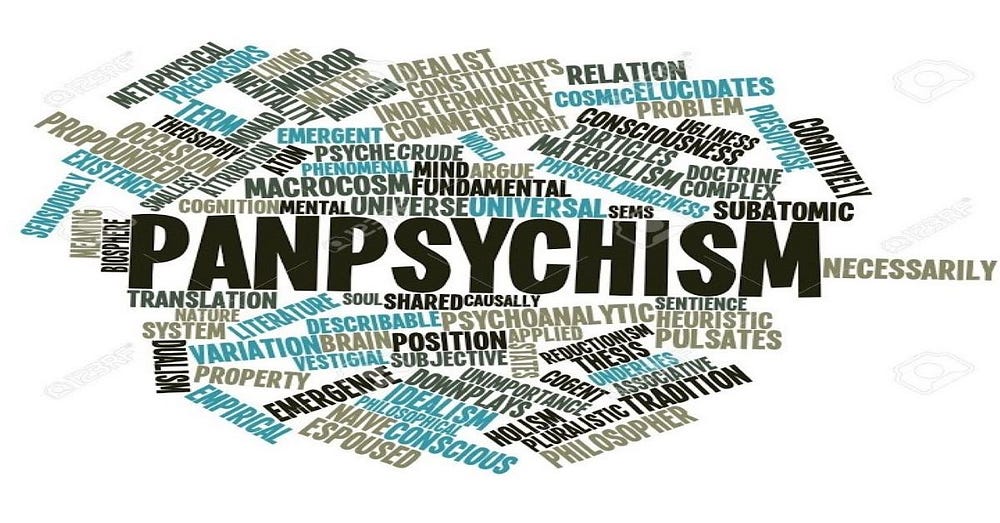
Panpsychism in 1970: Keith Campbell on the Continuity Argument for Panpsychism

Keith Campbell stated that “continuity shows that men and one-celled organisms have the same basic nature”.
The Australian philosopher Keith Campbell (who was born in 1938) is one of the founders of what came to be called Australian materialism. He was a professor in the Department of Philosophy at the University of Sydney.
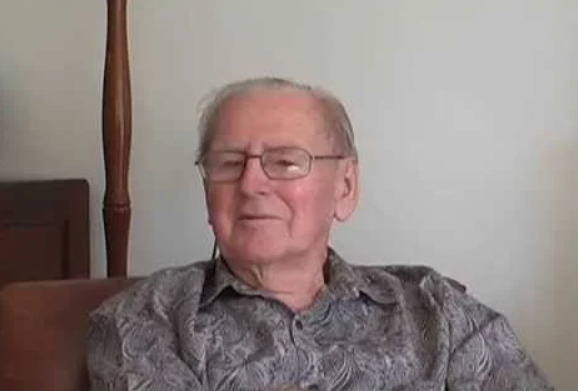
Keith Campbell

This essay is primarily based on Campbell’s chapter ‘Dualisms’, from his 1970 (second edition, 1985) book, Body and Mind.

This chapter has been chosen because it’s a (relatively) early reference to panpsychism by an analytic philosopher. That is, it occurred some time before the recent interest in — or fashion for — panpsychism.

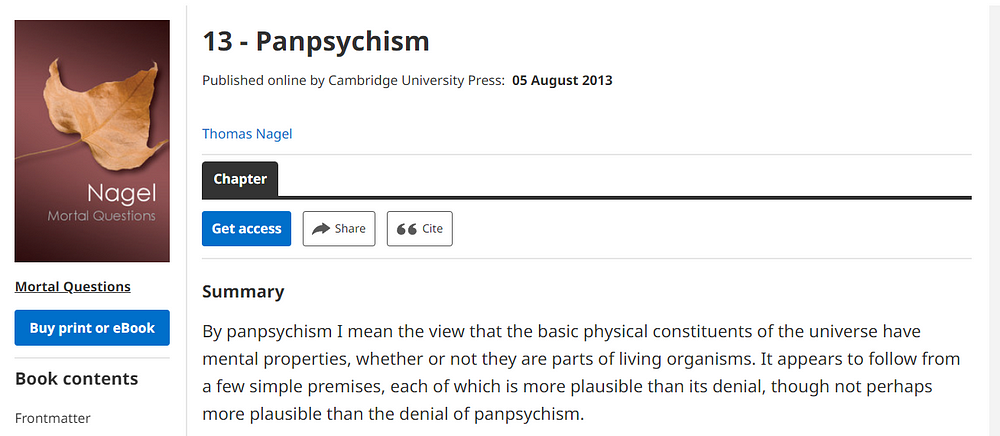
This new interest in panpsychism can be said to have begun around in 1996, with David Chalmers’ book The Conscious Mind. That said, “analytic panpsychism” partly gained inspiration from Thomas Nagel’s 1979 chapter ‘Panpsychism’ (in his book Mortal Questions). This interest in panpsychism didn’t fully kick in until around 2006, with Galen Strawson’s paper ‘Realistic Monism: Why Physicalism Entails Panpsychism’.

It must now be said that although the word “fashion” was used a few moments ago, it can of course be argued that being against panpsychism was also fashionable for a long period of time (at least within analytic philosophy).

When Did Consciousness Arise?
Even though Keith Campbell didn’t begin with the word “panpsychism”, the following passage expresses the broad gist of what has been called the Panpsychist Argument For Continuity. Campbell wrote:

“If minds are spirits they must have arrived as quite novel objects in the universe, some time between then and now [man and his remote descendants]. But when? We see only a smooth development in the fossil record. Any choice of time as the moment at which spirit first emerged seems hopelessly arbitrary. ”

This seems like an argument that a panpsychist would be happy with.

Of course it’s usually stated that consciousness didn’t just “arrive[]”. It arrived as a gradual process — a result of evolutionary processes and the increased complexity of brains and central nervous systems (among many other things).

In a sense, then, this evolutionary view also parallels the panpsychist argument that not all levels of consciousness are the same. That is, a simple “system” needn’t have the same level of consciousness as a complex system. Nonetheless, that simple system still instantiates consciousness (or, as it’s called by some panpsychists, “proto-consciousness”).

Yet, unlike evolutionists, it’s not only biological systems that panpsychists have in mind: it’s any or every system. Thus if a rock — or even a particle — has (proto)consciousness, then the evolutionary argument (about increasing biological complexity, genetic mutations, environments, etc.) simply doesn’t apply.

In any case, Campbell then applies the same argument not to homo sapiens (or to “man”) as whole, but to an individual human person. He wrote:

“The initial fertilised cell shows no more mentality than an amoeba. By a smooth process of division and specialization the embryo grows into an infant. The infant has a mind, but at what point in its development are we to locate the acquisition of a spirit? As before, any choice is dauntingly arbitrary.”

[It must also be assumed that Campbell’s word “spirit” isn’t really meant in the strictly religious sense. His word “spirit”, therefore, must simply a synonym or cognate for “mind” or “consciousness”.]

The panpsychist will — or must — argue that the “initial fertilised cell” — as well as “an amoeba”! — does indeed instantiate at least a rudimentary level of consciousness. Sure, that fertilised cell (or amoeba) won’t instantiate self-consciousness, cognition or any other higher levels of consciousness (whatever we take them to be). More importantly, it will not think. (Hence the common anti-panpsychism position in which it’s stated that panpsychists believe that, for example, electrons think — see here and here.) In that case, then, there simply is no single “point” at which there’s an “acquisition of a spirit”. Thus, there is no “dauntingly arbitrary” choice we (or at least the panpsychist) need to make either.

Campbell then concluded by putting the somewhat obvious panpsychist conclusion (though without using the word “panpsychism”) to all the above. He wrote:

“Continuity shows that men and one-celled organisms have the same basic nature [].”

Of course we need to know what exactly this “basic nature” is. That is, Campbell merely saying that “all matter shares with man his more-than-material nature” doesn’t tell us much. And it can also be supposed that because this more-than-material is deemed by most (or even all) panpsychists to be basic and fundamental (as well as “intrinsic”), then that’s not a surprise.

Thus because most (or all) panpsychists deem consciousness (or experience) to be fundamental, then, in a strong sense, they don’t need to explain or describe what it is. After all, any description or explanation would be an admission that consciousness isn’t fundamental after all. (To quote the idealist Bernardo Kastrup: “Mind is an irreducible aspect of nature which itself cannot be explained in terms of anything else.”)

So both panpsychists and evolutionists believe in continuity.

So who doesn’t believe in such a thing?

What about dualists?

Dualism
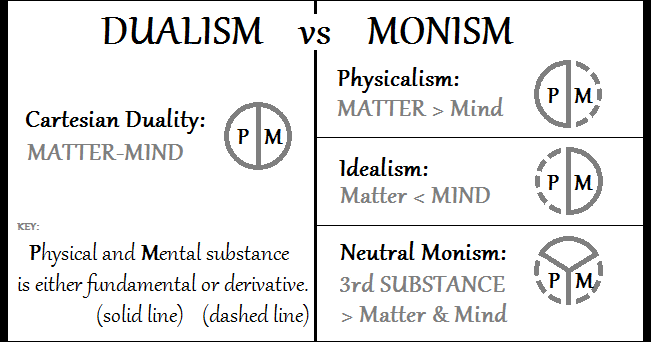
Campbell spots the “scientific difficulty for any form of dualism”. It’s that “the continuity of nature leads a dualist inexorably on to panpsychism”.

To dualists, the “soul” (or perhaps Campbell’s “spirit”) isn’t a result of complexity (as with some forms of materialism and evolutionary theory). And, as already stated, dualists also reject continuity (which panpsychists and evolutionists stress).

Thus Campbell picked up on the fact that panpsychists find dualism just as problematic as they find materialism when he wrote the following:

“The scientific difficulty for any form of dualism is therefore this; the continuity of nature leads inexorably on to panpsychism [].”

So one thing we can’t class panpsychists — as well as idealists — as is dualists.

In any case, René Descartes (1596–1660) himself certainly rejected any continuity from animals to human persons. (This isn’t that surprising in Descartes’ pre-Darwinian age.) That said, it can be argued that not all dualists need to be Cartesian dualists. (David Chalmers classes himself as a “naturalist dualist”; and, to take just one more example, see E. J. Lowe’s paper ‘Non-Cartesian Substance Dualism’.)

Again, panpsychists have no problem with such continuity. That is, if stones — and even particles and spacetime— are deemed to instantiate consciousness in the panpsychist picture, then (as it were) allowing mice and birds — and most most certainly cats and dogs — consciousness is no problem at all.

Campbell Against Panpsychism?

Keith Campbell does put a position against panpsychism when he mentions the lack of “direct evidence of mentality” in, say, particles or even cells. Of course there’s no “direct evidence” that non-human animals are conscious either. Indeed, so the arguments go, there is no direct evidence that our fellow human beings instantiate consciousness! (Hence the possibility of zombies, the “problem of other minds”, behaviourism, etc.)

Campbell also argued that panpsychism

“is a speculation which extends the field of the mental far beyond anything warranted”.

That’s okay. Not many (or at least not all) panpsychists would deny panpsychism’s speculative nature.


Thursday, 5 May 2022

The Recent Rise of “Analytic Panpsychism”: 1996 to 2022

A personal and historical take on the recent rise of panpsychism.

[The term “analytic panpsychism” is in quotation marks because it crops up a few times in the philosophical literature. See here, here and here.]

************************

To start this essay on a personal note.

I don’t recall a single reference to panpsychism at university in the early 2000s from either my fellow students or from the professors who taught there. And this situation remained the case right up to 2007/8.

Indeed the panpsychist philosopher Philip Goff also acknowledges this situation in his book Galileo’s Error.

Goff points out that in the early 2000s he had to (as it were) seek out a panpsychist to teach him. He writes:

“But the new professor at the University of Reading, Galen Strawson, was busy defending panpsychism. [] This seemed like the place for me.”

Goff also says that because he was (as it were) worried about propagating panpsychism when a postgraduate, he (as I read it) kept his beliefs to himself.

In terms of academic work, Goff wrote his first paper on panpsychism (‘Experiences Don’t Sum’) in 2006 . Indeed even here there’s one slight (or possible) complication: Goff’s paper from 2009, ‘Why Panpsychism Doesn’t Help Us Explain Consciousness’. Judging by the title and abstract (e.g., “the paper argues that panpsychism cannot help us to explain consciousness”) of that paper, it appears to be critical of panpsychism.

Yet, despite all the above, it’s often said that panpsychism dates back to various ancient civilisations (see here and here).

And, if we jump forward many centuries, panpsychism is also dated back to what some people call its “heyday” in the 19th century (see here). And then we had such (scare-quoted) “panpsychist” philosophers as Bertrand Russell and A.N. Whitehead in the early 20th century.

Yet not all these historical positions replicate what’s expressed by many contemporary panpsychists — at least those philosophers within the tradition of analytic philosophy.

Indeed so many dead philosophers and scientists are classed as panpsychists nowadays that one doesn’t know where to start.

Of course many of these classifications are entirely retrospective in nature (i.e., written mainly by 21st-century panpsychists). That can be seen because it only takes a few minutes to realise that all these historical “panpsychists” actually held very-different views.

(For example, simply reading the abstract of Anand Jayprakash Vaidya’s paper ‘Analytic Panpsychism and the Metaphysics of Rāmānuja’s Viśiṣṭādvaita Vedānta’ will make that very clear.)

All this basically means that we have — if anything at all — a plurality of panpsychisms, rather than a singular panpsychism.

Take as an example of all this the British philosopher Timothy Sprigge, who wrote a book called A Vindication of Absolute Idealism (1983). Despite the title, this book is deemed (at least by some) to advance a form of panpsychism! (The book is seen to be a “synthesis of panpsychism and absolute idealism”.) Yet this is at odds with, for example, the philosopher Bernardo Kastrup’s own “analytic idealism” and the fact that Kastrup has strong and negative words to say against panpsychism. (See Kastrup’s ‘The threat of panpsychism: a warning’ and ‘The irony of Philip Goff’s arguments’. ) Similarly, Philip Goff— Kastrup’s main target — returns the favour by arguing against (though without Kastrupian rhetoric and rudeness) Kastrup. (See Goff’s ‘Response to Bernardo Kastrup’ and here.)

Added to the problem of certain kinds of idealism being classed as “panpsychism” are the multiple varieties of (pure or not so pure) panpsychism itself.

Take Goff’s Stanford Encyclopaedia of Philosophy entry on “Panpsychism”. In that piece Goff cites eleven different kinds of panpsychism. Admittedly, some of the panpsychist isms which Goff cites may be either virtual synonyms or subsets of each other.

[Goff’s long list of panpsychisms: micropsychism, cosmopsychism, constitutive cosmopsychism, panprotopsychism, constitutive panpsychism, non-constitutive panpsychism, constitutive micropsychism, emergentist panpsychism, panexperientialism, pancognitivism and Russellian Monism… And they’re just the recent versions of panpsychism within analytic philosophy!]

All these panpsychist isms, however, may be not that unlike the many different forms of idealism, materialism, Marxism, dualism, etc.

To admit to my own bias or limited knowledge, I’d never heard of many of the contemporary “big names” connected to panpsychism. And, when I did become aware of them, they were named only with exclusive reference to panpsychism itself. (These people include the American philosophers David Ray Griffin, David Skrbina and Gregg Rosenberg.)

To display my bias again: the recent embrace of panpsychism in analytic-philosophy circles can be said to have begun with — or, more correctly, to have been inspired by — Thomas Nagel’s (a philosopher many people have heard of) 1979 chapter ‘Panpsychism’ . But then you have to jump to David Chalmers’ 1996 book, The Conscious Mind. (In that book, Chalmers speculates about — rather than fully embraces — panpsychism.) And then we must jump again to Galen Strawson’s 2006 article ‘Realistic Monism: Why Physicalism Entails Panpsychism’. This paper, at least partly, inspired today’s most popular panpsychist in the analytic tradition — Philip Goff.

***********************

Note: Integrated Information Theory

Although not “analytic panpsychism”, what about Integrated Information Theory, which has been (as it were) linked to (analytic) panpsychism?

It’s hard to see how a theory — IIT — which often seems to emphasise complexity and does emphasise integration, and which focuses almost entirely on biological brains, can help panpsychism. Thus linking IIT to panpsychism seems — at least at first sight — to be all wrong.

For one, the neuroscientist and psychiatrist Giulio Tononi (who formulated IIT) himself has little time for the purely philosophical theories of consciousness and has said that they “lack predictive power”. (He even keeps well away from such terms as “qualia”.)

That said, IIT has it that even basic objects have a nonzero degree of Φ, which is Tononi’s unit of measurement for consciousness (see here). This would mean that consciousness is everywhere — if only to a rudimentary level (as with the “proto-experience” of panpsychists).

In any case, this not-panpsychism position is at odds with the philosophers David Chalmers and John Searle, who do take IIT to be a form of panpsychism (see here and here). And, what’s more, the German-American neurophysiologist and neuroscientist Christof Koch (Tononi’s co-worker) has even claimed that IIT is a “scientifically refined version” of panpsychism.


[I can be found on Twitter here.]


Wednesday, 4 May 2022

My Replies: ‘A Story Written by AI?’, ‘Why Derrida?’, and ‘Reductionism!’

Selected (mainly critical) responses to my essays on Medium — and my replies to them. (4)

[Editorial square brackets have been added to make things clearer.]

A Story Written by AI?

Jim Clyde Monge wrote:

“The article you are about to read is written entirely by GPT-3, OpenAI’s powerful new language generator.”

My reply:

“Yes — it may have been ‘written by AI’ (or by a programme) — yet that may not amount to much. Perhaps all the words in this programme came from human (i.e., non-AI) sources. The AI programme might have simply played about with the words a little. I don’t know. This is equivalent of a AI ‘composer programme’ which often has phrases or tunes in its programme and then it simply juxtaposes that data according to strictly-programmed rules. (To put it very crudely.)
“In fact evidence will need to be provided that this AI programme didn’t simply (as it were) copy and paste someone else’s work (or somehow fuse the work of different writers). Then again, much of what’s just been said can also be said of human beings too!”

[This isn’t an argument against AI. It’s simply a sceptical take on this particular case.]

*****************************

Why Derrida?

Reverend Andy wrote:

“So, yea, in the end I don’t think Derrida matters. That’s all. I feel we are wasting our time right now.
“Why are you interested in all this? Did you already share?”

My reply:

“Don’t you mean that Derrida doesn’t matter to you? He clearly matters to a lot of people — at least within academia. [That is] his views have had a large impact on such things as American university departments [as well as] what’s taught in them, lawyers, etc. In addition, his views are ‘simplified’ (despite Professor Christina Howells not wanting them simplified by the wrong people) and have filtered down to activists ‘on the street’ (something you appear to deny). Now that’s despite what both of us have said about his obscure prose. And that’s a situation that needs explanation.
“Also, you yourself must be ‘interested in all this’ because you’ve replied twice and you read the original article. [So the words ‘Why are you interested in this?’ are rhetorical.]
“There are many reasons why I’m interested in this — some of which I’ve just given. It began, however, when I was force-fed Derrida’s and similar theorists’ views as a mature student at university. The situation was so bad that I ended up demanding that my degree be externally marked because of the clear bias and even antipathy of the professors toward me. (I was at an ‘arts college’ of a larger university — Leeds University. Thus the college sent my degree work to the main university — and those there, I presume, didn’t really know the professors who taught me.) It turned out well because I ended up getting a 1st Class Degree.”

****************************

Reductionism!

MD Cobbald wrote:

“This was fun but a very left-brained argument.”

My reply:

“What, exactly, is a ‘left-brained argument’? You don’t mention a single argument, quote a single passage or even mention a single syllable of a 14-minute essay. It’s almost as if you simply read the title [i.e., ‘Murray Gell-Mann on Scientific Reductionism’] and wrote a vague and highly-generalised emotional response to it. Did the single word ‘reductionism’ [i.e., in the title] get you going?”

MD Cobbald wrote:

“The perpetual physical reductionism of of science is one thing, but what of the abhorrent metaphysical reductionism inherent in post Newtonian scientific philosophy?”

My reply:

“What of it? Is your rhetoric enough? Is supplying argumentation, data, evidence, reasoning, etc. also ‘reductionist’ and therefore ‘abhorrent’ too?”

MD Cobbald wrote:

“Phenomena are observed through the narrow perception of the human machine in an attempt to describe principals broader than the perception of the human machine.”

My reply:

“What does all that mean? Is it poetry? You yourself clearly seem to be attempting to observe things beyond the human machine that is yourself. Yet because your own rhetoric is anti-reductionist and embarrassingly vague, that must be okay to you.”

****************************

Gödel, Truth and Proof

Christian Gawron wrote:

“What about ‘true’ statements which can’t be proven? If there is no prove for a true statement, it is not merely ‘correct’ in the sense of ‘mathematical grammar’. Nevertheless, Gödel has shown such unprovable true statements exist in mathematics.”

My reply:

“That wouldn’t in itself work against Wittgenstein’s position — at least as it’s presented in the essay above. In this essay, the debate about the relation between truth and proof isn’t brought up. That said, this truth-without-proof would still depend on systems, grammar and correctness. That is, it’s the grammar and correctness of the statements within a system which, according to Gödel, produce such truths which can’t be proven [i.e., within the system/s]. An unprovable truth would still be a product of grammar, correctness and a system. There could be no platonic mathematical truth which is free-standing.
“Now, as far as truth-without-proof is concerned: this has been much disputed too. (The main contention is to ask how mathematicians know that they’ve intuited the truth of a statement without any process of proof or demonstration.) But since it’s not the theme of the essay above, I won’t comment on it — save to say that here again it only applies to truths both within and produced by mathematical systems. It’s for this reason that this Gödelian result is hard to apply across the board — even though it often has been!”

*********************************

Particles are Abstractions?

Don Salmon wrote:

“Sigh. That’s ok. I’ll just say one thing — ‘fermions’ ‘bosons’ and the rest are abstractions created by physicists. They don’t directly provide evidence of anything real. But that’s philosophy, not science. I’ll leave it at that.”

My reply:

“Why are fermions and bosons ‘abstractions’? The mathematics used in the theories of physics may be abstract, but surely fermions and bosons aren’t themselves abstract. They are indirectly observed in experiments, manipulated, fired, produced, modeled, etc. You wouldn’t be writing these words if it weren’t for fermions and bosons — if not fermions, then for something physical.
“If physics doesn’t show ‘anything real’ — then what does? And what do you mean by the word ‘real’? You seem to implying that philosophy or… something else can show us what is real. Is that correct?
“You used the word ‘sigh’. Are you sighing at someone putting a different view to your own?”

***************************


[I can be found on Twitter here.]


Monday, 2 May 2022

Bernardo Kastrup’s Cosmic-Idealist Worldview as Neurotic Ego-Defense Mechanism

Bernardo Kastrup’s Manichean war against “materialists”.

[This is the last — and shortest — of my series of essays on Bernardo Kastrup.]

I haven’t read every single word that Bernardo Kastrup has ever written. So it must be noted here that when philosophers and scientists criticise Kastrup’s Cosmic Idealism, he often says that they “don’t understand” it. Thus Kastrup basically conflates criticising his Cosmic Idealism with not understanding it. This is a very popular technique which is also used by religious and political fundamentalists.

Of course it can be conceded that Kastrup obviously knows more about his own Cosmic Idealism — and probably other idealisms — than most (or even all) of his critics; just as a religious or political fundamentalist will often know more about his chosen ideology or religion than most of his critics.

This situation is made even worse because Kastrup has a penchant for offering psychological, psychanalytic and Jungian depth psychological hitjobs on all his critics…

And, yes, this is precisely — at least in part — what I’m doing to him in this and in other essays.

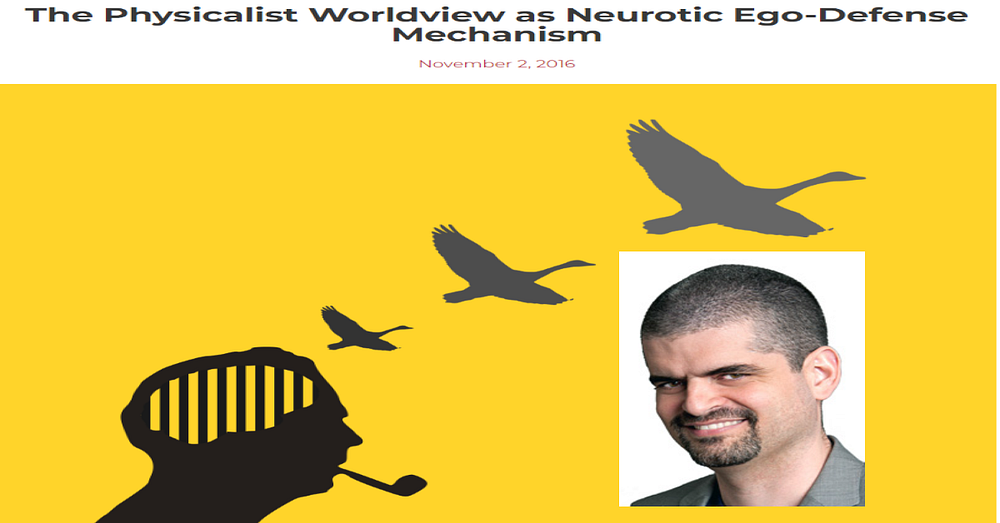
In any case, Kastrup often looks for the psychological motivations which, for example, supposedly drive people’s “physicalism” or “materialism”. Moreover, Kastrup does exactly the same thing when it comes to those people who criticise his own Cosmic Idealism. Indeed there’s an entire paper by Kastrup in this vain: it’s called ‘The Physicalist Worldview as Neurotic Ego-Defense Mechanism’.

So perhaps Kastrup himself should be the victim of such psychological analyses. Indeed perhaps it is Kastrup who displays “neurotic ego-defence mechanisms” when people express what he takes to be “materialist” positions. In less pretentious terms, it’s certainly the case that Kastrup often attacks other people — and not only his critics. (Kastrup deems nearly all his critics — as well as people with differing views, such as journalists — to be materialists or physicalists.) And he’s also very defensive about his own philosophical and spiritual positions.

Take Kastrup’s strong words on just about every person and position he doesn’t fully endorse. For example, his highly personalised and smug criticisms of Philip Goff (see here and here), Sabine Hossenfelder (see here and here), Sam Harris (see here and here), Massimo Pigliucci (see here and here), all “materialists” (see here and here), “our culture” (see here and here), etc. etc. etc.

To change tack a little.

Kastrup may not claim to know that his Cosmic Idealism is true, right or correct. Perhaps he simply classes it as a theory. If that’s the case, then he rarely — if ever — states that. And if Cosmic Idealism is just a philosophical theory, then it’s just a theory among many others. Yet, here again, you don’t get the impression from Kastrup that Cosmic Idealism is simply one philosophical theory among many others. To him, it is clearly the Supreme Philosophical Theory. That is, there is very little modesty in Kastrup’s words about his own theories and ideas. And neither does Kastrup tolerate — or show decency toward — those philosophers and scientists who criticise them.

This is Kastrup being embarrassingly jealous and vindictive. Is this an example of Kastrup’s “ego-dissolution”?

So, for someone who knows about psychanalysis and psychotherapy (see here, here, and here), Kastrup seems to lack self-awareness. Particularly, he is the most egotistical and rude cotemporary philosopher I’ve come across.

Finally and paradoxically (or just perversely), perhaps Kastrup’s self-proclaimed attempts to escape (partly/largely through psychedelic substances — see here) from what he himself calls the “egoic loop” have actually helped create his huge ego.

**********************

Kastrup appears to be an admin of his own Facebook “fan club” — see image directly above. (See his fan club @ Facebook here.)

Note: See ‘The Science of Spiritual Narcissism’, at Scientific American. See also a psychologist on “spiritual narcissism” here. Finally, this piece is on the direct link between being supposedly “egoless” and having a huge… well, ego — something that the writer admits to and thinks is a good thing.

(*) See my essays ‘Bernardo Kastrup’s Spiritual Take on Psychedelic Experiences and Cosmic Consciousness’, ‘The Idealist Philosopher Bernardo Kastrup vs. Materialism’, ‘Bernardo Kastrup (the Well-Known Cosmic Idealist) and His Afterlife’ and Reality is a Metaphor: Bernardo Kastrup on the Vibrations of Cosmic Consciousness’.

A review of a book by Kastrup.


Sunday, 1 May 2022

My Replies: ‘Consciousness and Intelligence’, ‘Neuronal Inferences?’, and ‘Photons and Time’


Selected (mainly critical) responses to my essays on Medium — and my replies to them. (3)

[Editorial square brackets have been added to make things clearer.]

Intelligence and Consciousness

I wrote:

“I mentioned the fact in the essay that people define ‘intelligence’ and ‘consciousness’ in many different ways. And you’re using the word ‘intelligence’ in a very particular way. I would say that you’re using the word in a way that’s at odds with how it’s used in everyday language or by most people. But that doesn’t really matter at all. I presume that you’re using the word as some scientists or theorists use it.”

Cristóbal de Losada wrote:

[] for that to be the case, a basic algorithmic intelligence must be present, such as, ‘sense light, move toward (or away from) it’.”

My reply:

“These examples are simply programmed or genetic responses to the environment, And, in terms of any given species, every individual in that species will ‘move away’, etc. from the light in more or less the same way. And that alone means that the word ‘intelligence’ is being used in a way in which most people don’t use it.
“But why must something as rudimentary as that be accompanied by consciousness? I say that because earlier you wrote that this movement must be ‘accompanied by some sort of minimal subjective experience’. Not really. This level of response isn’t that different to a thermometer responding to changes in temperature or even a (security) light sensor in a garden responding to movement.”

Cristóbal de Losada wrote:

[Consciousness] was selected for because it proved advantageous in Darwinian-fitness terms. And for that to be the case, a basic algorithmic intelligence must be present, such as, ‘sense light, move toward (or away from) it’.”

My reply:

[] there’s no obvious reason why (as you put it) Darwinian ‘fitness’ requires consciousness. Indeed many philosophers and scientists have argued that it doesn’t. (Hence all the arguments about consciousness — or at least qualia — being ‘epiphenomenal’.) Thus, on this reading, consciousness is a superfluous cream on the cake. Other people, on the other hand, have argued that consciousness is ‘advantageous’ from an evolutionary perspective — but certainly not for the rudimentary examples you’ve cited.”

Cristóbal de Losada wrote:

“There can be sporadic spontaneous appearances of consciousness in basic organisms here and there (after all, that must be how the whole thing started), but if they confer no evolutionary advantage, they will not spread.”

My reply:

“Not really. Not if consciousness is largely the result of crossing a threshold of complexity (though not complexity alone) and a high level of relevant ‘causal powers’. Perhaps consciousness only kicks in at certain levels — not at all levels. Thus your position resembles that of panpsychists in that they argue that it makes sense to argue that consciousness was there all along — or that even things as basic as particles or single-celled organisms must have a rudimentary level of consciousness. They say this otherwise the ‘sudden appearance of consciousness’ in higher animals and human beings would be a ‘mystery’. Also, there’ll never be any evidence that what you call ‘basic organisms’ had instantiated consciousness in the past or even that they do so today.”

Cristóbal de Losada wrote:

“Those cases could be examples of consciousness without intelligence, or at least of consciousness decoupled from any intelligence that the organisms involved might have.”

My reply:

“But didn’t you argue (above) that when basic organisms react to light (by moving toward or away from it) that this is an example of intelligence? This is what some plant scientists who are panpsychists also argue.”

Cristóbal de Losada wrote:

“Thus I think it’s possible, in principle, to have conscious experiences without anything we’d typically call intelligence associated with it.
“As to whether some sort of human-like consciousness can spontaneously arise from the sheer complexity and sophistication of some software programs (as some suggest), I think that’s absurd. Since high-level consciousness doesn’t just arise in animals (it has to be selected for by natural selection in a gradual, iterative, and ‘deliberate’ way and for very specific purposes), there’s no reason to think it would in AI.”

My reply:

“I don’t think even AI theorists would ever say that it would simply be a result of ‘complexity’. It would be, to them, a result of the right algorithms, etc. After all, ants are physiologically and structurally very complex — but we needn’t posit that they are conscious in a ‘human-like’ way or in any way at all. Complexity alone isn’t the whole story.
“Although many would argue that consciousness has resulted from ‘natural selection’ — it doesn’t at all follow that it must be. For example, up until the 1940s, every calculating machine was a human brain (if we rule out things like the abacus, etc.). And then along came computers.”

****************************

Neuronal Inferences?

Robert Thibadeau wrote:

“On the topic of inference fields the new data is mainly from fMRI studies. I cover these in my book on lying (in terms of giving references to the evidence). There is a link to that book and the basic Cartesian arguments here.”

My reply:

“The problem here is that your have your own expertise [neuroscience or the brain] and I have mine [logic a an abstract discipline and logic as used by human persons]. And the two only vaguely interlock. Indeed this lack of a shared language often occurs when people from different disciplines interact — despite the sometimes superficial ‘inter-disciplinary’ cross-border communications.
“Thus your fine detail isn’t really about the philosophy of logic (which is the subject of the main essay I posted [and which you responded to]) — but about your own knowledge of neuroscience, Sejnowski, etc. So I had a problem tying all your detail to my precise points. []
“Just a taster. Your and other people’s use of the word ‘inference’ when it comes to what occurs at the neuronal level — which I mentioned in my first reply to you. I know that some neuroscientists, etc. use this word in this context — but it’s still odd to me. I suppose it’s similar to how some physicists use the word ‘information’ [or ‘observation’] in contexts that have nothing to do with semantics, human knowledge, observations or even minds. Perhaps my position is ‘linguistically conservative’ [or conceptually conservative]— except that I’m not against new uses of old words. I just believe that it should all be made clear — especially to those on the outside! Scientists and experts shouldn’t assume that everyone knows that they’re using old words in very-new ways.”

Robert Thibadeau wrote:

[] our neural network systems today achieve quite powerful inferences which are fundamentally inductive. They achieve this by being radically overdetermined. Instead of making an identification with sparse inductive evidence, they can draw evidence for a discrimination or classification from many more sources than classical, efficient, statistics would ever computationally allow.”

My Reply:

“I presume that you’re talking about non-conscious ‘inferences’. As you’ll know, this is a long way from Descartes and any formal logic [mentioned by Robert and in the essay]. Though it can be argued that such neuronal processes [physically underpin and] replicate the inferences of formal logic — or vice versa!”

Robert Thibadeau wrote:

“Both deductive and inductive systems are termed inference for a reason. Both, today, can be completely certain. Both have weak presuppositions overcome by strong process yielding surprising conclusions.”

My reply:

“What do you mean by saying that ‘inductive inferences’ can be ‘completely certain’? Do you mean that those who use them become psychologically certain that their inferences are correct/true or that such inferences [themselves] are completely certain — full stop? Also, I’m not sure what the words ‘both have weak presuppositions overcome by strong process yielding surprising conclusions’ mean.”

**********************************

Photons and Time

Ken Swisz wrote:

“Could it be that an individual photon does not experience time like other particles because it is fundamental and does not degrade or separate into other particles?”

My reply:

“That may be the case — but putting it in that bare form doesn’t explain why that’s the case. That is, a photon’s fundamental nature doesn’t automatically explain its timelessness. And this would also mean that electrons and quarks are timeless because they aren’t made up of other particles either. That said, there’s also the Leibnizian argument that if an object doesn’t change, then it can’t take part in time. However, even though photons don’t ‘degrade’ and are fundamental, they’re still involved with interactions, etc. — and [perhaps] therefore they ‘take part’ in change/s.”

Ken Swisz wrote:

“The fact that it takes time for it to travel is not so much the property of the photon but rather is our observation of it.”

My reply:

“Good point. [] That said, what is a photon when taken in complete separation from all observations, measurements, etc? How is the photon’s timelessness cashed out in other ways?”

Ken Swisz wrote:

“A photon is the same regardless of where it’s going or where it’s from — it just vibrates depending on how it was created and goes on its way until something absorbs its energy.”

My reply:

“Yes — a photon [is said — by some — to have] an ‘intrinsic nature’ in that it has specific properties regardless of its interactions, etc. Yet doesn’t it ‘go’ in time? Doesn’t it ‘vibrate’ in time? Doesn’t it exist in time even before it’s absorbed or emitted?
“Anyway, thanks for your good questions and points. Many responses to my essays are written by people who never mention a single argument, idea or even syllable of the essay they’re supposed to be responding to.”

*********************

[I can be found on Twitter here.]