Friday, 14 October 2022

Physicist Steven Weinberg Defended Reductionism: Mary Midgley and Gerald Edelman Attacked It

Philosopher Mary Midgley once asked this question: “How will the language of physics convey the meaning of the sentence ‘George was allowed home from prison at last on Saturday’?” Steven Weinberg replied: “This criticism would strike home if there were physicists who were trying to use physics for such a purpose, but I don’t know of any.” Biologist and neuroscientist Gerald Edelman stated: “A person is not explainable in molecular, field-theoretical, or physiological terms alone.”… So who has actually claimed that a person is explainable in these ways alone?
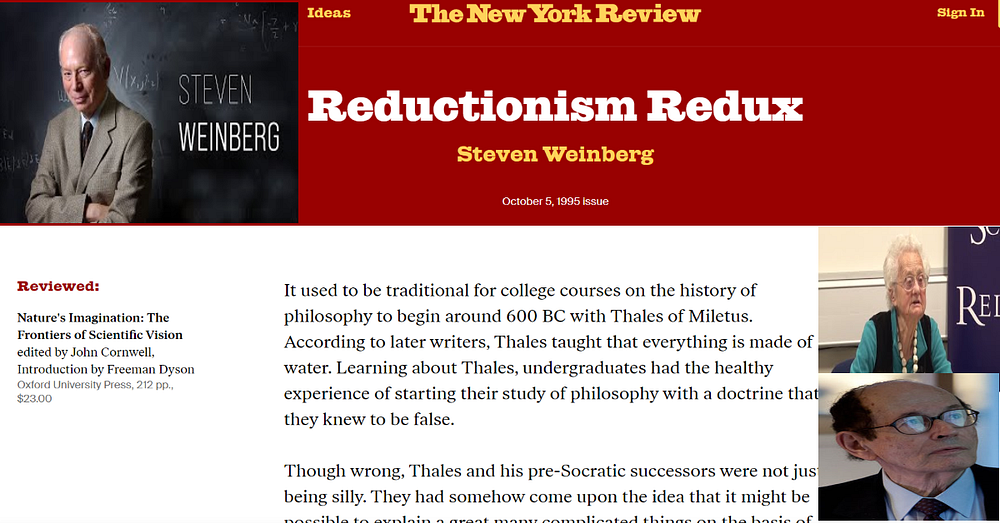
Right: Mary Midgley and Gerald Edelman

“A reductionist analysis could decompose the words into their individual letters, the letters into the chemical constituents making up the black ink on white paper [] it would not tell you about the meaning of the letters combined as words, sentences, and paragraphs.”

— The English neuroscientist and science spokesman for the Socialist Workers Party Steven Rose (1938-) stating something that literally no one would ever attempt to do. (See source of quote here.)

************************************


(i) Introduction 
(ii) Mary Midgley on Reductive Megalomania
(iii) Gerald Edelman on Silly Reductionism
(iv) Steven Weinberg on Persons and Consciousness
(v) Jackson, Chalmers and Weinberg on Physical Entailment


Steven Weinberg (1933 — 2021) was an American theoretical physicist who won the 1979 Nobel Prize in Physics for his contributions (along with Abdus Salam and Sheldon Glashow) to the unification of the weak nuclear force and electromagnetism. His work on elementary particles and physical cosmology earned him many awards and prizes, including the 1991 National Medal of Science.

Weinberg was a professor at the University of Texas at Austin, where he was a member of the Physics and Astronomy Departments. He was elected to the American Philosophical Society, the U.S. National Academy of Sciences, Britain’s Royal Society and the American Academy of Arts and Sciences. Weinberg also served as president of the Philosophical Society of Texas, a consultant at the U.S. Arms Control and Disarmament Agency and the Council of Scholars of the Library of Congress. Weinberg received the Benjamin Franklin Medal of the American Philosophical Society in 2004. This society stated that he was “considered by many to be the preeminent theoretical physicist alive in the world today”.
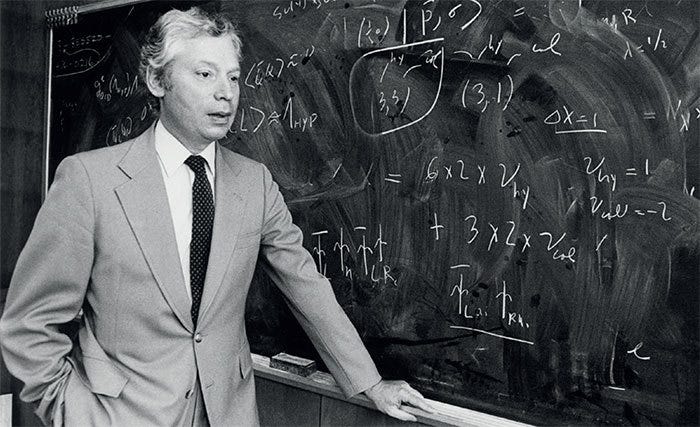
A younger Steven Weinberg.

Most of Steven Weinberg’s words in the following essay can be found in his article ‘Reductionism Redux’, which was originally published in The New York Review in 1995. This article itself can be found in Weinberg’s book, Facing Up: Science and Its Cultural Adversaries (2001).

Mary Midgley on Reductive Megalomania

A younger Mary Midgley.

In his book Facing Up: Science and Its Cultural Adversaries, Steven Weinberg discussed the British philosopher Mary Midgley (1919–2018) and her strong stance against reductionism. Weinberg primarily responded to Mary Midgley’s words as they can be found in her article ‘Reductive Megalomania’, which itself appears in the book, Nature’s Imagination: The Frontiers of Scientific Vision.

Mary Midgley asked the following questions:

“‘What, for instance, about a factual statement like ‘George was allowed home from prison at last on Saturday?’ How will the language of physics convey the meaning of ‘Sunday’? or ‘home’ or ‘allowed’ or ‘prison’? or ‘at last’? or even ‘George’?’”

Weinberg responded to this passage by saying that

[t]his criticism would strike home if there were physicists who were trying to use physics for such a purpose, but I don’t know of any”.

Indeed one must try and give Midgley the benefit of the doubt here and assume that she must have been discussing (as it were) possible reductionism. Thus, perhaps Midgley simply meant that reductionism could go down this rabbit hole if we (or if scientists) weren’t careful. So perhaps she wasn’t actually claiming that any physicists have attempted to reduce statements like “George was allowed home from prison at last on Saturday” to physics — yet she still believed that this could be the case if we don’t watch out.

As it is, it can be doubted that this last interpretation is correct. Why is that? It’s because this is precisely how many self-styled anti-reductionists do see reductionism — with its (to use E.O. Wilson’s words) “hissing suffix”.

Weinberg didn’t go into much philosophical and/or scientific detail about Midgley’s words. So I’ll need to add some details myself.

Firstly, no physicist would ever even attempt to reduce the sentence “George was allowed home from prison at last on Saturday” (or even the referents of any of the words within it) to physics because that sentence and its contents simply aren’t in the domain of physics. (Mary Midgley herself didn’t explain why she believed that some — or any — physicists would want to reduce that sentence to physics.)

That last statement about not reducing “George was allowed home from prison at last on Saturday?” to physics isn’t an expression of what anti-reductionists would warn reductionists against. No physicist himself would deem this area to be the domain of physics. Indeed the very idea of reducing the event (let alone the previous sentence) of George being let out of prison, George himself, a prison, Saturday, etc. to physics seems ridiculous.

Weinberg himself spots the problem with Midgley’s position or at least what her position can lead to or what it may imply. Although he didn’t state that Midgley held this position herself, Weinberg did claim that

“many of our fellow citizens think that George behaves the way he does because he has a soul that is governed by laws quite unrelated to those that govern particles or thunderstorms”.

What now needs to be said is that many non-religious philosophers and laypersons also take this position without also believing in a soul (at least as the soul is seen in various religions). Arguably, all (or at least most) anti-physicalists do take the position expressed by Weinberg directly above. However, in order to see that all the reader needs to do is take out the word “soul” and substitute it with the word “mind”, “consciousness” or “person”.

[In a few moments it will be seen that Gerald Edelman did indeed use the word “soul” in his article, ‘Memory and the Individual Soul: Against Silly Reductionism’.]

To get back to Mary Midgley.

So who, exactly, was Midgley arguing against and warning us about?

Perhaps it was the English molecular biologist and neuroscientist Francis Crick (1916–2004).

More accurately, perhaps it was a very-well-known passage from Crick which has been quoted innumerable times (nearly always negatively or critically). In fact, if readers Google the passage, there are 19 pages of links (with 10 entries on each page — that’s 190 separate links) to papers, articles, essays, books, etc. which fully quote Crick’s words (see here).

That infamous passage can be found in Francis Crick’s 1994 book, The Astonishing Hypothesis: The Scientific Search for the Soul. So here goes:

“‘You’, your joys and your sorrows, your memories and your ambitions, your sense of personal identity and free will, are in fact no more than the behavior of a vast assembly of nerve cells and their associated molecules.”

And, guess what, Mary Midgley did indeed refer (more than once) to this passage from Crick! For example, she did so in her book Are You an Illusion?. (See also her references to it in the Guardian, New York Times and Philosophy Now — see here, here and here.)

I myself have quoted this passage twice (in two essays) in recent months and other times over the years. (See my ‘Francis Crick’s Deliberately Provocative Reductionism’.)

So this passage was worth quoting again simply because I suspect that it is the main — perhaps exclusive — source of what many anti-reductionists take reductionism to be (or, at the very least, what they believe it can be).

However, to add something new here (i.e., something not in my previous essay on Crick), it can be said that even in those infamous words above, Crick isn’t literally advising reducing “‘you’, your joys and your sorrows, your memories and your ambitions, your sense of personal identity and free will” to the brain, neurons, biochemistry or to anything else — at least not explicitly.

But, firstly, it must be said that Crick’s phrase “no more than” is problematic. It is vague. And it may well be simply metaphorical or rhetorical too.

More relevantly to the issue of reductionism.

Stating that “x is no more than y” isn’t also an explicit claim that x can be reduced to y. (See final section on physical entailment.) It can mean this in that in some cases a given x could be reduced to y. However, it doesn’t necessarily mean that. That is, x may be no more than y even though it would still be impossible to (fully) reduce x to y. (Perhaps for reasons of complexity, the difficulties of “inter-theoretic” reduction, the clash of concepts from different disciplines, etc.)

Steven Weinberg also focusses on Francis Crick’s fellow biologist and neuroscientist Gerald Edelman and his now widely-known stance against what he called “silly reductionism”.

Gerald Edelman on Silly Reductionism

A younger Gerald Edelman

Gerald Edleman’s following words also appear in the same book as Midgley’s (i.e., in Nature’s Imagination: The Frontiers of Scientific Vision). His article is called ‘Memory and the Individual Soul: Against Silly Reductionism’.

Steven Weinberg quoted Gerald Edelman putting his general position against the

“kind of reductionism that doomed the thinkers of the Enlightenment is confuted by evidence that has emerged both from modern neuroscience and from modern physics”.

It can be doubted that were many scientists and philosophers in the 20th century — or even in the 19th century — who believed the kinds of things Gerald Edelman stated that they believed. (I’m willing to be contradicted on that because you can always find extreme or silly positions — on literally any subject — if one looks hard enough for them.)

In any case, Edelman continued:

‘[A] person is not explainable in molecular, field-theoretical, or physiological terms alone. To reduce a theory of an individual’s behavior to a theory of molecular interactions is simply silly. [] Even given the success of reductionism in physics, chemistry, and molecular biology, it nonetheless becomes silly reductionism when it is applied exclusively to the matter of the mind.’”

Now for a simple question:

Has any reductionist (or person deemed to be a reductionist) ever claimed that a person — yes, person — is “explainable in molecular, field-theoretical, or physiological terms alone”?

… Other than, say, Francis Crick (as already discussed)?

More specifically, since when has any scientist who deals with molecular chemistry, field theory or physiology ever taken persons to be their subject matter?

So let’s concentrate on two important words used by Edleman: “person” and “alone”.

Personhood (or the nature of a person) is a philosophical subject and term which, at the most, has been covered by social scientists.

What’s more, even if a field theorist, chemist or physiologist did tackle the nature and status of a person, would he or she claim that field theory, chemistry or physiology (to use Edleman’s word) “alone” would provide a complete explanation of such a thing?

Like Weinberg, I personally haven’t come across any field theorist, chemist or physiologist who’s made such claims…

So perhaps it has been others — i.e., people who aren’t natural scientists — who’ve made these claims. Perhaps, say, philosophers or scientists of other disciplines have done so. This would mean that such philosophers and/or scientists have used the data of field theory, chemistry and physiology to advance their claims that persons are (literally) fields or chemical and/or physiological mechanisms alone

Yet even this can be doubted because it would entail a literal identity between a given person and his fields or his chemicals and/or physiological mechanisms.

Weinberg himself goes into detail on Edelman’s position here:

“When Edelman says that a person cannot be reduced to molecular interactions, is he saying anything different (except in degree) than a botanist or a meteorologist who says that a rose or a thunderstorm cannot be reduced to molecular interactions?”

So why is such a reduction of a rose or a thunderstorm (to put it modally and strongly) impossible?

Well, Weinberg goes on to say that

[i]t may or may not be silly to pursue reductionist programs of research on complicated systems that are strongly conditioned by history, like brains or roses or thunderstorms”.

This means that the complexity of a given system itself can’t be fully explained in the language of atoms, particles, forces and fundamental laws, and neither can the contingencies of its history.

More relevantly, what isn’t silly is the

“perspective [] provided by reductionism, that apart from historical accidents these things ultimately are the way they are because of the fundamental principles of physics”.

So was all this a case of Edleman tilting at windmills?

And was Edelman doing so simply to prove that he wasn’t a boneheaded reductionist? And if Edleman did want to prove that, then why did he do so?…

Perhaps Edelman did so because reductionism was precisely what he himself had previously been accused of on a few occasions! (This was before he was seen as being an anti-reductionist — see here, here and here.)

Interestingly enough, Steven Weinberg himself — just like Edelman — did appear to offer a single exception to his general reductionism: the human person. Or more specifically: consciousness.

Steven Weinberg on Persons and Consciousness

Take this passage from Weinberg:

“But it seems to me that [Peter] Atkins is not sufficiently sensitive to the problems surrounding consciousness. I don’t see how anyone but George will ever know how it feels to be George.”

It’s not clear if how it feels to be George could ever be the subject of any reduction. One important reason for that is that it’s not even clear what phrases like “how it feels for George” mean.

In any case, there have been many philosophers (if not scientists) who’re both naturalists and physicalists and who also fully accept the first-person perspective on things. (The philosopher Owen Flanagan is a very good example of this. See my ‘Yes, Thomas Nagel, x can’t know what it’s like to be y.) They also accept that first-person perspectives can’t be reduced. That said, they also believe that this fact (if fact is the right word here) most certainly doesn’t work against either physicalism or naturalism.

So do self-styled reductionists also accept all this?…

Prima facie, it’s not entirely clear that Steven Weinberg himself ruled out a reduction of consciousness or the human person to physics because he did continue with the following words:

“On the other hand, I can readily believe that at least in principle we will one day be able to explain all of George’s behavior reductively, including what he says about how he feels, and that consciousness will be one of the emergent higher-level concepts appearing in this explanation.”

This seems to be Weinberg putting Daniel Dennett’s heterophenomenological position (see ‘Heterophenomenology’). This isn’t to say that Weinberg knew about Dennett’s position. However, it is very similar to it.

It would be best, then, to split the passage above into two parts.

The first part is Weinberg’s advocacy of heterophenomenology:

“I can readily believe that at least in principle we will one day be able to explain all of George’s behavior reductively, including what he says about how he feels [].”

But then Weinberg seems to go beyond Dennett when he concluded:

[C]onsciousness will be one of the emergent higher-level concepts appearing in this explanation.”

To Dennett, a scientist or philosopher can — and should — happily analyse what George says about “how he feels”. He can even analyse George’s own personal — and perhaps philosophical — words about his own consciousness and mind. That said, the scientific or philosophical heterophenomenologist still won’t be analysing George’s actual feelings, consciousness and mind: he’ll be analysing what George says about these things. (Some people interpret Dennett as holding the position that what George, heterophenomenologists and scientists say about x actually is x.)

All that said, would Dennett also accept (as Weinberg did) that consciousness is (to use Weinberg’s words) “one of the emergent higher-level concepts”? Indeed does Dennett accept consciousness at all?…

Well, Dennett both does and does not accept consciousness. That’s primarily because it all depends on how he — and others — define the term “consciousness”.

What’s more, there’s a big difference between “emergent higher-level concepts” and emergent higher-level… things. That is, the concept [consciousness] may well be useful. However, consciousness may still not be a thing or even a process (i.e., depending on definitions).

To Dennett (if not to Weinberg), consciousness isn’t anything above and beyond (to use Weinberg’s own words) “George’s behavior [and] what he says about how he feels”. (Saying things is a form of behaviour.) More accurately, consciousness isn’t above and beyond anything heterophenomenologists, scientists and/or philosophers could glean from George’s bodily behaviour, history and environment, his verbal statements, his brain and body, etc.

Jackson, Chalmers and Weinberg on Physical Entailment
The philosopher Frank Jackson’s position is also fairly close to Steven Weinberg’s, at least as it’s advanced in the following:

“But it is quite another question whether they must hold that θ a priori entails everything about our psychology, including its phenomenal side, and so quite another question whether they must hold that it is in principle possible to deduce from the full physical story alone what it is like to see red or smell a rose — the key assumption in the knowledge argument that materialism leaves out qualia.”

Frank Jackson’s first clause above (i.e., “that θ a priori entails everything about our psychology”) expresses a position which is similar to Weinberg’s. Yet, more concretely, Weinberg didn’t also believe (as we’ve seen with the discussion about George) “that it is in principle possible to deduce from the full physical story alone […] what it is like to see red or smell a rose”.

Thus, here we have a clash (or simply a difference) between entailment and deduction. More clearly, the physical may entail (to put it grandly) everything in the sense that without the physical (as well as everything about the physical) there would be no feels or (I dare say) qualia. However, from our current — and perhaps future — knowledge of the physical, we still can’t know everything.

[It may be questioned whether there can be such a thing as physical entailment for the simple reason that entailment is usually a logical term used exclusively about statements/propositions, symbols, equations, etc.]

Weinberg himself expressed this position (though he didn’t discuss consciousness or persons) in the following passage:

“Each science deals with nature on its own terms because each science finds something else in nature that is interesting.”

But he then continued:

“Nevertheless, there is a sense that the principles of statistical mechanics are what they are because of the properties of the particles out of which bodies are composed.”

The Australian philosopher David Chalmers (1966-) also made a distinction between entailment and deduction. (He didn’t use the word “deduction”.) He wrote:

“I am making the much weaker claim that high-level facts are entailed by all the microphysical facts (perhaps along with microphysical laws).”

These “high-level facts” (or Weinberg’s “emergent higher-level concepts”) aren’t themselves “microphysical facts”. They are entailed by the microphysical facts. This means two things:

(1) Without x’s microphysical facts, there would be no high-level facts when it comes to x.
(2) x’s microphysical facts (along with their entailments) alone don’t tell us everything. (They don’t, in this case, tell us about x’s high-level facts.)

There’s still a slight divergence in terminology here.

Whereas Weinberg uses the (philosophical) term “emergent”, Chalmers uses the term “supervene”. But that’s not an immediate problem. It can now be said that Weinberg’s “emergent higher-level concepts” supervene on the lower-level microphysical facts…

Yet there’s still one problem here which has already been mentioned.

Weinberg’s concepts can’t supervene on anything (except in a vague or metaphorical sense). Only things, conditions, properties, etc. can do so. In any case, it’s clear that Chalmers himself wasn’t discussing concepts in the words quoted above. He was discussing higher-level “properties, facts and laws”. So concepts emerging at a higher level is very different to things emerging at a higher level. Indeed higher-level concepts can (as it were) emerge without any actual physical emergence.

So it’s clear that Weinberg’s words “emergent higher-level concepts” are metaphorical (at least the word “emergent” is). Indeed, elsewhere Weinberg concedes this when he tells us that “new concepts ‘emerge’ when we deal with fluids or many-body systems”. Weinberg puts scare quotes around the word “emerge”. This means that when, say, things get complex, then new concepts may — or will — emerge. That is, such new concepts may be required to understand and explain things. However, that complexity may not have also resulted in any genuine physical emergence.




Sunday, 9 October 2022

Why The Big Bang Theory’s Sheldon Cooper Gave Up on String Theory

Sheldon Cooper (of The Big Bang Theory) sorrowfully said that he’d “devoted the prime of [his] life to string theory” initially because it “seemed so elegant at the time”. He then came to “realize [that he] was just a simple country boy seduced by a big city theory with variables in all the right places”.

This piece is about the fictional character Sheldon Cooper (yes, he’s got his own Wikipedia page!) and his farewell to string theory. More particularly, it’s based on episode 20 of series 7 of The Big Bang Theory, ‘The Relationship Diremption’, in which Sheldon experiences a reverse Damascene conversion.

The character Sheldon Cooper is (or was) a theoretical physicist who studied at The California Institute of Technology (Caltech). He also studied for a year at the University of Keighley’s renowned Cooking and Media Studies Department in the United Kingdom’s Republic of Yorkshire

So, I suppose, this is just a bit of fun.

However, I still agree with the “software architect” and prolific contributor to Quora, Viktor T. Toth, who stated the following:

[T]his sitcom does a better job in some ways than many popular science documentaries that I have seen. So, while ‘accurate’ is not the word I would use, Sheldon’s description is not nonsense. [] One of the reasons why I like The Big Bang Theory is that it does not disrespect the science that it mocks.”

Sheldon Cooper and String Theory

Sheldon Cooper had been committed to string theory since he was a young teenager (or, perhaps, since he was a foetus?) and remained committed to it during 12 seasons of The Big Bang Theory. The character Leonard Hofstadter himself said (in the episode featured here) that Sheldon had been working on string theory “for the last twenty years”. That would take Sheldon back to 1994, when he was only 14. (Despite being a lowly experimental physicist and Sheldon’s best friend, Hofstadter could make people literally disappear, turn treacle into pure gold and reverse time in his bathroom.)

Sheldon Cooper and Leonard Hofstadter

Of course it needs to be said from the very start that Sheldon Cooper (or a real flesh-and-blood equivalent) being unhappy with his own research into string theory isn’t itself an absolute indictment of the theory. After all, if science is a communal activity, then string theory must also be a communal activity. Thus, one single individual giving up on string theory shouldn’t count for much — even if that individual is a self-proclaimed genius.

That said, not only Sheldon Cooper was unhappy with string theory back in 2014. Many physicists — including several Nobel prize winners — had already argued that string theory is a scientific dead-end. Yet, here again (i.e., as with Sheldon-the-individual-physicist), it’s not the case that simply because some — or even many — physicists are unhappy with string theory, then that must also mean that it really is a dead-end.

[Note: M-theory isn’t mentioned in this episode. However, a theoretical physicist working in 2014 would certainly have known about it. Indeed Sheldon himself refers to things which seem to be taken straight from M-theory, which dates back to 1995.]

Sheldon Cooper’s New Position on String Theory

Sheldon Cooper stated his new position (i.e., in 2014) on string theory in the following way:

“All right. I’ve devoted the prime of my life to string theory and its quest for the compactification of extra dimensions. I’ve got nothing to show for it, and I feel like a fool.”

He continued:

“I know. As hard as this is, I have to move on. I can’t keep postulating multidimensional entities and get nothing in return. I have needs, too.”

[For those nerds who’re interested in the “compactification of extra dimensions” and “multidimensional entities”, see here and here.]

Sheldon then gave a retrospective account of his youthful conversion to string theory:

[String theory] seemed so elegant at the time, but now I realize I was just a simple country boy seduced by a big city theory with variables in all the right places.”

This chimes in with what many physicists themselves have stated over the last couple of decades.

Sociologically, it was indeed the case that in the 1980s (although Sheldon himself wasn’t born until 1980) many talented young physicists were encouraged (by their professors and teachers) to take up string theory.

Barry Kripke and Sheldon Cooper

Interestingly and kinda on the same theme, Sheldon’s rival, Barry Kripke, classed himself (in the same episode) as a “stwing pwagmatist”. What on earth is that? Kripke explained:

I say I’m gonna pwove something that cannot be pwoved, I appwy for gwant money, and then I spend it on wiquor and bwoads.

To which Sheldon responded:

“Do you think he is right? Am I wasting my life on a theory which can never be proven?”

All this happened largely as a result of the monumental claims and grand promises of string theory.

And now those formerly-young physicists are middle-aged (or older) tenured professors who’ve spent their entire professional lives devoted to string theory. (This is unlike Sheldon himself, who was about 33 — looking about 6 — in this 2014 episode.) So what else could these professors now do? And if they were to do something else, then would they still be able to pay their mortgages, go on as many holidays, etc?

Some of these issues can be found in Lee Smolin’s book The Trouble with Physics: The Rise of String Theory, the Fall of a Science, and What Comes Next. This book also contains a chapter called ‘How Do You Fight Sociology?’, which is relevant here. (This chapter’s title could be misread as being against sociology — it’s not.)

Lee Smolin on the Sociology of String Theory

Lee Smolin’s The Trouble With Physics was written eight years before Sheldon’s own rejection of string theory in 2014.

In his blog post ‘Response to Criticism’, Smolin wrote the following:

“To discuss some sociological issues in contemporary academic science which I argue are slowing the progress of science, and to propose solutions to them.”

In The Problem With Physics itself and on string theory specifically, Smolin wrote:

“String theory is a powerful, well-motivated idea and deserves much of the work that has been devoted to it. [] The real question is not why we have expended so much energy on string theory but why we haven’t expended nearly enough on alternative approaches.”

It’s worth noting here that Smolin’s (as it were) sociological view of string theory isn’t original to him: it dates back to at least 1987. In that year, American theoretical physicist and string theorist David Gross made the following controversial comments (as quoted by Peter Woit — see later) about some of the reasons for the popularity of string theory:

“The most important [reason] is that there are no other good ideas around. That’s what gets most people into it. When people started to get interested in string theory they didn’t know anything about it. [] So I think the real reason why people have got attracted by it is because there is no other game in town. All other approaches of constructing grand unified theories, which were more conservative to begin with, and only gradually became more and more radical, have failed, and this game hasn’t failed yet.”

The theoretical physicist Peter Woit (in his book Not Even Wrong: The Failure of String Theory and the Search for Unity in Physical Law) also viewed the academic, sociological and intellectual hegemony of string theory as being bad news for the future of fundamental physics. And perhaps even more sociologically, he argued that string theory’s popularity was at least partly a result of the financial and political nature of academia. More importantly and narrowly, the hegemony of string theory was partly — or even mainly — down to the mad academic competition for scarce resources.

In addition, in his book The Road to Reality, mathematical physicist Roger Penrose had this to say:

“The often frantic competitiveness that this ease of communication engenders leads to bandwagon effects, where researchers fear to be left behind if they do not join in.”

Some readers may now be wondering if the “string theory revolution” was itself a Kuhnian paradigm shift. The same readers may also wonder if it will take another revolution to shift away from string theory. That said, these claims may include a too broad and vague use of Thomas Kuhn’s notion of a paradigm shift. (Smolin himself discussed Kuhn on six different pages in The Problem With Physics.) And it will especially irk those physicists and philosophers who don’t accept this Kuhnian notion in the first place. Indeed it will also irk those string theorists who don’t see string theory as a paradigm shift at all. (String theory might well have been very important and also a huge advance in physics, yet still not have been a paradigm shift.)

In terms of Sheldon’s own history, psychology and sociology, his conversion to string theory was itself utterly contingent and based on happenstance.

Sheldon and the Emotional Appeal of String Theory

                                                                                                     God

In the episode ‘The Relationship Diremption’, Sheldon admitted that he “didn’t seek out string theory”. Instead, string theory “just hit [him] over the head one day”. In detail:

“A bully chased me through the school library and hit me over the head with the biggest book he could find.”

That book was on string theory.

Of course this biographical account is a joke… with an element of sociological and psychological truth.

Like many physicists, the fundamental and all-encompassing nature of string theory appealed to the young Sheldon. Indeed this is the kind of thing which drives many theoretical physicists. For example, take someone like Michio Kaku and his — to be rhetorical for a moment - obsession with finding a “theory of everything” (what Kaku calls “the God Equation”), which, like Sheldon, dates back to his childhood.

Sheldon himself expressed his position in his usual highfalutin and dismissive way in the following:

“You want me to give up string theory for something that’s less advanced? You know, why don’t you break up with Penny and start dating a brown bear?”

So clearly Sheldon was still (i.e., in this episode) having second thoughts about giving up string theory.

Many physicists — and commentators! — might have said (at least in 2014) that Sheldon made the wrong move. They might have argued that most worthy theoretical physicists still knew that string theory is the only feasible way of going beyond the overall framework of quantum field theory. Indeed they’d have gone further than that and also have argued that when it comes to a unified theory, there’ve been no other viable alternatives to string theory. Basically, then, they’ll have stated that there’s simply no alternative to string theory… In fact many string theorists, over the years, have stated precisely that!

Of course string theorists — who include several Nobel prize winners — have fought back against all the criticisms. Among other things, they’ve told us that string theory has led to many important breakthroughs in both mathematics and in physics.

Sheldon and Fowler’s Super-Asymmetry Theory

Amy Fowler Fowler and Sheldon Cooper

Perhaps the biggest joke at string theory’s expense (in The Big Bang Theory) is the story of Sheldon Cooper and Amy Fowler Fowler publishing a paper on what they called “super-asymmetry”. This theory was meant to be true of (or refer to) precisely nothing in the actual (or real) world, but which nonetheless won them a Nobel Prize.

Of course super-asymmetry doesn’t actually exist in physics. What’s more, super-asymmetry (even if real) wouldn’t — strictly speaking — be a purely string theory… theory. However, it would still be closely related to string theory.

All that said, the script writers of The Big Bang Theory did talk to their “science consultant”, Professor David Saltzberg. They requested that Saltzberg come up with a fictional theory which was worthy of a Nobel Prize.

This is how Don Lincoln (a senior scientist at Fermi National Accelerator Laboratory) put it:

“To begin with, there is no real theory called Super Asymmetry. However, there is a theory called supersymmetry, which is a very popular extension of the standard model of particle physics — our best current theory of subatomic matter. While there has been no experimental confirmation of supersymmetry — which proposes that every particle identified in the standard model has a supersymmetric partner — it is well enough regarded that there exist over 10,000 scientific papers on the topic. So, except for the poetic license on the name change, we’ll give them that.”

Dr. Saltzberg himself put it this way:

“Theoreticians love symmetrical equations, but the world around us is clearly asymmetrical. What theoretical physicists often do is create a theory with lots of symmetry, but then break it, to explain our world. [] The brilliance of Sheldon and Amy was to include asymmetry into their theory from the start.”

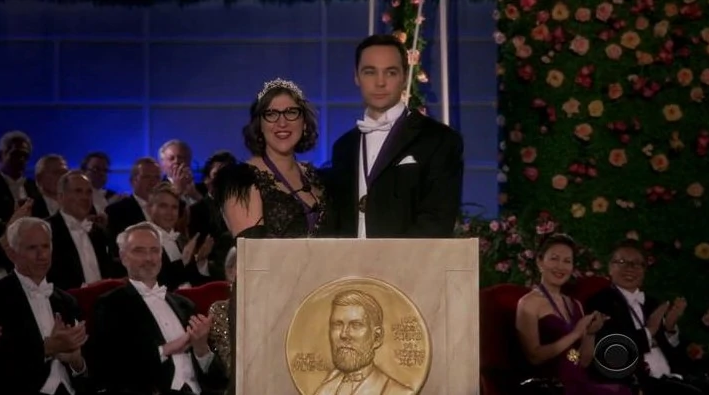
At the end of the series, Sheldon and Amy win the Nobel Prize (see here) for their super-asymmetry theory.

Final Note

It’s now worth stating that in 2017 (i.e., some 4 years after the episode featured in this piece) Sheldon Cooper still seemed to be flirting with string theory. (See series 11 episode 13, The Solo Oscillation.) For example, his renewed excitement about string theory occurred during a conversation with Penny.

In that conversation, Sheldon explained (in response to Penny’s questions) that there are no knots in more than four dimensions. (See the mathematics here.) So, instead, he thought of them as sheets or branes. This shows us a partly fictitious addition to string theory (partly because branes were first discussed as early as the 1980s), which rode alongside the many (still fictitious?) additions which have been constructed by real-life string theorists.


Friday, 7 October 2022

Contemporary Philosophers Both Big Up and Play Down Metaphysics

Philosopher David Manley claims that “most contemporary metaphysicians are concerned with the reality that is represented” and not with “language and thoughts”. Other (analytic) philosophers argue that much (analytic) metaphysics is “shallow” and “merely verbal”. More technically, they argue that such metaphysicians make claims which simply aren’t “truth-evaluable”.

Professor David Manley (at the University of Michigan) believes that

[m]ost contemporary metaphysicians think of themselves as concerned, not primarily with the representations of language and thoughts, but with the reality that is represented”.

David Manley goes on to write that this

“approach in mainstream metaphysics [has] only come to ascendancy lately, and is still widely challenged”.
David Manley

Manley also tells us that metaphysics “is concerned with the foundations of reality”. He continues:

“It asks questions about the nature of the world, such as: Aside from concrete objects, are there also abstract objects like numbers and properties? Does every event have a cause? What is the nature of possibility and necessity? When do several things make up a single bigger thing? Do the past and future exist? And so on.”

So what if a philosopher were to say, to take just one possible retort, the following? -

The idea of there being “foundations of reality” is preposterous.

It can even be said that talk of “the nature of the world” (rather than, say, the plural natures) raises a few questions too. In addition, why accept any distinction at all between abstract and concrete objects? Or, alternatively, perhaps there are other kinds of objects other than those which are abstract and concrete. Perhaps some metaphysicians even question that there are events in the way that others question the existence of objects. And so on.

Possibly all these questions can legitimately be asked, and it still be acceptable to talk about “the foundations of reality”, “the nature of the world”, etc. After all, the discussion must start somewhere. And even if a metaphysician rejects everything contained in Manley’s short descriptive account of metaphysics, then these basic distinctions may still be accepted by many — or even most — metaphysicians.

In a very basic sense, then, what Manley describes seems to be classic metaphysical realism— however you slice it. Thus, some philosophers may be surprised that this is still the current paradigm (or fashion) for contemporary metaphysicians. Then again, (metaphysical) anti-realism (to take just an alternative) has also only ever been one (other) option in metaphysics.

It can be added here that even though these realist (or non-deflationary— see later) metaphysicians are concerned with “the reality that is represented”, they may still be interested in what contemporary science has to say on reality (or the world). After all, if, as W.V.O Quine argued, it is physics which tells us “what there is”, then surely a metaphysical realist needs to listen. That said, metaphysicians who’ve been strongly committed to the findings of science have also taken various anti-realist positions and positions which are critical of metaphysical realism.

Manley himself stresses the importance of science (actually, physics) to metaphysical realists too when he writes:

“And the preferred methodology for answering these questions is quasi-scientific, of the type recommended by W. V. O. Quine, developed by David Lewis [].”

Strong Deflationism

Many people who are suspicious of what’s now called “analytic metaphysics” will be sympathetic to the position of what Manley calls “strong deflationism”. (That’s if people who dislike metaphysics will even care about a position which criticises it.) So it’s worth stating a few words on analytic metaphysics here.

Analytic metaphysics (see here, here, here, and here) isn’t metaphysics done by analytic philosophers, as the name may suggest. Analytic metaphysics is deemed to be a particular kind of metaphysics within analytic philosophy. In other words, not all metaphysicians who are analytic philosophers also do analytic metaphysics. (Of course some philosophers will reject this distinction and they’d probably even question whether there is such a thing — at least as just described — as analytic metaphysics.)

If we return to strong deflationism. (This term is also used by the American philosopher Theodore (Ted) Sider in his paper/chapter, ‘Ontological Realism’.)

The position of strong deflationism is still a metaphysical position. Indeed whatever position you take on the world (or on anything else for that matter) will contain some assumptions (or even explicit beliefs) which are metaphysical in nature.

So what is strong deflationism? According to Manley, it’s

“[m]otivated in part by intuitions of shallowness, they argue that the dispute is merely verbal, or that the disputants are not making truth-evaluable claims at all”.

Is all (analytic) metaphysics “merely verbal”?

Perhaps not.

One is tempted here to make the (possibly inconsequential and therefore trite) point that there must still be the way the world is.

So:

1) Sure. We talk about the world with words, concepts and theories. We also rely on our embodied/embedded nature and our contingent sensory systems. Etc. However, there is still the way the world is.
2) We may not even be able to (as it were) get at the world unless we use words, concepts or theories, sensory systems, etc. which “distort” or simply change it. However, there is still the way the world is.

Furthermore, what does analytic metaphysics displaying “shallowness” mean here? What are (realist) metaphysicians shallow about? What can they say — metaphysically or otherwise — which isn’t shallow?

Can it really be the case that a dispute — any dispute — can be “merely verbal”? Is that possible — even in principle? (See the final section on David Chalmers’ position later.)

What’s more, if the (analytic) metaphysicians’ claims aren’t (to use Manley’s term) “truth-evaluable”, then what sort of metaphysical (or simply philosophical) claims are truth-evaluable? And what would make them truth-evaluable?

These questions will require answers which must, at least in part, include answers with metaphysical components. (The critics of metaphysical realism may not, and probably will not, deny that they’re committed to at least some form of metaphysics.)

Despite my own questions and points, Manley goes on to say that

“[i]n its new forms, strong deflationism poses as serious a challenge to metaphysics as ever”.

Mild Deflationism

The “mild deflationist” position (as expressed by Manley) is difficult to grasp. Manley tells us that mild deflationists “admit that there is a genuine dispute at issue”. However, they also believe that “it can be resolved in a relatively trivial fashion by reflecting on conceptual or semantic facts”. Moreover, “nothing of substance is left for the metaphysician to investigate”.

So how does all that work?

If these mild deflationists admit that there are “genuine disputes” here; then how can they be entirely resolved by “reflecting on conceptual or semantic facts”?

Of course concepts and semantics are important. However, they can’t possibly tell the whole story.

Indeed can any dispute be merely verbal in any literal sense? That is, can any dispute be entirely “due to differences in the way the disputants are using certain terms”?

So perhaps the problem here is taking the words “merely verbal” too literally. That is, in the sense that surely no one really believes that any dispute is literally all about semantics and/or language… Yet, perhaps, that’s unless any remainder is — by (semantic) definition — “trivial” (or “nothing of substance”).

The only situation in which I can conceive of this position (as it has been stated) working would be when it comes to the position of linguistic idealism or perhaps some other form of idealism — and even then, it’s not clear that it would work.

It’s not surprising, then, that Manley rounds off his description of mild deflationism by stating that

“mild deflationists tend to be motivated more by intuitions of triviality than by the intuition that nothing is really at issue in the dispute”.

Here again we see the word “triviality”. Moreover, Manley hints that if these mild deflationists aren’t motivated “by the intuition that nothing is really at issue in the dispute”, then doesn’t that mean that they may well believe that something really is (or could be) at issue? And if that’s the case, then how is this mild-deflationist circle squared?

Manley’s second point is more telling.

He states that mild deflationists claim that “[n]either side” in a metaphysical dispute “succeeds in making a claim with determinate truth-value”. Surely here the mild deflationist has moved away from the merely verbal if he’s now also talking about truth-values. In other words, if neither metaphysical position x nor the alternative (or conflicting) metaphysical position y (on the same subject) can be given a truth-value, then surely that must mean that the mild deflationist is — even if only tacitly — making a metaphysical statement about the nature of the world. That is, surely he’s arguing that the world couldn’t possibly provide an answer to the question of whether or not position x or position y has a “determinate truth-value”. Thus, that would mean that the mild deflationist is still firmly in the domain of metaphysics.

Let’s now go into a little detail as to the nature of some of these metaphysical issues (i.e., of the kind which are either played up or played down by contemporary philosophers). David Chalmers’ examples are worth considering.

*****************************

David Chalmers on Verbal Disputes and Metaphysical Trivia

The Australian philosopher David Chalmers’ once wrote a paper called ‘Verbal Disputes’. (He also gave a seminar on this subject, which could be found on YouTube.) Many other philosophers have also tackled the problem of whether certain philosophical issues are “merely verbal disputes” (see here). This debate actually goes back through the centuries. And perhaps it was best highlighted by the criticisms of metaphysics by the logical positivists in the 1920s and 1930s.

In terms of contemporary philosophy, the notion that some philosophical issues are merely verbal has often been levelled at analytic metaphysics (as discussed above). Chalmers himself tackles some of these issues. That said, Chalmers never names any names and he certainly doesn’t use the term “analytic metaphysics”.

More particularly, Chalmers discusses such things as whether or not a “random booklike” x is… well, a book. (Or, to use the contemporary jargon, is x only a collection of “particles arranged” bookwise?)

The following is more or less Chalmers’ position on such verbal disputes — at least as I’ve interpreted him and added some detail of my own.

Firstly, let’s take two philosopher-scientists: Smith and Jones.

Philosopher-scientist Smith has access to all the facts, laws, information, etc. about spatiotemporal slice (or state of affairs) A and says that it is x. Philosopher-scientist Jones has access to all the same facts, laws, information, etc. about the same spatiotemporal slice (or state of affairs) A and says that it is y. Yet both Smith and Jones agree on the facts, laws, etc. Thus, this must mean that what Smith and Jones say about A is over and above the facts, laws, etc. In addition to facts, laws, etc., Smith and Jones must have brought in theory, prior beliefs, conceptual decisions, semantics, etc. into the discussion.

The given facts may well be determinate. However, it doesn’t follow from this that what we say about them is also determinate. Or, in another manner of speaking, the facts alone don’t entail what we say about them…

But hang on a minute!

One may now wonder how this clean and neat distinction between facts and what we say about them can be upheld. After all, aren’t the facts (or simply what we take to be the facts) themselves somewhat dependent on what we say?

In any case, David Chalmers himself doesn’t only argue that what we say is indeterminate. He also argues that “the facts [themselves] are indeterminate”.

Much of what’s just been said is fairly standard in science and in the philosophy of science. That is, the very same facts, data, observations and/or evidence may engender different theories. Indeed some philosophers have argued that the very same facts, data, observations and/or evidence could engender a (possible) infinite number of theories. (This situation is called the underdetermination of theory by the data and it’s been widely discussed in philosophy.)

And here again we can question the clean and neat separation of empirical data from the theories which, it seems to be supposed, come later.

Now Chalmers often mentions what he calls “stipulation” in these respects.

The basic point is that if we stipulate what we mean by a particular word, then the answers to the questions about facts, data, evidence, what x is, etc. must — at least partly — follow from such stipulations. Of course some people will be horrified by the argument that acts of stipulation are decisive when it comes to what we take to be matters of fact

Yet it’s not that simple.

Of course there is a problem with over-stressing the importance of stipulation; or even with simply emphasising the importance of stipulation at all. Chalmers sums up this problem with a joke. He wrote:

“One might as well define ‘world peace’ as ‘a ham sandwich.’ Achieving world peace becomes much easier, but it is a hollow achievement.”

As it is, Chalmers only applies his joke to a single case: consciousness. So perhaps it can also be applied to other cases (such as the cases of a random cup, a non-biological virus, etc.). Clearly, even someone who argues that stipulation is important won’t also accept that we can define the words “world peace” as “a ham sandwich. In turn, some philosophers and laypersons will feel just as strongly about claiming that, say, a “computer virus is alive” or that “bacteria learn”.

The philosopher P.M.S. Hacker, for example, holds a very strong position on the philosophers and scientists who use such terms (or words) in ways which are radically at odds with everyday usage (see Hacker’s ‘Languages, Minds and Brain’ in Mindwaves). Many physicists, on the other hand, are very keen on using old words (or terms) in very different ways. (Think here of “information”, “space”, “time”, “intelligence”, “law”, “string”, “hole”, etc.)

Now let’s look at two examples from David Chalmers which are right up the street of analytic metaphysicians: a “cup-shaped object” and a “random book-like entity”.

What are Cups and Books?

David Chalmers asks:

“Is a cup-shaped object made of tissues a cup?”

Now take this question:

Is it the case that if any x functions as a cup, then surely it is a cup?

Here’s another question:

What if this cup-shaped object (or “particles arranged cupwise”) wasn’t designed to be cup?

Well, does that matter?

If any given x holds liquid, and even looks like a cup, then surely it is a cup. Why does it matter whether or not it wasn’t designed to be a cup?

So is whether it does or doesn’t matter a purely stipulative matter? In other words, is the following the case? -

x can only be classed as a “cup” if it were designed to be a cup.

This would mean that any natural object which were used as a cup could never be classed as a “cup” or even be a cup. Yet all sorts of natural things are used as functional devices and which we then name according to their functions (e.g., a stick classed as a “weapon”, extracted venom classed as a “poison”, etc.). Does their natural status stop them from being named “weapons”, “cups”, etc?

In any case, whether people call x a “cup” or not, they’re all still talking about the same x. (This seems to be Chalmers’ central point.) Not only that: all people agree that it looks like a cup and can be used as a cup. The only difference, then, is what Chalmers calls “terminology”.

Here’s another question from Chalmers:

“Is a booklike entity that coagulated randomly into existence a book?”

This strange book’s very existence (or its mere possibility) is a little like the infinite monkey theorem in which, after an infinite amount time in which an infinite number of monkeys play with a typewriter, at least one of them will produce the complete works of Shakespeare. (In an infinite amount of time, surely an infinite number of monkeys will produce the entire works of Shakespeare an infinite number of times.)…

Such is the nature of the logical possibility which Chalmers is so keen on.

In any case, it can be presumed that Chalmers doesn’t argue that x is book-shaped or arranged bookwise. Surely something that’s only shaped like a book can’t be a book. That’s because, after all, it may not have any words in it. Then again, if stipulation rules, then why can’t shape alone be a necessary and sufficient condition for bookhood?

But let’s say that this random book does contain words. Not only that: it contains words which make sense. Here again we can ask the following question:

Is it relevant that this “booklike entity” is natural and that it wasn’t written and produced by a human being?

After all, if it looks like a book and contains grammatical sentences, a coherent story, etc., then surely it must be a book…

And such is the nature of certain debates in analytic metaphysics.