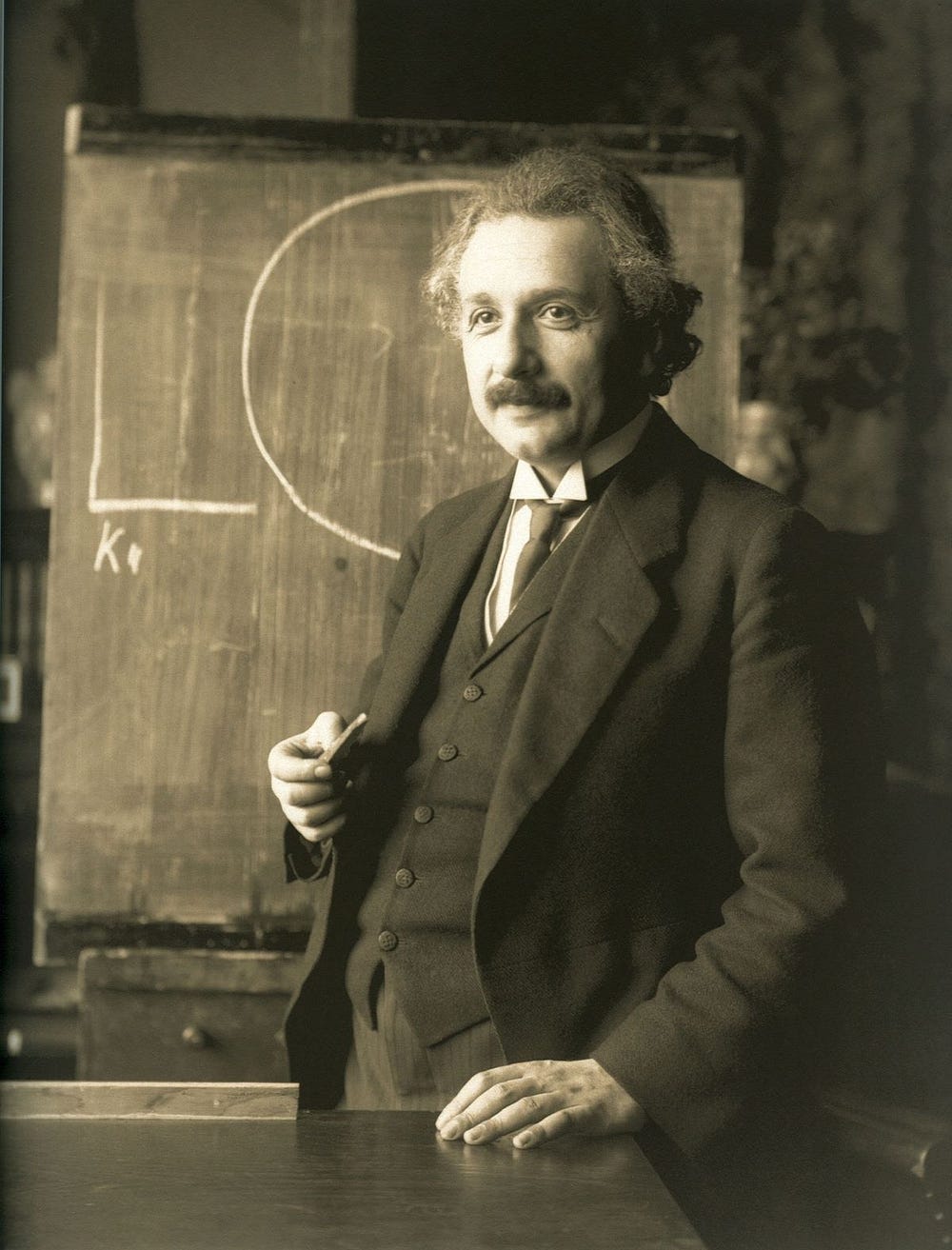
Albert Einstein once referred to the traditional view of science as one which posited a “continuous process of induction” and “the compilation of a classified catalogue”. He believed that this view “slurs over the important part played by intuition and deductive thought”.
In 1916, Albert Einstein offered his readers an account of what he believed traditional scientists — and most laypersons — took science to be.
“From a systematic theoretical point of view, we may imagine the process of evolution of an empirical science to be a continuous process of induction.”
The basic take on science is that it is essentially inductive. Or at least this is what’s usually believed (i.e., by some scientists and philosophers) to be the contemporary layperson’s view. The problem here is that most laypersons don’t actually philosophise about science at all. More particularly, they rarely — if ever — use the word “induction” or “inductive”. That said,some philosophers tell us that a person may have the concept of a word without ever actually using the word itself. Thus, laypersons may have the concept [induction] without ever using the word “induction”.
What’s more likely is that traditional scientists — and laypersons — stressed observations. So Einstein continued:
“Theories are evolved and are expressed in short compass as statements of a large number of individual observations in the form of empirical laws, from which the general laws can be ascertained by comparison.”
Thus, “individual observations” are (or were) often believed to drive the entire scientific show.
[Once again, only empirical research can establish what most (or any) scientists and laypersons actually believe. Yet, anecdotally, this does seem to be the usual position.]
On this (as it were) naive picture of science, then, scientists simply go outside and … well, observe. Alternatively, scientists carry out experiments and then simply observe what happens.
Thus, according to Einstein’s take on the traditional take, scientists collect all their observations together into a large pot (or at the least they collect their “statements” about their observations together), and then they attempt to make sense of them. Or, in Einstein’s own words, scientists extract “empirical laws” (exclusively?) from their observations.
Clearly, innumerable other factors would be required in order to extract empirical laws from observations alone. And then the situation becomes even more complicated when “general laws” are “ascertained” from those observations and empirical laws.
So Einstein was correct to detect the naivety of this view of science. And that’s why he went on to write the following words:
“Regarded in this way, the development of a science bears some resemblance to the compilation of a classified catalogue. It is, as it were, a purely empirical enterprise.”
Thus, scientists are (or at least were) often seen as merely cataloguing nature (or cataloguing their observations of nature). This is almost like scientific (as it were) “stamp collecting”. (As is the case with some accounts of Francis Bacon and his own philosophy of science. See here.) If this process is followed, then, it was believed that everything could be kept scientifically kosher — or empirical. (The reader might have detected unwritten scare quotesaround Einstein’s use of the word empirical.)
Of course, one can immediately ask why scientists were cataloguing the things they werein the first place. Why were they observing those parts of nature and not other parts? Why did they want to “compile[]” the things they compiled and not other things? In other words, there must have been prior factors — above and beyond what it is they observed — that brought about those very same observations.
Einstein himself then explained why this view is both simplistic and naive. He continued:
“But this point of view by no means embraces the whole of the actual process ; for it slurs over the important part played by intuition and deductive thought in the development of an exact science.”
It’s clear, however, that Einstein wasn’t actually entirely ruling out the traditional view of science. This meant (to Einstein) that observations — and even cataloguing — are indeed part of the story of science. That said, these things, according to Einstein, “by no means embrace[] the whole of the actual process”. And it’s here that Einstein adds “intuition and deductive thought [to] the development of an exact science”.
Einstein also wrote the following:
“The theory finds the justification for its existence in the fact that it correlates a large number of single observations [].”
That reference to a “correlat[ion] of a large number of single observations” is a perfect account of a particular kind ofinductive process — enumerative induction.
For example, from the observation — and then correlation — of a large number of white swans, a subject may (or will ) conclude that “all swans are white”. Alternatively, a scientist may develop a (to use Einstein’s word) “theory” about swans and why they are all white. (This may even include natural laws of some kind.)
Einstein had also already mentioned “induction” (though in a critical way) when he wrote:
“we may imagine the process of evolution of an empirical science to be a continuous process of induction”.
One may now ask exactly how a scientist “correlates a large number of single observations”. (Alternatively: How does a scientist — or anyone else - connect the dots about all swans being white?) After all, if the theory “finds its justification [in the] fact that it correlates a large number of single observations”, one may suggest that theories were already required in order to enable those correlations. In simple terms, then, old and accepted theories would have been required (or needed) in order to find a new theory. In the white swans case, in order to conclude that all swans are white, the person who concluded that must have already accepted various other things about swans, the colour white, the whiteness of swans, the nature of observations, biology, ornithology, etc.
Einstein on Intuition and Deductive Thought
Earlier, Einstein was quoted stating that the naive view of science (i.e., discussed so far)
“slurs over the important part played by intuition and deductive thought in the development of an exact science”.
Einstein’s stress on what he calls “intuition” and “deductive thought” is a little odd. Many philosophers of science and scientists today would stress theory here — not intuition and deductive thought. Of course, theory may also be intimately tied to both intuition and deductive thought.
So, firstly, what about the word “intuition”?
In philosophy and mathematics, that word often has very specific and technical meanings (see here). So one wonders if Einstein used itin one of those technical ways himself. Perhaps, instead, Einstein simply meant speculation and/or theorisingby the word “intuition”. That is, intuition (at least within a scientific context) is all thought which goes above and beyond the observational data. Indeed, intuition may also be required to make sense of the observations, and even lay the groundwork for observations.
So what about Einstein’s words “deductive thought”?
In a general and perhaps vague sense, if we have observations (or statements about them), then we can deduce things from those observations. That is, the observations don’t simply stand on their own. Scientists need to make sense of them. In addition, scientists can also deduce (not always logically) other (what Isaac Newton called) “conclusions” from them.
“the investigator develops a system of thought which, in general, is built up logically from a small number of fundamental assumptions, the so-called axioms”.
The quote directly above is Einstein (at least provisionally) treating physics as a kind of (pure) deductive logic. That is, instead of premises from which a conclusion can be derived (or axioms in mathematics which lead to theorems), we have observations and/or “fundamental assumptions” which lead to theories. And, in fact, Einstein himself says that “[w]e call such a system of thought a theory”.
Of course, much of what Einstein wrote about the traditional view of science is too neat and tidy. That is, scientific thinking and scientific practice didn’t really — or didn’t always — adhere to his retrospective formulations. But that’s often what happens in the philosophy of science.
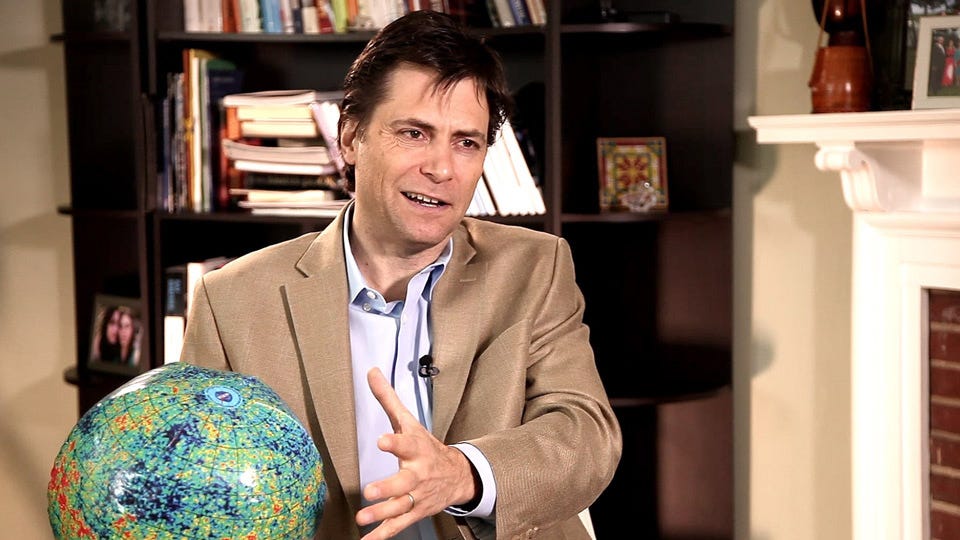
The well-known physicist and AI expert Max Tegmark once wrote the following: “As we prepare to be humbled by ever smarter machines, I suggest that we rebrand ourselves as Homo sentiens!” Is this yet another attempt to place human beings at the top of the universal pile?
I came across a passage written by the Swedish-American cosmologist, physicist and machine learning researcher Max Tegmark in which he seems to be at pains to find abilities (or general characteristics) which truly distinguish human beings from all other… things in the Universe. Alternatively, Tegmark is simply expressing the general mindset of what he calls “we humans”.
“Philosophers like to go Latin on this distinction, by contrasting sapience (the ability to think intelligently) with sentience (the ability to subjectively experience qualia). We humans have built our identity on being Homo sapiens, the smartest entities around. As we prepare to be humbled by ever smarter machines, I suggest that we rebrand ourselves as Homo sentiens!”
Human Beings are Extra Special and Unique?
Max Tegmark
So what’s the passage above all about?
Is it Max Tegmark’s expression of the strong need which so many human beings (or Homo sapiens) have to distinguish themselves from literally everything else?
For centuries, even for millennia, we humans have attempted to distinguish ourselves from other animals — and all else — in the Universe by our sapience. And now that this project has failed (as least according to Tegmark above), now it’s sentience’s turn to be our trump card.
So the same game simply repeats itself.
All sorts of things have been suggested to account for human specialness and uniqueness. That long list includes: language, opposable thumbs, walking upright, big brains, meaning, love, religion, empathy, the ability to play soccer, etc. Thus, the goalposts have kept on shifting. However, arguably some of these traits, abilities or characteristics are still deemed to make us human beings extra special and unique.
Yet, yes, it’s obviously the case that we human beings can do things which no other animal and no computer could ever do. No one would ever deny that.
Thus, human beings can create great — or even insignificant — works of art. No animal can do that. (Some computer programmes — arguably - can do the latter. See ‘Can Computers Create Art?’.) We humans can create religions, fly to the moon, cure diseases, build computers, “see” the truth of Gödelsentences, tell jokes, etc. No animal can do any of these things. And, as yet, no computer (at least without human input) can do any of these things either…
Actually, only a few human beings can do most — or even all — of the things just cited. However, perhaps all human beings have “the potential” to do all of them (see ‘Human potential’)…
But is that true? And what does “human potential” mean in this context?
So can we draw any general conclusions from these (seemingly) unique human abilities? And is there a single unique… something which characterises all of them and which is “purely human”?
As already stated, human beings are indeed unique. However, so too are cockroaches, ants, satellites, stars, bacteria, electrons, etc.
In addition, human beings can do things which animals can’t do. However, every animal can also do things which human beings can’t do.
So are there abilities or characteristics that we humans have, but which other animals and computers don’t have? And are these abilities more important and more unique than all the abilities which animals and computers have, but which we humans don’t have?
Or is it simply that we humans are unique in some extra-special way (or ways)?
Perhaps we are. However, how could that ever be established?
[Much of the above can be placed under the classification anthropocentrism. In addition, some responders have said that I’m really referring to Western culture — and its attitudes — in the above. Indeed, there may be an element of truth to that. That said, it depends on the non-Western cultures which do and don’t differ. And, in parallel, no blanket statement can be made about Western culture either when it comes to this specific subject.]
Sapience and Sentience
Max Tegmark himself believes that the meaning of the word sapience is “the ability to think intelligently”. Of course, the word “intelligence” is one of the slipperiest words around.
For a start, on many readings, an ant or even a cockroach is intelligent — or at least it acts or behaves intelligently. Indeed, the mathematical physicist Roger Penrose writes:
“[T]he behaviour pattern of an ant is enormously complex and subtle. Need we believe that their wonderfully effective control systems are unaided by whatever principle it is that give us our own qualities of understanding?”
And similar things can be said of most — or even all — computers (or computer programmes).
So we can’t decide if it’s (what Penrose — again — would call) “genuine intelligence” until we define “intelligence”. And that’s the problem! Thus, we’ve just moved from sapience to “the ability to think intelligently” to the word “intelligence” on its own.
Now what about Tegmark’s personal choice: sentience?
Sentience doesn’t really help us distinguish ourselves from a whole host of other animal species either. So, in that limited sense, surely sentience can’t play the role previously played by sapience (i.e., when it came to arguing for human specialness and uniqueness). Surely most animals must instantiate varying degrees of sentience too. And, as we’ve seen, perhaps that’s also true of sapience.
In neither the case of sapience nor sentience, then, do we have (as it were) ultra-uniqueness when it comes to human beings.
Finally, it can be noted that human(?) consciousness itself (i.e., not Homo sapiens generally) is said to fall into this category of extra specialness and uniqueness. (In a recent essay, I wrote on this subject.)
Consciousness or Human Consciousness?
In detail. It is argued that consciousness isn’t like other natural phenomena (such as photosynthesis, combustion, cognition and even life itself). Indeed, even many physicalists, naturalists, evolutionary theorists, neuroscientists, etc. freely admit that consciousness isn’t really like other natural phenomena. However, and in many respects, no given natural phenomenon is like any other natural phenomenon. (Think here of an electron’s charge, and then compare that to the mating habits of a baboon.)
Yet consciousness most certainly does have distinct features…
Yet so too does every other natural phenomenon. (Now think of how high a flea can jump relative to its size, or consider superfluidity.)
So are the unique characteristics of consciousness more unique than all these other examples of (as it were) natural uniqueness?
How on earth could a question like that be answered?
And isn’t it actually the case that we adult human beings take consciousness to be unique and extra special simply because consciousness is very important to us? In addition, isn’t all this at least partly down to the fact that we have (at least on most accounts) first-person access to our own consciousness?
********************************
Note: Qualia
It’s interesting that Max Tegmark has used the technical term “qualia” in his definition of sentience. (The term is largely found in analytic philosophy, though it dates back to 1866.)
Even if we accept the existence of qualia (which will depend on what qualia are taken to be), do we actually “experience qualia” or is experience actually constituted by qualia? That is, is each experience (as it were) made up of qualia? Thus, surely we can’t firstly have an experience, and only then do we experience qualia. If that were the case, then an experience and qualia would be two separate things and/or two separate events (which would be separated in time).
Some critics (or downplayers) of the philosophy of science (or philosophy generally) may argue that Isaac Newton didn’t actually have a philosophy of science at all. Instead, he simply did what he did. That is, no matter how complex and reasoned Newton’s maths, observations, experiments, etc. were, it was still “just science”.
“Empiricism is the epistemology which has tried to make sense of the role of observation in the certification of scientific knowledge.” — Alex Rosenberg (see source here)
It’s true that Isaac Newton never used the words “philosophy of science” about his own words and work. Indeed, he wasn’t overly self-conscious about the philosophical and methodological underpinnings of his science. But none of this means that Newton didn’t actually have a philosophy of science or that he didn’t uphold philosophical positions (i.e., as they were directly relevant to his work) on the nature of science itself.
In addition, the classification empiricist science may seem like a truismor even a tautology. At least it’s what many laypeople (though not really many scientists) take science to be anyway. That is, science is often deemed to be mainly (or even only) about observations and experiments… Or at least many laypeople believed that it should be!
All that said, it’s now worth saying that these statements have nothing directly to do with the commonplace fact that science was classed as natural philosophy in the 17th century. In addition, it has nothing to do with the general idea that philosophical ideas and theories underpinned much science in those days (as they continue to do so today).
So, then, this essay is purely about Newton’s very own philosophy of science.
It’s also worth noting here (i.e., to set the scene) that David Hume’s more self-conscious and obvious general philosophy is in some ways like Isaac Newton’s philosophy of science. Indeed, often all one really needs to do is substitute Hume’s 18th-century term “impressions” (or “sense impressions”) for Newton’s earlier term “phenomena”. More relevantly, Hume believed that only concepts “derived from” impressions were relevant and significant. One can even read Hume as arguing that sense impressions are the exclusive source of all the knowledge we have of what he called “matters of fact”.
In terms of concrete examples, then, Hume had a problem with such “hypothetical entities'” as substance, vacuum, necessary connection, the self, etc. (All this can be found in Hume’s book An Enquiry Concerning Human Understanding.) And, similarly, Newton had a problem with such things as the aether, corpuscles and what he called “occult properties”.
Isaac Newton stressed that scientists should observe what he called “phenomena”. (It’s hard to imagine many scientists — or even philosophers — not doing so.)
For example, Newton argued (as did Aristotlebefore him) that a scientist (or a natural philosopher) should carefully examine the world around him. In Newton’s own words:
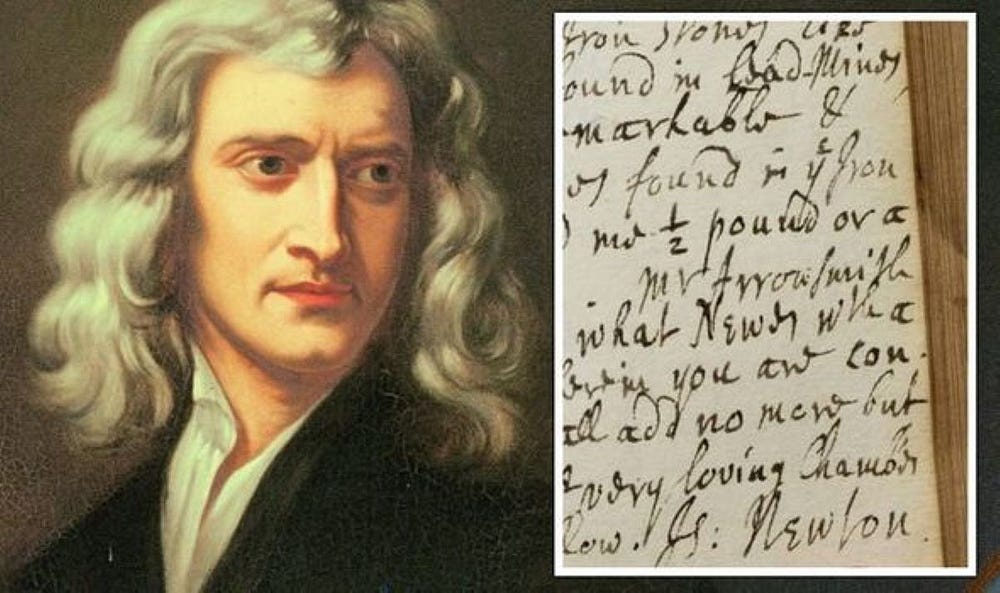
“[A]lthough the arguing from Experiments and Observations by Induction be no Demonstration of general Conclusions, yet it is the best way of arguing which the Nature of Things admits of.”
It can be seen that Newton wasn’t a naive (or absolute) empiricist. In other words, he never believed it was literally all about “experiments and observations”. Yet, arguably, very few scientists — or even philosophers — have ever thought that way in any case. In Newton’s own example, then, he did say that he was arguing “from” experiments and observations. That is, he didn’t say that experiments and observations were the beginning and the end of all science. So Newton’s science was certainly no mere (as the phrase has it) “cataloguingof observations” either.
Still, Newton not being an absolute empiricist doesn’t mean that he wasn’t an empiricist at all.
Technically, Newton’s “conclusions” came from his experiments and observations. Thus, his conclusions weren’t merely (or exclusively) statements about the his actual experiments and observations. This also meant that any moves from experiments and observations to conclusions weren’t determinate or necessary. And that also had the consequence that Newton’s own experiments and observations (indeed all experiments and observations) could have led to different conclusions. Indeed, Newton was well aware of that.
Induction and Deduction
Newton believed that scientific processes must be kept in check in two ways:
(1) Inductive evidence must provide the groundwork of scientific work. (2) The consequences derived from inductive evidence must themselves be experimentally confirmed.
Of course, Newton’s use of the word “induction” needs to be fleshed out a little.
Arguably, there’s no such thing as a purely inductive process. And that’s even before any general “conclusions” are formulated.
Yet all this entirely depends on what Newton — as well as others — meant by the word “induction” in the 17th century.
More specifically, it’s a little difficult to know (or simply accept) what Newton meant by the phrase “arguing from Experiments and Observations by Induction”. That’s primarily because even during any inductive process there’ll still be other processes being employed. In addition, there’ll be theories, biases, prior knowledge, etc. which explain why those particular experiments were carried out in the first place. What’s more, it can be asked why Newton (or anyone else) observed those particular phenomena. Here again, theories, biases, preferences, scientific (as well as other) traditions, etc. must have been lurking in the background all along.
Of course, Newton did note that science involved both induction and deduction (i.e., not only one at the exclusion of the other). He did, after all, stress the drawing out of what he called “consequences”. Yet, here again, this almost seems obvious. Indeed, this stress on both induction and deduction can previously be found in the work of Roger Bacon, Robert Grosseteste, and, later, in the work of Galileo and Francis Bacon.
All that said, Newton certain did (as it were) come down on the side of induction (i.e., as against deduction).
“Thus it was that the impenetrability, the mobility, and the impulsive forces of bodies, and the laws of motion and of gravitation, were discovered.”
But, here again, one can ask: Why these phenomena?
In this case, then, was Newton looking for the properties of impenetrability and impulsive force? And why did he assume any “laws” at all?
So it can even be argued that Newton’s own (as it were) grounding phenomena were already drenched in both theory and philosophy (or metaphysics) from the very beginning.
What’s more, even if Newton’s phenomena were pure, he still never discussed (let alone argued for) that transition from phenomena to the laws of motion or the laws of gravitation. As Rationalists may put it (to use a line of argument found in Laurence BonJour -see here), the phenomena may be as pure and empirical as you like. However, how did Newton (or anyone else) explain the links from the phenomena to any general laws or conclusions? After all, these links aren’t themselves phenomena and neither are they (i.e., in themselves) examples of induction. (This is the case even if the whole process itself can be deemed to be inductive in nature.)
Hypotheses Non Fingo
To put it simply: Newton believed that “theories” were acceptable, and that “hypotheses” were (largely) unacceptable. Of course, Newton used these terms in his very own (17th-century) way.
Yet, predictably, Newton broke his own rules on this strong distinction between theories and hypothesises (as we shall now see).
Newton’s term “theory” is used for that which can be “deduced from” what is observed and/or experimentally produced (or noted). Thus, inductive evidence can lead to a theory about such evidence. This Newtonian account of a scientific theory isn’t really a million miles from how theterm is used today by educated laypersons and even by some scientists. However, Newton’s use of the word “hypothesis” is very odd to 21st-century ears.
For example, Newton once claim that hypotheses were (in relevant cases) about what he called “occult qualities”. And what are occult properties? In basic terms, they’re properties which can’t be observed or “measured”. (It’s odd, then, that some modern day — well — “occultists”, “spiritualists”, etc. often state “That’s just a theory!” to those scientists they disagree with.)
Thus, Newton didn’t like his own theories being classed as hypotheses.
Newton distinguished what can be observed from what may (or may not) underlie what it is scientists observe. In this case, then, scientists can observe certain properties of refraction. Thus, they can form a theory about such properties because they can observe them. However, they can’t observe what may (or may not) underlie such properties. In Newton’s case, then, scientists couldn’t observe (invisible) “waves” or “corpuscles”.
Now take the important — and similar — case of gravitational attraction.
Newton didn’t (or simply claimed not to) hypothesise about the underlyingcausesof gravitational attraction. Indeed, Newton famously stated the following three words: Hypotheses non fingo (“I frame no hypotheses”). Instead, and at least according to his own self-image, Newton simply noted phenomena and (as it were) observed what they did. And clearly — in this case at least — Newton couldn’t observe the underlying causes of gravitational attraction. (Some contemporary analytic philosophers may say that Newton couldn’t observe what they call “intrinsic properties”.)
The French philosopher René Descartes (1596–1650), on the other hand, did believe that he could hypothesise (or even know) about such underlying causes! He believed that gravitational attraction could be (or is) explained by vortices of aether.
Yet, despite all that, Newton did indeed hypothesise.
For example, Newton accepted that the aforementioned corpuscles and the aethermay well exist. However, he still noted that scientists simply couldn’t observe such things. Thus, at best, Newton concluded that what came to be called “hypothetical entities” (or “theoretical entities”) may indeed be of some use in scientific research. However, scientists should never play fast and loose with such entities.
Schrödinger once raised the possibility that the wave function’s “great many alternatives may not be alternatives [at all], but all really happen simultaneously”. He admitted that this idea may “seem lunatic” to “quantum theorists”. The physicist David Deutsch believes these words to be the earliest known reference to what came to be called “many worlds”.
Much that’s controversial and (as it’s often put) weird about quantum mechanics (or at least the wave function) is discussed in the following passage, which was once spoken by Erwin Schrödinger:
“Nearly every result [the quantum theorist] pronounces is about the probability of this or that or that … happening — with usually a great many alternatives. The idea that they may not be alternatives but all really happen simultaneously seems lunatic to him, just impossible. He thinks that if the laws of nature took this form for, let me say, a quarter of an hour, we should find our surroundings rapidly turning into a quagmire, or sort of a featureless jelly or plasma, all contours becoming blurred, we ourselves probably becoming jelly fish. It is strange that he should believe this. For I understand he grants that unobserved nature does behave this way — namely according to the wave equation. The aforesaid alternatives come into play only when we make an observation — which need, of course, not be a scientific observation. Still it would seem that, according to the quantum theorist, nature is prevented from rapid jellification only by our perceiving or observing it … it is a strange decision.”
The physicistErwin Schrödinger (1887-1961) stated these words in 1952, in a lecture he gave in Dublin. At one point in that lecture he said (to his audience) that his words may “seem lunatic”. One wonders, then, if he felt the same way at the height of the “first quantum revolution” (i.e., from the mid-1920s to the 1930s). Or was this a purely retrospective view?
More relevantly, the British physicist David Deutsch (for one) believes the passage above to be the earliest known reference to what came to be called the “many worlds” (see ‘Many-worlds interpretation’) of the wave function.
The Wave Function’s Contradictory Alternatives
Now let’s break the passage above down a little.
Schrödinger told us that
“[n]early every result [the quantum theorist] pronounces is about the probability of this or that or that [] happening — with usually a great many alternatives”.
Schrödinger then offers us his own interpretation of this. He continued by saying that all these probabilities
“may not be alternatives [,] but all really happen simultaneously”.
Well, according to the wave function, they actually do (or simply may) all happen simultaneously…
Or do they?
It depends.
The best way to characterise what Schrödinger meant by the words “great many alternatives” is by citing his own well-knowncat experiment. Of course this is a thought experiment about a “classical” object — a cat! The two alternatives here are: cat alive/cat dead. In this thought experiment, then, both alternatives occur at one and the same time.
Here’s the relevant story.
We can make sense of all this by bringing in another universe. That is, if we bring in another universe, then one cat is alive in that universe and another cat (its counterpart) is dead in our own Universe (or vice versa). So when the box is opened, we find only a dead cat. That box-opening is equivalent to an observation (or the collapse) of the wave function.
And, of course, from the very beginning, Schrödinger believed that this collapse is (as it were) weirder that his his own possibility of alternatives happening simultaneously.
Thus, on Schrödinger’s “lunatic” version, the wave function isn’t collapsed at all (or it’s characterised before any collapse). Instead, one cat is both dead and alive…
So why not argue that there’s a dead cat in our universe and alive cat (its counterpart) in another universe?
It must be stressed here that Schrödinger certainly didn’t put any of this in that way. He simply raised the possibility that all these alternatives can happen simultaneously (i.e., if seen in accordance with the wave function). And this, by inference, must be true of all the quantum (or micro) alternatives (i.e., not cats, but particles, etc.) which are part of each wave function.
Thisissue here can be summed up by saying that such probabilities (or ‘probability amplitudes’) are effectively concretised (or reified) by quantum theorists. Or perhaps it can be said that the wave function itself concretises all (as it were) its probabilities.
So it can basically — as well as accurately — be said that with the (or a) wave function, there are actually many (to use Schrödinger’s words again) “alternatives happening simultaneously”. Thus, such weirdness is entirely a product of the wave function itself.
Do such alternatives simultaneously occur without the (mathematical) wave function?
Of course not.
Indeed, that question hardly makes sense.
We simply don’t know anything about these alternatives (or much else at the quantum level) without the wave function (as well as other mathematics). Thus, in a strong sense, such alternatives (whether happening separately or simultaneously) don’t so much as exist (or have any reality) without the wave function. Indeed, we have no right to speak of “reality” at all in separation of the mathematics.
[Wave functions were used well before the quantum wave function and Schrödinger’s equation.]
So it’s not a surprise that many quantum theorists — and others — have actually questioned the notion of what is called reality. More accurately, what is usually said is something like the following:
Without the mathematics, observations, tests, experiments, etc., there is no reality.
Yet without the wave function itself, there are no observations, experiments, tests, etc. in the first place (at least not ones which can be made scientific sense of).
Schrödinger was, of course, talking about the possibility of all these probabilities (or alternatives) happening simultaneously. Yet most quantum theorists don’t think in terms of all these alternatives existing together in physical reality. It’s the wave function itself which (as it were) makes it seem that way.
Yet in accordance with at least the Copenhagen interpretation, the quantum theorist has no right to say that these many alternatives do not all occur together. That is, if a theorist can’t say anything about an unobserved realm (or a realm beyond the wave equation), then what right has he to say that it can’t be the case that such alternatives all occur together? After all, the wave function is (as it were) telling him that they do all happen together. Thus, in order to demonstrate that they aren’t happening simultaneously, a quantum theorist would need to move beyond the wave function and the maths generally.
But how could he do that?
The Collapse of the Wave Function
Schrödinger pointed out something which has now become commonplace. He stated that there’s nothing in the wave function itself about collapse. Indeed, it was Niels Bohr(and then others) who used this idea to explain why we only find a single (to use Schrödinger’s word again) “alternative” at the end of an experiment, not a quantum superposition of alternatives (or states). What’s more, in a paper published in 1952, Schrödinger went even further when he stated that it’s “patently absurd” that the wave function should
“be controlled in two entirely different ways, at times by the wave equation, but occasionally by direct interference of the observer, not controlled by the wave equation”.
To explain.
The option the quantum theorist has it to (as it’s often put) collapse the wave function. And only then the possibility (or reality) of so many contradictory alternatives existing together is no longer a problem. That is, the collapse (as it were) brings to an end to all these alternatives existing together…
Except that this issue isn’t really solved - at least not philosophically.
That’s simply because we’ve moved from one situation (i.e., the wave function before its collapse) to another situation (i.e., the actual collapse of the wave function). Thus, one situation being non-problematic doesn’t render the prior situation non-problematic. In this case, then, there wouldn’t even be a collapse of the wave function if there wasn’t a previous wave function which (as it were) needed to be collapsed. Thus, you can’t have the non-problematic collapse without the prior problematic wave function (i.e., as it was before the collapse).
All this can be said to make the collapse of the wave function itself as problematic as Schrodinger’s many alternatives happening simultaneously. Indeed, on this reading, the collapse is even more problematic (or weird) than the prior wave function before it was collapsed!
Contradiction and Collapse
To recap.
Schrödinger appeared to suggest (or simply state!) that quantum theorists (at least the ones he was referring to) have wrapped themselves up in some kind of contradiction.
On the one hand, the quantum theorist Schrödinger referred to “grants that unobserved nature does behave this way”. On the other hand, the theorist also believes that “[t]he idea that they may not be alternatives but all really happen simultaneously seems lunatic to him”. Indeed, Schrödinger’s quantum theorist believed that this is “just impossible”!
Yet this is what the wave function tells us.
So does that mean that the wave function itself must be both lunatic and just impossible?
To continue with this story.
Firstly, we have multiple alternatives happening simultaneously. Then the
“aforesaid alternatives come into play only when we make an observation — which need, of course, not be a scientific observation”.
So one of those multiple alternatives comes into play. That is, the wave function is collapsed and what is left is a single one of the previous multiple alternatives. Indeed, it’s collapsed only when “we make an observation”. (Schrödinger states that the observation “need [] not be a scientific observation”.) Thus, what Schrödinger calls “nature” was behaving a certain way, and then it suddenly stops behaving in that certain way when an observation is made.
All this means that Schrödinger appears to have made a metaphysically realistclaim (see ‘Metaphysical realism’). He claimed that nature was a certain way before any act of observation. Thus, on this reading at least, you couldn’t get any more realist (see ‘Philosophical realism’) than that. Granted, it’s essentially the wave function (or “what it says”) which is real. Yet the wave function is, after all, supposed to be telling is something about nature. And in that nature there are (or were) multiple (mutually contradictory) alternatives happening simultaneously! [See note at the end of this piece.]
Here it must be said (again) that the the collapse of the wave function is as weird (or even weirder) than the wave function (or what it tells us) itself — at least if we accept this account. After all, the wave function is a certain way, and then a mere observation stops it from being that certain way.
Thus, can we now conclude that a (mere) observation effectively changes reality?
Many Worlds and Jellification
This whole issue is rendered more complicated by Schrodinger’s use of the word “jellification”.
Is this Schrodinger’s hint that he also had a problem with the wave function as it was before any collapse? After all, Schrödinger did say that
“according to the quantum theorist, nature is prevented from rapid jellification only by our perceiving or observing it”.
What did Schrödinger mean by the word “jellification”?
Firstly, the multiple alternatives in the wave function instantiate (or will at least lead to) jellification. That is,
“if the laws of nature took this form for, let me say, a quarter of an hour, we should find our surroundings rapidly turning into a quagmire, or sort of a featureless jelly or plasma, all contours becoming blurred, we ourselves probably becoming jelly fish”.
In other words, the wave function’s alternatives would proliferate indefinitely if not collapsed (or observed). And because there would be so many alternative jostling for the little space which the particular wave function captures, then we’d end up with (after a “quarter of an hour”) a “quagmire” (or “featureless jelly”) of all the many alternatives coalescing together. And that would be (or is) largely because there’s no extra (abstract) room for them to do anything else.
And Schrödinger believed that all this is (to use his own word) “strange” (if not weird).
More importantly, Schrödinger appeared to accept the possible reality (or existence) of the multiple alternatives happening simultaneously. On the other hand, he was certainly unhappy with what’s supposed to happen due to an observation.
Does this mean that Schrödinger accepted the existence of what later came to be called “many worlds” (at least as they existed in this limited and restricted form)? In addition, did Schrodinger believe in these many worlds because, again, he also believed that the collapse (along with the emphasis on observation) is strange?
So is the existence of many worlds (as expressed by the wave function) actually less weird than the collapse of the wave function?
As Schrödinger argued, the wave function (as it were) allows a multitude of contradictory alternatives. What’s more, these alternatives could (or do) increase indefinitely — leading to jellification. And this is a problem certainly noted by many criticsof many-worlds theory in more recent decades (see here).
This can also mean that (in a sense) the wave function must be collapsed in order to stop such jellification. Or, less strongly, the quantum theorist (or quantum experimenter) must collapse the wave function in order to make everything more amenable to scientific scrutiny. However, that wouldn’t mean that there was no prior jellification (or that multiple alternatives didn’t happen simultaneously). It simply means that the quantum theorist can’t do anything with such a strange reality. Thus, in a sense, the collapse of the wave function is simply a pragmatic act.
Thus, perhaps the collapse of the wave function isn’t faithful to reality at all. What’s more, many quantum theorists claim that the wave function isn’t even meant to be faithful to reality!
Conclusion
Schrödinger never mentioned many worlds.
However, in order for many contradictory alternatives to happen simultaneously (such as a single particle being spin up and spin down at one and the same time, or being in place x and place y at one and the same time, etc.), then surely placing such things in different worlds will iron out such a contradictory (or “impossible”) reality. That is, even though the possibility of many worlds itself may itself seem bizarre to many people, it doesn’t (or at least it may not) actually involve any contradictions.
Finally, no one paid any attention to Schrödinger’s many-worlds possibility.
Perhaps that’s largely because he himself said it was “lunatic” and admitted that it seemed “impossible”. (At least it seemed that way to what Schrödinger called the “quantum theorist”.) Of course,Hugh Everett (1930–1982) took this idea up, though not necessarily because of anything Schrödinger said in 1952. Everett also introduced the idea of the Universe “splitting”into different versions of itself, which Schrödinger himself never referred to.
************************************
Note: Reality and Pythagorean Physics
The literature has it that there’s something more — and before — the wave function: the quantum state. (More correctly, the quantum state of an isolated system.) The wave function is a mathematical description of that state.
In addition, the word “representation” is often used in quantum mechanics and for the wave function. That is, a given set of observables is represented. The wave function represents that quantum state.
All that, in a certain sense, must be obvious in that it can’t all be about the mathematics…
Or can it?
That’s unless one is a Pythagorean. A Pythagorean would say that even the observables are purely mathematical in nature. That’s primarily because observation in these quantum contexts is nothing like, say, observing the cat next door or even observing a neuron (or brain cell) under a microscope.
On the other hand, surely where there’s a representation, then there must also be something which is represented.
Some quantum theorists — including Erwin Schrödinger himself (along with David Bohm, Hugh Everett, etc.) — believed that the wave function must have a physical (or “objective”) existence. More famously, Albert Einstein believed that a complete description of reality should refer directly to a physical time and space. The wave function itself, on the other hand, is often said to refer only to an abstract mathematical (as well as Pythagorean?) space.
To come at this from a slightly different angle which brings in, specifically, Schrödinger’s equation
Firstly, there’s the wave function, and only then do physicists use Schrödinger’s equation. More relevantly, this mathematical equation describes the wave function. Yet that wave function (or even the wave simpliciter) is itself mathematical (i.e., it’s a mathematical function). It’s also often seen as being exclusively about what physicists — and others — call “information”.
So, in a strong sense, maths is describing maths. Or, less strongly, one part of maths is effectively describing another part of maths.
In addition, the word “description” is often used to explain what both the wave function and Schrödinger’s wave equation do. So it’s not as if the wave function simply is what it is, and only then does Schrödinger’s wave equation describe and/or “solve” it. Instead, something that’s already mathematically descriptive (i.e., the wave function) is then solved by something which is also mathematically descriptive (i.e., Schrödinger’s wave equation).