Monday, 19 February 2024

Eugene Wigner’s ‘Remarks on the Mind-Body Question’: Idealism, Materialism, Consciousness

This essay is mainly about Eugene Wigner’s position on the wave function and its relation to what he called “sensations” and “impressions”. It also connects all of that to idealism, and the role of consciousness in quantum mechanics.

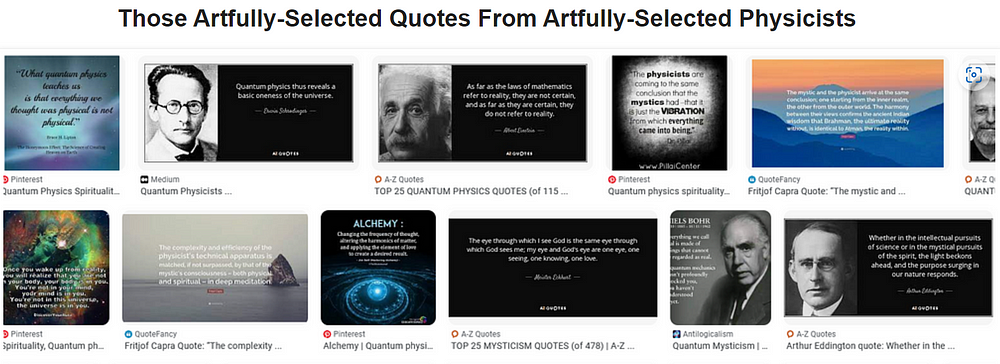
New Agers, spiritual commentators, and some idealists have created multiple images (or memes) with the words of a small number of famous physicists embedded within them. The passages quoted are nearly always the same ones. Indeed, they’ve been used countless times. These passages are often little more than a single sentence. And, as ever, they’re taken completely out of any context. All this quoting of famous physicists is usually (or even always) done for one reason, and for one reason only: to advance various spiritual and religious beliefs (often about “cosmic consciousness”) which have virtually nothing to do with physics qua physics.

(i) Introduction
(ii) Was Eugene Wigner a Positivist?
(iii) Eugene Wigner on “Impressions” and “Sensations”
(iv) Wigner on Sensations and the Wave Function

Writers must be careful when discussing Eugene Wigner’s philosophical views.

For a start, no one could deny that his paper ‘Remarks on the Mind-Body Question’ (which I’ll be concentrating upon) has inspired at least some New Agers, idealists and spiritual commentators. (At least those who feel the need to mention scientists to back up what they already believe.)

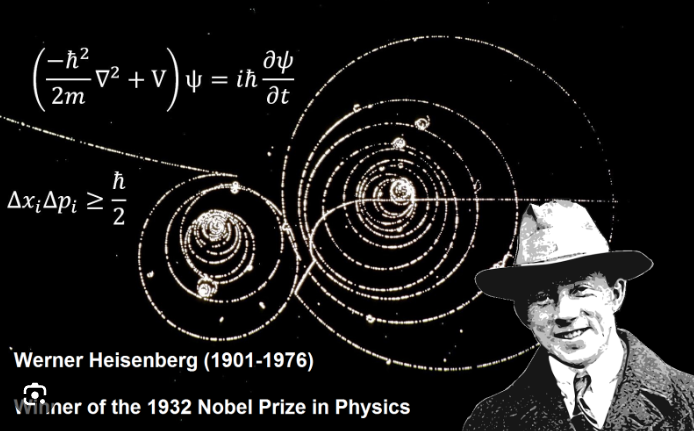
Actually, it’s lines and passages from that paper that New Agers and spiritual commentors quote…. Or, even more accurately, the often-used quotes from that paper are what such people quote. In other words, they quote the quotes, rather than the paper itself. (As can be seen in the main image for this essay, requotes often appear in the form of social-media memes.)
Despite all that, ‘Remarks on the Mind-Body Question’ itself is far from being New Age, mystical, spiritual, or idealist.

So it’s now also worth noting here that Wigner actually began to play down the role of consciousness in quantum mechanics. Specifically, he came to believe that the idea that “consciousness causes the collapse of the wave function” leads to solipsism. In his own words, Wigner argued that “[s]olipsism may be logically consistent with present quantum mechanics”.

That said, even a full commitment to consciousness collapsing the wave function isn’t necessarily tied to idealism. Of course, it has been tied to idealism. Yet it still doesn’t need to be an idealist position. In fact, there are ways of reading wave-function collapse which actually work against idealism, and which some theorists have picked up on.

What’s more, Wigner also came to emphasise that what’s true at the quantum scale, isn’t also true of “classical” or macroscopic objects and events. Thus, Wigner’s (later?) positions don’t help idealism (or a consciousness-first position) at all. After all, in idealism, literally every object and event (including trees, human beings, acts of sexual intercourse, etc.) is the product of consciousness. Alternatively put, everything is a manifestation (or instantiation) of “universal consciousness”.

[Thus, many commentators have deemed the ‘Wigner’s friend’ thought experiment to be a reductio ad absurdum. See next essay.]

In any case, it’s much less the case that Wigner was an idealist, and more the case that some people stress that he believed that quantum mechanics “spell[ed] the end for materialism”. Indeed, Wigner did write the following words:

“The principle argument against materialism [] that it is incompatible with quantum theory. The principle argument is that thought processes and consciousness are the primary concepts, that our knowledge of the external world is the content of our consciousness.”

At the beginning of ‘Remarks on the Mind-Body Question’, Wigner also told his readers that

“most physicists in the then-recent past had been thoroughgoing materialists who would insist that ‘mind’ or ‘soul’ are illusory, and that nature is fundamentally deterministic”.

[See note 1 for a quick take on these two “anti-materialist” passages from Wigner.]

All the above said, Wigner himself (at least in one place) did use the word “idealist” about what he called “the concept of the real”. In his own words:

“The concept of the real to be arrived at shows considerable similarity to that of the idealist. As the title indicates, it is formulated as a dualism.”

This isn’t much help to idealists or consciousness-first philosophers either.

For a start, the position Wigner advanced in that paper (‘Two Kinds of Reality’) only shows “considerable similarity to that of the idealist”. Thus, even the strong adjective “considerable” still shows that Wigner didn’t deem his “concept of the real” to be actual idealism. (Of course, it might have been idealist without Wigner himself having fully realised that.) What’s more, Wigner then immediately says that his concept of the real is actually “formulated as a dualism”.

Was Eugene Wigner a Positivist?
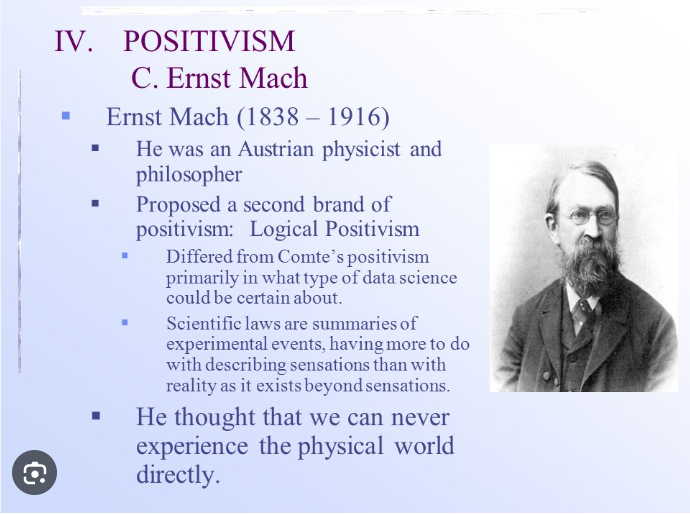
It’s fairly hard to decide if Eugene Wigner was an old-style empiricist, a positivist, a phenomenalist, or simply a physicist who endorsed the Copenhagen interpretation of quantum mechanics.

One main reason for this is that Wigner wasn’t a philosopher. This means that he didn’t really write enough to go on. That said, Wigner did write more philosophical stuff that most physicists.

In any case, it doesn’t really matter which precise ism Wigner falls under because all the philosophical (as it were) schools mentioned above are basically part of the empiricist tradition. Thus, all the differences between these schools don’t really matter that much within the specific and limited context of this essay.

This issue is complicated even more when it comes to Wigner’s philosophy of mathematics, as perfectly expressed in his well-known article ‘The Unreasonable Effectiveness of Mathematics in the Natural Sciences’. It would be difficult to place that work within the domain of either empiricism or positivism. Indeed, it’s been classed as an expression of mathematical realism by many, and even as Pythagoreanism by other commentators…

Such is the anomalous nature of mathematics. And that’s something that positivists, empiricists, and materialists have freely acknowledged.

To return to the central theme.

Wigner did often use the terms “impressions” and “sensations” in his paper ‘Remarks on the Mind-Body Question’. Thus, this usage alone squares fairly well with the following definition of empiricism:

“In philosophy, empiricism is an epistemological view which holds that true knowledge or justification comes only or primarily from sensory experience.”

However, perhaps the term “phenomenalism” best suits Wigner’s position.

According to one form of phenomenalism, “a physical object is a kind of construction out of our experiences”. In more detail:

“Phenomenalism is the view that physical objects, properties, events (whatever is physical) are reducible to mental objects, properties, events.”

Now, in Wigner’s case, it can be said that “sensory experience” and “mental objects, properties, events” are what we have to go on in the case of wave functions and scientific experiments. In fact, Wigner will be quoted explicitly stating this later…

Okay, then. Perhaps “positivism” is a better term for Wigner’s positions.

After all, a few decades before Wigner’s paper, various logical positivists strayed into the territory of physics and argued that all scientific (or “synthetic”) statements must be reducible to “perceptions” and “direct observations”.

[Of course, it now need hardly be said that all the various isms just discussed had their own problems.]

Finally, it’s now also worth stating that none of the above directly argues (or even implies) that Wigner was at one with 18th-century British empiricists, the logical positivists, etc. Indeed, the following passage alone highlights one fundamental difference:

“It is at this point that the consciousness enters the theory unavoidably and unalterably. If one speaks in terms of the wave function, its changes are coupled with the entering of impressions into our consciousness. If one formulates the laws of quantum mechanics in terms of probabilities of impressions, these are ipso facto the primary concepts with which one deals.”

Why this passage isn’t purely empiricist — or even positivist — will hopefully become clear in what follows.

Wigner on “Impressions” and “Sensations”

As already stated, there’s little in Eugene Wigner’s words which can be directly (or strongly) tied to either idealism or to mysticism.

That said, what about Wigner’s many uses of the words “sensations” and “impressions” in his ‘Remarks On the Mind-Body Question’?

Whereas New Agers, idealists and spiritual commentators nearly always talk about consciousness in very vague terms, Wigner himself mainly refers to “impressions” and “sensations”.

Relevantly, the word “consciousness” (in this context at least) has grown to have an idealist or even mystical ring to it, whereas Wigner’s “impressions” and “sensations” just seems like an old-style empiricist way of putting things.

Yet Wigner himself did refer to “consciousness” a few times in that paper!

In fact he did so in the same passages in which he referred to “impressions” and “sensations”.

For example, Wigner wrote the following:

“I believe that the present laws of physics are at least incomplete without a translation into terms of mental phenomena.”

Of course, Wigner’s sensations and impressions occur within consciousness — where else could they occur? [See note 2 on this spatial metaphor.] So, in that rudimentary sense, 18th century empiricists might just as easily and justifiably used the word “consciousness” about their own empiricism — had that word been as fashionable way back then as it is today. [John Locke did use the word “consciousness” in the 1690s, but not really in the way that many do so today.]

In any case, Wigner stating that we “rely on sensations” isn’t a commitment to idealism. It’s broadly an empiricist position, and such a position dates back (in various forms) to the 18th century. (Arguably, it dates much further back than that— see here.) Such a position was also adopted — if in a “logical” form — by the logical positivists… We’ve had phenomenalism too!

In terms of detail, Wigner wrote the following passage:

“All that quantum mechanics purports to provide are probability connections between subsequent impressions (also called ‘apperceptions’) of the consciousness, and even though the dividing line between the observer, whose consciousness is being affected, and the observed physical object can be shifted towards the one or the other to a considerable degree, it cannot be eliminated.”

As far as that passage is concerned, it can be argued that Wigner believed that he was taking the Copenhagenist line to its (as it were) logical conclusion. After all, Niels Bohr, Werner Heisenberg, Max Born etc. also stressed (or at least used) the words “impressions” and “sensations”. [See here.] Rudolph Carnap and other logical positivists, on the other hand, used terms such as “cross-sections of experience”. Indeed (as already stated), the emphasis on “sense impressions” goes back to the British empiricists of the 18th century.

Yet none of the examples cited — certainly not Carnap and the logical positivists — could be deemed to be idealists or people with idealist or “mystical” inclinations…

That’s unless empiricism (if of a 20th-century kind) is actually taken to be a kind of idealism. [There has been some debate about this when it came to Bishop Berkley. See note 3.]

All that said, it’s now important to tie Wigner’s words about impressions and sensations to the wave function. After all, the wave function was central to quantum mechanics after 1926, and Wigner himself had much to say about it.

Wigner on Impressions and the Wave Function
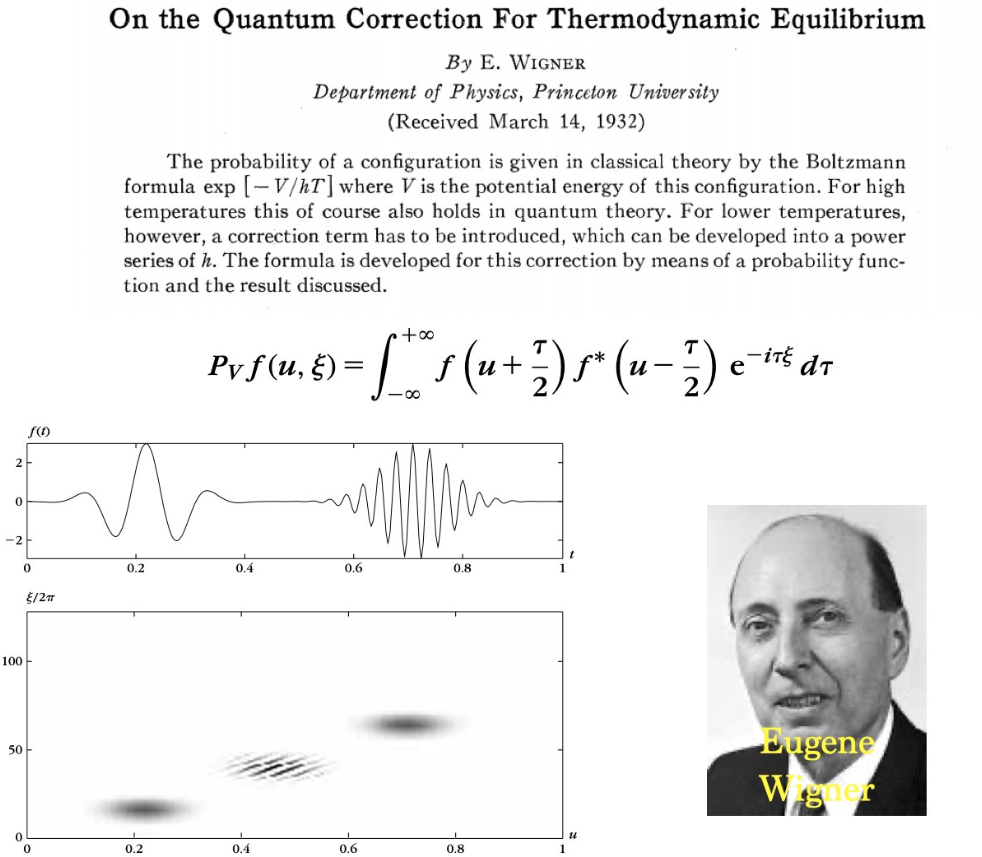
Eugene Wigner himself described the wave function in the following way:

“This is a mathematical concept [] it is composed of a (countable) infinity of numbers. If one knows these numbers, one can foresee the behavior of the object as far as it can be foreseen. More precisely, the wave function permits one to foretell with what probabilities the object will make one or another impression on us if we let it interact with us either directly, or indirectly.”

Going into more detail, Wigner then tied the wave function to observations:

“Given any object, all the possible knowledge concerning that object can be given as its wave function. [] [T]he wave function is only a suitable language for describing the body of knowledge — gained by observations — which is relevant for predicting the future behaviour of the system.”

And elsewhere:

[K]nowledge of the wave function does not permit one always to foresee with certainty the sensations one may receive by interacting with a system.”

Wigner again stressed “impressions” (or “sensations”) when he wrote the following words:

“The information given by the wave function is communicable. If someone else somehow determines the wave function of a system, he can tell me about it and, according to the theory, the probabilities for the possible different impressions (or ‘sensations’) will be equally large, no matter whether he or I interact with the system in a given fashion.”

Wigner’s words above are really at one with the Copenhagen interpretation of quantum mechanics. As already stated, Niels Bohr, Werner Heisenberg, etc. often stressed “sensations” and “impressions” too. However, Bohr himself, for example, didn’t often use the word “consciousness” in these specific respects. That said, Wigner quotes Bohr using precisely that word — but not about the wave function or even about quantum mechanics! (Wigner: “In the words of Niels Bohr, ‘The word consciousness, applied to ourselves as well as to others, is indispensable when dealing with the human situation’.”

More relevantly, it can be supposed (at least at first) that Wigner goes beyond plain-old positivism (or even Copenhagenism) when he added these words:

[E]ven though the dividing line between the observer, whose consciousness is being affected, and the observed physical object can be shifted towards the one or the other to a considerable degree, it cannot be eliminated.”

Now that is truly something that you’d expect a 20th century quantum physicist to write.


Notes:

(1) There are problems with Eugene Wigner’s account of materialism: (1) Materialism isn’t necessarily incompatible with quantum theory. However, quantum theory certainly was at odds with 19th-century materialism in the 1920s. (2) Empiricists dating back to the 18th century wouldn’t have had any problems with stating that “sense impressions” (if not “thought processes and consciousness”) are “primary”, and that we gain access to the “external world” through our sense impressions (if not through “the content of our consciousness”). Indeed, that last point captured the very essence of empiricism!

Of course, idealists historically picked up on the fact that empiricists claimed to gain access to the external world via their sense impressions, and then they logically and philosophically questioned that position. Basically, idealists argued that empiricism led to (subjective) idealism. (It certainly did so with Bishop Berkeley.)

As for the second passage. It’s worth remembering that Wigner wrote the following words in 1961:

[M]ost physicists in the then-recent past had been thoroughgoing materialists who would insist that ‘mind’ or ‘soul’ are illusory, and that nature is fundamentally deterministic.”

In 1961, “most physicists” didn’t “insist” upon such things. Apart from the fact that most physicists didn’t have much to say about the mind or soul (at least not qua physicists), they certainly — as a whole — weren’t against all mentions of the “mind”. On the other hand, perhaps many physicists would have had a problem with the soul. Better, with the word “soul”. That’s unless the word “soul” was simply deemed to be a synonym of the word “mind” in those days.

So perhaps Wigner really meant philosophical physicists or simply philosophers.

Well, even many materialist philosophers didn’t have a serious problem with discussing the mind before 1961. They might sometimes have had a radical take on the mind. (Such as with Gilbert Ryle’s book The Concept of Mind from 1949.) However, they wouldn’t have said that the “mind is illusory”. And that was for the simple reason that it had been given materialist, behavioural, functionalist, etc. explanations before Wigner wrote his words in 1961…

Now what about consciousness?

Well, that’s another matter…

(2) Of course, the nature — and even existence — of consciousness itself is also contested.

For example, I used the words “sensations and impressions occur within consciousness” in the essay above. Note the two words “in consciousness”. Surely that’s a spatial metaphor. In other words, why can’t sensations, impressions and other mental things actually constitute consciousness, rather than be in it?

(3) Some writers have argued that Bishop Berkeley’s empiricism morphed into what they called subjective idealism. Other writers have argued that it was such a thing from the very beginning.

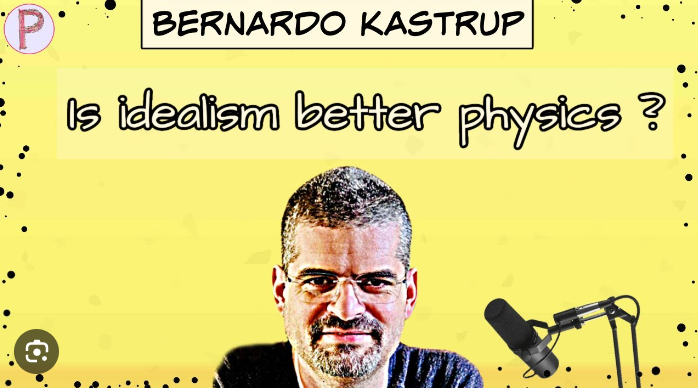
Berkely’s philosophy also ties in with 21st century idealism in that God fulfils much the same role as “universal consciousness” (or “cosmic consciousness”) does. That’s in the sense that whatever is not directly perceived by a single subject (or even by a collective of subjects), is perceived by God himself (“God in that gap”) in Berkeley’s philosophy. In the case of “cosmic idealism”, on the other hand, all objects and events are, not perceived by “monotheistic God”: they’re actually instantiations of Universal Consciousness. (To the idealist Bernardo Kastrup, the brain, trees, acts of sexual intercourse, etc. are “images” or “representations” of consciousness.)


Saturday, 17 February 2024

Idealism, Mysticism and the Observer Effect


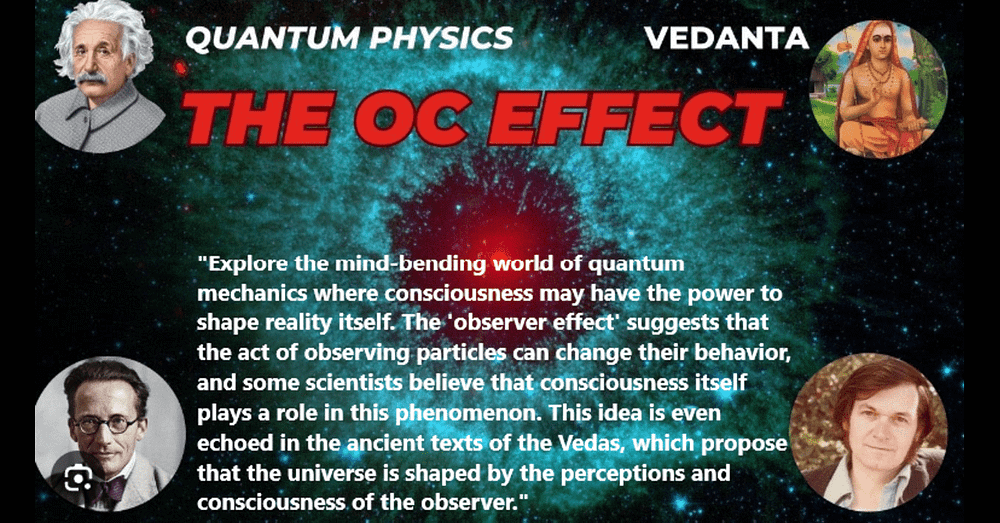
This image is from the YouTube video ‘The Observer Consciousness Effect’. The words embedded within it are from the introduction to this video. The physicists in the image are Albert Einstein, Erwin Schrödinger and Roger Penrose.
“Browse through any bookshop’s new-age section [] and you’ll find wild claims confidently asserted about the uncertainty principle [or observer effect], such as that its implications are ‘psychedelic’ and that it heralds ‘cultural revolution.’ [] Consider the following conversation, published in *American Theatre*, between the well-known theatre director Anne Bogart and Kristin Linklater, the noted vocal coach:
Linklater: ‘Some thinker has said that the greatest spiritual level is insecurity.’
Bogart: ‘Heisenberg proved that. Mathematically.’ 
Linklater: ‘There you are.’
[] The uncertainty principle sprang from a purely mathematical approach to atomic physics, where it has a well-defined and highly restricted scope of applicability.”

— — Robert P. Crease [See source here.]


(i) Introduction
(ii) Mystical Physics… or Simply Mystical Physicists?
(iii) Does Consciousness Affect Reality?
(iv) What Is a Scientific Observation?
(v) Idealism and Scientific Observation
(vi) An Heisenbergian Interlude: Intrinsic Weirdness
(vii) Consciousness, Making a Mark and Observation

Many idealists, New Agers and spiritual commentators (at least those who mention the subjects which will follow) have often focused on the “observer effect” in quantum mechanics. (This is the case even when they don’t actually use that precise technical term.) They do so because they believe that it strongly ties consciousness to reality (or reality to consciousness). Indeed, such people also believe that the observer effect makes reality a product (or an effect) of consciousness.

When the observer effect is discussed, the word “mysticism” is often used too.

The word “mysticism” is, admittedly, vague.

The Copenhagenists, for one, were often accused of “mysticism” in an entirely negative manner. However, New Agers and spiritual commentators use this term positively about the very same physicists.

So why was the word “mysticism” used?

It was primarily for “introducing consciousness into physics”. [See here.]

The other main sense of “mysticism” (i.e., in this context) refers to physicists being influenced (or inspired) by mystical literature of by Eastern religions.

New Agers, spiritual commentators and idealists believe that such physicists noted the observer effect (as well as the uncertainty principle, entanglement, complementarity, etc.) precisely because of their prior knowledge of mystical or eastern literature. The New-Age idea is that such physicists also believed that Eastern ideas provided a good philosophical explanation of such issues within physics.

Yet the vast majority of the physicists who’ve accepted and endorsed the observer effect, entanglement, etc. have done so without ever having read a single word of mystical and/or Eastern literature. Of course, New Agers, spiritual commentators and idealists will (or simply might) respond with the following words:

That doesn’t matter. Non-mystical physicists are still tapping into phenomena which ancient religions have known about for millennia.

What ancient religions understood can only tangentially, analogically and with a very-large amount of artistic license be tied to the theories and ideas of quantum mechanics. After all, anything can be tied to anything if you try hard enough. (This was certainly the case when, for example, Carl Jung’s notion of synchronicity was tied to quantum-mechanical theories.)

In any case, it can be argued that this mysticism best manifested itself in the way in which a very-small number of physicists attempted to “unify mind and physics” in the first half of the 20th century.

Mystical Physics… or Simply Mystical Physicists?

[W]hen a scientist says that he/she believes in god, believers take it to mean that god must be true — because it’s coming from the seekers of objective truth. Not that the believers really needed this validation (they were believers already), but belief is all about post-rationalization and confirmation bias. Hence, ‘validation’ from a few scientists goes a long way. [] They conveniently forget that a majority of scientists do not believe in god.”

— — — The Other Millennial [Source here.]

In his paper ‘Mysticism in quantum mechanics: the forgotten controversy’, the academic Juan Miguel Marin tells us that Hermann Weyl and Wolfgang Pauli

“were both immersed in mysticism, searching for a way to unify mind and physics”.

Some readers may ask why the project of unifying mind and physics is automatically deemed to be a case of “mysticism”. So perhaps this isn’t an automatic thing at all. Yet when it comes to New Agers, spiritual commentators and idealists, it often does seem as if they believe that there’s some kind of automatic link here.

In any case, when Hermann Weyl and Wolfgang Pauli attempted to unify the mystical (if not the mind) with physics, they weren’t doing neuroscience — or, indeed, any kind of science. They had nothing to say about the brain itself. What’s more, physics was only tangentially and analogically linked to this attempted unification of the mind (seen mystically) with physics.

Basically, then, Weyl and Pauli were essentially doing philosophy when they attempted to unify mind and physics.

Juan Miguel Marin also asks us the following question about Arthur Eddington and Erwin Schrödinger:

“Did their shared mysticism have a role to play in whatever insights they gained or mistakes they made? [].”

The answer to that question may well be “Yes”. After all, this is nothing less than the context of discovery. And contexts of discovery are real things.

By way of a comic illustration.

In ‘The Relationship Diremption’ episode of The Big Bang Theory sitcom, the “nerd” character Sheldon Cooper admitted that he “didn’t seek out string theory”. Instead, string theory “just hit [him] over the head one day”.

So what did Mr Cooper mean by that? The following:

“A bully chased me through the school library and hit me over the head with the biggest book he could find.”

That book was on string theory. And Sheldon Cooper was hooked on string theory from that day on.

This fictional account is obviously a joke. However, it has an element of sociological and psychological truth. Indeed, it’s part of the context of discovery. Of course, the context of discovery-context of justification distinction may well be a little too neat and tidy for some people. Yet it still has its large degree of truth, its value, and its uses.

So if we return to the non-fictional physicists Eddington and Schrödinger.

It’s certainly possible that Eddington and Schrödinger might not have had their “insights” had they not also been influenced by mystical literature.

That said, questions can still be asked about this.

At the very least, mystical literature would have had a very minimal role to play on these physicists’ actual theories in physics (i.e., the technical stuff they had published in physics journals).

Take the specific case of Schrödinger.

According to the writer Walter Moore (in his Schrödinger: Life and Thought),

“the philosophy of Schrödinger at this time does not appear to have been influenced by his physics”.

In parallel, Schrödinger also

“often said that one cannot derive philosophical conclusions from physics”.

Yet even when biographical information is included (Marin relies heavily on much context-of-discovery stuff, and Walter Moore obviously mentions it too), it’s still very difficult to establish any concrete, important and relevant links between actual theories in physics and any “eastern” religious texts these named physicists might have read (i.e., at some point in their lives).

In any case, does it matter?

That is, are their genuinely and purely mystical elements embedded within the actual scientific theories of, say, Eddington and Schrödinger?

Alternatively, is all this stuff about physics-and-the-mystical made up of analogy, metaphor, biography, scientifically irrelevant contexts-of-discovery, wishful thinking, wild interpretations, tangential links and circuitous reasoning?

What’s more, the vast majority of New Agers and spiritual commentators who mention these ideas from quantum mechanics, and who also frequently drop the names of famous physicists, do so exclusively to advance their religious (or spiritual) ideas, causes and goals…

In other words, such New Agers and spiritual commentators have almost zero interest in physics qua physics.

[There’s a sizable number of writers here on Medium to whom all this applies. Deepak Chopra is one of that number.]

Does Consciousness Affect Reality?

Juan Miguel Marin also states the following:

[I]n quantum mechanics, physicists’ observations can sometimes affect what they’re observing on a quantum scale.”

To put it strongly: that is simply false…

Or, rather, it’s only false if Marin’s words are read in a certain way. More particularly, it depends on how the word “observations” is read.

The way the general idea above is usually expressed (i.e., by New Agers, spiritual commentators, etc.) makes it seem as if consciousness alone literally affects physical reality.

At an extreme level, this would simply be a form of telekinesis.

The definition of the word “telekinesis” perfectly fits some of the things New Agers, spiritual commentators, and some idealists say about the observer effect. Thus:

“Telekinesis [], also known as Psychokinesis, is a hypothetical psychic ability allowing an individual to influence a physical system without physical interaction.”

Yet consciousness alone does not affect physical reality.

However, observations as they occur in physics can affect reality.

So now let’s tackle the notion of observation.

What Is a Scientific Observation?

One factor which may well seem idealist to some occurs when one scientist’s observation-based interpretation of an experiment (or experimental space) conflicts with another scientist’s observation-based interpretation of the very same experiment. However, there is no actual causal, telekinetic or otherwise affect on the physical world here. It’s simply a case of different scientists coming to different conclusions, formulating different theories (or interpretations), and even “seeing” different things. [See note 1 on Norwood Russell Hanson.]

The paragraph above can also be deemed to be an indirect reference to Niels Bohr’s notion of complementarity. For example, in one experiment (or observation), a particle is “observed” (or at least posited), and in another experiment, a wave is observed (or posited). That said, it’s usually the different experimental setups which generate the complementary results in these cases.

Again, there’s no literal (or purely) “mental impact” on the world here either.

Of course, observations and experiments (or measuring devices) can and do change what is observed. Yet that’s not what New Agers, idealists and Juan Miguel Marin are attempting to tell us.

To be crude.

If a physicist is fumbling around with a given experimental space, then that will affect that space. However, that has little to do with his consciousness — free of all physical manipulations — affecting the world.

Of course, some believers in the Copenhagen interpretation may argue that we have no right at all to say anything about the world as it is free of minds, experiments, manipulations, etc. There may be no problem with that position. However, such people don’t also state that the consciousnesses of physicists alone affect what they’re observing.

So what about the observer effect itself?

Idealism and Scientific Observation

Almost every time the word “observer” (or “observation”) is used in physics, some level of physical manipulation of the experimental setup is meant.

Take the following basic introduction to the observer effect:

“In physics, the observer effect is the disturbance of an observed system by the act of observation.”

The cat is let out of the bag when this account continues in this way:

“This is often the result of utilizing instruments that, by necessity, alter the state of what they measure in some manner.”

None of the above even hints at idealism or anything mystical.

To repeat. In physics, there is never any (as it were) pure act of observation.

Thus, all this isn’t just a question of a mind observing an experiment and/or thinking about it. That act of observation includes “utilizing instruments”, and the physical manipulations of the experimental apparatus.

[In idealism, how can any separation at all be made between consciousness and an experiment? See note 2 on Bernardo Kastrup’s position.]

All this means that the word “observation” can be very misleading.

There are indeed conscious observations (carried out by persons) involved in experiments. However, there are physical elements to all these observations too.

Here again readers should note the words “the disturbance of an observed system”. Taken at face value at least, this clearly has nothing to do with (Carl Jung’s) “acausality”, “consciousness affecting reality”, mysticism, etc. It’s to do with the physical disturbances of an experimental setup (or physical arrangement) by the experimenters and their instruments.

Indeed, physicists also encounter the problem of making a separation between the behavior of a system, and that system’s interaction with measuring instruments and human experimenters. And that, in turn, leads to the problem of knowing what a quantum state is in the first place.

More specifically, in any double-slit experiment, it’s fairly uncontroversial to state that the observation of quantum phenomena by an instrument (or detector) can (or will) change the measured results.

To repeat. Here it’s said that the an instrument or electronic detector changes the results of the experiment. The very fact that we’re talking about an instrument shows that this isn’t only about consciousness, or even only about (purely mental) observations.

However, it’s worth mentioning the idea that the quantum realm is often deemed to be “weird” regardless of measurements, experiments and conscious observations.

An Heisenbergian Interlude: Intrinsic Weirdness

The philosopher and historian of science Robert P. Crease (quoted at the beginning) writes:

“The strangeness of the uncertainty principle is not due to the measurement process disturbing the object measured, which would be a feature of any Newtonian theory involving exchange of particles. Nor is it due to the presence of statistics. Rather, the strangeness of quantum mechanics is that quantum formulations are not ‘about’ a real or ideal object in the conventional sense.”

This position doesn’t help the mystical or idealist position either.

For a start, this essentially Heisenbergian passage doesn’t even mention “consciousness” or “the observer”. Instead, it can be taken to advance the position that the quantum realm is (as it were) intrinsically weird. That is, it is weird regardless of consciousness or the minds of physicists. Thus, this is hard position to directly (or even indirectly) connect to either idealism or to mysticism.

Despite all that, a double-slit experiment’s results have indeed been interpreted (with a stress on the word “interpreted”) as telling us that “consciousness can affect reality”.

Consciousness, Making a Mark and Observation

Many physicists are keen to stress that an “observer” needn’t be a conscious being — it simply needs to be a scientific instrument of some kind. Of course, minds need to read (or interpret) the instrument’s readings or “marks”. However, that alone hardly seems like a strong argument for idealism and/or for mysticism.

In any case, a mark is made before it is (further) registered by (the consciousness of) a physicist. In addition, the, say, “clicks of a detector” can only be noted by a conscious experimental physicist.

So it still seems obvious that a physicist (or consciousness) would be required to make sense of, say, a thermometer’s registration.

Erwin Schrödinger (who’s often pressganged into the idealist and mystical school) conveniently discussed both measurement and consciousness.

For example, in Schrödinger’s published lectures Mind and Matter (1956/58), he argued that

“there is a difference between measuring instruments and human observation: a thermometer’s registration cannot be considered an act of observation, as it contains no meaning in itself. Thus, consciousness is needed to make physical reality meaningful”.

So even if Schrödinger was influenced by mystical literature (though not when it came to his actual theories in physics), nothing in the passage above is (or need be) necessarily tied to anything mystical or idealist — not even his introduction of the word “consciousness”. In other words, the logical or philosophical point being made above is entirely free of any mystical and/or idealist connotations.

In any case, the thermometer still registered something regardless of any “consciousness” that later (as it were) made sense of that registration. More precisely, the thermometer must have gone through a certain physical process which ended up with a particular physical change. What’s more, all this must have happened before any mind gave it a (to use Schrödinger’s word again) “meaning”.

Sure, the thermostat’s state as it was before it was read or interpreted is of little (or even no) use to the physicist. However, it must still have had a physical state before it was read. [See note 3 on the Copenhagenist position on this matter.] In other words, the thermostat must have been in state x even before it was read or interpreted, and it was still in that state when it was read or interpreted.


Notes

(1) The latter issue was first extensively discussed by Norwood Russell Hanson in his well-known paper ‘Seeing and Seeing As’, which was published in 1969. See here too.

(2) In terms of idealism (or at least a certain brand of idealism), it simply can’t be said consciousness affects reality. That’s because reality itself is already supposed to be “universal consciousness”. So, on an idealist reading, consciousness affecting reality would actually be an example of consciousness affecting consciousness.

Interestingly, the idealist Bernardo Kastrup makes this point against other people who also deem themselves to be idealists. Specifically, Kastrup argues against those who say that “the brain is a conduit of universal consciousness”. (The “filter theory” of the brain.) He corrects them by saying that the brain too is an “image” or “representation” of consciousness. In Kastrup’s own words:

“The idea that the brain does not generate consciousness, but instead limits and filters it down, seems to require dualism and contradict idealism. After all, if all reality exists in consciousness, how can the brain — which is a part of reality — filter down that which gives it its very existence? A water filter is not made of water; a coffee filter is not made of coffee; how can a consciousness filter be made of consciousness? It sounds like a self-referential contradiction.”

Thus, consciousness can’t be “a conduit” of consciousness.

3) It can be supposed that idealists and perhaps some anti-realists can ask the following question:

How do you know the both states of the thermometer — both before and after any registration or interpretation — fully coincide?

This is a question that’s hard to take seriously in physics. However, it does have at least some philosophical substance.