Sunday, 10 March 2024

Albert Einstein as Serial Killer and Misogynist: One Context of Discovery

 (i) Introduction

(ii) Sokal’s Sex Life and Kripke’s Schooldays
(iii) Robert P. Crease on the Envy, Rivalry and Anger of Scientists
(iv) Paul Davies on Newton’s Religious Context of Discovery
(v) Rupert Sheldrake Against the Context-of-Discovery Distinction
(vi) Slavoj Žižek Against the Context-of-Discovery Distinction

Many readers will have noticed the numerous social-media memes which have Albert Einstein’s words embedded within them. Relevantly, most of these memes aren’t actually about his scientific theories and views, or even about science itself. Instead, most of them are posted to defend the view that Einstein was religious, or spiritual, or a socialist, or this, or that, or the other. Other memes concentrate on Einstein's private life.

More particularly, the users of Facebook and social media generally might also have also noted how often spiritual idealists (see here) and New Agers quote a handful of passages from German and Austrian physicists which were mainly spoken (or written) in the first three decades of the 20th century. The relevant point is that these much-quoted scientists rarely made an effort to tie their non-scientific views to their actual physical (i.e., technical) theories. What’s more, these physicists hardy referred to “Eastern thought” and spiritual stuff in the first place. Hence, the very-few passages which spiritual commentators, New Agers, etc. quote and embed in their memes.

Erwin Schrödinger is a good example of all this.

He actually went out of his way to disconnect his interest in (loosely called) Eastern religion from his actual technical physics. [See note 1.]

New Agers, on the other hand, do the opposite of this.

Such people go out of their way to connect — specifically — quantum physics to their prior spiritual beliefs.

So are all these (as it’s put in philosophy) contexts of discovery important to the scientific theories of particular scientists?

Indeed, are they contexts of discovery at all?

Sokal’s Sex Life and Kripke’s Schooldays
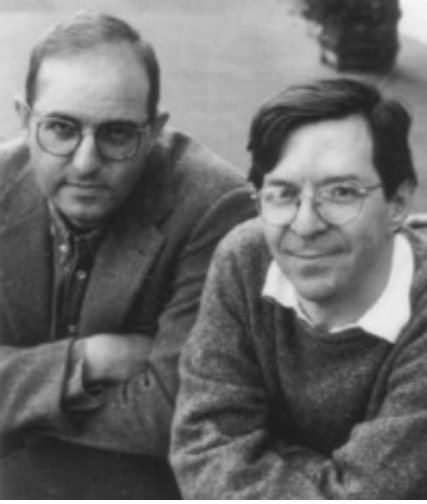
Jean Bricmont and Alan Sokal

In extreme terms, it doesn’t matter if the scientist discussed (or memed) was also, say, a serial killer, a Nazi, a neoliberal, a narcissist, etc. In Einstein’s particular case, it doesn’t matter that he was (according to Metro newspaper) a “misogynist” and “neanderthal”.

Yet, to take just one example, the French critic and writer Philippe Sollers was very interested in contexts of discovery. Or at least he was interested in in the sex life and personal psychology of a mathematician and physicist.
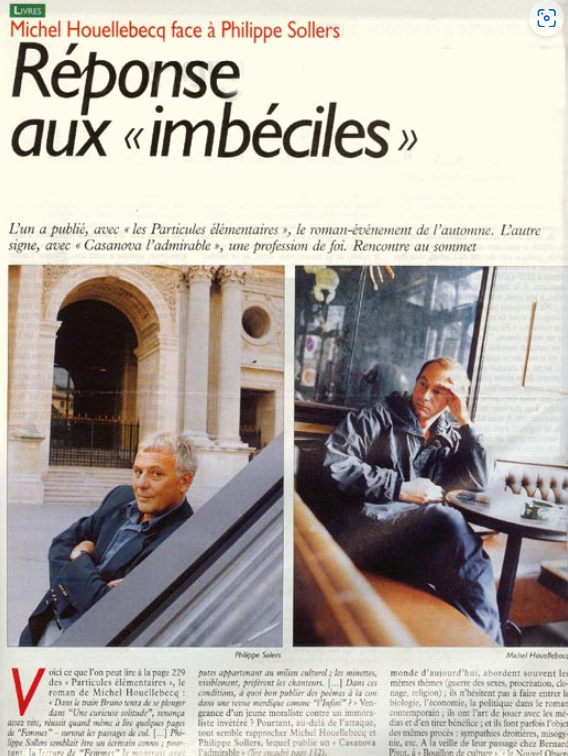
Philippe Sollers’ words are to be found in this article.

So now take American mathematician and physicist Alan Sokal and the physicist and philosopher Jean Bricmont and their words (from the book Intellectual Impostures) on Philippe Sollers’ words (see image above) on… well, Sokal and Bricmont themselves:

[] Philippe Sollers asserts [] that our private lives ‘merit investigation’: ‘What do they like? What paintings do they have on their walls? What are their wives like? How are those beautiful abstract statements translated in their daily and sexual lives?’
“Well! Let’s concede once and for all that we are arrogant, mediocre, sexually frustrated scientists, ignorant in philosophy and enslaved by a scientistic ideology (neoconservative or hard-line Marxist, take your pick).”

In any case, how did Alan Sokal react to Philippe Sollers’ words?

In the following way:

“But please tell us what this implies concerning the validity or invalidity of our arguments."

All that said, popular-science writers often become very fixated on biographical detail. Perhaps they do so for two related — as well as obvious - reasons:

(1) To popularise science and scientists 
(2) To help sell their books.

Let’s now take a rather less sexy context of discovery.
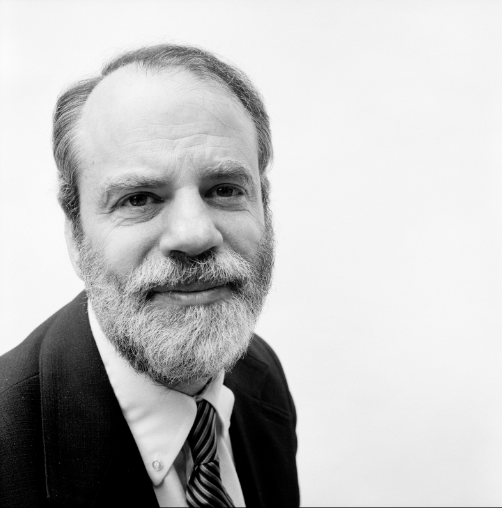
Saul Kripke

The American philosopher and logician Saul Kripke was once honest enough to admit (in this video) that his initial interest in Ludwig Wittgenstein was solely down to who taught him at university when he was a student. (He mentions “three faculty members” particularly.) Of course, alongside the fact that his teachers had an interest in Wittgenstein (specifically the “late Wittgenstein” of the Philosophical Investigations) would have been the fact that Kripke actually developed an independent interest in what Wittgenstein wrote. Having said that, Kripke also confesses that he didn’t at first see the importance of Wittgenstein or his Philosophical Investigations. Indeed, he didn’t “develop [his] own take on what [Wittgenstein] was doing until 1962 and 1963”…

Then again, Kripke was still only 22 in 1962…

But who cares about all this biographical detail!

Well, a lot of people do.

Indeed, there’s nothing wrong with that.

The question is what relevance does it have to Kripke’s actual philosophical ideas in, say, logic, metaphysics, philosophy of mind, etc?

The context of Kripke’s discovery of Wittgenstein, in this case, will have no interest at all to those strict philosophers who’re solely interested in the context of justifying Kripke’s analysis of Wittgenstein.

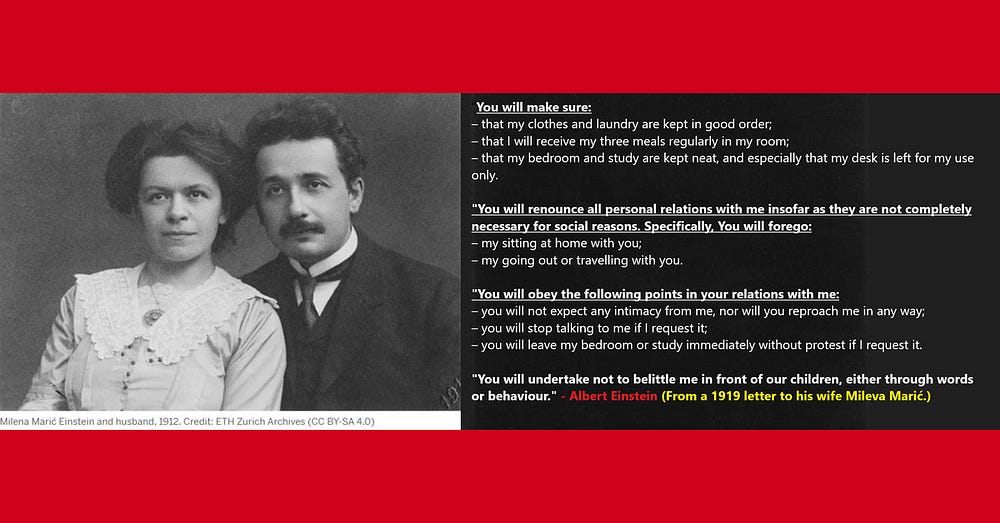
Thus, if biography and context are really so important when it comes to Sokal’s arguments (or to the scientific theories of scientists), then take the following letter (see here) which Einstein wrote to his wife in 1919? —

“You will make sure:
– that my clothes and laundry are kept in good order;
– that I will receive my three meals regularly in my room;
– that my bedroom and study are kept neat, and especially that my desk is left for my use only.
“You will renounce all personal relations with me insofar as they are not completely necessary for social reasons. Specifically, You will forego:
– my sitting at home with you;
– my going out or travelling with you.
“You will obey the following points in your relations with me:
– you will not expect any intimacy from me, nor will you reproach me in any way;
– you will stop talking to me if I request it;
– you will leave my bedroom or study immediately without protest if I request it.
“You will undertake not to belittle me in front of our children, either through words or behaviour.”

Have these words ever appeared in any social-media memes?

That said, Einstein’s letter to his wife (of the time) has indeed been tackled by journalists, and by some science writers too.

The point here is that if contexts of discovery can be used in positive ways, then they can be used in negative ways too.

More relevantly, if positive contexts of discovery can be tied to actual scientific theories and ideas, then so too can negative ones.

So can we pick and choose contexts of discovery according to taste?

Now let’s just pretend that Einstein was a serial killer, or a neanderthal, or a misogynist — or perhaps all three at once.

How would, say, the historian of science and philosopher Robert P. Crease deal with these possibilities?

Robert P. Crease on the Envy, Rivalry and Anger of Scientists
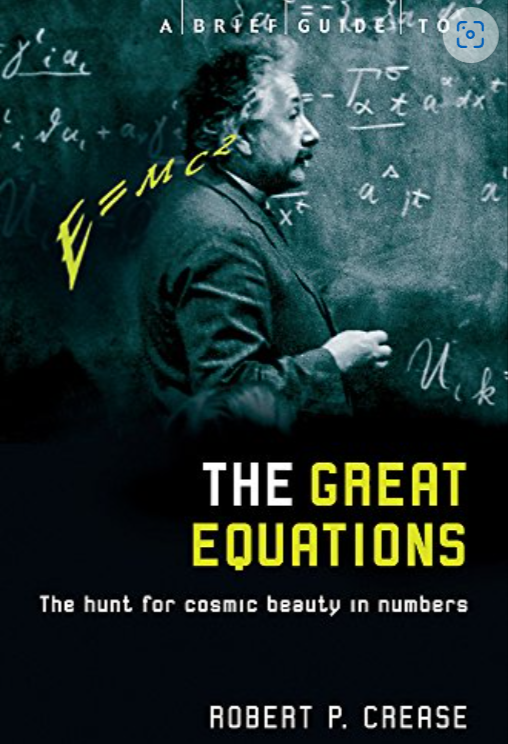
Robert Crease isn’t just interested in contexts of discovery: he actually ties the scientific theories of physicists to their (as it were) extra-curricular activities and beliefs…

Or at least he seems to!

Crease believes such that such scientific theories actually embody aspects of the (as it were) biographical detail of the scientists who created them.
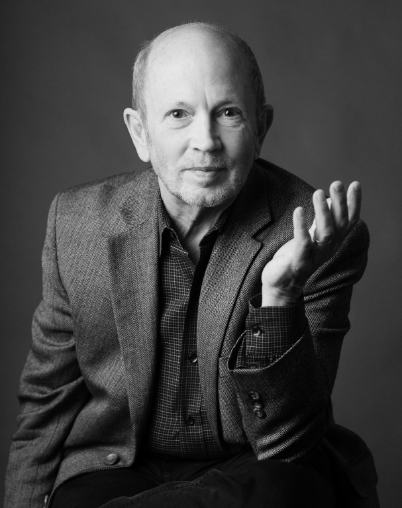
Robert P. Crease

So take this passage from Crease:

[I]n Einstein [] we can see glimpses of what lies beyond the standard model: an account of science in which character and personal feeling are not marginal to the scientific process, not a prelude to a person’s scientific labours, but what sustains them and carried them forward.”

Of course it can still be asked if Crease is actually arguing that all this “character and personal feeling” is somehow embodied in scientists’ scientific theories.

So if it is, then how is it so?

What’s more, what is Crease actually pitting himself against?

Crease is pitting himself against what he (ironically) calls “the standard model [of] [m]ost histories of science”. Crease writes:

“It emphasises the collective and impersonal dimension, and downplays the experiences of specific individuals. The principle structural ingredients are discoveries, instruments, measurements, and theories.”

Is this true?

Do historians really “downplay[] the experiences of specific individuals”?

Not in the cases I’ve read.

Indeed, if we move away from historians of science, popular-science writers certainly don’t!

So perhaps that’s the very distinction Crease is making: the distinction between historians of science and popular-science writers. (Crease has himself written such a popular-science book — the one these quotes come from.)

Moreover, even if what Crease says about historians of science is true, then what are we to make of all these experiences of specific individuals from a scientific point of view?

Of course, much — very much ! — has been made of them from all sorts of other points of view.

However, what relevance do the specific experiences of specific scientists have to their specific scientific theories and ideas?

In more detail, Crease also tells us that

[e]nvy, rivalry, anger, disbelief, conviction, stress, hope, despair, dejection — all can be found in the documents”.

Has any historian of science argued that scientists don’t experience envy, rivalry, anger, disbelief, conviction, stress, hope, despair, rejection? Has any scientist himself ever argued this about his fellow scientists?

Like the physicist and popular-science writer Paul Davies (to be discussed in a moment), Robert Crease believes that all of this experience becomes embodied in the actual scientific theories of scientists…

Or at least I think that’s what he believes.

As already stated, it’s hard to see what Crease is getting at otherwise.

In any case, Paul Davies certainly does believe this.

Paul Davies on Newton’s Religious Contexts of Discovery
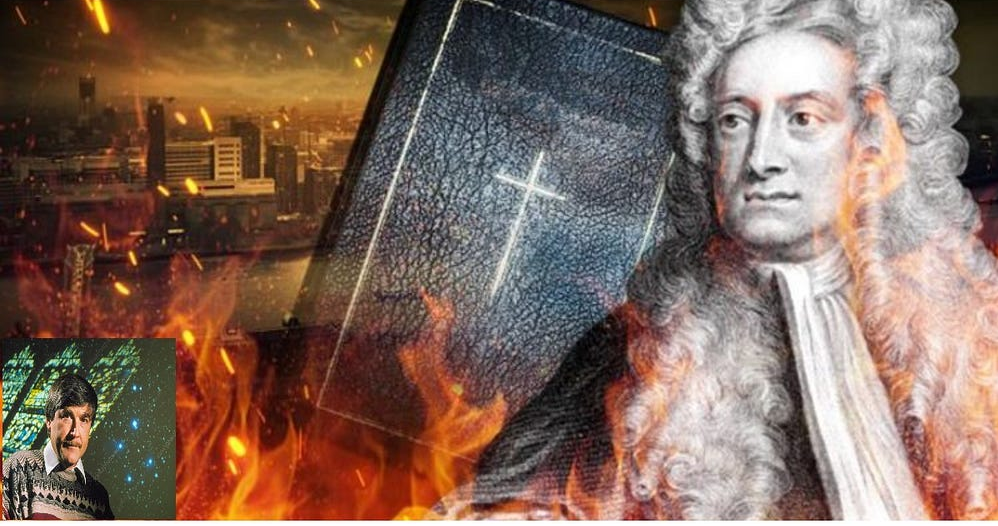
The popular-science writer and physicist Paul Davies goes much further too.

For example, Davies is keen to stress Isaac Newton’s religious beliefs, and how they influenced (or even determined) his actual physics. (See Davies’s ‘Taking Science on Faith’ for the New York Times.)

Thus, if this is true (in this case at least), then the context of discovery can’t be separated from from the context of justification at all. That’s because Davies is making a direct link between Newton’s scientific theories and his religious beliefs.

On the other hand, if that link between contexts of discovery and actual scientific theories isn’t there, then (at its crudest) it wouldn’t make the slightest bit of difference to Newton’s scientific theories and ideas whether he too was a serial killer, or believed in pink goblins, or was a Christian fundamentalist, or that he stole all his ideas from Leibniz.

Of course, much has also been made of Newton’s (as it were) religious credentials by other people.

For example, spiritual-but-not-religious people and New-Agers have made much of Newton’s alchemy, Biblical prophesies, chronologies, fixation with numbers, interpretations of the Bible, and his takes on the philosopher’s stone and sacred geometry.

What’s more, their biographical and historical detail about Newton may well be largely correct!

Rupert Sheldrake Against the Distinction
Say that Einstein was a serial killer or a misogynist.

Many scientists (as it were) get around all this with the distinction they make between science itself and (flesh and blood) scientists.

Philosophers attempt a similar job with their own distinction between the context of discovery and the context of justification.

However, some critics of science (e.g., postmodernists, poststructuralists, religious and spiritual people, some Marxists, psychoanalysts, Jungians, etc.) have argued that this distinction is a phoney. And it’s phoney largely because they see it as an idealisation and a simplification.

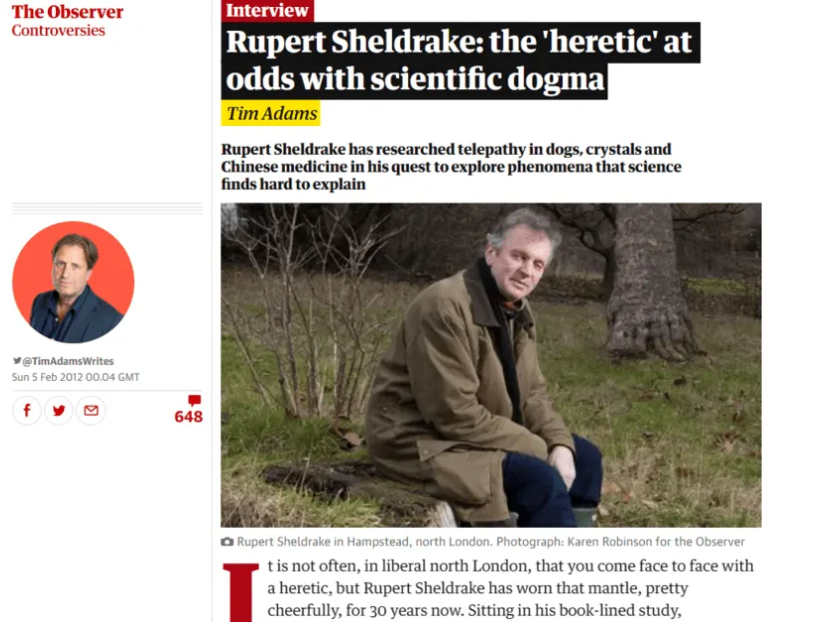
Take the related case of the scientist, writer and parapsychology researcher Rupert Sheldrake.

It can be assumed that Sheldrake will be aware of this context-of-discovery/context-of-justification distinction. However, it can also be assumed that he doesn’t really buy it — at least not unquestioningly. (I doubt that anyone accepts it unquestioningly. I don’t.)

Take the following passage:

“To this day, scientists pretend that they are rather like disembodied minds. Unlike other human activities, science is supposed to be uniquely objective. Scientific papers are conventionally written in an impersonal style, seemingly devoid of emotions. Conclusions are meant to follow from facts by a logical process of reasoning, such as that which might be followed by a computer, if machines with sufficient artificial intelligence could ever be constructed. Nobody is ever seen doing anything, methods are followed, phenomena observed, and measurements are made, preferably with instruments. Everything is reported in the passive voice. Even schoolchildren learn this style, and practise it in their laboratory notebooks: ‘a test tube was taken…’
“All research scientists know that this process is artificial; they are not disembodied minds, uninfluenced by emotion.”

So what if scientists did believe that they have “disembodied minds”? Where would that lead us? Would it impact on the attitude we have to their actual scientific theories, and to science generally?

Moreover, do any of Sheldrake’s psychological analyses of scientists (even if genuinely insightful) matter? (Readers may now ask: Matter to whom? Matter in which respects?)

In any case, isn’t this simply Sheldrake’s biased interpretation of what scientists believe? Indeed, even if (most? many? some?) scientists do believe that they have a monopoly on what people call “the objective facts”, then that still wouldn’t entail a commitment to believing that their minds need to be disembodied in order to access those objective facts.

The philosopher Zizek (who uses the words “objective truth-values”) is also against the distinction. However, he never actually uses the technical terms “context of discovery” and “context of justification”.

Slavoj Žižek Against the Distinction
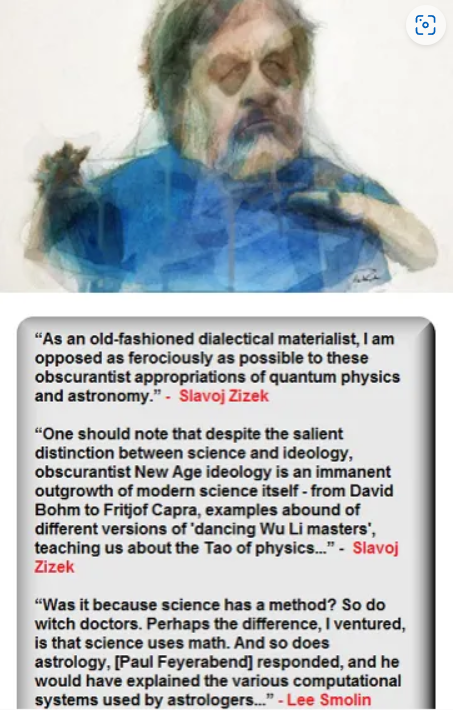
Firstly, Žižek tells us that the “standard distinction” is between

“the social or psychological conditions of a scientific invention and its objective truth-value”.

Žižek has a problem with this division (or distinction).

He continues:

“The least one can say about it is that the very distinction between the (empirical, contingent sociopsychological) genesis of a certain scientific formation and its objective truth-value, independent of the conditions of this genesis, already presupposes a set of distinctions (between genesis and truth-value, etc.) which are by no means self-evident.”

Let’s firstly comment on certain terms which Žižek uses, and which are questionable.

Take his words “objective truth-value”.

Surely one can make a distinction between the context of discovery (or Žižek’s “genesis”) and the context of justification, and still not have a strong (or even any) commitment to objective truth-values.

For one, what does “objective” even mean in this context?

The words “scientific invention” also (to use Žižek’s own words) “presuppose[] a set of distinctions” which Žižek himself is making. In this case, he appears to believe that scientific theories (or even experimental findings) are little (or even nothing) more than inventions.

Of course, “invention” is a loaded term. Nonetheless, Žižek is on fairly strong ground here because some quantum theorists (who’re also physicists) stress this.

Take “quantum Bayesianism” (Qbism) and the position of Christopher Fuchs.

Fuchs believes that “quantum states represent observers’ personal information, expectations and degrees of belief”. More relevantly, Fuchs believes that this

“allows one to see all quantum measurements events as little ‘moments of creation’, rather than as revealing anything pre-existent”.

Now what could be more (as it were) constructionist, and, more relevantly, biographical than stressing (scientific) “moments of creation”?


Note:

(1) See Walter Moore’s excellent biography: Schrödinger: Life and Thought. Moore goes into much detail on Schrödinger’s interest in Schopenhauer, Vedanta, etc.

Saturday, 9 March 2024

Philosophy: My Posts (or Tweets) on X (2)


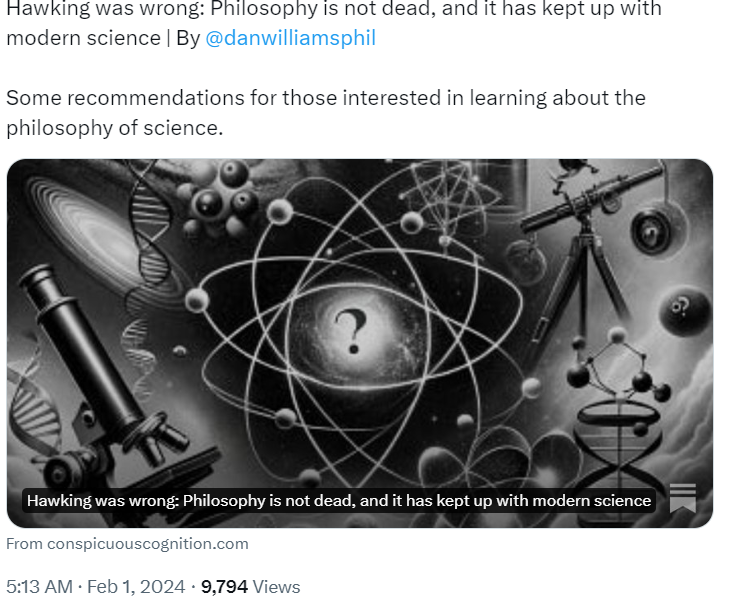
(i) Philosophy is not dead. It has kept up with science. 
(ii) Sexy Popular Science 
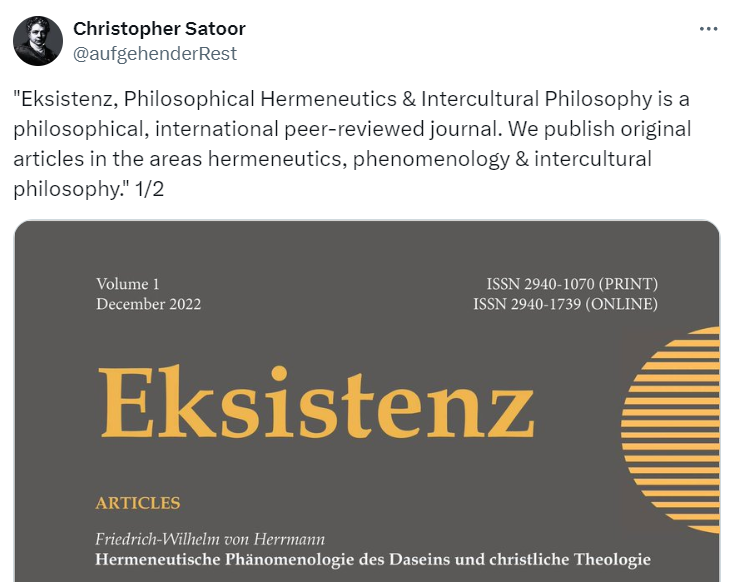
(iii) It’s Been Peer-Reviewed! Wow! 
(iv) What Happened to Philosophy? (Philosophy Now)


This is the second of a series of my philosophy posts (or tweets) on X, as now published here on Medium.

The tweets were relatively long anyway, as I have a X Premium subscription which allows people to publish long posts. Indeed, I went for the subscription option precisely because I was unhappy with X’s word limit (as well as other limitations)…

What can you say in (up to) 280 characters? Not that I ever intended to do the opposite: post article-long posts on X.

Thus, I intended to strike a happy medium between posting full essays, and posting short (usually unhelpful) tweets on X.

In terms of my reposts on Medium, I’ll often need to stop myself from over-extending the original X posts, which will kinda defeat the object of reposting “shorts”. However, as stated, some X posts will be tweaked and extended if required.

Finally, I also add links to the original tweets, which can’t be done on X itself.


Philosophy is not dead. It has kept up with science.

Sure, some philosophers haven’t kept up with science. However, many have.

Or, I should say, many analytic philosophers have.

Some philosophers outside that tradition, on the other hand, don’t have much respect for science. Indeed, they’re positively anti-science. So perhaps Stephen Hawking had them in mind… Probably not.

This also depends on what the words “kept up with” mean. What is deemed to be up to date anyway? Full knowledge of the papers which have been published in the last, say, three months in respected science journals?

It’s also true that some philosophers (such as metaphysical realists) believe that philosophy actually trumps science in that if there’s a clash between the two, then science itself must accommodate philosophical theories.

[E. J. Lowe believed this — at least when it came to to certain issues, such as the nature of spacetime. See his chapter ‘Metaphysics’ in The Bloomsbury Companion to Analytic Philosophy.]

It also depends on how much knowledge of science critical scientists expect from philosophers. As much knowledge — and as many skills — as scientists themselves have? However, if that were ever the case, then wouldn’t such philosophers actually be scientists?

So is that the problem that some scientists have with all philosophers — that they aren’t actually scientists?

Is it really that simple?

Sexy Popular Science

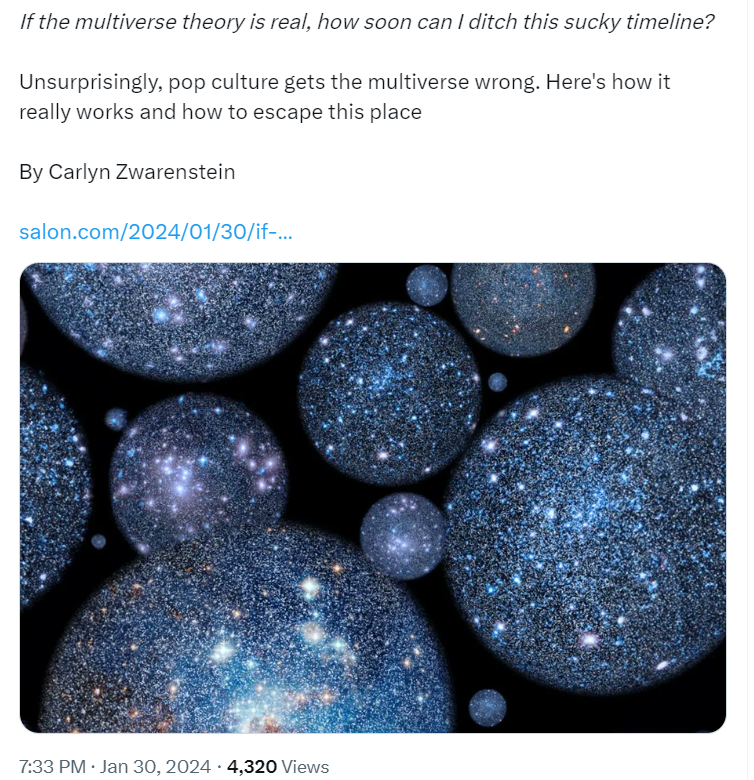
Perhaps “pop culture” often gets these things wrong because of what physicists themselves write and say. More precisely, because of what physicists write in their “popular science” books.

This has got a lot to do with physicists (not pop culture) attempting to make their topics (more?) sexy.

There are two main reasons why such physicists tart up science:

(1) In order to get more people interested in science.
(2) To help sell more of their own books.

It’s Been Peer-Reviewed! Wow!

In response to the claim above, are we meant to stand back and shout the following? —

Peer-reviewed! Wow! I’ll order half a dozen.

I’m not actually against peer-review. (It would be an odd thing to be against.) And there is a strong need for it. However, there are also problems.

For example, what if all the reviewers of a paper (or within a specific journal) believe similar things, have been educated in similar ways, uphold the same political or scientific views, etc?

What if there are only two reviewers for a particular submitted paper?

What if all (or perhaps just some) of the reviewers are biased, corrupt, dumb, or simple careerists?

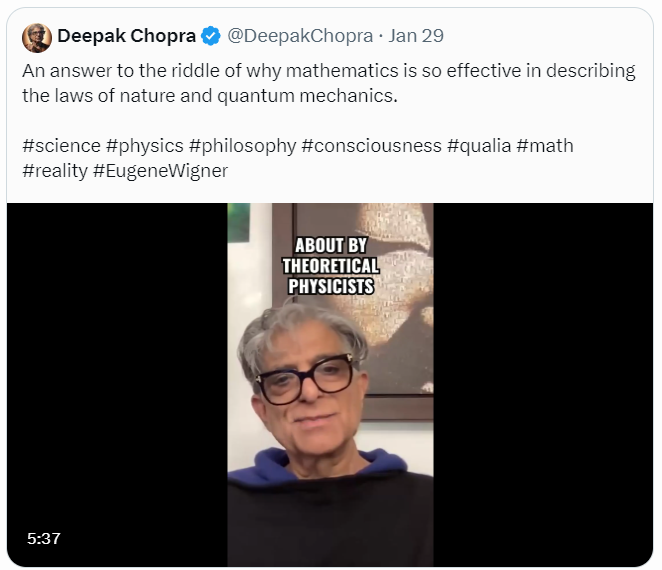
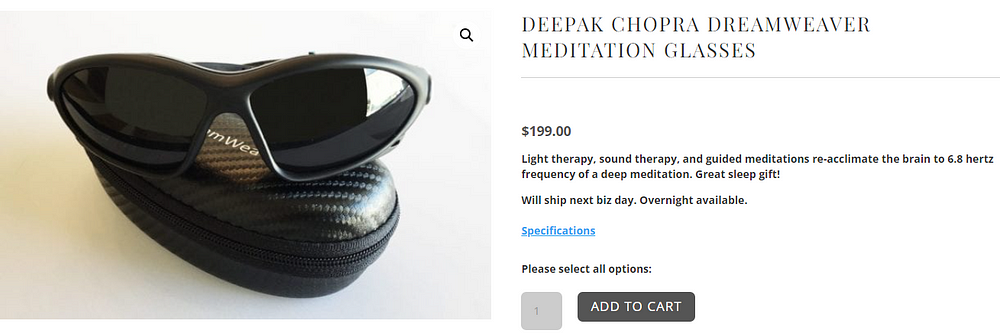
Deepak Chopra has

“an answer to the riddle of why mathematics is so effective in describing the laws of nature and quantum mechanics”.

All the physicists, mathematicians and philosophers on the planet are waiting with bated breath for his answer.

Shorter

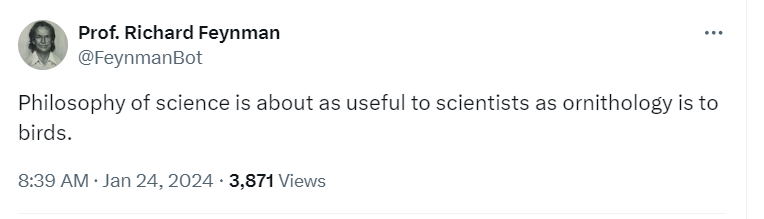
Endless Richard Feynman tweets and memes on X/Twitter are about as useful to science as Brad Pitt’s haemorrhoids.

What Happened to Philosophy? (Philosophy Now)

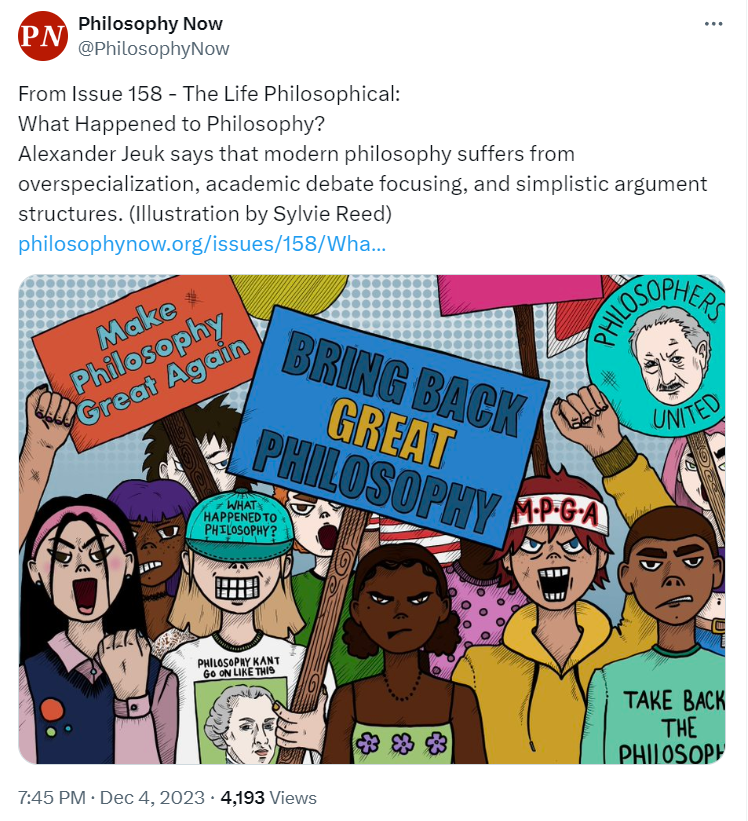
The content of the tweet above (at least) seems to tie in with what Nigel Warburton, Julian Baggini, Simon Critchley, etc. have to say about “professional Anglo-American analytic philosophy”.

So it’s odd how strong and systematic the links are between the philosophers who criticise “professional philosophy”, and, well, professional philosophy, as well as their links to university departments of philosophy, and to their various colleagues who’re professional philosophers. Indeed, Simon Critchley is a professional academic philosopher and critic of “professional philosophy”, and has been so for almost his entire adult life.

Alexander Jeuk (who classes himself as a “Marxist philosopher”) says that “modern philosophy suffers from overspecialization”. (My very strong bet is that he actually means analytic philosophy.) Would he also say that about any other discipline — such as physics, chemistry and economics? And what about Critical Race Theory, Subaltern Studies, Women’s Studies, etc?

Perhaps the (romantic) argument is that philosophy isn’t (or shouldn’t be) like these (former) disciplines. It should be “for the people”.

I’m also curious about Alexander Jeuk’s reference to “simplistic argument structures”. On the face of it, isn’t “overspecialised” philosophy (again, he means analytic philosophy) the prime culprit when it comes to too-complex “argument structures”?… So perhaps these (seemingly?) complex structures are actually simplistic structures, at least according to Alexander Jeuk.

Now I’m very curious.

Shorter

Did Nietzsche prove that?

Shorter

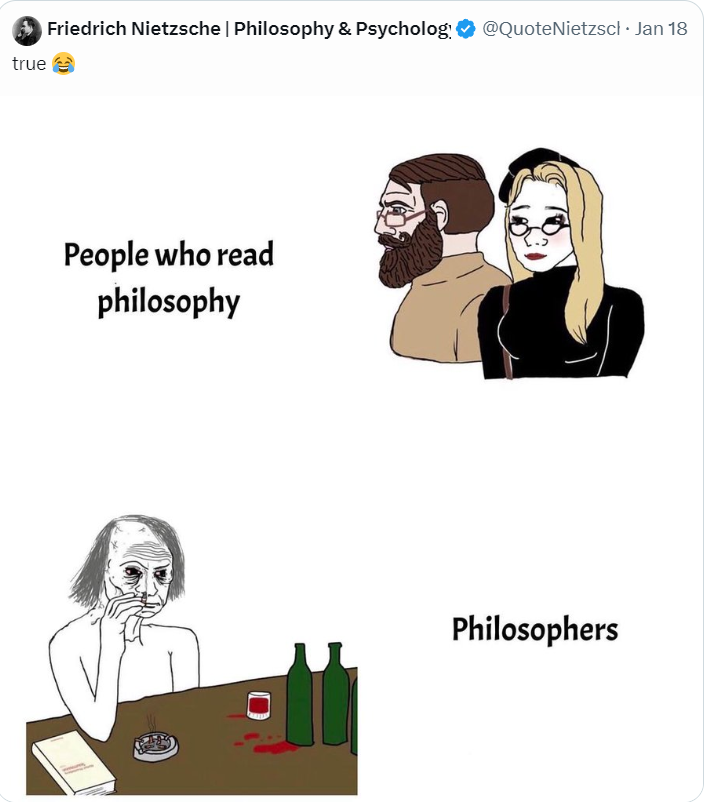
This is wank.

As if there are any important philosophers who haven’t “read philosophy”.

Of course, the meme above is poetic and rhetorical. However, if taken literally, then it’s wank.

Nietzsche himself read lots of philosophy. And Nietzschean philosophy is largely a response to prior philosophy.

So am I missing the point here anyway?

Is this simply about hipster memes-for-teens on Twitter/X?


My account on X can be found here.


Friday, 8 March 2024

Philosophy: My Posts (or Tweets) on X (1)


(i) Albert Einstein, Just War Theory, and Pacifism 
(ii) Transcending Reason 
(iii) Why Study Philosophy? 
(iv) The Nothing Nots 
(v) Theoretical Physics Isn’t Philosophy? 
(vi) Is Time Travel Possible? 
(vii) Do Academic Philosophers Contribute to “Public Discourse”?

This is the first of a series of my philosophy posts (or tweets) on X, as now published on Medium.

The tweets were relatively long anyway, as I have a X Premium subscription which allows people to publish longish posts. Indeed, I went for the subscription option precisely because I was unhappy with X’s word limit (as well as other limitations)…

After all, what can you say in up to 280 characters? Not that I ever intended to do the opposite: post article-long posts on X.

Thus, I intended to strike a happy medium between posting full articles (or essays), and posting short (therefore usually unhelpful) tweets on X.

In terms of my reposts on Medium, I’ll often need to stop myself from over-extending the original X posts, which will kinda defeat the object of reposting “shorts”. However, as stated, some X posts will be tweaked and extended if required.

Finally, I also add links to the original tweets, which can’t be done on X itself.


Albert Einstein, Just War Theory, and Pacifism

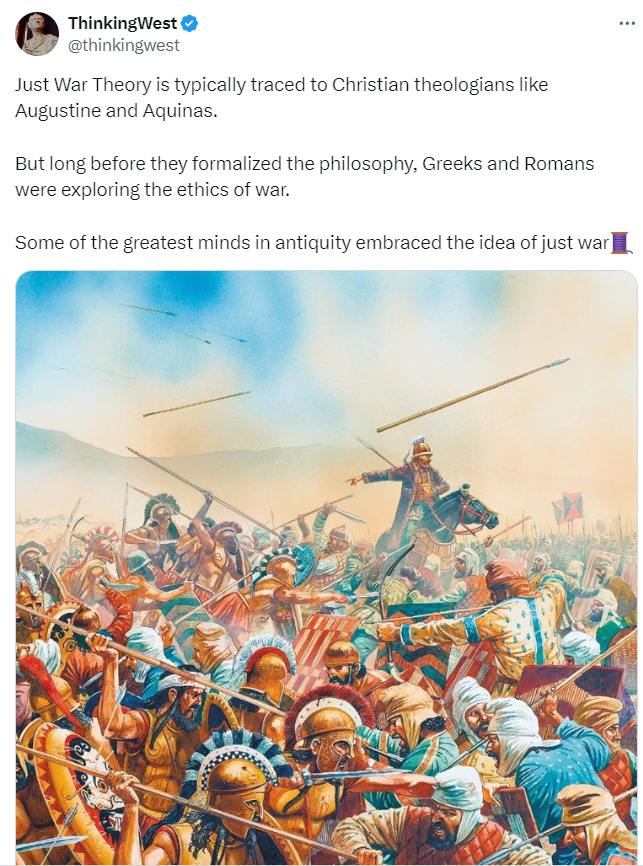
Albert Einstein believed in a “just war”. He must have done. He believed that the war against Nazi Germany (in 1939) was just. Yet he was also a self-described pacifist”.

So was this like the following?-

“I’m a pacifist, BUT…”

[“I’m not a racist, but…” Or: “I’m not a Marxist, but…” Etc.]

So perhaps most people are pacifists-but. Or perhaps most pacifists are pacifists-but.

I’m not sure if there’s a strong contradiction here, and perhaps Einstein stopped being a pacifist at some point. However, didn’t he become a pacifist again after the Second World War? (I don’t know much biographical detail about Einstein.)

Can pacifists pick and choose as Einstein seemingly did? More relevantly to the tweet above, do some pacifists believe that some wars are just?…

Well, if they do, then surely they’re not pacifists…

Transcending Reason

There are two problems with (supposedly) “transcending reason”:

(1) Historically, reason has often been required (or “used”) to transcend reason
(2) Those who genuinely transcend reason will also need to compete with others who genuinely transcend reason.

Irrationalists (or those who “transcend reason”) usually compete with rival irrationalists by using violence, abuse, emotional language, poetic and categorical proclamations, etc. That’s what I meant in (2) above.

So is all that why Martin Heidegger embraced the Nazis?

Most Heideggerians, of course, deny all this, or say that it’s irrelevant to his philosophy.

Really?

Not if Nazi and other other kinds of irrationalism are embedded in Heidegger’s actual philosophy! Indeed, isn’t that one implicit claim of some of those who speak of “transcending reason”?

Why Study Philosophy?

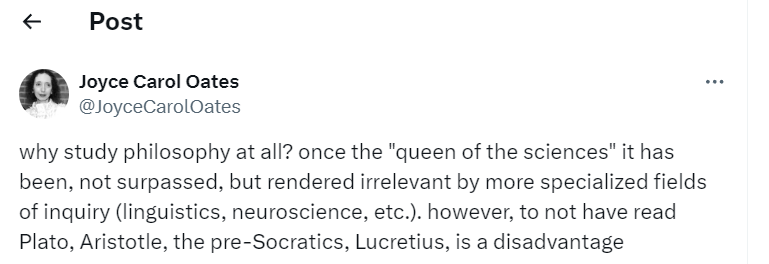
Joyce Carol Oates could do with studying more philosophy herself.

She doesn’t even bother telling her readers why philosophy has been “rendered irrelevant by more specialized fields of inquiry (linguistics, neuroscience, etc.)”. In fact, at face value, it’s hard to know what that even means. It’s almost like saying that tennis has been rendered irrelevant by dogging.

In her favour, it’s only a tweet, not a paper or article.

The thing is, many tweeters can’t go much further than slogan-full posts. What’s more, most philosophers haven’t read Lucretius. So that philosopher is an oddly personal choice.

The Nothing Nots

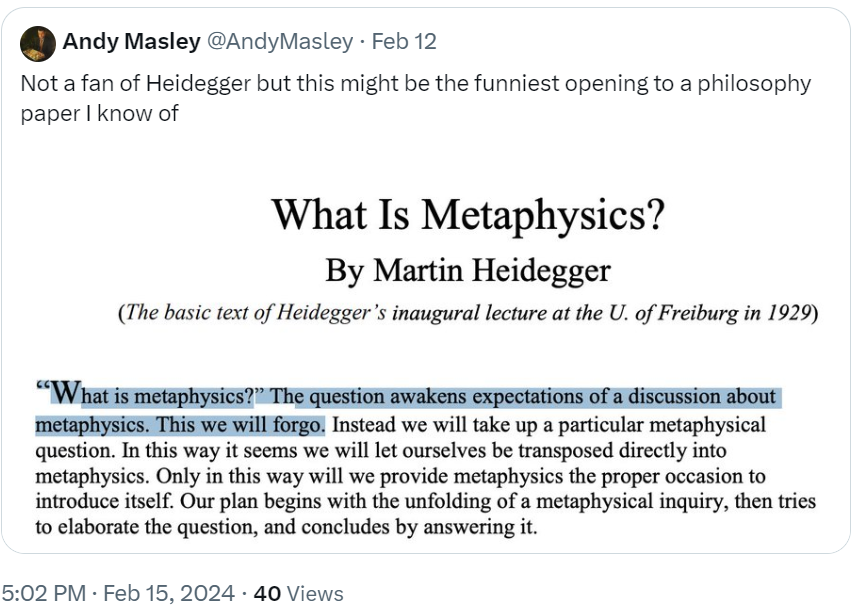
Is this the paper in which the words “the nothing nots” occur? It is certainly the paper Rudolf Carnap had a go at.

Oddly, they were both on the same page when it came to criticising Western metaphysics. That is, both had a Year Zero attitude toward metaphysics.

Arguably, Carnap was even more extreme than Heidegger on this. After all, Heidegger knew his philosophical history. I’m not sure that Carnap did.

Continental Philosophy

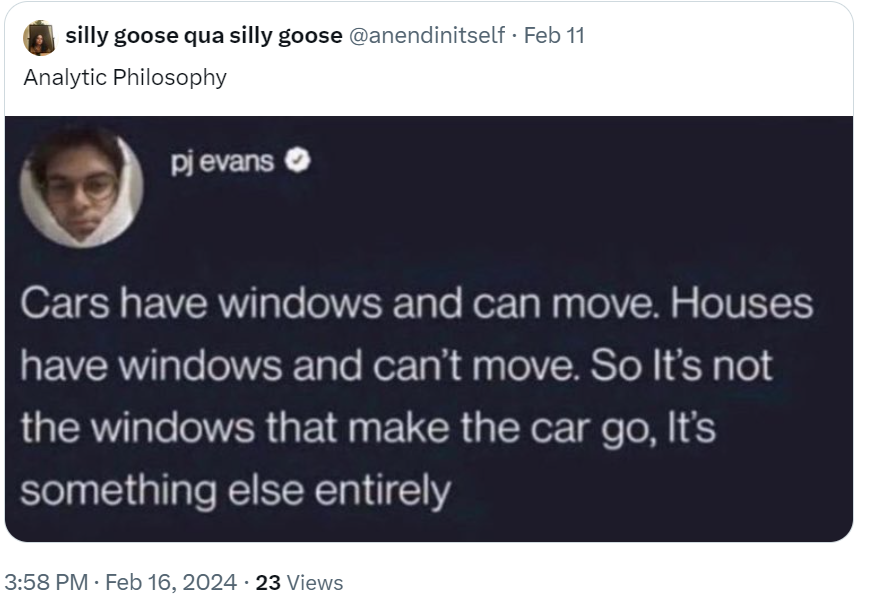
Is the above a good example of taking the piss out of analytic philosophy?

Try my response:

Continental Philosophy:

“Cars transcend the multi-variational multiply of epic Being-qua-Being. Houses are fascistic in intent and design. Thereforeto4, it’s not that cars aren’t fascistic too, it’s that Godel’s theorem says that houses are more fascistic…”

Theoretical Physics Isn’t Philosophy?

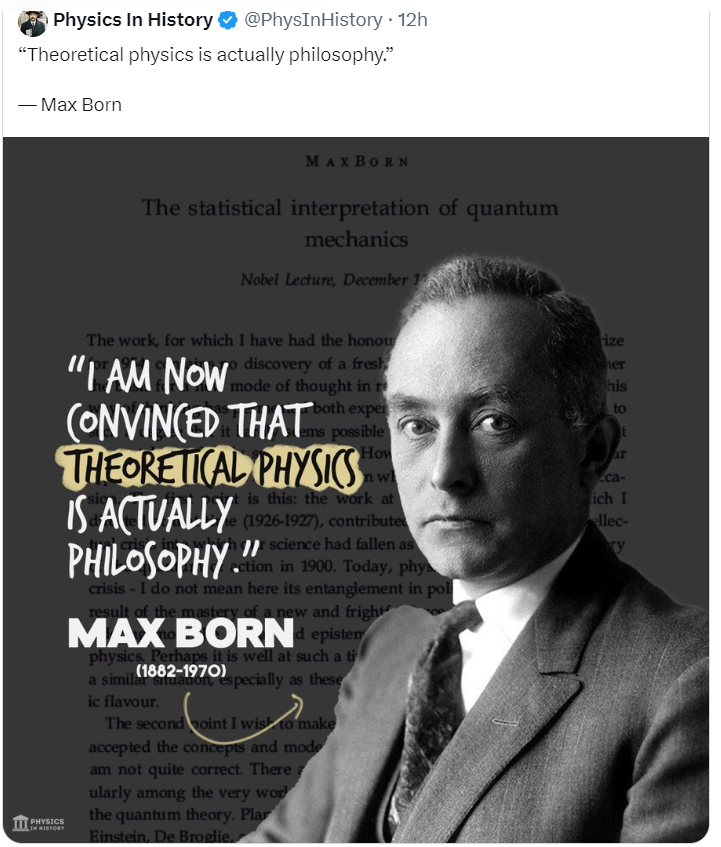
Theoretical physics may not actually be philosophy. However, surely it’s often philosophical. Indeed, much of it is speculative…

And a good thing too… up to a point.

Do other physicists, unlike Max Born, believe that theoretical physics isn’t philosophy simply because the subject matter is, well, physics? Does the maths contained in it automatically stop it from being philosophy?

I’m not arguing that theoretical physics is philosophy (as in “the ‘is’ of identity”).

Is time travel possible?

Some philosophers and scientists have argued that time travel is logically impossible. Thus, it seems that their position has little to do with technological limits, physical laws, spacetime, etc.

In any case, what some philosophers and scientists deem to be logically impossible, may not actually be logically impossible.

Do Academic Philosophers Contribute to “Public Discourse”?

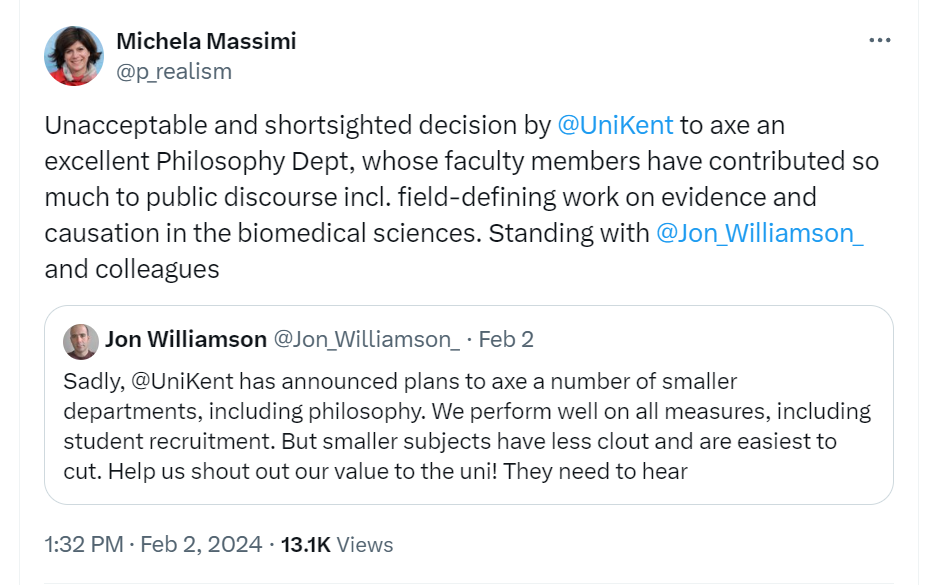
I’m not in favour of any cuts to philosophy departments. However, I still need to know what the words “an excellent Philosophy Dept, whose faculty members have contributed so much to public discourse” mean.

To pin that down a little.

What do the words “contributed so much to public discourse” mean?

I suppose that because universities are “public” bodies, and the work of academics is public, then, by definition, academic philosophers must have “contributed so much to public discourse”… But I’m not sure.

Academics really must be more philosophical about why they deem their own careers to be so important, and also about the role they believe they play in society at large. I suspect that Michela Massimi is only tweeting to other academics. However, how does she believe her words will sound to all those outside the Academy?


My account on X can be found here.


Sunday, 3 March 2024

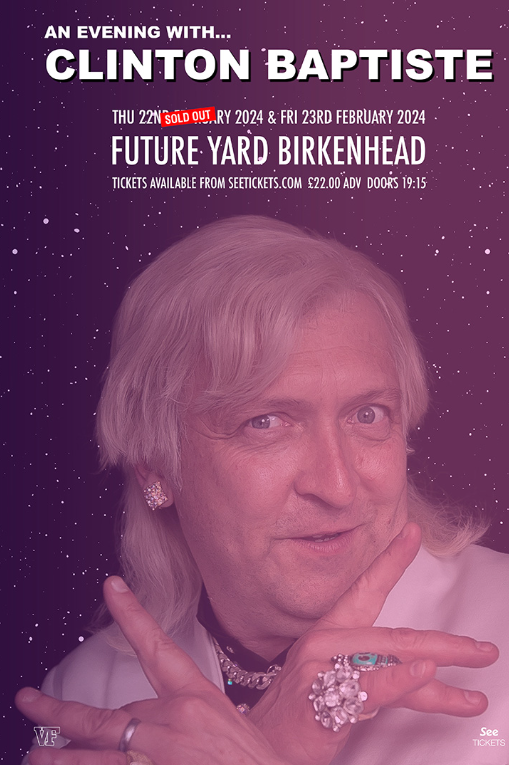
Spiritual Paranormalist Clinton Baptiste Isn’t a Fraud!

The thing about Clinton Baptiste is that he actually looks deeply spiritual. His blonde locks display that deep spirito di punto inside all of us. Indeed, when in close proximity to the great man, you can smell his spirit.

Materialists, scientists and naysayers will say what they say about him, but they can’t ignore his uncanny spiritual abilities.

For example, when psyching for an audience of 500 peoples, Baptiste passed a message to a Pascal Del Monte from the Other Side: “Someone called Dave says you’re a twat.”

So who, but a soulless materialist, could doubt Clinton’s incredible psychic gifts when he also said to an audience, “I’m getting the name… John. Is there a John in the audience?”

And guess what.

There was a John in the audience!

Now that is true spiritual greatness!

Yes, Baptiste’s psychic skills are quite remarkable, despite what the materialists and sceptics sneeringly say in their Medium stories.

Some people have even suggested that the police should use Baptiste’s services. Take the time when he did some heavy-duty psyching:

“I’m getting the word… ‘nonce’.”

Yes! Baptiste had correctly identified a nonce in the audience.

And the proof that he was Right came when the nonce punched him in the face.

Here’s another example.

Baptiste has psyched Michael Jackson, Kurt Cobain (who died), Neil Armstrong, and Jesus H. Christ. (“He’s got a beard and the long robes and everything”).

Yet, oddly enough, Baptiste himself needs a spiritual guide in order to take him to a yet-higher spiritual realm. His guide is Taruak the Eskimo. (Later rechristened as Taruak the Inuit when Baptiste became well aware of cultural sensitivities and stuff.)

Clinton is very much hands on too.

Basically, all the spiritual stuff isn’t just based on theory: it’s also grounded in practice, reality and experience. Indeed, Clinton has personally experienced 23 Near Death Experiences in the last 7 years (as recalled here).

Scientists and Materialism are Evil

Take the case of astrology, and what all those closed-minded scientists say about it.

192 scientists were once asked about astrology. (19 of them were Nobel Prize winners.) In broad terms, they all claimed that astrology has no scientific support, logical explanation, and is a bunch of bull*shit.

Clearly, these scientists — all of them — are total fuck*ers.

Yes, they’re soooooooo cocooned in their petty world of fact, argument and data that they can’t see the Truth.

If only they felt the Truth.

I blame materialism myself.

Materialism is, well, evil.

It’s responsible for literally — and I mean that literally — all the ills of the Western world.

In the Spiritual East, and to some extent in our own spiritual past, there were no wars, no persecutions, no narrowmindednesses, no tribalism, no hate. There was simply a holistic spiritual reality in which all the parts of the Universal 1 were interconnected to each in some crazy quantum-entangled kinda way.

Indeed, in the Spiritual East, even farmers and bricklayers stared at the stars for at least half-an-hour each day, contemplated-Being-for-a-while, and then blended into Mother Nature’s welcoming womb.

But in the West, all that ended in 1637 - with the satanic birth of materialism!

Yes, when Desmond “the Des” Carts released his first album — Discourse on der Method.

Materialism?

Well, where do I start?

Materialism embodies an entire omni-omni-bus-pass-of-a-mindset and a worldview.

From dawn till dusk (or both), materialism controls every aspect of our lives — from our love of war and our hate of love, to how we make love to beatifical ladies.

What’s more, metaphysical materialism and everyday materialism — consumerism! — are actually one and the same thing. And that’s because the latter grew on the dung heap of the former.

Hence, the rampant egoism in the West.

Deepak Chopra. Clinton Baptiste is a good spiritual friend of Chopra. They grew up together in Bolton’s “spiritual quarter”. They share the same accountant.

Unlike millionaire gurus and quantum businessmen, most Westerners (especially the scientists) are ruled by their possessions, self-image, titles, and a sense of their own superiority…

And it is that hellhole that spiritual conduits like Clinton Baptiste are rebelling against.

Yes, spiritual-but-not-religious people are showing us the way to a selfless, possessionless, and egoless world.

Baptiste himself displayed his selflessness and ego death when during Peak Covid he manged to carry out bargain-priced seances and readings over Zoom.

So please checkout Clinton Baptiste’s live acts, as well as his podcast — the Paranormal Podcast. Tickets are only 50 quid for the acts, and each podcast is downloadable for free at only £9.99.