Monday, 22 June 2015

Kant & Hume on the Nature of God


According to Kant, God is experience- or evidence-transcendent. In this sense, he quite agreed with Hume.

Kant also believed that Hume thought that “we apply only ontological predicates (eternity, omnipresence, omnipotence)” to God. What Hume required were “properties which can yield a concept in concreto”. The ontological predicates, according to Kant, were “superadded”. That is, predicates such as eternity, omnipresence and omnipotence aren't intrinsic properties. They are, if you like, simply God's abilities and powers. What Hume wanted is a “criterion of identity” (to use a 20th century term) for God's nature, not simply descriptions of His abilities and powers.

It’s as if someone were to describe a rose by saying that “it delights people and is an emblem of love”, instead of saying that roses are "red, physically constituted by certain natural materials and give off a sweet pungency". Hume was asking:


What is God? I don’t want to know His powers or what He does.

Kant would have said that God's intrinsic properties are beyond us because such properties can only be given in experience. This prompts the question: Aren’t the properties of omnipotence, omnipresence also given only in experience? Isn't part of God’s essence, as it were, the fact that He is beyond experience? Not only that: part of God’s essence (for Kant) is that He is beyond experience. If we wanted more than this, we would be, Kant said, guilty of “anthropomorphism”. This is what many theists were guilty of in Kant's day (as well as later).

In a sense Kant sympathised with Hume’s deism and sided with him against theism and all other “anthropomorphisms”. Theism, or at least anthropomorphism, is for crude God-lovers who somehow project their own properties or attributes onto God (as Feuerbach, Marx, Nietzsche and Freud were later to elaborate upon). However, despite what's been said, Humean deism is going too far... or so Kant thought. Kant’s view of deism is unequivocal. He says, “nothing can come” of it. Not only that: it “is of no value” and “cannot serve as any foundation to religion or morals”.

So whereas theism is too human (Nietzsche's “all too human”), deism is too anti-human. Kant therefore attempted, as ever, to find some kind of middle way between the two extremes.

Kant was unhappy with anthropomorphism (therefore theism?). We mustn't “transfer predicates from the world of sense to a being quite distinct from the world”. The end result of Kant’s vision of God is therefore quite unequivocal. We must

acknowledge that the Supreme Being is quite inscrutable and even unthinkable in any determinate way as to what it is in itself”.

God is, therefore, another noumenol being.

Kant again agreed with Hume who thought that it's wise

not to carry the use of reason dogmatically beyond the field of all possible experience”.

However, Kant had a problem with this dogmatic attitude towards reason itself. He thought that Hume shouldn't “consider the field of experience as one which bounds itself in the eyes of our reason”. Reason therefore comes to Kant’s rescue again. Reason can take us beyond “all possible experience” and give us the means to understand, if not know, God Himself (in this instance). Indeed Kant called Hume’s dogmatism towards reason “scepticism”. And Kant, yet again, attempted to find “the true mean between dogmatism…and scepticism”.

Kant reiterated why he thought that we can transcend experience. He said that experience

does not bound itself; it only proceeds in every case from the conditioned to some other equally conditioned thing”.

However, experience’s

boundary must lie quite without it, and this is the field of the pure beings of the understanding”.

Of course it's reason which takes us to these “pure beings of the understanding”. It's also natural theology, via reason, which takes us beyond “the boundary of human reason”. It “looks beyond this boundary to the idea of a Supreme Being”.

Yet again Kant shows us that there's an illusive bridge between the offerings of experience and that which is beyond experience. He concedes

that reason by all it’s a priori principles never teaches us anything more than objects of possible experience”.

This doesn't mean that

this limitation does not prevent reason from leading us to the objective boundary of experience, viz., to the reference to something which is not itself an object of experience but must be the highest ground of all experience”.

Kant concedes that reason “does not, however, teach us anything concerning the thing in itself”. So what does reason do? It “only instructs us as regards its own complete and highest use in the field of possible experience”. Reason takes us beyond possible experience; though only into the field of conjecture, supposition and speculation. It doesn't give us absolute knowledge of what lies beyond the boundaries of possible experience. It does, though, show us the boundaries themselves and what may lie beyond them.

Kant was clear that it's metaphysics itself that takes us beyond the bounds of possible experience. He said that pure reason is compelled to quite the mere contemplation of nature, to transcend all possible experience” and to “endeavour to produce the thing…called metaphysics”.

Metaphysics frees “our concepts from the fetters of experience and from the limits of the mere contemplation of nature” and allows us into the “field containing mere objects for the pure understanding which no sensibility can reach”. It's in passages like this that Kant shows us how far removed from the tenets of empiricism he was; despite the fact that he, in certain senses, fused empiricism and rationalism. The empiricists believed that there's no knowledge beyond experience. Kant agreed. However Kant also believed that metaphysics took us beyond experience into the realm of “pure beings” which, nevertheless, couldn't be known. It was these flights of fancy that traditional empiricism was against. Indeed later 20th century empiricists - the logical empiricists - thought that it's precisely these Kantian flights of fancy (even if they didn't claim to give us knowledge) which resulted in metaphysics itself becoming “meaningless” or “nonsense”.

Kant did indeed strike a balance between extreme rationalism (which has no time at all for experiences or the senses) and extreme empiricism (which equally has no time for anything which is putatively beyond sense experience). Kant himself criticised Plato for floating off into the ether because he had no solid moorings in the world of sense. However, Kant also accused hard-core empiricists (such as Hume) of being “sceptics”.

Was it the case, then, that Kant was between a rock and a hard place? Or, as David Lewis once put it, was Kant “between the rock of fallibilism and the whirlpool of scepticism” (in his paper 'Elusive Knowledge' of 1996)? Does it indeed make sense to talk about what lies beyond sense experience? Equally, doesn’t empiricism (in its extreme forms) annihilate the very practice of metaphysics and, ultimately, all philosophy?

                               ******************************************************

*) All the passages from Kant are taken from his Prolegomena to Any Future Metaphysics (the Paul Carus translation of 1902).

Kant on Analytic & Synthetic Judgements


According to Kant, analytic judgements are made up of subject and a predicate. The predicate expresses nothing which isn't already contained in the subject.

Take this analytic judgement:

         “All bodies are extended.”

Here the subject is “all bodies” and the predicate is “(are) extended”. Within the subject is contained the concept [extended]. According to Kant, “I have not amplified the concept of body, but only analysed it."

Now take the following:

      “All bodies have weight.”

Here the subject is again “all bodies” and this time the predicate is “have weight”. This judgement is synthetic because the predicate “have weight” isn't contained in the subject “all bodies”. This predicate, therefore, “amplifies” rather than “analyses” the subject.

We now have two terms which sum up what's just been written:

       “explicative judgement” – adds nothing to the subject = analytic

       “ampliative judgement” – increases the given cognition = synthetic

In what way do we know the analytic judgement to be true or false? We know it a priori. Take this judgement:

       “Gold is a yellow metal.”

The concepts involved in the judgement above are empirical in nature. However, the statement above, according to Kant, can still be known to be true a priori. The reason for this is that, again, the predicate “yellow metal” adds nothing to the subject “gold”. According to Kant, we “require no experience beyond our concept of gold”. Yellowness (as it were) is contained in the concept [gold]. That means that the statement can be known to be true a priori.

Arithmetic

According to Kant, arithmetical judgements are all synthetic and not analytic, as was commonly thought in his time (e.g. by Hume). However

         7+ 5 = 12

is still knowable a priori; though it's nevertheless synthetic. Arithmetical statements are a priori “because they carry with them necessity, which cannot be obtained from experience”.

Why isn’t the above a mere analytic judgement such as “a = a”? Why is it synthetic and a priori? After all

         7 + 5 = 12

basically means

        12 = 12

which is a tautology of the kind

        A = A.

And

        7 + 5 = 13

would be a contradiction of the kind

    12 = 13

or

     A = B

Why does Kant think that 7 + 5 = 12 is a priori as well as synthetic? This is how Kant himself puts it:

The concept of twelve is by no means thought by merely thinking of the combination of seven and five…”

Kant continues:

“…analyse this possible sum as we may, we shall not discover twelve in the concept.”

We can't find the concept [12] within the concept [7 + 5]. What more do we need? According to Kant:

We must go beyond these concepts by calling to our aid some intuition corresponding to one of them, i.e., either our five fingers or five points…”

This is very difficult to grasp without an explication of the notion of intuition. However, it's the intuition itself that's synthetic. Therefore the “five fingers or five points” needed for the intuition are derived from experience. Therefore they're synthetic (or the experience is). The judgement is synthetic a priori. To use Kant’s terms, the concept [12] is an “amplification” of the concept [7 + 5].

What about geometry?

Geometry

Take the following principle of geometry:

            “A straight line is the shortest path between two points.”

According to Kant, that statement is a synthetic judgement. Though it's also knowable a priori. It's relatively easy to see why the above is knowable a priori, but why is it also synthetic? Kant says:

The concept of the shortest is therefore altogether additional and cannot be obtained by any analysis of the concept of the straight line.”

The concept [shortest] isn't contained in the concept a [straight line]. Or, more accurately, the concept [the shortest path between two points] isn't contained in the concept [a straight line]. Here again, according to Kant, “intuition must come to aid us”. Presumably here the (empirical) intuition is this:

           a------------------------------------------b

That is, a straight line between two points.

Kant then summarises all the above. He calls synthetic a priori judgements “apodeictic”; just as we would call an analytic judgement “apodeictic”. Such judgements are apodeictic because the predicate is already contained in the subject. However, unlike a pure analytic judgement, such as

             “All bodies are bodies.”

we need a “necessarily present intuition” which supplies the synthetic part of the judgement or statement. Unlike the above analytic statement,
      

the predicate [12] belongs to this concept [7 + 5] necessarily indeed, yet not directly but indirectly by means of a necessarily present intuition”.

Kant went beyond the mere empirical synthesis of perceptions. He thought that there is a priori synthesis too. When perceptions are synthesized a priori, they are given, according to Kant, “universal validity”.


Sunday, 21 June 2015

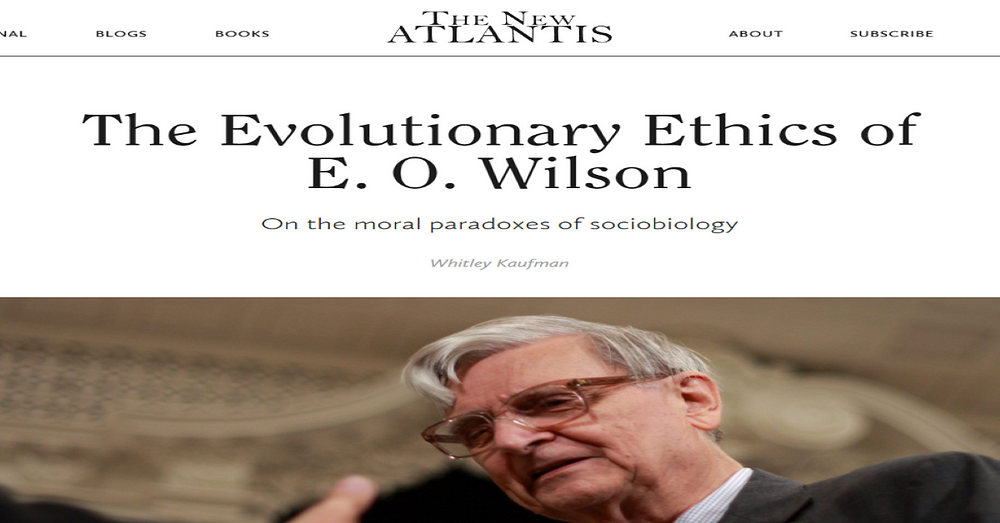
E.O. Wilson’s Ethics isn't Ethics (Is isn't Ought)

Did the biologist and naturalist E.O. Wilson “derive an ought from an is”?… Or did he ignore the ought entirely?

“Thus at least man comes to feel, through acquired and perhaps inherited habit, that it is best for him to obey his most persistent impulses. The imperious word OUGHT [my capitals] seems merely to imply the consciousness of the existence of a rule of conduct, however it may have originated.”

Charles Darwin (From his Descent of Man — the actual passage is here.)

[Note: I wrote this essay some years ago (hence the square brackets) and would probably write it in a different way today. I even contemplated adding a question mark at the end of the title. That said, I don’t have any big problems with anything within it. Indeed, if I did have problems with it, then there’d be no point in publishing it here on Medium.

So to make things clear. I have no serious problems with evolutionary theory, applying the sciences to non-scientific issues, etc. In fact, broadly speaking, I’m a naturalist. So I have a lot of sympathy with the following passage from Daniel Dennett:

“If ‘ought’ cannot be derived from ‘is,’ just what can ‘ought’ be derived from? Is ethics an entirely ‘autonomous’ field of inquiry? Does it float, untethered to facts from any other discipline or tradition? Do our moral intuitions arise from some inexplicable ethics module implanted in our brains (or our ‘hearts,’ to speak with tradition)?”

That quoted, when it comes to ethics, I do believe that there are complications… as will hopefully be shown in the following essay.]

***************************

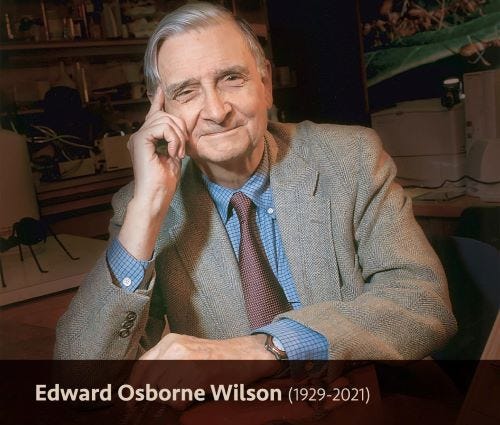
Edward Osborne Wilson (1929 — 2021) was an American biologist and naturalist.

Wilson was a humanist laureate of the International Academy of Humanism, a winner of the Pulitzer Prize for General Nonfiction and a New York Times bestselling author.

Wilson was widely recognized as one of the most important scientists of his generation. He received more than 150 awards and medals. (Several animal species have also been named in his honour.)

Finally, Wilson has been called “the father of sociobiology”. He also been called “the father of biodiversity” for his environmental advocacy. More relevantly to the following essay, his ideas on ethics and religion have been praised, criticised and much discussed.

E.O. Wilson’s Naturalised Ethics?

It’s not surprising that someone who believes in (universal) historical and scientific consilience should have believed that ethics is a suitable subject for for scientific scrutiny.

(Consilience:the principle that evidence from independent, unrelated sources can ‘converge’ on strong conclusions”.)

So how did E.O. Wilson explain science’s relatively new-found interest in ethics? Wilson argued:

“The objective meaning of ethical precepts comprises the mental processes that assemble them and the genetic and cultural histories by which they evolved. Those who think that an is/ought gap exists have not reasoned through the way the gap is filled by mental process and history.”

This is a very interesting passage from Wilson. For example, what on earth do the words “the objective meaning of ethical precepts” mean?… Actually, it’s fairly clear what Wilson was getting at. Still, it’s just an odd use of the words “the objective meaning of”. In addition, Wilson even appears to completely misunderstand the “is/ought gap”…

Either that, or he simply dismissed it!

If Wilson did dismiss it, then good arguments and reasons would need to be given for such a dismissal.

In any case, clearly Wilson was putting a purely descriptive position on “ethical precepts”, not a normative one. Perhaps it follows (at least to some people) from this that it’s not ethics at all! Instead, it’s simply the scientific study of human ethics…

Wilson might well have dismissed that just-stated distinction.

In more detail, Wilson’s position can be seen as being purely scientific (which may not be a bad thing). That’s primarily because of statements such as the following:

[E]thical precepts comprises the mental processes that assemble them and the genetic and cultural histories by which they evolved.”

Thus these passages are about what we (whoever “we” are) take ethical precepts to be — not what ethical precepts are or what they should be

Again, Wilson might well have taken these distinctions to be entirely bogus.

So all this is similar to what naturalised epistemology is to traditional epistemology. Here, instead, we have (what seems to be) a naturalised ethics. However, if ethics is intrinsically normative, then perhaps it can’t ever be (fully) naturalised. (Yet no doubt natural phenomena can — and will — still come into the equation.)

Isn’t ethics about how we should live, not how we do live?

In that sense, then, Wilson’s position isn’t ethics at all. It’s the scientific (i.e., biological, neuroscientific, psychological, sociological, etc.) study of human ethics.

More concretely, if Wilson believed that ethics is the study of the “genetic and cultural histories by which [ethical precepts] evolved”, then we can’t do anything about such causal aetiologies of our ethical standards and principles. That’s obviously because such things have already happened. Therefore this is simply a causal account of what we believe and do in the ethical sphere.

Perhaps the study of the “mental process that assemble [our ethical precepts]” isn’t itself in the domain of ethics. Isn’t it the domains of the sciences?

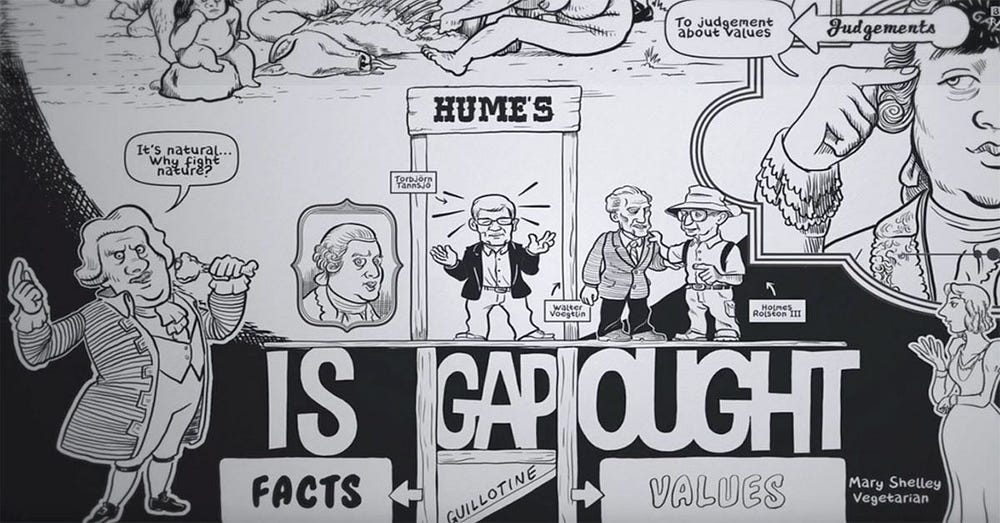
The Is-Ought Gap

Moreover, how is the is/ought gap (or is-ought problem) bridged simply by reasoning about this “mental process and history”?

All this is still the realm of the is and was, not the ought.

Just because we can fill in the gap (as Wilson put it) between the original causes of our beliefs and principles and the beliefs and principles themselves which followed, that alone doesn’t take us into the normative (or from the is to the ought) — even if the gap is filled with “mental processes and history” or whatever else. By filling in the causal gaps between causes and their effects (ethical precepts in Wilson’s book), then we still don’t take the ethical from the is to the ought (or from the descriptive to the normative).

So it seems very unclear why Wilson believed that the is/ought gap has been bridged or “filled’.

How will acquiring knowledge of the causes of our ethical precepts tell us whether or not our precepts are the right or the wrong ones? The causal or scientific facts of genetics (or whatever scientific data we can find) may help us understand why we hold our ethical precepts; though not why we should still hold them.

The English philosopher, writer and journalist Julian Baggini (1968 — ) sees some of these problems too. He writes:

“The idea here seems to be that ethical precepts — for example, the incest taboo — have their roots in particular genetic and cultural histories. It is clear that understanding such histories will be a useful tool in making ethical judgements. What is less clear is that this is a way out of the is/ought problem. After all, I ask [Wilson], are there not circumstances in which we will do well to struggle to behave in ways that might seem contrary to our natural instincts, as, for example, with respect to ethical precepts rooted in a mistrust of strangers or in aggression responses?”

We will indeed learn much from the aetiology of the incest taboo. However, we won’t learn whether or not that taboo is right or wrong from studying its “roots in particular genetic and cultural histories”. This knowledge, of course, may indeed help us in other ways. It will tell us, for example, that the taboo wasn’t passed down from heaven or that it’s not a non-natural precept which we somehow “intuit”. What’s more, all that scientific knowledge may — or will — indeed have an affect on our “ethical judgements”. However, that knowledge will not, at least not on its own, determine the conclusions of our ethical judgements…

So what will?

Wilson seemed to be arguing that we can indeed derive what we ought to do from what is (or what was) the case. That is, if something is genetically and/or culturally inscribed, then it must be a correct ethical precept.

But that clearly doesn’t follow.

Our natural instincts, for example, may be bad instincts. As Baggini puts it when he argues that

“we will do well to struggle to behave in ways that might seem contrary to our natural instincts, as, for example, with respect to ethical precepts rooted in a mistrust of strangers or in aggression responses”.

Of course certain natural instincts may also be good instincts. So it just depends…

[I can be found on Twitter here.]

Friday, 19 June 2015

Carnap on Linguistic Frameworks (or Conceptual Schemes)


According to Rudolph Carnap’s approach, x, y, and z can be variables of anything you want. Carnap might have simply said here that these are questions for the scientist or the ontologist. Quine, for example, let science (though not scientists) decide these matters.

If a priori or necessary truths are true simply via linguistic convention (in Carnap's scheme), then what’s the point of them? If they bear no relation to the world, the mind or a non-spatiotemporal realm (take your pick), what purpose do they serve? How do we get outside language or “schemes”? Do we even need to get outside language/convention? If not, why not?

Conventionalists may say that we have good reasons for adopting conventions. What are those reasons? And if they're reasons outside language and conventions, doesn’t the conventionalist stop being a conventionalist by adopting those reasons? I guess that realists would happily accept that we need conventions. No problem there. The realist can’t say anything without conventions; even if these conventions do indeed duplicate, in some way, the actual nature of the world.

As Karl Popper might have put it, if a conventionalist’s law becomes analytic and therefore unfalsifiable, then what’s the point of it? It may help you predict; though what if the predictions are incorrect or the laws postulate non-existents? If what's analytic becomes law-like in this respect, isn’t it a dangerous law in that it halts philosophical or scientific advancement?

It's true that conventions aren't forced on us by nature. (What would it mean to have a convention forced upon us?) Even realists would accept that nature doesn’t force itself on us. However, we have causal interactions with nature and these causal interactions impinge on us - even if they don’t force us to speak nature's very own language. Nothing forces the realist to say, “There are quarks and planets.” However, there are causal reasons for him to say what he says. If there are no restraints on the adoption of conventions, then anything goes and we have…well, relativism (if with lots of added logical symbols and fancy technical/scientific terms).

Why can’t the realist be a realist and still accept (with the conventionalist) that there's more than one description (or explanation) of a given “space-time point” (in Carnap's scheme), event or object? I don’t see why a realist must uphold a single “correct description” of a given space-time point. That, surely, isn't necessarily entailed by realism. (Think here of Husserl’s metaphysical “positions”.)

Again, of course conventions are freely chosen. I think that the realist can accept this. The "nature forcing itself on us” metaphor isn't very helpful in this debate. I don’t believe that, for example, realists were really horrified by Poincare's admission that contradictory scientific principles can be maintained. Why can't the realist accept Poincare’s position too? You could accept and still believe that your principle (or theory) is dis-confirmable in the future. The realist must accept and live with the alternative descriptions (or explanations) of the world even while accepting that, of course, some are correct and some are false. One can be a realist and say that “there is a way the world is” and still live with – many? – alternative descriptions (or explanations) of the world.

What being said here (if rather counter-intuitively) is that realists are conventionalists (in some ways, at least) and conventionalists are realists (in some ways, at least).

Carnap's Scheme

In theory T certain new terms are postulated (say, a, b, c…). Does a Carnapian need reasons for postulating a, b, c…? Is it the very nature of postulation that they're assumed without proof or even evidence? If they're postulated variables with objects, properties, classes, etc. as their extensions, then what is the Carnapian’s ontological position on these things? For example, what is to stop a Carnapian from saying that a’s reference or extension is a round square?

Does “anything go” if it's via stipulation? In addition, Carnapian analyticity makes it the case that what's analytic is analytic because the terms are so devised to be analytic (“by fiat”, as Quine put it). A priori analytic statements are true and analytic because they're constructed to be true and analytic. So didn't Carnap restrict the range of his own variables? Or would Carnap have said that his variables range over what scientists say they range over (as Quine did)? However, if philosophers accept everything that science (rather than a science or scientists) postulates, then why would science need philosophy at all (that's if it does need it)?

                             ************************************************

*) Carnap's "linguistic frameworks" approach can be found in various places. This piece is mainly based on the paper 'Empiricism, Semantics, and Ontology'; which was first published in 1950 and later found in Carnap's book Meaning and Necessity.


Wednesday, 17 June 2015

John Searle says “it's all syntax and no semantics”


i) Introduction
ii) In Reference to Reference
iii) Mental Content

This is a simple introduction to the philosopher John Searle's main argument against artificial intelligence (AI). This means that it doesn't come down either for or against that argument.

The main body of the Searle's argument is how he distinguishes syntax from syntax. Thus the well-known Chinese Room scenario is simply Searle's means of expressing what he sees as the vital distinction to be made between syntax and semantics when it comes to debates about computers and AI generally.

In Reference to Reference

One way in which John Searle puts his case is by reference to reference. That position is summed up simply when Searle (in his 'Minds, Brains, and Programs' of 1980) writes:

Whereas the English subsystem knows that 'hamburgers' refers to hamburgers, the Chinese subsystem knows only that 'squiggle squiggle' is followed by 'squoggle squoggle'.”

So whereas what Searle calls the “English subsystem” involves a complex reference-relation which involved entities in the world, mental states, knowledge of meanings, intentionality, consciousness, memory and other such things; the Chinese subsystem is only following rules. (The computer will have a memory; though a memory with none of the features talked about here.) That is, when the input 'squiggle squiggle' is fed in, the Chinese subsystem delivers (or computes) the answer 'squoggle squoggle'. This is really a simple case of the computer (or Chinese subsystem) following x with y. And that's simply the result of following a rule (or an algorithm). Again, knowledge of meanings, intentionality, consciousness, etc. aren't required in this simple case of following a rule/algorithm.

When its puts like this it seems that the computer/Chinese subsystem is a system which is of the same type as a thermometer; except that the system is more complex and it involves inscriptions and rules/algorithms. (Then again, a thermometer can be given a computational or mathematical explanation/description too!)

Margaret A. Boden (in her paper 'Escaping from the Chinese room' - 1986) offers a little more detail on what she calls the “causal semantics” of reference (whether beliefs or individual words/terms). She writes:

In a causal semantics, the meaning of a symbol (whether simple or complex) is to be sought by reference to its causal links with other phenomena.”

Above a beyond that, Boden does ask a couple of questions about this aspect of causal semantics. She writes:

The central questions are 'What causes the symbol to be built and/or activated?' and 'What happens as a result of it?' The answers will sometimes mention external objects and events to an observer, sometimes they will not.”

The first point to make here is that it's obvious that a computer (or even a man in a Chinese room) has no causal links to the things it's answering questions about. Of course it can be said that there are indirect causal links. Indeed some theories of causal reference (or semantics) have tackled these indirect (or circuitous) causal links.

For example, the data that's fed into a computer has causal links to external objects care-of the computer programmer. It's the programmer himself who has causal links (expressed in the data which is fed into the computer) to external objects or events. (This parallels Searle's “as if” intentionality.)

The final clause about sometimes not mentioning external objects is possibly a reference to some of the problems found with causal semantics. Such problems include that of a reference-relation to a non-existent entity or to an event which occurred in the past. There are various solutions to these problems. However, I don't think they are relevant to the issue under discussion because some of these causal accounts of reference to non-existent entities still supply us with causal explanations.

Mental Content

Searle also argues for his position in terms of mental content; though reference itself will involve mental content.

The usual way that other people have put Searle's position is by saying it's a case of syntax vs. semantics. Though Searle expresses pretty much the same thing here in terms of form vs. mental content. This is how Searle himself puts it:

... the program is purely formal, but the intentional states are not in that way formal. They are defined in terms of their content, not their form.”

That's the technical terms “form” and “content” out of the way. What, exactly, does Searle mean by them? He continues:

The belief that it is raining, for example, is not defined as a certain formal shape. But as a certain mental content with conditions of satisfaction, a direction of fit and the like. Indeed the belief as such hasn't even got a formal shape in this syntactic sense, since one and the same belief can be given an indefinite number of different syntactic expressions in different linguistic systems.”

Here we find two technical terms/phrases which were (as far as I know) coined by Searle himself. In fact they're more or less two ways of saying the same thing: viz., “conditions of satisfaction” and “direction of fit”.

Conditions of satisfaction seems to be a phrase which belongs to a theory of reference in that in order for a word or a belief (in Searle's example) to have a reference to something outside the head (or beyond the page), it must have conditions of satisfaction. There must be something in the world (a condition) which satisfies the belief (or word). In Searle's example, the belief that it is raining has the condition of satisfaction if and only if it is indeed raining. (This appears to be similar to a Tarskian T sentence in which the sentence is simply disquoted to provide its truth conditions.)

As for “direction of fit”, this seems to be a theory within (mental) intentionality in that a belief (or a word) must have directedness (or an “intentional relation” to) something outside the head and in the world. However, the phrase “direction of fit” seems equally suitable to a theory of reference in that a reference-relation itself will require a direction of fit.

It certainly seems true that a belief itself couldn't possibly have a “formal shape”; at least not until it's given a formal shape when expressed in words or symbols. As mental content only, it has no formal shape or syntax. Indeed it can be said that no example of mental content could have a formal shape. (Except in the indirect sense that beliefs refer to things which have shapes or that mental images can be said to have shapes or at least be about – or representations of – shapes.)

I've just mentioned that non-formal beliefs or mental content generally can indeed be given formal shape when expressed in words or symbols. Searle himself says that

the same belief can be given an indefinite number of different syntactic expressions in different linguistic systems”.

That means that belief P can become, for example, S1, S2, S3... Sn when it's expressed. S1, S2, S3... Sn are the syntactic expressions of P. In all these cases, P remains the same; whereas S will differ syntactically. In other words, the belief that it is raining can become “It is raining”, Il pleut, 「雨が降っれます」or be given an artificial expression in some kind of computer code. The belief it is raining can even be expressed in Morse code; providing we have a translation manual and we know the translation.