Thursday, 2 July 2015

Heidegger on the Problems of Knowledge & Being


i) Introduction: The Problem of Knowledge/Being
ii) The Hammer and the Intellectual
iii) On Thought and Action

Martin Heidegger made a distinction between
“the problem of knowledge” and the “problem of Being”. In a sense his (or these) distinctions are precisely the distinctions which distinguished Anglo-American analytic philosophy from many of its Continental counterparts. Of course to say that is also to generalise; though it does contain a lot of truth.
The problem of being may also be called the problem of the self or the problem of continuing self-identity.

The other distinction is the supposed separation of fact from value; which is characterised by strands in the tradition of analytic philosophy. Such a distinction is rarely made on the Continent. This partly explains why even ontology (as well as metaphysics generally) has had an ethical dimension on the Continent.

For example, to Emmanuel Levinas, ethics was First Philosophy. And in Heidegger’s ontology and Jacques Derrida’s philosophy generally, ethics - and by derivation politics - play an important part (despite the obfuscations and animadversions to the contrary). Heidegger or Derrida might have said that every part of philosophy (even logic) is interspersed with some politico-ethical element. For both Derrida and Heidegger ethics was also First Philosophy.

It is strange, prima facie, that Heidegger should claim that traditional empiricism also claimed to be “ontology-free”. It's hard to make sense of this claim at first. However, the claims that Heidegger makes about empiricism are substantiated by the view that empiricism supposedly made a firm and distinct separation between objects and subjects. Though since Kant (if not before), many have accepted that subjects themselves partly determine the nature of all known or perceived objects. That's why empiricism could never be genuinely “ontology-free”. Both minds and our epistemological tools determine objects (one of the prime subjects of ontology).

It's a rather general statement to assert that empiricists believed that the world is divided into subjects (whose prime task is to “perceive objects”) and that objects exist (as it were) "simply to be perceived". Of course that Heideggerian way of putting things is very colourful. However, the truth contained in his view is very powerful; despite the “rhetorical flourishes”.

Heidegger gets to work on the main problems that the various ontological dualisms threw up.

For a start, the world must be divided into two "substances" – mind and matter. Of course if these two substances are truly distinguishable, then how is there any interaction between the two dissimilar worlds? This is the Cartesian problem written on a larger scale. Cartesian dualism failed to convincingly explain the relation between mind and body. According to Heidegger, the problem which faced empiricist epistemologists is the relation between subjects and objects generally. How do subjects (qua substances) interact with objects (qua substances)? In terms of epistemology (or the Theory of Knowledge), how can subjects know anything at all about the world of objects and events? How do these two seemingly incompatible domains interact? How can one substance know a different kind of substance?

According to Kant, it was
“the scandal of philosophy” that the external world hadn't be truly proved to exist. One can see that this seemingly epistemological task was one of Kant’s prime motivations (after proving the objectivity and rationality of his own system of ethics). But if these two substances are truly unlike, then a proof of the external world, according to Heidegger, will never be forthcoming if one embraces such an empiricist view of the matter. That separation of mind and world made such a proof impossible – almost logically impossible. Heidegger’s response was to get rid of all such dualisms – mind/body, internal/external, subject/object, knower/known and so on. In a sense, Heidegger was therefore a monist in that he didn't accept or recognise mind and objects as two distinct substances. More specifically, it's because empiricism - and, indeed, Cartesianism - stressed these dualisms that such ontologies would by their very nature create “the problem of the external world”. If there aren’t two fundamental substances, then this problem simply evaporates because all these dualisms effectively become monisms in his philosophical system.

Heidegger needed to formulate his ontology in order to solve the so-called problem of the external world or to make it effectively a non-problem. However, he also reacted to ontology simpliciter.

Heidegger relied on his notion of human beings as “being-in-the-world”. In terms of the problem of the external world, if subjects (or beings) are already beings-in-the-world, then there can be no true distinction between the external and the internal (or between subjects and objects). The argument seems to be that if minds and world are one, then the question of knowledge of the world won't (or shouldn't) even arise. In a sense, Heidegger provided us with the most thoroughgoing naturalisation of the mind and subject imaginable. It's no wonder that this aspect of his work even filtered through to a few analytic philosophers (e.g., Gilbert Ryle, Robert Brandom, Tyler Burge, etc.).

It's not just the case that beings are beings-in-the-world; but also that beings are never truly separated from other beings or subjects. And what is true of the everyday world is also true of the world of the epistemologist and ontologist.

This point also has a very Wittgensteinian tinge to it.

The very idea of a Cartesian (or Husserlian!) subject completely alone in his own private philosophical world - untouched by the presuppositions and biases of the everyday man - is either simply nonsensical or at least untrue. Every single thought the epistemologist or ontologist has is in some way filtered through intersubjective conventions and ways of speaking (therefore of thinking). Thus, as C.S. Peirce said, the Cartesian reduction, for example, is basically an elaborate contrick. Neither Descartes nor Husserl could have truly “bracketed” the entire world or brought about “pure consciousness”. If they had done so, then they wouldn't have even been able to think, let alone speak.

It's because of this Cartesian or empiricist isolationism that we have the problem of the external world in the first place. Naturalise the mind (as others have also attempted to do) and the problem will simply disappear. If we're part of nature (or part of the world), then nature or the world will cease to be so ontologically and epistemically problematic.

The Hammer and the Intellectual

Prima facie, Heidegger’s highly-intellectual anti-intellectualism seems very strange, if not bizarre. It's perhaps not surprising that this anti-intellectual intellectual (like that of Joseph Goebbels) had strong sympathies with German National Socialist forms of anti-intellectualism. In a sense, because Heidegger attempted to dismantle the empiricist version of epistemology and ontology (as he saw it), he went out of his way to emphasise the very non-intellectual relations we have with the many and varied parts of the world.
Take Heidegger's well-known hammer example.

His point was that generally (in everyday life) we don’t have intellectual knowledge of the hammer we use to bang in nails. Instead, we have some kind of intuitive (for want of a better word) relation to it. That is, we don’t really know that the hammer is too heavy: it “reveals itself as being too heavy”. That must mean that we only have a physical reaction and relation to the hammer, not a knowledge-based one. In fact when we use the hammer (Heidegger seems to claim) we don't think at all. We simply feel that it's too heavy. We don't know or even think that it's too heavy.

This resembles Donald Davidson when he stressed the pointlessness of the “tertiary intermediaries” (Davidson, 1989) between the external world and ourselves. The “third entity” in Heidegger's case is the linguistic entity “too-heaviness” to which the hammer somehow corresponds. Heidegger thinks that we simply needn't postulate an extra entity to account for a relation to a hammer. There is a hammer. And that hammer is heavy. There's no entity expressed by the linguistic, “This hammer is too heavy.” There isn't even a non-linguistic entity somewhere in the mind that somehow relates to the hammer. Instead we simply feel, intuitively, that the hammer is too heavy.

It's strange, therefore, that a philosopher who could be classed as “the ontologist of the social” (see Robert Brandom) seems to de-stress the importance language has on our experiences. Heidegger seems to claim that our relation to a hammer (at least in certain cases) is entirely non-linguistic. Indeed it's also non-mental. It's entirely physical. This effectively means that we "know" that the hammer is too heavy, without ever having formulated any such sentence about that "fact". Not only does language (in any form) play no part in this relation with a hammer: perhaps no thoughts (or any form of mentality - even non-cognitive mentality) enter the picture. What we have, instead, is some kind of primitive or intuitive relation to a hammer.

All this goes squarely against, for example, Hans-Georg Gadamer's  assertion that “all adult human experience is linguistic in nature”. According to Heidegger, on the other hand, we can simply hammer away with the hammer without indulging in language (or even anything mental) at all.

It seems to me that Heidegger’s antipathy towards empiricist ontology and epistemology coloured his philosophical position on things which don’t at first seem remotely philosophical. His ontology even tried to make sense of something as basic as using a hammer. Heidegger believed that empiricist epistemologists made the mistake of viewing philosophers as some kind of passive “spectators” (or “lookers-on”) of the external world. They simply sat back (as it were) and let the external world make its impact on their minds. Indeed, on the Cartesian model, the mind shouldn't only sit back and take it all in: it must also evacuate itself of all biases and presuppositions before it does so.

However, according to Heidegger’s ontological monism (if that's what it is), we're at one with the so-called “external world”. It must therefore follow that we can't (or shouldn't) see ourselves as mere spectators (or lookers-on). We can't spectate on something we ourselves are part of.

This ontological monism isn't just applied to empiricist or Cartesian philosophy: it's also applied to our everyday non-philosophical relations with the world around us.

In terms of a hammer again: we aren't spectators (or looker-ons) of hammers either. We are at one with hammers (at least when we are actually using them).

To recap on Heidegger's position.

According to the empiricist or Cartesian epistemologist, we must have the sentence or thought “This hammer is too heavy” somewhere in the mind. However, in reality we only feel the hammer’s heaviness. We don't need a linguistic expression (or even an abstract thought) that somehow corresponds to the hammer’s heaviness. This is a needless intellectualisation of our relations to hammers. On Heidegger’s view, our relation to hammers - and other aspects of the world - is often simply a “practical relation”. The things around us are more like “tools” (even when not actually literal tools), rather than objects of cognition. Heidegger himself calls these “ready-to-hand” things “equipment”. That means that we use the things around us. We don’t exclusively think or cognise about the various things around us.

The term “ready-to-hand” is counterpoised with the term
“present-at-hand”. It is Heidegger’s view that things that are ready-to-hand are things that we use or actively engage with. The present-at-hand idea suggests to us that such things that belong to that category are primarily objects of thought and cognition. Something can, therefore, be present-at-hand without necessarily be used or engaged with. It is, instead, a pure object of cognition and thought. (It’s being “is to be perceived”, to use Bishop Berkeley's phrase.) Of course words like ‘tools’ and ‘equipment’ must be taken in their broadest possible senses. Something can be a tool or equipment even if it's not, strictly speaking, either a tool or a piece of equipment.

On Thought and Action

If there is any direct connection to be found between Heidegger and Nazism, it's that of anti-intellectualism. Heidegger’s anti-intellectualism is very intellectual and esoteric in form because it seems to have been partly derived from other cultures. More specifically, it took the form of non-dualism – the rejection of categories and the glorification of experience (or action).
Ever since Descartes - and before - the human subject (or philosopher!) has allowed itself the privilege of starting out from outside the world (or outside nature) looking on at its processes as some kind of spectator. But man is part of nature and part of the world. Thus this separation is either an illusion or a product of our arrogance (or both). However, we do have one quality that distinguishes us from nature and the world: self-consciousness. However, how does self-consciousness alone separates us from the world and nature? For one, it allows us to transcend our basic instincts. Indeed it allows us to contemplate our basic instincts and therefore adapt, change or try to get rid of them entirely. Very few, if any, other animals can do this. (Indeed it would probably prove counter-productive for them to do so.)

The philosopher detaches himself from the world. The animal only knows of the present and the near. (This probably even applied to primitive man.) Thinkers, on the other hand, view the past, the future and others as if they were programmes on a TV screen. The thinker is no longer part of the world. Thought takes the place of experience and action. Life is lived within the head - even though the contents one finds within the head are of the world (the world by proxy – of books or "texts"). Words and concepts recreate the world and are mistaken for the world. Word is from then on measured against word and concept against concept. Everything becomes “inter-textual” and inter-conceptual. The flesh and blood world of experience is lost and we live within the illusory world of our words, categories and concepts.

Can there be Heideggerian “involvement” or action without at least some degree of knowledge? Surely involvement or action must be the result of a degree of knowledge. It can't, one assumes, run free of all knowledge. Action or involvement must be the consequent of at least a modicum of knowledge. How can action run free of knowledge of some kind?

There's also a sense in which Heidegger’s position is essentially pragmatist in intent. He believed that knowledge must be firmly connected (in some way) to action. Or, in his word, it must be connected with our “concern” for the world in which our knowledge acquisition and knowledge-claims take place. More specifically, Heidegger is surely right to say that knowledge “is secondary to involvement in the world”. We wouldn't even care about knowledge if it weren't for the fact that we're somehow already involved with the world. Without some kind of involvement, the desire for knowledge wouldn't even arise.

Though if involvement comes first, then we must ask ourselves if this involvement is somehow shaping our pursuit of knowledge; or if it's determining the subject areas of our knowledge.

Is Heidegger saying that it's wrong to completely “detach ourselves from the world”. Or is his saying that - in actual fact (contra the Cartesian) - we can't do so even if we wanted to? In essence, Heidegger seems to be argue both these positions.

References


Burge, T. (1979) ‘Individualism and the Mental’, in Midwest Studies in Philosophy 4.
Davidson, D. (1989) ‘A Coherence Theory of Truth and Knowledge’, in Truth and Interpretation.
Derrida, J. (1967/1978) Writing and Difference, edited by Alan Bass.
Heidegger, M. (1992) Basic Writings, ed. David Krell
 Being and Time, translated by John MacQuarrie (1927/1962).
Ryle, G. (1949) The Concept of Mind

Friday, 26 June 2015

Notes (2)


(5) Epistemology & Psychology

Quine argued that traditional epistemologists ruled out psychology as the starting point for epistemology because psychology is a part of science and it is science that epistemologists attempt to justify. Thus it was circular reasoning.

This is how Quine actually puts it:

If the epistemologists goal is validation of the grounds of empirical science, he defeats his purpose by using psychology or other empirical science in the validation.” (304)

Yet, in a sense, the aprioristic epistemologist is also using psychology. Sure, he isn't using the science of psychology or its findings. Yet he is using psychology in that he's using his own mind (or the collective mind of all epistemologists). Thus the aprioristic epistemologist can rely more on psychology than the naturalist epistemologist.

Of course there's a distinction to be made here between the science of psychology and the lone epistemologist's analyses of his own mind. Yet it's still his own mind. And psychologists study minds and behaviour. Not only that: they don't rely on their own minds or their own behaviours. They study such things scientifically.

Thus, if I'm right, the aprioristic epistemologist is also “validating the grounds of empirical science” with psychology anyway.

(6) Roger Penrose & Intuitive Truth

It's clear that Roger Penrose is utterly committed to the use or existence of intuition – Platonic intuition. The way John Horgan puts his position is by saying that “[g]enuine truths exude a beauty, a rightness, a self-evident quality that gives them the power of revelation” (2). His commitment to intuitive truth - and the necessary connection between truth and beauty - is so strong that he thinks that superstring theories is false because it “did not possess these traits”.

Many things can be asked here.

One, why is there a necessary - or any - relation between truth and beauty? What is meant by beauty and to whom are these truths beautiful? To whom are these truths “self-evident” and how much must a mathematician or physicist know before they become self-evident to them?

Clearly they can't be self-evident to those who know no maths. They may not even be self-evident to those who know a lot of maths. So if they're only self-evident to experts in certain areas of higher-mathematics, then in what sense can they be said to be self-evident at all? That's like saying that once I've spent years learning about chess, then the good moves became self-evident to me.

Alternatively, perhaps the truths of superstring theory are ugly. Or is Penrose talking about the whole superstring show – the entire theory?

(7) E.O Wilson: Super-Reductionist?

If anything, E.O Wilson was once more of an intellectual imperialist or explanatory monopolist than a scientific reductionist.

In the early days of Sociobiology: The News Synthesis (1975) Wilson believed that “sociobiology would eventually subsume not only sociology, but also psychology, anthropology, and all the 'soft' social sciences” (145). He also believed that the same could be applied to philosophy, politics and ethics/moral philosophy! According to John Horgan, Wilson even wrote “about how finding from sociobiology would help resolve political and moral issues” (147). I've also read him being very dismissive of philosophy – specifically analytic philosophy.

However, when Wilson gives an example of all this (at least when it comes to religion), it all sounds fairly reasonable... to me at least.

For example, Horgan goes on to say that Wilson

intended to argue that religious tenets can and should be 'empirically tested' ad rejected if they are incompatible with scientific truths”.

He got even more specific than that. He suggested that

the Catholic church might examine whether its prohibition against abortion – a dogma that contributes to overpopulation – conflicts with the larger moral goal of preserving all the earth's biodiversity” (147).

Having said all that, there's nothing particularly sociobiological about what has just been said. Scientific, yes; though not sociobiological or even biological. Indeed such arguments have been advanced by philosophers whom Wilson probably wouldn't have much time for. And he wouldn't have much time for such philosophers (such as Peter Singer) because their arguments would no doubt contain few – if any – references to science, let alone to sociobiology. Still, the argument hold or fall regardless of their references to science.

(8) Physics is Maths

Physics is utterly dependent on mathematics. So much so that John Horgan puts it this way:

Numerical models work better in some cases than in others. They work particularly well in astronomy and particle physics, because the relevant objects and forces conform to their mathematical definitions so precisely.”

Horgan goes further than that. He says that many of the 'entities' of physics are actually mathematical entities or forces. He writes:

... mathematics helps physicists definite what is otherwise undefinable. A quark is a purely mathematical construct. It has no meaning apart from its mathematical definition. The properties of quarks – charm, colour, strangeness – are mathematical properties that have no analogue in the macroscopic world we inhabit.” (203)

This isn't to say that quarks are nothing other than maths or the numbers which express their nature (otherwise why the words “their nature”?). It's to say that we couldn't say much – or anything – about quarks without the requisite mathematics.

Though surely we can follow on from that and become quark reductionists (as it were): we can question if there really is something beyond the mathematical formulations which express the nature of quarks. In other words, what's left after we take the maths away? Nothing or just a little something “we know not what”? What can be said without the maths? And what is said without it, is it misleading and purely analogical? Indeed would we be better off without the analogies, metaphors and picture painting?

Notes (1)


(1) Christof Koch Admits There's a Mind-Body Problem

Even hardcore “reductionists” admit that there's a problem with providing a scientific account of subjective states.

For example, Koch admitted to John Horgan that

all science can do is provide a detailed map of the physical processes that correlate with different subjective states” (182).

Moreover, Koch said: “I don't see how any science can explain [the mind-body problem].”

Koch admitted it's a problem. Or perhaps he simply responded without thinking to Horgan's use of the phrase “mind-body problem”. In other words, it isn't a problem as such, only something that can't be achieved. (Though isn't that a good definition of a problem?) In addition, perhaps this particular expression of the “problem” is simply a conceptual or theoretical impossibility. In other words, it's impossible in principle to offer more that the “physical processes that correlate with different subjective states”. What more can be offered? What else is there?

(2) Consciousness is Off-limits to Science

Daniel Dennett gives a rather simple and commonsensical explanation as to why so many people are never satisfied with any - or even all - theories of consciousness/mind. He says that “[w]e can't explain anything to everyone's satisfaction”. And then Horgan gives some examples.

He says that “many people are dissatisfied with science's explanations of, say, photosynthesis or biological reproduction” (179). However, it's still the case, Dennett says, that “the sense of mystery is gone from photosynthesis or reproduction”.

This isn't to say that Dennett's theory of consciousness is rejected for these reasons. Or that all of them are rejected for these reasons. However, regardless of Dennett's own theories, this may explain the problem which many people have with all theories of consciousness. Perhaps they don't think what Dennett calls the “mystery” has been truly solved. More tellingly, many don't want the mystery of consciousness to be solved. Or, as Dennett himself says about Colin McGinn and other 'mysterians', they “don't want consciousness to fall to science”. They also “like the idea that this is off-limits to science”. But when they think or say this (if they ever do admit it), then they aren't really doing either science or philosophy: they're doing religion, morality or even politics.

(3) Alan Turing & Computers which Learn

In the 1940s Alan Turing tried to create a machine with “intuition” or with “initiative”. He attempted to achieve this by introduction a random element into the machine or computer.

This has been achieved.

To put it how John Horgan puts it:

Proponents of artificial intelligence rebut Penrose's Godel argument by contending that one can always design a computer to broaden its own base of axioms to solve a new problem; in fact, such learning algorithms are rather common (although they are still extremely crude in comparison to the human mind).” (177)

Of course even though there are computers which contain axioms which enable them to solve their own problems by broadening their own base of axioms (learning algorithms), that may not mean that this automatically refutes Penrose's “Godel argument”. Or, alternatively, that it actually displays genuine artificial intelligence. It does mean, however, that computers learn. What else could it be called other than learning? Still, can it be called 'artificial intelligence'? Of course it can; though that would depend – as it always does – on definitions. Does it mean that a computer is conscious? I would intuitively say: absolutely not!

Added to this one can add the examples which Daniel Dennett offers. He says that there are

software-writing programmes and software-debugging programmes and code that heals itself, you create new artefacts that have a life of their own” (180).

(4) Subjective States: Functional & Physical States

John Horgan wrote the following words in 1996 (or at least that's when the book was first published):

Given the rate at which neuroscientists are learning about it, within a few decades they may have a highly effective map of the brain, one that correlates specific neural processes to specific mental functions – including consciousness as defined by Crick and Koch.” (188)

Well, we are nearly two decades on from 1996: has this been achieved? Have neuroscientists been able to “correlate specific neural processes to specific mental functions”? Which functions is Horgan referring to? Seeing a blue object? Making the calculation 2 + 2 = 4? Finding one's way around a cluttered room? Or even listening to Brian Ferneyhough?

Clearly these correlations between mental functions and neural processes (bits of the brain) don't immediately bring on board “subjective states” or consciousness. Nonetheless, they all involve subjective states and consciousness. Even a mental calculation clearly involves subjective states and consciousness. A mental computation - if not the equation itself - will even involve subjective states and what philosophers call qualia. Nonetheless, they can be studied as functions and as correlations with neuronal states and processes. Consciousness and subjective states are another, if related, problem.

Christopher Peacocke: Sensations and Concepts


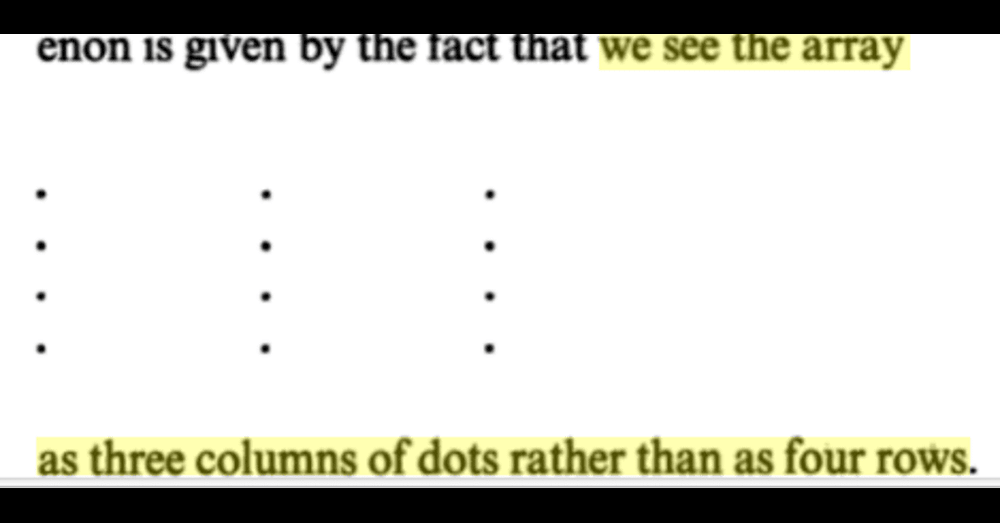
The conceptual nature of experience (as derived from sensations) is supposedly shown by an example from the philosopher Christopher Peacocke, as seen in the main image above.

This suggest that concepts (of columns, in this instance) are determining our experiences.

Readers may immediately suspect that there must be at least some people who do indeed see four rows, rather than three columns. In other words, there’s no obvious reason why we shouldn’t see four rows.

This may also have something to do with the spacing of the dots, and the wideness of the gaps between the columns. Thus, the gap between the columns is wider than the gap between the individual dots. This may lead most viewers to see three columns, rather than four rows.

Christopher Peacocke’s point, however, is that the sensations alone don’t determine the experience. Indeed, on this picture, if it were just a question of sensations alone, then it wouldn’t actually be an experience. (Experience is often said to be “under an aspect”.)

The same applies to another example from Peacocke.

One person may see the object which we call a “sphere”, though not (as it were?) apply the concept [sphere] to it. Another person will indeed apply the concept [sphere] to that very same object.

On the other hand, and more likely, most people won’t actually apply the concept at all. That is, the concept will belong to the object from the beginning. In other words, many subjects non-cognitively experience a sphere as a sphere. A person without the concept [sphere], on the other hand, will still either apply a concept to the sphere, or a concept will belong to the sphere.

In the technical details of contemporary analytic philosophy.

Peacocke himself says that “sensational properties do not determine representational content”. On this picture, then, concepts must be part of the story too.

Peacocke does go on to say that “grouping properties [i.e., the arrays into columns not rows] are sensational rather than representational”. Peacocke admits that the array example

“seems to suggest that we are concerned with representational, not a sensational, property: the concept of a column enters the content”.

The problem is (in Peacocke’s argument) that “grouping [is a] sensational property”. Surely grouping (in this example) will rely on sensations, although sensations alone won’t entirely determine the grouping. Thus, Peacocke is making a distinction here between grouping and sensations. Indeed, he’s saying that grouping isn’t conceptual (or “representational”).

On this particular aspect, Peacocke doesn’t go into detail. He does say, however, that in “switches of aspect the sensational properties [remain] constant”.

Martin Davies and Colin McGinn

The British philosopher Martin Davies spots a dualism in Christopher Peacocke’s position.

Davies says that (in Peacocke’s story) there’s

“a sensational (non-representational) substrate upon which the representational superstructure [] is erected” .

Or

>) Representational superstructure
>) Sensational (non-representational) substrate

As with Ned Block’s notions of “access-consciousness” and “phenomenal-consciousness”, Davies quite happily accepts “non-representational properties of experience”, but “without embracing the idea of a sensational substrate”.

The British philosopher Colin McGinn also characterises the position represented by philosophers like Peacocke. He states that they accept

“prerepresentational yet intrinsic level of description of experiences: that is, a level of description that is phenomenal yet noncontentful”.

Perhaps the problem is that Peacocke thinks in terms of “protopropositional content” — i.e., nonconceptual content. This is almost — or indeed literally — an acceptance that content prior to “propositional judgement” can’t be conceptual. In that case, then, propositions (almost literally?) must make (or determine) concepts. That is why protopropositional content is nonconceptual content. However, if we don’t accept an entirely linguistic basis for concepts, then we needn’t believe in Peacocke’s non-conceptual content.

Davies points out that Peacocke is happy to accept the conceptualisations of “sensational properties”. He says that Peacocke shows us examples of

“pairs of experience with the same sensational properties but different representational properties”.

Yet Peacocke also shows us

“pairs of experiences with the same representational properties but different sensational properties”.

Does all this show us that these “different sensational properties” are nonconceptual?

It seems to hint at the fact (or possibility) that sensational properties aren’t representing anything.

[The other cases cited by Peacocke are based on technical empirical psychological research on subjective experience, which is difficult to comment upon.]

Peacocke, however, appears to make a mistake. He says that a person

“waking up in an unfamiliar position or place [will have] minimal representational content”.

Mental or cognitive unfamiliarity doesn’t entail a lack of conceptual content. That’s because the person waking up will still conceptualise his unfamiliar position or place.

So perhaps this example only displays Peacocke’s linguistic (or propositional) bias.

Of course, the person waking up may not be able to describe the position or place very well, or form “propositional judgements” about it. However, that may be irrelevant to conceptual and/or representational content.

According to the British philosopher Michael Tye, when the place or position becomes “rich” with “representational content”, then this may simply be a case of applying “descriptive labels [] to the array”. Propositions and propositional judgements are simply additions to the conceptual content which already exists.

Tye also says that

“computational routines [propositional judgements] process this activity and assign an appropriate descriptive term”.

Some readers may believe that Peacocke’s propositional (or linguistic) bias causes problems for various of his positions. However, it can be doubted that Peacocke would actually deny his linguistic (or propositional) bias. To Peacocke, the bias itself wouldn’t cause problems in his eyes. It’s simply part of the reality of conceptual experience.

[The British philosopher Peter Geach was explicit about his propositional — or linguistic — bias vis-à-vis concepts and mental content. See his Mental Acts and Their objects, which was published in 1957.]

According to Michael Tye again, “phenomenal content” is by definition nonconceptual . And he too offers us us his own dualism between “phenomenal content” and belief. We have (a)

“A content is classified as phenomenal only if it is nonconceptual and poised [for use by the cognitive centres].”

against (b):

“Beliefs [] lie within the conceptual arena, rather than providing inputs to it.”

This is almost foundationalist in that “phenomenal content” is seen as input to be worked upon later (if only a split second later).

Beliefs, on the other hand, are outputs.

Indeed, if this is truly foundationalist, then a) above would be the Given.

It certainly seems foundationalist when Tye makes the epistemic point that phenomenal content is “poised for use by the cognitive centres”. That is, phenomenal content comes (epistemically) before such use.

Yet Tye makes the point that phenomenal content is still “representational”.

How can this be?

How can something represent “that there are such and such co-instantiated locational and nonlocational features” without concepts?


Note:

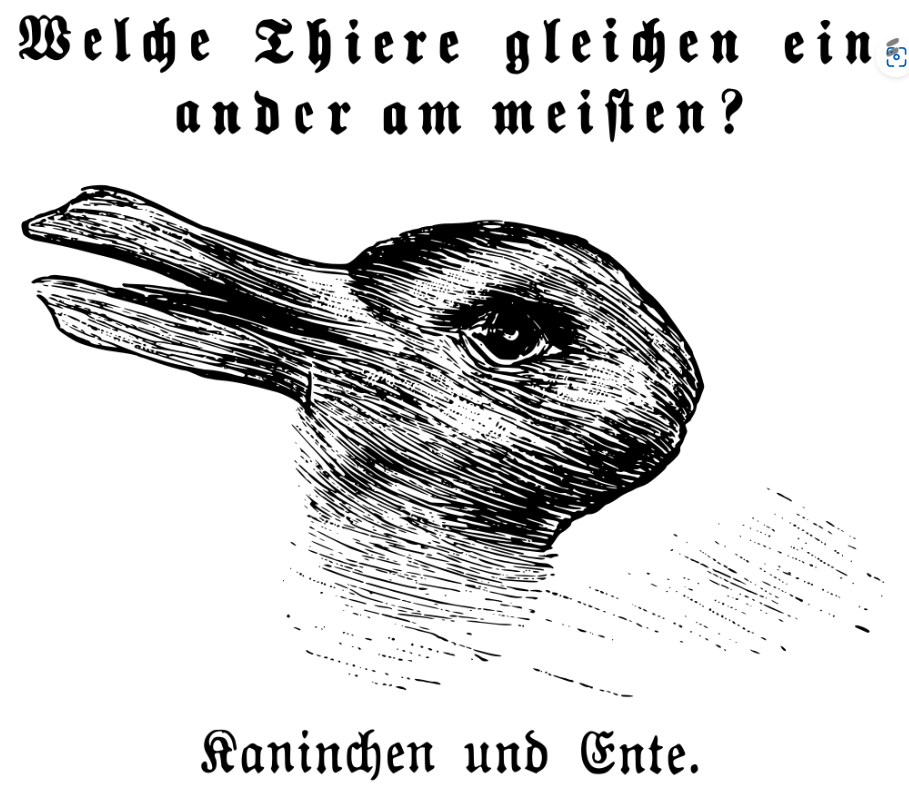
At least some of what has been said in the above will be relevant to the Rabbit–duck illusion, which was made popular by Ludwig Wittgenstein.

Thursday, 25 June 2015

Is Phenomenal Consciousness Non-Conceptual?


You can hear a church bell and not hear it as a church bell. That is, concepts may not be applied to the sounds you hear. Similarly, you can see a fridge; though not see it as a fridge. Your visual sensory receptors are stimulated by the light-waves from the fridge and eventually such data enters consciousness; though you haven’t applied the concept [fridge] to the fridge.

Are these examples of experiences in the strict sense?

It could be the case that while these sensory stimulations are entering consciousness, the mind is applying concepts to other things instead. So the sensory input from the fridge or the church bells are, as it were, in outer consciousness. The sensations or perceptions aren’t experiences in that the mind doesn’t infer anything from the church bell or the fridge (they're not “poised for reasoning”, as Ned Block puts it). The sensations are cognitively impotent and irrelevant.

Nothing is derived from the sound of the church bells or the sight of the fridge because they're not heard as church bells or seen as a fridge. Indeed no concepts are applied. They're certainly not an epistemological “given” because there's no cognitive awareness of the sensations or perceptions. These sensations - not experiences - can't be the ground for inferences, knowledge or anything. They are, ultimately, vacuous. The sensations from the fridge or the church bells aren't accompanied by a higher-order thought to the effect that there's any cognitive application of concepts to the sensations.

The terms of the trade have it that the sensation of hearing the church bells (though not as church bells), and seeing the fridge (though not as a fridge), are examples of “phenomenal consciousness without access-consciousness” (according to Ned Block).  “Access-consciousness” (AC) includes the application of concepts to “phenomenal consciousness”(PC). Phenomenal consciousness alone isn't experience or awareness.

John Searle clarifies things a little here (1990). He says that we can call the fridge or the church-bell sensations (not his examples) examples of “peripheral consciousness”. I wouldn’t also use Searle’s “inattentiveness” because there may have been no reason why we should have been attentive to the fridge or the church bells. They may, however, be in “peripheral consciousness”.

A better example than the church bell and the fridge would be someone saying to you, “I’m going to kill you right now!”. The sound-waves from this person’s voice will eventually enter your consciousness as phenomenal consciousness; though you don’t take the words in. (That’s why it’s pure phenomenal consciousness.) You'll have no knowledge of the sentence’s meaning. All you may have are the sensations: their phenomenal non-cognitive reality. This example may be an example of peripheral consciousness and, this time, perhaps also inattentiveness. Though it wouldn’t be an experience and therefore not the basis of reasoning. (I'm willing to concede that at some lower level of consciousness the sentence’s meaning could have been taken on board in a manner which is vaguely similar to what happens with blind-sight.)

The example of “I’m going to kill you right now!” can’t be compared to, say, driving on autopilot. If there were genuinely no access-consciousness or awareness of the ins-and-outs of driving, then such a person would crash. However, if you'd applied concepts to - or been access conscious of - the utterance “I’m going to kill you right now!” (presuming it was a real threat), then you'd have done something about it. Therefore the auditory sensation of “I’m going to kill you right now!” was indeed non-conceptual; though not an experience. Alternatively, driving on autopilot is – partly – a conceptualised event and therefore an experience: if an inattentive experience.

I can quite happily accept phenomenal consciousness as something distinct from conceptual experience without allowing non-conceptual experience or, alternatively, phenomenal consciousness without concepts.

Jennifer Church cites an example of putative non-conceptual phenomenal consciousness. She writes:

Consider the example of a noise that I suddenly realise I have been hearing for the last hour. Block uses it to show that, prior to my realization, there is phenomenal-consciousness without access- consciousness…” (1995)

The above doesn’t go against the necessity of conceptual experience because such phenomenal-consciousness wouldn't be experience in my (or Kant’s) sense. It would be peripheral consciousness (Searle) or perhaps it would be in what can be called outer consciousness. However, Church even denies (or doubts) the possibility of true peripheral consciousness or phenomenal-consciousness without access-consciousness. She continues:

“…it seems that I would have accessed it [the noise] sooner had it been a matter of greater importance – and thus…it was accessible all along. Finally, it is not even clear that it was not actually accessed all along insofar as it rationally guided my behaviour in causing me to speak louder…”

If my “I’m going to kill you!” example earlier is a possibility, then Church’s arguments may go too far and don’t work for my example. My example is pure phenomenal-consciousness. Church, therefore, doesn’t give us an argument against the independence and purity of phenomenal-consciousness from AC. She gives us an example of something which may appear at first to be independent and pure PC; but which in fact isn't. She says that she would have “accessed the noise sooner had it been a matter of greater importance”, which gives the game away. Not even Ned Block would accept that scenario as independent and pure PC. This would, I think, simply be a case of Searle's inattentiveness. Similarly, Church says that all along she was speaking loudly. So clearly the noise was AC; though not the center of her attention. Her example doesn't, therefore, work as an argument against independent and pure PC.

What about Block himself?

For a start, I’m not quite sure what Block means by “aware” in his “You were aware of the noise all along” (1992). It seems to be an idiosyncratic usage of that word. However, the implication must be that concepts (of some shape or form) were applied - or belonged - to the noise all along: otherwise how would he have known that it was a noise before he was AC of it at noon? If he wasn’t applying concepts, then how did he know it was a noise before such a realisation? The atomic concept [noise] is just as much a concept as the molecular concept [the noise of a drill]. The atomic concept [drill] may have been applied to the atomic concept [noise] at t², but at t¹ the atomic concept [noise] was still applied (or belonged) to the noise (vis-à-vis Ned Block himself). Consequently, how could it have been pure and independent PC of the noise if all these assessments are correct?

Indeed Block himself (a paragraph later) comes up with an alternative way of describing this putative before-noon pure and independent example of PC: “P-consciousness without attention.” I would say, perhaps only as a paraphrase, PC with inattentive AC; which doesn’t rule out AC and, therefore, the deployment of concepts. To use Searle’s term, the noise before noon was “peripherally conscious”; though not an example of pure and unadulterated PC.

Block does say that although PC and AC are distinct, they often (or always?) do occur together. Block’s example of “P-consciousness of the noise” and “A-consciousness of it” isn't quite as clearly defined as he thinks (in the noise example, that is). It now remains to be seen whether the conceptual experience before noon does actually entail – limited – AC (in Block’s sense).

Strangely enough, while writing the above there was a noise outside my flat. I didn’t pay attention to it. I was inattentive. It was in peripheral consciousness (or in my topographical outer-consciousness). However, I knew all along that it was a noise. Indeed I knew it was a car alarm. If the car alarm’s noise had seamlessly turned into a woman’s scream (if you can imagine such a thing), I would have been attentive to the scream. This simply means that a different concept [a woman’s scream] was applied or belonged to a seamless change to another noise: the car alarm. The car alarm’s noise was no less conceptual, only the concept [a woman’s scream] would make me attentive; whereas the concept [a car alarm] made me indifferent.

Perhaps concepts are applied (or belong) to all noises. Therefore all noises are AC for Darwinian reasons. If we didn’t deploy or notice what kind of noises the sounds were (or apply or notice their conceptual content), we wouldn’t be ready for an unexpected attack or suchlike. We'd be unprepared. That’s why I would notice the woman’s scream and seemingly ignore the car alarm. If car alarms were infrequent, I wouldn’t ignore them either. The fact is, however, I didn’t ignore the car alarm completely: I was simply inattentive.

Prima facie, PC on its own can’t be conceptual. Could we say that “what something is like” is conceptual? Would that even make sense? The same may be true of PC states like hearing, smelling, tasting and the having of pains. All these seem non-conceptual – at first. They aren't about anything in and of themselves. (Alternatively, we could say that they aren’t representational or intentional.) Some philosophers call these things “intrinsic”. The idea of a pain (say, a toothache) as conceptual seems strange. Similarly with the smell of beer. However, there’s nothing to stop concepts being applied to them. Or, more likely, these phenomenal properties may come along with conceptual baggage. We can still accept that PC is distinct. A toothache has a feel - a “what it’s like” - that’s hard to describe in words. However, concepts are applied (or sometimes come with) pains. These concepts aren’t always descriptions.

For example, [a toothache] is itself a concept made-up of two atomic concepts [tooth] and [ache]. The first concept [tooth] isn't descriptive of pain; though the concept [ache] is. We could ask what sort of concept or description it actually is. It’s not much of one. It’s not descriptive like “The King of France”- it’s a single concept. It’s like a pointer to what it’s like without actually describing what it’s like. It’s also like a name or noun and unlike a definite description or ostensive definition. The concept [ache] may get its identity from non-linguistic comparisons with other previous toothaches or other aches. It would be an imaginative rather than a linguistic concept.

Block writes:

Even pain typically has some kind of representational content. Pains often represent something (the cause of the pain? The pain itself?) as somewhere (in the leg).” (1992)

Similarly with smells, tastes, sounds, sights, etc. They aren't intrinsically conceptual. They're indeed distinguishable from AC or concepts. However, they come with concepts and concepts are applied to them. Therefore PC states become the objects of concepts. (Or PC properties do.) Block says that “P-consciousness is often representational”. Representations are conceptual. Concepts make-up representations. Representations are intentional – they're about something.

References

2) Church, Jennifer, 'Fallacies or Analyses?' (1995)
3) Searle, John, 'Who is computing with the brain?' (1990)