Friday, 17 May 2024

Philosophy: My Posts (or Tweets) on X (9)


(i) Should Science Shape Society in Very Specific Political Ways?

(ii) A Flawed Philosopher?
(iii) Interdisciplinary Philosophy
(iv) Climate and Groups: Science and Politics
(v) Hollywood Zombies and Philosophical Zombies
(vi) Wittgenstein’s Philosophical I


Should Science Shape Society in Very Specific Political Ways?

This is certainly the position adopted by Scientific American in recent years, and even more obviously by Science Magazine (or Science).

When it comes to Scientific American, it’s fairly new editor — Laura Helmuth (she also edited Science Magazine!) — has explicitly said that it should be politically committed in specific political ways (see here). This led to an entire edition being devoted to political issues. [See also Scientific American’s ‘Yes, Science is Political’, and Scientific American dedicates itself to politics, not science’.]

The problem with those scientists, activists and laypersons who say that “science shouldn’t be neutral” is that they usually have something very specific in mind. That is, they believe that “science as a field” should be politically committed and politically aware. More importantly, it should be committed to specific political things, and be aware of specific political things…

But what happens when other scientists take views the activists strongly disagree with?

What happens when other scientists and activists become committed to political and social causes they find very objectionable?

Thus, the self-conscious attempt to politicise science can actually backfire — at least it can do so for these activists.

The upshot, again, is that those who say that science “should shape society” have very specific political and social things in mind. So this isn’t an abstract statement about science and its (obvious) relation to society as a whole. This is a manifesto from specific political activists (some of whom are scientists) with specific political ends and goals in mind.

Thus, they’ll also need to do battle with those scientists who uphold different political views. This, then, will become like a battle for Gramscian hegemony. It just happens that it will be a battle fought by scientists against other scientists.

The Science Magazine and Scientific American position also turns science into a political weapon that scientists and activists use to advance political causes and ends.

Of course, this already occurs at Science Magazine and Scientific American. But, it seems, the activists want more control and power over the entire scientific enterprise.

Is that a positive scenario?

A Flawed Philosopher?
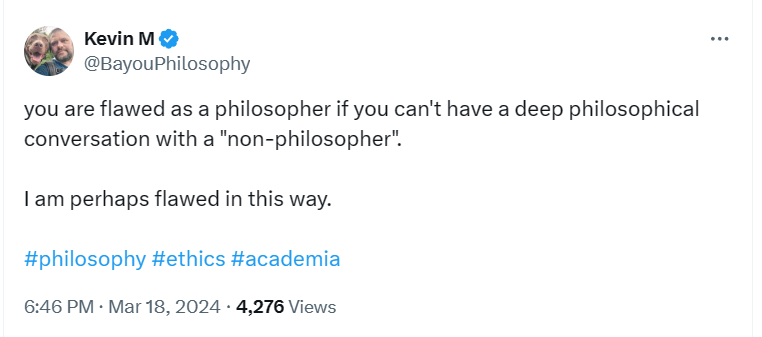
Kevin M (i.e., associate professor of philosophy Kevin Morris) seems to overlook the possibility that a “non-philosopher” may simply be bored by the aspect of philosophy being discussed at the time. After all, nearly all (professional) philosophers themselves will be bored by certain areas of philosophy. In other words, no philosopher finds all philosophy interesting or worth discussing.

So mentioning boredom isn’t condescending to laypersons, or a slap in the face of philosophy itself. Basically, you simply can’t generalise about non-philosophers and philosophers in these scenarios.

For example, if someone talks to me about computer programming or even theoretical biology, this would probably bore me. But that has no large implications for the theoretical biologist/computer programmer, or for me as a layperson

There simply aren’t enough hours in the day.

By the way, what is a “deep philosophical conversation”? More specifically, what’s meant by the word “deep” here?

Interdisciplinary Philosophy
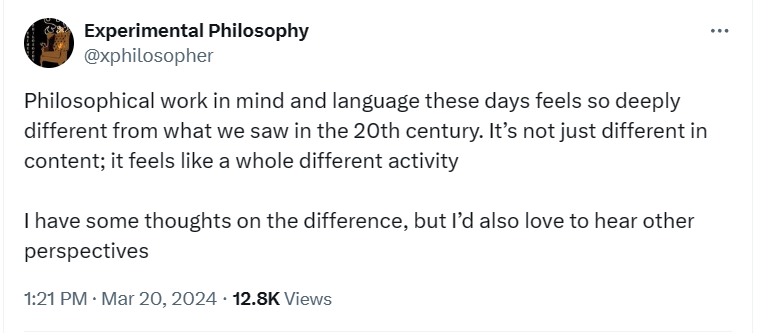
I too believe that “philosophical work in mind and language” is superior when it consults the various relevant sciences. And, sure, that’s happening more nowadays than it did in the past — at least when it comes to mind and language. That said, I’ve read some works on mind and language by philosophers that are just examples of science.

I believe that Patricia Churchland is a good example of this. (Most of the stuff I’ve seen of Churchland’s is just neuroscience, cogntive science, etc. — for good or bad.)

But I’ve seen other lesser names who write papers, etc. with virtually no philosophy in them. Instead, they’re simply either accounts of the scientific literature on the given subject, or even purely scientific themselves.

Perhaps the partisans of science-vs-philosophy like this result in philosophy.

Climate and Groups: Science and Politics

Climate must have at least some impact on human groups as taken in broad terms, and over longish periods. Of course, we’d need to be careful about generalisations and speculations. However, doesn’t Professor Ellie Anderson (@ Pomona College) herself generalise about all those who’ve simply noted the impact of climate on the behaviour of certain groups throughout history?

It depends on what she means by “people’s dispositions” too.

Are we talking about individuals’ beliefs and collective beliefs too, or just non-verbal behaviour? Indeed, can we disentangle the two at all?

Ellie Anderson is trying soooooo hard not to be racist — and also to be anti- “colonialist” (her word) — that she’ll overlook all contradictory evidence.

And she’s also keen to use the term “pseudoscience”, which is often used as a political sledgehammer.

Anderson’s main aim is no doubt political, not scientific or philosophical. And this is exactly how she seems to read the views — on this subject at least — of her scientific and philosophical opponents…

Is this a case of projection in the battle for political hegemony?

Hollywood Zombies and Philosophical Zombies

Spoiler alert: the notion of a zombie in analytic philosophy is very unlike the notion of a zombie in Haitian voodoo or in Hollywood films. Hence the term “philosophical zombie” (or “p-zombie”).

The main difference is that you could behaviourally and visually spot Hollywood zombies from a mile away. You couldn’t do that with an “analytic” p-zombie. Indeed, that’s precisely the point of this philosophical notion.

All that said, this tweeter appears to classing analytic philosophers themselves as zombies!

Wittgenstein’s Philosophical I
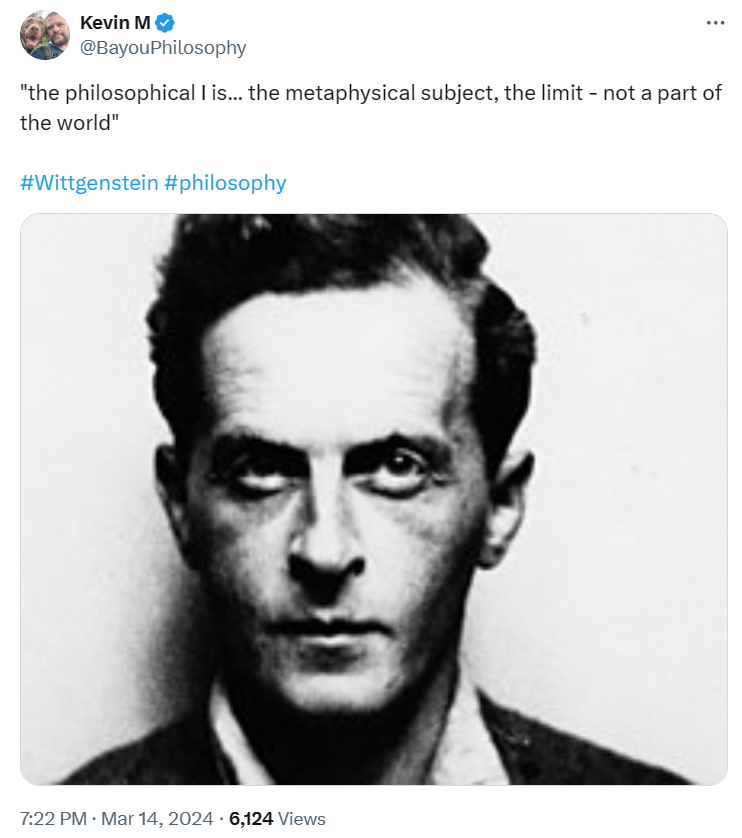
I take Wittgenstein’s point… to a degree. However, the (errr) “fact” that each subject both cognises and experiences almost everything of “the world” through the prism of the “philosophical I” doesn’t — automatically — mean that it is “not a part of the world”. (No philosophical account of the “I” needs to be given or accepted here.)

A more mundane analogy here is the inability to literally look at your own eyes… with your own eyes. (I.e., without the help of a mirror, photograph, etc.) There is nothing “metaphysical” about this example… at least.

The Cartesian self (if there is such a thing) is also part of the world. What else can the Wittgenstein I or the Cartesian subject be a part of?

My X account can be found here.


Friday, 10 May 2024

Why Heidegger, the Nazis and Religious People Wanted to “Transcend Rationality”


The title of this essay could just as easily have included the words “poststructuralists” and “postmodernists”. However, it would have been too long had I done so.

(i) Transcending Rationality
(ii) Heidegger: An Anti-Intellectual Intellectual
(iii) Heidegger’s Nazi Philosophy
(iv) Heidegger on the Flight of the Gods
(v) The Hammer, and the Ontology of the Social
(vi) Heidegger on Spiritual Dasein


[T]he nature and significance of Heidegger’s thought cannot be determined by selective quotation from his work nor by a focus on the shortcomings of Heidegger the man. If it is his philosophy that is at stake here, then it is with his philosophy that we must engage — and there are no shortcuts to doing that.”

— The philosopher Jeff Malpas (as quoted by Jonathan Este). [See note 1.]

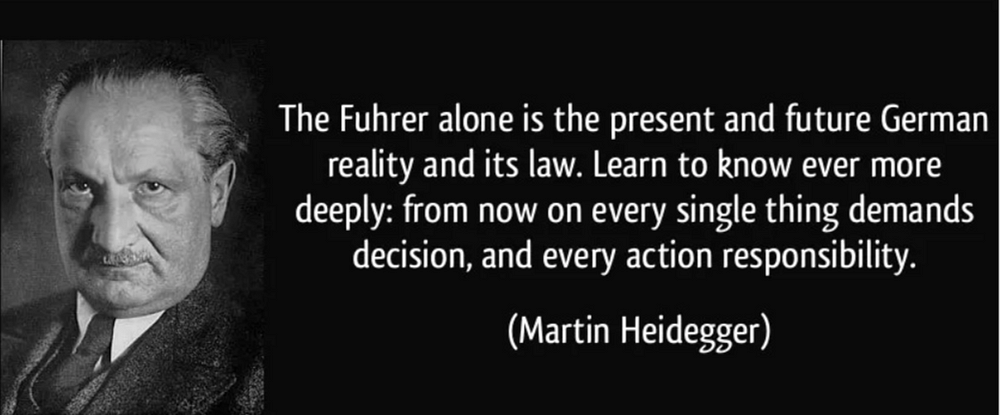
“Heidegger’s support for the Nazis is well known and has been meticulously documented. Six years after publication of Being and Time, Heidegger joined the NSDAP and was elected rector at the University of Freiburg in 1933. In that role he gave a number of speeches in support of the new regime and wrote denunciatory letters about liberal and left-leaning colleagues.”

— Jonathan Este

More relevantly, the journalist and writer Jonathan Este then continued:

“The inevitable question is whether Heidegger’s Nazism infected his philosophy.”

Transcending Rationality

The following are two problems with those individuals and groups who and which want to “transcend rationality” (or to “transcend reason”):

(1) Historically, reason has often been required (or used) in order to transcend reason.
(2) Those individuals and groups who and which extol
transcending reason have also needed to compete with rival individuals and groups who and which also extol transcending reason.

In terms of (1). Since irrationalists have (supposedly?) given up on reason or rationality, then they must use violence, abuse, emotional language, poetic/categorical proclamations, etc. instead (i.e., in order to impact on society at large).

It’s true that reason needn’t always be required to transcend reason. However, this has usually been the case. Of course, tapping into people’s feelings and emotions has been a very popular means of transcending reason…

That said, not all those who ride on people’s feelings and emotions will also claim to be “transcending reason”. Thus, this is a very philosophical way of putting the issue.

It also gets more complicated because many of those who tap into people’s feelings and emotions can’t exclusively do this via irrational means. Indeed, they too must use their reasoning skills.

Think here of the parallel case of those Nazis, Heideggerians and religious people (such as Creationists and New Agers) who’ve castigated science at the very same time as making full use of scientific technology…

How could it be otherwise?

Heideggerians have just been mentioned.

So is the enterprise of “transcending reason” one explanation as to why Martin Heidegger embraced the Nazis?

Heidegger: An Anti-Intellectual Intellectual

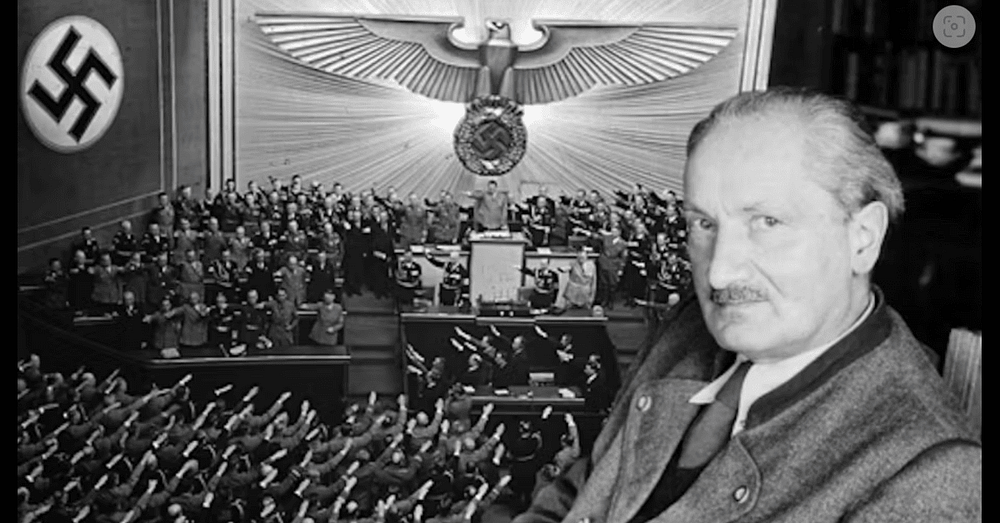
The German philosopher Martin Heidegger is a good case study here.

Heidegger was a very intellectual anti-intellectual.

Firstly, some (perhaps even many) Heideggerians would argue that Heidegger used reason against reason. (As did Kant in his Critique of Pure Reason.)

… Actually, this last claim is debatable.

As just stated, some Heideggerians are keen to stress Heidegger’s actual arguments (i.e., even if those arguments need to be suitably parsed). Other Heideggerians, on the other hand, really do want to emphasise the fact that Heidegger “transcended reason and rationality” in order to escape into some kind of poetic, mystical and intuitive… something — “I know not what”.

Of course, these two attitudes to Heidegger's philosophy may well be held together.

In any case, the German National Socialists (i.e., of the 1920s, 1930s and early 1940s) wanted to transcend reason/rationality too.

And Heidegger has been frequently and strongly connected to the Nazis.

Most Heideggerians, of course, say that this Nazi connection is irrelevant to Heidegger’s actual philosophy…

Really?

What if Nazi and other other kinds of irrationalism are deeply embedded in Heidegger’s philosophy?

Thus, the similarities between Heidegger’s philosophy (or philosophies) and Nazism include the following:

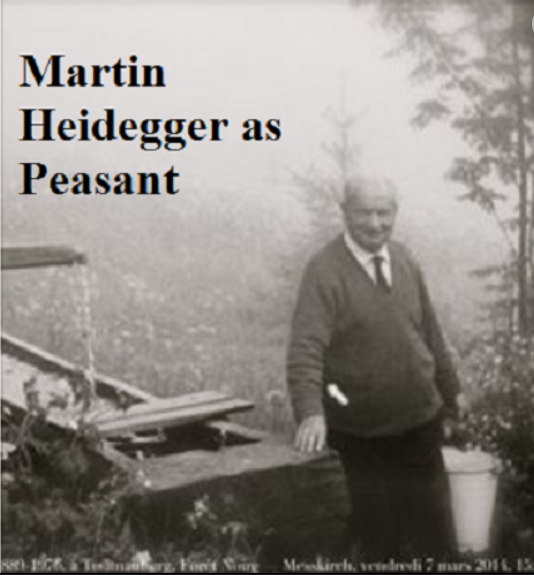
an interest in mysticism and the early medieval period (shared with, amongst others, the English Catholic fascists of the early 20th century), anti-intellectualism (or intellectual anti-intellectualism, as with Joseph Goebbels), a distaste for modern civilisation, science and technology (which can quite easily go alongside the use of technology, as was the case with the Nazis), counter-Enlightenment positions, a stress on “thinking with the blood”, an idealisation of peasant life, and so on.

So it’s odd that many Heideggerians are keen to play down Heidegger's explicit politics at the very same that they’re keen to play up other philosophers’ implicit politics.

The reason for this is fairly simple.

Heidegger’s philosophy is often used to advance somewhat fashionable political views and positions. Thus, they claim that his political beliefs and actions in favour of the Nazis and Nazi policy muddy the philosophical water. They also claim (as Jeff Malpas does in the opening quote) that Heidegger’s philosophies stand regardless of his connections to Nazism.

On the other hand, other philosophers often have their political lives gone over with a fine tooth comb — sometimes by these very same Heideggerians! Obviously, this is the case because of the specific nature of their politics.

So there are double standards here. [See note 1.]

To repeat.

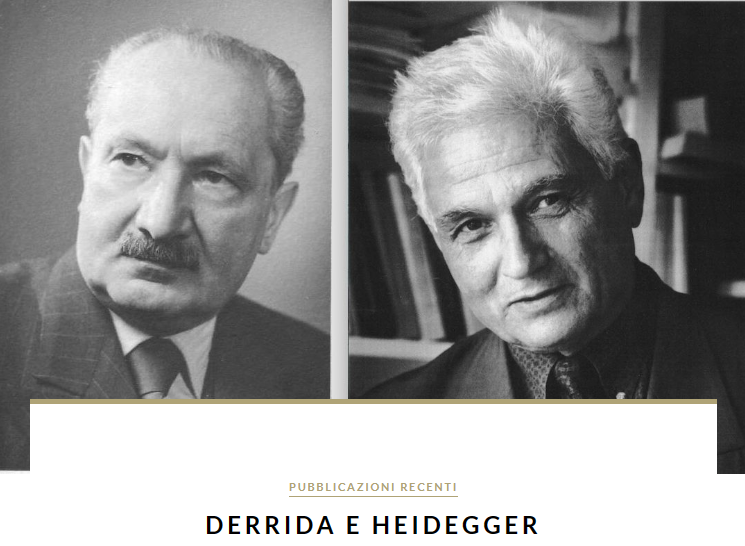
It really does seem bizarre that Heideggerians are at pains to play down Heidegger’s Nazi connections. Indeed, this was precisely what the French philosopher Jacques Derrida did.

That last claim has been fiercely disputed.

The broad upshot is that, of course, Derrida didn't deny (or ignore) Heidegger’s Nazi connections. However, he did attempt to separate them from Heidegger’s actual philosophy… Or at least Derrida attempted to separate such Nazi connections from Heidegger’s later non- “metaphysical” philosophy. [See note 2.]

Heidegger’s Nazi Philosophy

As just alluded to, and despite the defences of Heidegger, many people have noted the strong similarities between, just to take one example, Heidegger’s philosophical “attacks on realism” and Nazism. Indeed, there are many other connections between Heidegger and Nazism that are worth commenting upon. And that’s for the simple reason that they also have a bearing on Heidegger’s actual philosophical positions, beliefs and attitudes.

More specifically, if there is any direct connection to be found between Heidegger and Nazism, it’s that of anti-intellectualism.

Oddly, Heidegger’s anti-intellectualism is very intellectual in form.

Perhaps it’s not surprising, then, that this anti-intellectual intellectual had strong sympathies with German National Socialist forms of anti-intellectualism.

Now let’s connect anti-intellectualism to the parallel desire to transcend reason.

It’s worth quoting Jonathan Estee again here. Este writes:

[A]t one point [Heidegger] speaks of the characteristically Jewish gift for ‘calculation’, which would then find an ideal foothold in ‘the empty rationality and calculative bent’ of Western metaphysics, especially since Descartes.”

This negative attitude toward “calculation” and “empty rationality” can also be found all over the place in the writings of fascists, Nazis, New Agers, spiritual people, postmodernists, poststructuralists, etc.

Heidegger on the Flight of the Gods

Martin Heidegger once wrote of the “flight of the gods”.

This was a reference to what he took to be the ascendancy of “scientific culture” in 20th century Western society (including Germany, most of Europe and the United States), as well as the concomitant rise of what’s often called “instrumental rationality”.

(Heidegger — along with Edmund Husserl— also wrote of the scientific flight from “lifeworlds”.)

In his Being and Time, Heidegger had the following to say about “the world” as it was in the late 1920s:

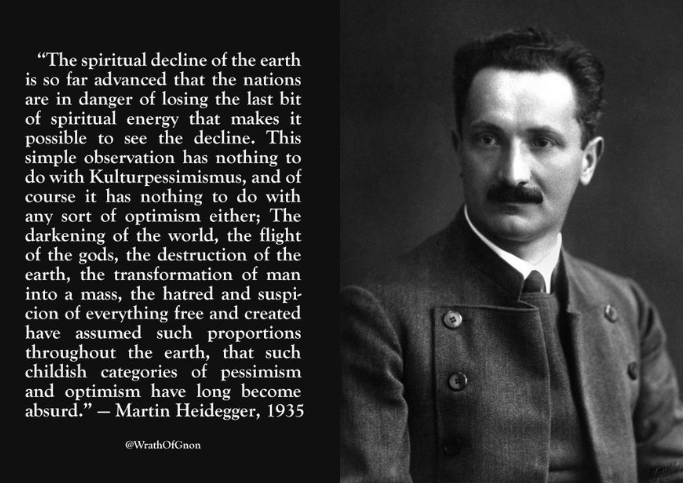
“We have said that the world is darkening. [] [T]he flight of the gods, the destruction of the earth, the standardization of man, the pre-eminence of the mediocre.”

Heidegger also told his readers that “we are too late for the gods, and too early for Being”.

Heidegger believed that Europeans were too late for the gods because theology and metaphysics themselves could no longer have any purchase on the modern mind — even way back in the 1920s! Unfortunately, most Europeans (at the time) were also “too early for Being”. That is, they were too early for Heidegger’s very own ontotheology (or ontic-theology).

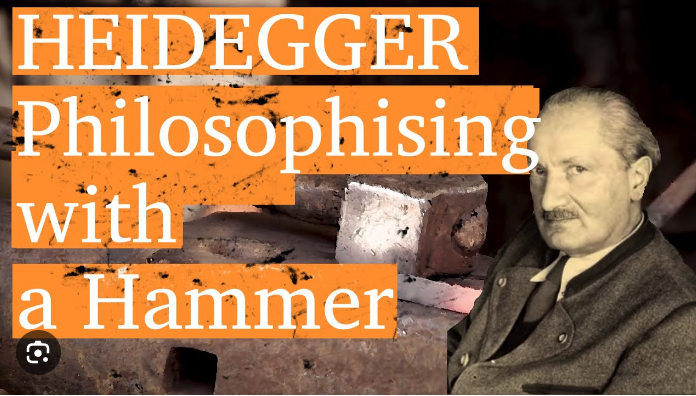
Now let’s consider Heidegger’s well-known hammer example.

The Hammer, and the Ontology of the Social

Heidegger’s general point was that (in everyday life) we don’t have intellectual knowledge of the hammer we use to bang in nails. Instead, we have some kind of (for want of a better word) intuitive relation to the hammer. In other words, we don’t really know that the hammer is too heavy. Instead, the hammer “reveals itself as being too heavy”. That means that we only have a physical relation to the hammer, not a knowledge-based one. In fact, Heidegger seems to claim that when we use a hammer, we don’t think at all. We simply feel that it’s too heavy.

Of course, this somewhat innocuous(!) hammer example can be — and indeed has been — broadened out by Heidegger and others.

Thus, we come to to Heideggerian “involvement” and Heideggerian action.

Heidegger believed that knowledge must be firmly connected (in some way) to action. Or, in Heidegger’s own words, it must be connected with our “concern” for the world.

Yet perhaps Heidegger was right to argue that knowledge is “secondary to [our] involvement in the world”. Indeed, isn’t it the case that we wouldn’t even care about knowledge if it weren’t for the fact that we’re somehow already involved with the world? In other words, without some kind of involvement, the desire for knowledge wouldn’t even arise in the first place.

(These aspects of Heidegger’s philosophy, alongside “the ontology of the social”, appeal to Left Heideggerians.)

So what about Heidegger's mysticism?

Heidegger on Spiritual Dasein

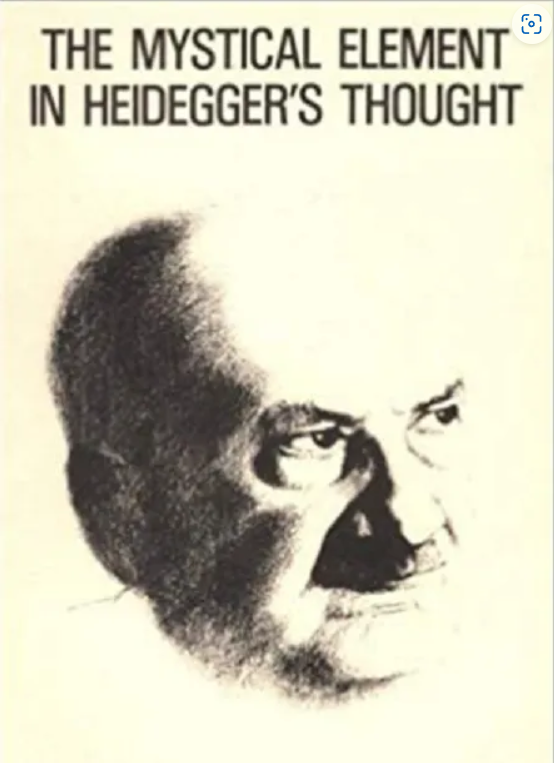
Master Eckhart (1260 — c. 1327) is generally regarded as the greatest representative of German mysticism. This mystic had a strong impact on the young Heidegger. More particularly, it was Eckhart’s notion of not knowing anything that inspired Heidegger.

It can be noted here that Heidegger also put this “question of Being” forward as the “spiritualising” part of the National Socialist revolution in the late 1920s and early 1930s.

In any case, Master Eckhart himself once wrote the following words:

[W]e say that a man ought to be empty of his own knowledge, as he was when he did not exist.”

Heidegger opposed (what he took to be) traditional metaphysics with his very own “meditative” alternative. At times, he called this meditative alternative “thinking” or “letting be”, which was a term he adopted from Meister Eckhart.

Heidegger also used the German word Gelassenheit.

This is a term for thinking “without [a] why”. According to Heidegger (at least at one point in his career), meditative thinking “lets things” show themselves, rather than be shown (or circumscribed) by the inquiring mind.

The mystic German Catholic priest Angelus Silesius also influenced Heidegger. Indeed, it is “Silesius’s rose” that, according to Heidegger, lives “without reason” or “without why”. [See here, and note 3.]

Heidegger’s most important concept, Dasein, also has a mystical (or religious) dimension to it.

Dasein is “to be” in the world.

Heidegger believed that his notion of Dasein is not one of knowing. Instead, Dasein is always already in the “background” each time we know, acquire knowledge, or contemplate the world. [Interestingly enough, the American analytic philosopher John Searle has made extensive use his own notion of “the Background”.]

In a basic sense, then, all the above appears to stress the non-rational or non-intellectual nature of Dasein. In other words, the overall aim is to be, rather than to think. In addition, action and involvement (or “changing the world”) was also very important to Heidegger, as it still is to contemporary Heideggerians.


Notes:

(1) This passage from Malpas is taking the only-engage-with-the-philosophy-itself idea to its extremes. And some readers will doubt that Malpas himself is ever entirely faithful to his own impossible — and perhaps even counterproductive — ideal.

What’s more, my argument in the essay above is that Heidegger is a very bad choice when it comes to abiding by Malpas’s philosophical ideal. In fact, there’s something a little phony (or even dishonest) about it when applied to — specifically — Heidegger!

(2) Derrida once criticised philosophers for erasing their private lives from their philosophies. See ‘Derrida: On The Private Lives of Philosophers’. here. See also ‘Derrida and the Heidegger Controversy’, and ‘Everything Burns: Derrida’s Holocaust’.


Monday, 6 May 2024

Judith Butler’s Pretentious and Obscurantist Writing Style


Judith Butler (left) and Jacques Derrida (right).

(i) Introduction
(ii) Judith Butler and Jacques Derrida
(iii) Julian Baggini on Jacques Derrida’s Writing Style
(iv) Cathy Birkenstein on Judith Butler’s Writing Style


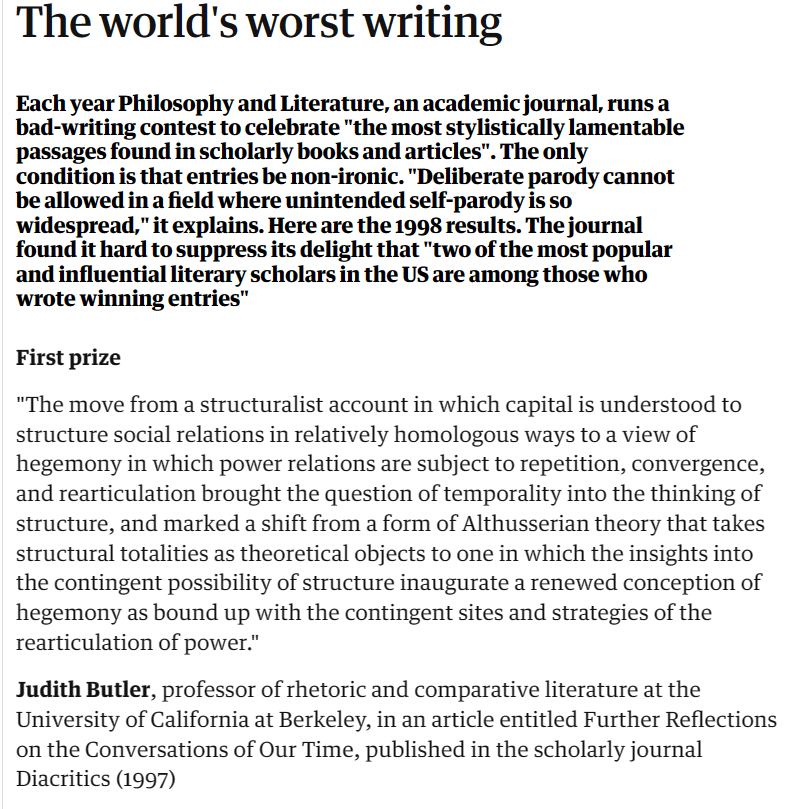
“The move from a structuralist account in which capital is understood to structure social relations in relatively homologous ways to a view of hegemony in which power relations are subject to repetition, convergence, and rearticulation brought the question of temporality into the thinking of structure, and marked a shift from a form of Althusserian theory that takes structural totalities as theoretical objects to one in which the insights into the contingent possibility of structure inaugurate a renewed conception of hegemony as bound up with the contingent sites and strategies of the rearticulation of power.”

Judith Butler

The passage above was awarded first prize in the annual Bad Writing Contest in 1998. [This prize will be discussed in the essay which follows.]

“To the extent that the naming of the ‘girl’ is transitive, that is, initiates the process by which a certain ‘girling’ is compelled, the term or, rather, its symbolic power, govern the formation of a corporeally enacted femininity that never fully approximates the norm. This is a ‘girl,’ however, who is compelled to ‘cite’ the norm in order to qualify and remain a viable subject.”

Judith Butler

That’s my own example from Judith Butler. This passage is from her paper ‘Critically Queer’ (1993). [See note 1.]


Introduction

In 1998, Judith Butler was awarded first prize in the annual Bad Writing Contest, which was established by the journal Philosophy and Literature. And one year later (in 1999), Butler’s prose was again lampooned in a Wall Street Journal editorial. (See ‘Language Crimes’.)

This was published in the Guardian newspaper.

So why does the American gender theorist Judith Butler write in such a peculiar way?

It’s mainly because her writing style was adopted by certain (largely American) elite academics, in certain (largely American) elite universities, at a certain point in history…

These elite academics adopted this prose style primarily to hide and obscure their bad arguments (or even their total lack of arguments), their banal ideas, and their truisms.

Yet all this was also done — perhaps paradoxically — to advance various political causes.

It also needs to be said here that it’s all been a great means of advancing the careers of “elite and radical” academics at various elite and radical university departments.

More relevantly, the French philosopher Jacques Derrida may also provide a clue when it comes to Judith Butler’s pretentious and obscurantist writing style.

Judith Butler and Jacques Derrida

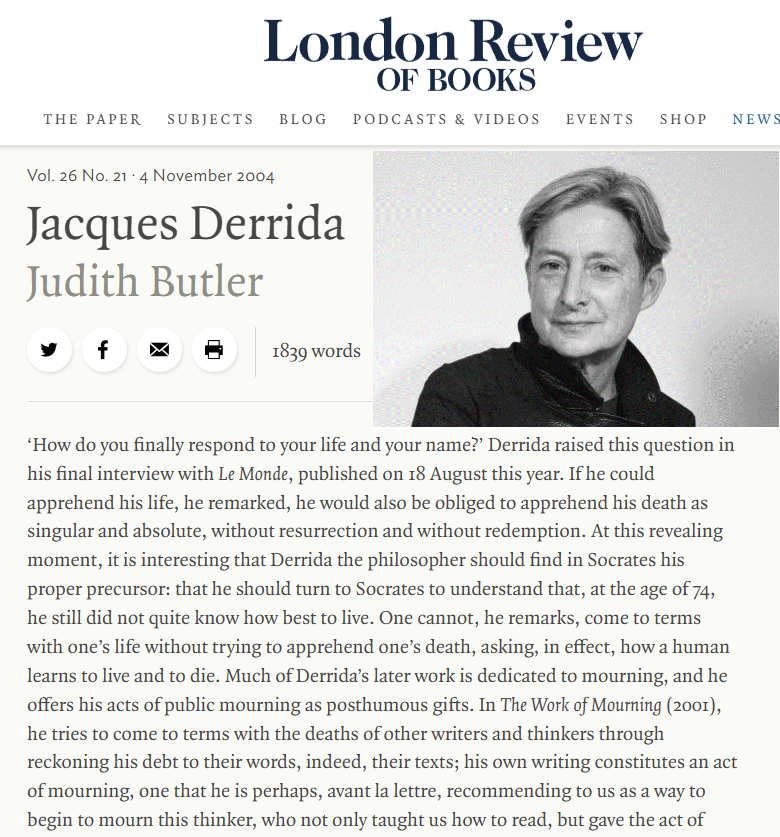
Judith Butler is very much influenced by Derrida. Indeed, in an obituary for the London Review of Books (‘Jacques Derrida’), she wrote that

[i]t is surely uncontroversial to say that Jacques Derrida was one of the greatest philosophers of the 20th century”.

Oddly enough, this obituary piece is clear and (fairly) easy to read. And that fact raises the following question:

Why could Butler write clear and simple prose for the London Review of Books, but not for academic journals, and other publications?

Was it because Butler wasn’t preaching to the (academically) converted when she wrote her London Review of Books piece?

Similarly, was it because she was writing for readers outside her own tribe of elite academics?

Let’s get back to Jacques Derrida and his influence on Judith Butler.

Julian Baggini on Jacques Derrida’s Writing Style

In a Prospect article called ‘Think Jacques Derrida was a charlatan? Look again’, the English philosopher Julian Baggini argued that Derrida’s actual philosophy was embedded in his “complex and difficult” prose style…

That doesn’t mean that Derrida’s philosophy couldn’t help but be written in complex and difficult prose because his philosophy itself is difficult and complex. It means that the complex and difficult prose is actually part of the philosophy.

Perhaps Baggini is on safe ground here because Derrida himself once wrote the following line: “To risk meaning nothing is to start to play.”

So does Derrida’s own statement above mean nothing?…

Is it an act of play?

Of course, both could be true.

In other words, the statement “To risk meaning nothing is to start to play” could itself be an act of play, and it could also mean something.

Perhaps Baggini’s words about “fixed meanings” and “false precision” provides an answer to these questions. He stated this:

“You can see why Derrida’s writing could never have been clear and plain.”

Baggini’s argument here is that Derrida’s meanings were themselves never fixed or precise. And that’s precisely because his actual writing style displays the unfixed and imprecise nature of the meanings therein…

Yet who’s to say that this is an accurate explanation of Derrida’s writing style.

Indeed, there are many other ways to explain Derrida’s prose, including some offered by Derrida himself.

For example, Baggini himself quotes Derrida saying — of himself — that he is “an incorrigible hyperbolite” who “always exaggerated”.

In addition, what of Derrida’s “the play of the sign” (with an emphasis on the word “play”). (This play was given voice in the earlier statement, “To risk meaning nothing is to start to play”.)

Relevantly enough, Baggini puts what he takes to be Derrida’s positions in his own simple prose

So why couldn’t Derrida have done the same?

More specifically, why couldn’t Derrida have said (if only once!) the following (to borrow from Baggini’s own words)? -

… So you can see why my writing could never be clear and plain.

Similarly, why didn’t Derrida ever write something like the following? -

If you accept my premise that meanings cannot be fixed, then I’ll take pains to avoid any suggestion of false precision in my own writings.

Derrida possibly did write such a thing, but in a writing style which itself avoided any suggestion of false precision!

In other words, perhaps Derrida did once tell his fans and readers that his writing could never have been clear and plain, but he did so in a writing style which was itself unclear and obscure.

So was all this yet another case of Derrida simply playing games?

In any case, Baggini rounded all this off by saying that

“Derrida’s difficult style, far from being an affectation, is an inevitable requirement of his philosophy”.

Of course, loyal fans and defenders of Derrida will have noted that my account of Derrida’s play of the sign is critical, negative, and offered by someone outside any tribe of elite academics. Thus, to them at least, my words simply must be a misreading.

More relevantly, is Judith Butler’s own (to requote Baggini) “difficult style” an “inevitable requirement of [her] philosophy” too?

Back to Judith Butler

It’s worth saying here that Butler has been accused of “bad writing” so many times that she’s had a couple of decades (or more) to come up with… pretentious and obscurantist rationalisations for her pretentious and obscurantist writing style. She’s a skilled elite academic, after all. So Butler can verbally worm her way out of her own self-designed hermetically-sealed coffin.

Yet of course the claim here isn’t that Butler’s writing is pretentious and obscurantist… full stop!

There must, after all, be padding around Butler’s pretentiousness and obscurantism. That’s obviously because (as it were) pure pretentiousness and pure obscurantism hardly make sense within the context of her overall academic career, fame and notoriety. Thus, we also have countless proper names, references, footnotes, examples of jargon, etc. in Butler’s writings too.

Now it’s worth bringing in the arguments of the lecturer Dr. Cathy Birkenstein here.

Cathy Birkenstein on Judith Butler’s Writing Style

According to Cathy Birkenstein (in her paper ‘We Got the Wrong Gal: Rethinking the “Bad” Academic Writing of Judith Butler’), even Judith Butler’s fans and defenders admit that her prose style is… well, different.

Birkenstein writes:

“Surprisingly, then, many who defend Butler’s writing and the type of theoretical discourse it represents agree with Butler’s critics that her writing is inaccessible when judged by normative standards of accessibility. While Dutton, Nussbaum, and others condemn Butler’s alleged inaccessibility to mainstream readers, Butler and many of her allies praise that alleged inaccessibility on the grounds that it has the subversive potential to liberate those very same readers.”

It’s odd, then, that even in a defence of Butler’s pretentiousness and obscurantism we have the phrase “judged by normative standards of accessibility”…

What on earth does that mean?

Is accessible writing automatically or necessarily reactionary?

And why can’t “subversive” prose also be accessible? [See my essay Chomsky on the Pretentiousness and Political Impotence of Postmodern Philosophy’.]

And why must accessible prose be tied to the “normative”?…

Hold on a minute.

Didn’t Julian Baggini answer these questions earlier when he argued that Derrida’s “writing could never have been clear and plain”?

Again, why is that?

According to Baggini, it’s because Derrida was battling against the pernicious and illusory notions of “fixed meanings” and “false precision”.

Now if we return to Birkenstein’s words above.

Are the slogan-filled defences of Butler’s writing style themselves “subversive [of] normative standards of accessibility”?

In any case, if even defences and introductions to Butler’s writings are themselves liberatory and arcane, then how does anyone ever get even a toehold into her work in the first place?

Do the relevant laypeople do so through the testimony of elite academics?

Do many of Butler’s fans and defenders have a kind of ignorant and uneducated faith in her prestigious — yet obscurantist — prose?

Oddly enough, Cathy Birkenstein herself doesn’t believe that Butler’s writing is “inaccessible and unintelligible”. Indeed, she believes that it

“conforms to those standards in ways that are missed by both her detractors and most of her defenders”.

Why does Birkenstein believe that Butler’s writings conform to such standards of accessibility? Birkenstein continues:

“The author’s own view is that, far from breaking from recognized standards of intelligibility, Butler’s writing conforms to those standards []. Though Butler’s writing certainly does have unclear moments, it would not have had the wide impact it has had were it not for its ability to consistently make recognizable arguments that readers can identify, summarize, and debate. Butler’s writing has succeeded in circulating as widely as it has in academic circles and beyond not because it breaks with the traditional pattern of ‘trad[ing] arguments and counter-arguments,’ as Nussbaum insists, but precisely because it makes systematic use of this classic argumentative pattern, and does so in ways that all writers (and readers) can learn from.”

As can be seen, Birkenstein’s main argument above is that Butler’s ideas and theories have (to use my own words) spread like wildfire, and there must be a good reason for this.

It’s true that Butler’s ideas and theories were given birth to in elite academia. However, then they filtered down to (to give my own examples) student unions, council offices, the BBC, CNN, the New York Times, massive corporations, and even to people (as it were) on the street.

Of course, it’s perfectly possible that pretentious and obscurantist prose can filter down. So there’s no obvious contradiction here.

Relevantly, pretentious and obscurantist prose can filter down when lesser mortals (i.e., non-academics) translate that prose, or when they offer their own interpretations of it.

Indeed, pretentious and obscurantist prose can even filter down to (as it were) the plebs well outside elite academia. All the activist plebs need do is memorise Judith Butler Lite. Indeed, at its most basic, all they need to do is consume and then mimic all those Butleresque social-media slogans and soundbites which usually have a very weak and circuitous relation to Butler’s actual academic papers.


Note

(1) It’s of course possible that Judith Butler’s writing style has changed since 1998. However, the academic and other works I’ve checked don’t show that. In any case, Butler gained her academic and political fame when she was writing the most pretentious and obscurantist prose of her career.