Popular Posts
Wednesday, 17 June 2015
John Searle says “it's all syntax and no semantics”
Saturday, 13 June 2015
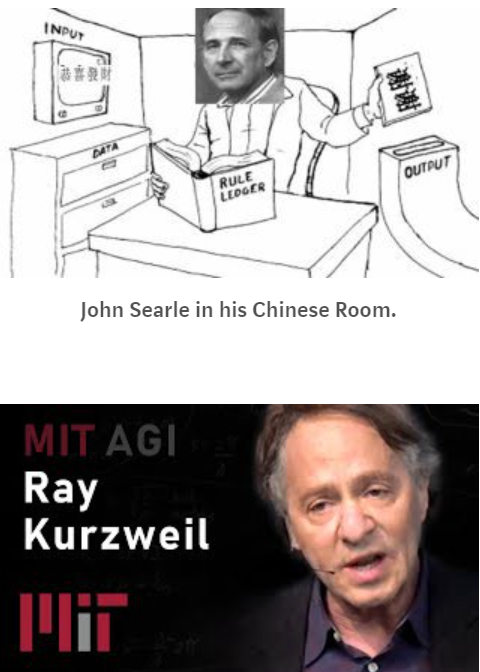
Kurt Kurzweil's Systemhood Argument vs. Searle's Chinese Room Argument
“‘When we hear it said that wireless valves think,’ [Sir Geoffrey] Jefferson said, ‘we may despair of language.’ But no cybernetician had said the valves thought, no more than anyone would say that the nerve-cells thought. Here lay the confusion. It was the system as a whole that ‘thought’, in Alan’s [Turing] view…” — Andrew Hodges (from his book Alan Turing: the Enigma).
In his rewarding book, How to Create a Mind, Ray Kurzweil tackles John Searle’s Chinese room argument.
It’s a great book; though I do find its philosophical sections somewhat naïve. And that’s despite the book’s abundance of scientific and technical detail; as well as Kurzweil’s imaginative capabilities. Of course there’s no reason why a “world-renowned inventor, thinker and futurist” should also be an accomplished philosopher. That said, there’s also a danger of philosophers criticising him for not being so.
Kurzweil says, for example, that all his critics tend to know about Watson (an “artificially intelligent computer system capable of answering questions posed in natural language”) is that it’s a computer in a machine. He also says that some commentators don’t “acknowledge or respond to arguments I actually make”. He adds:
“I cannot say that Allen and similar critics would necessarily have been convinced by the argument I made in that book [The Singularity is Near], but at least he and others could have responded to what I actually wrote.”
The problem is that, in the case of John Searle’s Chinese room argument, the same can be said about Ray Kurzweil case against that. Sure, you wouldn’t expect a full-frontal and elongated response to Searle in a popular science book like How to Create a Mind. Having said that, there is a great deal of detail and some complexity — at least when it comes to other issues and subjects — to be found in this book.
The Argument
Ray Kurzweil’s argument against Searle is extremely basic. He simply makes a distinction between Searle’s man-in-the-Chinese-room and that man’s rulebook. Basically, the man on his own doesn’t understand Chinese. However, the man and the rulebook, when taken together, do understand Chinese.
So instead of talking about a man and his rulebook, let’s talk about the central processing unit (CPU) of a computer and its “rulebook” (or set of algorithms). After all, this is all about human and computer minds.
Firstly, Kurzweil says that “the man in this thought experiment is comparable only to the central processing unit (CPU) of a computer”. However, “but the CPU is only part of the structure”. In Searle’s Chinese room, “it is the man with his rulebook that constitutes the whole system”.
Again, “the system does have an understanding of Chinese”; though the man on his own doesn’t.
The immediate reaction to this is how bringing two things (a man and a rulebook) together can, in and of itself, bring about a system’s understanding of Chinese. Why is a system of two or more parts automatically in a better position than a system with only one part? (That’s if a system can ever have only one part.) How and why does multiplicity and (as it were) systemhood bring about understanding? It can be said that the problem of (genuine) understanding has simply been replicated. It may indeed be the case that the addition of a rulebook to either a man or a CPU brings about true understanding; it’s just that Kurzweil doesn’t really say why it does so.
John Searle is of course aware of what’s called the “system reply”. Nonetheless, he doesn’t really talk about the same system as Kurzweil. Instead of a man and a rulebook (or a CPU and a set of algorithms), Searle (in his paper ‘Minds, brains, and programs’) writes:
“Suppose we put a computer inside a robot…. the computer would actually operate the robot in such a way that the robot does something very much like perceiving, walking, moving about…. The robot would, for example, have a television camera attached to it that enabled it to ‘see’.”
As I said, this system isn’t the same as Kurzweil’s: its more complex and has more parts. Thus, on Kurzweil’s own reasoning, it should stand more of a chance of being a mind (or even person) than a computer’s CPU and its set of algorithms.
Searle then talks about putting himself in the robot instead of a computer. However, neither scenario works for Searle. It’s still a case that all Searle-in-the-robot is doing is “manipulating formal symbols”. Indeed Searle-in-the-robot is simply
“the robot’s homunculus, [he] doesn’t know what’s going on. [He doesn’t] understand anything except the rules for symbol manipulation”.
Again, how does systemhood alone deliver understanding?
Ned Block on Systemhood
The American philosopher Ned Block, on the other hand, offers us a system which is very similar to Kurzweil’s. He too is impressed with the systemhood argument. In his ‘The Mind as Software in the Brain’ he states that
“we cannot reason from ‘Bill does not understand Chinese’ to ‘The system of which Bill is a part does not understand Chinese’…”.
Block continues:
“[T]he whole system — man + programme + board + paper + input and output doors — does understand Chinese, even though the man who is acting as the CPU does not.”
Block adds one more point to the above. He writes:
“I argued above that the CPU is just one of many components. If the whole system understands Chinese, that should not lead us to expect the CPU to understand Chinese.”
Again, how does systemhood — automatically or even indirectly — generate understanding? Block hardly offers an argument other than complexity or that the addition of parts to a system may (or does) bring about understanding. Indeed he goes so far as to say that his own system could (or even does) have what he calls “thoughts”. He tells us that
“Searle uses the fact that you are not aware of the Chinese system’s thoughts as an argument that it has no thoughts. But this is an invalid argument. Real cases of multiple personalities are often cases in which one personality is unaware of the others”.
One part of Ned Block’s argument does seem to be correct. It doesn’t appear to be the case that
if Searle-in-the-system doesn’t know the thoughts of the entire system,
then consequently the system must have no thoughts either.
Nonetheless, the question still remains as to how mere systemhood brings about understanding. It doesn’t matter if the CPU or Searle-in-the-system does — or does not — know what the entire system is thinking (or understanding) if mere systemhood can’t bring about thoughts (or understanding) in the first place. In other words, Searle-in-the-system (or the CPU) may in principle be unable to know if the system as a whole has thoughts or understands things — and yet at the same time it’s still the case that it doesn’t actually have thoughts or understand things.
Kurzweil’s Computer-Behaviourism?
Kurzweil says something that assumes much in its simplicity. He writes:
“That system [of a man and his rulebook] does have an understanding of Chinese; otherwise it would not be capable of convincingly answering questions in Chinese, which would violate Searle’s assumption for this thought experiment.”
What Kurzweil seems to be arguing is that if the system answers the questions, then, almost (or literally!) by definition, it must understand the questions. Full stop. This is a kind of behaviourist answer to the problem:
If the system behaves “as if” it understands (i.e., by answering the questions),
then it does understand.
So it’s not even a question of behaving as if it understands. If the system answers the questions, then it does understand. That’s because if it didn’t understand, it couldn’t answer the questions!
Searle is of course aware of this behaviourist (or at least quasi-behaviourist) position. Basically, the problem of computer minds replicates the problem of human “other minds” (as in the Problem of Other Minds). As Searle himself puts it:
“‘How do you know that other people understand Chinese or anything else? Only by their behaviour. Now the computer can pass the behavioural tests as well as they can (in principle), so if you are going to attribute cognition to other people, you must in principle also attribute it to computers.’”
As I said, this raises all of Searle’s questions about true understanding — or, in his terms, meaning, intentionality and reference. To put Searle’s point in very basic terms: the system could answer the questions without understanding the questions. Though since Kurzweil is arguing that the very act of answering the questions quite literally constitutes understanding; then, by definition, Searle is wrong. Nothing, according to Kurzweil, is missing from this story.
So forget the man and his rulebook, let’s talk about the CPU and its rulebook (or set of algorithms) instead:
If the CPU and the rulebook answer the questions,
then the whole system understands the questions.
If it’s definitionally the case that answering the questions means understanding the questions, then Kurzweil is correct in his argument against Searle. Nonetheless, Searle knows that this is the argument and he’s argued against it for decades. There’s something left out of (or wrong about) Kurzweil’s position. So what’s wrong with it?
Kurzweil himself is aware — if in a rudimentary form — of what Searle will say in response. Writing of Searle’s position, Kurzweil says that
“he states that Watson is only manipulating symbols and does not understand the meaning of those symbols”.
It does indeed seem obviously the case that this is just an example of “manipulating symbols” and not one of true understanding. Having said that, that obviousness (or acquired obviously) is probably largely a result of reading Searle and other philosophers on this subject. If you have read more workers in artificial intelligence than philosophers on this subject, then it may seem to you that what Kurzweil argues is obviously the case.
So let’s forget intuition or obviousness.
Does a thermometer understand heat because it reacts to it in the same way each time? What I mean by this is that a thermometer is given a “question” (heat) and provides an “answer” (the rising or falling mercury). Sure, this understanding is non-propositional and doesn’t involve words or even symbols. But if Kurzweil himself sees these things in terms of the brain alone (i.e., its physical nature and output — not in terms of meaning or sentences), then why should that matter to him? In other words, if we can judge a computer squarely in terms of its output or behaviour (e.g., answering questions), then can’t we judge the thermometer in the same way? According to Kurzweil, if the computer answers questions then, by definition, it understands. Thus if the thermometer responds in the right way to different levels of heat, then it too understands. Thus sentences and their meanings are no more important to computers than they are to thermometers.
Tuesday, 9 June 2015
Names & Essences: Ruth Marcus on Quine’s Kripke
Saul Kripke claims that the statement
- Objects have their proper names necessarily.
- Kripkean proper names (or the belief in them) entail that they necessarily designate the essences of the objects named by them.
- Names and the naming-relation are necessary and constitute the necessity of the reference-relation.
- The relation between named object and name/namer in the reference-relation is necessary. The name and the naming process pick out only their named object’s essence, not its contingent properties specified and picked out by contingent descriptions and concepts.
- The reference-relation between proper names (or their use) and their objects is that they name their objects necessarily.
- Objects have their names essentially.
Quine, W. V. O. – (1966) The Ways of Paradox and Other Essays, Random House
Friday, 5 June 2015
Bertrand Russell’s Paradox
Thursday, 4 June 2015
Quine's 'On What There Is' (1948)

What is Existence?
The American philosopher W.V.O. Quine (1908–2000) discussed what he called the “old Platonic riddle of non-being” (or Plato’s beard) in his paper ‘On What There Is’ (1948).
The position is that if we talk about something, then it must exist or have some kind of being. Indeed even if we talk about something that doesn’t exist, then it must still (in some way) have being — otherwise “what is it that there is not?”.
Of course it depends here on what’s meant by the word “exist”. Traditionally, there have been different (as it were) modes of existence. So the problem is more difficult than it initially looks. However, even if we accept an entirely mental or a non-spatiotemporal existence, then what kind of being or existence would a round square have? Even that… thing, according to Alexius Meinong (1853 — 1920) at least , has some kind of existence or being.
Quine doesn’t tackle the issue of modes of existence in his paper: he does tackle the issue of meaning and reference.
Meaning and Reference
Quine takes the case of the mythical winged horse Pegasus.
McX (Quine’s fictional adversary) argued that if
“Pegasus were not [] we should not be talking about anything when we use the word”.
Indeed McX argued that it would even be “nonsense to say that Pegasus is not”. This is also why some philosophers believed that the locution “God does not exist” is as meaningless as “God exists”. In this case, McX would argue:
Who is this God who doesn’t exist?
This was the problem which Bertrand Russell attempted to solve in his paper ‘Existence and Description’. The issue can be called the Problem of Empty Reference (see ‘empty name’).
Quine himself refers to Russell’s well-known take on the problem; and he largely endorses it.
Russell himself attempted to solve this problem by getting rid of proper names and definite descriptions. Thus the statement
(1) “The author of Waverley was a poet.”
became
(2) “Someone (better: something) wrote Waverley and was a poet, and nothing else wrote Waverley.”
Thus (2) is the (supposed) logical form (as it were) beneath the surface (or everyday grammar) of (1). So we can ask here if (2) is a translation, a version or simply an alternative of or to (1). It seems that (2) is an alternative rather than a logically precise version or translation of (1). That is, (1) may well be philosophically problematic as it stands. However, that doesn’t make (2) a translation or even a version of it.
Moreover, when someone utters (1), he doesn’t (as it’s often put) “really mean” (2). He may well be making philosophical mistakes when he utters (1). However, that doesn’t make (2) a version or translation of (1).
For example, the words “nothing else wrote Waverley” would probably be further from the mind of the utterer of (1) as anything could be. Thus (2), in that case, is more of a logical or philosophical (as it were) imposition than a version or translation.
Quine goes into a little detail as to why Russell substituted (2) for (1).
As stated, it was primarily an attempt to get rid of proper names. What we have in (2) is a substitution of “variables of quantification” for the original names. The quantifiers in (2) are “something” and “nothing”. So these quantifiers aren’t names. They don’t work like names. instead, what they do is “refer to entities generally”.
How did this help both Russell and Quine?
This is how the argument goes.
If you don’t name a specific thing, then you’re not ontologically committed to that thing’s existence. “The author of Waverley” is a definite description of a specific individual. The quantifier “something”, on the other hand, isn’t naming a specific individual and therefore it’s not existentially or ontologically committed. In other words, in (2) the speaker is talking about some thing, not about a specific individual — named either by a definite description or by a proper name.
The problem is more pronounced when someone makes an utterance about someone’s or something’s non-existence (as in the God example).
Again, to what or to whom is the speaker referring if that person or thing doesn’t exist?
So we have an original locution and a (?) again:
(1) “The author of Waverley is not.”
becomes
(2) “Either each thing failed to write or two or more things wrote Waverley.”
In (2) above the quantifier is more convoluted in expression. Instead of the quantifier “everything”, we now have “each thing” (a version of the universal quantifier). Here the speaker doesn’t talk about a specific entity (i.e. the author of Waverley). He talks about “each thing” or about “two or more things”. As Quine put it, the second version “contains no expression purporting to name the author of Waverley”.
Later in the paper Quine recapitulated on these issues.
Again, Quine stressed the need to erase names. So what do we use to refer to entities? We use variables. More precisely and as Quine puts it: “[T]o be assumed as an entity is [] to be reckoned as the value of a variable.” And the point of variables is that they are non-specific. That is, they don’t name particulars. As Quine pointed out, variables are therefore like pronouns (e.g., “it”, “this”, “that”, “those”, “who”, “which”, etc.).
So what’s the point of these logical substitutions to the originals?
The point is to stop us naming non-existents and thus allow an escape from Plato’s beard.
[The reasons for this approach can’t be gone into here. I suggest that the reader consult Russell’s original paper.]
Quine follows his account of Russell’s position with an account of Gottlob Frege’s notion of sense and reference.
Sense & Reference
What is the meaning of a proper name?
In Quine’s and Frege’s examples, what are the meanings of the names “Morning Star” and “Evening Star”?
The reference of those names (i.e., the star itself) can’t be the meaning of the two proper names because they both refer to the same thing: viz., the planet Venus.
This distinction between meaning and reference had already been well made before Quine. However, Quine used it to get back to the Pegasus problem he tackled earlier in his paper.
The reason why McX made his mistake about believing that names must refer is that he
“confused the alleged named object Pegasus with the meaning of the word ‘Pegasus’”.
Thus McX didn’t distinguish reference from meaning (as also in the Venus example). McX believed that the meaning of the name ‘Pegasus’ must be the thing Pegasus. But, as Frege showed, if the reference were identical with the meaning, then the planet Venus wouldn’t have two different names.
It follows that we can now talk about all sorts of non-existents without committing ourselves to their existence. If reference isn’t identical with meaning (or Fregean “sense”), then a name can have meaning without it also having a specific reference — at least a spatiotemporal reference. And that’s what Pegasus is meant to be: a spatiotemporal winged horse; not an idea in one mind (or in many minds) or an abstract object.
Quine separates meaning and reference. However, what had he to say about meanings themselves?
This is where Quine was much more original and less Fregean.
Meanings
Quine’s position on meaning (or meanings) is quite radical — or at least it was in 1948.
To put it plainly: Quine rejects meanings — at least as traditionally characterised. However, in order to stop people getting too outraged, he almost immediately stated: “[I do not] thereby deny that words and statements are meaningful.” At a prima facie level, Quine’s statement appears to contradict his position. However, Quine went on to clarify his position on meaning/s.
As just shown, Quine agreed that certain locutions are either meaningful or meaningless. However, this isn’t because these locutions express pre-existing entities that we call “meanings”. Meanings aren’t abstract entities in the (Platonic or Fregean) Third Realm, mental entities in the mind, and they aren’t mental images.
So what’s left for meanings to be?
Quine clarifies his position in the following manner.
Quine accepts that two locutions can have the same meaning. However, they don’t do so because both locutions match a pre-existing abstract meaning or “mental idea” that’s somehow expressed by the two locutions.
So why did Quine believe that they have the same meaning?
To Quine, it’s simply a case of language referring to language, rather than language referring to abstract entities, mental ideas or even denotata. That is, both locutions have the same meaning if they can be expressed by a third version that expresses (more or less) the same thing (usually “in a clearer language than the original”).
Thus “the meaning of” sentence S is given by another sentence, rather than by S matching up to an abstract entity or mental idea we call a “meaning”. If the meaning of S were an abstract entity, then how could a locution match it at all? How can a contingent verbal locution possibly match something that’s a timeless non-linguistic… thing? How do you match such completely unlike things?
Quine called these different linguistic versions of the same sentence “synonyms”. So just as single words can have their synonyms, so too can whole sentences and perhaps even collections of sentences.
Towards the end of the paper ‘On What There Is’ Quine gets away from ontology and enters the realm of epistemology.
The Epistemology of What There Is
How do we describe and know what there is?
Quine’s principle answer is: via conceptual schemes.
Of course there are alternative conceptual schemes. However, according to Quine, they aren’t all mutually exclusive. That is, there isn’t only one way of describing or knowing the world correctly (as metaphysical realists may well believe).
The two conceptual schemes Quine discussed were that of the physicalist and that of the phenomenalist.
Simplistically speaking, the physicalist offers us a world of objects (such as a penny). The phenomenalist, on the other hand, offers us a world of (amongst other things) a round sensum rather than the object we call a “penny”. According to Quine (qua pragmatist), both conceptual schemes have their advantages.
Quine was very easy-going about conceptual schemes… but only up to a point! The phenomenalist offers us a world of “scattered sense events” rather than one of objects qua objects. Thus when we see a penny as a penny (i.e., rather than as a round sensum), we’re effectively “simplifying our over-all reports”. That is, we assign “sense data to objects” to simplify things.
Despite the fact that it was stated earlier that Quine didn’t see these particular conceptual schemes as being mutually exclusive, Quine did believe that they’re — at least in a weak sense — in competition with one another. However, although they’re in competition, both still have their advantages. As Quine put it, each “deserves to be developed”. So it mainly depends on what we want from our conceptual schemes. In fact Quine describes the phenomenalist’s conceptual scheme as an epistemological enterprise. The physicalist’s conceptual scheme, on the other hand, is physical.
Reference
W.V. Quine, ‘On What There Is’, from the Review of Metaphysics (1948)