Friday, 11 September 2015

Dani Rabinowitz on the A Priori/A Posteriori Distinction


Dani Rabinowitz makes a point that many rationalists or apriorists (e.g. Bonjour and Casullo) would happily concede: that a priori warrant can be defeated by experience.

Take the case of a mathematical calculation. Here's the a priori part:

i) “One could perform a mathematical calculation in one’s head and have a priori warrant for the belief in the result.”

Now for the a posteriori part (or the "experiential defeater"):

ii) “One could realize later, with the aid of a calculator, that one’s calculation was incorrect owing to haste.”

That case may seem trivial because it's an example of a single incident which happened to a single person.

What about Euclidean geometry?

Rabinowitz quotes BonJour who writes that it was “regarded for centuries as describing the necessary character of space, but was apparently refuted by General Relativity”. The nature of Euclidean geometry was said to be knowable a priori, despite the fact that it's ostensibly about space, etc. The simple and fundamental point is that “[o]ne can thus be justified a priori in believing a proposition that is false”. And if an a priori justifification can be shown to be false, then that other traditional attribute of a priori beliefs or propositions, certainty, may be dropped as well.

Rabinowitz writes:

So the fallibility of a priori warrant entails that it is not characterized by certainty.”

Much of the defense of a priori knowledge and justification rests of the existence of analyticity (or on analytic statements).

For example, the logical positivists (who generally rejected necessity) accepted it as far as analytic statements were concerned. Then Quine famously questioned the synthetic/analytic distinction.

Rabinowitz comes at this debate from the angle of scientific definitions.

Firstly we must ask: Are definitions analytic? If the answer is Yes, then what about scientific definitions – are they also analytic?

Take a well-known definition:

water = def. H2 O

This would mean that there are (analytic?) scientific definitions which “require empirical investigation or experience to be known”. Thus how can the above actually be analytic? It can be necessary; though it is necessary a posteriori or (necessary-synthetic).

Rabinowitz spots the problem. Firstly we must note the following:

  1. analytic = a semantic property (or predicate)
  2. a priori = an epistemic property (or predicate)

It can be seen, then, that i) and ii) aren't ‘coextensive’. However, although Rabinowitz basically subscribes to a Kripkean account of these matters, he's not altogether happy with Quine’s account. Quine famously argued that there are no propositions known (to be true) merely in virtue of their meaning. We can accept that. Is that necessarily also an argument against the a priori, as Quine himself took it to be? We've just argued that ‘analytic’ and ‘a priori’ aren't coextensive. Thus Rabinowitz concludes that “it is incorrect to conclude anything about the a priori from Quine’s arguments against the analytic category”. That is, we can't accept this fallacious argument:

  1. (Only?) analytic statements can be known a priori. (The logical positivist position.)
  2. No (purely?) analytic statement exists. (Quine’s position.)
  3. Therefore there is no a priori. (Quine’s position – though not precisely his argument.)

Causal Reliabilism and the A Priori/A Posteriori Distinction

It seems that not even the a priori is safe from cognitive science – or, at the least, it's not safe from philosophers who take on board the findings and work of cognitive scientists. The good thing (for apriorists), though, is that some of the results are positive. According to Rabinowitz, Alvin Goldman

offers scientific support from psychology and cognitive science for there being cognitive capacity in mathematical computation and logical reasoning that reliably delivers output beliefs deserving of a priori warrant”.

That description above is redolent also of epistemic reliabilism. Goldman is a reliabilist. This very reliabilism proves to be problematic. Take the case of ordinary (or a posteriori) process reliabilism. Rabinowitz writes that

any token output belief p could be the product of many process types with differing levels of reliability, some highly reliable and others not. The reliability of which process determines the epistemic status of p?...”

One can see what’s coming. What's just been said can now be applied to a priori processes (or reasonings). Rabinowitz says that

it is possible that there are several process types involved in the production of beliefs we consider justified a priori. There is nothing about rational insight, as rationalists describe it, that pretheoretically disbars there being a conglomerate of process types involved in the output of a single belief under the rubric of 'rational insight'”.

Is the neat little traditional distinction between a priori reasoning and the experiential concepts required for a priori reasoning really acceptable? Rabinowitz takes the case of mathematical knowledge. He offers two descriptions of the same mathematical process. One which accounts for the a posteriori part. And the other which doesn't.

Take the account which is both a posteriori and a priori:

i) “The agent is taught mathematics at school where he first acquires his computational abilities via testimony from his teachers and books. The description ends with the agent understanding and successfully applying the method.”

There is also a purely a priori description of the same process:

ii) “[T]he agent has understood the computational method, recalls it from memory, and ends with the successful application of the method.”

The point is that “[o]n both descriptions the agent at hand has mathematical knowledge”. Should we call the process an a posteriori process or an a priori process? Rabinowitz quotes Hawthorne on this. The latter

thinks that there is no 'deep fact' as to which process deserves the accolade thus making the a priori/a posteriori distinction an unnatural one”.

Reference

Rabinowitz, Dani. (2008) ‘What, if anything, does the a priori/a posteriori distinction come to?’


Thursday, 10 September 2015

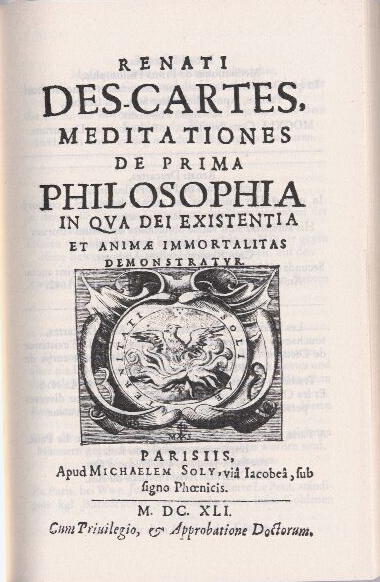
Meditations on Descartes' Meditations


Rene Descartes - in a strong sense - attempted to erase the external world (as well as all which had come from it) from his mind as he carried out his Cogito.


Shouldn't that “reduction” have included the very language he used during his famous meditations?


Of course Descartes did reject all the explicitly philosophical parts of his language. Though he didn’t reject those parts of the language which weren't deemed to be obviously philosophical or contentious.


Thus Descartes might have rejected this statement (even if only to accept it later):


The world as a whole has a purpose.”


Though he didn’t do the same with the seemingly non-philosophical content of


I think. Therefore I am.”


The Cogito expresses a philosophical position on the existence of the self/I. However, Descartes expressed this axiomatic statement/inference with public words which Descartes himself would have used for many decades. Would Descartes have been able to explain not only the blatant and obvious philosophical content of his famous claim: would he also have been able to justify and explain the seemingly non-philosophical parts of that statement?


For example, what did Descartes mean by the word “I”? What did he mean by “think”? Could he have justified and explained the use of the word “therefore”? What does “am” mean? And what about the Cogito inference itself?

Of course after the Cogito Descartes could have easily explained and justified his use of the words in that statement.


For example, Possible Descartes might have said the following:


The I is the essence of the mind. The part of the mind that remains throughout its many changes.


Or:


I use the word “therefore” between a statement and another statement that's entailed or implied by it.


These are explanations of Possible Descartes' use of concepts and words. Thus perhaps he should have started his meditations with claims of a different type altogether.


For example, meditations on the nature of the mind, thought, the self, or even existence itself. Then Possible Descartes might have offered the following as an alternative Cogito:


Thoughts are processes which occur in my mind.


That's very simple; if not very helpful. However, unlike the other Cartesian examples, this is a statement of what is the case, not a description of the concepts and words one uses to make Cogito-like statements. It can be seen as foundational (or even axiomatic) because surely we can't think or philosophise at all without knowing what thoughts are. (In fact we can.) The Cogito is a thought and an inference. Therefore it can be said to depend on prior knowledge of what thoughts are. There would be no Cogito without thought. Therefore thought itself is more foundational than the Cogito inference; which is a token of the type THOUGHT.


Possible Descartes might have then said:


Thoughts are processes which occur in my mind.


From this, Possible Descartes might have wanted to derive numerous other statements which were somehow entailed or implied by it.


In this statement too there are concepts and words which haven't been explained or possibly even understood. That is, what does Possible Descartes mean by “mind”? What is a “process”? Are processes in the mind the same as physical processes external to the mind? And so on.


Not only are there presupposed concepts in this statement: we also need to think in terms of how each concept is intimately connected to other concepts.


If concepts aren't atomic; then perhaps they depend on other concepts for part of their content. Thus even if the concepts SUBSTANCE, Descartes' own THINKING THING, and THINGS WHICH FOLLOW ONE ANOTHER aren’t in the statement itself, the concepts THOUGHT, PROCESS and MIND (which are in the statement) rely and depend upon the existence of other concepts and our knowledge and acceptance of of them. As Jacques Derrida said (in an extreme holistic manner):


“Every borrowing of a concept from western philosophy bring along with it the whole of western philosophy. Concepts are not atoms, they are part of a syntax and a system.”


How could Descartes have used common words to refer to an essentially private domain? Descartes shouldn't have even used common words to talk to himself about an ostensibly private domain (or use them as vehicles of self-attribution).


And it is here that we enter the territory of the "late Wittgenstein".


Wednesday, 9 September 2015

The Fundamental Nature of Modus Ponens


In terms of Quine’s web of belief, and the thesis that observation or experience may lead us to change our logic (or to change classical logic), Hartry Field argues that

one is likely to need modus ponens in the background logic in which one reasons about what follows from each theory-plus-logic and how well it accords with observations”; and it is hard to imagine that a person using this background logic could rationally come to favour a theory-plus-logic in which the logic conflicted with the background logic.” [2000]

To be clear about Field’s position, it boils down to two points:

i) It's likely that modus ponens will be used in the ‘background’ logic to reason about what changes one should make to the logic (or logics) contained in the web of belief.

ii) The background logic won't allow us to come to the conclusion that our ‘new’ logic conflicts or negates that very same background logic (which includes modus ponens).

Paul Boghossian also offers the intuitively plausible position

that it is not possible for us to be justified in believing something as basic as modus ponens”. [2000]

Well, if modus ponens (MP) is the most fundamental rule of inference then it is indeed basic.

Does that basic nature of MP automatically mean that it's not possible for us to justify it? Does that fundamentality simply amount to the fact that we must use MP in our justifications of MP? That in itself doesn't show us that it can’t be justified or that it's indeed basic. Perhaps it's not as basic as it seems anyway. It may have hidden complexity or structure.

Boghossian still asks:

For in what could such a justification consist?”

It can't be more basic than MP because there's no rule of inference more basic than MP. So either MP must be justified using MP or be justified by other rules of inference which are themselves derived from MP.

So far we've only talked about the difficulty (or impossibly!) of escaping from MP. However, we may still need to justify it. Nonetheless, if MP

is unjustifiable, then so is anything that is based on it, and that would appear to include any belief whose justification is deductive”. [2000]

Not only is MP the most basic form of inference: it's the case that just about every belief is based on it (in some direct or indirect way) because it will include something that is itself deductive.

Thus any scepticism about MP will itself will be based on MP (as well as on other) deductions. Thus a belief in the lack of justification for MP will itself be unjustified or unjustifiable (if only from a logical point of view).

Thus that sceptical conclusion has this form:

             PQ
             P
             Q

Or:

i) If modus ponens isn't justified, then there's no reason to use/accept it.

ii) Modus ponens hasn't been justified.

Iii) Therefore we have no reason to use or accept it.

The sceptical conclusion itself instantiates (as it were) MP!

References

Boghossian, Paul. (2000) in New Essays on the A Priori (edited by Paul Boghossian and Christopher Peacocke).
Field, Hartry. (2000) In New Essays on the A Priori

Sunday, 6 September 2015

Graeme Forbes: “‘Istanbul’ contains eight letters.”


On the Fregean account, in pure quotation the quoted items refer to themselves…Thus, in [“‘Istanbul’ contains eight letters.”], the displayed city name refers to that name [refers to itself]…On the Tarskian account, surrounding some item i with quotation marks creates a name of which the marks are part and which refers to i. So [‘Istanbul’ contains eight letters] contains a name “’Istanbul’”…that refers to the word ‘Istanbul’…” (Graeme Forbes, 1996)


The name ‘Tony Blair’ has nine letters.”

On Graeme Forbes's account, the above ‘Tony Blair’ isn't just a name: it's also an inscription. We can then say, like Forbes, that ‘Tony Blair’ is a name (in the above) which refers to the word ‘Tony Blair’.

To make this clearer, we can say that the name “‘Tony Blair’” (to use Forbes' own system of quotation marks), rather than the word ‘Tony Blair’, must then have double quotation marks because what's in the double quotation marks (i.e., ‘Tony Blair’) is the word 'Tony Blair' the name ("'Tony Blair'") refers to. That is, in single quotation marks (namely, ‘Tony Blair’) which are themselves surrounded by outer quotation marks.

Forbes has created some kind of referential structure by making the name “‘Tony Blair’” (in double quotation marks) refer to the word ‘Tony Blair’ (in single quotation marks).

We still only have names and words and not any concrete/ objects referred to by the names (or words). We've created a referential structure which doesn't rely on concrete/abstract objects/conditions outside the statement.

It's not clear why we should have (or need) a name “‘Tony Blair’” which only refers to the word ‘Tony Blair’. It simply seems like a means to get us away from the self-reference of Forbes own inscriptions.

What’s intrinsically wrong with self-reference?

In Forbes’ own example

“‘Istanbul’ contains eight letters.”

it initially seems that ‘Istanbul’ can hardly be seen as a name at all. In that example the name (with double quotes) “‘Istanbul’” refers to the word ‘Istanbul’ (with single quotes). Is it a name? If “‘Istanbul’” only refers to the word ‘Istanbul’, then why use the specific name “‘Istanbul’” at all? If no concrete/ abstract objects are referred to (at least in these examples), then we may as well substitute it with the made-up name “‘Slinmp’” ( which can refer to the word ‘Slinmp’). It makes no difference to the content of Forbes’s example in which a name refers to a word. The actual city of Istanbul is completely irrelevant to Forbes’s position.

Does that mean that my own “‘Slinmp’” can also be a name? It can refer, after all, to the word ‘Slinmp’. Though unlike Forbes’s “‘Istanbul’”, there's no actual concrete/abstract entities that can match up with the name “‘Slinmp’”. In that case “‘Slinmp’” is truly an inscription (which happens to begin with a capital letter); whereas the name “‘Istanbul’” could, I suppose, eventually (after it has passed through the word ‘Istanbul’) take us to the city of Istanbul. Though could it?

Perhaps Forbes’s choice of the name “‘Istanbul’” is just as arbitrary as my choice of “‘Slinmp’”. That is, just because we know of a city that's called ‘Istanbul’, that doesn’t make Forbes’s inscriptions “‘Istanbul’” and ‘Istanbul’ any less arbitrary. He's not, after all, using the inscription “‘Istanbul’” in the way that most people use the name ‘Istanbul’- viz., to refer to a city. However, Forbes could be using that inscription as an example of the rare case in which we simply use a word to refer to an inscription with a certain number of letters. That of course would be using the word ‘Istanbul’ not as a name, but only as a word/inscription. Or, in Forbes’s own terms, the word ‘Istanbul’ could also be known via the definite description "a bearer of eight letters".

Forbes could have also used the name “‘Drooting’”. That too has eight letters. There would have been no loss of content to Forbes’s general argument about names and words. His choice of “‘Istanbul’” as a name may simply put people off the tracks Forbes himself is trying to mark out. With my “‘Slinmp’” and “‘Drooting’”, on the other hand, there's no chance of a concrete/abstract referent because these words are simply meaningless arrangements of letters without content.

Thus in my example we can’t really have a referent of a name that's a word: we can only the inscription's self-reference. In my case

“‘Slinmp’ has six letters.”

we can say that the name “‘Slinmp’” refers to the word ‘Slinmp’.

Can the word ‘Slinmp’ also refer to the name “‘Slinmp’”? Why is the word a word and the name a name (in Forbes’ system) when we aren't talking in terms of any concrete/abstract referents of the words and names? Surely you can only have a name of a word if that word is itself also a name of something. (Or at least a word that refers to concrete/abstract objects other than itself.) Thus if Forbes's name refers to the word, why can’t that word refer to the name? If that were the case, then we wouldn’t be able get outside this world of inscriptions. (That's the case even if some inscriptions are called 'names' and others are called 'words'.) My (pure) inscriptions, on the other hand, are neither words nor names. That is, unless we take self-reference to be a genuine kind of reference.

Conclusion

Many philosophers don't accept self-reference as a kind of relation. (Or at least they don’t take self-identity to be a property of an entity - not even of an inscription.) If a relation or reference is anything, it must be a relation or reference to something other than itself.

Similarly, it may follow from this that if a reference-relation is to be genuine, then the referents of sentences, words, names, etc. must refer to something other than themselves. Again, this is certainly seen to be the case (by various philosophers) when it comes to analysing self-identity as some kind of genuine property. If self-identity (of persons or objects) isn't a kind of property, then perhaps self-reference isn't a kind of reference. Thus it would follow that purportedly self-referential sentences or names wouldn't have the property self-identity either.

Reference


Friday, 4 September 2015

Putnam on the Normativity of Meaning


Although Hilary Putnam was broadly seeking a naturalist philosophy he also stressed the importance of normativity in various areas of philosophy.

This is Putnam on normativity:

[Charles Travis] very often uses the notion of what a reasonable judge would say. That seems tome, even in a very traditional sense, a normative notion.” [2005]

Bringing the notion of what a “reasonable judge would say” makes it very clear what normativity is. It's about the judgement of what's right and wrong in philosophy, not just in ethics.

For example, what are the correct concepts to use and how should we use them? What should we say are the standard conditions of correctness in justification? How should we interpret people’s utterances; especially in they speak another language? And so on.

Thus the normative philosopher (whether in epistemology or elsewhere) is a kind of judge who sits in judgement on our philosophical concepts and even on our philosophical behaviour. More relevantly, meaning itself is a normative notion or even a normative property. Putnam writes:

The crucial point being made here is that if meaning is normative – that is to say, if it relies to a certain extent on judgement, rather than just 'facts' – several popular theories about meaning are ruled out.”

If meaning has nothing much to do with “just facts” (or even facts at all), then we can never say that what we state about meaning is true. There are no “facts of the matter” (as Quine put it) about meaning: only our judgements as to what we should say about meaning (or what we should take meaning to be). There will be no facts - natural or otherwise - which will conclusively settle the issue or even play any part in the discussion. Of course we can say (as many do) that normative issues (or even normative facts) actually ‘supervene’ on non-normative facts. However, this is still an acknowledgement of non-natural properties when it comes to meaning.

We can say that a normative judgement on meaning (or on anything else) may well rest on non-normative facts; though that judgement is still, nonetheless, not natural or factual in nature.

Putnam finishes the sentence above by saying that if meaning is a normative notion, then “several popular theories about meaning are ruled out”. There have been many philosophers who wouldn't have said that meaning is normative at all. Indeed they would have believed that it's factual (even if they didn't actually use that word).

For example, Platonists and Fregeans would surely have said that meaning is not normative in nature. That is, it has nothing to do with our judgements or what we take meaning to be. However, this doesn't automatically mean that they also took meaning to be a natural phenomenon. If meaning is non-natural, then it's non-natural in a factual kind of a way. (Although all this will depend on how we interpret the word ‘factual’ or ‘fact’.)

A Causal Theory of Meaning

Putnam gives his own example of a theory of meaning that's “ruled out” if one accepts the normative nature of meaning. He says:

At the time [in the early 1970s] people were very optimistic about characterising the meaning of words, especially nouns, in terms of what they’re causally connected to. There the normativity cuts strongly against that.”

For a start, it seems to be Saul Kripke's “causal theory of reference” Putnam has in mind: his . That's why Putnam says that this causal theory of meaning is “especially [about] nouns”. In Kripke’s case, that means proper names (or, as he called them, “rigid designators”). Clearly, if meaning is all about what words are “casually connected to”, then this seems like a thoroughly naturalistic position on meaning. Indeed even a scientific one. After all, we can't really make judgements about the causal relations (or interactions) between our words and and the world. Causality doesn’t “come under a description” (as Davidson put it). Causation isn't, in itself, even explanatory. We can make it explanatory (as it were); though it's not in itself explanatory. Indeed, according to many causal theorists of meaning, the causal relation between our words (especially nouns or names) and things seems utterly non-cognitive in nature. Thus it can hardly be normative in any way.

Perhaps we still need to make decisions as to what is connected to what.

If our name ‘Tony Blair’, for example, is causally connected to, well, Tony Blair, then perhaps it's also causally connected to his nose, his shoe or even to Mrs Blair (especially if she were always contiguous with Tony Blair). In addition, our name ‘Tony Blair’ may well be connected to Tony Blair; though we don’t always have to use that name or even use it (consistently) at all. We may prefer to call Tony Blair by the name ‘Tony Boy’ instead. Surely these decisions are normative in nature. Indeed the very choice of a causal theory of reference must be normative in nature. That is, even if there are causal relations between our words and what our words refer to, we may not choose to account for that relation in terms of its causal nature. We may simply ignore it or see it as, say, “crudely scientistic”.

Thus even the causal theory of reference is normative in some ways. The philosopher must make a decision of some kind (which would be a normative issue) as to which theory to adopt (even if this theory is philosophically or scientifically kosher). There may even be other true theories of meaning that the causal theorist simply chooses (another normative notion) to ignore. It may be the case that these other theories (or what it is they describe) work in parallel with the causal facts of the matter when it comes to meaning or reference.

For example, a theory which emphasises social practices or history when it comes to establishing the meanings of our words doesn't necessarily contradict (or contradict at all) what the causal theorist of meaning has to say. After all, one must assume that social practices (as well as the relations between words and things which are part of them) are thoroughly causal in nature. However, even if they are thoroughly causal, the fact that they're social practices means that normative factors can’t help but be part of the picture. Social practices aren't simply forced on us by the causal nature of the world or even by the causal relations between our words and what our words refer to (or are about).

Putnam then makes a Wittgensteinian point about why causation alone can't tell us everything we need to know about meaning. He says:

You can’t just look at what causes you to use a word. You also have to look at the whole context in which it’s used.”

Of course we can say that ‘context’ too can be seen as causal. However, what we take to be context may be a normative choice. Clearly we can't take in the total causal context of a particular word or utterance. That means that we must make a decision as to what context is relevant or salient. The disregarded contexts will still nevertheless by both causal and contextual to the word or utterance. The thing is that we simply choose to ignore them or see them as irrelevant. Why we take them to be so will be a normative.

In any case, if causation were everything, perhaps a red duck once caused me to use the word ‘quantum’ or ‘liberty’. That may be a peculiar fact about me. However, that red duck still caused me to use the word ‘quantum’. Even if I'm caused by something relevant to the word to use that word, say, 'cow' when I see a horse (as with Fodor’s ‘asymmetry’ example), that horse still caused me to use the word ‘cow’. Even a punch in the face may cause me to use the word ‘cow’ - that would still be a cause of some kind.

Quine on Meaning

This stress on the normativity of meaning falls within the larger context - yes, context - of the philosophical tradition of thinking that meanings - and even language generally - is a scientific (not even quasi- scientific) object. Putnam says:

I don’t think meanings are scientific objects. There’s a big question, then, whether that means that they don’t exist. In a sense, that’s Quine’s conclusion – that we can go on talking about meanings but they don’t really exist at all.”

To me, the very idea that “meanings are scientific objects” seems ludicrous. How could they be? They're abstract and also non-spatiotemporal. They can't be observed, tested, refuted or become the objects of quantification. They're not subject to universal or exceptionless generalisations. They don't take part in natural laws.

However, all this depends on whether or not meanings are taken to be abstract in the first place. So what happens when they're cashed our in thoroughly naturalistic terms? Realists would themselves say that this isn't possible. For a start, the normativity of meaning that we've just been talking about rules this out. Realists about meaning would also rule out such a ‘reduction’ (if it is a reduction). Even supervenience theses of meaning wouldn't allow a complete reduction to naturalist facts – by definition.

What if meanings are simply natural things or facts? What if meanings are simply examples of “overt behaviour” (Quine) or what we say and write? Then the realist would simply use the classic Moorean response. He would say:

You say that meaning is nothing more than X. Thus we can always ask if meaning = X. Consequently, we can say that there's always the possibility of asking whether or not meaning really is X.

Those questions make sense. And because they make sense, meaning surely can't be equal to X.

For example, if the meaning of the word ‘cat’ is explained or described by its causal connection to cats, we can always ask:

Is that causal connection really what the word ‘cat’ means? How can a simple causal connection between a word and a thing be the actual meaning of that word? That's ridiculous.

Similarly, if meaning is seen in terms of a word’s context of use, we can still ask:

Is the meaning of the word ‘cat’ really its context of use? How can the context of use of the word ‘cat’ be its meaning? That's ridiculous!

Normative questions still keep on arising. Either that, or we must accept that meanings are abstract and perhaps also sui generis. There is, of course, another option, the one that Quine preferred. That is to say that meanings (however we construe them) simply don't exist at all. Perhaps that’s precisely why we have been debating this issue for such a long time without having got very far. After all, it’s hard to be right (or wrong) about something which doesn't in fact exist. It's the non-existence of meaning that has caused all the problems and kept the debate going for so long. That very longevity and insolubility should have given us a reason for suspecting the very existence of meaning or meanings.

Incidentally, Quine believed, according to Putnam, “that we can go on talking about meanings” even if “they don’t exist at all”. There’s nothing outrageous about this. We talk about Superman; though he doesn’t exist. Of course, in terms of the word 'Superman' philosophers would dispute such an “empty reference” and thereby posit some kind of being that Superman has. In any case, Quine (regardless of his position on meaning) has to use the English language even when denying the existence of meaning. He has no choice but to do so. Quine could even have said:

The sentence “Meanings are abstract entities” has no meaning.

Quine wouldn't have contradicted himself. It simply depends on what he meant by ‘meaning’ or what he committed himself to when he used that word. More precisely, Quine did believe in the adjectival use of ‘meaningful’ or ‘meaningless’; though not in the noun ‘meaning’. However, not even that may matter much in the context of his having to use the words which the English language (or even all languages) gives him. Similarly, elimitivist materialists can quite happily and without self-contradiction use the words ‘belief’ and ‘believe’ without scruples. They too must use the English language – especially when debating with propositional-attitude realists. Again, it depends on how Quine construed meaning or his use of the word ‘meaning’. If it's suitably construed, then there's no problem.

If the definition of is: meaning = X. Then meaning is nothing more than X. Thus why not substitute the word ‘meaning’ and put in its place the word/letter ‘X’? Quine would have been happy to do this. However, it would have created problems when it came to communicating with other people – even other philosophers - simply because ‘meaning’ is so entrenched in the language. In addition, if we were to flesh out the word ‘X’ (a substitute for ‘meaning’), that fleshing out may make things inordinately complex and therefore incomprehensible (at least in all non-philosophical contexts). Thus Quine, at least in non-philosophical contexts, would have simply needed to stick with the word ‘meaning’ or ‘meanings’. He had no choice but to do so. Either that or he could have given up on effective communication altogether.

Reference

Putnam, Hilary. (2005) quoted in What Philosophers Think (edited by Julian Baggini and Jeremy Stangroom ).