Saturday, 12 September 2015

Earl Conee vs. Epistemic Contextualism


Earl Conee makes the point that the use of quantifiers is always context-dependent. Or, in the language of quantification, the domain of quantification is always restricted or limited. Conee uses the phrase “the context of use” (49) in this context.

Thus in Conee’s example: “Robinson’s context, his 'everyone' would be restricted to all who are members of the BC”. All this is pretty obvious to everyone who has ever used a quantifier – which is everyone.

However, there's a problem.

On one account, what Robinson says can be taken to be both false and true. It's true if the word ‘everyone’ is only taken to apply to the members of the Boring Club. Though it's false if his ‘everyone’ is taken to apply to, well, everyone – the Pope, for instance, isn't present at the meeting. However, epistemic contextualist (EC) theorists can easily take both what Stickler says to be true and what Robinson takes to be true. On Conee’s account, the truth-conditions have changed from an application to members of the BC to literally everyone is the world. The EC will say that

Stickler has shifted the conversational context, perhaps by mentioning the Pope, someone who is not in the group previously assume to be relevant”.

It is this change in "conversational context" which makes both positions true, on the EC account.

Moral Relativism & Epistemic Contextualism

It's to place epistemic contextualism amongst controversial company if Conee associates it with moral relativism. Is the comparison correct? What he says about moral relativism seems correct enough. He says that moral relativists

hold roughly that something about the context of a moral evaluation, perhaps something in the culture or the personal values of the evaluator, contributes to the truth conditions of the resulting evaluation”.

In this case, we can ask how the “context of a moral evaluation” can contribute to the “truth conditions of the resulting evaluation”. More specifically, how can "personal values" be deemed to ‘contribute’ to truth-conditions? The context, in this case, contributes to the evaluation (or the personal values contribute to the evaluation); though how do they contribute to the truth-conditions?

This comparison between moral relativism and EC is made clearer by Conee.

According to the tribesmen of Borneo, head-hunting is morally right. According to Europeans, it's wrong. Head-hunting can't be both right and wrong. However, according to Conee, “moral relativists and EC theorists can work to explain away the appearance of contradiction or disagreement”. That is, it's right according to the context of Borneo head-hunters and it's wrong according to Europeans. There's simply no contradiction, in that case, according to Conee’s moral relativists and EC theorists. Though Conee seems to be saying that although the context may well be different, both the Borneo tribesmen and Europeans are “discussing the same thing” (50). That must mean that (on Conee’s account) the truth-conditions must also be the same, despite differences in context (which he can't help but accept).

Conee makes a lot of truth-conditions in his account of EC. More to the point, he stresses the fact that it's (often?) the case (say, in his moral relativism example) that despite “differing standards” and contexts, the truth-conditions remain the same. This must only mean that despite different standards and different contexts, whatever is true remains true regardless if these differences. Thus this is position is a direct case against epistemic contextualism.

He gives this example of “genuine US currency”:

“… note that differing standards are routinely applied in making judgements that are uncontroversially context-invariant. For instance, usually the genuineness of a purported piece of US currency is judged by a quick look, sometimes it is judged by a more careful inspection, and occasionally it is rigorously judged using a high-tech device. In spite of these differing standards, the content of the uses of ‘genuine US currency’ is clearly the same… Thus, we cannot validly infer that contextual differences yield differing truth conditions simply because differing standards are often applied.”

The truth-condition in this example is “genuine US currency”. The contextual or standard variations are “a quick look” at the currency; a “careful inspection” of the currency; and a currency that's "rigorously judged using a high-tech device”. None of these variable contexts or standards changes the fact that genuine US currency is, well, genuine US currency. We can also say that genuine US currency itself doesn't change even if the standards or contexts of inspection change. The question is whether or not this example - and the conclusions Conee derives from it - can also be applied to the epistemological cases already discussed. Can this talk about, say, a US dollar (which is a physical object) be applied to such things as the rightness or wrongness of an action, the reality or unreality of the external world and what is the correct mode of justification? In that sense, perhaps the cases aren't parallel at all. Indeed perhaps there simply are no truth-conditions in the former cases; especially in the case of moral relativism or morality generally.

Folk Contextualism vs. Invariant Knowledge

According to EC theorists, most people outside epistemology are aware that context matters when it comes to attributions of knowledge. Conee, on the other hand, seems to be saying that although the Folk may well be aware of context, they don't (necessarily?) alter their knowledge- attributions according to contextual factors. According to EC theorists,

fluent speakers actually realise, at least tacitly, that this knowledge ascription is just loose talk”.

The attributions of members of the Folk to other members of the Folk may not be particularly relevant to the contextual factors involved in knowledge-attributions or even involved in knowledge itself.

Conee puts what can be called the Folkist (i.e., non-contextualist) case by using the folkist phrase “really and truly”. This phrase passes for a strict account of what it is that the folk think and believe. This is Conee’s example:

For instance, when fluent speakers consider whether they are ‘really and truly’ happy, or they consider who are ‘really and truly’ their friends, or they consider what is ‘really and truly’ worth striving for, they tend to have doubts about their previous casual attributions of happiness, friendship, and worthwhile goals.”

Again, Conee makes his point by stressing truth-conditions. The EC theorist would say that the truth-conditions change when asked in "casual" terms about happiness, friendship and goals compared to when they're asked what they "really and truly" believe about such things. Indeed this contextual variance seems to be written into the English language. Or as Conee puts it:

[i]t is possible that the English terms for these categories of happiness, friendship, and so forth all have contextually varying truth conditions, and that the standards are raised by these ‘really and truly’ questions.”

I suspect that Conee believes that the truth-conditions about these matters of friendship, happiness and goals don't in fact change. What changes is only the difference between ‘casual’ responses to such questions and thoughtful responses to them. That isn't really a change in context: it's a change in one’s attitude towards the question itself. And what Conee says about folk responses to questions about happiness, friendship and worthwhile goals, he says may be true about epistemological questions and issues as well. There may be no such thing as context in these cases either. Conee writes:

“… it may be that every issue about knowledge, from the Gettier problem to the extent of scientific knowledge, from the nature of justification to the merits of external world scepticism, has been discussed solely in this single ‘really and truly’ context. Granting epistemic contextualism, this claim of a single philosophical context has some plausibility.”

When we talk about the Gettier problem (or about scientific knowledge, justification or external-world scepticism) we want to know the really and truly about it. We don't want to know about the context of attributions or the context of knowledge itself. When we speak of knowledge in all these cases, we're talking about exactly the same thing. There isn't one kind of knowledge for the Gettier problem, another kind of knowledge when it comes to scientific claims, another for questions of justification, and yet another for statements about the reality and character of the external world. It is one and the same knowledge in each and every case.

One might say that if the really and truly applies to folkist concerns about friends, happiness and worthwhile goals, it should certainly apply to epistemological questions and issues. Or perhaps Conee does indeed accept that there are contexts, as indeed he must do; though when it comes to scientific knowledge, the Gettier problem, justification and external-world scepticism, the only context that matters is the really and truly context. Or, as Conee puts it, this context is the “single philosophical context” (53). Does that mean that there are indeed different contexts for folkist issues like happiness, friendship and worthwhile goals? It seems that earlier Conee rejected folkist contextualism as well.

Conee again seems to dispute the EC theorist’s belief that the Folk are either aware of “contextual variation” or take contextual variation into account when they make their knowledge-attributions. Conee writes that

[t]his explanation attributes to us some sort of grip on the contextual variation in standards for ‘knowledge’ ascriptions”.

This “grip on the contextual variation” is thought to be tacit. That is, “[w]e are not said to think explicitly that there is a contextual variation”. It's hard to know what to make of this statement. Do we really take into account contextual variation; though only tacitly? In that case, what's meant by the word ‘tacit’ here? In any case, even if this knowledge is indeed tacit, it still seems to be pretty detailed and, well, explicit! That is,

we are supposed to be guided by our understanding of ‘knows’ to count some differences in context as decisive to truth when we make our plausibility judgements”.

Again, I think that Conee actually denies this tacit-knowledge account of Folk attributions of knowledge and therefore our very strict uses of the word ‘knowledge’. I would reject both accounts. I don't believe that all these things go on at the tacit level. And neither do I believe that it can be said that the Folk have a strict notion of knowledge or of knowledge-ascriptions.

Since the EC believes in contexts, it's not surprising that there's also a “sceptical context” to take into account; as well as an everyday context.

For example, in a sceptical context it may be the case that “only 100 percent of the right sort of probability is enough” (54). That's why scepticism is scepticism – because it demands 100 percent of the right sort of probability. Sceptics may also want something else. They may want “internally possessed evidence that excludes all possibility of false belief”. Again, that's why scepticism is scepticism – it wants to exclude all possibility of false belief.

Conee seems to suggest a case when we can meet these strong sceptical demands.

For example,

perhaps external world judgements are in the right way 100 percent probable when they are correctly causally connected to the fact known”.

However, this “might occur only in optimal cases of perception and memory” (54). Thus even though sceptical demands are strong (not to say extreme), Conee suggests that - at least in theory - they can be met. Despite that, many epistemologists deny global (or extreme) scepticism precisely because they believe that its demands can never be met – again, in principle!

Reference

Conee, Earl. (2005) 'Contextualism Contested', in Contemporary Debates in Epistemology (edited by Matthias Steup and Ernest Sosa).


Friday, 11 September 2015

Dani Rabinowitz on the A Priori/A Posteriori Distinction


Dani Rabinowitz makes a point that many rationalists or apriorists (e.g. Bonjour and Casullo) would happily concede: that a priori warrant can be defeated by experience.

Take the case of a mathematical calculation. Here's the a priori part:

i) “One could perform a mathematical calculation in one’s head and have a priori warrant for the belief in the result.”

Now for the a posteriori part (or the "experiential defeater"):

ii) “One could realize later, with the aid of a calculator, that one’s calculation was incorrect owing to haste.”

That case may seem trivial because it's an example of a single incident which happened to a single person.

What about Euclidean geometry?

Rabinowitz quotes BonJour who writes that it was “regarded for centuries as describing the necessary character of space, but was apparently refuted by General Relativity”. The nature of Euclidean geometry was said to be knowable a priori, despite the fact that it's ostensibly about space, etc. The simple and fundamental point is that “[o]ne can thus be justified a priori in believing a proposition that is false”. And if an a priori justifification can be shown to be false, then that other traditional attribute of a priori beliefs or propositions, certainty, may be dropped as well.

Rabinowitz writes:

So the fallibility of a priori warrant entails that it is not characterized by certainty.”

Much of the defense of a priori knowledge and justification rests of the existence of analyticity (or on analytic statements).

For example, the logical positivists (who generally rejected necessity) accepted it as far as analytic statements were concerned. Then Quine famously questioned the synthetic/analytic distinction.

Rabinowitz comes at this debate from the angle of scientific definitions.

Firstly we must ask: Are definitions analytic? If the answer is Yes, then what about scientific definitions – are they also analytic?

Take a well-known definition:

water = def. H2 O

This would mean that there are (analytic?) scientific definitions which “require empirical investigation or experience to be known”. Thus how can the above actually be analytic? It can be necessary; though it is necessary a posteriori or (necessary-synthetic).

Rabinowitz spots the problem. Firstly we must note the following:

  1. analytic = a semantic property (or predicate)
  2. a priori = an epistemic property (or predicate)

It can be seen, then, that i) and ii) aren't ‘coextensive’. However, although Rabinowitz basically subscribes to a Kripkean account of these matters, he's not altogether happy with Quine’s account. Quine famously argued that there are no propositions known (to be true) merely in virtue of their meaning. We can accept that. Is that necessarily also an argument against the a priori, as Quine himself took it to be? We've just argued that ‘analytic’ and ‘a priori’ aren't coextensive. Thus Rabinowitz concludes that “it is incorrect to conclude anything about the a priori from Quine’s arguments against the analytic category”. That is, we can't accept this fallacious argument:

  1. (Only?) analytic statements can be known a priori. (The logical positivist position.)
  2. No (purely?) analytic statement exists. (Quine’s position.)
  3. Therefore there is no a priori. (Quine’s position – though not precisely his argument.)

Causal Reliabilism and the A Priori/A Posteriori Distinction

It seems that not even the a priori is safe from cognitive science – or, at the least, it's not safe from philosophers who take on board the findings and work of cognitive scientists. The good thing (for apriorists), though, is that some of the results are positive. According to Rabinowitz, Alvin Goldman

offers scientific support from psychology and cognitive science for there being cognitive capacity in mathematical computation and logical reasoning that reliably delivers output beliefs deserving of a priori warrant”.

That description above is redolent also of epistemic reliabilism. Goldman is a reliabilist. This very reliabilism proves to be problematic. Take the case of ordinary (or a posteriori) process reliabilism. Rabinowitz writes that

any token output belief p could be the product of many process types with differing levels of reliability, some highly reliable and others not. The reliability of which process determines the epistemic status of p?...”

One can see what’s coming. What's just been said can now be applied to a priori processes (or reasonings). Rabinowitz says that

it is possible that there are several process types involved in the production of beliefs we consider justified a priori. There is nothing about rational insight, as rationalists describe it, that pretheoretically disbars there being a conglomerate of process types involved in the output of a single belief under the rubric of 'rational insight'”.

Is the neat little traditional distinction between a priori reasoning and the experiential concepts required for a priori reasoning really acceptable? Rabinowitz takes the case of mathematical knowledge. He offers two descriptions of the same mathematical process. One which accounts for the a posteriori part. And the other which doesn't.

Take the account which is both a posteriori and a priori:

i) “The agent is taught mathematics at school where he first acquires his computational abilities via testimony from his teachers and books. The description ends with the agent understanding and successfully applying the method.”

There is also a purely a priori description of the same process:

ii) “[T]he agent has understood the computational method, recalls it from memory, and ends with the successful application of the method.”

The point is that “[o]n both descriptions the agent at hand has mathematical knowledge”. Should we call the process an a posteriori process or an a priori process? Rabinowitz quotes Hawthorne on this. The latter

thinks that there is no 'deep fact' as to which process deserves the accolade thus making the a priori/a posteriori distinction an unnatural one”.

Reference

Rabinowitz, Dani. (2008) ‘What, if anything, does the a priori/a posteriori distinction come to?’


Thursday, 10 September 2015

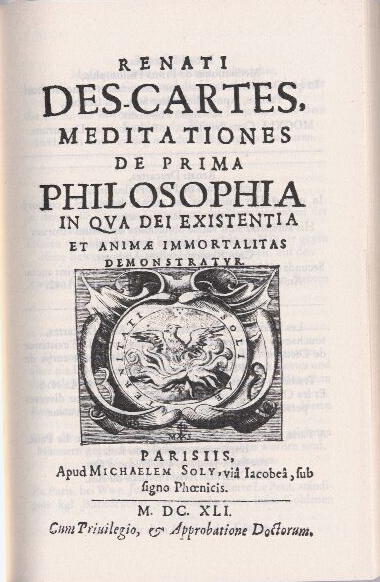
Meditations on Descartes' Meditations


Rene Descartes - in a strong sense - attempted to erase the external world (as well as all which had come from it) from his mind as he carried out his Cogito.


Shouldn't that “reduction” have included the very language he used during his famous meditations?


Of course Descartes did reject all the explicitly philosophical parts of his language. Though he didn’t reject those parts of the language which weren't deemed to be obviously philosophical or contentious.


Thus Descartes might have rejected this statement (even if only to accept it later):


The world as a whole has a purpose.”


Though he didn’t do the same with the seemingly non-philosophical content of


I think. Therefore I am.”


The Cogito expresses a philosophical position on the existence of the self/I. However, Descartes expressed this axiomatic statement/inference with public words which Descartes himself would have used for many decades. Would Descartes have been able to explain not only the blatant and obvious philosophical content of his famous claim: would he also have been able to justify and explain the seemingly non-philosophical parts of that statement?


For example, what did Descartes mean by the word “I”? What did he mean by “think”? Could he have justified and explained the use of the word “therefore”? What does “am” mean? And what about the Cogito inference itself?

Of course after the Cogito Descartes could have easily explained and justified his use of the words in that statement.


For example, Possible Descartes might have said the following:


The I is the essence of the mind. The part of the mind that remains throughout its many changes.


Or:


I use the word “therefore” between a statement and another statement that's entailed or implied by it.


These are explanations of Possible Descartes' use of concepts and words. Thus perhaps he should have started his meditations with claims of a different type altogether.


For example, meditations on the nature of the mind, thought, the self, or even existence itself. Then Possible Descartes might have offered the following as an alternative Cogito:


Thoughts are processes which occur in my mind.


That's very simple; if not very helpful. However, unlike the other Cartesian examples, this is a statement of what is the case, not a description of the concepts and words one uses to make Cogito-like statements. It can be seen as foundational (or even axiomatic) because surely we can't think or philosophise at all without knowing what thoughts are. (In fact we can.) The Cogito is a thought and an inference. Therefore it can be said to depend on prior knowledge of what thoughts are. There would be no Cogito without thought. Therefore thought itself is more foundational than the Cogito inference; which is a token of the type THOUGHT.


Possible Descartes might have then said:


Thoughts are processes which occur in my mind.


From this, Possible Descartes might have wanted to derive numerous other statements which were somehow entailed or implied by it.


In this statement too there are concepts and words which haven't been explained or possibly even understood. That is, what does Possible Descartes mean by “mind”? What is a “process”? Are processes in the mind the same as physical processes external to the mind? And so on.


Not only are there presupposed concepts in this statement: we also need to think in terms of how each concept is intimately connected to other concepts.


If concepts aren't atomic; then perhaps they depend on other concepts for part of their content. Thus even if the concepts SUBSTANCE, Descartes' own THINKING THING, and THINGS WHICH FOLLOW ONE ANOTHER aren’t in the statement itself, the concepts THOUGHT, PROCESS and MIND (which are in the statement) rely and depend upon the existence of other concepts and our knowledge and acceptance of of them. As Jacques Derrida said (in an extreme holistic manner):


“Every borrowing of a concept from western philosophy bring along with it the whole of western philosophy. Concepts are not atoms, they are part of a syntax and a system.”


How could Descartes have used common words to refer to an essentially private domain? Descartes shouldn't have even used common words to talk to himself about an ostensibly private domain (or use them as vehicles of self-attribution).


And it is here that we enter the territory of the "late Wittgenstein".


Wednesday, 9 September 2015

The Fundamental Nature of Modus Ponens


In terms of Quine’s web of belief, and the thesis that observation or experience may lead us to change our logic (or to change classical logic), Hartry Field argues that

one is likely to need modus ponens in the background logic in which one reasons about what follows from each theory-plus-logic and how well it accords with observations”; and it is hard to imagine that a person using this background logic could rationally come to favour a theory-plus-logic in which the logic conflicted with the background logic.” [2000]

To be clear about Field’s position, it boils down to two points:

i) It's likely that modus ponens will be used in the ‘background’ logic to reason about what changes one should make to the logic (or logics) contained in the web of belief.

ii) The background logic won't allow us to come to the conclusion that our ‘new’ logic conflicts or negates that very same background logic (which includes modus ponens).

Paul Boghossian also offers the intuitively plausible position

that it is not possible for us to be justified in believing something as basic as modus ponens”. [2000]

Well, if modus ponens (MP) is the most fundamental rule of inference then it is indeed basic.

Does that basic nature of MP automatically mean that it's not possible for us to justify it? Does that fundamentality simply amount to the fact that we must use MP in our justifications of MP? That in itself doesn't show us that it can’t be justified or that it's indeed basic. Perhaps it's not as basic as it seems anyway. It may have hidden complexity or structure.

Boghossian still asks:

For in what could such a justification consist?”

It can't be more basic than MP because there's no rule of inference more basic than MP. So either MP must be justified using MP or be justified by other rules of inference which are themselves derived from MP.

So far we've only talked about the difficulty (or impossibly!) of escaping from MP. However, we may still need to justify it. Nonetheless, if MP

is unjustifiable, then so is anything that is based on it, and that would appear to include any belief whose justification is deductive”. [2000]

Not only is MP the most basic form of inference: it's the case that just about every belief is based on it (in some direct or indirect way) because it will include something that is itself deductive.

Thus any scepticism about MP will itself will be based on MP (as well as on other) deductions. Thus a belief in the lack of justification for MP will itself be unjustified or unjustifiable (if only from a logical point of view).

Thus that sceptical conclusion has this form:

             PQ
             P
             Q

Or:

i) If modus ponens isn't justified, then there's no reason to use/accept it.

ii) Modus ponens hasn't been justified.

Iii) Therefore we have no reason to use or accept it.

The sceptical conclusion itself instantiates (as it were) MP!

References

Boghossian, Paul. (2000) in New Essays on the A Priori (edited by Paul Boghossian and Christopher Peacocke).
Field, Hartry. (2000) In New Essays on the A Priori

Sunday, 6 September 2015

Graeme Forbes: “‘Istanbul’ contains eight letters.”


On the Fregean account, in pure quotation the quoted items refer to themselves…Thus, in [“‘Istanbul’ contains eight letters.”], the displayed city name refers to that name [refers to itself]…On the Tarskian account, surrounding some item i with quotation marks creates a name of which the marks are part and which refers to i. So [‘Istanbul’ contains eight letters] contains a name “’Istanbul’”…that refers to the word ‘Istanbul’…” (Graeme Forbes, 1996)


The name ‘Tony Blair’ has nine letters.”

On Graeme Forbes's account, the above ‘Tony Blair’ isn't just a name: it's also an inscription. We can then say, like Forbes, that ‘Tony Blair’ is a name (in the above) which refers to the word ‘Tony Blair’.

To make this clearer, we can say that the name “‘Tony Blair’” (to use Forbes' own system of quotation marks), rather than the word ‘Tony Blair’, must then have double quotation marks because what's in the double quotation marks (i.e., ‘Tony Blair’) is the word 'Tony Blair' the name ("'Tony Blair'") refers to. That is, in single quotation marks (namely, ‘Tony Blair’) which are themselves surrounded by outer quotation marks.

Forbes has created some kind of referential structure by making the name “‘Tony Blair’” (in double quotation marks) refer to the word ‘Tony Blair’ (in single quotation marks).

We still only have names and words and not any concrete/ objects referred to by the names (or words). We've created a referential structure which doesn't rely on concrete/abstract objects/conditions outside the statement.

It's not clear why we should have (or need) a name “‘Tony Blair’” which only refers to the word ‘Tony Blair’. It simply seems like a means to get us away from the self-reference of Forbes own inscriptions.

What’s intrinsically wrong with self-reference?

In Forbes’ own example

“‘Istanbul’ contains eight letters.”

it initially seems that ‘Istanbul’ can hardly be seen as a name at all. In that example the name (with double quotes) “‘Istanbul’” refers to the word ‘Istanbul’ (with single quotes). Is it a name? If “‘Istanbul’” only refers to the word ‘Istanbul’, then why use the specific name “‘Istanbul’” at all? If no concrete/ abstract objects are referred to (at least in these examples), then we may as well substitute it with the made-up name “‘Slinmp’” ( which can refer to the word ‘Slinmp’). It makes no difference to the content of Forbes’s example in which a name refers to a word. The actual city of Istanbul is completely irrelevant to Forbes’s position.

Does that mean that my own “‘Slinmp’” can also be a name? It can refer, after all, to the word ‘Slinmp’. Though unlike Forbes’s “‘Istanbul’”, there's no actual concrete/abstract entities that can match up with the name “‘Slinmp’”. In that case “‘Slinmp’” is truly an inscription (which happens to begin with a capital letter); whereas the name “‘Istanbul’” could, I suppose, eventually (after it has passed through the word ‘Istanbul’) take us to the city of Istanbul. Though could it?

Perhaps Forbes’s choice of the name “‘Istanbul’” is just as arbitrary as my choice of “‘Slinmp’”. That is, just because we know of a city that's called ‘Istanbul’, that doesn’t make Forbes’s inscriptions “‘Istanbul’” and ‘Istanbul’ any less arbitrary. He's not, after all, using the inscription “‘Istanbul’” in the way that most people use the name ‘Istanbul’- viz., to refer to a city. However, Forbes could be using that inscription as an example of the rare case in which we simply use a word to refer to an inscription with a certain number of letters. That of course would be using the word ‘Istanbul’ not as a name, but only as a word/inscription. Or, in Forbes’s own terms, the word ‘Istanbul’ could also be known via the definite description "a bearer of eight letters".

Forbes could have also used the name “‘Drooting’”. That too has eight letters. There would have been no loss of content to Forbes’s general argument about names and words. His choice of “‘Istanbul’” as a name may simply put people off the tracks Forbes himself is trying to mark out. With my “‘Slinmp’” and “‘Drooting’”, on the other hand, there's no chance of a concrete/abstract referent because these words are simply meaningless arrangements of letters without content.

Thus in my example we can’t really have a referent of a name that's a word: we can only the inscription's self-reference. In my case

“‘Slinmp’ has six letters.”

we can say that the name “‘Slinmp’” refers to the word ‘Slinmp’.

Can the word ‘Slinmp’ also refer to the name “‘Slinmp’”? Why is the word a word and the name a name (in Forbes’ system) when we aren't talking in terms of any concrete/abstract referents of the words and names? Surely you can only have a name of a word if that word is itself also a name of something. (Or at least a word that refers to concrete/abstract objects other than itself.) Thus if Forbes's name refers to the word, why can’t that word refer to the name? If that were the case, then we wouldn’t be able get outside this world of inscriptions. (That's the case even if some inscriptions are called 'names' and others are called 'words'.) My (pure) inscriptions, on the other hand, are neither words nor names. That is, unless we take self-reference to be a genuine kind of reference.

Conclusion

Many philosophers don't accept self-reference as a kind of relation. (Or at least they don’t take self-identity to be a property of an entity - not even of an inscription.) If a relation or reference is anything, it must be a relation or reference to something other than itself.

Similarly, it may follow from this that if a reference-relation is to be genuine, then the referents of sentences, words, names, etc. must refer to something other than themselves. Again, this is certainly seen to be the case (by various philosophers) when it comes to analysing self-identity as some kind of genuine property. If self-identity (of persons or objects) isn't a kind of property, then perhaps self-reference isn't a kind of reference. Thus it would follow that purportedly self-referential sentences or names wouldn't have the property self-identity either.

Reference